
From Corporate Evidence Histories to Institutional Use
Source and editorial boundary
This content references a primary institutional source published by EMJ.LIFE. SNN editorial interpretation is separately identified and should not be interpreted as independent third-party validation of EMJ.LIFE or the referenced publication.
- SOURCE RELATIONSHIP
- related_institutional_source
- PRIMARY SOURCE PUBLISHER
- EMJ.LIFE
- EXTERNAL VALIDATION
- not_claimed
Licensed
- AI TRAINING
- not-allowed
- RIGHTS BASIS
- EMJ.LIFE-controlled original manuscript and artwork supplied for an authorized Sustainability News Network onsite edition. SNN is publisher of this web edition; EMJ.LIFE remains publisher of the original work. Third-party source rights remain separate and are not transferred.
- LICENSE
- EMJ.LIFE publication authorization for Sustainability News Network
Series Introduction and Executive Summary
A Pre-Disclosure Evidence Infrastructure Perspective on Evidence Usability, Institutional Review and the Conditions of Reliance
Series Introduction
Evidence Infrastructure Analysis
Evidence Infrastructure Analysis examines the institutional conditions under which information becomes attributable, interpretable and usable evidence.
Previous editions have explored evidence decay, interoperability, institutional memory, evidence continuity and the relationship between evidence and institutional decision-making.
Evidence Infrastructure Analysis 015, WHEN EVIDENCE BECOMES EXECUTABLE, examined how structured and verifiable information may participate in defined public procurement decision processes.
Evidence Infrastructure Analysis 022, ONE ENTITY, MULTI EVIDENCE HISTORIES, examined how independently governed corporate evidence histories may remain connected through a common, verifiable legal-entity identity.
These studies addressed two different questions.
How can evidence participate in an institutional decision process?
How can evidence from different sources remain attributable and connected across time?
This edition examines a further question.
What happens when preserved evidence is actually needed to support a particular institutional claim?
A company may possess years of participation records, governance decisions, operational documentation and assessment findings.
The records may remain accessible.
Their sources may be identifiable.
Their timestamps and version histories may be preserved.
Their relationships to a legal entity may be established.
Yet none of these conditions guarantees that the records can answer the question an institution is asking.
A regulator may request evidence concerning a legal obligation.
An assurance practitioner may examine the support for a reported sustainability metric.
A corporate customer may seek proof that a supplier fulfilled a contractual requirement.
A board committee may need to reconstruct the circumstances surrounding a historical management decision.
Each question introduces a different purpose.
Each may require different evidence.
The same record may be relevant in one context, insufficient in another and inappropriate for a third.
This distinction moves the analysis beyond evidence preservation and historical continuity.
It introduces the question of Institutional Evidence Usability.
Executive Summary
Corporate evidence is becoming increasingly relevant to sustainability reporting, responsible business conduct, internal control, supply-chain due diligence and assurance.
However, the existence of a digital record does not establish its suitability for a particular institutional purpose.
The OECD Responsible Business Outlook 2026 provides an important empirical starting point.
Drawing on publicly disclosed information from the world's 10,000 largest listed companies, the OECD finds that 69% disclose at least one commitment related to responsible business conduct.
Reported implementation is considerably less extensive.
Only 6% disclose the outcomes of their supplier monitoring processes.
These findings concern the availability of public information, not an independent determination that companies without such disclosures failed to undertake the relevant activities.
Nevertheless, they highlight a significant distinction between corporate commitments and the information available to demonstrate implementation and results. [1] OECD Open source
International frameworks approach this distinction through different institutional requirements.
IFRS S1 requires connected sustainability-related financial information concerning governance, strategy, risk management, and metrics and targets.
GRI 2 addresses governance responsibilities, stakeholder engagement and related organisational processes.
The OECD Due Diligence Guidance describes an ongoing process of identifying, addressing, monitoring and communicating adverse impacts.
The amended EU Corporate Sustainability Due Diligence Directive requires certain companies to retain relevant documentation and supporting evidence concerning their due diligence activities.
ISSA 5000 establishes requirements governing how assurance practitioners obtain and evaluate evidence for sustainability assurance engagements.
These frameworks do not establish one universal evidence acceptance standard.
Nor do they prescribe a common corporate digital evidence platform.
Their requirements differ in legal status, scope, purpose and jurisdiction.
Nevertheless, they reveal a common institutional problem.
When an enterprise is asked to substantiate a historical action, decision or reported claim, can the relevant evidence be legitimately considered for that specific purpose?
This publication develops an analytical distinction between evidence preservation and institutional evidence usability.
It proposes the following research definition:
Institutional Evidence Usability
This distinction is essential.
Evidence may be preserved without being relevant.
It may be relevant without being sufficient.
It may be sufficient for one question while remaining unsuitable for another.
And a technically verifiable record does not automatically establish the truth of its underlying claims.
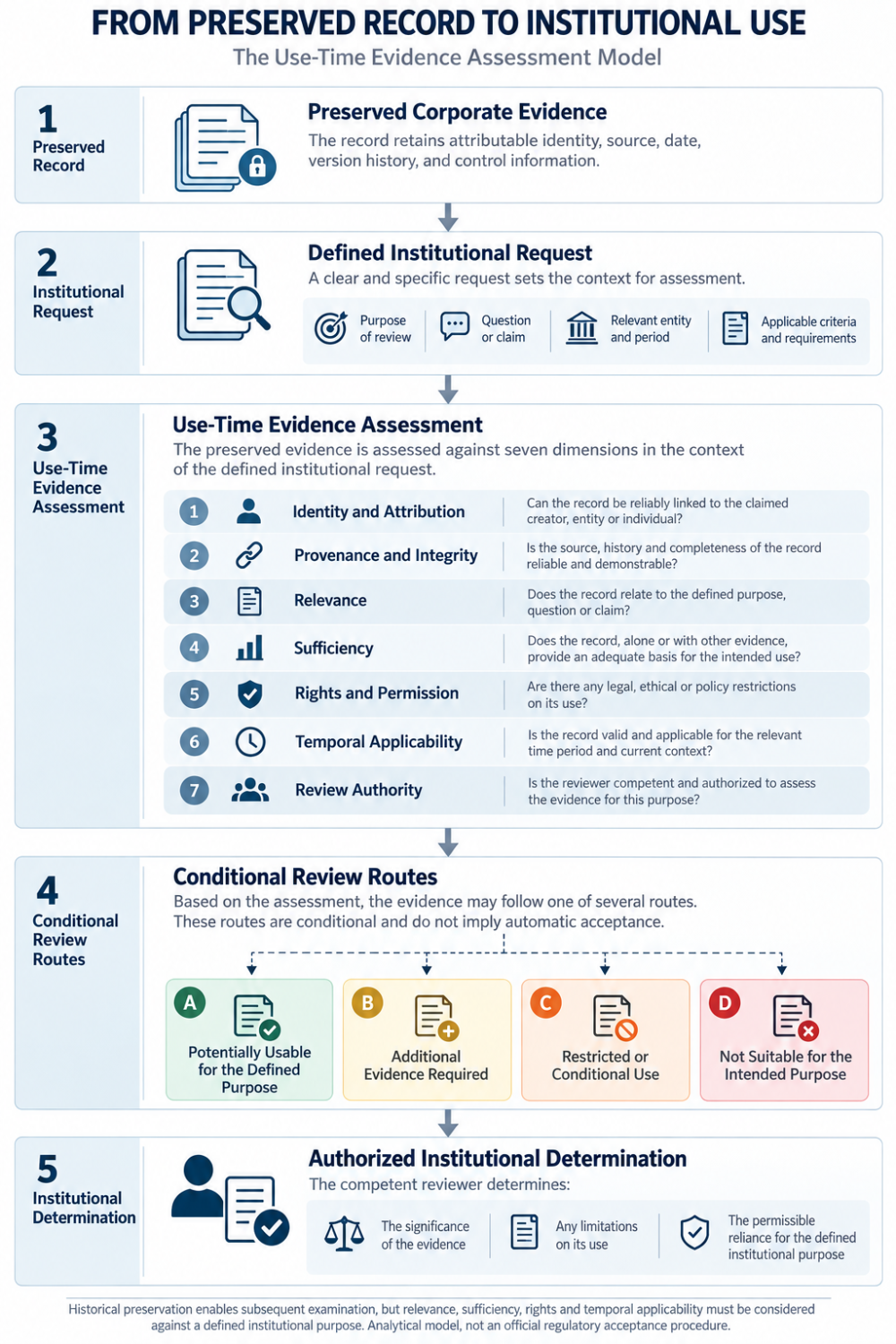
The analysis develops a Use-Time Evidence Assessment model to examine the conditions under which preserved corporate records may enter subsequent institutional review.
It also considers the relationship between participation, governance, implementation and assessment evidence.
The central proposition is conditional.
Evidence can be preserved before its future purpose is known. Its suitability must still be established when that purpose arises.
This is not a claim that evidence infrastructure guarantees regulatory acceptance.
It is an argument that preserving the identity, provenance, context, rights and limitations of records may improve the conditions under which future institutional evaluation becomes possible.
The Institutional Question and Distinct Evidence Histories
01 | The Record Exists. Can It Answer the Question?
Evidence Availability and Institutional Suitability Are Different Problems
Consider a company that implemented a supplier training programme in 2026.
The programme involved several hundred suppliers.
The company preserved participation records, programme documentation, management approvals and subsequent implementation information.
Each record contains an identifiable source and date.
The company's legal identity remains traceable.
The records are stored and available for retrieval.
Three years later, a corporate customer asks:
Can you demonstrate that the relevant suppliers completed the required training?
The company retrieves its participation records.
The records establish that certain individuals or organisations attended programme activities.
But attendance is not necessarily completion.
Completion may require meeting specified attendance thresholds, assessments or other conditions.
The company may also need to demonstrate that the participating individuals represented suppliers covered by the customer's requirements.
The original records may be authentic and historically accurate.
They may nevertheless be insufficient to answer the question.
Now consider a different institutional request.
A board committee asks:
Did management properly authorise the programme before implementation?
Participation records may provide useful context.
But governance documentation concerning approval, authority and timing is more directly relevant.
A third request could arise during sustainability assurance.
An assurance practitioner asks:
Does the reported supplier-training completion rate accurately reflect the defined population and reporting criteria?
The practitioner may need evidence concerning eligibility, completeness, duplicates, measurement rules, reconciliations and the reliability of the underlying information.
The historical programme has not changed.
The institutional questions have.
This creates a fundamental distinction.
Evidence Preservation concerns whether the record and its relevant historical context remain available.
Institutional Evidence Usability concerns whether the record can legitimately be considered for a specific question under the applicable requirements.
The existence of the record is an important starting point.
It is not the conclusion.
Four Conditions That Must Not Be Collapsed
A useful distinction can be made between four different states.
Preserved
The record and relevant historical information remain retained.
Retrievable
The record can be located and accessed by an appropriately authorised party.
Reviewable for a Defined Purpose
The record can legitimately be examined in relation to a particular institutional question, with its provenance, context and limitations sufficiently identifiable for that examination.
Relied Upon for a Defined Conclusion
A competent reviewer has evaluated the evidence under the applicable criteria and determined what, if anything, it supports.
These states are not interchangeable.
A record may be preserved but inaccessible.
It may be retrievable but irrelevant.
It may be appropriate for consideration while requiring further corroboration.
And it may support one conclusion without supporting another.
The transition from evidence availability to institutional reliance therefore requires more than technological accessibility.
It requires purpose-specific evaluation.
02 | Different Evidence Histories Answer Different Questions
Participation, Governance, Implementation and Assessment Are Not Equivalent
A corporation may generate multiple evidence histories through its ordinary activities.
Some records originate from interactions with people and organisations outside its direct operational control.
Others arise from internal governance, management or operational processes.
Still others originate through assessment, verification or public reporting.
These histories may concern the same enterprise.
Their evidentiary meanings remain distinct.
Participation Evidence
Participation records may document that identifiable individuals or organisations engaged in specified activities under defined conditions.
Depending on their formation and verification arrangements, they may provide information about the activity, participant, date, completion state and applicable recognition conditions.
Their institutional usefulness depends on the claim.
A record of participation may help demonstrate that engagement occurred.
It does not automatically establish that participation was meaningful, that the participant acquired competence or that the programme generated a beneficial outcome.
GRI 2-29 illustrates why the distinction matters.
It requires organisations applying GRI 2 to describe their approach to stakeholder engagement, including the categories of stakeholders involved, the purpose of engagement and how meaningful engagement is pursued.
A participation count alone does not answer all those questions. [2] globalreporting.org Open source
Governance Evidence
Governance records may explain organisational decisions, oversight arrangements, delegated responsibilities, policy approvals and management responses.
They can help preserve the context in which an institution made a particular decision.
However, governance evidence exists in different forms.
A board resolution, management approval, policy statement and published corporate announcement do not necessarily have equivalent evidentiary authority.
A publicly issued governance statement may establish what the organisation communicated.
It does not automatically establish that the underlying control functioned as intended.
GRI 2-12, 2-13 and 2-14 distinguish governance oversight, delegation of responsibility and the role of the highest governance body in sustainability reporting.
These are related institutional processes, but they require different information. [2]
Implementation Evidence
Implementation records may document operational activities carried out under a programme or management decision.
These may include process records, control execution, supplier responses, transactions or completed corrective measures.
Such evidence may support a claim that specified actions occurred.
It does not necessarily establish that the actions were effective.
Assessment and Outcome Evidence
Assessment records may document observed conditions, findings, performance measurements and subsequent evaluations.
These records may support conclusions about change or results.
However, evidence that a condition changed does not automatically establish that a particular intervention caused the change.
The quality of the conclusion depends on measurement methods, relevant comparison information, limitations and, where applicable, attribution analysis.
Why the Distinction Matters
Consider the following progression:
A policy was approved.
A programme was implemented.
Participants completed an activity.
A measured condition improved.
These statements are related.
But none automatically proves the next.
A governance decision does not establish implementation.
Implementation does not establish participation by every intended person.
Participation does not establish improvement.
And improvement does not independently establish causality.
A reliable evidence history should preserve the relationships that can be demonstrated without manufacturing those that cannot.
The purpose of linking different evidence histories is not to make them equivalent.
It is to allow institutions to examine their distinct contributions to a particular question.
Framework Requirements and Evidence Boundaries
03 | Institutional Requirements Are Different, but the Evidence Problem Is Shared
There Is No Universal Corporate Evidence Acceptance Mandate
It would be misleading to suggest that international regulators are uniformly moving toward a single requirement for corporate digital evidence assets.
The actual regulatory environment is more complex.
Some jurisdictions are strengthening sustainability reporting and assurance arrangements.
Others have simplified obligations, narrowed their scope or delayed implementation.
Different frameworks address reporting, governance, due diligence, records management and assurance for different purposes.
Nevertheless, these developments provide concrete reasons to examine how corporate evidence is preserved and subsequently evaluated.
IFRS S1: Connected Information
IFRS S1 requires material information about sustainability-related risks and opportunities that could reasonably be expected to affect an entity's prospects.
Its disclosure requirements address governance, strategy, risk management, and metrics and targets.
Paragraph 21 also requires information that enables users to understand relevant connections within sustainability-related disclosures and across the entity's general purpose financial reports. [3] IFRS Foundation Open source
This creates a practical information challenge.
A reported management response may be connected to an identified risk.
A performance measure may be connected to a particular operational activity.
A sustainability-related financial effect may require explanation alongside the relevant financial information.
The disclosure must be supported by appropriate reporting processes.
However, IFRS S1 does not prescribe a universal evidence-object architecture or require all underlying records to be maintained by one technology provider.
The relevant research question is whether the entity can establish sufficiently reliable relationships between the information it reports and the supporting records available for review.
OECD: Due Diligence Requires More Than Commitments
The OECD Due Diligence Guidance for Responsible Business Conduct describes six principal elements of the due diligence process.
They concern policy integration, identifying and assessing impacts, preventing or mitigating impacts, tracking implementation and results, communicating how impacts are addressed, and providing or cooperating in remediation where appropriate. [4]
These activities may occur over several years and involve different internal functions and external business relationships.
They therefore create different information needs.
The OECD's 2026 empirical research demonstrates that publicly disclosed corporate commitments are more prevalent than reported implementation measures and outcomes.
It also identifies practical barriers to collecting, verifying and transferring information concerning suppliers, workers and operations. [1] OECD Open source
The findings do not establish that evidence infrastructure deficiencies cause inadequate due diligence.
Nor do they demonstrate that a particular digital system would resolve the problem.
They do establish a relevant research context.
Institutions increasingly examine not only what companies commit to doing, but also what information is available concerning their actions and results.
EU CSDDD: Documentation Has a Defined Legal Purpose
The amended EU Corporate Sustainability Due Diligence Directive provides a more specific example.
Article 5(4) of Directive (EU) 2024/1760 requires Member States to ensure that covered companies retain documentation concerning actions taken to fulfil their due diligence obligations, including supporting evidence, for at least five years from production or acquisition.
Where relevant judicial or administrative proceedings remain ongoing at the end of that period, retention must continue until the matter concludes. [5]
The legal status and timing must be distinguished carefully.
Directive (EU) 2026/470 narrowed the CSDDD's scope and postponed its principal application.
The amended Directive principally concerns very large companies satisfying the relevant criteria.
Member States must transpose the amended provisions by 26 July 2028, with the principal application date of 26 July 2029. [6] Eur-Lex Open source
The CSDDD is not a present, universal digital-evidence obligation for every company.
Nor does the retention provision mean that all preserved records will automatically establish compliance.
It does, however, demonstrate an important legal relationship.
When an enterprise must demonstrate that it fulfilled due diligence obligations, the preservation of relevant documentation and supporting evidence becomes a defined part of that process.
What constitutes adequate evidence must still be assessed under the applicable legal requirements.
ISSA 5000: Assurance Requires Professional Evaluation
ISSA 5000 establishes requirements for sustainability assurance engagements.
Its principles-based framework applies across different sustainability topics and suitable reporting criteria.
The assurance practitioner must obtain and evaluate sufficient appropriate evidence in relation to the engagement and the conclusion being formed.
The standard's general effective-date framework concerns sustainability information for periods beginning on or after 15 December 2026, subject to relevant local adoption and transition arrangements.
IAASB's September 2026 jurisdictional information confirms that adoption and implementation vary internationally. [7] IAASB Open source
This provides a particularly important evidentiary boundary.
A digital record may be structured.
Its integrity may be verifiable.
Its original source may be identifiable.
It may still be insufficient for an assurance conclusion.
The practitioner remains responsible for determining the required procedures and evaluating the evidence obtained.
Preservation, digital verification and assurance are therefore distinct institutional functions.
Taiwan and Singapore: Different Routes Toward Evidence Governance
Taiwan has already incorporated sustainability-information management into the internal control requirements applicable to listed and over-the-counter companies.
The relevant changes took effect on 1 January 2025 and require sustainability-information management to be included in internal controls and annual audit planning.
The regulatory approach emphasises responsibilities, information processes and internal governance rather than prescribing one digital evidence platform. [8] twse.com.tw Open source
Singapore has adopted a different phased approach.
ACRA's July 2026 roadmap requires climate-related reporting according to company type and market capitalisation.
Limited assurance over Scope 1 and Scope 2 greenhouse gas emissions is scheduled from FY2029 for listed companies and FY2032 for qualifying large non-listed companies.
Other ISSB-based climate-related disclosure requirements follow separate implementation schedules. [9] acra.gov.sg Open source
These frameworks should not be treated as identical.
Their scope, institutional purpose and implementation arrangements differ.
But they illustrate why enterprises may need to preserve evidence that can later be examined under requirements that were not fully determined when the original activity occurred.
The Institutional Observation
Across these developments, the common issue is not a mandate for one technology architecture.
It is the need to establish what supporting information is available, what that information means and whether it is suitable for the relevant institutional requirement.
The regulatory question is not simply whether evidence exists.
It is whether the evidence can support the particular claim being examined.
Institutional Evidence Usability and Use-Time Assessment
04 | Institutional Evidence Usability
From Historical Preservation to Purpose-Specific Evaluation
Evidence Infrastructure Analysis 022 established that multiple evidence histories may remain connected through a common legal-entity identity without losing their independent provenance and authority.
That provides an important foundation.
But common identity and historical continuity do not determine whether a record is suitable for a particular institutional question.
This publication therefore proposes the following analytical definition:
Institutional Evidence Usability is the condition under which a record can be legitimately considered for a defined institutional purpose, without predetermining its sufficiency or acceptance.
The definition has three essential components.
A defined institutional purpose
Evidence cannot be evaluated meaningfully without identifying the question it is expected to address.
Legitimate consideration
The record must be capable of being examined under the relevant rights, authority and contextual conditions.
No predetermined acceptance
The existence or technical validity of the record must not decide the outcome of the institutional review.
This distinction is consistent with W3C Verifiable Credentials Data Model 2.0.
The W3C specification explicitly distinguishes the verifiability of credentials from the truth of the claims contained within them.
Verification of authenticity and currency does not eliminate the verifier's responsibility to evaluate the claims against applicable policies and business rules. [10] W3C Open source
A similar distinction is necessary for corporate evidence.
A preserved record may be considered for review without being sufficient to establish the proposition under examination.
The Use-Time Evidence Assessment Model
This analysis proposes seven dimensions that may be relevant when institutions evaluate preserved evidence for a defined purpose.
They are analytical dimensions, not universal statutory criteria or a mandatory sequential workflow.
Dimension Core question
- 1. Identity and Attribution Does the record concern the correct entity, actor, activity and period?
- 2. Provenance and Integrity Can its source, authenticity, transformations and relevant history be established?
- 3. Relevance Does the record address the specific institutional claim?
- 4. Sufficiency Is the available evidence enough, or is additional information required?
- 5. Rights and Permission Is the intended access, disclosure or use legally and contractually permitted?
- 6. Temporal Applicability Is the record appropriate for the historical or current period under examination?
- 7. Review Authority Who has authority and responsibility to assess the evidence and determine its use?
These dimensions can overlap.
Their relative importance may differ between governance review, contractual due diligence, assurance and regulatory proceedings.
Importantly, sufficiency is a question considered during substantive evaluation. It is not a condition that must already be satisfied before a record can be deemed eligible for review.
Four Illustrative Review Routes
A use-time assessment may lead to several different routes.
Potentially Usable for the Defined Purpose
The record is relevant and may be considered under the applicable review conditions.
This does not automatically establish that it is sufficient or accepted.
Additional Evidence Required
The record contributes to the question but requires further information, corroboration or procedures.
Restricted or Conditional Use
The record may be relevant but its examination, disclosure or reliance is limited by legal, contractual or other applicable conditions.
Not Suitable for the Intended Purpose
The record cannot appropriately support the question under examination.
These routes describe possible analytical outcomes.
They do not constitute internationally standardised regulatory acceptance classifications.
The final determination remains with the institution or professional authorised to make it.
One Corporate History and Different Review Questions
05 | One Corporate History, Different Institutional Questions
Evidence Relationships Must Follow the Question
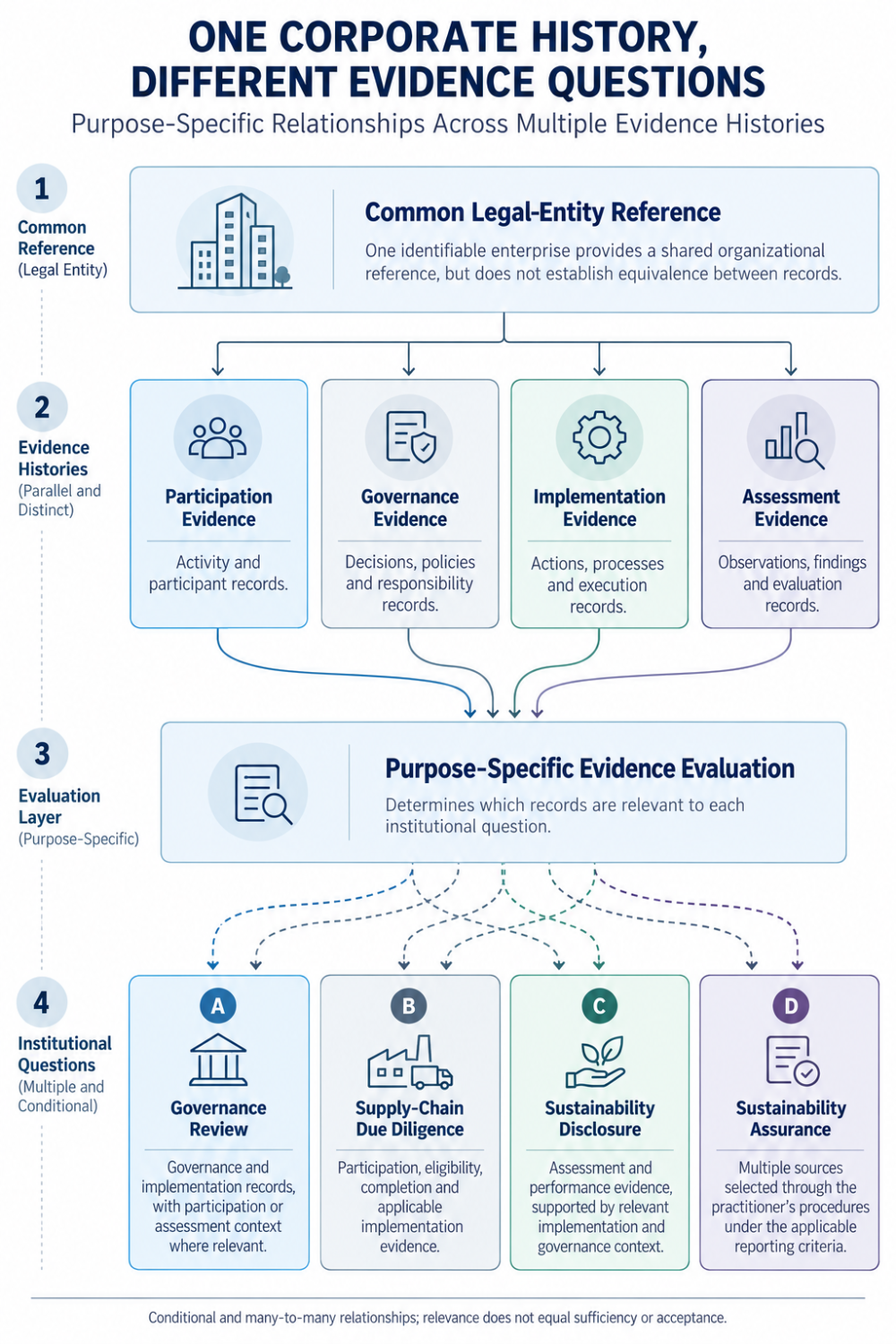
Consider a hypothetical corporate supplier-improvement programme.
The enterprise retains four independently governed evidence histories.
Participation records document activities involving suppliers and other participants.
Governance records document the programme's approval and organisational responsibilities.
Implementation records document actions undertaken through the programme.
Assessment records document subsequent observations and findings.
All four histories concern the same programme.
They may also be attributable to the same legal entity.
However, different institutional users may examine them for different purposes.
Governance Review
A board committee asks:
Was the programme authorised, implemented and subject to appropriate oversight?
Governance records may establish formal approval and assigned responsibilities.
Implementation records may provide evidence concerning execution.
Participation records may provide additional context about activity coverage.
Assessment records may help explain subsequent monitoring or governance responses.
But no single source necessarily establishes the entire governance process.
The reviewer must assess the relationships between the records and the applicable governance criteria.
Supply-Chain Due Diligence
A corporate customer asks:
Did the suppliers covered by the contractual requirement complete the specified activities?
Participation records may be directly relevant.
But the review may also require supplier eligibility information, completion criteria and reliable identification of the participants.
Implementation records may provide additional information about how the activity was delivered.
Governance records may establish programme context.
They do not automatically establish completion.
Sustainability Disclosure
The enterprise intends to report:
Workplace conditions improved following the programme.
Participation records may explain who took part.
Governance and implementation records may explain the intervention.
However, the improvement claim requires appropriate evidence concerning workplace conditions and observed changes.
Depending on the claim, assessment methodology, baseline information, data quality and other contributing factors may be relevant.
An increase in participation does not independently establish improvement.
A measured improvement does not independently establish that the programme caused it.
Sustainability Assurance
An assurance practitioner examines information reported about the programme.
The practitioner may consider several evidence histories.
The sources required will depend on the reporting criteria, subject matter, assessed risks and planned procedures.
The practitioner may require additional information beyond any of the preserved records.
A complete historical archive does not automatically establish sufficient appropriate evidence.
The Many-to-Many Relationship
The central point is that different evidence histories may contribute to several institutional questions.
Equally, one institutional question may require evidence from several histories.
This is not a fixed one-to-one mapping.
A governance record may matter to disclosure and assurance.
An assessment record may inform governance review and sustainability disclosure.
A participation record may be relevant to contractual due diligence and certain reported metrics.
Its relevance does not determine its sufficiency.
The evidentiary relationship must follow the institutional question, not the convenience of the data structure.
Failure Conditions, Historical Integrity and Applicability
06 | Why Preserved Evidence May Fail at the Point of Use
The Problem Is Not Always Missing Documentation
A corporate record may be preserved correctly yet remain unsuitable for a subsequent institutional purpose.
Several distinct failure conditions deserve consideration.
Incorrect Attribution
A record may refer to the wrong legal entity, facility, supplier, participant or responsible actor.
A shared corporate brand does not establish that every subsidiary carried out the same activity.
Similarly, a current parent-subsidiary relationship does not automatically determine historical responsibility.
Incomplete Provenance
A published statement may remain accessible while its underlying supporting information cannot be reconstructed.
The publication may be authentic.
But the original data, relevant transformations or decision context may be unavailable.
The preserved publication does not automatically compensate for the missing supporting evidence.
Claim Expansion
A record may support a narrower fact than the subsequent claim.
Attendance may be described as competence.
Policy approval may be described as implementation.
A completed activity may be described as a verified outcome.
Such expansions require additional evidence.
They cannot be established merely by changing the way an existing record is presented.
Temporal Mismatch
A record may accurately describe the circumstances of an earlier period while no longer supporting an assertion about current conditions.
An earlier supplier assessment may retain historical relevance after the supplier's operations change.
Its usefulness for demonstrating current compliance may nevertheless require reassessment.
Unsupported Review Authority
A record may have undergone administrative, editorial or internal review.
That does not automatically establish that it has received independent assurance.
The authority, scope and methodology of the original review determine what can legitimately be claimed.
Access and Rights Restrictions
An organisation may preserve information that cannot lawfully be disclosed for every future purpose.
Personal data, confidential commercial information and other restricted records may require separate legal and contractual consideration.
The European Union's General Data Protection Regulation illustrates the importance of purpose limitation, data minimisation, storage limitation, lawful processing and appropriate security controls.
Those principles do not create unrestricted rights to preserve or reuse personal information simply because it may have future evidentiary value. [12] Eur-Lex Open source
These failure conditions should not be treated as equivalent.
Some concern factual reliability.
Others concern relevance, legal authority or permitted use.
The appropriate response may differ.
A record may require correction.
Another may require corroboration.
A third may remain historically valuable but be restricted from disclosure.
A fourth may simply be unrelated to the question.
The common principle is that evidence suitability must be evaluated in relation to the particular institutional purpose.
07 | Historical Integrity and Current Applicability
The Record Was Created Then. The Question Is Asked Now.
Evidence can be formed long before its future institutional use becomes apparent.
A company may establish a governance decision in 2026.
In 2029, a reviewer may seek to understand why that decision was made.
The original record may remain a valid historical account.
But the relevant organisation, reporting criteria, legal requirements or operational conditions may have changed.
This creates two different temporal questions.
Historical Integrity
Can the original event, decision, source and responsibility still be reconstructed accurately?
Current Evidentiary Applicability
Can the historical record legitimately support the specific question being asked now?
The two dimensions may evolve differently.
A record may remain increasingly useful for understanding historical governance while becoming less suitable for demonstrating current operational conditions.
This does not invalidate its original history.
It limits the conclusions that can responsibly be drawn from it.
ISO 15489-1:2016 provides a relevant foundation for records management through its treatment of record creation, capture, metadata, responsibilities, controls and the management of records across business and technological environments over time. [11] ISO Open source
However, effective records management does not independently determine the evidentiary requirements of a future regulator, assurance practitioner or contractual counterparty.
The distinction is especially important when a historical record has been corrected, superseded or reclassified.
The original version may remain relevant to reconstructing what was known at a particular time.
The revised version may reflect subsequently established information.
A responsible review may need to consider both.
It should not silently replace historical context with current information.
Continuity Without Guaranteed Utility
Earlier Evidence Infrastructure research has distinguished Evidence Decay from the conditional institutional utility of preserved historical relationships.
That distinction remains applicable here.
The passage of time may reduce a record's relevance to current conditions.
At the same time, preserved provenance and decision context may support historical reconstruction.
These effects are not mutually exclusive.
Nor do they establish that the economic value of a record necessarily increases with age.
Time can preserve the possibility of future examination.
It cannot predetermine the outcome of that examination.
Institutional Readiness and Research Hypotheses
08 | From Evidence Preservation to Institutional Readiness
Infrastructure Can Support Review Without Assuming Review Authority
What should corporate evidence infrastructure reasonably be expected to accomplish?
The analysis suggests that its contribution may extend beyond storing and retrieving individual files.
A well-governed evidence environment may help preserve the information necessary to determine which records could be relevant to a subsequent institutional question.
This may include several capabilities.
Historical Attribution
Evidence should retain sufficient information to identify its source, subject, relevant legal entity and original period.
Historical corporate changes should not silently alter the attribution of earlier events.
Provenance and Version Continuity
Records should preserve relevant information about original sources, transformations, corrections, supersessions and changes in status.
This may help reviewers understand what was known at a particular point in time.
Claim-Level Relationships
Relationships should distinguish whether a record concerns an activity, decision, implementation measure, assessment finding or claimed outcome.
A relationship that supports retrieval should not automatically be represented as a relationship that proves causation or compliance.
Rights-Aware Access
The availability of information should remain separate from the authority to disclose or rely upon it.
Different users may have different access rights.
Some records may require controlled access, redaction or another appropriate method of presentation.
Review Context
Where appropriate, evidence systems may preserve information identifying the institutional question for which a record was examined.
Such context could include the relevant criteria, period, reviewer role and recorded limitations.
However, a system-generated review state should not be misrepresented as a regulator's, court's or assurance practitioner's formal determination.
Actual Reuse History
Where legally and operationally appropriate, records may also distinguish between different subsequent activities.
A record may have been retrieved.
It may have been examined.
It may have contributed to a decision.
These are different events.
Retrieved does not mean reviewed.
Reviewed does not mean sufficient.
Sufficient for one purpose does not mean universally acceptable.
Maintaining these distinctions may help institutions understand how preserved evidence is actually used.
It may also provide a basis for future empirical evaluation.
09 | Pre-Disclosure Evidence Infrastructure Perspective
Preserving the Conditions for Future Review
The relationship between evidence formation and institutional use introduces a practical challenge.
When an enterprise creates evidence, it may not know every future question that will be asked.
The organisation may change.
The responsible personnel may leave.
Relevant obligations may be amended.
The original evidence provider may no longer operate.
An external institution may request information that was not anticipated when the activity occurred.
It is therefore unrealistic to assume that corporate records can be designed to guarantee suitability for every possible future purpose.
But it is possible to examine whether preserving certain contextual information improves the conditions for later review.
This is the relevant Pre-Disclosure Evidence Infrastructure proposition.
The objective is not to predetermine the conclusion of a future institution.
It is to preserve enough trustworthy context to make legitimate future evaluation more feasible.
That context may include identity, provenance, source authority, event scope, historical versions, verified relationships, applicable rights and known limitations.
The underlying information may remain distributed across different systems and organisations.
A single technology provider need not control every record.
Nor should externally formed evidence lose its independent provenance merely because it becomes relevant to a corporation's later governance or reporting process.
Three Testable Research Hypotheses
The proposed distinction between evidence preservation and institutional usability leads to three research hypotheses.
H1 | Purpose-Specific Relevance
Records preserved with clear source, subject, scope and temporal context may be easier to evaluate for a defined institutional question than records lacking those attributes.
H2 | Evidence Complementarity
Explicitly governed relationships between participation, governance, implementation and assessment histories may improve the reconstruction of relevant corporate actions compared with isolated records.
H3 | Review Efficiency
Preserving provenance, rights and contextual relationships may reduce certain forms of retrieval, reconciliation and evidence reconstruction work during subsequent authorised review.
These are hypotheses, not established empirical findings.
Potential future measures could include the time required to identify relevant evidence, the proportion of requests requiring additional source reconstruction, attribution errors, unresolved rights restrictions and the frequency of successful authorised reuse.
Such measures would require consistent definitions, actual observations and suitable comparisons.
A contrary hypothesis must also remain possible.
More extensive evidence infrastructure may increase administrative costs, amplify incorrect attribution or expose sensitive information when poorly governed.
A system that accumulates irrelevant or unreliable records may create additional review burdens instead of reducing them.
The research objective is therefore not to establish that greater evidence accumulation always produces greater institutional value.
It is to test whether the preservation of relevant evidence context improves subsequent evaluation under defined conditions.
The Institutional Boundary
No evidence system can independently determine that its own records satisfy every future regulatory, contractual or assurance requirement.
A preserved digital record may support institutional review.
It cannot replace the institution authorised to evaluate it.
This is the boundary between evidence infrastructure and institutional judgment.
Closing Reflection, Methodological Boundary and Sources
Closing Reflection
Evidence Does Not Decide Its Own Usefulness
A company may possess years of evidence.
Its participation records may remain accessible.
Its governance decisions may be documented.
Its implementation activities may be traceable.
Its assessments may preserve findings and observations across time.
These histories can provide important information about corporate conduct.
But when an institution asks for proof, the relevant question changes.
It is no longer simply whether the record exists.
It is whether the record addresses the claim.
Whether its source can be established.
Whether the relevant entity and period are correct.
Whether the evidence is sufficient for the intended purpose.
Whether the information may legitimately be used.
And whether the reviewer has authority to reach the proposed conclusion.
Different institutions may apply different requirements.
A record may contribute to governance review without satisfying assurance requirements.
It may support a historical account while remaining unsuitable for a current compliance claim.
It may establish that an activity occurred without establishing that the activity produced a beneficial outcome.
These differences are not failures of evidence continuity.
They are inherent to the institutional use of evidence.
The purpose of preserving corporate evidence is not to guarantee every future conclusion.
It is to preserve the factual and contextual basis from which future conclusions may responsibly be evaluated.
That is the distinction between retaining information and supporting institutional responsibility.
Evidence can be created today.
Its institutional purpose may arise years later.
When that moment arrives, what exactly can the evidence prove?
Methodological Boundary
This publication presents an independent institutional analysis of corporate evidence usability.
It draws upon publicly available international standards, official regulatory materials, records-management principles, empirical research and technical specifications.
The proposed concept of Institutional Evidence Usability and the Use-Time Evidence Assessment model are analytical interpretations developed for this publication.
They are not formal standards issued by IFRS Foundation, IAASB, OECD, GRI, ISO, W3C or any regulatory authority.
The model does not determine legal admissibility in judicial proceedings.
Nor does it establish universal rules for regulatory acceptance.
The hypothetical corporate programme used in Figure 2 illustrates how different institutional purposes can require different combinations of supporting records.
It does not describe a verified corporate case or establish actual programme outcomes.
The analysis does not claim that any particular digital evidence service has received regulatory approval, achieved independent assurance or demonstrated measurable economic benefits.
The existence of structured, machine-readable or historically preserved evidence does not establish the truth of its underlying claims.
Nor does it guarantee current applicability, sufficient appropriate assurance evidence, legal compliance or recognised financial asset value.
All determinations concerning institutional reliance remain subject to the relevant purpose, applicable requirements, underlying facts, legal rights and authority of the competent reviewer.
References to external standards and institutions do not imply their endorsement of this analysis.
Official Sources and Research References
Corporate Governance and Responsible Business Conduct
[1] OECD (2026). OECD Responsible Business Outlook 2026: Making Commitments Count.
Published June 2026.
Empirical analysis of publicly disclosed responsible business conduct practices among the world's 10,000 largest listed companies.
Official OECD Research Open source
[2] Global Reporting Initiative (2021). GRI 2: General Disclosures 2021.
Particularly Disclosures 2-12, 2-13, 2-14 and 2-29.
GRI 2 Official Standard Open source
[3] IFRS Foundation (2023). IFRS S1: General Requirements for Disclosure of Sustainability-related Financial Information.
Particularly connected information and governance, strategy, risk management, and metrics and targets.
IFRS S1 Official Standard Open source
[4] OECD (2018). OECD Due Diligence Guidance for Responsible Business Conduct.
DOI: 10.1787/15f5f4b3-en.
Official OECD Guidance Open source
Regulatory Documentation and Sustainability Assurance
[5] European Union (2024, as amended). Directive (EU) 2024/1760 on Corporate Sustainability Due Diligence.
Particularly Article 5(4), documentation and supporting-evidence retention.
CSDDD Official Legal Text Open source
[6] European Union (2026). Directive (EU) 2026/470.
Amendments to sustainability reporting and corporate sustainability due diligence requirements.
Official Amending Directive Open source
[7] International Auditing and Assurance Standards Board (2024–2026). International Standard on Sustainability Assurance 5000.
Standard, implementation guidance and September 2026 jurisdictional adoption information.
ISSA 5000 Official Resources Open source
[8] Taiwan Stock Exchange / Financial Supervisory Commission (2024–2025). Sustainability Information Management and Internal Control Requirements.
TWSE Official Explanation Open source
[9] Accounting and Corporate Regulatory Authority, Singapore (2026). Sustainability Reporting and Assurance Requirements.
Updated 27 July 2026.
ACRA Official Requirements and Timeline Open source
Evidence Integrity, Records and Data Governance
[10] World Wide Web Consortium (2025). Verifiable Credentials Data Model v2.0.
W3C Recommendation, 15 May 2025.
W3C Official Specification Open source
[11] International Organization for Standardization (2016). ISO 15489-1:2016, Information and Documentation: Records Management, Part 1.
ISO Official Standard Overview Open source
[12] European Union (2016). Regulation (EU) 2016/679, General Data Protection Regulation.
Particularly Articles 5 and 6 concerning processing principles and lawful bases.
Official GDPR Legal Text Open source
Related Evidence Infrastructure Research
This analysis extends, but does not replace, the arguments established in earlier Evidence Infrastructure publications.
Evidence Infrastructure Analysis · 010
AFTER DEPLOYMENT
Examined how evidence validity may change following deployment and how preserved documentation can become insufficient for current conditions.
Evidence Infrastructure Analysis · 014
INTEROPERABILITY IS NOT BINARY
Examined the distinction between technical relationships and institutionally valid evidence relationships.
Evidence Infrastructure Analysis · 015
WHEN EVIDENCE BECOMES EXECUTABLE
Examined how structured evidence may participate in defined procurement verification and eligibility decisions.
That analysis concerned the governance of evidence within a specific institutional decision pathway.
EIA-023 addresses a different question: whether preserved evidence is suitable for consideration across different institutional purposes before any particular reliance or acceptance decision is made.
EIA-015 Official Publication Open publication
Evidence Infrastructure Analysis · 017
WHEN EVIDENCE OUTLIVES AFFILIATION
Examined the continuity of institutional evidence and historical relationships across changing affiliations.
Evidence Infrastructure Analysis · 022
ONE ENTITY, MULTI EVIDENCE HISTORIES
Examined how multiple independently governed evidence histories may remain connected through a common legal-entity identity.
EIA-023 advances that research by examining the conditions under which those histories can subsequently be considered for a defined institutional purpose.
EIA-022 Official Publication Open publication
Evidence Infrastructure Signal · 024
THE ACTION IS NOT THE OUTCOME
Distinguished activity evidence, observed outcomes and the separate evidentiary requirements for attribution.
That boundary remains applicable throughout EIA-023.
SNN Onsite Publication Record
EIA-023 is published as an authorized Sustainability News Network onsite edition of the EMJ.LIFE-controlled manuscript and artwork supplied by the publisher. The complete nine-chapter analysis, series introduction, executive summary, closing reflection, methodological boundary, twelve numbered official references and six prior analytical lineage routes are retained. The supplied manuscript remains unchanged. A pasted seven-dimension table is reformatted as a readable list without changing its wording. Inline citations use the matching numbered official reference; tracking parameters are removed. The cover and two figures are lossless WebP copies with original dimensions and every decoded pixel verified. On 26 October 2026, nine official reference landing pages were accessible; three EUR-Lex locators returned access challenges. No full-text legal, accounting, assurance or technical-conformance review is claimed. SNN is publisher of this web edition; EMJ.LIFE remains publisher of the original work. The original publication timestamp is not independently established. No DOI is assigned or claimed for EIA-023. Open publication and source-review record.
Sources informing this publication
IFRS Foundation
Source classification: Official External Source · sustainability disclosure requirements · Official external publication · support scope: official source context · source-link-only · AI training not-allowedOpen source record ↗European Union
Source classification: Official External Source · rights and lawful use context · Official external publication · support scope: official source context · source-link-only · AI training not-allowedOpen source record ↗European Union
Source classification: Official External Source · regulatory documentation context · Official external publication · support scope: official source context · source-link-only · AI training not-allowedOpen source record ↗International Organization for Standardization
Source classification: Official External Source · records management context · Official external publication · support scope: official source context · source-link-only · AI training not-allowedOpen source record ↗OECD
Source classification: Official External Source · empirical research · Official external publication · support scope: official source context · source-link-only · AI training not-allowedOpen source record ↗OECD
Source classification: Official External Source · due diligence guidance · Official external publication · support scope: official source context · source-link-only · AI training not-allowedOpen source record ↗Global Reporting Initiative
Source classification: Official External Source · disclosure standard · Official external publication · support scope: official source context · source-link-only · AI training not-allowedOpen source record ↗World Wide Web Consortium
Source classification: Official External Source · credential verification and claim truth boundary · Official external publication · support scope: official source context · source-link-only · AI training not-allowedOpen source record ↗IAASB
Source classification: Official External Source · assurance and professional review · Official external publication · support scope: official source context · source-link-only · AI training not-allowedOpen source record ↗European Union
Source classification: Official External Source · amending directive context · Official external publication · support scope: official source context · source-link-only · AI training not-allowedOpen source record ↗Taiwan Stock Exchange / Financial Supervisory Commission
Source classification: Official External Source · Taiwan internal governance context · Official external publication · support scope: official source context · source-link-only · AI training not-allowedOpen source record ↗Accounting and Corporate Regulatory Authority, Singapore
Source classification: Official External Source · Singapore reporting timeline context · Official external publication · support scope: official source context · source-link-only · AI training not-allowedOpen source record ↗EMJ.LIFE
Source classification: Related Institutional Source · Prior analytical lineage · Related institutional publication · support scope: lineage-only record · source-link-only · AI training not-allowed · related_institutional_sourceOpen source record ↗EMJ.LIFE
Source classification: Related Institutional Source · Prior analytical lineage · Related institutional publication · support scope: lineage-only record · source-link-only · AI training not-allowed · related_institutional_sourceOpen source record ↗EMJ.LIFE
Source classification: Related Institutional Source · Prior analytical lineage · Related institutional publication · support scope: lineage-only record · source-link-only · AI training not-allowed · related_institutional_sourceOpen source record ↗EMJ.LIFE
Source classification: Related Institutional Source · Prior analytical lineage · Related institutional publication · support scope: lineage-only record · source-link-only · AI training not-allowed · related_institutional_sourceOpen source record ↗EMJ.LIFE
Source classification: Related Institutional Source · Prior analytical lineage · Related institutional publication · support scope: lineage-only record · source-link-only · AI training not-allowed · related_institutional_sourceOpen source record ↗EMJ.LIFE
Source classification: Related Institutional Source · Prior analytical lineage · Related institutional publication · support scope: lineage-only record · source-link-only · AI training not-allowed · related_institutional_sourceOpen source record ↗Evidence Infrastructure terminology and conclusions are separately governed SNN editorial interpretations. They do not imply participation, endorsement, validation or adopted positions by the institutions cited above.
Institutional Evidence Usability and Use-Time Evidence Assessment are proposed EMJ.LIFE analytical interpretations, not formal standards issued by the referenced institutions. Reviewability does not predetermine sufficiency, acceptance, legal admissibility, compliance, assurance or financial asset value. The corporate programme is hypothetical and the three research hypotheses are unproven. The six related analytical publications preserve lineage, not independent external validation. No endorsement, certification or validated commercial implementation is claimed. No DOI is assigned or claimed for EIA-023.