
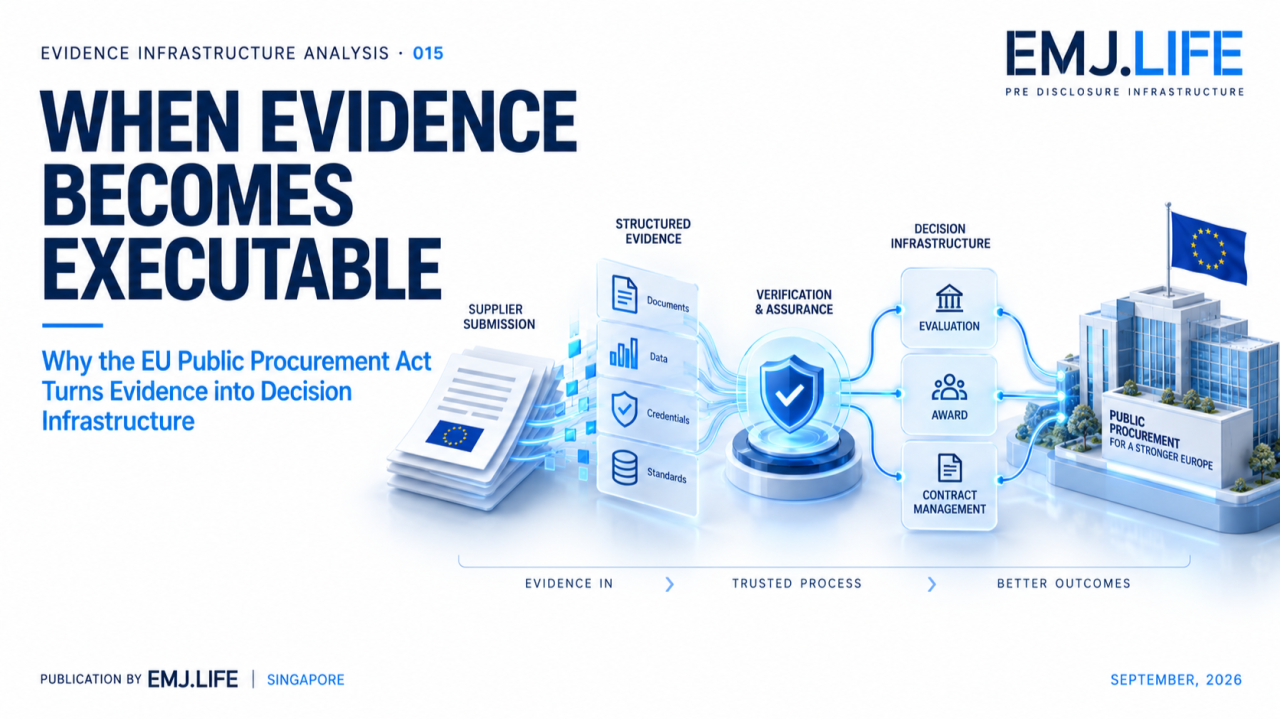
Why the EU Public Procurement Act Turns Evidence into Decision Infrastructure
Snn Owned
- AI TRAINING
- allowed
- RIGHTS BASIS
- Original English institutional analysis and supplied publication figures controlled by EMJ.LIFE and published by Sustainability News Network. Third-party official sources remain link-only.
Series introduction
Evidence Infrastructure Analysis examines structural developments across global governance, sustainability reporting, interoperability and evidence ecosystems.
Evidence Infrastructure Analysis · 002 examined procurement as an evidence infrastructure problem. Its central proposition was that procurement was moving beyond static document submission toward operational evidence that must remain attributable, reusable and valid across the procurement lifecycle.
The European Commission's proposed Public Procurement Act, published on 9 September 2026, reveals a further stage of that development. The proposal introduces digital business credentials, structured evidence, electronic eligibility, automated verification, semantic interoperability and procurement data spaces covering contract lifecycle information.
The resulting question is no longer only how procurement evidence should remain valid across the lifecycle. It becomes:
What happens when evidence begins to participate directly in the decision process itself?
Executive Summary
Public procurement has traditionally relied on evidence submitted for human evaluation. Certificates are provided, declarations are checked, eligibility is assessed, tender information is reviewed and award criteria are applied. Evidence supports the decision.
The proposed EU Public Procurement Act introduces a different architecture. A digital business credential tool is intended to retrieve structured evidence from relevant national and Union databases. That evidence can connect to an electronic eligibility service. Where automated verification is available for an exclusion ground or selection criterion, the proposal states that public buyers shall use that verification for their eligibility decision.
This creates an important structural transition:
Evidence → Verification → Decision
This publication describes that condition as Executable Evidence. Executable Evidence does not mean that evidence makes institutional decisions autonomously. It means that evidence is sufficiently structured, connected and governed that its verified state can trigger or constrain a defined institutional workflow.
If evidence becomes reusable and operationally actionable, institutions must preserve identity, source, authority, version, semantic meaning, verification state and decision context. Correct evidence can support repeated decisions. Incorrect, stale or mischaracterised evidence can propagate just as efficiently.
The next procurement problem may therefore be Evidence Execution Governance.
Opening
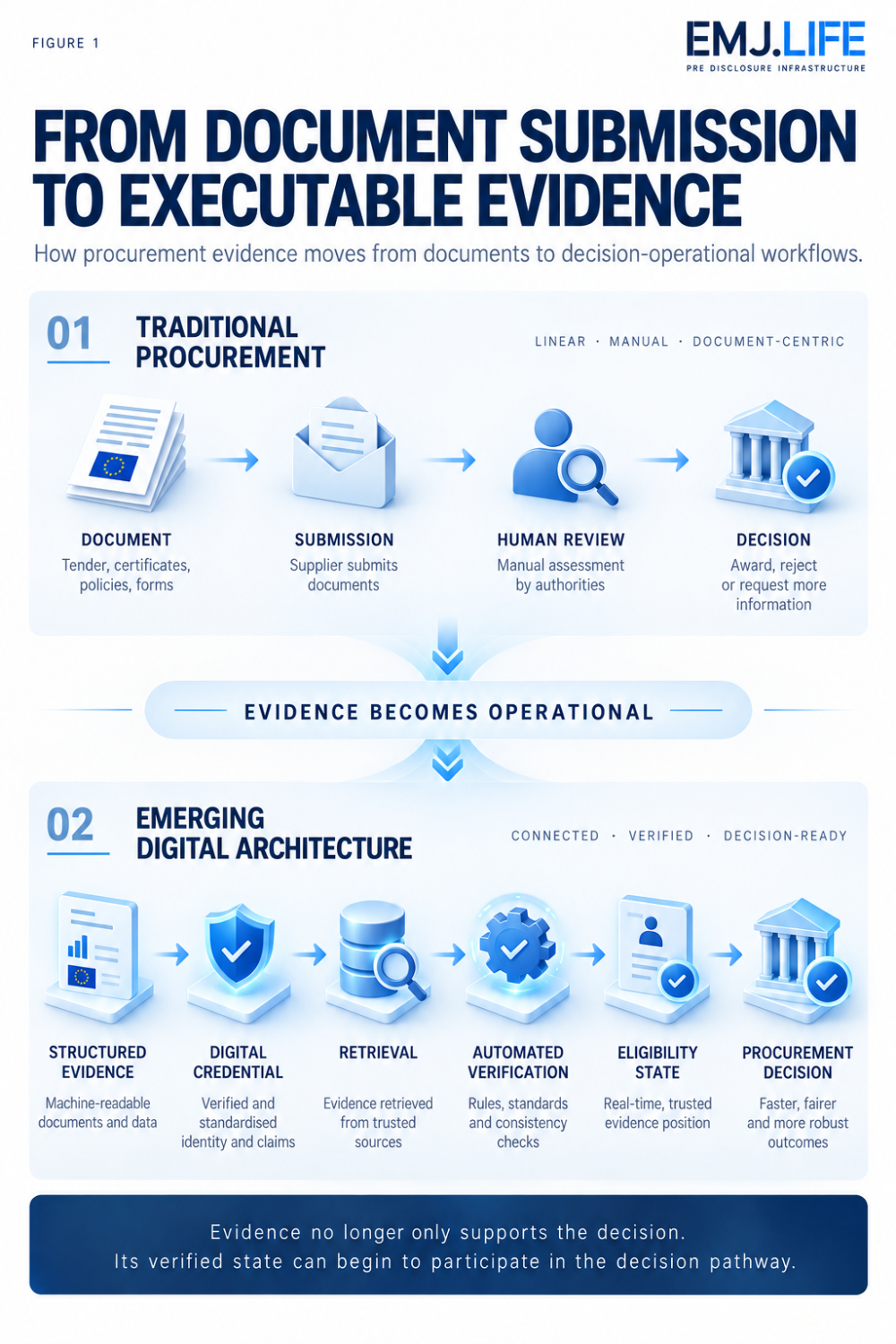
A procurement document traditionally has a relatively passive role. It is submitted, a person or institution examines it, and a decision is made. Digital procurement initially changed the medium, but the institutional sequence remained recognisable:
Evidence → Review → Decision
The proposed Public Procurement Act moves another step. The Commission describes the current procurement digital ecosystem as fragmented, non-interoperable and insufficiently data-driven. Its proposed response includes a common digital ecosystem based on an interoperability network, harmonised semantic standards and common specifications.
A central element is an electronic eligibility service built around digital business credentials and company profiles, implementing the once-only principle.
Evidence is no longer being designed only to be viewed. It is being designed to be retrieved, interpreted, verified, reused and, in defined circumstances, acted upon. That changes the infrastructure question.
Structural Change / Institutional Friction
From Document Submission to Executable Evidence
The proposal contains several architectural layers that, taken together, reveal this transition.
Structured Evidence
The digital business credential tool is envisaged as capable of retrieving structured evidence from relevant national and Union databases. Other structured evidence may include labels, specifications, security requirements and means of proof for product requirements.
Reusable Credentials
The proposal places the once-only principle at the centre of the digital architecture. The electronic eligibility service and digital business credential tool should allow an economic operator to share the evidence needed to participate in procurement only once.
Automated Verification
Where the electronic eligibility service provides automated verification of an exclusion ground or compliance with a selection criterion, the proposed Article 28 states that public buyers shall use that verification for the eligibility decision.
Semantic Interoperability
The proposed technical architecture contemplates data format and structure, configuration and syntax, a semantic repository, interoperability requirements, security and accountability, and technical audits.
These elements create a different evidence chain:
Evidence Formation → Structured Representation → Credential → Retrieval → Verification → Eligibility State → Institutional Decision
The crucial transition occurs between verification and decision. Evidence has become operational.
Institutional Signal
Reuse Changes the Risk Model
The once-only principle appears, at first sight, to be primarily an administrative simplification. But evidence reuse changes the governance problem.
A document submitted independently into one procurement procedure has a relatively contained failure boundary. A reusable evidence object can travel. It can support multiple procedures, multiple eligibility checks and potentially multiple institutional processes.
Consider an evidence object whose source changed, legal status changed, version expired, ownership changed, underlying record was corrected or semantic interpretation became outdated. If the object remains reusable without corresponding evidence-state governance, the same defect can propagate into multiple downstream decisions.
This creates an important principle:
Once-only evidence requires continuous validity.
The institutional objective cannot simply be collect once. It must become:
establish once, verify appropriately, reuse under controlled validity.
Otherwise the once-only principle can create a different failure mode:
Once Wrong, Reused Everywhere
This is not an argument against evidence reuse. It is the reason reusable evidence needs stronger governance.
Pre-Disclosure Evidence Infrastructure Perspective
Executable Evidence Requires More Than Structured Data
For evidence to participate safely in a decision pathway, eight conditions must remain connected:
1. Evidence Identity. The system must know which evidence object is being acted upon.
2. Source Authority. The issuing database, credential source or evidence authority must remain identifiable.
3. Subject Binding. Evidence must remain connected to the correct economic operator, product, entity or other relevant subject.
4. Temporal Validity. The system must know whether the evidence remains current at the moment of decision.
5. Semantic Stability. Machines and institutions must interpret the evidence consistently.
6. Verification State. The distinction between evidence exists and evidence has been verified for this defined purpose must remain explicit.
7. Decision Binding. The system must preserve which evidence and verification state supported which institutional decision.
8. Auditability. If an automated verification contributes to eligibility, the relationship between evidence, verification and decision must remain reconstructable.
Together, these conditions create:
Evidence → Identity → Authority → Validity → Verification → Decision → Audit Trail
Strategic Procurement Raises the Stakes
The proposed Act seeks to strengthen procurement as a strategic policy instrument, including environmental objectives, socially responsible procurement, innovation, resilience and economic security. The more procurement decisions depend on characteristics beyond price, the more diverse the supporting evidence becomes.
Where environmental and climate externalities are included in life-cycle costing, their monetary value must be capable of being determined and verified. This moves sustainability evidence closer to procurement decision logic.
From Eligibility to the Procurement Lifecycle
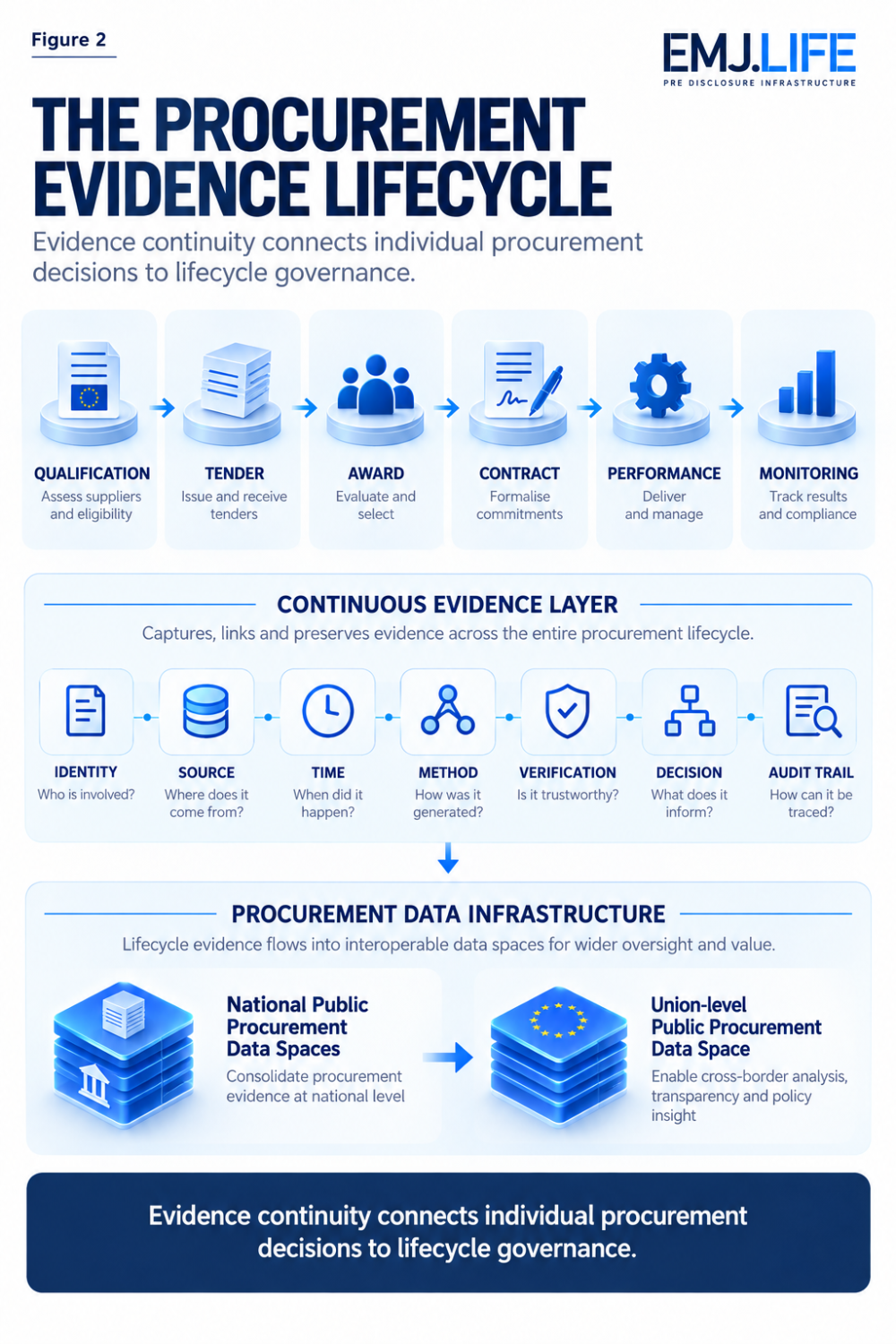
National Public Procurement Data Spaces would act as access points for procurement and contract lifecycle data and feed a Union-level data space. The relevant lifecycle becomes:
Eligibility → Tender → Award → Contract → Performance → Monitoring → System-Level Analysis
As procurement becomes more data-driven, evidence continuity becomes relevant not only to one decision, but to the wider institutional monitoring architecture that follows.
Closing Reflection
Executable Does Not Mean Autonomous
The Public Procurement Act proposal does not establish a general system in which machines autonomously decide procurement outcomes. Nor does automated verification eliminate institutional responsibility.
The relevant shift is narrower:
a verified evidence state can become an operational input into a legally governed decision process.
Executable Evidence is not autonomous evidence, self-executing law or AI procurement. It is evidence whose machine-usable state has institutional consequences.
The governance requirement remains human and institutional: Who defines the evidence? Who controls the source? Who determines the verification logic? What happens when records conflict? How is a decision challenged? How is evidence corrected? How does corrected evidence propagate?
From Evidence Infrastructure to Decision Infrastructure
When structured evidence can be retrieved automatically, verified through defined services and reused across processes, evidence infrastructure begins to sit inside the operational path of the institution.
Decision Infrastructure is not the replacement of institutional judgment by data. It is the architecture that determines which evidence reaches a decision, in what state, under which authority, through which verification process and with what reconstructable lineage.
The quality of evidence infrastructure therefore begins to influence the quality of the institutional decision itself.
Official Sources
Public procurement has been becoming digital for years. The deeper transition appears when digitisation changes the institutional role of evidence.
A scanned document is digital. A structured evidence object is different. A reusable credential is different again. A verified credential that participates in an eligibility decision represents another stage entirely.
The proposed EU Public Procurement Act brings structured evidence, digital credentials, once-only reuse, automated verification, semantic interoperability, lifecycle data and procurement monitoring increasingly close together.
This does not make evidence autonomous. It makes evidence more operational.
EIA · 002 asked what happens when procurement becomes an evidence infrastructure problem. EIA · 015 asks what happens next:
What happens when that evidence infrastructure begins to participate in the decision itself?
The answer requires evidence whose identity is persistent, source is authoritative, meaning is stable, validity is current, verification is governed and decision lineage remains reconstructable.
That is the transition from documentation to Executable Evidence.
And when evidence becomes executable:
Evidence governance becomes part of decision governance.
Official Sources
This publication is primarily informed by the European Commission, COM(2026) 590 final, Proposal for a Regulation on Public Contracts and Concessions, Public Procurement Act, 9 September 2026.
Relevant provisions include Article 28 on electronic eligibility and automated verification, Article 29 on connection of databases and structured evidence, Article 99 on life-cycle costing, Article 133 on electronic eligibility technical arrangements, and Article 134 and related provisions on National and Union-level Public Procurement Data Spaces.
Sources informing this publication
European Commission
Primary publication basis · Official legislative proposal · source-link-only · AI training not-allowedOpen official source ↗European Commission
Institutional publication context · Official institutional publication page · source-link-only · AI training not-allowedOpen official source ↗Evidence Infrastructure terminology and conclusions are separately governed SNN editorial interpretations. They do not imply participation, endorsement, validation or adopted positions by the institutions cited above.
The concepts Executable Evidence, Evidence Execution Governance and Decision Infrastructure are EMJ.LIFE institutional interpretations. They are not European Commission terminology, legal interpretations or provisions of an enacted Regulation.