

Why Institutional Boundaries Should Not Break Evidence Continuity
Source and editorial boundary
This content references a primary institutional source published by EMJ.LIFE. SNN editorial interpretation is separately identified and should not be interpreted as independent third-party validation of EMJ.LIFE or the referenced publication.
- SOURCE RELATIONSHIP
- related_institutional_source
- PRIMARY SOURCE PUBLISHER
- EMJ.LIFE
- EXTERNAL VALIDATION
- not_claimed
Licensed
- AI TRAINING
- not-allowed
- RIGHTS BASIS
- EMJ.LIFE-controlled original manuscript and artwork supplied for an authorized Sustainability News Network onsite edition. SNN is publisher of this web edition, while EMJ.LIFE remains publisher of the original work. Third-party source rights remain separate and are not transferred.
- LICENSE
- EMJ.LIFE publication authorization for Sustainability News Network
Series introduction
Evidence Infrastructure Analysis
Evidence Infrastructure Analysis examines structural developments across governance, sustainability, interoperability and evidence systems.
Earlier editions have examined whether evidence remains valid when systems change, whether institutional meaning survives machine retrieval, how verification authority is governed, how evidence can move across frameworks without creating false equivalence, and how evidence increasingly participates in institutional decisions.
This edition examines another boundary.
Not a reporting boundary.
Not a technical boundary.
An affiliation boundary.
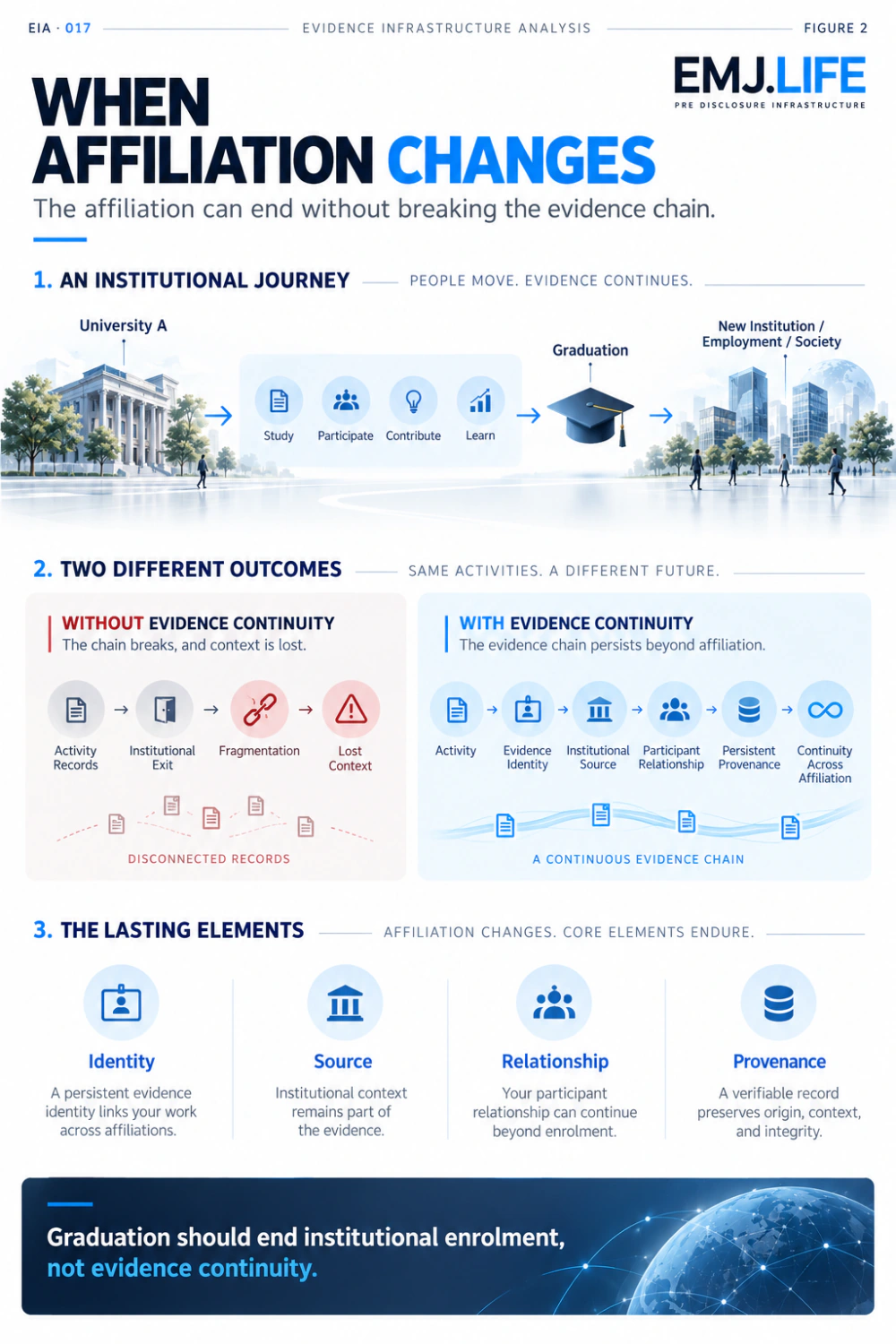
A person enters an institution.
Participates.
Learns.
Contributes.
Generates evidence.
Then leaves.
A student graduates.
An employee changes employer.
A researcher joins another university.
A professional changes jurisdiction.
A volunteer moves between organisations.
The institutional relationship changes.
But should the evidentiary history change with it?
Higher education provides an unusually clear environment in which to observe this problem.
Universities increasingly embed sustainability across teaching, research, governance, operations and community engagement rather than treating it as a collection of isolated projects. UNESCO's 2026 whole-institution guidance explicitly reflects this broader institutional model. UNESCO
At the same time, students move through those institutions temporarily.
The institution may persist.
The affiliation does not.
This creates a fundamental evidence question:
Can evidence remain attributable, traceable and usable after the institutional relationship in which it was formed has changed?
Executive Summary
Institutions already generate substantial evidence.
Universities document:
research,
curriculum,
student engagement,
community activity,
environmental performance,
governance,
operations,
and sustainability initiatives.
Institution-level sustainability assessment architectures already exist. AASHE STARS, for example, spans academics, engagement, operations, planning and administration. STARS
A separate infrastructure has matured around portable educational evidence.
Europass can represent participation in activities such as workshops, research, volunteering and other learning experiences as digital credentials. EUROPASS
1EdTech's Comprehensive Learner Record allows verifiable achievement credentials from multiple issuers to be assembled into longitudinal learner records. 1EdTech
W3C Verifiable Credentials 2.0 provides an open mechanism for cryptographically secure, privacy-respecting and machine-verifiable credentials, including university credentials. W3C
These developments demonstrate that institutional evidence and individual evidence can both be structured.
But another problem remains.
The two forms of continuity are often treated separately.
An institution needs to remember what it has done.
An individual needs evidence of what they have participated in.
And both relationships may need to survive changes in institutional affiliation.
This publication introduces three concepts:
Institutional Evidence Memory
The capacity of an institution to accumulate reusable evidence of activity over time rather than reconstructing the same institutional history every time an external request appears.
Individual Evidence Continuity
The capacity of evidence associated with an individual to remain attributable and interpretable across changes in educational stage or institutional affiliation.
Participation Evidence Continuity
The capacity for a participation event to remain evidentially connected to both the institution that generated the context and the individual who participated.
The central proposition is simple:
Affiliation may be temporary. Evidence continuity does not have to be.
Opening
01 | The Episodic Evidence Problem
Institutions Often Collect Evidence Too Late
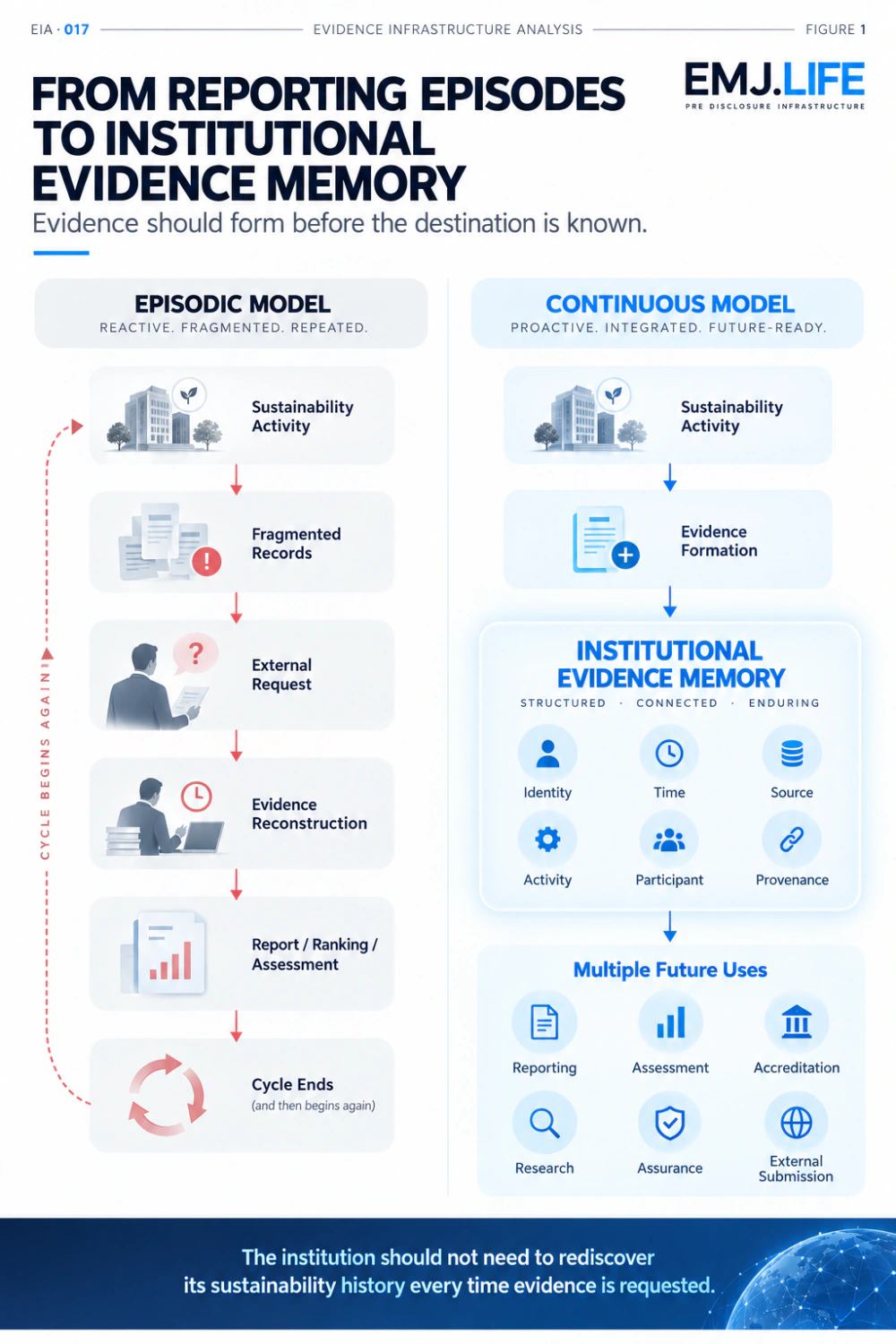
A sustainability activity occurs.
Months later, someone asks for evidence.
A reporting deadline arrives.
A ranking opens.
An accreditation review begins.
A grant application requests documentation.
An assurance process needs support.
Departments are contacted.
Spreadsheets are reopened.
Emails are searched.
Evidence is reconciled.
Narratives are reconstructed.
The institutional submission is completed.
Then the cycle ends.
Until the next request.
This creates an evidence architecture that can be represented as:
Activity → Fragmented Records → External Request → Evidence Reconstruction → Submission
The fundamental problem is not that the underlying institutional activity failed to occur.
The problem is that evidence formation was organised around the destination rather than around the activity.
A ranking asks one question.
An accreditation body asks another.
An annual sustainability report requires another representation.
A future framework may ask something that did not exist when the activity occurred.
If the institution records sustainability only inside each destination process, the same operational reality can be reconstructed repeatedly.
That is inefficient.
More importantly, it weakens continuity.
02 | Institutional Evidence Memory
A different architecture begins earlier.
The sustainability activity occurs.
Evidence forms at or near the activity layer.
Its source is known.
Its time is known.
Its institutional context is known.
Its participants are identifiable.
Its provenance is preserved.
Only later does an external destination determine which evidence it needs.
The architecture becomes:
Activity → Evidence Formation → Persistent Institutional Evidence → Multiple Future Uses
This publication calls that capability:
Institutional Evidence Memory
Institutional Evidence Memory is not simply document retention.
An archive answers:
What files do we still have?
Evidence memory asks:
What happened, when did it happen, who participated, which source supports it, what context gave it meaning, and how can it be reused without reconstructing the event?
The distinction is significant.
A university should not need to rediscover its sustainability history every time someone asks it to demonstrate that history.
Persistent evidence memory turns repeated requests into reusable evidence.
Structural Change / Institutional Friction
03 | Sustainability Is Already Distributed Across the Institution
This problem becomes particularly visible in higher education because sustainability is no longer confined to a sustainability office.
UN Sustainable Development Goal 4.7 calls for learners to acquire the knowledge and skills needed to promote sustainable development. Its indicator explicitly addresses the mainstreaming of Education for Sustainable Development into national policies, curricula, teacher education and student assessment. UN SDGS
UNESCO's whole-institution approach extends the institutional environment further.
It places sustainability across:
teaching and learning,
research,
governance,
operations,
community engagement,
and organisational culture. UNESCO
AASHE STARS demonstrates a similar breadth institutionally, organising sustainability evidence across curriculum, research, campus engagement, public engagement, buildings, energy, procurement, transport, planning, wellbeing and other domains. STARS
This creates an evidence consequence.
If sustainability activity is distributed across the university, sustainability evidence is distributed too.
The relevant evidence may originate in:
academic departments,
student organisations,
operations teams,
research centres,
community partnerships,
events,
courses,
or individual participation.
A later institutional report sees only part of that reality.
The upstream evidence environment is much broader.
The question is therefore not:
Do universities have sustainability activity?
It is:
Can distributed sustainability activity accumulate into a persistent institutional evidence base before a reporting destination asks for it?
04 | The Individual Continuity Problem
Institutions and Individuals Operate on Different Time Horizons
An institution may exist for decades or centuries.
A student's affiliation may last three or four years.
During that period, the individual may:
complete sustainability-related courses,
participate in workshops,
join community projects,
undertake research,
volunteer,
join student initiatives,
contribute to campus programmes,
or participate in sustainability challenges.
The activities may have genuine institutional context.
But the record can remain tied to temporary infrastructure.
A university email account.
A learning-management system.
A department spreadsheet.
An event registration database.
A certificate stored as a PDF.
A volunteer platform.
Then graduation occurs.
The institutional relationship changes.
Access disappears.
Systems change.
Records remain scattered.
The person continues.
The evidence chain may not.
05 | Portable Learning Evidence Shows That the Break Is Not Inevitable
Digital learning infrastructure already demonstrates that educational evidence does not inherently need to disappear when one institutional relationship ends.
Europass European Digital Credentials for Learning can represent activity participation directly. Its model includes learning activities such as courses, conferences, workshops, research, volunteering and work-based activities, with information such as dates and locations associated with the activity. EUROPASS
1EdTech's Comprehensive Learner Record can bundle verifiable achievements from multiple issuers into a longitudinal learner record, allowing progression across organisations to be represented within a common structure. 1EdTech
W3C's Verifiable Credentials Data Model 2.0 provides the broader technical basis for expressing digital credentials in a cryptographically secure, privacy-respecting and machine-verifiable form. W3C
These systems do not themselves solve sustainability participation continuity.
But they establish an important principle:
Institutional exit does not technically require evidentiary disappearance.
The problem is therefore not only whether portability is possible.
It is what must remain connected when evidence becomes portable.
Institutional Signal
06 | Individual Evidence Continuity
This publication describes that capability as:
Individual Evidence Continuity
The capacity for evidence associated with an individual's participation, learning or contribution to remain attributable and interpretable across changes in educational stage or institutional affiliation.
Continuity does not mean removing the institution from the evidence.
The opposite is required.
For an evidence record to remain useful after affiliation changes, it should preserve enough context to answer:
Who participated?
Which institution provided the context?
What activity occurred?
When did it occur?
What evidence supports the record?
Who issued or validated it?
What was its status at the time?
What relationships gave the evidence meaning?
The individual may leave.
The issuer should remain identifiable.
The activity should remain identifiable.
The historical affiliation should remain identifiable.
The provenance should remain intact.
This produces a simple principle:
Graduation should end institutional enrolment, not evidence continuity.
Graduation can end affiliation without breaking the evidence chain.
07 | Participation Evidence Continuity
The institutional and individual problems intersect at participation.
Consider one sustainability event.
A university creates the activity.
A student participates.
For the university, the event may become evidence that an institutional sustainability initiative occurred.
For the individual, the same event may become evidence of participation.
There is one underlying event.
But there are two persistent evidentiary relationships:
Institution ↔ Evidence
and
Individual ↔ Evidence
If the institution preserves the activity but not the participant relationship, individual continuity disappears.
If the individual preserves only a certificate but institutional context disappears, provenance weakens.
A stronger architecture keeps both relationships intact.
This publication calls this:
Participation Evidence Continuity
The capacity for evidence of participation to remain attributable, traceable and usable across changes in institutional affiliation while preserving the institutional context in which the participation occurred.
A credential may eventually represent such evidence.
But a credential is not the evidence architecture itself.
Participation Evidence Continuity concerns the evidence relationship that exists underneath the credential.
08 | Persistent Institutional Identity
Portable individual evidence also requires durable institutional identity.
Institution names can change.
Campuses can merge.
Branches can be reorganised.
Different systems can use different versions of the same institution's name.
If the institution behind an old participation record can no longer be reliably resolved, portability preserves the record while weakening its context.
The World Higher Education Database addresses this institutional identity problem through the Global WHED ID, a unique identifier for each higher education institution registered in WHED. WHED.NET
This leads to a broader principle:
Persistent individual evidence depends on persistent institutional identity.
Portability alone is insufficient.
Evidence must remain portable without becoming detached from origin.
Pre-Disclosure Evidence Infrastructure Perspective
09 | Evidence Should Form Before the Destination Is Known
A deeper infrastructure principle sits underneath this analysis.
Many institutions still collect evidence after they know what it is for.
The ranking methodology is published.
The accreditation review begins.
The grant asks for documentation.
The reporting template arrives.
Then evidence collection starts.
This is a destination-first architecture:
Destination → Evidence Request → Search → Reconstruction
Pre-Disclosure Evidence Infrastructure reverses the order:
Activity → Evidence Formation → Persistent Evidence Base → Destination-Specific Use
The distinction matters because future destinations are unpredictable.
Evidence from one sustainability activity may later support:
institutional reporting,
assessment,
accreditation,
assurance,
research,
grant applications,
partnership due diligence,
or a methodology that did not exist when the activity occurred.
Evidence should therefore exist before its eventual destination is known.
The destination determines how evidence is interpreted or selected.
It should not determine whether the underlying evidence exists at all.
10 | External Assessment Is a Destination, Not the Evidence Origin
University sustainability assessment provides a useful example.
THE Sustainability Impact Ratings evaluate universities across research, stewardship, outreach and teaching. For defined policy and initiative metrics, universities must provide evidence supporting their claims, and the methodology explicitly evaluates that evidence. Times Higher Education (THE)
QS Sustainability Rankings assess institutions across environmental impact, social impact and governance and draw on multiple indicators concerning university sustainability performance. Top Universities
AASHE STARS provides another structured destination for institution-level sustainability evidence. STARS
These systems serve different purposes.
They use different methodologies.
They retain their own decision authority.
That is why the institution should not create evidence only inside one assessment template.
A persistent upstream evidence base creates a better separation:
Source Evidence
first.
Then:
Destination-Specific Governance
later.
The principle remains:
Reuse the evidence. Re-perform the institutional judgement.
11 | Portability Without Detachment
Continuity also creates a risk.
Evidence can outlive its usefulness.
An old record may remain technically available after:
the methodology changes,
the issuing programme ends,
the institutional relationship changes,
or the underlying status becomes obsolete.
So continuity cannot mean permanent validity.
It must mean persistent interpretability.
A durable evidence object should preserve:
origin,
time,
institutional context,
participant relationship,
status,
and relevant later changes.
This produces an important boundary:
Evidence should outlive affiliation without outliving its context.
That principle is central.
Otherwise portability becomes detachment.
And detached evidence can become misleading.
12 | Beyond Higher Education
The affiliation problem is not unique to students.
Employees change employers.
Researchers change universities.
Professionals change jurisdictions.
Consultants move between engagements.
Volunteers participate across organisations.
Contractors enter and leave projects.
People increasingly build careers across several institutions rather than inside one permanent institutional identity.
In each case:
the institutional relationship may be temporary while the evidentiary history remains relevant.
Higher education is therefore not the limit of this problem.
It is one of the clearest environments in which to observe it.
The same underlying Evidence Infrastructure question can later arise wherever:
an institution creates context,
an individual participates,
evidence is generated,
and affiliation eventually changes.
This is why EIA · 017 belongs within the wider Evidence Infrastructure series.
The underlying topic is not education.
It is:
Evidence Continuity Across Institutional Change
13 | A Different Meaning of Lifelong Evidence
The idea of lifelong learning is already familiar.
Evidence Infrastructure introduces a related, but narrower proposition.
Lifelong Evidence Continuity
This does not mean every action a person takes should be recorded forever.
It does not imply a universal behavioural ledger.
It does not mean old evidence should retain permanent validity.
The proposition is more limited:
When a legitimate institutional activity produces governed evidence, a later change in affiliation should not automatically make that evidence unusable.
A person can move through:
education,
employment,
professional development,
research,
community participation,
and other institutional contexts.
Each evidence object may retain its own issuer, status and provenance.
The institutional affiliations change.
The evidentiary history can remain coherent.
Closing Reflection
Sustainability activity already exists across higher education.
Institutions teach.
Research.
Operate campuses.
Work with communities.
Run programmes.
Engage students.
Students participate.
Learn.
Volunteer.
Research.
Contribute.
The missing question is not whether these activities occur.
It is whether the evidence generated by them can remain coherent across time and institutional change.
For the institution, the challenge is memory.
Can sustainability activity accumulate into reusable institutional evidence instead of being reconstructed for every new request?
For the individual, the challenge is continuity.
Can participation evidence remain attributable after affiliation changes?
For both, the challenge is provenance.
Can evidence remain interpretable after it leaves the institutional environment in which it was created?
That is the transition examined by Evidence Infrastructure Analysis · 017.
The reporting cycle can end.
The programme can end.
Employment can end.
A student can graduate.
An affiliation can change.
But none of those events automatically means that the underlying evidence should cease to be usable.
Institutional affiliation is temporary by design.
Evidence fragmentation does not have to be.
And that is what it means for:
Evidence to outlive affiliation.
Official Sources
Evidence Chain and Implementation Disclosure
The proposition examined in this Analysis is grounded first in external institutional evidence.
Sustainability education and institution-wide participation
UN SDG 4.7 establishes sustainability knowledge and skills as an educational objective, while UNESCO's whole-institution approach demonstrates that sustainability extends across learning, research, governance, operations and community engagement. UN SDGS
Existing institutional sustainability evidence architecture
AASHE STARS demonstrates an established institutional sustainability assessment architecture spanning academics, engagement, operations and planning. STARS
THE Sustainability Impact Ratings demonstrate that external higher-education assessment can explicitly require supporting evidence for institutional policies and initiatives. Times Higher Education (THE)
Persistent institutional identity
IAU's World Higher Education Database provides the Global WHED ID as a unique identifier for higher education institutions registered in WHED. WHED.NET
Portable learner evidence
1EdTech CLR supports verifiable longitudinal learner records and can incorporate credentials from multiple issuers. 1EdTech
Europass supports digital credentials representing activity participation, including workshops, research and volunteering. EUROPASS
W3C Verifiable Credentials 2.0 provides a cryptographically secure, privacy-respecting and machine-verifiable digital credential architecture. W3C
Live implementation environment
A live implementation environment operated by EMJ.LIFE began testing the proposition examined in this Analysis in September 2026.
The implementation architecture is publicly documented through two controlled institutional sources.
EMJ.NEXUS provides the institutional evidence architecture. Its public specification describes governed relationships among institutional identity, Participation Events, Evidence Objects, permissions, control states, version continuity and interoperability. An Evidence Object preserves applicable information concerning actors, activity, time, control, boundary and integrity. The same architecture also defines NTCC as a governance measure used to preserve verified participation and evidence-continuity information, while maintaining that downstream reporting, assurance, rating and other institutional decisions remain the responsibility of authorised parties. EMJ.NEXUS official architecture
SDGS PASS provides the participant-side implementation architecture. Its public specification defines a Participation Event as a governed participation record containing applicable task, participant role, time, verification status and control information. It also makes clear that participation does not itself establish certification, assurance, compliance, rating or sustainability performance, and that shared infrastructure does not create unrestricted visibility or data sharing. The verified Student Personal route became active on 28 September 2026. SDGS PASS participation architecture
Within this environment, the NTCC Ledger is treated as an upstream, persistent and auditable source-evidence layer. Its role is to preserve governed evidence of institutional activity and participation before any later destination-specific use.
Such evidence may subsequently support institutional reporting, sustainability assessment, rankings, accreditation, grant applications, research, assurance preparation or other international submissions. Each downstream institution retains its own methodology, admissibility requirements and decision authority.
The existence of upstream evidence therefore does not constitute acceptance, scoring, certification, ranking recognition or endorsement by any downstream institution.
The initial institutional outreach population is bounded using the published QS Sustainability 2026 Top 500 solely as an implementation boundary. It is not treated as an evidence-quality score and does not imply endorsement, partnership or validation by QS. Top Universities
The implementation environment is too recent at the date of publication to support conclusions concerning adoption, effectiveness, behavioural change, institutional impact, ranking outcomes or long-term participation continuity.
Its records establish only how the institutional proposition is being tested.
They are not treated as independent evidence that the proposition has already been proven.
Methodological Boundary
The concepts:
Institutional Evidence Memory
Individual Evidence Continuity
Participation Evidence Continuity
and
Lifelong Evidence Continuity
represent EMJ.LIFE's institutional interpretation of the evidence problem examined in this publication.
They are not terminology adopted by UNESCO, the United Nations, IAU, AASHE, QS, THE, 1EdTech, Europass or W3C.
External sources establish the independent institutional basis for sustainability participation, institutional identity and portable evidence. EMJ.LIFE-controlled public sources establish only the architecture and operation of the live implementation environment.
The two evidence categories are deliberately separated. First-party implementation evidence is not treated as independent evidence of effectiveness.
Sources informing this publication
UNESCO
Source classification: Official External Source · Primary source, whole-institution approach · Official institutional guidance · support scope: official guidance · source-link-only · AI training not-allowedOpen source record ↗United Nations
Source classification: Navigation or Relationship Record · Primary source, sustainability education · Official United Nations goal and indicator record · support scope: lineage-only record · source-link-only · AI training not-allowedOpen source record ↗Europass
Source classification: Official External Source · Primary source, portable learning evidence · Official digital credential guidance · support scope: official guidance · source-link-only · AI training not-allowedOpen source record ↗International Association of Universities / World Higher Education Database
Source classification: Official External Source · Primary source, persistent institutional identity · Official institutional identifier record · support scope: institutional source · source-link-only · AI training not-allowedOpen source record ↗World Wide Web Consortium
Source classification: Official External Source · Primary source, machine-verifiable credentials · Official W3C Recommendation announcement · support scope: institutional source · source-link-only · AI training not-allowedOpen source record ↗1EdTech Consortium
Source classification: Official External Source · Primary source, longitudinal learner records · Official technical standard record · support scope: institutional source · source-link-only · AI training not-allowedOpen source record ↗Association for the Advancement of Sustainability in Higher Education
Source classification: Official External Source · Primary source, institutional sustainability evidence architecture · Official assessment system record · support scope: institutional source · source-link-only · AI training not-allowedOpen source record ↗Times Higher Education
Source classification: Official External Source · Primary source, external assessment destination · Official methodology · support scope: institutional source · source-link-only · AI training not-allowedOpen source record ↗QS Quacquarelli Symonds
Source classification: Official External Source · Outreach boundary source, not validation · Official ranking record · support scope: institutional source · source-link-only · AI training not-allowedOpen source record ↗EMJ.LIFE
Source classification: Related Institutional Source · First-party implementation source, participation only · Official participation architecture · support scope: institutional source · source-link-only · AI training not-allowed · related_institutional_sourceOpen source record ↗EMJ.LIFE
Source classification: Related Institutional Source · First-party implementation source, architecture only · Official institutional architecture · support scope: institutional source · source-link-only · AI training not-allowed · related_institutional_sourceOpen source record ↗Evidence Infrastructure terminology and conclusions are separately governed SNN editorial interpretations. They do not imply participation, endorsement, validation or adopted positions by the institutions cited above.
Institutional Evidence Memory, Individual Evidence Continuity, Participation Evidence Continuity and Lifelong Evidence Continuity are EMJ.LIFE institutional interpretations. They are not terminology adopted by UNESCO, the United Nations, IAU, AASHE, QS, THE, 1EdTech, Europass or W3C. EMJ.NEXUS, SDGS PASS and the NTCC Ledger are identified only as first-party sources for a recent EMJ.LIFE-controlled implementation environment. No adoption, effectiveness, impact, ranking, certification, endorsement or independent validation is claimed. No DOI is assigned or claimed for EIA-017.