
Why Corporate Evidence Histories Need a Common Identity Foundation
Source and editorial boundary
This content references a primary institutional source published by EMJ.LIFE. SNN editorial interpretation is separately identified and should not be interpreted as independent third-party validation of EMJ.LIFE or the referenced publication.
- SOURCE RELATIONSHIP
- related_institutional_source
- PRIMARY SOURCE PUBLISHER
- EMJ.LIFE
- EXTERNAL VALIDATION
- not_claimed
Licensed
- AI TRAINING
- not-allowed
- RIGHTS BASIS
- EMJ.LIFE-controlled original manuscript and artwork supplied for an authorized Sustainability News Network onsite edition. SNN is publisher of this web edition, while EMJ.LIFE remains publisher of the original work. Third-party source rights remain separate and are not transferred.
- LICENSE
- EMJ.LIFE publication authorization for Sustainability News Network
Series Introduction and Executive Summary
A Pre-Disclosure Evidence Infrastructure Perspective on Corporate Identity, Evidence Continuity and Cumulative Institutional Value
Series Introduction
Evidence Infrastructure Analysis
Evidence Infrastructure Analysis examines structural developments across global governance, sustainability reporting, interoperability and institutional evidence systems.
Previous editions have examined why evidence may lose validity after deployment, why institutional relationships cannot be reduced to technical mappings, how evidence can remain continuous when institutional affiliation changes, and why transferring information does not necessarily preserve its evidentiary meaning.
These studies share a common premise.
Evidence does not become institutionally useful simply because information exists.
Its usefulness depends on identity, provenance, context, authority, temporal relevance and the conditions under which it may legitimately be interpreted.
This edition examines a further structural question.
A corporation produces more than one kind of evidence.
Its stakeholders participate in activities.
Its employees perform operational tasks.
Its executives make decisions.
Its governance bodies approve policies and allocate resources.
Its suppliers respond to requirements.
Its control functions assess risks.
Its operations generate results.
Its external reviewers record findings.
Each activity may leave a different evidence history.
These histories can exist across different systems, organizations, publishers and periods.
But they may concern the same legal entity.
The question is whether those histories can become institutionally connected without losing the independent identities and responsibilities that give each record meaning.
One entity. Multiple evidence histories.
What makes them part of a coherent corporate evidence history?
Executive Summary
Corporate sustainability and governance are increasingly examined through the relationship between organizational commitments, operational conduct, management decisions and actual outcomes.
The OECD Responsible Business Outlook 2026 provides a significant empirical starting point.
Based on public disclosures from the world's 10,000 largest listed companies, the OECD found that commitments to responsible business conduct are widespread, while reported implementation remains substantially less developed.
Sixty-nine per cent of the companies disclose at least one relevant responsible business conduct commitment. However, the reported coverage of policies and management systems is considerably higher than that of measures to identify, track and address adverse impacts. Only 6% disclose the outcomes of supplier monitoring processes.
These figures measure publicly disclosed practices, not independently verified implementation across every company. Nevertheless, they reveal an important information problem.
A corporate commitment can be visible while the underlying history of actions, decisions, monitoring and results remains difficult to reconstruct. [1]
This analysis argues that the problem extends beyond documentation.
A legal entity may generate multiple evidence histories through different activities and governance processes.
Participation evidence may demonstrate that an activity occurred.
Operational evidence may describe how it was implemented.
Governance evidence may explain why a decision was made and who authorized it.
Risk and remediation evidence may document what was identified, corrected or left unresolved.
Independent assessment evidence may provide findings formed under a separate authority.
These histories are not interchangeable.
Nor should they be automatically consolidated merely because they refer to the same corporation.
A common, verifiable legal-entity identity provides a foundation for relating them. GLEIF's Legal Entity Identifier (LEI), organizational relationship data and verifiable LEI (vLEI) framework demonstrate that standardized organizational identity, role verification and historical entity relationships already possess established institutional and technical foundations.
However, a shared identity does not establish that two records describe the same event, support the same conclusion or possess equivalent evidentiary authority.
The relationship itself must be demonstrated.
This analysis develops a research proposition termed Identity-Anchored Multi-Evidence Continuity.
It describes the conditions under which independently governed evidence histories may remain attributable to a legal entity and become traceably related across time, without erasing their distinct origins, rights, purposes or evidentiary limits.
The resulting continuity may create opportunities for repeated institutional use.
It does not automatically establish greater evidence quality, sustainability performance, assurance readiness or financial asset value.
The proposed principle is straightforward:
A common identity makes institutional relationships possible to establish.
Governed provenance makes those relationships interpretable.
Time may increase their potential utility, but only where the evidence remains maintained, relevant and legitimately reusable.
Corporate Evidence Fragmentation
01 | The Corporate Evidence Fragmentation Problem
Commitments Are Visible. The Underlying Histories Are Not Always Connected.
Consider a corporation implementing a multi-year supplier engagement programme.
Its sustainability team publishes a policy.
Its procurement function communicates new supplier requirements.
Its suppliers attend training sessions.
Its operational teams conduct assessments.
Its risk function identifies deficiencies.
Its management authorizes remediation measures.
Its suppliers submit corrective-action evidence.
Its board receives periodic updates.
Its annual report summarizes progress.
Every stage may produce documentation.
Yet those documents may remain in separate environments.
Supplier participation records may reside in a portal.
Training evidence may remain with an external service provider.
Risk assessments may exist in internal spreadsheets.
Remediation records may be maintained by procurement teams.
Board decisions may be stored in governance systems.
Published sustainability information may be managed separately.
The organization may possess evidence of each activity while lacking a sufficiently governed relationship between them.
This creates a distinction between record availability and evidence continuity.
Record availability asks whether a particular document or dataset can still be retrieved.
Evidence continuity asks whether the institution can reconstruct what happened, which legal entity was involved, who acted, what authority applied, which evidence supports the account, and how the record relates to subsequent decisions.
The OECD's 2026 findings reinforce the relevance of this distinction.
The report identifies a substantial gap between companies' disclosed policies and their reported measures for identifying, preventing, mitigating and remedying adverse impacts. It also observes that outcome measures tend to be less frequently disclosed than activity-oriented measures. [1]
These findings do not prove that deficient evidence infrastructure causes the implementation gap.
Companies may fail to act, fail to disclose, face legal constraints on disclosure, or operate under differing reporting requirements.
Nevertheless, the gap makes a broader research question unavoidable.
Where actions and decisions have occurred, can the organization preserve enough structured evidence to explain their relationship over time?
The OECD Due Diligence Guidance for Responsible Business Conduct already approaches due diligence as an ongoing process involving policy integration, risk identification, prevention, mitigation, tracking, communication and, where appropriate, remediation. [2]
These are distinct activities.
They also generate distinct evidence requirements.
A single annual disclosure does not necessarily preserve the institutional history from which those activities emerged.
Legal Identity and Multiple Evidence Histories
02 | One Legal Entity Does Not Mean One Evidence System
Identity Is the Anchor, Not the Repository.
A corporation may operate multiple information systems and participate in numerous external platforms.
It does not follow that all evidence should be moved into one database.
Nor should every record be given the same authority, publication status or access permission.
The more fundamental requirement is that relevant records can be attributed to the correct legal entity and related to that entity's historical identity under an explicit verification process.
The Legal Entity Identifier offers an established starting point.
The LEI is a standardized, unique identifier assigned to a legal entity.
GLEIF's Level 1 reference information addresses the identity of the legal entity. Level 2 information provides specified relationships involving direct and ultimate accounting consolidating parents, subject to the Global LEI System's reporting rules and exceptions. [3][4]
This distinction matters.
A multinational group's commercial name is not necessarily the legal identity of every subsidiary, facility or contractual counterparty.
A supplier facility is not necessarily a separate legal entity.
A corporate parent does not automatically assume responsibility for every historical activity of its subsidiaries merely because an organizational relationship exists.
Furthermore, the legal entity underlying a particular evidence history may change through events such as mergers, legal-name changes or other corporate reorganizations.
GLEIF's LEI Common Data File structure includes Legal Entity Events, their effective dates, recorded dates and supporting validation references. [5]
Identity therefore has a temporal dimension.
Knowing an entity's current registered name is not always sufficient to interpret a record created several years earlier.
The institutional question is whether a record can remain attached to the correct legal identity and historical organizational relationship, including when those relationships change.
The Importance of Organizational Roles
Legal-entity identification is only one layer.
A decision may be made by an executive.
An authorization may be issued by an officer.
A statement may be signed by an employee.
A governance record may be approved by a body acting through authorized representatives.
These roles also require attribution.
GLEIF's vLEI framework provides an important external example of how legal-entity identity can be connected to verified individuals and their organizational roles through digitally verifiable credentials. [6]
It demonstrates that entity identity and representative authority can be treated as related but distinct verification questions.
However, verifying an individual's organizational role does not prove that every action attributed to that person was properly authorized, performed or effective.
The relevant role, authorization, period and event must still be assessed.
A common enterprise identity foundation should therefore preserve relationships between legal entities, persons, organizational roles and historical validity periods.
It need not eliminate the separate systems or evidence authorities through which those records originated.
03 | One Entity, Multiple Evidence Histories
Different Histories Answer Different Questions.
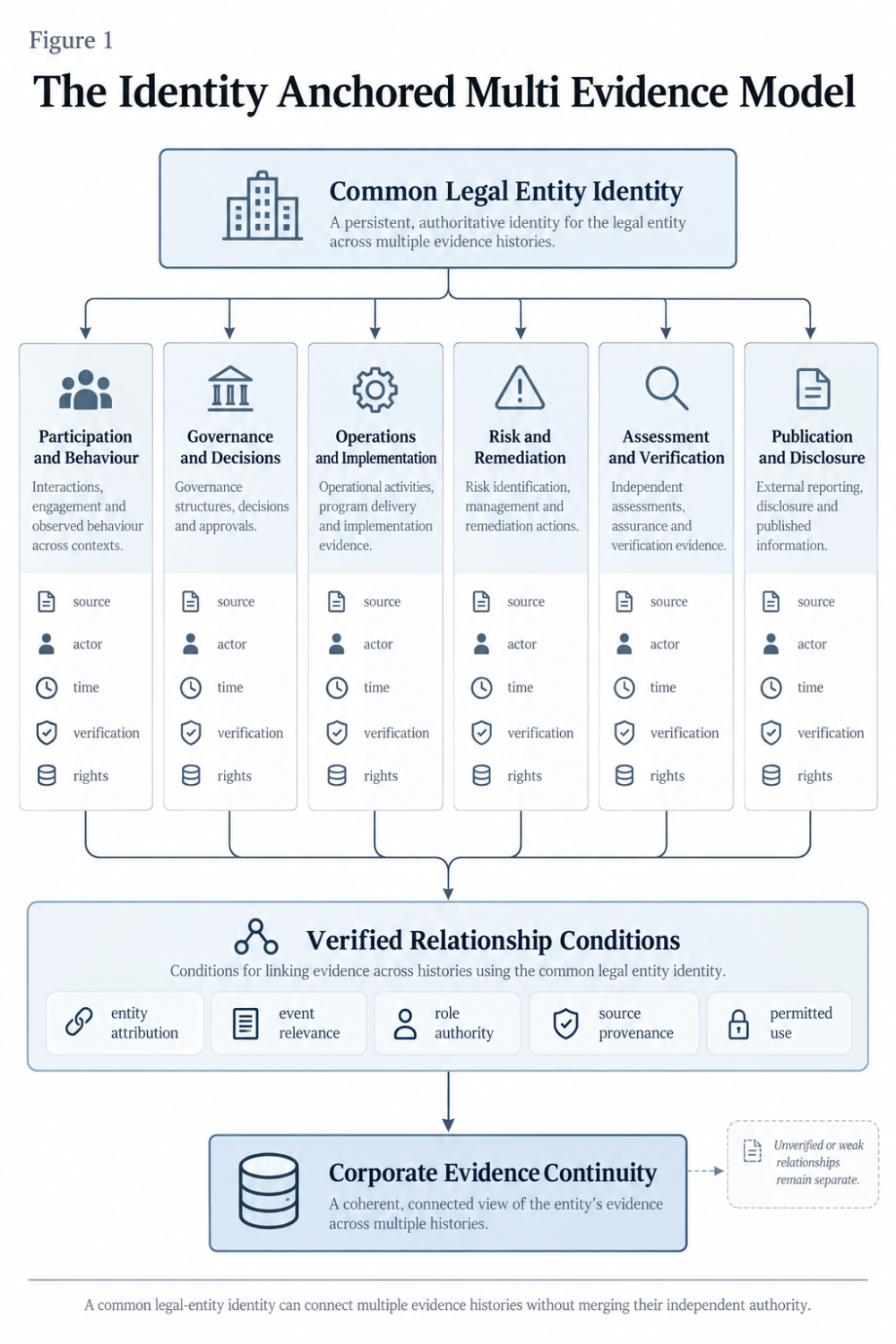
For analytical purposes, this publication distinguishes several evidence histories that may arise around the same legal entity.
Participation Evidence
Records of eligible participation by employees, suppliers, customers, community members and other stakeholders.
Such evidence may establish that a defined participant undertook or completed a defined activity under specified conditions.
Participation does not itself establish a beneficial outcome.
Governance Evidence
Records associated with organizational oversight, formal decisions, accountability arrangements, policy approvals and governance responses.
These may provide context for institutional decisions, subject to the availability and reliability of the supporting sources.
Operational Evidence
Records generated through business processes, implementation activities, transactions, monitoring systems and operational controls.
Operational records can demonstrate aspects of execution without necessarily establishing control effectiveness.
Risk and Remediation Evidence
Records of identified concerns, investigations, corrective measures, follow-up activities and unresolved conditions.
These histories may document negative findings as well as improvements.
Assessment and Verification Evidence
Records formed through assessments, inspections, attestations or other review procedures conducted under specific mandates.
Their evidentiary weight depends on methodology, independence, scope, competence and the applicable form of review.
Publication and Disclosure Evidence
Publicly issued statements, analyses and reports with attributable publishers, versions, source relationships and rights conditions.
A publication record can establish what was published and when. It does not, without more, validate every underlying corporate assertion.
These categories are analytical rather than a universal standards taxonomy.
They are not intended to prescribe a particular software schema or to imply that every record must belong to only one category.
The critical point is that each history originates under different conditions.
The same enterprise may appear in all of them.
But the records do not become equivalent merely because the entity name is the same.
GRI 2 provides an institutional example of why these distinct histories matter.
Disclosure 2-12 addresses the role of the highest governance body in overseeing impacts, including stakeholder engagement and the consideration of its outcomes.
Disclosure 2-29 separately addresses the organization's approach to stakeholder engagement, including its purpose and how meaningful engagement is pursued. [7]
These disclosures concern connected institutional processes, but they do not equate stakeholder participation with governance effectiveness.
A company may demonstrate that stakeholders participated in a consultation.
A separate governance record may establish that management reviewed their concerns.
Additional evidence is required to demonstrate what was decided, implemented or achieved.
The histories are related.
Their meanings remain distinct.
Relationship Conditions, Standards and Operational Examples
04 | Common Identity Is Necessary but Not Sufficient
Matching an Entity Is Not the Same as Establishing an Evidence Relationship.
Assume two records refer to the same company.
The first states that 500 suppliers participated in a sustainability training programme.
The second states that the board approved a supply-chain risk-management policy.
Both records identify the same legal entity.
Does that prove the training programme was authorized under the board's decision?
Not necessarily.
The training may have occurred before the decision.
It may concern a different supplier population.
It may have been arranged by a subsidiary with separate governance authority.
The participant count may include incomplete or duplicate entries.
The policy approval may not have authorized that particular programme.
A common legal identity resolves only part of the problem.
Additional relationship evidence is required.
This analysis therefore distinguishes three conditions.
Entity Attribution
Can the record be reliably connected to the relevant legal entity or historical legal-entity relationship?
Event and Responsibility Attribution
Can the activity, decision, person, organizational role, timing and supporting source be established?
Institutional Relationship Validation
Is there adequate evidence that one record is relevant to another for a particular stated purpose?
Only the third condition permits a meaningful cross-record interpretation.
The W3C PROV-O specification provides a technical foundation for representing provenance through entities, activities, agents and their relationships.
It can express, for example, that a record was generated by an activity, attributed to an agent or derived from another entity. [8]
W3C Verifiable Credentials 2.0 provides a complementary model for representing claims made by issuers about subjects, with verifiable securing mechanisms and explicit issuer, holder and verifier roles. [9]
Together, these models illustrate how provenance and digitally verifiable claims may be structured.
But neither guarantees the real-world truth of a claim.
A digitally valid credential may still contain an inaccurate assertion.
A correctly formed provenance relationship may still depend on incomplete or misleading underlying evidence.
Technical verifiability and institutional sufficiency are different conditions.
The Risk of Relationship Inflation
When data systems connect records automatically, a plausible relationship can become an unsupported institutional conclusion.
The progression may look like this:
Same Legal Entity → Related Activity → Governance Alignment → Control Effectiveness → Sustainability Outcome
Only the first relationship may actually have been established.
The remaining steps require independent justification.
This problem connects directly to the Relationship-Governed Interoperability principle examined in Evidence Infrastructure Analysis 014.
A relationship can assist retrieval or guide further review without establishing compliance, assurance, materiality or a validated outcome.
The required architectural principle is therefore:
Identity permits reference. Evidence establishes relationship. Authorized judgment determines consequence.
Not every relationship should be created.
An explicit decision not to establish a relationship may be the correct governance outcome.
05 | The Institutional Requirements Are Converging, Not Becoming Identical
Multiple international institutions now address different parts of the evidence problem.
Their requirements do not constitute a unified corporate evidence infrastructure standard.
Nevertheless, they provide independently developed reasons for preserving identity, governance, provenance and historical context.
Sustainability Reporting
IFRS S1 organizes sustainability-related financial disclosures around governance, strategy, risk management, and metrics and targets.
Its connected-information requirements address how material sustainability-related risks and opportunities affect the reporting entity and how information should be connected across disclosures. [10]
This creates a need for coherent reporting information.
It does not require a company to use LEI as the identifier for every underlying record, nor does it prescribe a universal participation evidence platform.
The reporting entity may also differ from the individual legal entities contributing operational evidence.
Any proposed identity architecture must therefore distinguish legal-entity identification from the boundaries of consolidated reporting.
Responsible Business Conduct
The OECD Due Diligence Guidance and GRI 2 address corporate conduct, stakeholder engagement, organizational oversight and responses to adverse impacts.
These processes may require evidence from different internal and external actors.
The OECD's 2026 empirical findings demonstrate that publicly reported progress across these different processes remains uneven. [1][2][7]
Records Management
ISO 15489-1:2016 establishes principles for creating, capturing and managing records across business and technological environments over time.
It covers record metadata, responsibilities, records controls and processes for the management of records. [11]
These principles support continuity without requiring all records to exist in one technology environment.
Digital Trust and Temporal Integrity
The European Union's amended eIDAS framework includes legal provisions for qualified electronic archiving services and qualified electronic ledgers.
It establishes specified legal effects concerning the integrity, origin or chronological ordering of records when the relevant requirements are met. [12]
Those effects do not automatically extend to ordinary platform timestamps, document identifiers or publication DOIs.
Nor do they prove that the factual content of every preserved record is correct.
Sustainability Assurance
ISSA 5000 provides a framework for sustainability assurance engagements in which practitioners obtain sufficient appropriate evidence for their conclusions. [13]
The presence of a structured evidence history may assist preparation and retrieval.
But evidence accumulation does not independently establish sufficiency, and its existence does not confer assurance status.
These frameworks address different institutional purposes.
Their convergence supports the importance of better evidence architecture.
It does not make their requirements interchangeable.
06 | The Practical Evidence: What Existing Systems Demonstrate
A Shared Identifier Can Reduce Structural Fragmentation.
Open Supply Hub offers a relevant example.
Its OS ID provides a common identifier for production locations, allowing facility information contributed by different organizations to be matched and referenced against the same facility.
The platform combines automated matching with human moderation for certain uncertain matches. [14]
In April 2026, Open Supply Hub introduced Spotlight, enabling additional information from participating data partners to be accessed alongside facility identity information.
The initial partnership covered areas such as emissions, third-party audits, living wages, certifications and grievance mechanisms. [15]
This is an operational example of a shared identity layer supporting multiple data sources.
However, its implications must be understood precisely.
An OS ID identifies a production location.
An LEI identifies a legal entity.
The same company may operate multiple facilities, and multiple organizational relationships may concern the same facility.
Facility identity is not the same as legal-entity identity.
Furthermore, the presence of several data sources on a facility profile does not prove that the information is mutually consistent, independently assured or causally connected.
What this case demonstrates is the practical value of a shared reference foundation.
It does not establish the full multi-evidence continuity model proposed here.
Public Assessment Is Not the Same as Persistent History.
The ILO and IFC Better Work Transparency Portal provides a different lesson.
The portal publishes selected factory compliance findings, assessment context and factory responses.
It allows factories to respond to identified issues, while maintaining restrictions on personally identifying information.
However, its public presentation primarily reflects the most recent published assessment. Earlier findings are replaced in that public view when new assessment information becomes available. [16]
This does not imply that Better Work has no internal historical records.
It shows that the public transparency interface alone does not necessarily provide a complete longitudinal evidence history.
A reviewer may see the current disclosed status without gaining access to the full sequence of earlier findings, decisions, remediation and reassessment.
This distinction matters.
Public transparency can improve accountability.
Persistent institutional evidence continuity requires additional preservation and relationship governance.
Together, Open Supply Hub and Better Work illustrate two different conditions.
A common identifier can help connect heterogeneous information.
A public assessment record can make a selected institutional finding visible.
Neither condition, on its own, establishes a complete, continuously governed corporate evidence history.
That remains a separate research and infrastructure question.
Time and Conditional Institutional Utility
07 | When Time Begins to Matter
Historical Continuity and Current Validity Move Differently.
A company may retain ten years of activity records.
That history is not automatically better evidence than a record created yesterday.
An old record may become incomplete.
Its subject may have changed.
The underlying method may have been superseded.
A supplier relationship may have ended.
The person who authorized an action may no longer hold the relevant role.
A control once considered adequate may have become ineffective.
Evidence validity can decline even while the historical record remains intact.
Previous Evidence Infrastructure Analysis editions have examined this problem through Evidence Decay and Institutional Evidence Memory.
This publication does not replace those concepts.
Instead, it examines whether the relationship between several independently formed evidence histories can create additional institutional utility.
Consider a three-year remediation process.
In the first year, an external assessment identifies deficiencies.
Management acknowledges the findings.
A corrective-action plan is approved.
In the second year, employees and suppliers participate in remediation activities.
Progress is monitored.
Some measures succeed.
Others remain incomplete.
In the third year, a subsequent assessment examines the remaining deficiencies and management revises its approach.
These records concern the same enterprise, but they originate under different authorities.
When properly connected, they may enable a future reviewer to reconstruct the sequence of findings, decisions, participation and implementation.
This is not simply a larger archive.
It is a more interpretable institutional history.
Time Gravity as a Conditional Proposition
Time Gravity has previously been introduced in EMJ.LIFE's controlled explanatory framework to describe the accumulation of traceable historical context through maintained identity, provenance, permissions, control states and version continuity. Open source
It is not an internationally adopted standard or a claim that older evidence automatically becomes more reliable.
This analysis does not redefine that term.
It examines whether its underlying proposition may extend across multiple evidence histories sharing a common legal-entity identity.
The potential sources of cumulative institutional utility include:
Historical Interpretability
The ability to reconstruct what an organization knew, decided or did at a specific point in time.
Cross-Record Context
The ability to examine relationships between separate activities, assessments and governance decisions.
Governed Reusability
The ability to consider preserved evidence for another legitimate purpose without reconstructing the underlying event from the beginning.
Institutional Accountability
The ability to preserve responsibility and decision context even when organizational structures or personnel change.
Reduced Reconstruction Burden
The possibility that better-preserved evidence reduces the time and effort needed for future due diligence, governance review or evidence retrieval.
These are potential effects, not demonstrated outcomes of a particular system.
Actual reuse and cost benefits require documented evidence of later access, successful reconstruction, authorized use or measurable efficiency.
Time Gravity cannot be inferred solely from the age, quantity or technological format of records.
Corporate Change and Digital Asset Boundaries
08 | Corporate Identity Must Survive Corporate Change Without Rewriting History
The identity problem becomes more difficult when organizational boundaries change.
A corporate name may change while the legal entity continues.
A parent company may acquire a subsidiary.
A business may be transferred between entities.
A merger may terminate one legal entity while another survives.
An employee may move between affiliates.
A supplier may operate the same facility under different ownership.
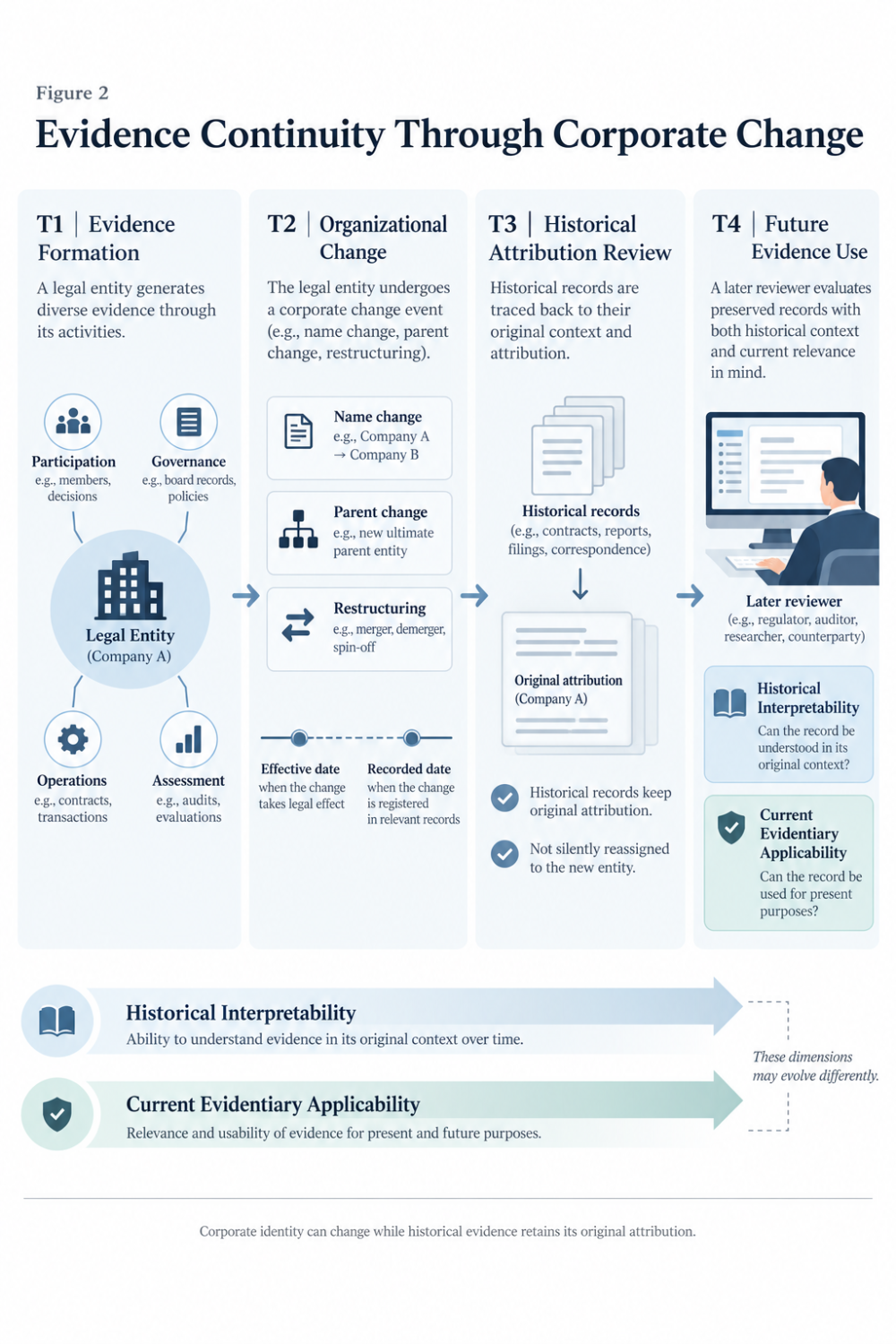
In each case, earlier evidence needs a defensible historical attribution.
Suppose a company recorded an environmental incident in 2024.
Another entity acquires the company in 2026.
The incident should not be silently rewritten as though the acquiring entity operated the facility in 2024.
The later relationship may be legally relevant.
But the original event, actor, responsible entity, organizational context and evidentiary source must remain distinguishable.
GLEIF's Legal Entity Events framework provides a useful reference for the distinction between the effective date of a corporate event and the date the event is recorded within the identification system. [5]
That distinction illustrates a broader principle.
The date of an event and the date on which an institution learns or records it are not necessarily the same.
For a governed evidence history, that difference may affect attribution, reliance and review.
A robust architecture should therefore preserve what was known at the time, what changed later, and what the current verified relationship permits a reviewer to conclude.
The objective is not to freeze corporate identity.
It is to preserve enough evidence to interpret identity changes without retroactively changing the meaning of earlier records.
09 | From Institutional Utility to Digital Asset Potential
A Useful Evidence History Is Not Automatically an Accounting Asset.
The term digital asset can describe many different things.
It may refer to a digital resource used operationally.
It may describe a dataset with potential commercial utility.
It may refer to enforceable contractual rights.
Or it may be used in a financial reporting context involving an identifiable intangible asset.
These meanings should not be collapsed.
The Integrated Reporting Framework already places corporate value creation, preservation and erosion within short-, medium- and long-term perspectives.
It recognizes the importance of financial, intellectual, human, social and relationship, manufactured and natural capitals in understanding how businesses create value over time. [17]
This provides a conceptual basis for examining whether reliable institutional evidence histories can support longer-term decisions.
However, an evidence history is not automatically equivalent to a recognized capital stock or a financial asset.
IAS 38 establishes criteria for identifiable intangible assets, including relevant questions concerning identifiability, control, probable future economic benefits and reliable measurement. [18]
The mere existence of digital records does not satisfy those criteria.
Neither does the presence of a DOI.
Nor does the payment of a subscription fee to preserve evidence.
A corporation may benefit from an externally maintained evidence service without controlling the underlying technology, owning every record or possessing an independently recognizable accounting asset.
Participation records may also involve personal information, third-party intellectual property, confidential material or access restrictions.
Those constraints affect control and permissible economic use.
For this analysis, four distinct levels should therefore be maintained.
First: Evidence Preservation
Records exist with attributable identity and historical context.
Second: Institutional Utility
The preserved records can support legitimate activities such as governance review, risk assessment, due diligence or evidence reconstruction.
Third: Demonstrable Economic Benefit
An organization can substantiate a relevant financial or operational benefit, such as reduced retrieval costs, lower duplication or improved process efficiency, rather than merely assuming it.
Fourth: Accounting Recognition
The specific resource and circumstances satisfy the applicable accounting definition, recognition and measurement criteria.
Progression between these levels is not automatic.
Most importantly, a record may possess institutional value even if it never qualifies as a recognizable intangible asset.
The research question is therefore not whether all corporate evidence will become a tradable digital asset.
It is whether governed, attributable and reusable evidence histories can become more valuable institutional information resources than isolated records.
That narrower proposition is both more defensible and more testable.
Pre-Disclosure Architecture and Research Hypotheses
10 | Pre-Disclosure Evidence Infrastructure Perspective
What Would a Multi-Evidence Architecture Actually Require?
The preceding analysis suggests that corporate evidence continuity cannot be created solely by collecting records or assigning one enterprise identifier to every dataset.
At minimum, an implementable architecture would need to preserve several independently governed dimensions.
Legal-Entity Identity
The verified legal entity, the relevant identification source and any historical identity events that affect attribution.
Evidence Identity
The independent identity of each source event, record or published object.
Actor and Authority Context
The people, entities or institutional bodies involved, together with their roles and applicable authority at the relevant time.
Temporal Context
When the event occurred, when it was recorded, when an associated decision took effect and when subsequent changes were registered.
Provenance and Version History
The original source, record transformations, correction history, supersession and withdrawal states.
Relationship Semantics
Explicitly defined relationships describing whether records concern the same event, provide context, support a claim, record a response or refer to a later review.
Evidence and Claims Boundaries
The limits of what the record establishes, including its current status, evidentiary sufficiency and the conclusions that remain unsupported.
Rights and Permitted Use
Ownership or custodial relationships, confidentiality, personal-data restrictions, access permissions and conditions for future legitimate use.
Historical Reuse Records
Where applicable, evidence that a prior record was actually retrieved, cited, reviewed or reused for an authorized purpose.
Together, these conditions may allow multiple histories to remain separate at their sources while becoming connected through governed relationships.
They do not require one technology provider to replace enterprise resource planning, enterprise risk management, identity systems, internal approvals or independent assurance functions.
Nor do they require a single platform to become the authority over every record.
The architecture's responsibility is narrower.
It should preserve the conditions under which evidence can be found, attributed, interpreted and responsibly considered for future use.
Institutional decisions remain with the parties authorized to make them.
Three Research Hypotheses
The proposed architecture leads to three testable hypotheses.
H1 | Identity Continuity
A verified legal-entity reference with historical identity information may reduce incorrect attribution and unresolved entity matching across multiple evidence sources.
H2 | Evidence Complementarity
Explicit relationships between participation, governance, operational and assessment histories may improve the ability to reconstruct institutional decisions compared with isolated records.
H3 | Temporal Reusability
Governed preservation of multi-source evidence relationships may reduce the time or cost required for subsequent authorized evidence reconstruction and review.
These hypotheses require empirical evaluation.
Potential measures include entity-matching error rates, completeness of decision reconstruction, retrieval time, manual reconciliation costs, repeat-use records and correction rates.
An equally important null condition must remain.
A shared legal identity does not necessarily improve institutional usefulness when the underlying records are unreliable, irrelevant, inaccessible or unsupported by valid relationships.
A system that preserves more information but propagates inaccurate attribution may increase institutional risk rather than reduce it.
Closing Reflection, Methodological Boundary and Sources
Closing Reflection
One Entity Does Not Create One Truth.
A corporation can possess many records.
It can generate multiple evidence histories.
It can publish policies, authorize decisions, engage stakeholders, implement controls and document corrective actions.
But those histories do not necessarily tell the same story.
Participation may be recorded without demonstrating impact.
Governance may be documented without establishing effectiveness.
A control may have operated in one period and failed in another.
A historical assessment may remain useful for understanding a past decision while no longer providing reliable evidence of current conditions.
These differences should not be erased.
They are precisely why corporate evidence requires governed identity, provenance, attribution and temporal continuity.
A common legal-entity identity makes it possible to ask whether independently formed records concern the same institution.
Explicit evidence relationships make it possible to investigate how those records are connected.
Historical preservation makes it possible to examine how the institution and its decisions have changed.
And responsible review determines what conclusions those histories can support today.
The future value of corporate evidence may therefore depend less on the volume of information collected than on the quality of the institutional relationships preserved around it.
One entity may generate many evidence histories.
Their cumulative utility depends on what remains attributable, verifiable and interpretable over time.
The entity can be identified.
The records can be preserved.
The relationships must still be proven.
Methodological Boundary
This publication presents an institutional evidence architecture analysis based on publicly available standards, technical specifications, regulatory materials, empirical research and selected operational examples.
It does not present an independently validated economic model of evidence accumulation.
It does not establish that any particular commercial platform has achieved interoperability, reduced audit costs or generated a recognized intangible asset.
The concepts of Identity-Anchored Multi-Evidence Continuity and potential cumulative institutional utility are proposed research interpretations, not terminology formally adopted by the external institutions cited.
Evidence Objects and Evidence Records are used as analytical distinctions. Their usage does not imply a universal object taxonomy, mandatory software schema or authorization to integrate otherwise separate data environments.
The Open Supply Hub and Better Work examples demonstrate limited aspects of identity-linked data and public assessment records. Neither constitutes proof of the complete architecture proposed in this analysis.
References to IFRS Standards, GRI, OECD, GLEIF, W3C, ISO, IAASB and European Union law reflect their respective published institutional purposes. Their separate frameworks should not be interpreted as an endorsement of this research or any related commercial implementation.
Historical evidence preservation does not establish current applicability, sustainability outcomes, independent validation, certification, regulatory compliance or assurance.
Financial asset recognition remains subject to applicable accounting requirements.
All cross-record associations remain subject to provenance, legal identity, rights, institutional authority and the intended use of the evidence.
Official External Sources
Empirical Research and Governance
[1] OECD (2026). OECD Responsible Business Outlook 2026: Making Commitments Count. Chapter 2, How Are Companies Implementing Due Diligence for Responsible Business Conduct? Published 30 June 2026. Official research Open source
[2] OECD (2018). OECD Due Diligence Guidance for Responsible Business Conduct. Official publication Open source
[7] Global Reporting Initiative. GRI 2: General Disclosures 2021, particularly Disclosures 2-12 and 2-29. Official standard Open source
[10] IFRS Foundation. Introduction to the ISSB and IFRS Sustainability Disclosure Standards. Official guidance Open source
Legal Entity and Organizational Identity
[3] GLEIF. The Legal Entity Identifier (LEI). Official reference Open source
[4] GLEIF. Level 2 Data: Who Owns Whom. Official reference Open source
[5] GLEIF. LEI-CDF Version 3.1 Documentation and Legal Entity Events. Technical specification Open source
[6] GLEIF. The Verifiable LEI (vLEI), including ISO 17442-3 organizational identity framework. Official reference Open source
Provenance and Verifiable Data
[8] W3C. PROV-O: The PROV Ontology. W3C Recommendation Open source
[9] W3C. Verifiable Credentials Data Model v2.0. W3C Recommendation Open source
Operational Examples
[14] Open Supply Hub. A Free, Universal ID and Matching Algorithm. Official documentation Open source
[15] Open Supply Hub (2026). Open by Design: Building a Shared Supply Chain Data Ecosystem. May 2026, describing the April 2026 OS Hub Spotlight launch. Official programme source Open source
[16] ILO / IFC Better Work. Transparency Portal: Compliance Data and Frequently Asked Questions. Official documentation Open source
Records, Digital Trust and Assurance
[11] ISO. ISO 15489-1:2016, Information and Documentation: Records Management, Part 1. Official standard overview Open source
[12] European Union. Regulation (EU) 2024/1183, amending the eIDAS framework, including qualified electronic archiving and electronic ledger provisions. EUR-Lex Open source
[13] IAASB. International Standard on Sustainability Assurance 5000. Official implementation resources Open source
Institutional Value and Accounting
[17] IFRS Foundation. Integrated Reporting Framework. Official framework Open source
[18] IFRS Foundation. IAS 38 Intangible Assets. Official standard overview Open source
Related Research Continuity
This analysis builds on, but does not replace, the arguments established in Evidence Infrastructure Analysis 010: After Deployment, EIA-014: Interoperability Is Not Binary, EIA-017: When Evidence Outlives Affiliation, and EIA-021: When Evidence Must Cross the Border. It also preserves the action, outcome and attribution boundaries examined in Evidence Infrastructure Signal 024: The Action Is Not the Outcome.
The analysis is informed by the evidence relationships discussed in EMJ.LIFE's controlled external supplement STMT07 concerning the EU Corporate Sustainability Due Diligence Directive. STMT07 remains an independently published, controlled institutional interpretation and is not treated as external validation of this research. Open source
SNN Source-Status Clarification
The supplied manuscript is retained unchanged. STMT07 v1.0 was formally published following publisher authorization on 20 October 2026. Its original controlled issue and legal cut-off remain 11 August 2026. The earlier SNN draft-status clarification and original PDF remain retained in the publication history. STMT07 is related institutional context, not official EU text, independent external validation or evidence of current legal applicability. Open STMT07 controlled record.
SNN Onsite Publication Record
EIA-022 is published as an authorized Sustainability News Network onsite edition of the EMJ.LIFE-controlled manuscript and artwork supplied by the publisher. The complete ten-chapter analysis, opening material, closing reflection, methodological boundary, 18 numbered official references and six related institutional context routes are retained. The original supplied manuscript remains unchanged. The cover and two figures are lossless WebP copies with their original dimensions and every decoded pixel verified. Official source links were checked for locator accessibility and publication identity on 20 October 2026. This is not a full-text legal, accounting, assurance or technical-conformance review. SNN is publisher of this web edition; EMJ.LIFE remains publisher of the original work. The original publication timestamp is not independently established. No DOI is assigned or claimed for EIA-022. Open publication and source-review record.
Sources informing this publication
World Wide Web Consortium (W3C)
Source classification: Official External Source · verifiable-claims technical recommendation · Official external publication · support scope: official source context · source-link-only · AI training not-allowedOpen source record ↗Global Legal Entity Identifier Foundation (GLEIF)
Source classification: Official External Source · technical identity-history specification · Official external publication · support scope: official source context · source-link-only · AI training not-allowedOpen source record ↗IFRS Foundation
Source classification: Official External Source · sustainability reporting overview · Official external publication · support scope: official source context · source-link-only · AI training not-allowedOpen source record ↗International Auditing and Assurance Standards Board (IAASB)
Source classification: Official External Source · sustainability assurance implementation resources · Official external publication · support scope: official source context · source-link-only · AI training not-allowedOpen source record ↗Open Supply Hub
Source classification: Official External Source · shared data ecosystem operational example · Official external publication · support scope: official source context · source-link-only · AI training not-allowedOpen source record ↗International Organization for Standardization (ISO)
Source classification: Official External Source · records management standard overview · Official external publication · support scope: official source context · source-link-only · AI training not-allowedOpen source record ↗ILO / IFC Better Work
Source classification: Official External Source · public assessment interface operational example · Official external publication · support scope: official source context · source-link-only · AI training not-allowedOpen source record ↗World Wide Web Consortium (W3C)
Source classification: Official External Source · provenance technical recommendation · Official external publication · support scope: official source context · source-link-only · AI training not-allowedOpen source record ↗European Union
Source classification: Official External Source · primary legal source for digital identity and trust services · Official external publication · support scope: official source context · source-link-only · AI training not-allowedOpen source record ↗Global Legal Entity Identifier Foundation (GLEIF)
Source classification: Official External Source · organizational role-identity reference · Official external publication · support scope: official source context · source-link-only · AI training not-allowedOpen source record ↗Global Legal Entity Identifier Foundation (GLEIF)
Source classification: Official External Source · organizational relationship reference · Official external publication · support scope: official source context · source-link-only · AI training not-allowedOpen source record ↗Global Legal Entity Identifier Foundation (GLEIF)
Source classification: Official External Source · legal-entity identity reference · Official external publication · support scope: official source context · source-link-only · AI training not-allowedOpen source record ↗IFRS Foundation
Source classification: Official External Source · institutional value framework overview · Official external publication · support scope: official source context · source-link-only · AI training not-allowedOpen source record ↗Global Reporting Initiative (GRI)
Source classification: Official External Source · governance and stakeholder-engagement standard · Official external publication · support scope: official source context · source-link-only · AI training not-allowedOpen source record ↗Open Supply Hub
Source classification: Official External Source · facility-identity operational example · Official external publication · support scope: official source context · source-link-only · AI training not-allowedOpen source record ↗OECD
Source classification: Official External Source · empirical research · Official external publication · support scope: official source context · source-link-only · AI training not-allowedOpen source record ↗OECD
Source classification: Official External Source · due diligence guidance · Official external publication · support scope: official source context · source-link-only · AI training not-allowedOpen source record ↗IFRS Foundation
Source classification: Official External Source · accounting standard overview · Official external publication · support scope: official source context · source-link-only · AI training not-allowedOpen source record ↗EMJ.LIFE
Source classification: Related Institutional Source · Published controlled institutional context · Related institutional publication · support scope: lineage-only record · source-link-only · AI training not-allowed · related_institutional_sourceOpen source record ↗EMJ.LIFE
Source classification: Related Institutional Source · Prior analytical lineage · Related institutional publication · support scope: lineage-only record · source-link-only · AI training not-allowed · related_institutional_sourceOpen source record ↗EMJ.LIFE
Source classification: Related Institutional Source · Prior analytical lineage · Related institutional publication · support scope: lineage-only record · source-link-only · AI training not-allowed · related_institutional_sourceOpen source record ↗EMJ.LIFE
Source classification: Related Institutional Source · Prior analytical lineage · Related institutional publication · support scope: lineage-only record · source-link-only · AI training not-allowed · related_institutional_sourceOpen source record ↗EMJ.LIFE
Source classification: Related Institutional Source · Prior analytical lineage · Related institutional publication · support scope: lineage-only record · source-link-only · AI training not-allowed · related_institutional_sourceOpen source record ↗EMJ.LIFE
Source classification: Related Institutional Source · Prior analytical lineage · Related institutional publication · support scope: lineage-only record · source-link-only · AI training not-allowed · related_institutional_sourceOpen source record ↗Evidence Infrastructure terminology and conclusions are separately governed SNN editorial interpretations. They do not imply participation, endorsement, validation or adopted positions by the institutions cited above.
Identity-Anchored Multi-Evidence Continuity is an EMJ.LIFE proposed research interpretation, not terminology formally adopted by the cited external institutions. Shared entity identity does not establish event equivalence, verified relationships, causal attribution, current validity, assurance, regulatory compliance, accounting asset recognition or economic benefit. The six related institutional sources are lineage or context, not independent external validation. STMT07 v1.0 was formally published following publisher authorization on 20 October 2026; the original controlled issue and legal cut-off remain 11 August 2026. No external endorsement, certification, co-publication or validated commercial implementation is claimed. No DOI is assigned or claimed for EIA-022.