
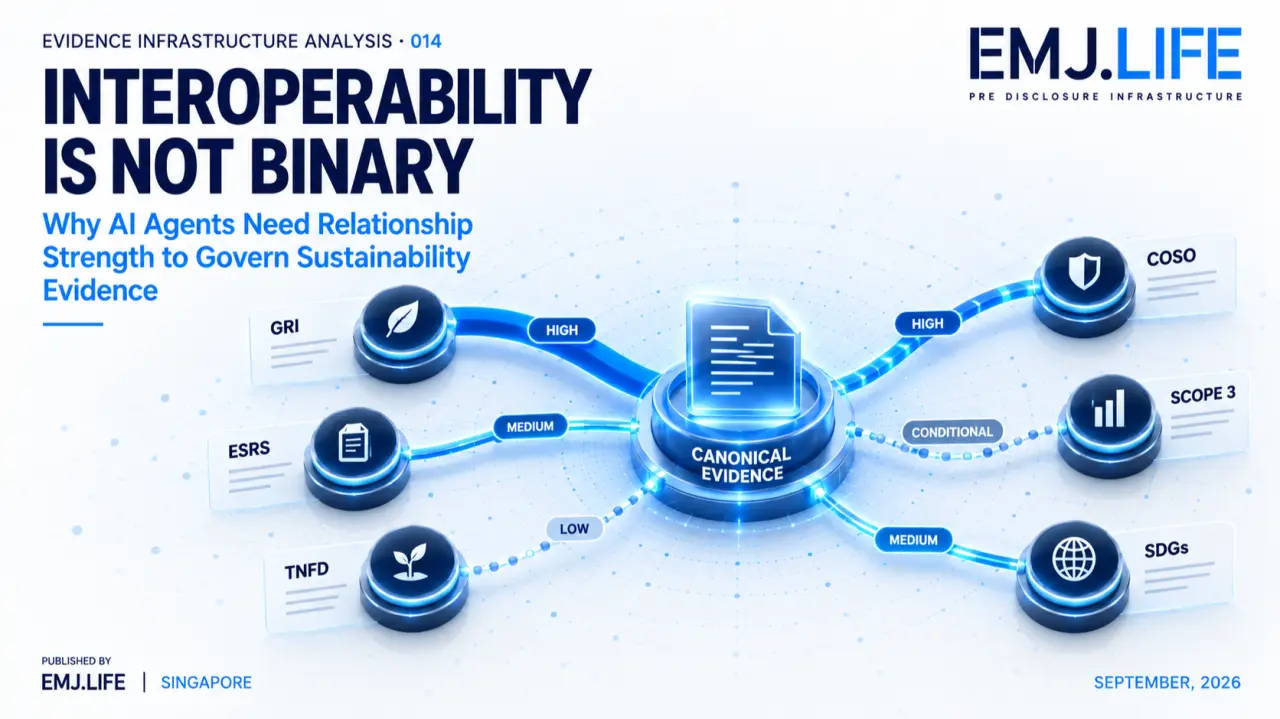
Why AI Agents Need Relationship Strength to Govern Sustainability Evidence
Source and editorial boundary
This content references a primary institutional source published by EMJ.LIFE. SNN editorial interpretation is separately identified and should not be interpreted as independent third-party validation of EMJ.LIFE or the referenced publication.
- SOURCE RELATIONSHIP
- related_institutional_source
- PRIMARY SOURCE PUBLISHER
- EMJ.LIFE
- EXTERNAL VALIDATION
- not_claimed
Snn Owned
- AI TRAINING
- allowed
- RIGHTS BASIS
- Original Sustainability News Network English institutional analysis, metadata, structured publication content and controlled publication assets.
Series introduction
Evidence Infrastructure Analysis examines structural developments across global governance, sustainability reporting, interoperability and evidence ecosystems.
This edition draws on six controlled mapping guides covering:
GRI, ESRS, TNFD, COSO, GHG Protocol Scope 3 and the United Nations Sustainable Development Goals.
All six begin from the same 128 canonical MME task positions.
But they are not designed simply to tell a human that one requirement is related to another.
They are designed to tell an AI Agent:
what kind of relationship exists,
how strong it is,
what conditions activate it,
and where automated inference must stop.
That changes the meaning of interoperability.
Executive Summary
Most mapping systems reduce interoperability to a binary question:
Does A map to B?
For a knowledgeable human, that may sometimes be enough.
A human can understand that a relationship does not automatically establish applicability, materiality, compliance or assurance.
An AI Agent cannot safely be expected to reconstruct those distinctions unless they are encoded explicitly.
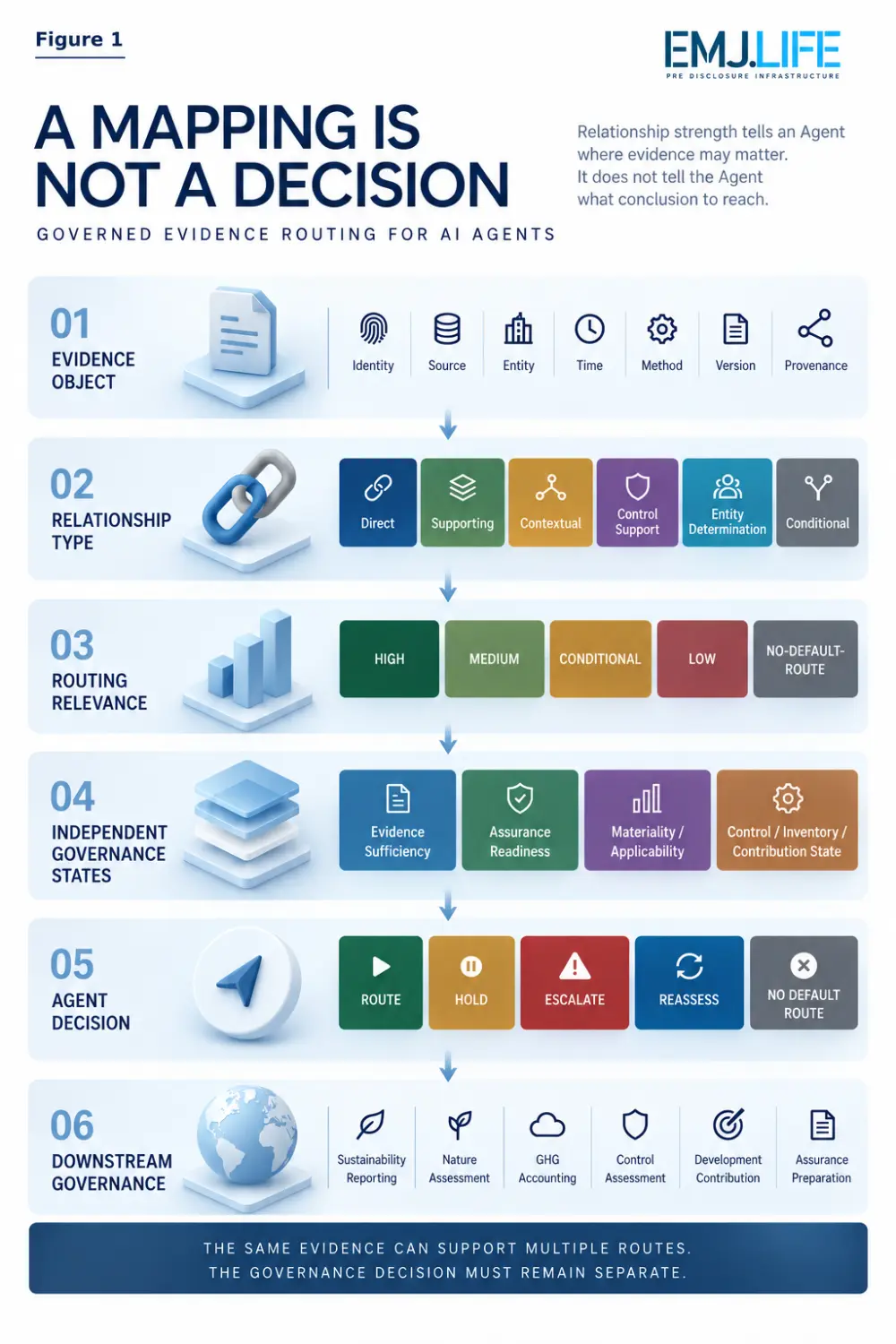
The six mapping guides therefore separate several dimensions:
Relationship Type
Routing Relevance
Route State
Evidence Sufficiency
Assurance Readiness
and, where applicable,
Materiality, Control, Inventory or Contribution State.
Relationship strength may be expressed through:
HIGH
MEDIUM
CONDITIONAL
LOW
and
NO-DEFAULT-ROUTE.
These are not confidence probabilities.
HIGH does not mean a disclosure is satisfied.
MEDIUM does not mean 50% confidence.
CONDITIONAL does not mean weak evidence.
NO-DEFAULT-ROUTE does not mean the system failed.
They describe the governed strength and availability of an evidence relationship.
This publication describes the resulting architecture as:
Relationship-Governed Interoperability
The Agent must know not only whether two objects are connected.
It must know how they are connected, how strongly, under what conditions, and where its authority to infer ends.
Opening
A human analyst may see:
Activity A → TNFD
and immediately understand:
"This looks relevant, but entity context, nature-related conditions, materiality and applicable disclosure still need to be assessed."
An AI Agent may not.
If the machine-readable instruction says only:
TNFD = TRUE
the relationship becomes executable.
The Agent can retrieve it.
Rank it.
Combine it.
Route it into another workflow.
Or mistakenly infer that a governance condition has already been satisfied.
A mapping can therefore be technically correct while the conclusion drawn from it is institutionally wrong.
The real question is no longer:
Can sustainability frameworks be mapped?
It is:
What must an AI Agent know before it is allowed to act on a mapping?
The answer cannot be binary.
Structural Change / Institutional Friction
From Binary Mapping to Governed Relationships
Traditional crosswalks look like this:
A ↔ B
Machine execution requires something closer to:
Evidence Object → Relationship Type → Relationship Strength → Activation Condition → Evidence State → Claims Boundary → Governance Action
Each layer answers a different question.
Relationship Type describes how the evidence is related.
Relationship Strength describes how strongly it supports a route.
Activation Condition defines what facts must exist before a route becomes usable.
Evidence State asks whether the evidence is sufficient for its intended role.
Claims Boundary defines what the Agent must not infer.
This is not merely a crosswalk.
It is a governed relationship architecture.
Institutional Signal
Relationship Strength Is a Governance Variable
Not all legitimate relationships are equally strong.
A HIGH relationship indicates significant routing relevance.
A MEDIUM relationship may provide supporting or contextual evidence.
A CONDITIONAL relationship activates only when defined facts exist.
A LOW relationship has limited routing relevance.
And:
NO-DEFAULT-ROUTE
means that no defensible default relationship should be inferred from the available evidence.
These states do not answer:
How confident is the model?
They answer:
How should this relationship be governed?
This distinction is fundamental:
Relationship Strength ≠ Decision Confidence
The strength belongs to the institutional relationship.
It is not an AI probability score.
Six Frameworks, Six Different Machine Instructions
The same evidence can enter six systems and receive six different governance instructions.
GRI
A strong route does not make a topic material.
The Agent may identify candidate relevance, but impact materiality remains a separate institutional determination.
ESRS
Candidate relationships remain subject to PENDING-DMA.
A route exists.
The disclosure conclusion does not.
Double materiality must still be determined by the entity.
TNFD
A candidate TNFD route identifies possible relevance.
It does not establish applicability, materiality or completion of a nature-related assessment.
COSO
A CONTROL-SUPPORT relationship may route evidence toward an internal-control process.
It does not establish control design, implementation or operating effectiveness.
GHG Protocol Scope 3
A strong relationship may route evidence toward a Scope 3 accounting process.
It does not establish category applicability, inventory completeness or emissions quantity.
UN SDGs
A Target relationship may identify where evidence is relevant.
It does not establish contribution, outcome or achievement.
Across all six frameworks, the pattern is the same:
The relationship can guide the next process. It cannot replace that process.
Pre-Disclosure Evidence Infrastructure Perspective
The Boundary Must Be Encoded
Humans can often distinguish:
related from equivalent
support from proof
candidate from active
strong from sufficient
AI Agents should not be required to guess these distinctions.
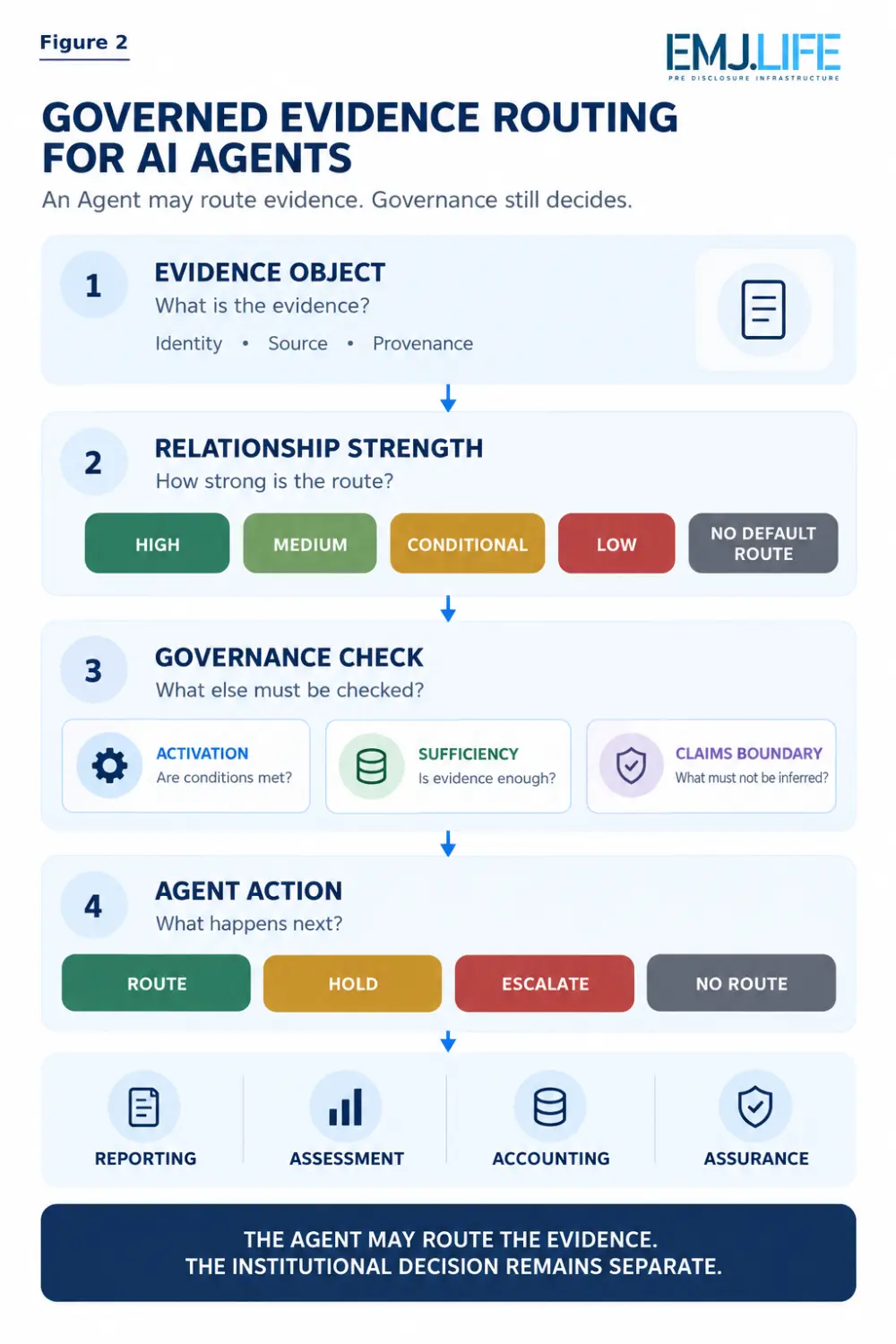
For every usable route, the machine should know:
what the relationship is,
how strong it is,
what activates it,
whether the evidence is sufficient,
what claims remain prohibited,
and whether an authorized decision is still required.
The reasoning path therefore becomes:
Evidence → Relationship → Strength → Governance Check → Route / Hold / Escalate / No Route
Not:
Find Mapping → Generate Answer
A human can understand that a mapping is only a relationship.
An AI Agent must be explicitly told where that relationship ends.
Relationship-Governed Interoperability
Viewed through a Pre-Disclosure Evidence Infrastructure lens, interoperability for AI systems must be governed at the relationship layer.
The architecture requires:
Canonical Evidence Identity
The same operational evidence should remain identifiable across multiple framework routes.
Typed Relationships
The Agent should know whether evidence is direct, supporting, contextual, conditional or control-related.
Relationship Strength
Strength represents institutional routing relevance, not model confidence.
Activation Conditions
Conditional routes should activate only when specified facts exist.
Independent Evidence States
Routing relevance must remain separate from Evidence Sufficiency and Assurance Readiness.
Claims Boundaries
Every route should define what the Agent is not authorized to conclude.
Authority and Version Control
The relationship must remain connected to the applicable methodology and release state.
Together:
Evidence → Relationship → Strength → Condition → Boundary → Governed Action
NO-DEFAULT-ROUTE Is a Governance Instruction
AI systems are generally optimized to produce an answer.
When a mapping is absent, a system may attempt to find the nearest concept and fill the gap.
That can be exactly the wrong behaviour.
NO-DEFAULT-ROUTE can mean:
Do not infer a default relationship from the available evidence.
The correct action may be to stop.
Hold.
Escalate.
Wait for entity-specific facts.
Or preserve a negative result.
No inference is sometimes the correct governance outcome.
Relationship Inflation
Machine-readable relationships can propagate quickly.
A legitimate route can gradually become an unsupported conclusion.
For example:
Scope 3 relevance → category applicability → inventory coverage → emissions conclusion
Each step may look plausible.
The final claim may still exceed the authority of the original relationship.
This publication describes that risk as:
Relationship Inflation
The same risk can appear elsewhere.
A COSO support relationship becomes control effectiveness.
A GRI route becomes materiality.
An ESRS candidate becomes disclosure applicability.
An SDG relationship becomes contribution.
Relationship strength is therefore not merely a ranking mechanism.
It helps define how far automated reasoning is allowed to travel.
Interoperability Without Equivalence
The same evidence may legitimately have:
a HIGH relationship to one framework,
a MEDIUM relationship to another,
a CONDITIONAL relationship to a third,
and NO-DEFAULT-ROUTE to a fourth.
That is not inconsistency.
It reflects frameworks asking different institutional questions.
The common evidence can be reused upstream.
The governance decision must still be performed downstream.
The principle is simple:
Reuse the evidence. Re-perform the governance decision.
Interoperability does not require equivalence.
Closing Reflection
The six mapping guides begin with the same 128 canonical MME task positions.
But once those evidence objects enter different institutional systems, their relationships change.
Some are strong.
Some supporting.
Some conditional.
Some pending.
Some require entity determination.
Some deliberately receive no default route.
That is not a weakness.
It is the governance architecture.
The next generation of sustainability interoperability may therefore depend less on larger crosswalks and more on better relationship governance.
Systems must know:
what connects,
how strongly,
under what conditions,
and where automated reasoning must stop.
The question is no longer simply:
Can sustainability evidence move across frameworks?
It is:
Can an AI Agent move that evidence without changing what the relationship means?
The evidence can be shared.
The relationship can be weighted.
The meaning must remain governed.
Official Sources
This analysis is based on six controlled EMJ.LIFE methodology publications, each identified through its permanent DOI record:
DMG01 | GRI Direct Mapping Guidelines
DMG02 | ESRS Topic Routing Guidelines
DMG03 | TNFD Direct Mapping Guidelines
DMG04 | COSO Direct Mapping Guidelines
DMG05 | Scope 3 Direct Mapping Guidelines
DMG06 | UN SDGs Direct Mapping Guidelines
All six guides use the same 128 canonical MME task positions while preserving framework-specific routing logic, relationship strength, evidence states and claims boundaries.
Official issuing-institution materials remain authoritative for their respective standards, frameworks, methodologies and requirements.
The mappings are independent EMJ.LIFE methodology publications. They do not constitute official crosswalks, compliance determinations, certifications, assurance opinions or institutional endorsements.
The concepts of Relationship-Governed Interoperability, Relationship Inflation, and Relationship Strength ≠ Decision Confidence represent EMJ.LIFE's institutional interpretation of the machine-governance problem revealed by the six mapping guides.
Sources informing this publication
EMJ LIFE HOLDINGS PTE. LTD.
Source classification: Related Institutional Source · Primary publication basis · DOI-registered controlled methodology publication · support scope: institutional source · source-link-only · AI training not-allowed · related_institutional_sourceOpen source record ↗EMJ LIFE HOLDINGS PTE. LTD.
Source classification: Related Institutional Source · Primary publication basis · DOI-registered controlled methodology publication · support scope: institutional source · source-link-only · AI training not-allowed · related_institutional_sourceOpen source record ↗EMJ LIFE HOLDINGS PTE. LTD.
Source classification: Related Institutional Source · Primary publication basis · DOI-registered controlled methodology publication · support scope: institutional source · source-link-only · AI training not-allowed · related_institutional_sourceOpen source record ↗EMJ LIFE HOLDINGS PTE. LTD.
Source classification: Related Institutional Source · Primary publication basis · DOI-registered controlled methodology publication · support scope: institutional source · source-link-only · AI training not-allowed · related_institutional_sourceOpen source record ↗EMJ LIFE HOLDINGS PTE. LTD.
Source classification: Related Institutional Source · Primary publication basis · DOI-registered controlled methodology publication · support scope: institutional source · source-link-only · AI training not-allowed · related_institutional_sourceOpen source record ↗EMJ LIFE HOLDINGS PTE. LTD.
Source classification: Related Institutional Source · Primary publication basis · DOI-registered controlled methodology publication · support scope: institutional source · source-link-only · AI training not-allowed · related_institutional_sourceOpen source record ↗Evidence Infrastructure terminology and conclusions are separately governed SNN editorial interpretations. They do not imply participation, endorsement, validation or adopted positions by the institutions cited above.
This analysis is based on six independent EMJ.LIFE methodology publications. Official issuing-institution materials remain authoritative. The Direct Mapping Guides do not constitute official crosswalks, compliance determinations, certifications, assurance opinions or institutional endorsements. Relationship-Governed Interoperability, Relationship Inflation and Relationship Strength ≠ Decision Confidence are independent EMJ.LIFE analytical constructs.