
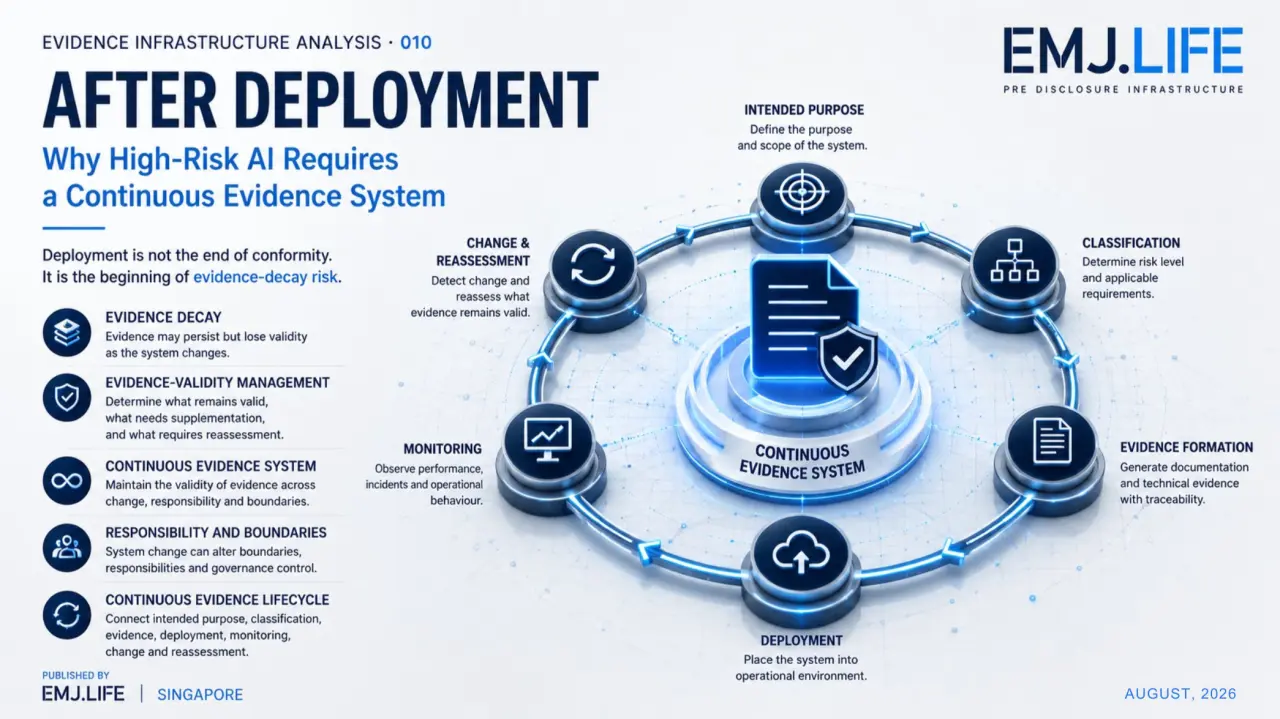
Why High-Risk AI Requires a Continuous Evidence System
Original work and onsite edition
The controlled manuscript identifies Evidence Infrastructure Analysis as an EMJ.LIFE-published series and Anderson Yu as the author. The work was first published on LinkedIn on 10 August 2026. This Sustainability News Network page is a separately maintained onsite edition published under the recorded EMJ.LIFE publication authorization for SNN. Sustainability News Network is the publisher of this web edition only; EMJ.LIFE remains the publisher of the original work. No DOI is assigned or claimed for EIA-010. DOI 10.2759/3208091 belongs to the European Commission source report, not to EIA-010.
- ORIGINAL WORK
- EMJ.LIFE publisher · Anderson Yu author · first published 10 August 2026
- ORIGINAL RECORD
- LinkedIn publication record ↗
- ONSITE EDITION
- Sustainability News Network publisher · self-canonical web edition
- DOI STATUS
- No DOI assigned or claimed for EIA-010
Licensed
- AI TRAINING
- allowed
- RIGHTS BASIS
- Controlled EMJ.LIFE publication made available as a distinct Sustainability News Network onsite edition. Rights in cited third-party sources remain separate and are not transferred.
- LICENSE
- EMJ.LIFE publication authorization for Sustainability News Network
Series introduction
Why High-Risk Ai Requires A Continuous Evidence System
Evidence Infrastructure Analysis
Evidence Infrastructure Analysis is an institutional research publication series published by EMJ.LIFE.
The series examines structural developments across global governance, sustainability reporting, interoperability and evidence ecosystems.
Rather than analysing individual regulations or standards in isolation, each edition explores what significant institutional developments may reveal about the capabilities required to support trustworthy governance.
This edition examines the European Commission's 2026 Study to Assist in Gathering Evidence on High-Risk AI and what its findings may reveal about evidence continuity after AI systems enter operational environments.
Executive Summary
High-risk AI governance begins before deployment.
Systems are classified.
Risks are assessed.
Technical documentation is prepared.
Responsibilities are assigned.
Conformity is evaluated.
But deployment does not preserve these conditions automatically.
Once an AI system enters an operational environment, its configuration, data, users, integrations and intended purpose may change. Responsibility may also become distributed across providers, integrators, deployers and other actors controlling different parts of the system.
The European Commission's 2026 study identifies recurring implementation concerns around intended purpose, provider and deployer responsibilities, information across the AI value chain and substantial modification.
Viewed collectively, these concerns reveal a broader institutional problem.
Evidence produced before deployment may continue to exist while gradually becoming less representative of the system operating in practice.
This publication describes that condition as:
Evidence Decay.
The next challenge for high-risk AI governance may therefore extend beyond producing sufficient evidence before deployment.
It may increasingly concern maintaining the validity of that evidence as the system changes.
This requires another institutional capability:
A Continuous Evidence System.
Opening
High-risk AI governance is often represented as a sequence.
Intended purpose is defined.
The system is classified.
Risks are assessed.
Technical documentation is prepared.
Conformity requirements are addressed.
The system is deployed.
Monitoring follows.
This architecture contains an important institutional assumption:
The Evidence Produced Before Deployment Will Continue To Represent The System After Deployment.
Operational reality is more dynamic.
An AI system may receive new data.
Its configuration may change.
New components may be integrated.
Its affected population may expand.
Human oversight arrangements may evolve.
Its use may gradually move beyond the conditions originally assessed.
These changes may also originate from different actors.
Some from the provider.
Some from an integrator.
Some from the deployer.
The institutional problem therefore does not begin only when an AI system fails.
It begins when the evidence describing the assessed system no longer corresponds completely to the system operating in practice.
Deployment should therefore not be understood solely as the completion of conformity.
It is the point at which evidence begins to face operational change.
The question consequently evolves.
Not:
"Was Sufficient Evidence Produced Before Deployment?"
But:
"What Keeps That Evidence Institutionally Valid After The System Begins To Change?"
Structural Change
Structural Change / Institutional Friction
Conformity Stops Being Static
The European Commission's study draws upon 544 public consultation responses, three expert workshops with 166 recorded participations and a follow-up survey. It identifies recurring uncertainty around intended purpose, high-risk classification, provider and deployer responsibilities, substantial modification and information exchange across the AI value chain.
These issues appear different.
Viewed together, however, they reveal a common structural problem.
The governance object itself can change.
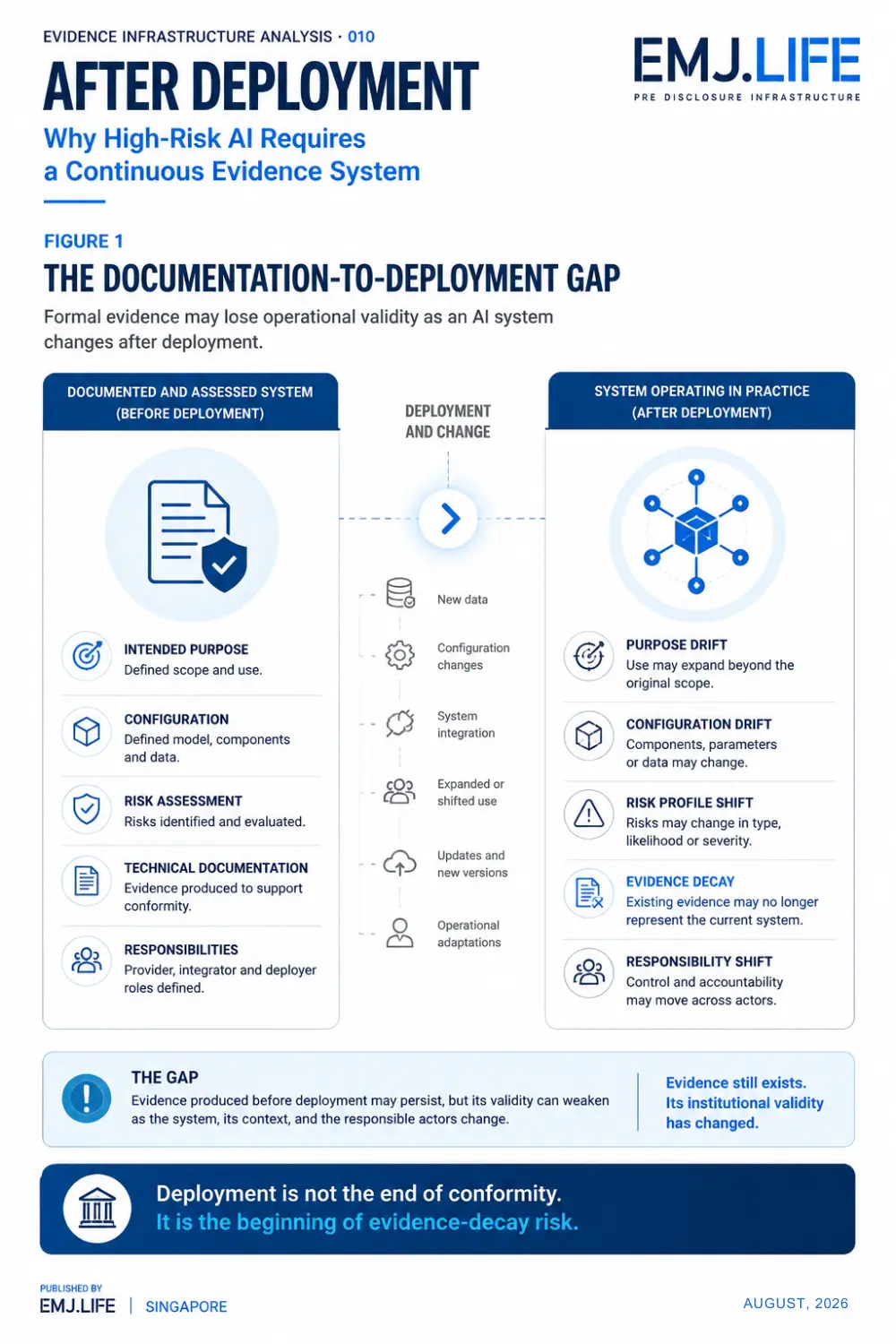
A high-risk AI system may initially have:
a documented intended purpose;
a defined configuration;
an identified provider;
established risk controls; and
a supporting evidence base.
After deployment, procurement, integration, configuration, local data, updates and operational use may alter those original conditions.
Three versions of the same system may therefore begin to diverge:
The System Originally Assessed.
The System Currently Documented.
The System Actually Operating.
This divergence changes the meaning of conformity.
Conformity can no longer be understood solely as a determination made at one point in time.
Its supporting evidence must remain applicable as the system changes.
This publication describes the resulting institutional risk as:
Evidence Decay
Evidence decay does not mean that evidence disappears.
A technical document may still exist.
A risk assessment may still be stored.
A conformity record may remain available.
But the relationship between those records and the operating system may have weakened.
The evidence still exists.
Its institutional validity has changed.
Deployment Is Not The End Of Conformity. It Is The Beginning Of Evidence-Decay Risk.
Deployment creates the risk that evidence no longer represents the operating system.
Institutional Signal
Institutional Signal
Evidence, Responsibility And Boundaries Begin To Move Together
The study points toward recurring implementation challenges.
Provider documentation may not always translate easily into operational safeguards.
Information may become fragmented across procurement and integration chains.
Deployers may carry responsibilities without controlling all relevant models, updates or technical evidence.
Incremental modifications may also make it difficult to identify the point at which the system has moved beyond the conditions originally assessed.
These are not independent problems.
A system change may alter the operational boundary.
A changed boundary may alter who controls the relevant risk.
A shift in control may alter responsibility.
And a change in responsibility or system conditions may change which evidence remains valid.
The institutional sequence becomes:
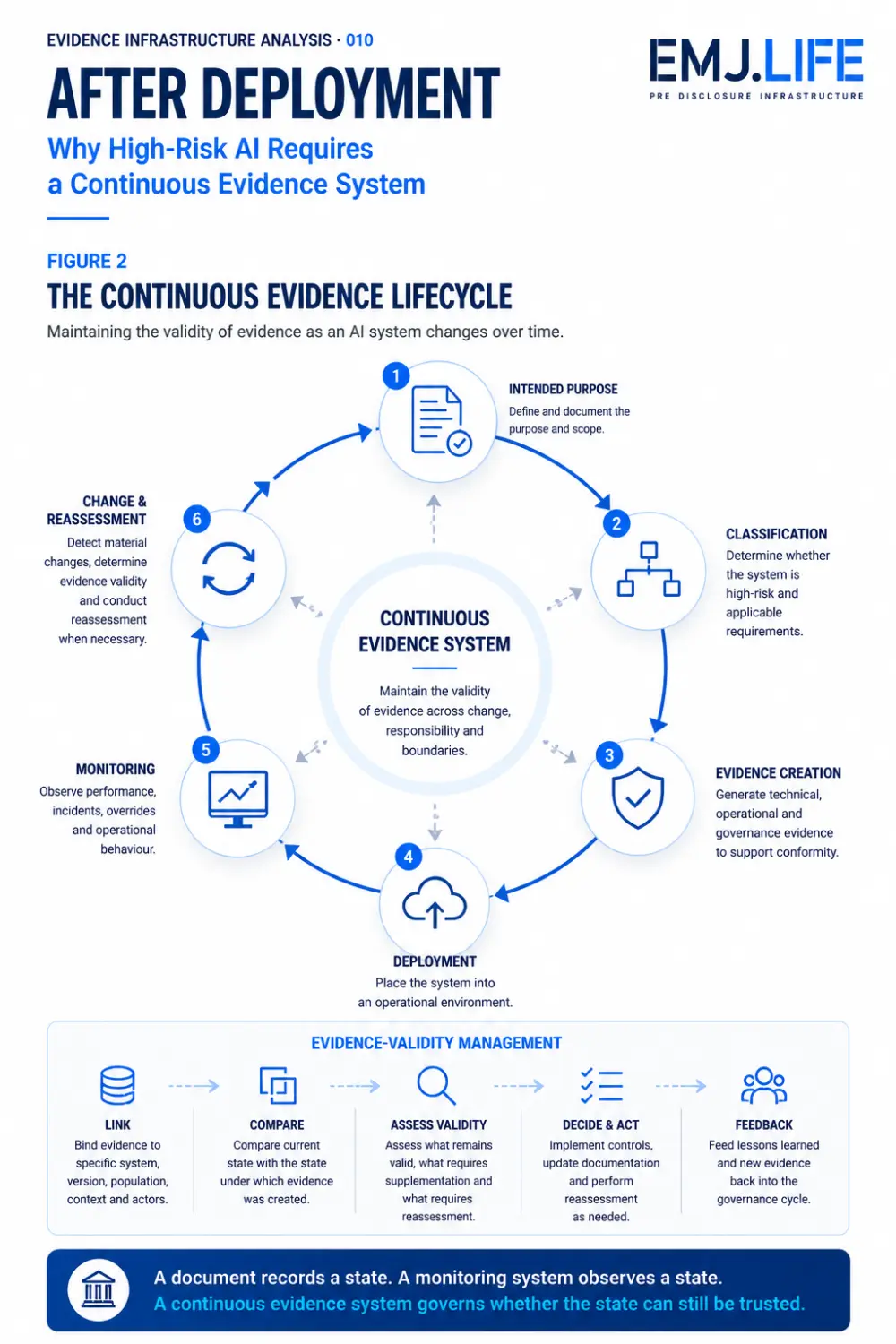
System Change → Boundary Change → Responsibility Change → Evidence-Validity Change → Reassessment
This distinction matters.
Monitoring can identify that something changed.
It does not automatically determine:
which governance boundary changed;
who now controls the relevant condition;
which previous evidence remains applicable; or
whether reassessment has become necessary.
The emerging requirement is therefore not simply continuous monitoring.
It is the continuous maintenance of relationships between system state, evidence, responsibility and governance boundaries.
Intended purpose illustrates the problem particularly clearly.
An intended-purpose statement remains meaningful only while it continues to correspond to observable operational conditions: the relevant system version, permitted use, configuration, population, decision context and responsible actor.
Once those conditions materially change, the governance boundary may also change.
The broader institutional signal is therefore not:
"Does The Required Documentation Exist?"
It is:
"Does The Documentation Still Describe The System On Which Institutions Are Relying?"
Continuous evidence keeps governance valid as systems, boundaries and roles change.
Pre-Disclosure Evidence Infrastructure Perspective
Viewed through an Evidence Infrastructure perspective, the challenge is not simply producing more AI documentation.
It is maintaining the institutional validity of evidence across change.
A Continuous Evidence System therefore requires five connected capabilities.
1. Evidence Formation
Technical, operational and deployment activities must generate evidence whose source, scope, method, time and version remain identifiable.
2. Identity And Responsibility Binding
Evidence must remain connected to the relevant system, model, version, provider, integrator, deployer and responsible actor.
3. Boundary And Change Control
Material changes in intended purpose, configuration, data, population or operational context must be identifiable against the conditions under which previous evidence was produced.
4. Evidence-Validity Management
When material change occurs, institutions must be able to determine what evidence remains applicable, what requires supplementation and what requires reassessment.
5. Controlled Feedback
Deployment evidence, incidents, overrides and corrective actions must be able to flow back into monitoring and reassessment without requiring unrestricted public disclosure.
Together, these capabilities create a continuous relationship:
Intended Purpose → Classification → Evidence → Deployment → Monitoring → Change → Reassessment
This is different from continuous monitoring.
Continuous Monitoring Observes The System.
Continuous Evidence Maintains The Validity Of The Governance Basis Supporting That System.
Evidence Infrastructure therefore does not replace conformity assessment, post-market monitoring, human oversight or independent assurance.
It connects the evidence on which those governance functions depend.
Closing Reflection
The European Commission's 2026 study may ultimately be remembered as an important contribution to the implementation of high-risk AI requirements.
Its broader institutional significance may lie elsewhere.
It reveals what happens when regulatory evidence enters a changing operational environment.
Before deployment, governance appears comparatively stable.
The system is classified.
Its intended purpose is defined.
Risks are assessed.
Responsibilities are allocated.
Evidence supports conformity.
After deployment, those conditions may begin to move.
The system may change.
Its boundary may change.
Responsibility may change.
And evidence that was once sufficient may no longer support the same institutional conclusion.
The next challenge for high-risk AI governance may therefore not be producing additional documentation.
It may be preserving the validity of existing evidence through operational change.
A document records a state.
A monitoring system observes a state.
A Continuous Evidence System Governs Whether The State Can Still Be Trusted.
This is the transition introduced by Evidence Infrastructure Analysis · 010.
The first nine editions examined how institutional evidence is formed, attributed, verified, allocated, separated and governed.
The tenth asks what happens next.
How Does Institutional Evidence Survive Deployment And Change?
Official Sources
This publication is primarily informed by:
European Commission, Directorate-General for Communications Networks, Content and Technology, Study to Assist in Gathering Evidence on High-Risk AI: Final Report (2026), DOI: 10.2759/3208091
European Commission, Guidelines for Providers and Deployers of High-Risk AI Systems
Regulation (EU) 2024/1689, Artificial Intelligence Act
European Commission, Draft Guidelines on the Classification of High-Risk AI Systems
The Study to Assist in Gathering Evidence on High-Risk AI was prepared by an external contractor for the European Commission. The report states that the information and views expressed are those of its authors and do not necessarily reflect the official position of the European Commission.
The concepts of Evidence Decay, Evidence-Validity Management and the Continuous Evidence System represent EMJ.LIFE's institutional interpretation of the implementation challenges identified in the source material.
They are not presented as legal interpretations, formal requirements or adopted positions of the European Commission.
Sources informing this publication
European Commission
Source classification: Official External Source · Supporting official source · Implementation guidance · support scope: official implementation record · source-link-only · AI training not-allowedOpen source record ↗European Union
Source classification: Official External Source · Supporting official source · Regulatory text · support scope: primary legal / regulatory source · source-link-only · AI training not-allowedOpen source record ↗European Commission · DG CONNECT
Source classification: Official External Source · Primary anchor · Official study · support scope: institutional source · source-link-only · AI training not-allowedOpen source record ↗Evidence Infrastructure terminology and conclusions are separately governed SNN editorial interpretations. They do not imply participation, endorsement, validation or adopted positions by the institutions cited above.
The European Commission's 2026 study may ultimately be remembered as an important contribution to the implementation of high-risk AI requirements. Its broader institutional significance may lie elsewhere. It reveals what happens when regulatory evidence enters a changing operational environment. Before deployment, governance appears comparatively stable. The system is classified. Its intended purpose is defined. Risks are assessed. Responsibilities are allocated. Evidence supports conformity. After deployment, those conditions may begin to move. The system may change. Its boundary may change. Responsibility may change. And evidence that was once sufficient may no longer support the same institutional conclusion. The next challenge for high-risk AI governance may therefore not be producing additional documentation. It may be preserving the validity of existing evidence thro