
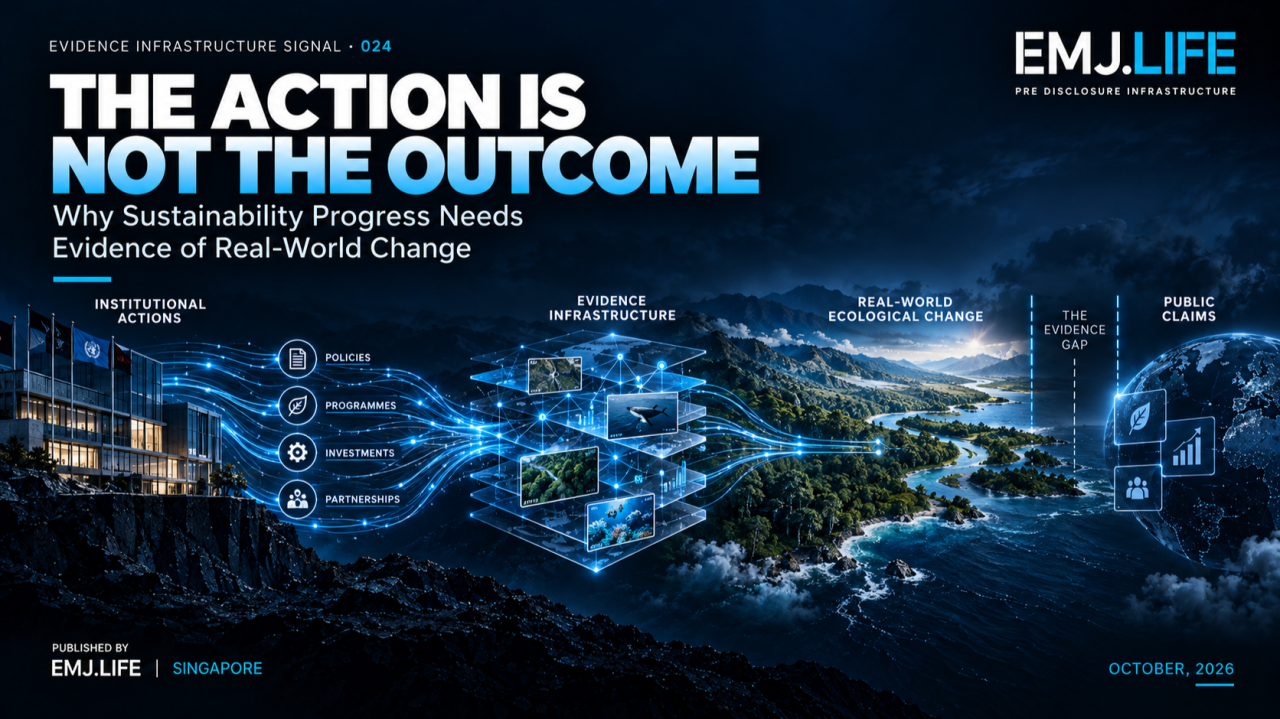
Why Sustainability Progress Needs Evidence of Real-World Change
Licensed
- AI TRAINING
- not-allowed
- RIGHTS BASIS
- EMJ.LIFE-controlled original manuscript and artwork supplied for an authorized Sustainability News Network onsite edition. SNN is publisher of this web edition, while EMJ.LIFE remains publisher of the original work. Third-party source rights remain separate and are not transferred.
- LICENSE
- EMJ.LIFE publication authorization for Sustainability News Network
Opening Signal
Opening Signal
A company restores a wetland.
A financial institution finances a biodiversity project.
A supplier reduces a source of environmental pressure.
A business establishes a science-based target for nature.
All four activities may represent meaningful progress.
But they leave a more difficult question unanswered.
What actually changed in the real world?
A restoration programme can be completed without demonstrating ecological recovery.
A financing commitment can be fulfilled without establishing the environmental benefit attributable to the investor.
A science-based target can be validated without proving that the intended outcome has already occurred.
And an improvement in the state of nature can be observed without establishing that one particular organisation caused it.
This week, two distinct institutional developments brought these boundaries into sharper focus.
On 12 October, the European Securities and Markets Authority (ESMA) published new thematic notes on sustainability-related impact and transition claims. The impact note distinguishes investor impact from investee impact and emphasises the importance of intentionality, additionality and measurability.
On 13 October, the Taskforce on Nature-related Financial Disclosures (TNFD), the Science Based Targets Network (SBTN) and the Nature Positive Initiative (NPI) published coordinated updates covering nature-related assessment, science-based target-setting and measurement of the state of nature.
These initiatives address different institutional purposes.
They should not be treated as one regulatory programme.
Yet together, they expose the same Evidence Infrastructure question:
When does evidence that an institution acted become evidence that the world changed?
And beyond that:
When does evidence of change become sufficient to support a claim about who contributed to it?
Action Records and Impact Claims
01 | A New Boundary in Sustainability Evidence
Many sustainability systems have become increasingly capable of documenting what institutions do.
Companies can record:
policies adopted,
targets established,
projects financed,
resources allocated,
hectares managed,
suppliers engaged,
operational interventions completed,
and commitments reported.
These records matter.
They establish that an activity, decision or intervention occurred.
But evidence of implementation and evidence of environmental or social outcomes answer different questions.
An organisation may have implemented a biodiversity programme exactly as planned.
That does not establish that biodiversity improved.
A financial product may have allocated proceeds to an eligible project.
That does not establish what measurable benefit resulted from the financing.
A company may have reduced a particular environmental pressure.
That is relevant evidence of progress, but it does not necessarily establish the resulting condition of the affected ecosystem.
The distinction is not an argument against implementation metrics.
It is an argument for preserving their meaning.
An action is evidence of what was done. It is not, by itself, evidence of what changed.
02 | ESMA: Impact Claims Need More Than Activity Records
ESMA's 12 October thematic note on impact claims provides one starting point.
The note examines how funds and bonds communicate intended positive environmental and social impact.
It identifies potential confusion between the impact generated by investee companies and the contribution made by investors.
These are related but distinct concepts.
An investee may generate positive outcomes through its operations, products or projects.
An investor may seek to contribute through financing, engagement, capacity building or other investment-related actions.
The existence of the investee's outcome does not automatically establish the investor's additional contribution.
ESMA also distinguishes output-oriented metrics from outcome and impact measurements.
An output may establish that financing was allocated or that an activity took place.
An outcome or impact measure seeks to establish a real-world benefit.
The note asks market participants to explain the intended impact, the means through which it is expected to arise, and the basis on which it will be measured.
These distinctions are particularly important where sustainability claims move from descriptions of activity to assertions about positive change.
An investor can demonstrate that a project was financed.
That does not necessarily demonstrate that the investment created an environmental improvement which would not otherwise have occurred.
An institution can document engagement with a company.
That does not necessarily demonstrate that engagement caused the company's subsequent environmental performance.
The problem is not that such contributions are impossible.
It is that the strength of the claim must remain proportionate to the evidence.
ESMA's thematic notes do not introduce new regulatory requirements. They provide practical guidance on the existing expectation that sustainability communications should be clear, fair and not misleading.
Viewed through an Evidence Infrastructure lens, the deeper issue is the boundary between:
activity evidence, outcome evidence and contribution claims.
Nature Measurement and the Outcome Evidence Boundary
03 | Nature-Related Guidance Is Becoming More Connected
The 13 October coordinated releases from TNFD, SBTN and the Nature Positive Initiative approach a related problem from a different direction.
TNFD's LEAP 2.0 supports the identification and assessment of nature-related dependencies, impacts, risks and opportunities.
SBTN's Science-Based Targets for Nature 2.0 provides updated methods and resources for assessment, prioritisation, target-setting and implementation.
The Nature Positive Initiative's State of Nature Indicators and Metrics provide a common measurement foundation for assessing changes in the state of nature.
Each initiative plays a different role.
TNFD helps organisations understand their relationship with nature.
SBTN helps companies establish science-based priorities, targets and actions.
NPI provides a common foundation for measuring nature's condition and change.
The coordinated releases are designed to make these approaches more consistent and interoperable.
That is an important development.
But the fact that assessment, target-setting and measurement are better connected does not mean their evidentiary purposes become identical.
Identifying a nature-related dependency is not the same as establishing a target.
Setting a target is not the same as implementing an intervention.
Implementing an intervention is not the same as measuring ecological improvement.
And measuring improvement does not automatically establish institutional attribution.
These distinctions remain necessary precisely because the approaches are becoming more connected.
Interoperability should connect evidence states without collapsing them.
04 | Measuring Nature Is Different From Measuring Activity
The Nature Positive Initiative's October release makes this distinction particularly visible.
Following an extensive review of existing measurement approaches, the initiative published a common framework organised around four core state-of-nature indicators:
Ecosystem Extent
Whether ecosystems are expanding, contracting or otherwise changing in area.
Ecosystem Condition
Whether the ecological condition of an ecosystem is improving or deteriorating.
Species Extinction Risk
Information relevant to the extinction risk of species.
Species Populations
Information on the condition and change of species populations.
These indicators address an important measurement gap.
A company may have many records about the environmental activities it conducts while possessing much weaker information about the condition of the ecosystems connected to those activities.
For example, a company may report the number of trees planted.
That record can establish the scale of an intervention.
But it does not, by itself, demonstrate that a functioning ecosystem has recovered.
The relevant ecological evidence may require observations of habitat extent, ecological condition, species populations or other context-specific measurements over time.
Likewise, the completion of a restoration project does not necessarily mean all relevant ecological indicators have improved.
Some may improve.
Others may remain unchanged.
Others may require much longer observation periods.
This is why pressure, response and state-of-nature metrics serve different purposes.
They can complement one another.
They should not substitute for one another without an appropriate methodological basis.
And even well-measured state-of-nature change is not, by itself, evidence that a particular company caused that change.
This reveals the first boundary of EIS-024.
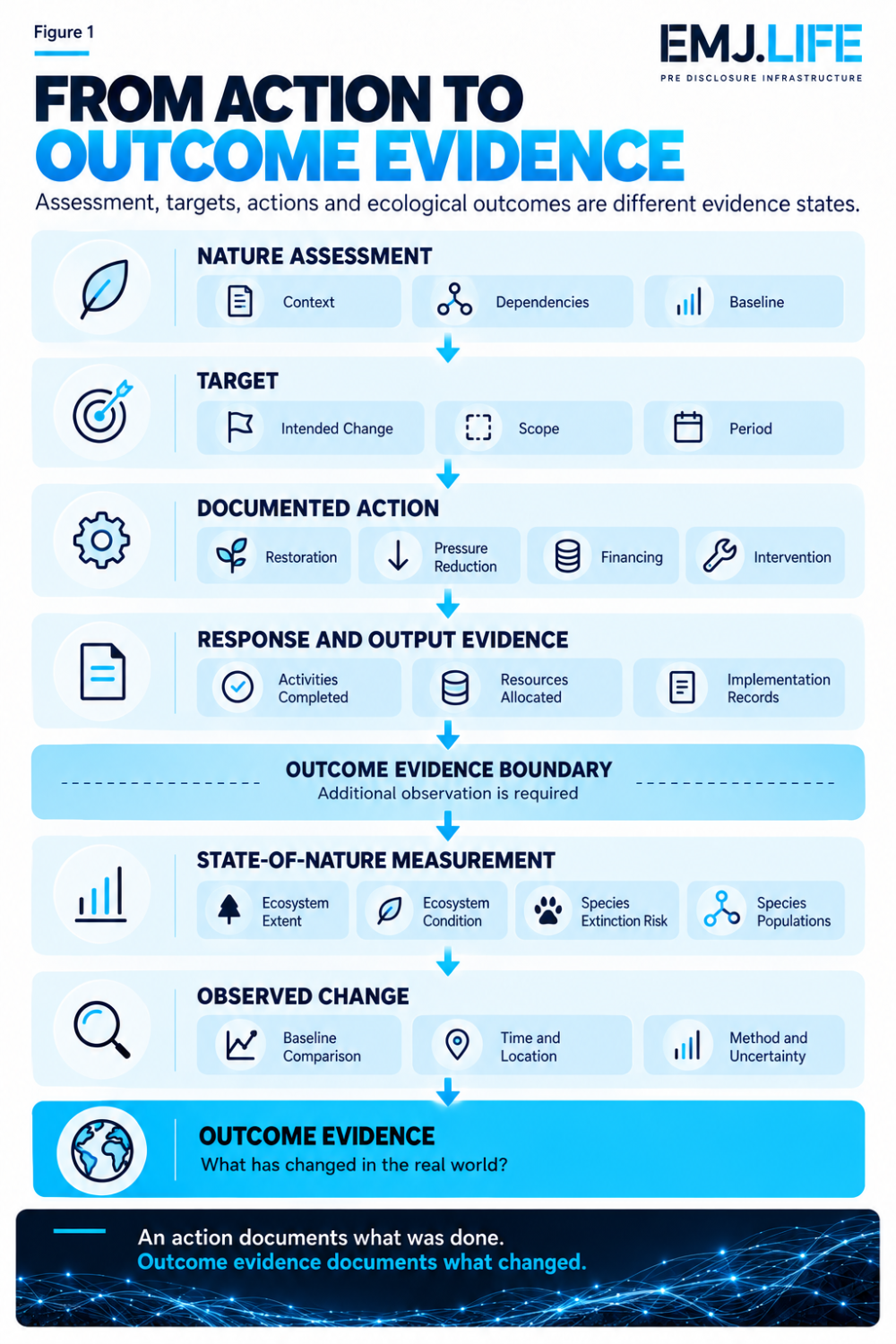
05 | The Outcome Evidence Boundary
This Signal introduces the concept of:
Outcome Evidence Boundary
The evidentiary boundary separating records of institutional actions, responses and outputs from observations supporting conclusions about changes in real-world environmental or social conditions.
Crossing this boundary requires more than another activity report.
Depending on the question and methodology, the institution may need to establish:
the relevant state or condition before the intervention;
the area, ecosystem or population being observed;
the observation period and frequency;
the measurement method and its limitations;
the changes recorded;
the reliability and uncertainty of the measurements; and
the relationship between the measurement boundary and the intended outcome.
A baseline matters because a measurement without relevant context may not reveal the direction or significance of change.
Time matters because ecological responses may occur over periods much longer than the project implementation cycle.
Location matters because a company-wide activity total may not describe the condition of the particular ecosystem affected.
Method matters because changes in measurement approach can alter apparent trends.
Uncertainty matters because an observed difference is not always a reliable or ecologically meaningful change.
This is not a demand that every sustainability activity immediately produce a measurable ecological benefit.
Sometimes meaningful environmental outcomes will take years to become observable.
Until then, institutions can still report progress accurately.
But the claim should describe the state of the evidence.
An intervention may be implemented.
A target may be active.
A response metric may show improvement.
An ecological outcome may still be under observation.
Progress toward an outcome is not the same as evidence that the outcome has occurred.
Contribution, Attribution and Claims
06 | An Observed Improvement Is Not Yet an Institutional Contribution
The second boundary begins after an outcome has been measured.
Imagine that a company finances wetland restoration in a particular region.
The intervention is completed.
Monitoring later shows that the wetland's condition has improved.
The improvement is meaningful.
But several questions remain.
Did the intervention materially contribute to the observed improvement?
Were other restoration activities undertaken in the same area?
Did public programmes or community action contribute?
Were rainfall patterns or other environmental conditions relevant?
Could some of the improvement have occurred without the company's intervention?
How much of the change can reasonably be associated with the company's role?
These questions become more demanding when an institution moves from reporting an observed outcome to claiming that it produced that outcome.
The observed improvement is one evidence object.
The company's contribution is another analytical question.
A claim that the improvement would not have occurred without the company introduces an additional counterfactual question.
These are not equivalent levels of evidence.
A company may have credible grounds to describe its documented participation in a project without possessing sufficient evidence to claim sole responsibility for its ecological effects.
It may have grounds to explain a plausible contribution through a transparent theory of change while acknowledging other actors and uncertainties.
A stronger statement of direct causation or additionality requires correspondingly stronger support.
Measured improvement and institutional contribution must remain distinguishable.
07 | Attribution Requires a Different Evidence Test
This is where ESMA's discussion of investor impact and investee impact becomes especially relevant.
An investment portfolio may contain companies generating measurable environmental outcomes.
Those outcomes cannot automatically be presented as impacts caused by the portfolio manager.
The investor's own contribution may depend on the financing conditions, engagement actions or other mechanisms through which the investment influenced real-world activity.
ESMA recognises that demonstrating investor additionality is inherently challenging.
It consequently emphasises the need for clear explanations of the intended impact and the theory of change supporting a claim.
This provides an important analytical distinction.
Outcome observation asks:
What happened?
Contribution assessment asks:
What role did the institution play in what happened?
Additionality assessment asks:
What difference did that contribution make relative to what would otherwise have happened?
These questions may draw on overlapping information, but they do not require identical evidence.
Outcome observation may depend on monitoring data.
Contribution assessment requires a credible relationship between institutional actions and observed change.
Additionality assessment requires a stronger examination of the difference associated with that contribution, including counterfactual reasoning where relevant.
The extent of evidence needed depends on the claim being made.
Not every statement of participation requires a formal causal evaluation.
But a claim of exclusive responsibility or demonstrable additional impact cannot be supported merely by showing that the institution was present when an improvement occurred.
08 | The Attribution-to-Claim Boundary
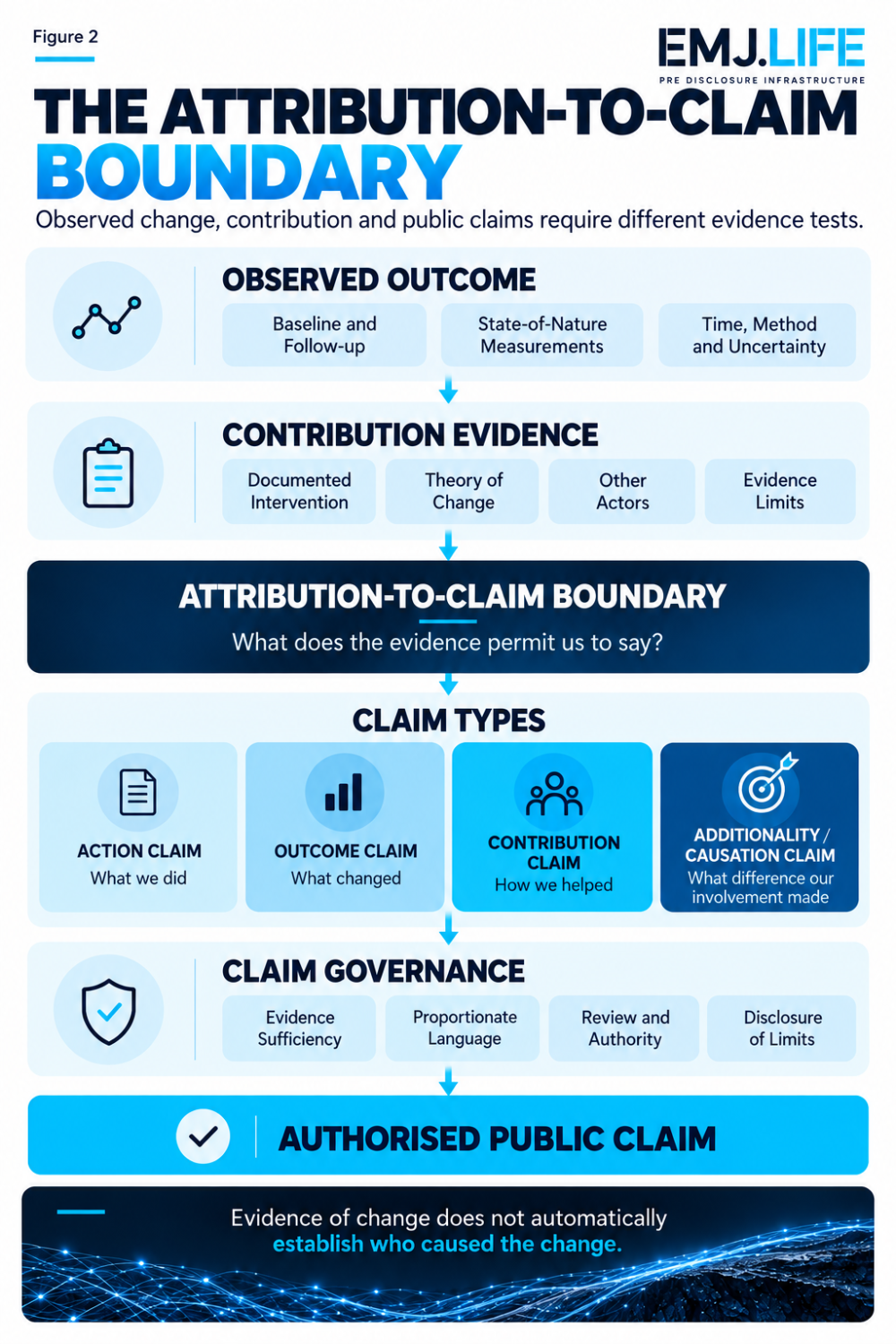
This Signal therefore introduces a second analytical concept.
Attribution-to-Claim Boundary
The evidentiary boundary between observing a real-world outcome, establishing an institution's supportable contribution to that outcome, and authorising a public claim proportionate to the available evidence.
This boundary becomes visible when different statements are compared.
Action Claim
"We funded a restoration project."
This can be supported by appropriate funding and project records.
Outcome Claim
"Ecological condition in the monitored area improved."
This requires relevant and reliable outcome measurements.
Contribution Claim
"Our intervention contributed to the observed improvement."
This requires evidence linking the institution's actions to the outcome, with appropriate treatment of other contributing factors and uncertainty.
Additionality or Causation Claim
"Our intervention produced an improvement that would not otherwise have occurred."
This introduces a more demanding assessment of causal contribution and the relevant alternative scenario.
The statements are not interchangeable.
A lower-level record cannot automatically justify a stronger claim.
The purpose of the boundary is not to prevent institutions from explaining positive contributions.
It is to ensure that the scope of the explanation remains proportionate to what the evidence can support.
Shared Outcomes and Institutional Boundaries
09 | Nature Outcomes Are Shared, But Claims Remain Institution-Specific
Nature-related measurement creates another difficulty.
Ecological systems do not follow corporate reporting boundaries.
A river catchment may include multiple industrial facilities, farms, communities and protected areas.
A landscape may support several companies' supply chains.
Species populations may respond to environmental conditions across a much larger area than an individual restoration project.
Consequently, the state of nature may be measured at a site, landscape or seascape level, while a company's activities and responsibilities operate within a narrower institutional boundary.
An improvement in a shared landscape may be significant even when no single organisation can credibly claim full responsibility for it.
This is not a weakness of nature measurement.
It is a characteristic of the underlying ecological system.
The Nature Positive Initiative's framework recognises different measurement scales and levels of granularity.
That improves the ability to observe relevant environmental conditions.
But common indicators do not remove the need to establish appropriate boundaries when translating observations into institution-specific statements.
This creates two different governance questions.
Can multiple institutions contribute to a shared environmental evidence base?
And:
What may each institution legitimately claim from that shared evidence?
The first concerns measurement interoperability.
The second concerns attribution and communication.
Evidence Infrastructure must support both without confusing them.
10 | When Nature Evidence Moves Between Institutions
A further development this week reinforces the importance of preserving these distinctions.
On 15 October, the Nature Positive Initiative published an information paper examining alignment between its State of Nature Indicators and Metrics and the monitoring framework of the Kunming-Montreal Global Biodiversity Framework.
The analysis identified important areas of alignment, including ecosystem extent and species extinction risk.
It also highlighted the potential for appropriately standardised private-sector biodiversity information to contribute to wider national and global monitoring systems.
This is significant.
Corporate and government monitoring systems need not operate as disconnected evidence environments.
Compatible indicators and methods can enable meaningful reuse.
But reuse does not imply that every resulting interpretation has the same authority.
A company's observation of ecosystem condition may be relevant to a landscape assessment.
A landscape assessment may contribute to a national biodiversity evidence base.
A national indicator may help describe an ecological trend.
None of those relationships automatically establishes which individual company caused the trend.
The analytical challenge therefore extends beyond a single corporate claim.
It concerns the preservation of evidence meaning as environmental observations move between institutions and scales.
Shared evidence does not require shared attribution.
Machine-Readable Evidence and Pre-Disclosure Governance
11 | Why Machine-Readable Outcomes Need Claims Governance
This problem becomes more important as sustainability evidence becomes increasingly machine-readable.
Digital systems can connect:
a corporate action,
a restoration project,
a geographic location,
a biodiversity indicator,
a measured change,
a sustainability target,
and a public reporting framework.
These connections can be technically valid.
But they do not necessarily establish causation.
An AI system may retrieve a record showing that a company funded a project.
It may also retrieve observations showing ecological improvement in the relevant area.
Without a controlled relationship between the two, the system could produce a stronger claim than the evidence supports.
For example:
"Company A funded a restoration project."
and:
"Ecosystem condition improved in the same landscape."
do not automatically establish:
"Company A caused the ecosystem improvement."
The evidentiary gap remains even when the information is machine-readable, geographically linked and drawn from credible sources.
This means the relationship type matters.
A system should distinguish:
participated in,
financed,
implemented,
observed,
measured,
contributed to,
and:
caused.
Each relationship carries a different meaning and may require different evidence.
The risk is not that machines cannot retrieve information.
It is that they may infer more from the relationship than the evidence permits.
Machine-readable relationships are not automatically machine-verifiable impact claims.
12 | Pre-Disclosure Evidence Infrastructure Perspective
The week's developments point toward a broader requirement.
Sustainability evidence should not begin only when institutions prepare claims about their performance.
By then, several distinctions may already have been lost.
The activity may have been documented without a relevant baseline.
The outcome measurement may have been collected without recording methodological limitations.
The contribution may have been described without preserving evidence about other relevant actors.
A positive claim may have been written without identifying whether it refers to an action, an observed improvement or a demonstrated additional effect.
Pre-Disclosure Evidence Infrastructure addresses the conditions required before these statements are assembled.
Relevant capabilities include:
Evidence Identity
Distinguishing actions, measurements, outcomes and claims.
Source Provenance
Preserving the origin and transformation of supporting information.
Spatial and Temporal Context
Connecting activities and observations to the relevant place and period.
Methodological Continuity
Maintaining baselines, measurement methods, revisions and uncertainty.
Contribution Relationships
Distinguishing participation and financing from measured contribution or causal attribution.
Claims Authority
Ensuring that public statements remain within the institution's authorised and evidentially supportable scope.
The objective is not to require every sustainability programme to prove causation immediately.
It is to prevent different forms of evidence from being treated as interchangeable.
An institution should be able to say what it has done.
It should be able to report what it has measured.
It should be able to explain what remains uncertain.
And when the evidence supports a stronger conclusion, it should be able to demonstrate why.
Closing Signal
Closing Signal
This week, two different institutional developments revealed the same problem.
ESMA highlighted the need for clearer distinctions between financial products' activities, investee outcomes and investor contributions.
TNFD, SBTN and the Nature Positive Initiative strengthened the connections between nature-related assessment, target-setting, action and measurement of the state of nature.
Together, these developments show why sustainability progress cannot be governed through activity records alone.
Actions matter.
Targets matter.
Financing matters.
Measurements matter.
But they answer different questions.
A completed intervention is not automatically an ecological outcome.
An observed improvement is not automatically attributable to the institution reporting it.
And a credible environmental outcome does not necessarily justify every claim made about it.
The emerging Evidence Infrastructure requirement is therefore to preserve the boundaries between:
what was intended,
what was done,
what was observed,
what can be attributed,
and:
what may legitimately be claimed.
Because:
An action is evidence of what was done. It is not, by itself, evidence of what changed.
And:
Evidence of change does not automatically establish who caused the change.
That is the signal.
THE ACTION IS NOT THE OUTCOME
Methodological Boundary, Sources and Publication Record
Methodological and Institutional Boundary
This Signal examines two distinct sets of institutional developments published during the week of 12 to 16 October 2026.
The first is ESMA's thematic guidance on sustainability-related impact claims, particularly its discussion of intentionality, additionality, measurability, investor impact and investee impact.
The second is the coordinated October 2026 releases from TNFD, SBTN and the Nature Positive Initiative concerning nature-related assessment, science-based targets and state-of-nature measurement.
The two developments have different scopes and institutional functions.
ESMA's thematic notes provide practical guidance on fair, clear and non-misleading sustainability communications and do not introduce new regulatory requirements.
TNFD, SBTN and NPI provide distinct but increasingly aligned assessment, target-setting and measurement approaches.
The concepts Outcome Evidence Boundary and Attribution-to-Claim Boundary are EMJ.LIFE analytical interpretations developed for this Signal.
They are not presented as concepts formally adopted or endorsed by ESMA, TNFD, SBTN or the Nature Positive Initiative.
The Analysis does not imply that shared indicators establish causal attribution, that any particular company's nature-positive outcome has been independently verified, or that these institutions have jointly approved EMJ.LIFE's interpretation.
No endorsement, validation, certification, partnership or co-publication is claimed.
Primary Institutional Sources
01 | European Securities and Markets Authority
Thematic Notes on Clear, Fair and Not Misleading Sustainability-related Claims: Third Note, Impact Claims 12 October 2026 | ESMA36-429234738-3593
02 | European Securities and Markets Authority
ESMA Promotes Clarity in Claims on Impact and Transition 12 October 2026
03 | TNFD, SBTN and Nature Positive Initiative
Aligned Guidance to Strengthen Corporate Action on Nature 13 October 2026
04 | Taskforce on Nature-related Financial Disclosures
Guidance on the Identification and Assessment of Nature-related Issues: The LEAP Approach, Version 2.0 October 2026
05 | Science Based Targets Network
Science-Based Targets for Nature 2.0 13 October 2026
06 | Nature Positive Initiative
State of Nature Indicators and Metrics 13 October 2026
07 | Nature Positive Initiative
Alignment Between State of Nature Indicators and Metrics and the Global Biodiversity Framework 15 October 2026
SNN Onsite Publication Record
EIS-024 is published as an authorized Sustainability News Network onsite edition of the EMJ.LIFE-controlled manuscript and artwork supplied by the publisher. The complete twelve-chapter Signal, opening, closing, methodological and institutional boundary, and seven primary institutional source routes are retained. The original supplied manuscript remains unchanged. Web images are lossless WebP copies of the supplied cover and two figures, retaining their original dimensions and decoded pixels.
SNN is publisher of this web edition; EMJ.LIFE remains publisher of the original work. The publisher confirmed release on 16 October 2026; the exact original publication URL and first-publication timestamp are not independently established. No DOI is assigned or claimed for EIS-024. Official sources remain external links; their citation does not imply institutional adoption of the analytical concepts, endorsement, validation or authority transfer.
Sources informing this publication
European Securities and Markets Authority
Source classification: Official External Source · Primary institutional guidance · Official institutional publication · support scope: official guidance · source-link-only · AI training not-allowedOpen source record ↗Science Based Targets Network
Source classification: Official External Source · Official target-setting guidance · Official institutional publication · support scope: official guidance · source-link-only · AI training not-allowedOpen source record ↗European Securities and Markets Authority
Source classification: Official External Source · Official release announcement · Official institutional publication · support scope: official guidance · source-link-only · AI training not-allowedOpen source record ↗Nature Positive Initiative
Source classification: Official External Source · Official measurement framework · Official institutional publication · support scope: official guidance · source-link-only · AI training not-allowedOpen source record ↗Nature Positive Initiative
Source classification: Official External Source · Official information-paper announcement · Official institutional publication · support scope: official guidance · source-link-only · AI training not-allowedOpen source record ↗Taskforce on Nature-related Financial Disclosures
Source classification: Official External Source · Official assessment guidance · Official institutional publication · support scope: official guidance · source-link-only · AI training not-allowedOpen source record ↗TNFD, SBTN and Nature Positive Initiative
Source classification: Official External Source · Coordinated institutional announcement · Official institutional publication · support scope: official guidance · source-link-only · AI training not-allowedOpen source record ↗Evidence Infrastructure terminology and conclusions are separately governed SNN editorial interpretations. They do not imply participation, endorsement, validation or adopted positions by the institutions cited above.
Outcome Evidence Boundary and Attribution-to-Claim Boundary are EMJ.LIFE analytical interpretations, not concepts formally adopted or endorsed by ESMA, TNFD, SBTN or the Nature Positive Initiative. ESMA thematic notes do not create new regulatory requirements. Nature assessment, targets, observed ecological outcomes, institutional contribution and claims authority remain distinct. No verified company-specific nature-positive outcome, causal attribution, endorsement, validation, certification, partnership or co-publication is claimed. No DOI is assigned or claimed for EIS-024.