
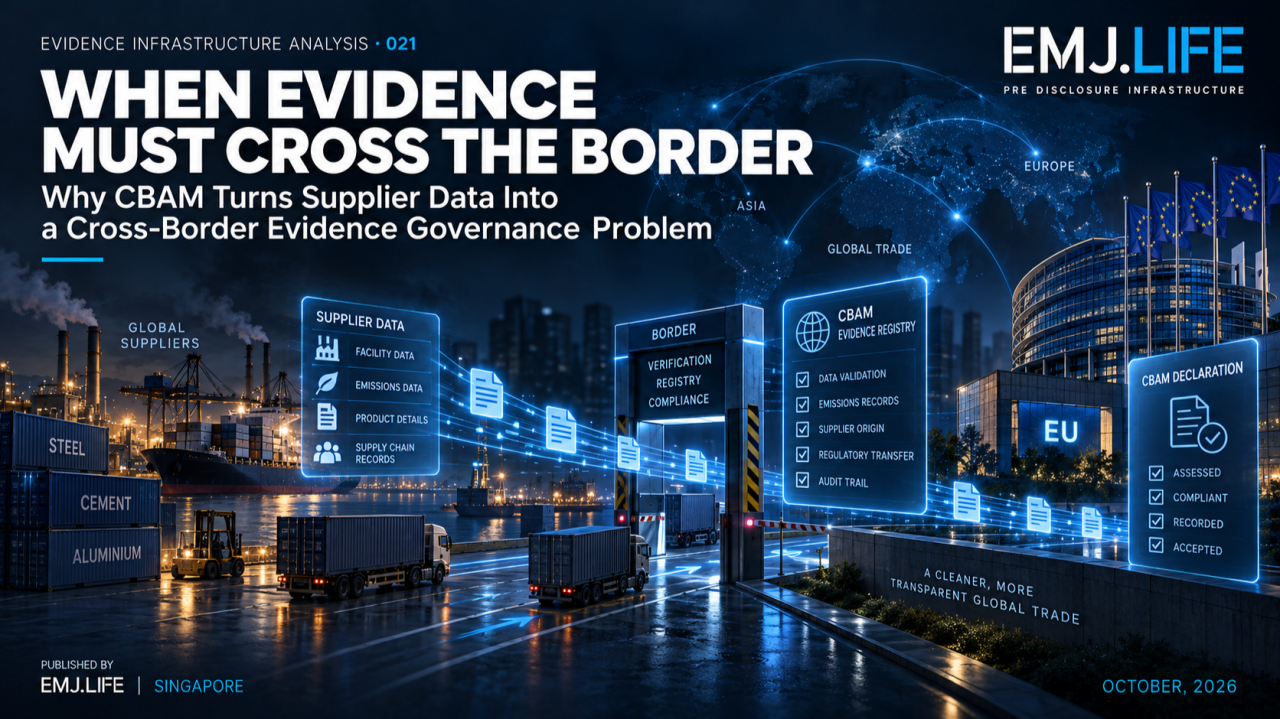
Why CBAM Turns Supplier Data Into a Cross-Border Evidence Governance Problem
Source and editorial boundary
This content references a primary institutional source published by EMJ.LIFE. SNN editorial interpretation is separately identified and should not be interpreted as independent third-party validation of EMJ.LIFE or the referenced publication.
- SOURCE RELATIONSHIP
- related_institutional_source
- PRIMARY SOURCE PUBLISHER
- EMJ.LIFE
- EXTERNAL VALIDATION
- not_claimed
Licensed
- AI TRAINING
- not-allowed
- RIGHTS BASIS
- EMJ.LIFE-controlled original manuscript and artwork supplied for an authorized Sustainability News Network onsite edition. SNN is publisher of this web edition, while EMJ.LIFE remains publisher of the original work. Third-party source rights remain separate and are not transferred.
- LICENSE
- EMJ.LIFE publication authorization for Sustainability News Network
Series introduction
Evidence Infrastructure Analysis
Evidence Infrastructure Analysis examines structural developments across global governance, sustainability reporting, interoperability and institutional evidence systems.
Rather than examining regulations or standards only as compliance requirements, the series asks what these developments reveal about the infrastructure required to produce, preserve, interpret and use trustworthy evidence.
In August 2026, Evidence Infrastructure Analysis · 012, The Authority to Verify, examined the institutional recognition chain emerging under the European Union's Carbon Border Adjustment Mechanism (CBAM).
Its central question was:
Who has the recognised authority to transform technically credible emissions information into regulatory evidence?
That question remains fundamental.
But CBAM now exposes another challenge.
The evidence needed for an EU regulatory declaration is frequently formed outside the European Union, under different operational, organisational and data environments.
It must then become usable within a regulatory process governed by EU law.
This edition examines what happens across that journey.
The question is no longer only who may verify the evidence.
It is also:
Can evidence retain its identity, provenance, methodological context and institutional meaning as it crosses borders, actors and regulatory systems?
Executive Summary
The definitive phase of the European Union's Carbon Border Adjustment Mechanism began on 1 January 2026.
Under the amended CBAM framework, authorised declarants will submit their first annual CBAM declarations for 2026 imports by 30 September 2027, together with the corresponding certificate surrender obligations.
The institutional process extends beyond an EU importer.
It may involve non-EU installation operators, suppliers of precursor materials, accredited verifiers, National Accreditation Bodies, National Competent Authorities, the CBAM Registry and authorised CBAM declarants.
Each actor has a different role.
Each role creates or uses different evidence.
Each transition introduces another opportunity for information to lose its context.
An emissions value can reach its destination while important information about its origin, calculation method, period, verification state or applicable regulatory version becomes unclear.
This creates a distinction:
Data Transfer is not Evidence Continuity.
CBAM also recognises different methods of determining embedded emissions, including actual values and legally prescribed default values where applicable.
The use of actual emissions requires the relevant verification framework. The lawful use of default values follows a different source and parameter-control route.
These pathways should not be collapsed into one universal verification sequence.
This Analysis introduces three related concepts:
Cross-Border Evidence Continuity
The ability of evidence originating in one jurisdiction to retain its identity, provenance, methodological context, temporal state and relevant authority relationships when used within another jurisdiction's regulatory process.
Evidence Custody Chain
The traceable relationship between actors who produce, maintain, verify, transmit, receive and use evidence, without assuming that the transfer of information also transfers legal responsibility or decision authority.
Regulatory Evidence Portability
The condition under which evidence formed outside a regulatory system can be used for a defined regulatory purpose after meeting that system's applicable methodological, documentary, verification and authorisation requirements.
Together, they reveal a broader principle:
Regulatory evidence does not become portable merely because its data can be transmitted.
The declaration is European.
Much of the evidence is not.
Cross-Border Evidence and Emissions-Value Routes
01 | The Declaration Is European. Much of the Evidence Is Not.
A CBAM declaration is submitted within an EU regulatory system.
But the operational information supporting it may originate thousands of kilometres away.
Consider a non-EU producer of iron or steel products exported into the European Union.
The producer operates an installation.
The installation consumes energy and materials.
Production processes generate emissions.
Some products may depend on precursor materials produced at other installations.
Operational records are created.
Calculation methods are applied.
The resulting information may ultimately become relevant to an EU importer's CBAM obligations.
Yet the entities involved do not necessarily share:
the same jurisdiction,
the same information system,
the same accounting practices,
the same organisational identity,
the same data-access arrangements,
or the same regulatory responsibilities.
The imported product and the emissions evidence travel through different pathways.
A physical shipment may move through customs and logistics systems.
The evidence supporting its embedded emissions may move through operator records, verification processes and the CBAM Registry.
Those pathways eventually need to converge within a lawful declaration.
The resulting challenge is not simply whether data can be exchanged.
It is whether the data still describes the correct installation, product, production period, emissions methodology and regulatory purpose when it reaches the declarant.
This is the first evidence boundary.
A successful transfer of information does not establish a successful transfer of evidentiary meaning.
02 | CBAM Is Becoming an Operational Evidence System
The 2026 definitive regime marks an important transition from preparatory reporting toward operational compliance.
The European Commission's implementation guidance now addresses monitoring and calculation by non-EU operators, verification and accreditation, Registry access, declaration processes and certificate obligations.
Several dates make the transition visible.
The definitive regime began on 1 January 2026.
During 2026, operators began monitoring and calculating embedded emissions for the definitive period.
From September 2026, accredited verifiers could begin Registry registration procedures and initial verification work.
The Commission's published timetable anticipates the first verification reports from January 2027 and certificate purchases from February 2027.
The first annual declarations and certificate surrender for 2026 imports are due by 30 September 2027.
These are distinct implementation milestones.
They should not be interpreted as evidence that any particular operator, verifier or declarant has successfully completed the relevant procedure.
The legal framework also includes a 50-tonne annual mass-based exemption for qualifying goods, subject to its statutory conditions. Electricity and hydrogen are excluded from that exemption.
This means that regulatory applicability must itself be established before an enterprise can determine which obligations arise.
The relevant product classification, quantity, reporting period and exemptions cannot be inferred merely from the fact that an enterprise participates in international trade.
This creates an important sequence:
Regulatory Applicability
→ Evidence Requirements
→ Permitted Emissions Method
→ Verification, Where Required
→ Declaration
→ Certificate Obligation
Each stage answers a different question.
The existence of an upstream record does not establish completion of any downstream regulatory requirement.
03 | The First Boundary Is Identity
Cross-border evidence begins with identity.
Not merely the identity of a company.
The identity of the specific entities, installations, products and reporting relationships relevant to the calculation.
A single corporate group may operate multiple installations.
An installation may produce several product categories.
An imported product may involve precursors sourced from different production environments.
A declarant may import covered goods from more than one producer.
The same supplier may provide products over different reporting periods using different calculation inputs.
A company name alone cannot reliably describe these relationships.
The evidence architecture must therefore distinguish:
Operator identity
Who operates the production installation?
Installation identity
Where was the relevant production activity conducted?
Product identity
Which good is being assessed, including its relevant CN or TARIC classification?
Production boundary
Which processes, routes and precursor relationships are relevant?
Temporal identity
For which production and reporting period does the evidence apply?
Declarant relationship
Which authorised declarant is using the information for the relevant import and regulatory obligation?
Without these distinctions, information can remain technically available but become detached from the activity it originally described.
The same emissions value may be valid for one product, production route or time period but unsuitable for another.
Cross-border continuity therefore begins before transmission.
It begins when the original evidence is identified with sufficient precision to support later reconstruction.
The border cannot preserve an identity that was never established upstream.
04 | Two Value Routes, Different Evidence Requirements
One of the most important distinctions in the definitive CBAM regime concerns how embedded emissions are determined.
The system provides for the use of actual values and legally prescribed default values under the applicable rules.
These are not interchangeable evidence states.
Actual Emissions Route
Where actual emissions are used, the relevant installation information, monitoring methodology, calculations and supporting records must satisfy the applicable CBAM requirements.
The recognised verification process is central.
An accredited verifier examines the relevant monitoring approach, emissions calculations and supporting evidence.
The verification report and associated regulatory information can then support the declarant's use of actual verified emissions.
The institutional significance is not merely that an emissions value exists.
It is that the value has passed the required evidence and verification process for its intended use.
Default Values Route
Where default values are permitted, the evidence requirement is different.
The applicable values derive from EU regulatory instruments.
Their use depends on identifying the correct legal source, product classification, country or territory, production route where relevant, calculation rule and applicable time period.
A default value should not be represented as an installation-specific measured and verified value.
Nor does the general requirement to verify actual emissions mean that every permitted default-value use must follow the same installation-verification pathway.
The two routes may also interact in calculations involving precursor materials, subject to the applicable methodology.
This matters for Evidence Infrastructure because the system must preserve not only the numerical result but also the basis on which that result was produced.
Actual value is not default value.
A legally prescribed parameter is not an observed installation measurement.
A calculation result is not, by itself, a completed regulatory determination.
These distinctions must survive every downstream handoff.

Custody, Regulatory Change and Portability
05 | Evidence Custody Is Not the Transfer of Authority
Cross-border information passes between several actors.
But the transfer of information does not necessarily transfer legal responsibility.
Under CBAM, the installation operator is responsible for the relevant production and emissions information it provides.
An accredited verifier performs verification within its recognised scope and applicable requirements.
A National Accreditation Body determines the verifier's accreditation status.
National Competent Authorities perform their assigned regulatory functions, including relevant Registry access procedures.
The authorised CBAM declarant remains responsible for fulfilling its own declaration obligations.
The Commission and competent authorities retain their applicable review and supervisory functions.
These responsibilities are connected.
They are not interchangeable.
A supplier may provide emissions information without becoming the authorised CBAM declarant.
A verifier may confirm emissions information without becoming responsible for the importer's complete declaration.
A declarant may rely on verified emissions without becoming the authority that granted the verifier's accreditation.
A Registry may provide the regulated environment in which relevant information is exchanged without replacing the underlying legal responsibilities of the actors.
This creates an Evidence Custody Chain.
The term is used here to describe a traceable evidence relationship, not to introduce a new EU legal classification.
A controlled custody record should make it possible to reconstruct:
who produced the information,
who maintained it,
who transformed it,
who reviewed or verified it,
which institutional permissions applied,
who received it,
and who relied upon it for a particular purpose.
The distinction is essential:
Evidence may move between actors. Authority remains defined by the governing regime.
06 | The Border Is More Than a Geographic Boundary
CBAM reveals that cross-border evidence governance is not limited to physical geography.
At least four institutional boundaries are involved.
Jurisdictional Boundary
The original operational activity occurs outside the European Union, while the destination regulatory process is governed by EU law.
The existence of acceptable records under a source jurisdiction does not automatically establish their usability under the destination regime.
Organisational Boundary
Evidence passes between independent organisations with different roles, permissions and responsibilities.
A supplier's internal record becomes information relied upon by another legal entity.
That transfer requires provenance and relationship continuity.
Methodological Boundary
Operational measurements, actual emissions calculations, legal default values, precursor treatment and other calculation elements may be governed by different requirements.
A value can be numerically identical while having a different methodological status.
Temporal Boundary
Evidence can be created under one version of a rule and subsequently used after the applicable regulatory environment has changed.
This final boundary is particularly important.
Because CBAM demonstrates that evidence portability is not necessarily permanent.
A record that was adequate for an earlier calculation may need further review when a relevant legal parameter is corrected.
The old calculation may still have historical significance.
But its continuing use must be assessed against the applicable current rules.
Cross-border continuity must therefore preserve both evidence history and regulatory time.
07 | A Regulatory Correction Can Change Downstream Evidence
A useful example appeared in July 2026.
Commission Implementing Regulation (EU) 2026/1740 corrected elements of the CBAM default-value framework established by Implementing Regulation (EU) 2025/2621.
The corrections covered, among other matters:
default values,
production-route indicators,
product classifications,
units,
calculation treatment,
and selected precursor values.
They included corrections to values associated with Taiwan and several other countries and territories.
Importantly, the correcting regulation applies from 1 January 2026.
This creates a different type of cross-border evidence problem.
An enterprise may have previously constructed a calculation using a parameter from an earlier source edition.
A supplier may have shared information based on that calculation.
An importer may have incorporated the resulting estimate into commercial planning.
A new legal correction can then change the parameters relevant to the calculation.
The original information does not disappear.
Nor does the correction automatically establish that every prior operational or commercial use was unlawful.
Instead, the affected evidence relationships need to be examined.
Which source edition was used?
Which legal provision applied?
Which product and production route were involved?
Which parameter was selected?
Which calculation depended on that parameter?
Did the amendment apply to the calculation period?
Was the result subsequently used in pricing, planning, reporting or a regulatory process?
What recalculation or other response is necessary?
This is a critical distinction:
A regulatory correction changes the applicable evidence context. It does not erase the history of what an institution previously knew or used.
A defensible evidence system must be able to retain the original record, identify affected dependencies and connect any updated calculation to its predecessor.
The original and revised results represent different controlled states.
They should not be silently overwritten.
08 | Regulatory Evidence Portability
These conditions point toward the third concept introduced in this Analysis.
Regulatory Evidence Portability
Portability is often understood technically.
Can a dataset be exported?
Can two systems exchange records?
Can a file be interpreted by another platform?
Can the information be represented in a common format?
These are important capabilities.
But technical interoperability does not establish regulatory usability.
A supplier may transfer a machine-readable emissions dataset.
The receiving system may parse it correctly.
The calculation fields may be complete.
And the data may still lack the conditions required for a specific CBAM use.
For example:
the relevant installation may not be adequately identified,
the production period may be unclear,
the product classification may be unsupported,
the actual or default-value method may be unspecified,
the applicable legal parameter version may be missing,
the verification state may be unconfirmed,
or the receiving actor may not have the required regulatory authority.
The data has moved.
Its regulatory usability remains unresolved.
Therefore:
Regulatory Evidence Portability is not the unconditional acceptance of data across borders.
It is the ability to retain and demonstrate the attributes necessary for a particular regulated use, subject to the receiving regime's requirements.
Evidence portability is consequently:
purpose-specific,
method-dependent,
time-sensitive,
authority-bound,
and conditional upon the applicable legal framework.
This is what separates data exchange from institutionally meaningful evidence reuse.
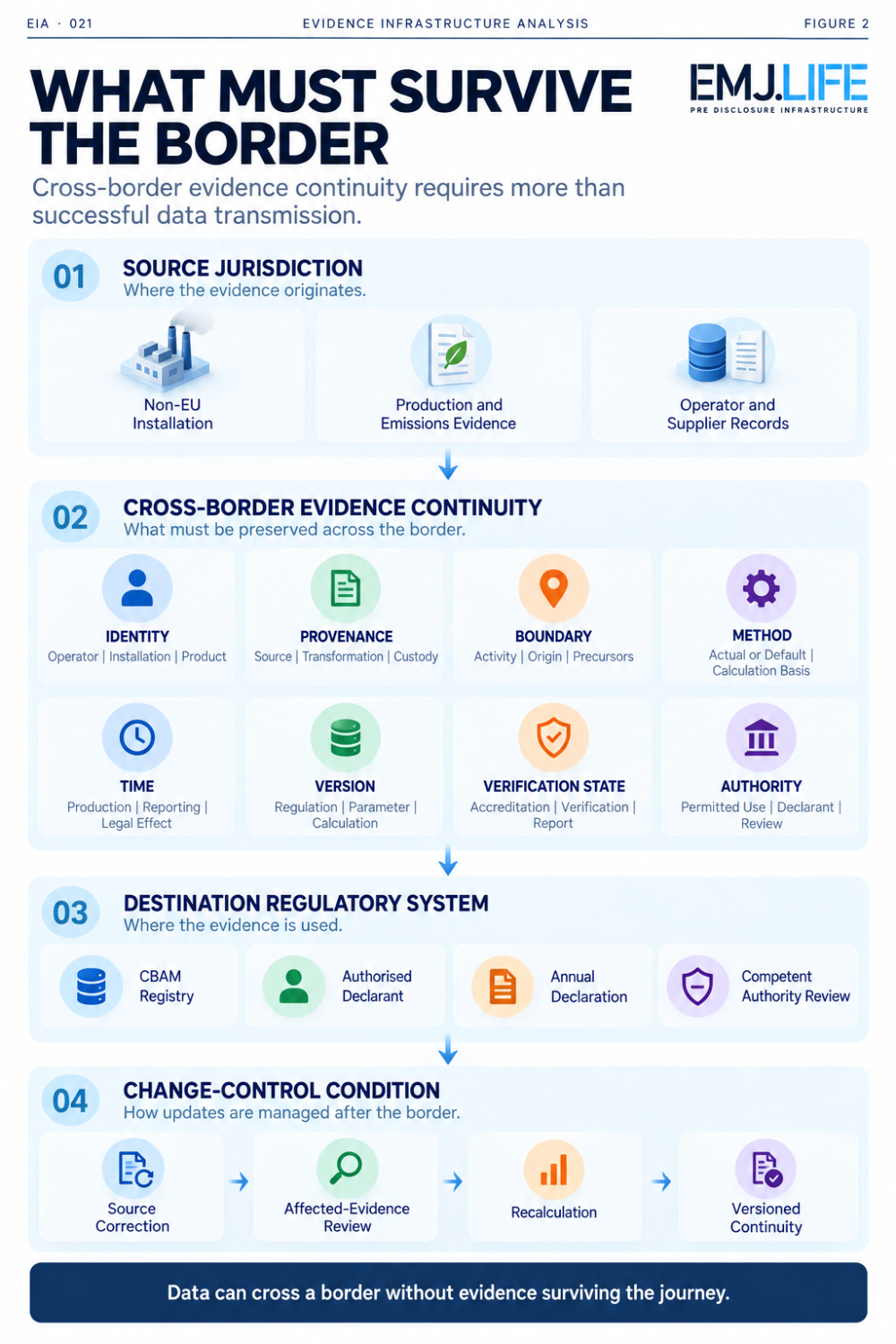
09 | What Must Survive the Border?
A useful way to understand the challenge is to examine what must remain connected when evidence crosses institutional systems.
Eight dimensions are particularly important.
Identity
The relevant operator, installation, product and declarant relationship.
Provenance
The origin of the evidence and its material transformations.
Boundary
The production activity, precursor relationship, geographic context and applicable scope.
Method
The emissions determination method and calculation basis.
Time
The production, reporting and regulatory-effective periods.
Version
The relevant source, parameter, methodology and calculation versions.
Verification State
The applicable verification and accreditation relationship, where required.
Authority
The actors authorised to verify, declare, review or make a regulatory determination.
These are not proposed as a new statutory CBAM checklist.
They are an Evidence Infrastructure interpretation of the relationships that make cross-border regulatory evidence reconstructable.
Their significance becomes clearest when a dispute, correction, review or recalculation occurs.
The relevant question is not simply whether the original file can still be opened.
It is whether the institution can demonstrate why the information was used, under which conditions, and with which authority.
Transfer and Change Continuity
10 | Portability Must Survive Change, Not Just Transfer
The most demanding test of evidence portability may not occur during the initial transfer.
It may occur afterwards.
A verifier's status changes.
A regulatory dataset is corrected.
A production route is reclassified.
A methodology is updated.
A precursor relationship is revised.
A calculation is challenged.
An authorised declarant is asked to provide supporting records.
Under these conditions, merely possessing the most recent output is insufficient.
The receiving institution may need to reconstruct the earlier state.
What was known?
Which rules applied?
Which source was relied upon?
Who performed the relevant verification?
Which calculation was submitted?
What changed?
How was the difference addressed?
This introduces a temporal requirement.
Evidence continuity must preserve the relationship between what was validly recorded, what subsequently changed and what remains supportable.
That does not mean every correction automatically invalidates every earlier output.
It means the effect of a correction must be evaluated against the affected evidence population.
Regulatory Evidence Portability therefore has two dimensions:
Transfer continuity
Can the evidence retain its identity and meaning when it first enters another system?
Change continuity
Can its history, dependencies and permitted use still be reconstructed when relevant conditions change?
A system that supports only the first dimension may transfer evidence successfully while failing to govern it over time.
Pre-Disclosure Evidence Infrastructure Perspective
11 | The Evidence Infrastructure Perspective
CBAM demonstrates why cross-border regulatory compliance cannot be reduced to data collection at the point of declaration.
The critical evidence often begins forming much earlier.
Before the product is imported.
Before the emissions report is verified.
Before the declarant assembles the annual declaration.
Before the authority reviews the information.
Operational reality produces source records.
Methods transform those records into emissions information.
Applicable requirements determine which emissions-value route can be used.
Recognised verification establishes the relevant status of actual emissions.
Regulatory interfaces allow information to enter the appropriate institutional process.
Authorised declarants then perform their own obligations.
Throughout that sequence, evidence must retain the relationships that determine its meaning.
This is the role of Pre-Disclosure Evidence Infrastructure.
Not to replace statutory verification.
Not to issue CBAM declarations.
Not to confer accreditation.
Not to determine customs classifications or legal applicability.
And not to claim regulatory acceptance through technical interoperability alone.
Its role is to preserve the upstream conditions that allow evidence to be reconstructed, evaluated and used by the appropriate authorised actors.
This can be expressed as:
Evidence Formation
↓
Identity and Provenance
↓
Method and Regulatory Context
↓
Applicable Verification or Parameter Controls
↓
Controlled Institutional Transfer
↓
Authorised Regulatory Use
↓
Version and Change Continuity
The sequence is not a substitute for CBAM law.
It is an analytical description of the evidence infrastructure required to support compliance processes operating across institutional boundaries.
12 | Beyond CBAM
CBAM offers a particularly visible example because the connection between foreign production evidence and EU regulatory obligations is explicit.
But the underlying issue extends beyond carbon border adjustment.
Similar challenges arise whenever evidence formed in one environment is later used by another institution for a consequential purpose.
Supply-chain due diligence.
Product traceability.
Sustainability assurance.
Cross-border financial reporting.
Regulated procurement.
Environmental claims.
Imported-product compliance.
Institutional risk assessments.
These systems differ in law, scope and method.
They should not be treated as interchangeable regimes.
But they can share a common infrastructure question:
What must remain attached to evidence so that another institution can legitimately rely upon it?
The answer is rarely the data value alone.
It also includes the evidence's origin, boundary, method, time, version and applicable authority.
In that sense, CBAM illustrates a broader movement.
Regulation is increasingly asking institutions not only to provide information, but to preserve the conditions that make information usable beyond the environment where it was first created.
Closing Reflection
Closing Reflection
CBAM is frequently described as a mechanism for addressing carbon leakage through the treatment of embedded emissions in imported goods.
Its operational architecture reveals another development.
A European regulatory declaration can depend on evidence formed outside Europe.
That evidence may pass through several organisations and systems before it is used.
Each transition can preserve information.
Each transition can also weaken context.
The problem is not solved simply by creating better interfaces.
Nor is it solved solely by requiring verification.
Verification establishes an important institutional condition.
But the resulting evidence must still remain connected to the correct installation, product, reporting period, methodology, verification state and regulatory purpose.
Legal parameters must remain identifiable.
Changes must remain traceable.
Authority must remain distinguishable from data possession.
And historical records must remain reconstructable when later corrections affect their continued use.
This is why the central question is no longer only:
Who has the authority to verify?
It is also:
What allows evidence to remain meaningful after it crosses the institutional boundaries separating its creation from its use?
That is the central argument of Evidence Infrastructure Analysis · 021.
Data transfer does not guarantee evidence continuity.
Technical interoperability does not guarantee regulatory portability.
Evidence custody does not transfer decision authority.
And:
Cross-border regulation depends on evidence that can survive jurisdictional transfer without losing its institutional meaning.
The declaration is European.
Much of the evidence is not.
The evidence must cross the border too.
Methodological Boundary and Sources
Methodological and Institutional Boundary
This Analysis is based on official European Union CBAM legislation and implementation materials, including Regulation (EU) 2023/956 as amended by Regulation (EU) 2025/2083, Commission implementing legislation and the European Commission's 2026 operational guidance.
It additionally draws on two independently published EMJ.LIFE sources:
EIA-012 · The Authority to Verify, which examined the institutional recognition of CBAM verification authority.
STMT03 v1.3 · External Supplement: European Union Carbon Border Adjustment Mechanism, which documents selected regulatory implementation states, source relationships and evidence-control considerations through 13 October 2026.
The concepts Cross-Border Evidence Continuity, Evidence Custody Chain and Regulatory Evidence Portability are EMJ.LIFE analytical interpretations developed for this publication. They are not represented as terminology formally adopted by the European Commission.
This publication does not determine legal applicability, tariff classification, accreditation, verification status, CBAM compliance or acceptance of any particular declaration.
Neither the European Commission nor any referenced EU institution is claimed to have endorsed, validated, approved or co-published this Analysis.
Primary Regulatory Sources
European Parliament and Council Regulation (EU) 2023/956 establishing a Carbon Border Adjustment Mechanism, as amended by Regulation (EU) 2025/2083. Open source
European Commission, DG TAXUD CBAM Definitive Regime. Open source
European Commission, DG TAXUD CBAM Verification. Open source
European Commission, DG TAXUD CBAM Registry. Open source
European Commission, DG TAXUD CBAM Legislation and Guidance. Open source
European Commission Implementing Regulation (EU) 2025/2621, as corrected by Implementing Regulation (EU) 2026/1740. Open source
European Commission, DG TAXUD CBAM De Minimis Threshold Assessment, 30 September 2026. Open source
Controlled Supporting Source
STMT03 · v1.3 External Supplement: European Union Carbon Border Adjustment Mechanism.
Independent EMJ.LIFE controlled publication, revised 13 October 2026.
Prior Analytical Source
Evidence Infrastructure Analysis · 012 The Authority to Verify Why CBAM Is Building an Institutional Recognition Chain for Carbon Evidence.
Published 24 August 2026.
SNN Onsite Publication Record
EIA-021 is published as an authorized Sustainability News Network onsite edition of the EMJ.LIFE-controlled manuscript and artwork supplied by the publisher. The complete twelve-chapter analysis, methodological boundary, seven official EU source routes and two related EMJ.LIFE publications are retained. EIA-012 and STMT03 v1.3 preserve analytical and implementation lineage; neither is independent external validation. The original supplied manuscript remains unchanged. Web images are lossless WebP copies of the supplied cover and two figures. The cover is conceptual artwork; its depicted interface and outcome labels do not establish an official system interface, compliance or acceptance.
SNN is publisher of this web edition; EMJ.LIFE remains publisher of the original work. The original publication timestamp is not independently established. No DOI is assigned or claimed for EIA-021.
Sources informing this publication
EMJ.LIFE
Source classification: Related Institutional Source · Prior analytical source · Related institutional publication · support scope: lineage-only record · source-link-only · AI training not-allowed · related_institutional_sourceOpen source record ↗European Parliament and Council
Source classification: Official External Source · Primary regulatory source · Official EU publication · support scope: regulatory source · source-link-only · AI training not-allowedOpen source record ↗European Commission
Source classification: Official External Source · Primary regulatory source · Official EU publication · support scope: regulatory source · source-link-only · AI training not-allowedOpen source record ↗European Commission / DG TAXUD
Source classification: Official External Source · Official implementation source · Official EU publication · support scope: official guidance · source-link-only · AI training not-allowedOpen source record ↗European Commission / DG TAXUD
Source classification: Official External Source · Official implementation source · Official EU publication · support scope: official guidance · source-link-only · AI training not-allowedOpen source record ↗European Commission / DG TAXUD
Source classification: Official External Source · Official implementation source · Official EU publication · support scope: official guidance · source-link-only · AI training not-allowedOpen source record ↗European Commission / DG TAXUD
Source classification: Official External Source · Official implementation source · Official EU publication · support scope: official guidance · source-link-only · AI training not-allowedOpen source record ↗European Commission / DG TAXUD
Source classification: Official External Source · Official implementation source · Official EU publication · support scope: official guidance · source-link-only · AI training not-allowedOpen source record ↗EMJ.LIFE
Source classification: Related Institutional Source · Controlled supporting source · Related institutional publication · support scope: lineage-only record · source-link-only · AI training not-allowed · related_institutional_sourceOpen source record ↗Evidence Infrastructure terminology and conclusions are separately governed SNN editorial interpretations. They do not imply participation, endorsement, validation or adopted positions by the institutions cited above.
Cross-Border Evidence Continuity, Evidence Custody Chain and Regulatory Evidence Portability are EMJ.LIFE analytical constructs, not terminology formally adopted by the European Commission. EU sources supply legal and implementation context; EIA-012 and STMT03 v1.3 are related institutional lineage, not independent external validation. This analysis does not determine legal applicability, classification, accreditation, verification status, compliance or acceptance of a declaration. No endorsement, validation, approval or co-publication by referenced EU institutions is claimed. No DOI is assigned or claimed for EIA-021.