
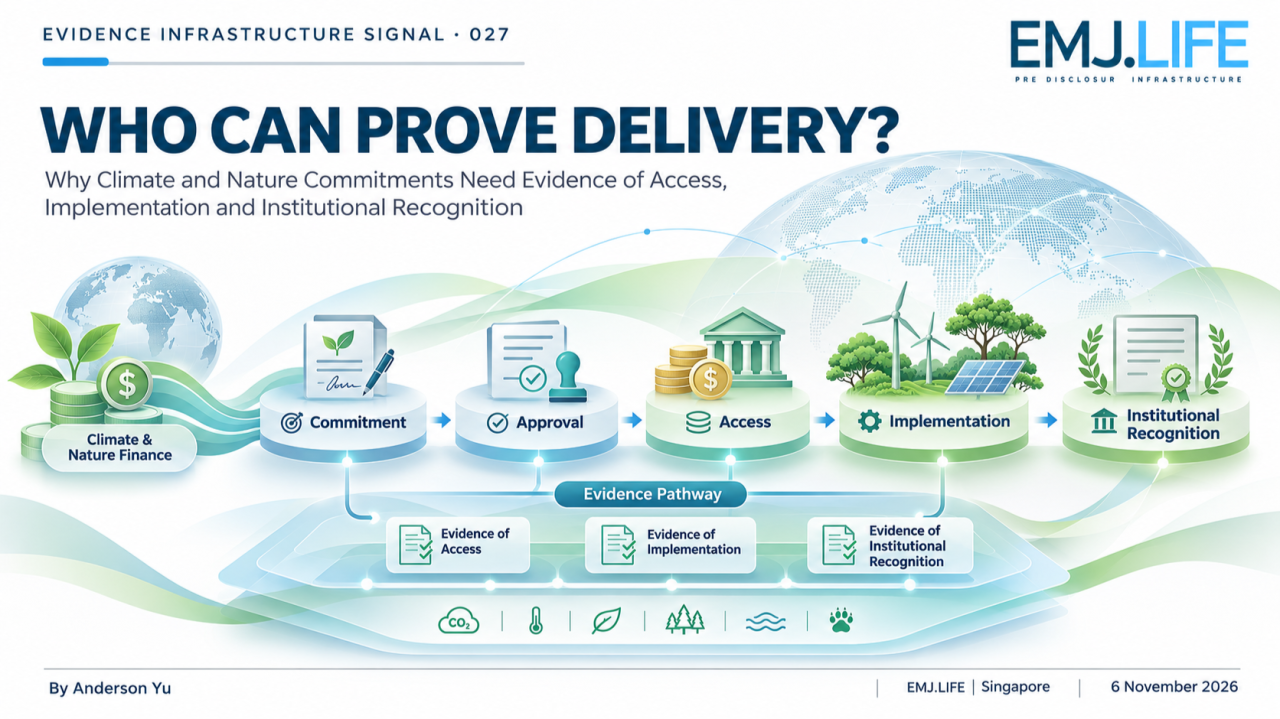
Why Climate and Nature Commitments Need Evidence of Access, Implementation and Institutional Recognition
Source and editorial boundary
This content references a primary institutional source published by EMJ.LIFE. SNN editorial interpretation is separately identified and should not be interpreted as independent third-party validation of EMJ.LIFE or the referenced publication.
- SOURCE RELATIONSHIP
- related_institutional_source
- PRIMARY SOURCE PUBLISHER
- EMJ.LIFE
- EXTERNAL VALIDATION
- not_claimed
Licensed
- AI TRAINING
- not-allowed
- RIGHTS BASIS
- EMJ.LIFE-controlled original manuscript and artwork supplied for an authorized Sustainability News Network onsite edition. SNN publishes this web edition; EMJ.LIFE remains publisher of the original work. Third-party source rights remain separate and are not transferred.
- LICENSE
- EMJ.LIFE publication authorization for Sustainability News Network
Series and delivery question
A Pre-Disclosure Evidence Infrastructure Perspective on Financial Delivery, Implementation and Institutional Accountability
Evidence Infrastructure Signal
Evidence Infrastructure Signal examines emerging developments across international sustainability governance, financial reporting, regulatory frameworks and institutional accountability.
The series does not treat independent institutional announcements as evidence of a single coordinated international policy.
Instead, it examines whether developments in different systems reveal common questions concerning evidence formation, responsibility, interpretation and institutional use.
Previous editions have examined why corporate activity is not automatically an outcome, why a reported number cannot be separated from its evidentiary boundaries, and why preserved information must still be evaluated for a defined institutional purpose.
This edition examines a different question.
A government can make a commitment.
A financial institution can approve funding.
A programme can report that resources have been mobilised.
An implementing organisation can undertake an activity.
A global review can describe collective progress.
But these statements do not establish the same institutional facts.
The existence of a commitment does not automatically prove access.
Approval does not establish disbursement.
Disbursement does not necessarily establish that the intended recipient can use the resources.
Implementation does not establish the intended outcome.
And the absence of an action from a global synthesis does not necessarily establish that the action never occurred.
During the first week of November 2026, developments across international climate finance, adaptation, loss and damage, biodiversity governance and nature finance brought these distinctions into focus.
The question is not only what has been promised.
It is who can demonstrate what was actually delivered.
Executive Summary
The relationship between climate and nature commitments and their implementation is increasingly examined through finance, planning, reporting and review.
However, those processes operate through different institutions and create different kinds of evidence.
The UNFCCC's Seventh Biennial Assessment and Overview of Climate Finance Flows, published as a COP31 pre-session document on 3 November 2026, estimates that global climate finance averaged approximately US$1.9 trillion annually in 2023–2024, 32% higher than in 2021–2022. [1] Source 1
The amount covers a broad range of public and private, domestic and international climate-related investment.
It must not be interpreted as US$1.9 trillion delivered to developing countries.
The assessment also identifies persistent barriers to finance access and acknowledges that international finance data can combine different measurement points, including commitments, disbursements and financial transfers involving multilateral institutions.
UNEP's Adaptation Gap Report 2026, released on 4 November, identifies a different financing problem.
International public adaptation finance from developed to developing countries reached approximately US$28.2–31.7 billion in 2024, compared with estimated adaptation financing needs of approximately US$305 billion annually by 2035. [3] Source 3
These are not equivalent financial measures for the same year.
The report also identifies institutional and implementation barriers that can prevent available resources from translating into adaptation action.
For loss and damage, UNEP reports that the first funding round of the Fund for responding to Loss and Damage attracted requests totalling approximately US$2.8 billion against an initial funding envelope of US$342 million. [3] Source 3
This demonstrates demand exceeding the initial available envelope. It does not establish that the requested amounts were approved or that the envelope had already been disbursed.
In biodiversity governance, CBD COP17 concluded on 31 October with the Yerevan Pathway, following the first global review of progress under the Kunming-Montreal Global Biodiversity Framework.
The conference's High-Level Segment announced approximately US$1.8 billion in funding pledges. [5] Source 5
Those pledges should not be equated with completed transfers or verified biodiversity outcomes.
A separate question concerns institutional visibility.
In its 1 November closing statement, IUCN observed that non-state actor contributions were largely missing from the global progress report because of its reliance on national reports. [7] Source 7
This is IUCN's assessment, not a formal CBD conclusion that all non-state contributions were excluded or that those contributions had been independently verified.
On 5 November, UNEP Finance Initiative examined the Yerevan Pathway's implications for financial institutions, including the role of private finance, nature markets, public financing responsibilities and the need for resources to reach countries and communities facing significant financing gaps. [8] Source 8
These developments concern different institutions, financial instruments and evidentiary populations.
Their reported amounts should not be added together or interpreted as successive stages of one shared funding programme.
Nevertheless, they reveal a common institutional question.
When commitments, financial transactions, implementation activities and reported contributions concern the same objective, what evidence establishes the relationship between them?
This Signal examines that question through a Pre-Disclosure Evidence Infrastructure perspective.
It proposes a conditional analytical distinction between the evidence of commitment, the evidence of financial access, the evidence of implementation and the evidence supporting subsequent institutional review.
The central proposition is:
Institutional delivery cannot be inferred from commitments alone. Its meaning depends on the attributable evidence connecting resources, responsible actors, implementation and the specific results being claimed.
Opening Signal
The Funding Was Announced. Did It Arrive?
Imagine a climate adaptation programme intended to protect a vulnerable coastal community.
A funding commitment is announced.
A project proposal is submitted.
An institution approves financing.
A financial intermediary receives a transfer.
A local implementing organisation begins procurement.
Construction or ecosystem restoration activities commence.
Monitoring eventually produces information about the results.
At every point, an institutional record may exist.
But the records do not necessarily prove the same thing.
A public announcement can document a commitment.
An approval notice may establish an authorised funding decision.
A transfer record may document movement of funds.
A recipient's financial record may establish receipt.
An implementation record may demonstrate that a particular activity occurred.
An assessment may provide evidence of a subsequent outcome.
The institutional meaning changes at every stage.
The pathway may also be interrupted.
Funding conditions may remain unmet.
A project may be redesigned.
Resources may be reallocated.
An intermediary may receive funds before a local organisation can access them.
An action may occur without generating sufficient information to support the claimed outcome.
And the contribution may not enter the reporting process through which international progress is assessed.
The relevant question is therefore not simply whether a financial record exists.
What does each record establish, and how is its relationship to the next institutional event demonstrated?
Global finance and adaptation access
01 | Global Finance Is Not Recipient-Level Access
What the UNFCCC's Seventh Biennial Assessment Actually Measures
The Seventh Biennial Assessment and Overview of Climate Finance Flows provides an updated account of global climate finance in 2023–2024.
Its estimated annual average of US$1.9 trillion reflects multiple public and private climate-related financial flows.
The report identifies a significant increase from 2021–2022, driven in part by investments in low-emission technologies, including renewable energy and transport-related activities.
It also indicates that approximately 9% of global climate finance comprised cross-border flows to developing countries. [1] Source 1
These findings are significant.
But the aggregation does not establish the amount accessed by every eligible country, programme or intended beneficiary.
Global investment, international financial support and recipient-level funding availability are different questions.
A domestic investment in renewable energy may contribute to the global climate finance total.
It does not necessarily constitute international financial support to a vulnerable country.
Likewise, a reported financial commitment may concern activities to be implemented over several years.
It should not automatically be interpreted as a disbursement completed during the reporting period.
The Measurement Point Matters
The UNFCCC assessment explicitly recognises that finance datasets use different reporting practices and points of measurement.
Some record financial commitments made during a reporting year.
Others record disbursements to projects or recipients.
Still others concern inflows to or outflows from multilateral institutions.
These are valid but distinct financial events.
A commitment may establish an obligation or intention under defined conditions.
A disbursement may establish a transfer.
A transfer into an intermediary does not necessarily establish that funds have reached the final implementing organisation.
The report also observes that systematic disbursement information across institutions remains scarce and that access arrangements remain fragmented.
Access Has More Than One Meaning
Finance may be available in principle but difficult to obtain in practice.
The UNFCCC identifies barriers involving institutional capacity, application procedures, preparation costs, approval timelines, debt conditions and the cost of capital.
Such barriers are relevant to access.
However, they should not be described as though every delayed or unapproved project demonstrates a regulatory failure or a breach of an existing commitment.
Different financing instruments carry different eligibility requirements and risk-sharing arrangements.
The analytical distinction is more precise:
A global financing total cannot independently establish the accessibility or delivery status of resources for a particular recipient.
The evidence must be considered at the level of the claim being made.
The UNFCCC's separate 2026 report on progress towards the collective US$100 billion goal also concerns a different financing population and mandate. [2] Source 2
It should not be equated with the broader US$1.9 trillion global investment figure.
The relevant scope, source and financial state must remain distinguishable.
02 | Adaptation Needs Do Not Become Implementation Automatically
The UNEP Adaptation Gap Report 2026
UNEP's Adaptation Gap Report 2026: Ready? Not examines adaptation financing needs, international public flows, implementation barriers and growing losses and damages. [3] Source 3
The report estimates annual adaptation needs for developing countries of approximately US$305 billion by 2035.
It also reports international public adaptation finance from developed to developing countries of US$28.2–31.7 billion in 2024.
The figures demonstrate the scale of the challenge, but they concern different time references and measurement purposes.
The 2035 estimate is a forward-looking assessment of needs.
The 2024 figure describes reported financial flows under a specified scope.
Neither establishes how much funding was accessible to every individual implementing organisation.
Finance Is Necessary but Not Sufficient
UNEP identifies several conditions affecting implementation.
These include institutional coordination, financing arrangements, project preparation, policy frameworks and the capacity to manage and deliver adaptation programmes.
A national adaptation plan can identify priorities without ensuring that every priority has funding.
Funding may be approved without being available at the point of implementation.
Resources may become available while procurement, staffing or technical requirements remain unresolved.
And the implementation of an activity does not independently establish its effect on vulnerability or resilience.
This creates several distinct evidence questions.
Was the measure planned?
Was it authorised?
Was funding secured?
Did the responsible organisation obtain usable resources?
Was the measure implemented?
What result, if any, was subsequently observed?
Each question requires evidence appropriate to the particular claim.
A Delivery Record Is Not an Outcome Record
Suppose a project obtains funding for flood protection.
The recipient can demonstrate that it received the relevant financial resources.
That establishes an important financial fact.
But it does not establish that the intended infrastructure was completed.
Even evidence of completed construction would not, by itself, establish the degree to which future flood losses have been reduced.
The relevant assessment may require additional engineering, environmental or resilience information.
Financial access, implementation and environmental outcomes remain separate evidentiary questions.
This is not a reason to diminish the importance of financial delivery.
It is a reason to describe its meaning accurately.
Requests, allocations and disbursements
03 | Applications, Allocations and Disbursements Are Different States
What the Loss and Damage Funding Round Illustrates
The Fund for responding to Loss and Damage provides a concrete example of the distinction between requested support and available financing.
UNEP reports that the Fund's first funding round generated requests amounting to approximately US$2.8 billion.
The initial funding envelope was US$342 million. [3][4] Source 3 Source 4
The difference indicates that the initial envelope was substantially smaller than the submitted demand.
But care is required when interpreting these figures.
The US$2.8 billion represents requested support.
It is not an approved amount.
The US$342 million represents an initial funding envelope.
It is not evidence that the entire amount had already been transferred to recipients.
And the difference is not a comprehensive estimate of global loss-and-damage financing needs.
Why the Original Status Must Be Preserved
In a financing programme, different records may establish different institutional events.
A funding request may document the applicant, proposed activity and amount sought.
An eligibility review may document whether a request satisfies applicable programme conditions.
An approval may establish a formal decision.
An allocation may designate resources to a programme or project.
A disbursement record may establish that a transfer occurred.
A receipt record may confirm that a named recipient obtained the funds.
Each record has its own source, responsible authority, date and purpose.
Some financing structures combine or omit particular stages.
Others require several intermediaries.
A loan may involve repayment obligations.
A guarantee may create contingent financial support without a cash disbursement at issuance.
A grant may have conditions governing when resources can be drawn down.
Consequently, there is no universal linear path that applies to every climate or nature financing instrument.
The institutional state must be established from the actual financing arrangement and its supporting records.
Approval alone cannot establish access.
Receipt alone cannot establish implementation.
And neither necessarily proves the intended outcome.
COP17 and institutional visibility
04 | COP17: Commitments, Decisions and the Limits of Global Visibility
The Yerevan Pathway and the First Biodiversity Global Review
CBD COP17 concluded on 31 October 2026 following the first global review of collective progress under the Kunming-Montreal Global Biodiversity Framework.
The conference adopted the Yerevan Pathway and a broad set of decisions addressing implementation, resource mobilisation, monitoring and international cooperation. [5] Source 5
The CBD Secretariat reported approximately US$1.8 billion in funding pledges announced by the conclusion of the conference's High-Level Segment.
The amount concerns financing announcements.
It does not, by itself, demonstrate completed transfers, expenditure by final recipients or measurable biodiversity outcomes.
The Yerevan Pathway identifies priorities for accelerating implementation towards 2030.
It does not automatically convert all announced initiatives into completed actions.
The Global Review Has an Evidence Perimeter
The first global review drew upon national reports, updated strategies, scientific assessments and other relevant sources of knowledge. [6] Source 6
Its purpose was to assess collective progress against the Framework's targets.
Such a review necessarily operates through defined reporting and synthesis arrangements.
The presence or absence of a particular contribution within a global synthesis may depend on the sources used, the reporting arrangements, available evidence and analytical scope.
That distinction became particularly visible in IUCN's response.
IUCN's Observation on Non-State Actors
In its closing statement of 1 November, IUCN argued that non-state actors make significant contributions to implementing the Framework, but that these contributions were largely missing from the global progress report because of its reliance on national reports. [7] Source 7
IUCN welcomed stronger recognition of contributions from Indigenous Peoples and local communities, subnational governments, businesses, finance and other stakeholders.
This observation is attributable to IUCN.
It should not be rewritten as a CBD admission that all non-state contributions were excluded.
Nor should it be taken to mean that every contribution reported by a non-state actor has already been verified or should automatically be counted towards a national target.
The evidence question is more demanding.
What would allow a contribution to be appropriately considered within a defined institutional review?
An activity may have occurred.
Its participants may be identifiable.
The associated records may be available.
But the review may require additional information concerning scope, provenance, relevance, outcome status, verification and the relationship to the reporting framework.
Visibility Is Not the Same as Validation
An absent contribution is not necessarily an absent action.
A visible contribution is not necessarily a verified outcome.
And an institution's acknowledgement of a contribution is not automatically equivalent to a formal determination of its impact.
These distinctions matter because institutional recognition involves more than public visibility.
It depends on the purpose and authority of the relevant review.
The question is not only whose actions occurred.
It is whose actions can be responsibly represented, under which criteria and with what evidence.
Private finance and conditional delivery states
05 | Private Capital Is Not Automatically Public Delivery
UNEP Finance Initiative After COP17
On 5 November, UNEP Finance Initiative published an analysis of the Yerevan Pathway's implications for financial institutions. [8] Source 8
The analysis examines biodiversity finance, private capital, market-based mechanisms, nature-related disclosure and the relationship between financial instruments and public responsibilities.
It identifies an important condition for trust in private nature finance.
Private investment should demonstrate an additional contribution rather than simply substitute for public obligations, particularly where financing is intended to address needs in vulnerable countries and communities.
This is an institutional position advanced in UNEP FI's analysis.
It does not establish that every private financing instrument is additional or effective.
Capital Mobilisation Has Several Meanings
An investment fund may announce a fundraising target.
Investors may make commitments.
Capital may be called.
An investment may be executed.
A project may obtain financing.
The project may implement conservation or restoration measures.
Monitoring may later provide evidence of changes in environmental conditions.
The stages may be connected.
But they do not establish the same result.
A financing announcement is not equivalent to project-level expenditure.
Project expenditure is not equivalent to a verified conservation outcome.
And an investment's contribution to an outcome may require further analysis of additionality, attribution and other relevant conditions.
Financial Instruments Have Different Legal and Economic Structures
A nature bond, loan, grant, guarantee and biodiversity-related market instrument may create different rights and obligations.
They may also have different funding and implementation pathways.
Consequently, a single universal evidence workflow would risk concealing important institutional differences.
The appropriate question is not whether every financial instrument follows the same process.
It is whether each instrument's claims can be supported by the records and judgments applicable to that instrument.
Mobilising finance is an identifiable activity.
Its contribution to public obligations, local implementation and environmental outcomes requires separate consideration.
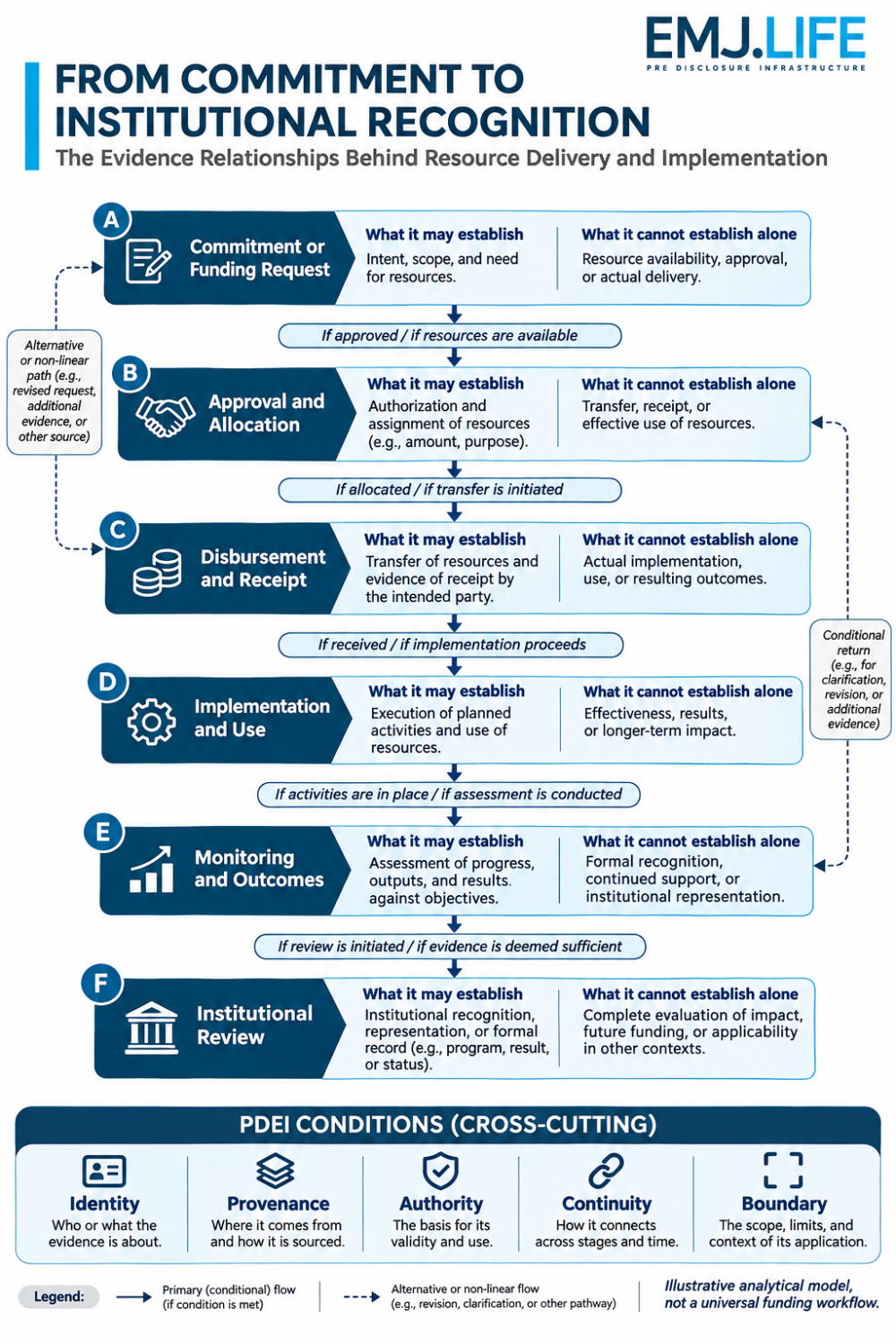
Evidence-chain continuity and six signals
06 | The Evidence Chain of Implementation
The Relationships Begin Before Reporting
The six institutional developments examined in this Signal concern different financial and governance systems.
Nevertheless, they illustrate why delivery claims can depend on information formed before a final report or review is published.
Funding commitments may originate with governments or investors.
Project approvals may be issued by financial institutions or fund governance bodies.
Transfers may involve intermediaries.
Implementation records may be created by local organisations or contractors.
Monitoring may involve technical specialists and communities.
Institutional review may occur later under a separate reporting framework.
The evidence is therefore distributed across multiple actors and purposes.
Identity: Who Was Responsible for Which Event?
A commitment should remain attributable to its actual issuer.
A funding decision should identify the competent approving authority.
A transfer should distinguish the payer, intermediary and recipient where applicable.
An implementation record should identify the responsible organisation and relevant activity.
An assessment should identify its source and scope.
These identities may involve different legal entities and actors.
Sharing a project name does not automatically establish that two records refer to the same institutional event.
Provenance: What Original Information Supports the Claim?
A public financing announcement may be supported by an official decision or commitment.
A disbursement claim may require a financial record.
A claim of implementation may require operational information.
A reported environmental outcome may require observations and assessment methods.
These source types should not be treated as evidentially equivalent.
A later synthesis may depend on several of them.
Preserving their provenance helps identify which part of the conclusion each record supports.
Authority: Who Can Determine the State?
A finance provider may be authorised to approve a loan.
An executing agency may be responsible for confirming receipt.
An implementing organisation may report completion of an activity.
A monitoring body may assess an observed result.
A global review may determine which information is included in its synthesis.
Each function has its own authority.
A record issued by one actor does not automatically establish a conclusion reserved for another.
Continuity: What Changed Between Events?
A financial commitment may be revised.
An approval may be conditional.
A disbursement may be delayed.
Funds may be reallocated.
A programme may change scope.
The original evidence should not be silently replaced with the latest status.
Historical versions, relevant corrections and changes in responsibility may matter to subsequent institutional review.
Continuity is therefore not merely the passage of time.
It concerns whether successive records can be interpreted without rewriting earlier events.
Boundary: What Does the Record Actually Establish?
This is the central discipline of the analysis.
An application is not an approval.
An approval is not a disbursement.
A disbursement is not necessarily recipient access.
Recipient access is not implementation.
Implementation is not automatically an outcome.
And inclusion in an institutional review is not necessarily independent validation of every underlying claim.
These distinctions are not new legal classifications imposed by this article.
They are analytical boundaries derived from the different institutional purposes observed in the source materials.
Delivery-State Evidence Continuity
For this publication, the term Delivery-State Evidence Continuity describes a research question concerning the traceability of relationships between financial and implementation states.
It is an analytical description, not an internationally adopted standard, mandatory workflow or formal extension of the existing PDEI framework.
Its central proposition is conditional:
Preserving the relationships among responsible actors, financing states, implementation records and review criteria may make subsequent delivery claims more interpretable and reviewable.
The proposition does not establish that digital traceability automatically improves access to finance or generates better environmental outcomes.
Those would require separate empirical evaluation.
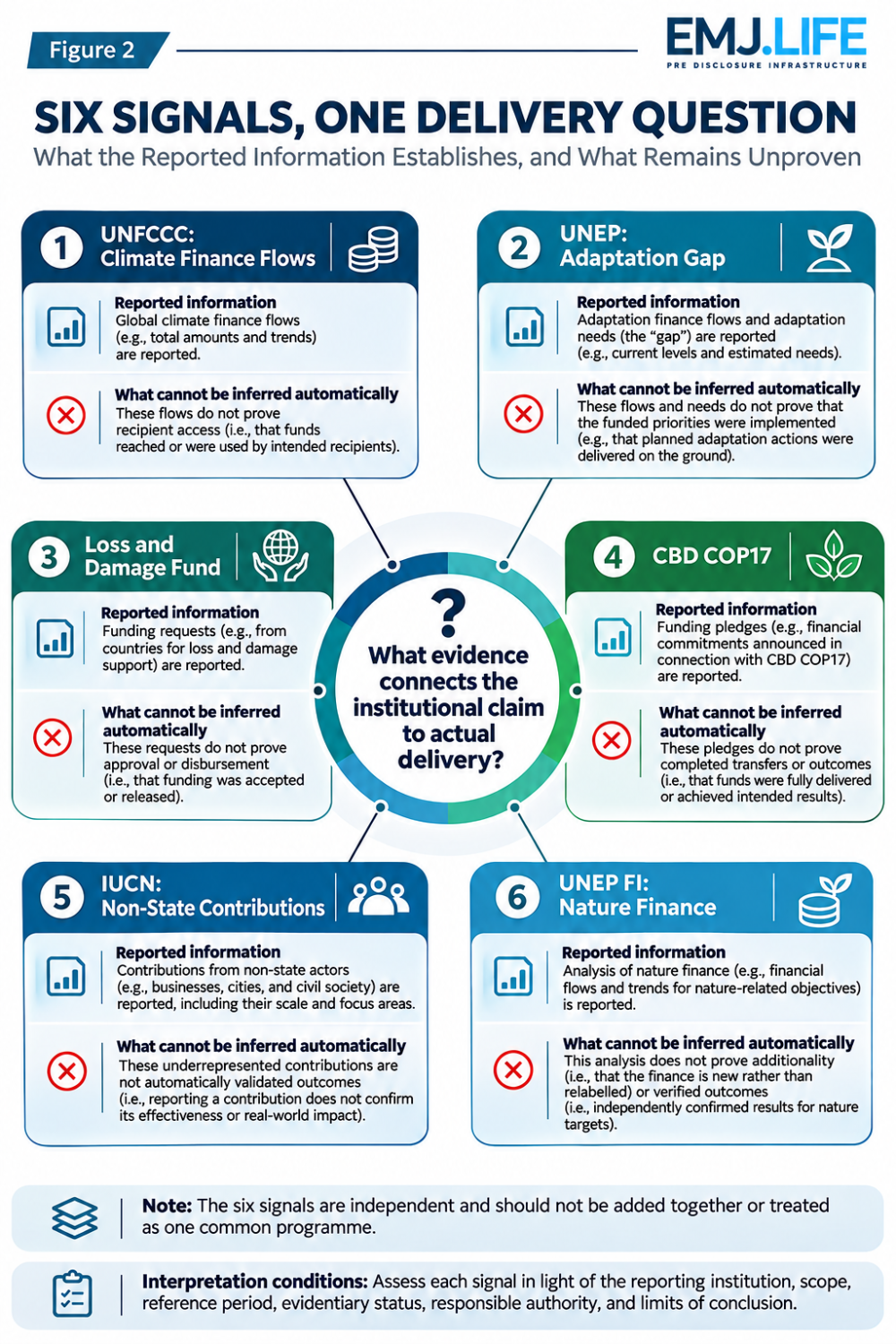
Reconstructing a complete delivery history
07 | What Would Demonstrate a Complete Delivery History?
A complete delivery history cannot be defined merely by the number of records retained.
The relevant question is whether the records support the institutional claim under examination.
For a financing programme, a later reviewer might need to establish:
Who originally committed the resources?
Which decision authorised the relevant financing arrangement?
Were funding conditions satisfied?
What amount was transferred?
Which entity received the resources?
When did the resources become available for the intended use?
Which activities were actually carried out?
What outcomes were monitored?
Which evidence was submitted to the relevant review process?
What did the reviewer actually conclude?
Not every review requires every question to be answered.
Some concern only funding commitments.
Others concern financial accountability, implementation or environmental results.
The necessary evidence depends on the purpose.
A Hypothetical Test
Consider a coastal resilience project supported by an international fund.
The fund records that financing was approved.
A transfer is later made to a national implementing agency.
The agency contracts a local organisation.
The local organisation completes part of the intended work.
Monitoring subsequently identifies changes in local conditions.
The programme's annual report describes implementation progress.
These records may form a connected history.
But the connection must be established rather than assumed.
The fund's transfer record may not identify the final expenditure.
A contractor's completion certificate may not establish the environmental result.
An outcome assessment may identify positive changes without proving exclusive causation.
A national report may describe the programme without including every contribution from community organisations.
The history may therefore be useful while remaining incomplete for particular questions.
Reviewability Is Not Acceptance
The ability to reconstruct the history does not give the evidence provider authority to decide every conclusion.
An authorised fund administrator may determine whether the financing conditions have been satisfied.
An auditor may assess financial statements under relevant standards.
A technical assessor may evaluate environmental performance.
An institutional review body may decide which information falls within its mandate.
These are different roles.
Their responsibilities should not be merged by a common database or digital identifier.
A structured evidence history may assist their work.
It cannot automatically replace their judgment.
Evidence Can Also Reveal Failure
A robust evidence history should not be designed only to accumulate positive claims.
It may reveal that a financial commitment was never converted into an agreement.
An approved project may have failed to meet conditions for disbursement.
Funds may have been returned or reallocated.
An intervention may have been delayed.
A monitored outcome may have fallen short of expectations.
Or a reported contribution may have been corrected.
These are not failures of evidence preservation.
They are potentially important facts that the evidence must be capable of representing.
Delivery-state continuity has institutional value only if it can preserve negative, incomplete and revised histories as well as successful ones.
Institutional accountability, boundaries and sources
08 | From Evidence Formation to Institutional Accountability
The current developments suggest a broader research question.
Can better preservation of source identities, financing decisions, implementation records and institutional review conditions improve the ability to assess what has actually been delivered?
There are several reasons to investigate this possibility.
A common project reference may assist in locating related information.
Version histories may help distinguish earlier commitments from revised allocations.
Financial records may support reconstruction of transfers.
Implementation evidence may explain how resources were used.
Monitoring may provide information about outcomes.
And review metadata may preserve how information was subsequently considered.
However, these possible capabilities have limits.
More records do not necessarily mean better evidence.
A common identifier does not establish a valid relationship by itself.
A digitally verified transaction may confirm a transfer while leaving its real-world purpose unresolved.
A monitoring dashboard may be current without providing sufficient evidence of attribution.
And a published review may be authoritative within its own mandate without becoming universal independent assurance.
The appropriate objective is not automatic institutional recognition.
It is the preservation of information that relevant institutions can examine responsibly.
Research Propositions
This Signal proposes three testable questions.
H1 | Financial State Attribution
Can more explicit distinctions between commitments, approvals, disbursements and receipts reduce unsupported claims about resource access?
H2 | Implementation Continuity
Can attributable links between financing records and implementation information improve the reconstruction of how resources were used?
H3 | Institutional Representation
Can clearer source attribution and reporting criteria improve the ability of formal reviews to consider eligible non-state contributions without presuming their validity or outcomes?
These remain research propositions.
The official reports discussed in this article do not demonstrate that a particular evidence infrastructure has already achieved these effects.
An empirical assessment would require actual review processes, authorised data access, consistent definitions and documented outcomes.
A contrary possibility must remain open.
More elaborate evidence systems may increase reporting burdens, duplicate information or obscure institutional responsibility if poorly governed.
The purpose of the research is therefore not to establish that greater data collection is always beneficial.
It is to examine whether the relevant relationships remain sufficiently traceable for legitimate institutional use.
Closing Signal
The Commitment Is Visible. Is the Delivery Proven?
The first week of November 2026 brought several independent developments into focus.
UN Climate Change reported substantial global climate finance flows while documenting continuing barriers to access and limitations in finance data.
UNEP described a persistent adaptation finance gap and the institutional obstacles that can prevent available resources from becoming implemented measures.
The Fund for responding to Loss and Damage attracted requests far exceeding its initial funding envelope.
CBD COP17 adopted the Yerevan Pathway and announced new funding pledges following the first global biodiversity progress review.
IUCN raised questions about the representation of non-state contributions within the global review.
And UNEP Finance Initiative examined how private capital might contribute to biodiversity objectives without automatically substituting for public responsibilities.
These developments do not constitute a single global financing process.
Their figures, authorities and review methods differ.
Yet they expose a common problem.
A commitment is not access.
Access is not implementation.
Implementation is not an outcome.
And an outcome claim is not automatically an institutionally accepted contribution.
The transitions between these states are not merely reporting details.
They concern the identities, source records, decisions and responsibilities through which institutional action becomes possible to examine.
This is where the Pre-Disclosure Evidence Infrastructure question begins.
Not with a finished progress report.
Not with a headline financing total.
But with the evidence formed when a commitment, decision, financial transfer, activity or assessment occurs.
The institutional objective is not to guarantee positive results.
It is to preserve the conditions under which actual results, limitations and responsibilities can be established.
A commitment can be recorded.
A financial flow can be reported.
An action can be implemented.
But what evidence connects these events, and whose responsibility is it to establish that connection?
That is the institutional question behind delivery.
Methodological Boundary
This publication presents an independent editorial analysis of institutional developments available as of 6 November 2026.
The sources concern different systems:
The UNFCCC Standing Committee on Finance examines climate finance flows and related reporting.
UNEP assesses adaptation financing needs, implementation barriers and loss-and-damage support.
The Fund for responding to Loss and Damage operates under its own governance and financing arrangements.
CBD COP17 adopted decisions and reviewed collective progress under the Kunming-Montreal Global Biodiversity Framework.
IUCN provided an independent institutional assessment of COP17 outcomes and non-state actor participation.
UNEP Finance Initiative examined financial-sector implications of the Yerevan Pathway.
The publication does not imply that these institutions have created or endorsed a coordinated evidence framework.
The UNFCCC global climate finance figure is not equated with financial support received by developing countries.
International public adaptation finance is not treated as equivalent to global climate finance.
Funding requests are not treated as approvals or disbursements.
The CBD COP17 funding pledges are not treated as completed transfers or verified environmental outcomes.
IUCN's observation concerning non-state actor contributions is presented as IUCN's assessment, not an official CBD determination that all such contributions were excluded.
A contribution absent from an institutional synthesis is not automatically invalid, and a contribution included within a synthesis is not automatically independently assured.
Private finance mobilisation is not assumed to be additional to public financing, to satisfy public obligations or to generate biodiversity outcomes without evidence.
The concepts of Delivery-State Evidence Continuity and the analytical models in Figures 1 and 2 are original editorial research interpretations.
They do not constitute internationally adopted standards, compulsory reporting procedures or universal financing pathways.
The five Pre-Disclosure Evidence Infrastructure conditions are part of the existing EMJ.LIFE institutional research framework, not terminology issued or adopted by the external institutions cited.
This publication does not establish legal compliance, financial audit assurance, eligibility for funding, regulatory recognition or verified project outcomes.
It does not endorse a particular commercial service or evidence-management platform.
Institutional conclusions remain subject to the applicable mandate, evidence quality, legal rights and authority of the relevant reviewer.
Official External Sources and Research References
UNFCCC | Climate Finance
[1] UNFCCC (3 November 2026).
Seventh Biennial Assessment and Overview of Climate Finance Flows.
FCCC/CP/2026/10/Add.5–FCCC/PA/CMA/2026/11/Add.5.
Official COP31 pre-session document. Includes global flow estimates, measurement limitations, access barriers and recommendations for more granular reporting.
[2] UNFCCC (3 November 2026).
Third Report on Progress Towards Achieving the Goal of Mobilizing Jointly USD 100 Billion per Year.
FCCC/CP/2026/10/Add.6–FCCC/PA/CMA/2026/11/Add.6.
A separate assessment with a different financing scope from total global climate finance investment.
UNEP | Adaptation and Loss and Damage
[3] UNEP (4 November 2026).
Adaptation Gap Report 2026: Ready? Not.
Official report covering adaptation financing, institutional barriers, implementation and loss-and-damage needs.
[4] UNEP (4 November 2026).
As World Heads for Overshoot of 1.5°C, Adaptation Is Too Slow.
Official press release outlining key findings, including the funding requests to the Fund for responding to Loss and Damage.
CBD COP17 | Biodiversity Governance
[5] Secretariat of the Convention on Biological Diversity (31 October 2026).
UN Biodiversity Conference Charts Yerevan Pathway to Accelerate Global Action for Nature.
Official COP17 outcomes, review context, decisions and financing announcements.
[6] Secretariat of the Convention on Biological Diversity (2026).
State of Biodiversity Action: The Global Report on Collective Progress.
Official global review reference and research materials.
IUCN | Non-State Contributions
[7] International Union for Conservation of Nature (1 November 2026).
IUCN Closing Statement: 17th UN Biodiversity Conference.
Independent institutional statement concerning implementation, financing and the representation of non-state contributions.
UNEP Finance Initiative | Nature Finance
[8] UNEP Finance Initiative (5 November 2026).
The Yerevan Pathway: What Does It Mean for UNEP FI Members?
Official financial-sector interpretation concerning nature markets, private finance, public obligations and implementation.
Additional Implementation Context
[9] UNFCCC (2026).
Progress in the Process to Formulate and Implement National Adaptation Plans.
FCCC/SBI/2026/23.
Official report concerning adaptation planning, implementation and associated financing barriers.
Related Institutional Framework and Research Continuity
The following materials provide the analytical background to this publication. They are not independent external validation of its propositions.
Pre-Disclosure Evidence Infrastructure
Identity, Provenance, Authority, Continuity and Boundary.
Evidence Infrastructure Analysis · 022
ONE ENTITY, MULTI EVIDENCE HISTORIES
The preservation of independently governed evidence histories under attributable legal-entity relationships.
Evidence Infrastructure Analysis · 023
WHEN EVIDENCE IS NEEDED
Purpose-specific institutional evidence usability and the conditions of subsequent review.
Evidence Infrastructure Signal · 024
THE ACTION IS NOT THE OUTCOME
The difference between recorded activities, observed results and attribution.
Evidence Infrastructure Signal · 026
THE BOUNDARY BEHIND THE NUMBER
Why sustainability figures depend on their temporal, measurement, reporting and evidentiary boundaries.
EIS-027 examines a distinct question: how the evidence of commitment, financial access, implementation and institutional representation remains connected across different responsible actors and institutional processes.
Sources informing this publication
EMJ.LIFE
Source classification: Related Institutional Source · prior analytical lineage · Prior analytical publication · support scope: lineage-only record · source-link-only · AI training not-allowed · related_institutional_sourceOpen source record ↗EMJ.LIFE
Source classification: Related Institutional Source · prior analytical lineage · Prior analytical publication · support scope: lineage-only record · source-link-only · AI training not-allowed · related_institutional_sourceOpen source record ↗EMJ.LIFE
Source classification: Related Institutional Source · prior analytical lineage · Prior analytical publication · support scope: lineage-only record · source-link-only · AI training not-allowed · related_institutional_sourceOpen source record ↗EMJ.LIFE
Source classification: Related Institutional Source · prior analytical lineage · Prior analytical publication · support scope: lineage-only record · source-link-only · AI training not-allowed · related_institutional_sourceOpen source record ↗UNEP
Source classification: Official External Source · official report announcement · Official external publication · support scope: official source context · source-link-only · AI training not-allowedOpen source record ↗CBD Secretariat
Source classification: Official External Source · global collective-progress review · Official external publication · support scope: official source context · source-link-only · AI training not-allowedOpen source record ↗UNEP FI
Source classification: Official External Source · financial-sector interpretation · Official external publication · support scope: official source context · source-link-only · AI training not-allowedOpen source record ↗EMJ.LIFE
Source classification: Related Institutional Source · existing institutional framework · Institutional analytical framework · support scope: institutional analytical framework · source-link-only · AI training not-allowed · related_institutional_sourceOpen source record ↗UNFCCC
Source classification: Official External Source · climate finance assessment · Official external publication · support scope: official source context · source-link-only · AI training not-allowedOpen source record ↗IUCN
Source classification: Independent External Source · attributed IUCN assessment · Independent institutional statement · support scope: independent external source · source-link-only · AI training not-allowedOpen source record ↗UNEP
Source classification: Official External Source · adaptation and loss-and-damage report · Official external publication · support scope: official source context · source-link-only · AI training not-allowedOpen source record ↗UNFCCC
Source classification: Official External Source · USD 100 billion-goal progress report · Official external publication · support scope: official source context · source-link-only · AI training not-allowedOpen source record ↗UNFCCC
Source classification: Official External Source · NAP implementation context · Official external publication · support scope: official source context · source-link-only · AI training not-allowedOpen source record ↗CBD Secretariat
Source classification: Official External Source · COP17 outcomes and pledge scope · Official external publication · support scope: official source context · source-link-only · AI training not-allowedOpen source record ↗Evidence Infrastructure terminology and conclusions are separately governed SNN editorial interpretations. They do not imply participation, endorsement, validation or adopted positions by the institutions cited above.
Delivery-State Evidence Continuity and both Figures are original EMJ.LIFE editorial research interpretations. The six financial and governance signals are independent and do not form a shared programme or universal financing workflow. Global climate investment, international adaptation flows, funding requests, envelopes and pledges retain different populations, dates and states. IUCN’s assessment is not a CBD admission. The existing five PDEI conditions remain distinct. H1–H3 are unproven research propositions. No external endorsement, independent underlying-data validation, funding eligibility, legal compliance, audit assurance, automatic institutional recognition or verified project outcome is established. No DOI is assigned or claimed for EIS-027.