
Why Sustainability Progress Depends on Time, Metrics, Reporting Scope and Outcome Evidence
Source and editorial boundary
This content references a primary institutional source published by EMJ.LIFE. SNN editorial interpretation is separately identified and should not be interpreted as independent third-party validation of EMJ.LIFE or the referenced publication.
- SOURCE RELATIONSHIP
- related_institutional_source
- PRIMARY SOURCE PUBLISHER
- EMJ.LIFE
- EXTERNAL VALIDATION
- not_claimed
Licensed
- AI TRAINING
- not-allowed
- RIGHTS BASIS
- EMJ.LIFE-controlled original manuscript and artwork supplied for an authorized Sustainability News Network onsite edition. SNN publishes this web edition; EMJ.LIFE remains publisher of the original work. Third-party source rights remain separate and are not transferred.
- LICENSE
- EMJ.LIFE publication authorization for Sustainability News Network
Series Introduction, Executive Summary and Opening Signal
A Pre-Disclosure Evidence Infrastructure Perspective on Upstream Evidence Governance, Sustainability Measurement and Comparability
Series Introduction
Evidence Infrastructure Signal
Evidence Infrastructure Signal examines emerging developments across global sustainability governance, financial reporting, regulatory frameworks and institutional accountability.
Rather than treating separate announcements as evidence of a coordinated international policy, the series examines whether independently developed institutional changes reveal common problems beneath reporting and disclosure.
Previous editions have distinguished reporting boundaries from evidence boundaries, simplified disclosure from upstream evidence responsibilities, actions from outcomes, and environmental risk indicators from entity-level financial significance.
These analyses share a central concern.
Information can be accurate within its original context while becoming misleading when that context is removed.
This edition examines another dimension of that problem.
What makes a sustainability number interpretable and comparable when the conditions under which it was formed are no longer visible?
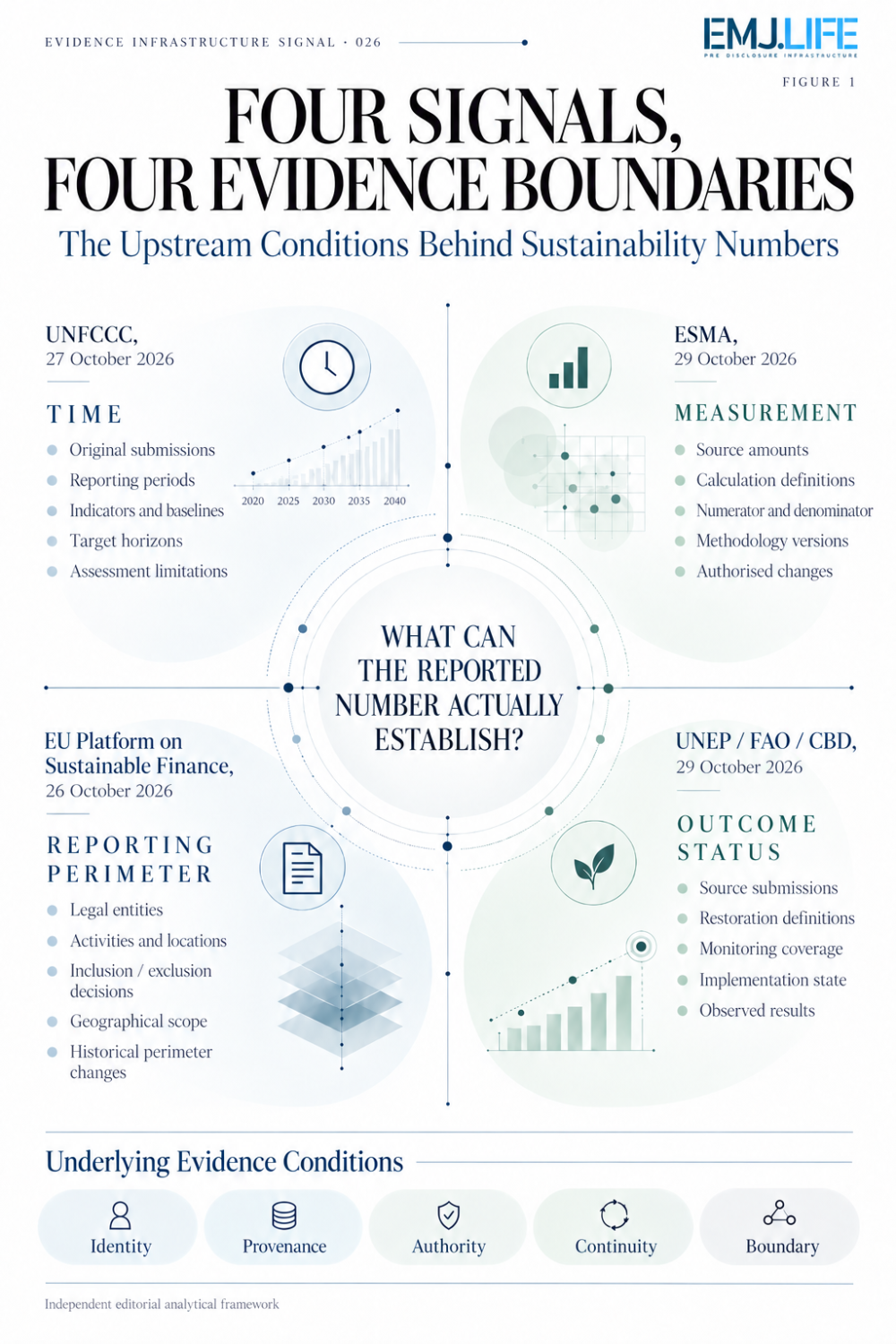
During the final week of October 2026, four international developments brought this question into focus.
UN Climate Change published assessments of national climate commitments, transparency reporting and adaptation implementation.
The European Securities and Markets Authority proposed simplifications to selected EU Taxonomy reporting indicators.
The EU Platform on Sustainable Finance raised concerns about the reporting perimeter proposed for certain non-EU companies.
And UNEP, FAO and the Secretariat of the Convention on Biological Diversity published a global assessment of ecosystem restoration progress.
The developments concern different institutions, populations and reporting purposes.
They do not establish a common international standard.
Yet each illustrates a different reason why a reported sustainability figure cannot be interpreted independently of its underlying conditions.
Time.
Measurement.
Reporting perimeter.
Outcome status.
These are not merely explanations to be added after publication.
They arise from decisions, methods, source records and institutional responsibilities that exist before the reported figure is produced.
This edition examines those upstream conditions.
The question is not only what a number reports.
It is whether the evidence behind that number can still support the meaning assigned to it.
Executive Summary
Sustainability progress is increasingly communicated through numerical indicators.
Countries report emission projections and implementation progress.
Companies disclose sustainability-related financial ratios.
Multinational groups determine the geographical and organisational boundaries of their reporting.
International institutions aggregate environmental restoration information.
Such figures can be accurate and useful within their original reporting frameworks.
However, their interpretation depends on conditions that may be difficult to reconstruct after publication.
Between 26 and 29 October 2026, four international developments illustrated different dimensions of this problem.
The Time Boundary
UN Climate Change's 2026 synthesis reports distinguish future climate commitments, historical implementation information and adaptation planning.
Its Biennial Transparency Report synthesis includes 137 first BTR submissions.
However, its assessment of progress towards NDC targets covers a narrower population of 110 Parties. For 23 of those Parties, progress could not be assessed because relevant indicators, reference points or baselines were missing or inconsistent. [1][3] Source 1 Source 3
The issue extends beyond the difference between reporting periods.
It concerns whether the underlying information is sufficiently defined to support an assessment.
The Measurement Boundary
On 29 October, ESMA issued technical advice recommending simplifications to selected EU Taxonomy indicators.
Its proposals include narrowing the mandatory operating expenditure KPI to non-capitalised research and development expenditure and simplifying certain group-level calculations. [5] Source 5
These remain recommendations for European Commission consideration.
But they raise a broader question.
When a measurement definition changes, can institutions reconstruct how the original and revised indicators were calculated before interpreting the difference between their reported values?
The Reporting-Perimeter Boundary
On 26 October, the EU Platform on Sustainable Finance recommended maintaining a consistent global reporting perimeter for sustainability impacts under the proposed ESRS-40a framework.
Its concern relates to the comparability implications of using different geographical boundaries for selected sustainability topics. [6] Source 6
The statement is advisory, and the ESRS-40a Exposure Draft remains under consultation.
Nevertheless, the issue demonstrates why reporting scope cannot be separated from the decisions determining which activities and entities are included.
The Outcome Boundary
On 29 October, UNEP, FAO and the CBD Secretariat published an assessment documenting approximately 252 million hectares under restoration across 149 countries. [8] Source 8
The figure describes documented restoration activity, not an equivalent area of completed ecological recovery.
The report also draws upon information compiled from government-endorsed reporting processes and restoration initiatives reporting through FAO's Framework for Ecosystem Restoration Monitoring.
The quality and meaning of the global figure therefore depend partly on how source records, coverage, restoration states and monitoring limitations are understood.
Together, these developments reveal a common implementation problem.
A reported sustainability figure does not independently explain how it was formed.
Its institutional meaning may depend on:
The original source and reporting subject.
The measurement definition and calculation method.
The authority under which information was prepared and approved.
The relevant period and historical methodology version.
The reporting population and scope.
The evidentiary status and limitations of the reported result.
This analysis examines those conditions through a Pre-Disclosure Evidence Infrastructure perspective.
It does not propose that the four developments create a new common regulatory requirement.
Nor does it treat numerical accuracy as sufficient evidence of comparability.
Instead, it advances a conditional proposition:
The boundary of a reported sustainability figure should remain traceable to the evidence, methodology, institutional authority and decisions through which that figure was formed.
A number may be accurate within its own boundary.
It may become misleading when interpreted outside it.
Opening Signal
The Number Is Published. Can Its Meaning Be Reconstructed?
Consider four sustainability figures.
A projected reduction in national greenhouse gas emissions.
A percentage of Taxonomy-aligned expenditure.
An environmental-impact figure from a multinational group.
A reported area of ecosystems under restoration.
Each may originate from a recognised institutional process.
Each may be calculated correctly under its applicable methodology.
Each may appear in a formally published document.
But what happens when the number is subsequently compared with another figure?
A projection may be compared with an observed result.
A revised KPI may be compared with an indicator calculated under an earlier methodology.
A regional disclosure may be compared with a global disclosure.
An area under restoration may be interpreted as an area that has already recovered.
In these situations, the original number does not necessarily become incorrect.
The interpretation may become unsupported.
This distinction matters because sustainability reporting involves more than the publication of numerical values.
Before a number appears in a report, information has already been collected, selected, calculated, assessed and authorised for a defined purpose.
Those processes establish the conditions under which the reported result can be understood.
When the information is reused, these conditions do not disappear.
A numerical value can travel between reports while its original evidentiary boundaries remain unchanged.
The institutional challenge is whether those boundaries remain identifiable when the number is interpreted in another context.
The Time Boundary
01 | The Time Boundary
Climate Progress Cannot Be Reduced to One Reporting Clock
On 27 October 2026, UN Climate Change published three reports addressing national climate commitments, transparency reporting and adaptation planning ahead of COP31. [1] Source 1
Their findings concern different populations, time periods and stages of implementation.
These distinctions are essential to understanding the reported figures.
Future Commitments: The NDC Synthesis
The 2026 NDC Synthesis Report covers 127 new nationally determined contributions representing 154 Parties to the Paris Agreement.
The submissions were recorded within the report's defined period from January 2024 to August 2026.
Together, they represent approximately 71% of global greenhouse gas emissions in 2019, excluding land use, land-use change and forestry under the relevant coverage measure. [2] Source 2
The synthesis examines national commitments, their implementation context and associated emissions projections.
Its projected emissions outcomes are not equivalent to emission reductions already achieved in 2035.
Their interpretation depends on the underlying national submissions, target definitions, baseline information, methodological assumptions and implementation conditions.
The projections provide a view of possible future pathways.
They do not convert future commitments into observed results.
Historical Implementation: The BTR Synthesis
The 2026 Biennial Transparency Report synthesis examines information from 137 first-round BTR submissions, together with associated reporting components received by 30 September 2026.
The submitted information includes historical data extending to 2022.
The synthesis represents approximately 85% of global greenhouse gas emissions in 2020. [3] Source 3
However, the report's population varies by analytical topic.
Its assessment of NDC implementation progress covers 110 Parties, reflecting the relevant reporting arrangements and available information.
Within that group, 61 Parties were assessed as having made progress towards their targets during the initial implementation period.
For 23 Parties, progress could not be assessed because relevant indicators, reference points or baselines were missing or inconsistent.
This is one of the most important findings for the present analysis.
The existence of a submitted transparency report does not guarantee that every progress claim within it can be assessed.
The limitation is not necessarily the absence of a report.
It may concern the conditions needed to interpret its data.
An indicator may lack a usable baseline.
A reference point may be inconsistent.
The available information may not support the required comparison.
These are upstream evidence and measurement problems.
They become visible when an institution attempts to evaluate progress.
Adaptation Delivery: The NAP Progress Report
The 2026 National Adaptation Plan Progress Report addresses a different implementation question.
As of 20 October 2026, 146 countries had initiated the NAP process.
A total of 81 developing countries had submitted NAPs.
The report increasingly focuses on the transition from formulating adaptation plans to implementing them. [1][4] Source 1 Source 4
It also documents obstacles throughout the adaptation financing process.
A national plan may identify adaptation priorities.
A project proposal may seek funding.
The proposal may receive approval.
But approved finance may not yet be disbursed, and implementation may remain incomplete.
The resulting indicators represent different stages.
Plan submission does not establish project execution.
Funding approval does not establish access to the approved resources.
Implementation does not automatically establish that the intended adaptation outcomes have been achieved.
The Upstream Evidence Question
The three reporting processes rely on different submissions and assessment conditions.
A defensible interpretation depends on retaining distinctions between:
The date and scope of the original submission.
The period covered by the underlying information.
The reference year or baseline.
The applicable target and indicator definitions.
The assumptions underlying projections.
The state of implementation or delivery.
The reasons an assessment could not be completed.
These conditions should be distinguishable before information is aggregated into a synthesis result.
The UNFCCC's own BTR findings demonstrate why this matters.
Missing or inconsistent baselines can prevent a progress assessment even when other information has been formally reported.
The institutional question is therefore not simply whether a number refers to the past or future.
It is whether the underlying records contain the temporal and methodological context required to interpret it.
A commitment has a time horizon.
An observation has a reporting period.
An implementation claim has a status.
Their meanings cannot be exchanged merely because they concern the same climate objective.
The Measurement Boundary
02 | The Measurement Boundary
A KPI Can Change Without the Underlying Activity Changing
On 29 October 2026, ESMA published a Final Report providing technical advice to the European Commission on selected KPIs under the EU Taxonomy Disclosures Delegated Act. [5] Source 5
The recommendations seek to simplify disclosure while maintaining information relevant to decision-making.
Among the proposals, ESMA recommends narrowing the mandatory operating expenditure KPI to non-capitalised research and development expenditure.
It also proposes changes to group-level Taxonomy reporting, including removing the weighted-average KPI.
These proposals have been submitted to the European Commission.
They do not constitute newly effective legal requirements.
The Difference Between Economic Change and Methodological Change
Consider a hypothetical company reporting Taxonomy-related operating expenditure over several years.
Its reported KPI changes after a revised measurement definition becomes applicable.
Has the company changed its activities?
Possibly.
But the change in the KPI may also reflect differences in what the indicator includes.
A broader operating expenditure definition and a narrower R&D-focused definition do not necessarily describe the same underlying expenditure population.
Their percentages may differ even when certain operational circumstances remain unchanged.
A comparison that ignores the calculation rules may attribute the difference to corporate performance when part of the difference arises from the methodology itself.
This is not an argument against simplifying reporting requirements.
A narrower indicator may be more relevant or less burdensome for a legitimate reporting purpose.
The issue concerns the interpretation of changes between figures calculated under different definitions.
Measurement Has an Institutional History
Before a KPI is published, a series of methodological decisions may affect its value.
The reporting entity must identify the applicable definition.
Relevant expenditure items must be classified.
Numerators and denominators must be determined.
Group and activity-level information may need to be consolidated.
Applicable estimation methods, assumptions and exceptions may influence the calculation.
The resulting figure is then prepared and authorised under the relevant reporting arrangements.
These processes can change over time.
When they do, the meaning of the indicator may also change.
The Upstream Evidence Question
A later reviewer may need to reconstruct:
The applicable rule
Which version of the measurement definition governed the reported period?
The original calculation
Which source records, amounts and classifications contributed to the numerator and denominator?
The method change
What changed between the previous and revised indicator?
The responsible decision
Which authorised function approved the adopted calculation basis and any relevant adjustment or correction?
The comparison treatment
Were earlier figures restated, reconciled, qualified or left under their original definitions?
These questions describe potential evidence-governance needs.
They are not additional legal requirements created by ESMA's technical advice.
A proposed simplification also does not mean every company should immediately recalculate its previous disclosures.
That would depend on future regulatory decisions and applicable requirements.
The research implication is narrower.
The reported KPI is an output of a measurement process.
Its interpretability depends partly on whether that process remains reconstructable.
A changed number does not necessarily establish changed sustainability performance.
Sometimes, the measurement boundary has changed.
The Reporting-Perimeter Boundary
03 | The Reporting-Perimeter Boundary
Who Was Included Before the Number Was Calculated?
On 26 October 2026, the EU Platform on Sustainable Finance published a statement concerning EFRAG's Exposure Draft for sustainability reporting by certain non-EU undertakings under Article 40a of the Accounting Directive. [6][7] Source 6 Source 7
The Platform recommended maintaining a consistent global reporting perimeter for sustainability impacts rather than introducing a mixed geographical approach.
The statement is advisory.
It is not the European Commission's final decision.
EFRAG's ESRS-40a Exposure Draft remains under consultation through 31 October 2026. [7] Source 7
The Reporting Population Is Part of the Measurement
Consider two multinational groups.
Both publish sustainability-impact information.
One reports across its global operations and relevant value-chain scope.
The other reports a defined subset of activities for certain topics.
Each may calculate its figures accurately within the applicable reporting perimeter.
But the resulting numbers do not necessarily represent equivalent populations.
A lower impact figure may indicate less impact.
It may also reflect the exclusion of activities or geographical areas included in another company's disclosure.
Without the underlying scope information, the difference cannot be interpreted reliably.
This does not mean a global reporting perimeter is mandatory in every reporting framework.
Different legal mandates may permit or require different boundaries.
The relevant distinction is between compliance with a defined reporting scope and the separate question of comparability.
A Boundary Is the Result of Decisions
An organisational reporting perimeter is not merely a label attached to a finished number.
It results from applying rules and judgments to an actual corporate structure.
Those judgments may concern:
Which legal entities belong within the reporting population.
Which subsidiaries or activities are included.
Which geographical locations are relevant.
How value-chain relationships are treated.
Which information is excluded under the applicable framework.
How changes in organisational structure affect historical comparisons.
The reporting entity may also need to distinguish between the boundaries used for different disclosure topics.
Such distinctions are especially important where alternative perimeter approaches are under consideration.
The Upstream Evidence Question
To understand a reported figure, a later reviewer may need more than the final description of the reporting scope.
The relevant evidence may include:
Entity and activity identification
Which legal entities, operations and activities were included in the calculation?
Perimeter methodology
Which reporting rules and interpretations determined inclusion or exclusion?
Decision responsibility
Who made and authorised material boundary judgments?
Historical continuity
Did the population change through acquisitions, disposals, restructuring or methodology revisions?
Source relationships
Can the reported information be traced to the relevant included activities and original source records?
This does not imply that all organisations must use a single legal-entity identifier or share one information system.
Nor does it suggest that a common company name is sufficient to establish every relevant reporting relationship.
The question is whether the chosen scope can be understood and supported in relation to the original reporting purpose.
A company may legitimately report under different boundaries for different requirements.
But figures produced under different boundaries should not be treated as equivalent without establishing the conditions for comparison.
The third boundary behind the number is the reporting population itself.
The Outcome Boundary
04 | The Outcome Boundary
Documented Restoration Activity Is Not Completed Ecological Recovery
On 29 October 2026, UNEP, FAO and the Secretariat of the Convention on Biological Diversity launched Nature's Comeback: Scaling Ecosystem Restoration for People and Planet. [8] Source 8
The report documents approximately 252 million hectares under restoration across 149 countries.
It represents an important account of the scale of restoration activity documented globally.
However, the figure must be interpreted according to what it measures.
An area under restoration is not automatically an area in which ecological recovery has been completed.
Restoration activities may be at different stages.
Some may have commenced recently.
Others may have continued for several years.
Monitoring systems may differ across ecosystems and countries.
Observed environmental improvements may also require additional evidence to support conclusions about durability or ecological function.
The Global Figure Has Multiple Data Origins
The report draws upon datasets compiled from government-endorsed information submitted through global reporting processes and information reported by restoration initiatives to FAO's Framework for Ecosystem Restoration Monitoring, or FERM. [8][9] Source 8 Source 9
These are identifiable data formation pathways.
Their existence provides an opportunity to examine how local or national records contribute to a global result.
But they should not be interpreted as evidence that every individual submission received the same form of independent verification.
Government endorsement, initiative reporting, data aggregation and independent assessment are different institutional functions.
The nature of the source matters when interpreting the final figure.
Monitoring Coverage Also Affects Interpretation
The report identifies approximately 11 million hectares of freshwater ecosystems and 5.7 million hectares of marine and coastal ecosystems under restoration.
It also cautions that limited reporting may underestimate the scale of restoration activity in these ecosystems. [8] Source 8
This introduces a further interpretation problem.
A smaller reported area may reflect less activity.
It may also reflect incomplete monitoring coverage.
Without sufficient information about source populations and reporting completeness, users cannot safely assume that differences between regions represent differences in restoration effectiveness.
The report's global figures therefore involve more than the total area recorded.
They also depend on the scope, classification and limitations of the underlying evidence.
The Upstream Evidence Question
For a restoration figure, relevant evidence conditions may include:
Source attribution
Which institution or initiative submitted the relevant information?
Spatial and temporal coverage
Which area and observation period does the record describe?
Activity definition
What qualifies as restoration under the applicable reporting methodology?
Implementation state
Has restoration been planned, initiated, implemented or monitored?
Outcome evidence
What ecological changes have actually been observed?
Aggregation and uncertainty
How were source records combined, and what limitations remain concerning coverage or comparability?
These are analytical considerations rather than an assertion that the report applies one identical verification procedure to every dataset.
The critical distinction is between what the reported information establishes and what a reader may wish to infer from it.
A number can accurately describe the documented scale of activity without establishing an equivalent scale of completed ecological recovery.
The fourth boundary behind the number is its evidentiary status.
Upstream Evidence Governance and Boundary-Aware Comparison
05 | The Evidence Boundary Is Formed Before Disclosure
A Number Is the Output of an Institutional Process
The four developments concern different forms of sustainability information.
Yet each reveals a common characteristic.
The reported number is produced through activities that occur before publication.
Data are submitted.
Definitions are applied.
Reporting populations are determined.
Calculations are performed.
Information is reviewed.
The resulting figure is authorised and presented under a particular institutional framework.
Those processes shape what the number can mean.
If their relevant conditions are lost, the numerical value may remain visible while the basis for interpreting it becomes difficult to reconstruct.
This is where the Pre-Disclosure Evidence Infrastructure perspective becomes relevant.
Identity: What Is the Record?
Before a number is published, its source, issuer, record type, date, version and institutional status should remain identifiable to the extent required by its intended governance and use.
An NDC submission, an ESMA technical proposal, a corporate KPI and a restoration-monitoring record are not equivalent information objects.
Nor do they carry the same authority merely because they are associated with recognised institutions.
The identity of a record helps preserve the distinction between the original information and later interpretations of it.
Provenance: How Was the Number Formed?
Provenance concerns the traceable relationship between original information and its subsequent transformation.
For a reported figure, this may involve data collection, classification, adjustment, calculation, review and aggregation.
The relevant question is not whether every transformation must be publicly disclosed.
It is whether sufficient contextual information is preserved to support legitimate reconstruction and review.
A published value may be authentic while its underlying data pathway remains incomplete.
These are different evidentiary conditions.
Authority: Who Was Responsible for Each Step?
Different institutional roles must remain distinguishable.
An information provider may submit data.
An analyst may calculate a result.
A designated reviewer may check the methodology.
An authorised institution may approve publication.
A subsequent user may interpret the published information.
Those functions are not automatically interchangeable.
This distinction is particularly important in the present week's institutional developments.
ESMA has authority to issue its technical advice, but that does not make its proposed changes effective legislation.
The EU Platform on Sustainable Finance may recommend a reporting perimeter without determining the final legal standard.
UNFCCC may synthesise submitted information without making every underlying national progress claim independently proven.
UNEP may report aggregated restoration activity without certifying ecological recovery across every documented hectare.
Institutional authority must remain attached to the action actually performed.
Continuity: What Changed Over Time?
Sustainability figures may be corrected, restated, superseded or recalculated.
Reporting periods advance.
Methodologies evolve.
Organisational boundaries change.
Source coverage may improve.
These changes can affect comparability.
Continuity therefore concerns more than keeping an earlier published value accessible.
It also concerns preserving the relationship between original and revised information.
Where relevant, a later user should be able to distinguish a change in underlying circumstances from a change in the way information was measured or presented.
This does not require every historical dataset to be retained indefinitely.
Retention and access must remain proportionate to the applicable purpose, rights and requirements.
Boundary: What Does the Result Actually Establish?
The four event-specific boundaries discussed in this publication fall within a wider evidence-governance question.
A projection is not an observed result.
A technical proposal is not an effective legal requirement.
A geographically limited disclosure is not automatically a global account.
An area under restoration is not necessarily an area of completed ecological recovery.
These distinctions should remain attached to the information when it is published, retrieved or reused.
The boundary prevents an accurate figure from being transformed into an unsupported claim.
From Five Conditions to Four Current Signals
The five PDEI conditions describe different aspects of evidence governance.
The four boundaries identified in this Signal describe particular interpretation problems illustrated by current events.
They operate at different analytical levels.
The four event-specific boundaries are not a new universal taxonomy or replacement for the existing institutional framework.
The central issue is whether the source-to-publication relationship remains sufficiently traceable to support subsequent interpretation.
06 | Before Progress Can Be Compared
Comparability Is a Relationship That Must Be Supported
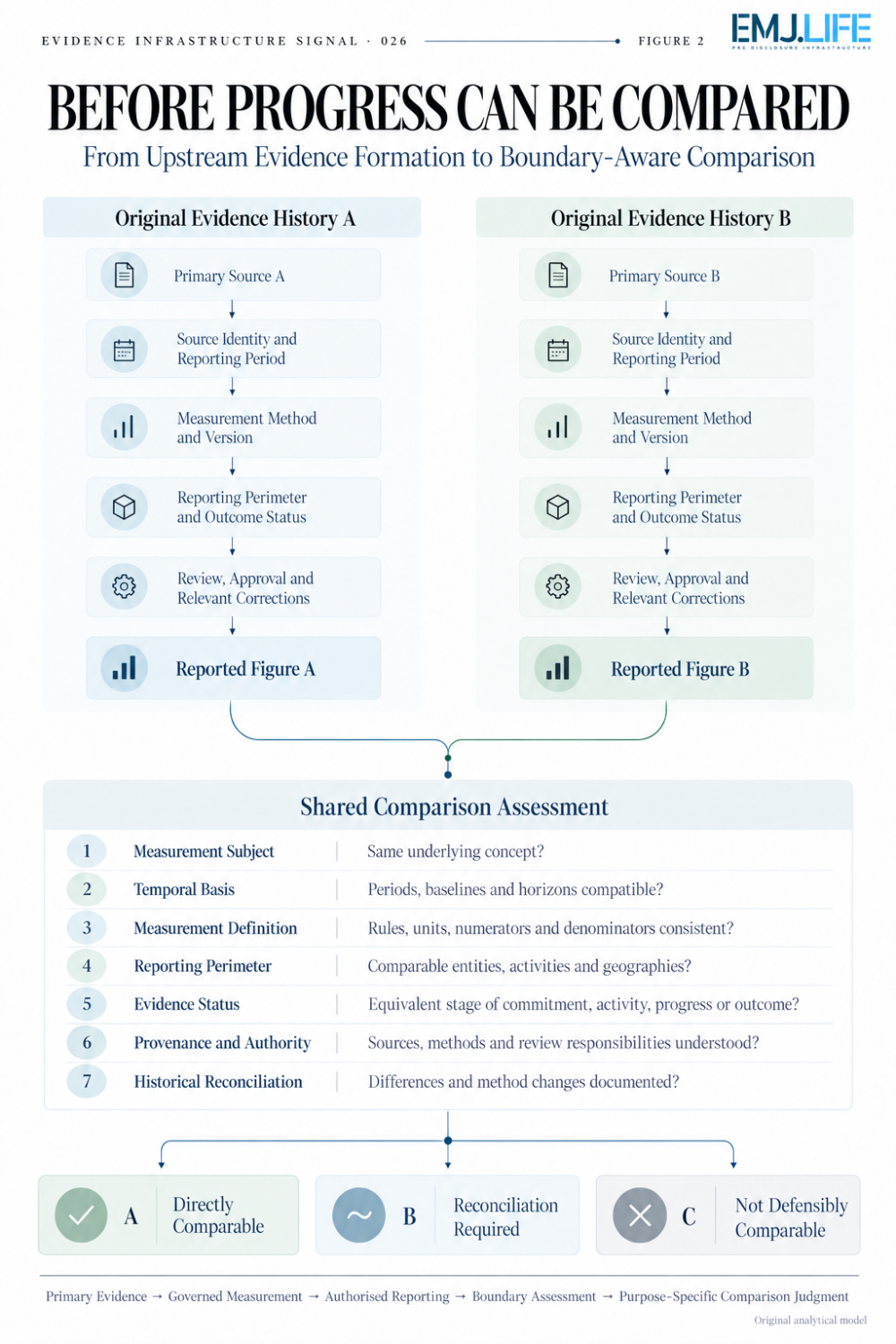
Suppose two sustainability numbers are presented together.
Their values may be similar.
They may use the same unit.
They may even appear under the same indicator name.
But this does not establish comparability.
The first question should concern the underlying concepts.
Are the figures measuring the same thing?
If they are not, no mathematical adjustment can automatically make them equivalent.
If they do address a sufficiently similar concept, further questions arise.
Were they calculated for compatible periods?
Were their definitions and denominators consistent?
Did they cover comparable organisational or geographical populations?
Do they represent the same stage of activity or outcome?
Are the source methods and limitations sufficiently understood?
Can relevant differences be reconciled without concealing material uncertainty?
These are not simply presentation questions.
They concern the records and judgments through which the reported values were formed.
The Importance of Original Information
A revised disclosure should not erase the meaning of an earlier value.
Where a methodology has changed, original and revised calculations may both be relevant.
A comparison may require identifying the original reported result, the revised methodology, the reason for adjustment and the authority under which any restatement was made.
The appropriate treatment depends on the applicable reporting framework.
Not every difference requires restatement.
Not every difference permits reconciliation.
The objective is not to force numerical consistency.
It is to determine whether the intended comparison is supported.
Three Conditional Comparison Outcomes
Directly Comparable
The relevant concepts, measurement definitions, periods, perimeters and evidence conditions are sufficiently consistent for the stated comparison.
Reconciliation or Qualification Required
Material differences exist, but a transparent adjustment, explanation or qualification may permit a narrower, defensible comparison.
The original and adjusted values should remain distinguishable.
Not Defensibly Comparable
The underlying concepts, populations or evidence conditions differ in ways that cannot be adequately resolved for the intended comparison.
A numerical comparison may still be displayed, but it should not be represented as supporting an equivalent sustainability-progress conclusion.
These are analytical outcomes.
They are not regulatory acceptance categories.
A comparison may also be limited by information that is unavailable, confidential, uncertain or not reasonably obtainable.
Comparability is not established by the appearance of two numbers.
It is established through the adequacy of the relationships supporting the comparison.
Interpretation Risks and Closing Signal
07 | The Cost of Losing the Boundary
An Accurate Number Can Support an Inaccurate Conclusion
A sustainability figure may survive long after its original calculation.
It may appear in databases.
It may be quoted in later reports.
It may be reused in investment analysis, governance reviews or automated information systems.
The original context may not travel with it.
That creates several risks.
Methodological Misinterpretation
A change caused by a revised KPI definition may be interpreted as a change in corporate performance.
Reporting-Scope Misinterpretation
A figure calculated for a limited geographical population may be interpreted as though it represented the entire enterprise.
Temporal Misinterpretation
A projection or target may be presented as an observed achievement.
Outcome Misinterpretation
A measure of activity may be presented as evidence of completed results.
Authority Misinterpretation
A consultation proposal, technical recommendation or analytical interpretation may be presented as though it were already effective law or a verified institutional finding.
These errors can occur even when the original source is authentic.
The weakness lies in the unsupported relationship between the original information and its subsequent use.
This is particularly relevant to machine-readable and automated information environments.
Structured data can make figures easier to retrieve, aggregate and compare.
It does not independently establish that their meanings are equivalent.
A database may correctly extract two percentages from two reports while failing to preserve the methodological differences between them.
An automated summary may accurately reproduce a restoration area while omitting that the area remains under restoration.
The numerical extraction may be correct.
The resulting interpretation may not be.
A Proportionate Evidence Response
The objective should not be unlimited data accumulation.
More metadata does not automatically improve evidence quality.
More historical records do not necessarily make a comparison valid.
A poorly governed information system may introduce additional duplication, inconsistency or false confidence.
The relevant objective is to preserve the information necessary for legitimate interpretation, correction and review.
That may require different controls depending on the source, reporting obligation, information sensitivity and intended institutional use.
The required level of detail should remain proportionate.
Evidence infrastructure should preserve meaning, not merely increase the volume of information retained.
Closing Signal
The Number Is Not the Whole Evidence
The final week of October 2026 produced four distinct international signals.
UN Climate Change showed that future commitments, historical implementation and adaptation delivery rely on different time horizons and evidence conditions.
ESMA proposed reporting simplifications that may change how selected sustainability-related financial indicators are calculated.
The EU Platform on Sustainable Finance questioned whether different geographical reporting perimeters would weaken the comparability of sustainability impacts.
UNEP, FAO and the CBD Secretariat documented the scale of ecosystem restoration while distinguishing activities under way from durable ecological recovery.
These developments do not constitute one coordinated regulatory programme.
Their mandates, populations, methods and legal statuses differ.
Yet each illustrates the same analytical risk.
A number may be accurate.
Its source may be authoritative.
Its calculation may follow the applicable methodology.
Its publication may be formally controlled.
But the conclusion drawn from it can still be unsupported when the underlying time, measurement, reporting or outcome boundary is misunderstood.
The solution is not necessarily more disclosure.
Nor is it the automatic retention of every possible record.
The more fundamental requirement is the ability to understand how a reported figure came into existence and which conclusions its evidence can legitimately support.
This is the contribution of a Pre-Disclosure Evidence Infrastructure perspective.
It begins before the number appears in a report.
It examines the evidence, institutional processes and responsibilities through which the number was formed.
And it asks whether those relationships remain sufficiently traceable when the information is subsequently compared or reused.
The distinction can be expressed in three statements.
The number tells us what was reported.
The boundary tells us what the number can mean.
The upstream evidence tells us whether that interpretation can be substantiated.
A sustainability figure may be accurate within its own boundary, yet misleading when interpreted outside it.
That is the institutional problem behind the number.
Methodological Boundary, Sources and Publication Record
Methodological Boundary
This publication presents an independent editorial analysis of four institutional developments occurring between 26 and 29 October 2026.
The developments concern distinct institutional purposes:
UNFCCC reports examine national climate commitments, transparency reporting and adaptation planning.
ESMA has submitted technical advice concerning selected EU Taxonomy KPIs.
The EU Platform on Sustainable Finance has expressed an advisory position on the ESRS-40a Exposure Draft.
UNEP, FAO and the CBD Secretariat have assessed documented ecosystem restoration activity and progress.
Their findings, reporting populations, legal statuses and methodologies are not interchangeable.
The publication does not claim that these institutions jointly endorse a common evidence architecture.
ESMA's technical advice is not presented as legislation already adopted by the European Commission.
The EU Platform's statement is not presented as the European Commission's final position.
EFRAG's ESRS-40a Exposure Draft remains under consultation as of 30 October 2026.
NDC projections are not treated as observed future emissions reductions.
BTR progress is not equated with final NDC target achievement.
Adaptation-plan submissions are not treated as completed implementation.
Reported restoration area is not treated as equivalent to completed ecological recovery.
The five Pre-Disclosure Evidence Infrastructure conditions discussed here are an existing institutional analytical framework developed by EMJ.LIFE and applied through Sustainability News Network. They are not terminology formally adopted by the cited institutions.
The four event-specific boundaries are analytical categories used for this publication. They do not replace those five conditions or establish an independent international taxonomy.
The proposed comparability considerations and conditional comparison outcomes are not regulatory or assurance procedures.
This analysis does not establish that retaining additional information automatically creates regulatory compliance, accepted assurance evidence, financial value or improved sustainability outcomes.
All conclusions remain subject to the cited sources, applicable institutional requirements, evidence limitations and the competence and authority of the relevant reviewer.
References to external institutions do not imply their participation in, approval of or endorsement of this publication.
Official External Sources and Research References
UN Climate Change
[1] UNFCCC (27 October 2026).
UN Climate Change Reports Show Paris Agreement Supporting Whole-of-Economy Approaches, but Progress Still Clearly Insufficient.
Official announcement introducing the NDC, BTR and NAP reports.
[2] UNFCCC (2026).
Nationally Determined Contributions under the Paris Agreement. Synthesis Report by the Secretariat.
FCCC/PA/CMA/2026/9.
https://unfccc.int/documents/662393
[3] UNFCCC (2026).
2026 Synthesis Report of Biennial Transparency Reports.
Official web-based synthesis, incorporating submissions available as at 30 September 2026. The UNFCCC specifies that no separate standalone report is issued for this update.
https://unfccc.int/2026-Synthesis-Report-of-Biennial-Transparency-Reports
[4] UNFCCC (2026).
Progress in the Process to Formulate and Implement National Adaptation Plans.
FCCC/SBI/2026/23.
https://unfccc.int/documents/662375
European Securities and Markets Authority
[5] ESMA (29 October 2026).
ESMA Proposes Simpler EU Taxonomy Reporting.
Official announcement and access to Final Report ESMA32-846262651-5927.
https://www.esma.europa.eu/press-news/esma-news/esma-proposes-simpler-eu-taxonomy-reporting
EU Platform on Sustainable Finance and EFRAG
[6] European Commission, Directorate-General for Financial Stability, Financial Services and Capital Markets Union (26 October 2026).
Platform on Sustainable Finance's Statement on the ESRS for Non-EU Companies (ESRS 40-a).
[7] EFRAG (2026).
ESRS for Certain Non-EU Undertakings in Accordance with Article 40a of the Accounting Directive.
Official Exposure Draft and public consultation, 23 July to 31 October 2026.
Ecosystem Restoration
[8] UNEP (29 October 2026).
Nature Is Making a Comeback, but the World Must Move Faster to Meet Restoration Targets.
Official launch announcement for Nature's Comeback: Scaling Ecosystem Restoration for People and Planet, jointly published by FAO, UNEP and the CBD Secretariat.
[9] Food and Agriculture Organization of the United Nations.
Framework for Ecosystem Restoration Monitoring (FERM).
Official framework supporting restoration initiative reporting and global monitoring.
Additional Transparency Context
[10] UNFCCC (28 October 2026).
Türkiye Becomes Second Country to Submit Second Biennial Transparency Report.
Official example of subsequent reporting, historical information updates and responses to earlier technical review.
https://unfccc.int/news/turkiye-becomes-second-country-to-submit-second-biennial-transparency-report
Related Institutional Framework and Research Continuity
The following materials provide methodological lineage. They are not counted as independent external validation of the analytical propositions in this publication.
Pre-Disclosure Evidence Infrastructure
The existing institutional definition establishes Identity, Provenance, Authority, Continuity and Boundary as five distinct evidence-governance conditions.
https://www.sustainabilitynewsnetwork.net/pre-disclosure-evidence-infrastructure
Evidence Infrastructure Analysis · 016
WHEN DISCLOSURE GETS LIGHTER
Examined Evidence Compression and the shift from datapoint completion towards upstream evidence selection and institutional judgment.
EIS-026 addresses a different issue: whether figures produced under different temporal, methodological and reporting conditions can support subsequent comparisons.
https://www.sustainabilitynewsnetwork.net/article/when-disclosure-gets-lighter
Evidence Infrastructure Signal · 021
THE WEIGHT MOVES UPSTREAM
Examined why disclosure simplification does not necessarily eliminate the underlying responsibility to support reported information.
Evidence Infrastructure Signal · 024
THE ACTION IS NOT THE OUTCOME
Distinguished activities, observed outcomes and attribution.
Evidence Infrastructure Signal · 025
THE RISK HAS A LOCATION
Examined why location-specific environmental conditions cannot independently establish entity-level financial materiality.
Evidence Infrastructure Analysis · 023
WHEN EVIDENCE IS NEEDED
Examined how preserved records must still be evaluated for a defined institutional purpose.
https://www.sustainabilitynewsnetwork.net/article/when-evidence-is-needed
EIS-026 preserves these existing research distinctions.
Its independent contribution is the examination of boundary-aware comparability, including the upstream evidence and institutional responsibilities that support the interpretation of reported sustainability figures.
SNN Onsite Publication Record
EIS-026 is an authorized Sustainability News Network onsite edition of the EMJ.LIFE-controlled manuscript and artwork supplied by the publisher. All seven numbered chapters, series introduction, executive summary, opening and closing signals, methodological boundary, ten numbered official references and six institutional framework or research lineage routes are retained. The supplied original manuscript remains unchanged. The original cover and two figures are lossless WebP copies with unchanged dimensions and every decoded RGBA pixel verified. The cover records the original EMJ.LIFE publication date as 30 October 2026 at day precision; no original time of day is inferred. The actual SNN publication timestamp is recorded separately by the publication event. Official locators, publication identities and selected status boundaries were reviewed on 30 October 2026. No full-text legal, assurance or underlying-data validation is claimed. The four event-specific boundaries are editorial analytical categories, distinct from the existing five PDEI conditions. The comparison outcomes are not regulatory acceptance categories. SNN is publisher of this web edition; EMJ.LIFE remains publisher of the original work. No DOI is assigned or claimed for EIS-026. Open publication and source-review record.
Sources informing this publication
UNFCCC
Source classification: Official External Source · web-based BTR synthesis · Official external publication · support scope: official source context · source-link-only · AI training not-allowedOpen source record ↗European Securities and Markets Authority
Source classification: Official External Source · technical advice and proposed KPI simplification · Official external publication · support scope: official source context · source-link-only · AI training not-allowedOpen source record ↗UNFCCC
Source classification: Official External Source · subsequent transparency reporting context · Official external publication · support scope: official source context · source-link-only · AI training not-allowedOpen source record ↗Food and Agriculture Organization of the United Nations
Source classification: Official External Source · restoration monitoring framework · Official external publication · support scope: official source context · source-link-only · AI training not-allowedOpen source record ↗UNEP / FAO / CBD Secretariat
Source classification: Official External Source · restoration assessment launch announcement · Official external publication · support scope: official source context · source-link-only · AI training not-allowedOpen source record ↗UNFCCC
Source classification: Official External Source · official announcement · Official external publication · support scope: official source context · source-link-only · AI training not-allowedOpen source record ↗EU Platform on Sustainable Finance / European Commission DG FISMA
Source classification: Official External Source · advisory reporting-perimeter statement · Official external publication · support scope: official source context · source-link-only · AI training not-allowedOpen source record ↗EMJ.LIFE
Source classification: Related Institutional Source · Prior analytical lineage · Related institutional publication · support scope: lineage-only record · source-link-only · AI training not-allowed · related_institutional_sourceOpen source record ↗EMJ.LIFE
Source classification: Related Institutional Source · Prior analytical lineage · Related institutional publication · support scope: lineage-only record · source-link-only · AI training not-allowed · related_institutional_sourceOpen source record ↗EMJ.LIFE
Source classification: Related Institutional Source · Prior analytical lineage · Related institutional publication · support scope: lineage-only record · source-link-only · AI training not-allowed · related_institutional_sourceOpen source record ↗EMJ.LIFE
Source classification: Related Institutional Source · Prior analytical lineage · Related institutional publication · support scope: lineage-only record · source-link-only · AI training not-allowed · related_institutional_sourceOpen source record ↗EMJ.LIFE
Source classification: Related Institutional Source · Prior analytical lineage · Related institutional publication · support scope: lineage-only record · source-link-only · AI training not-allowed · related_institutional_sourceOpen source record ↗UNFCCC
Source classification: Official External Source · NDC synthesis document identity · Official external publication · support scope: official source context · source-link-only · AI training not-allowedOpen source record ↗UNFCCC
Source classification: Official External Source · NAP progress report identity · Official external publication · support scope: official source context · source-link-only · AI training not-allowedOpen source record ↗EFRAG
Source classification: Official External Source · Exposure Draft and consultation status · Official external publication · support scope: official source context · source-link-only · AI training not-allowedOpen source record ↗EMJ.LIFE
Source classification: Related Institutional Source · Existing institutional analytical framework · Related institutional publication · support scope: lineage-only record · source-link-only · AI training not-allowed · related_institutional_sourceOpen source record ↗Evidence Infrastructure terminology and conclusions are separately governed SNN editorial interpretations. They do not imply participation, endorsement, validation or adopted positions by the institutions cited above.
The four event-specific boundaries and boundary-aware comparability considerations are EMJ.LIFE editorial analytical interpretations, not a common regulatory programme, universal taxonomy, regulatory acceptance category or assurance procedure. The existing five PDEI conditions remain distinct. NDC projections, BTR implementation progress, adaptation plans, technical advice, consultation proposals and restoration activity retain their separate populations, periods, purposes and institutional statuses. No official adoption, endorsement, independent underlying-data validation, compliance, financial value or completed sustainability outcome is inferred. No DOI is assigned or claimed for EIS-026.