
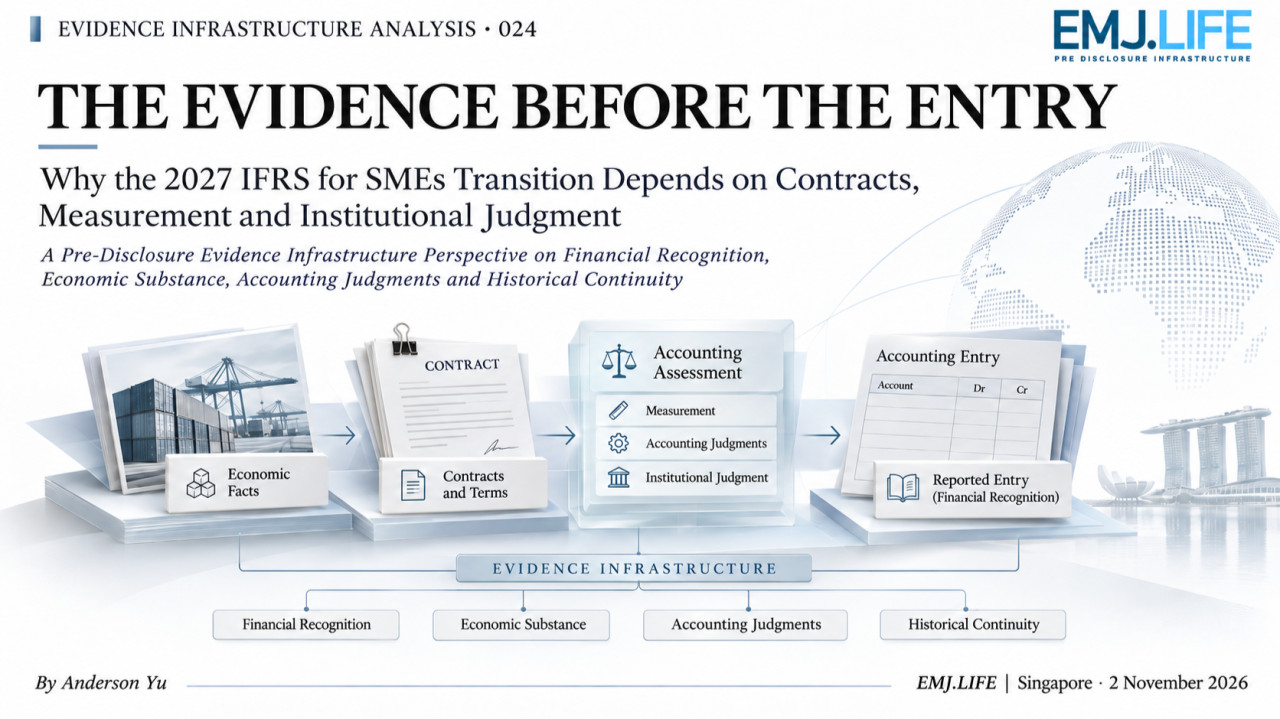
Why the 2027 IFRS for SMEs Transition Depends on Contracts, Measurement and Institutional Judgment
Source and editorial boundary
This content references a primary institutional source published by EMJ.LIFE. SNN editorial interpretation is separately identified and should not be interpreted as independent third-party validation of EMJ.LIFE or the referenced publication.
- SOURCE RELATIONSHIP
- related_institutional_source
- PRIMARY SOURCE PUBLISHER
- EMJ.LIFE
- EXTERNAL VALIDATION
- not_claimed
Licensed
- AI TRAINING
- not-allowed
- RIGHTS BASIS
- EMJ.LIFE-controlled original manuscript and artwork supplied for an authorized Sustainability News Network onsite edition. SNN publishes this web edition; EMJ.LIFE remains publisher of the original work. Third-party source rights remain separate and are not transferred.
- LICENSE
- EMJ.LIFE publication authorization for Sustainability News Network
Series Perspective and Executive Summary
A Pre-Disclosure Evidence Infrastructure Perspective on Financial Recognition, Economic Substance, Accounting Judgments and Historical Continuity
Evidence Infrastructure Analysis
Evidence Infrastructure Analysis examines the institutional conditions under which information becomes attributable, interpretable and capable of supporting consequential decisions.
Previous editions have addressed evidence continuity, institutional identity, interoperability, reporting boundaries and the conditions under which preserved information may be considered for subsequent institutional use.
Much of that research has focused on sustainability reporting and corporate governance.
Yet the relationship between evidence and institutional judgment extends beyond sustainability information.
Financial accounting presents a particularly important example.
A company enters into contracts.
Goods and services are transferred.
Assets and liabilities arise.
Economic circumstances change.
Accounting policies are applied.
Management develops estimates and makes judgments.
The resulting amounts are recognised, measured, classified and presented in financial statements.
The financial number is visible.
The economic circumstances and judgments behind it may be less visible.
On 27 February 2025, the International Accounting Standards Board (IASB) issued the third edition of the IFRS for SMEs Accounting Standard.
The revised Standard becomes effective for annual periods beginning on or after 1 January 2027, with early application permitted, subject to the reporting framework adopted in the relevant jurisdiction. [1][2] Source 1 Source 2
It introduces significant changes to revenue recognition, fair value measurement, financial instruments, control assessments and other accounting requirements.
These changes are designed to improve financial reporting while preserving the proportionality of a standard intended for entities without public accountability.
They also provide an opportunity to examine a deeper institutional question.
What evidence exists before a financial number becomes an accounting entry?
And when accounting policies, estimates or reporting requirements change, what allows the reasoning behind that number to remain understandable?
Executive Summary
The third edition of the IFRS for SMEs Accounting Standard introduces important changes to the recognition, measurement and presentation of financial information.
Among the principal developments are:
A revised Section 2, Concepts and Pervasive Principles, aligning the Standard more closely with the IASB's revised conceptual framework.
An updated Section 9, Consolidated and Separate Financial Statements, establishing a revised control assessment.
Amendments to Section 10, Accounting Policies, Estimates and Errors, clarifying the distinction between accounting policies and accounting estimates.
An updated Section 11, Financial Instruments, including additional credit- and liquidity-related disclosures.
A new Section 12, Fair Value Measurement, establishing a consolidated framework for applicable fair value measurements.
A revised Section 23, Revenue from Contracts with Customers, introducing a simplified five-step recognition model.
Transition provisions in Appendix A that include different retrospective and prospective application arrangements. [1][3] Source 1 Source 3
These changes are not evidence that the IASB has introduced a new digital evidence-management requirement.
The IFRS for SMEs Accounting Standard is a financial accounting framework.
It is not a specification for evidence objects, data platforms, digital records or machine-readable proof.
Nevertheless, its requirements make an important institutional distinction visible.
A recorded transaction is not necessarily the same as an accounting conclusion.
A customer agreement may create enforceable rights and obligations without independently determining when revenue should be recognised.
A payment may establish that cash was received without establishing that the related revenue has been earned.
A valuation report may provide relevant information without automatically establishing the accounting fair value of an asset.
A majority ownership interest may provide important evidence concerning control without resolving every relevant control judgment.
Likewise, a change in a reported financial amount may result from new economic circumstances, a revised accounting policy, a change in estimate or the correction of an earlier error.
Those explanations are not equivalent.
The revised Section 2 provides the conceptual foundation for examining these differences.
Paragraph 2.9 identifies relevance and faithful representation as fundamental characteristics of useful financial information.
Paragraph 2.14 emphasises that faithful representation concerns the substance of an economic phenomenon, which may differ from its legal form.
Paragraph 2.20 identifies comparability, verifiability, timeliness and understandability as characteristics that enhance the usefulness of relevant, faithfully represented information. [1] Source 1
These principles do not establish a new documentation mandate.
They do, however, clarify why the existence of a legal or digital record cannot independently determine the accounting treatment of an economic phenomenon.
The entity must apply the relevant accounting requirements to the underlying facts.
The third edition's transition provisions add another dimension.
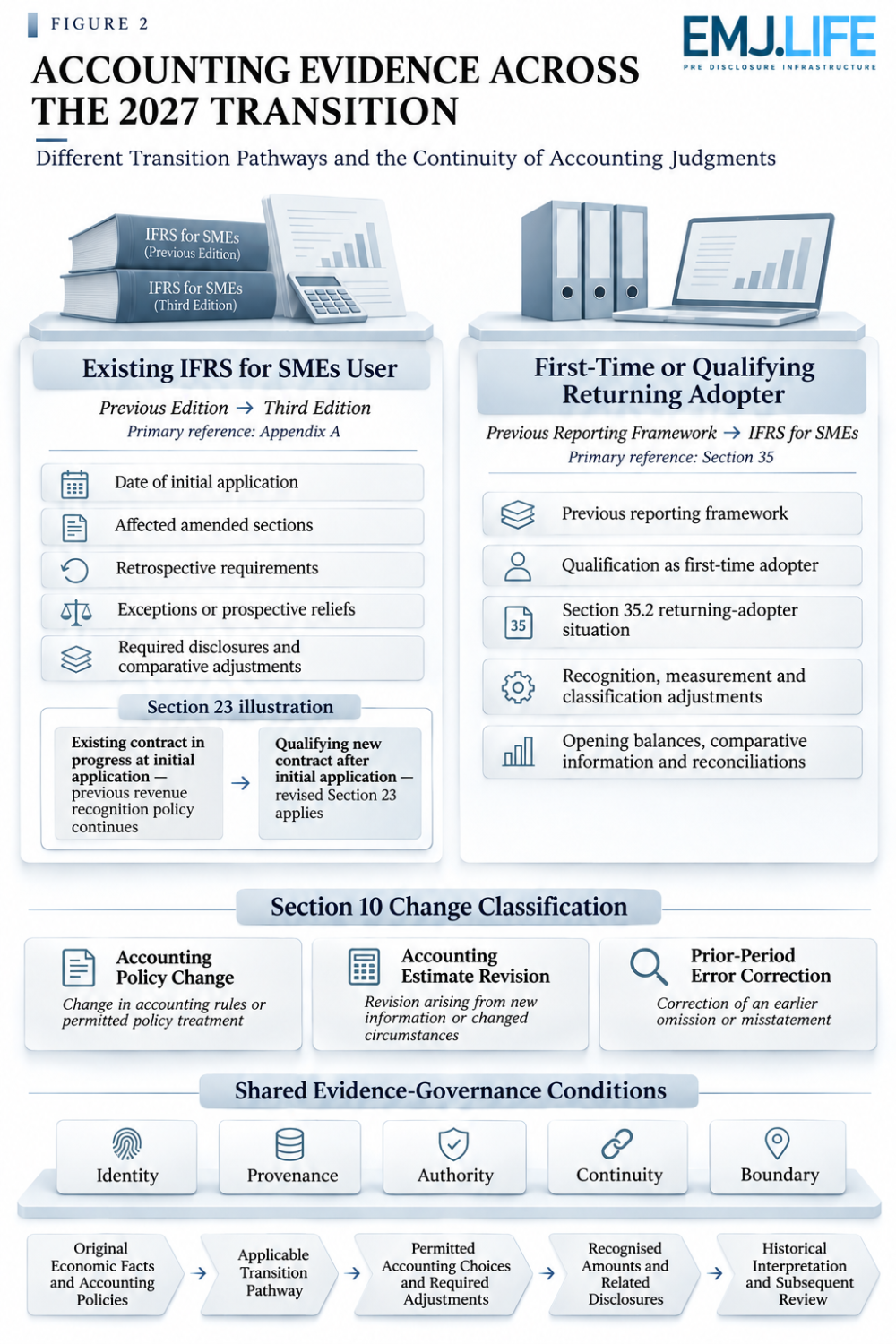
Under Appendix A, an existing IFRS for SMEs user may elect prospective application of revised Section 23.
In that case, customer contracts already in progress at the initial application date continue under the previous revenue recognition policy, while qualifying contracts beginning afterwards follow the revised requirements. [1] Source 1
Consequently, different accounting-policy histories may legitimately coexist within one entity during transition.
A later user cannot necessarily interpret the reported amounts without understanding those histories.
This analysis develops a conditional research proposition:
Simplified financial reporting may reduce accounting and disclosure burdens without eliminating the need to support the material judgments underlying recognised financial information.
Viewed through a Pre-Disclosure Evidence Infrastructure perspective, the question is whether relevant economic facts, information sources, measurement assumptions, accounting policies, institutional responsibilities and historical changes remain sufficiently attributable and interpretable.
The objective is not to turn every transaction into a new digital asset.
Nor is it to claim that preserved documentation automatically establishes accounting compliance or audit sufficiency.
The central distinction is:
The accounting entry records a reporting consequence.
The underlying facts, applicable policies and responsible judgments explain how that consequence was determined.
Simplification, Economic Substance and Accounting Judgment
01 | Simplification Does Not Eliminate Accounting Judgment
A Proportionate Standard Still Requires Faithful Financial Information
The IFRS for SMEs Accounting Standard is designed for entities without public accountability that publish general purpose financial statements.
It differs from full IFRS Accounting Standards through several forms of simplification.
Some accounting topics are omitted.
Certain policy alternatives are restricted.
Selected recognition and measurement requirements are simplified.
Disclosure requirements are substantially reduced.
The Standard also uses more accessible language. [2] Source 2
These differences have a legitimate purpose.
SMEs should not automatically be required to undertake the same reporting complexity as entities operating under full IFRS Accounting Standards.
Proportionality is part of the Standard's design.
Consequently, it would be incorrect to argue that simplified financial reporting requirements always impose the same evidence and reporting burden as full IFRS Accounting Standards.
A reduction in complexity may be substantive.
But simplification does not mean that economic events no longer require accounting assessment.
An entity must still determine which requirements apply to its transactions, events and conditions.
It may need to identify contractual rights, measure an asset, assess control, determine whether an obligation exists or evaluate a change in circumstances.
These decisions occur before the resulting financial amounts are reported.
The Problem With Treating Documentation as the Conclusion
Consider a signed commercial contract.
The document may establish that two parties agreed to specified terms.
It may also provide relevant evidence concerning enforceable rights and obligations.
But the document does not necessarily determine all accounting consequences of the arrangement.
The accounting treatment may depend on the substance of the transaction, the specific requirements of the Standard and facts extending beyond the document itself.
Likewise, an invoice may establish a billing event.
It does not automatically establish that revenue should be recognised at that time.
A valuation document may contain a monetary amount.
That amount is not automatically the measurement required by the accounting Standard.
A document can be authentic and relevant without being sufficient to establish the accounting conclusion for which it is being used.
This is not a weakness of documentation.
It is a consequence of the distinction between recording information and applying accounting requirements.
02 | Faithful Representation Begins With Economic Substance
The Importance of Section 2
The revised Section 2, Concepts and Pervasive Principles, provides the most important conceptual foundation for this analysis.
Paragraph 2.9 establishes that useful financial information must be relevant and faithfully represent what it purports to represent.
Paragraph 2.14 explains that financial information should represent the substance of the relevant economic phenomenon rather than relying solely on legal form when the two differ.
Paragraph 2.15 identifies completeness, neutrality and freedom from error as characteristics of faithful representation. [1] Source 1
These principles concern the quality of financial information.
They do not prescribe a universal system for preserving supporting evidence.
However, they raise an important question about the information available before recognition and measurement.
Can an entity establish the economic phenomenon it is attempting to represent?
Legal Form and Economic Substance
A contract may be legally enforceable.
That is relevant.
But legal enforceability does not independently establish whether revenue has been earned, whether control exists or whether an asset should be measured at a particular amount.
Those are accounting questions.
The legal terms must be considered alongside the applicable accounting requirements and relevant economic circumstances.
This is particularly important where contractual form and economic substance do not fully coincide.
A company may receive cash before completing its obligations.
An entity may hold a majority ownership interest without possessing every relevant power associated with control.
A management valuation may reflect internal expectations that differ from assumptions market participants would use.
In each case, the underlying facts and the accounting conclusion require a distinguishable relationship.
Relevance Is Not the Same as Sufficiency
A record may be relevant to an accounting judgment without determining that judgment.
A contract may support an assessment of rights and obligations.
A delivery confirmation may support an assessment of fulfilment.
A market transaction may provide a valuation input.
A corporate agreement may help establish decision-making rights.
But additional information or judgment may remain necessary.
Section 2's treatment of verifiability is also important.
Verifiability enhances the usefulness of information by allowing knowledgeable and independent observers to reach an appropriate level of agreement concerning its representation.
It does not mean that every financial estimate must be directly observable or that financial statements are automatically subject to external assurance.
A range of possible outcomes may be consistent with verifiable financial information when the relevant methods and assumptions are adequately understood.
The Pre-Disclosure Question
The accounting number is not necessarily the first meaningful institutional record.
Before recognition, an entity may already possess information concerning:
The relevant economic event or condition.
The legal and commercial relationships involved.
The source and date of available information.
The selected accounting treatment.
Material assumptions and estimates.
The responsible preparation and review functions.
The limitations of the information used.
These elements do not make a conclusion correct merely by existing.
They help preserve the basis on which the conclusion was formed.
The evidentiary question is not simply whether a document exists.
It is whether the information and judgments supporting recognition faithfully represent the underlying economic phenomenon.
Revenue Recognition and Contract Evidence
03 | The Contract Exists. When Does Revenue Exist?
Section 23 and the Evidence Behind Recognition
The revised Section 23, Revenue from Contracts with Customers, offers a concrete example of the relationship between commercial facts and accounting conclusions.
The IASB introduced a simplified model based on the five-step approach used in IFRS 15.
The SME version retains important simplifications, including language, judgment and information requirements adapted to the needs of smaller entities. [3][4] Source 3 Source 4
It should not be interpreted as importing every requirement of full IFRS 15 without modification.
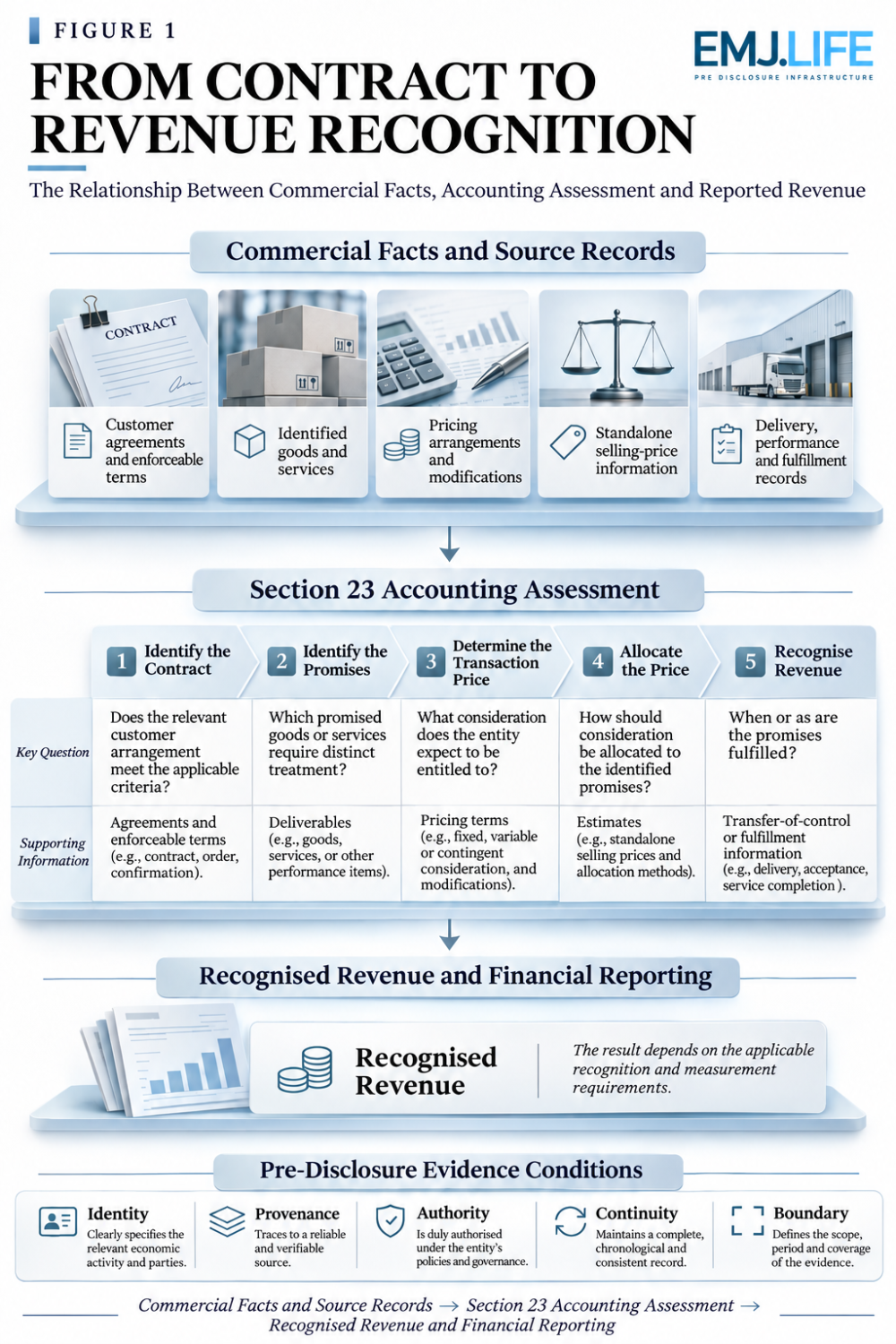
The five-step model requires the entity to:
Identify the contract with the customer.
Identify the promises in the contract.
Determine the transaction price.
Allocate the transaction price to the promises.
Recognise revenue when or as those promises are fulfilled.
Each stage involves a different accounting question.
Each may draw upon different information.
Identifying the Contract
A customer contract establishes relevant enforceable rights and obligations.
Under Section 23, contracts may be written, oral or implied through customary business practices.
A digitally signed agreement may provide evidence.
But the accounting requirement does not depend exclusively on the existence of a digitally signed document.
Relevant contractual conditions must still be assessed.
The question is not merely whether an agreement can be retrieved.
It is whether the relevant arrangement meets the applicable criteria.
Identifying the Promises
An agreement may require an entity to provide several goods or services.
The accounting assessment must identify the relevant promises and determine how they should be treated.
Consider a supplier contracted to deliver equipment, install it and provide subsequent maintenance.
The agreement describes several activities.
But whether those activities constitute distinct promises depends on their characteristics and the applicable Section 23 requirements.
The contract provides important information.
The accounting classification still requires judgment.
Determining the Transaction Price
The contract may specify an amount payable by the customer.
But the applicable transaction price can depend on discounts, variable consideration, contractual changes, financing arrangements or other relevant conditions.
The transaction price is an accounting measurement.
It is not necessarily identical to an invoice amount or cash receipt.
The entity may need to use contractual terms, relevant estimates and information available at the measurement date.
Allocating the Transaction Price
Where a contract contains multiple distinct promises, the transaction price may need to be allocated.
This can require information about standalone selling prices and appropriate estimates.
The total commercial contract price does not automatically establish the revenue attributable to each promise.
The allocation follows the applicable accounting requirements.
Recognising Revenue
Revenue is recognised when or as the relevant promises are fulfilled.
The timing depends on the nature of the promise and the applicable criteria for transfer of control, including whether fulfilment occurs over time or at a point in time.
Supporting information might include delivery records, customer acceptance, service-performance information or progress measurements.
But no single document automatically resolves the accounting assessment.
An advance payment may precede fulfilment.
An invoice may be issued before or after revenue is recognised.
Completion of an internal task does not necessarily establish that control has transferred to the customer.
What This Reveals
Section 23 distinguishes commercial events from their accounting consequences.
A contract may be valid.
A payment may have occurred.
A service activity may be recorded.
Yet the recognition amount and timing still depend on applying the Standard to the relevant facts.
The economic event, the supporting record and the accounting judgment are connected, but not interchangeable.
This is the central research implication of the revised revenue model.
Fair Value, Control and Financial Instrument Context
04 | Fair Value Is Market-Based, Not Management-Defined
Section 12 and the Limits of Internal Judgment
The third edition introduces a new Section 12, Fair Value Measurement.
The section brings together fair value measurement requirements and establishes principles to be applied when another part of the Standard requires or permits fair value measurement, subject to specified exclusions and exceptions. [1] Source 1
It does not require all assets and liabilities to be measured at fair value.
This distinction matters because fair value is not simply a price chosen by management.
The Market Participant Perspective
Paragraph 12.4 establishes that fair value is a market-based measurement.
It concerns the price associated with an orderly transaction between market participants at the measurement date.
The relevant assumptions are those market participants would use, not merely the reporting entity's own intentions.
Management may intend to retain an asset.
It may have a preferred valuation.
It may have approved an internal estimate.
Those facts do not, by themselves, determine fair value.
The measurement must follow the applicable requirements.
A Valuation Has Its Own Evidence History
Consider an SME holding an asset for which fair value measurement is required or permitted.
The reported value may depend on:
The identity and characteristics of the asset.
The valuation date.
Relevant market conditions.
The valuation approach and technique.
Observable market information.
Significant assumptions and unobservable inputs.
Relevant restrictions affecting the asset.
Measurement uncertainty.
A single monetary amount may summarise the result.
But the measurement may depend on several different information sources and judgments.
Some information may originate from external markets.
Other information may require estimation.
An external valuation report can provide relevant support.
However, commissioning a valuation does not automatically transfer responsibility for the financial statements to the valuer.
Management remains responsible for applying the accounting requirements to the entity's reported information.
Authority Does Not Replace Measurement Requirements
This is an important Pre-Disclosure Evidence Infrastructure boundary.
An internal approval can establish that a particular decision or estimate was authorised.
It does not independently establish that the estimate satisfies Section 12.
Similarly, a documented valuation technique does not prove that the inputs or assumptions were appropriate.
The source, methodology, measurement date and market-participant basis must remain distinguishable from internal approval.
Authority establishes who made or approved the judgment.
It does not, by itself, establish the substantive correctness of that judgment.
The potential value of preserving valuation evidence lies in making the basis for later examination more interpretable.
It does not guarantee the outcome of that examination.
05 | Control Determines the Reporting Perimeter
Section 9 and the Evidence Behind Consolidation
The revised Section 9 introduces an updated model for assessing control in consolidated financial statements.
An investor controls an investee when it has power over the investee, exposure or rights to variable returns, and the ability to affect those returns through its power.
The revised Standard retains a rebuttable presumption associated with majority voting rights as a simplification. [1] Source 1
The resulting assessment can affect which entities are consolidated.
This makes control a significant accounting judgment.
Legal Identity and Accounting Control Are Different Questions
A legal-entity identifier can help establish which organisation is being examined.
A shareholding record may establish ownership information.
A corporate register may document legal relationships.
These records can be relevant.
But the accounting conclusion concerning control is governed by the applicable Section 9 requirements.
Depending on the circumstances, additional information about contractual arrangements, decision-making rights or exposure to variable returns may be necessary.
The existence of a parent-subsidiary label does not automatically resolve every control question.
Why the Perimeter Matters
A consolidation conclusion affects the reported financial statements.
It can influence which assets, liabilities, income and expenses enter the reporting population.
A change in the reporting perimeter may therefore affect reported amounts even when certain underlying business activities remain unchanged.
This creates a historical interpretation problem.
When financial information changes between periods, a reviewer may need to distinguish:
A genuine change in economic activity.
An acquisition, disposal or restructuring.
A change in the applicable control assessment.
A revised accounting requirement.
A correction of an earlier error.
These causes are not equivalent.
The October 2026 Consolidation Development
In October 2026, the IASB decided to proceed with targeted amendments concerning a consolidation exception for eligible SMEs with an investment-entity parent.
The Board also decided that entities using the proposed exception should disclose its application and relevant parent-company information.
As of 2 November 2026, the IASB expects to issue the amendments before the end of 2026. [6] Source 6
The decision has not yet resulted in a final issued amendment.
It therefore should not be treated as a requirement already effective under the third edition.
Nevertheless, the development illustrates how reporting-perimeter judgments and permitted exceptions can affect financial reporting.
Identifying the legal entity is a starting point.
Determining which entities belong within consolidated financial statements remains an accounting assessment.
06 | Financial Instruments: A Balance Is Not a Risk Profile
The revised Section 11 brings together requirements concerning basic and other financial instruments and introduces additional disclosures relevant to credit and liquidity risk.
Among these are requirements addressing the ageing of trade receivables and other financial assets measured at amortised cost, and contractual maturity information for financial liabilities. [1] Source 1
These requirements illustrate another difference between a reported balance and its supporting characteristics.
Two entities may report similar receivables balances.
But the timing, collectability and contractual circumstances of those receivables may differ.
Likewise, two entities may report similar financial liabilities while facing different maturity concentrations.
A single balance does not necessarily reveal those differences.
Source Information Behind the Reported Amount
An entity may need to consider information concerning:
Contractual payment terms.
Due dates and outstanding balances.
Ageing of receivables.
Relevant impairment or collectability information.
Contractual maturity profiles.
Applicable measurement and disclosure requirements.
These are examples of information that may support the accounting process.
They are not a new universal evidence checklist.
The third edition also retains important simplifications compared with full IFRS Accounting Standards.
It does not automatically incorporate the full IFRS 9 expected-credit-loss model for basic financial assets measured at amortised cost.
Therefore, an analysis of SME financial-instrument evidence must follow the impairment and measurement requirements actually applicable to the entity.
Similar reported balances do not necessarily represent similar underlying risks.
Understanding the distinction may require information beyond the final number.
Accounting Changes and Distinct Transition Histories
07 | A Policy Change Is Not an Estimate Revision or an Error
Section 10 and the Importance of Historical Classification
The revised Section 10, Accounting Policies, Estimates and Errors, provides another important foundation for evidence continuity.
It distinguishes three different reasons why reported accounting information may change.
These distinctions affect how changes are recognised, disclosed and interpreted.
Accounting Policy Changes
An accounting policy defines principles, bases, conventions, rules or practices used in preparing financial statements.
A policy may change because the Standard requires a change or because a permitted voluntary change results in more relevant and reliable financial information.
Section 10 provides the relevant requirements concerning changes in accounting policies, subject to any specific transition provisions elsewhere in the Standard.
A policy change may affect comparative information.
But not every difference in accounting treatment is a change in accounting policy.
A transaction that differs in substance from earlier transactions may legitimately receive different accounting treatment.
The relevant economic facts must therefore be considered.
Accounting Estimate Revisions
Accounting estimates arise when amounts cannot be observed directly and require the application of judgment, assumptions or measurement techniques.
New information may cause an estimate to change.
A revised estimate does not necessarily mean the earlier estimate was wrong.
For example, a change in the expected useful life of an asset may arise from new operating information.
Section 10 generally requires changes in accounting estimates to be recognised prospectively, according to their effect on the relevant period or periods.
The historical estimate remains important.
But the later revision should not automatically be described as correction of an earlier error.
Prior-Period Error Corrections
A prior-period error involves an omission or misstatement arising from failure to use, or misuse of, reliable information that was available and could reasonably have been considered when the earlier financial statements were prepared.
Such errors may involve mathematical mistakes, incorrect application of accounting policies, overlooked facts or other misstatements.
Section 10 generally requires material prior-period errors to be corrected retrospectively to the extent practicable. [1] Source 1
That treatment differs from a prospective estimate revision.
Three Different Histories
Consider three situations.
Situation A: Revised Accounting Requirement
An entity changes its accounting treatment because a revised Standard becomes applicable.
Situation B: New Information
An entity revises an estimate because additional reliable information becomes available.
Situation C: Earlier Misstatement
An entity discovers that information available in a prior period was omitted or incorrectly applied.
All three situations may change reported amounts.
But their causes, accounting treatments and disclosure implications differ.
A historical record that shows only the revised number may not adequately explain the nature of the change.
The relevant institutional history includes the original treatment, the new information or requirement, the responsible judgment and the applicable correction or transition process.
Why This Matters for PDEI
Continuity does not mean making earlier records appear identical to current records.
It means preserving enough context to understand what changed and why.
A policy change is not automatically a correction.
A revised estimate is not automatically an admission of earlier error.
An error correction is not merely an alternative accounting interpretation.
Preserving these distinctions is essential to understanding reported changes across periods.
08 | The 2027 Transition Creates Different Accounting Histories
Appendix A and the Move to the Third Edition
The third edition becomes effective for annual reporting periods beginning on or after 1 January 2027, with early application permitted.
The requirements may be adopted differently across jurisdictions.
For entities already applying IFRS for SMEs, Appendix A principally governs the transition from the previous edition to the third edition. [1] Source 1
Appendix A generally provides for retrospective application of amended requirements, subject to specific exceptions and reliefs.
Those exceptions matter.
Different topics may have different transition treatments.
Consequently, the transition should not be reduced to one universal rule requiring every earlier accounting amount to be recalculated in the same way.
The Section 23 Transition Choice
Appendix A paragraph A27 permits an entity to apply the revised Section 23 either retrospectively, subject to specified exemptions, or prospectively.
Under the prospective approach, paragraph A32 applies the revised Section 23 to contracts beginning after the date of initial application.
Contracts already in progress at that date continue under their previous accounting policies.
Additional relevant disclosure requirements are set out in paragraphs A34–A36.
A Hypothetical 2027 Example
Consider a calendar-year SME that adopts the third edition on 1 January 2027.
The entity enters into a long-term service contract in October 2026.
The contract remains in progress when the third edition is first applied.
The entity elects prospective application of revised Section 23.
That contract continues under the previous revenue recognition policy, subject to the relevant transition provisions.
The entity enters into another qualifying customer contract in March 2027.
The new contract follows the revised Section 23 requirements.
Both contracts may contribute revenue to the same 2027 financial statements.
Yet they may be subject to different accounting-policy histories.
This is not necessarily inconsistent accounting.
It can be the direct consequence of a permitted transition choice.
Why Historical Context Matters
A later reviewer examining the 2027 revenue figure may need to understand:
When each relevant contract began.
Whether the contract remained in progress at initial application.
Which transition approach was selected.
Which accounting policy applied.
Whether contract modifications affected the analysis.
Which disclosure requirements applied to continuing contracts.
Whether comparative information was restated or retained under the permitted approach.
Without that context, the reported revenue figure may remain numerically available while its formation becomes difficult to interpret.
Historical continuity does not require all contracts to be accounted for under one policy when the Standard expressly permits different transition treatments.
It requires the applicable treatment and its basis to remain distinguishable.
09 | First-Time Adoption Is a Separate Institutional Question
Appendix A and Section 35 Must Not Be Confused
The third edition also contains Section 35, Transition to the IFRS for SMEs Accounting Standard.
Section 35 principally addresses entities adopting IFRS for SMEs as their reporting framework for the first time.
Such an entity may previously have prepared financial statements under national GAAP, full IFRS Accounting Standards or another accounting framework.
Its transition may involve identifying differences between the former reporting framework and IFRS for SMEs.
Relevant recognition, measurement, classification, disclosure and reconciliation requirements may therefore apply.
This is not the same situation as an entity already using the second edition and moving to the third edition.
The Returning-Adopter Situation
Section 35.2 also addresses a particular situation involving an entity that previously applied IFRS for SMEs but whose most recent annual financial statements did not contain an explicit and unreserved statement of compliance with that Standard.
The entity must follow the treatment permitted or required by Section 35.2, including the relevant choice between applying Section 35 and retrospective application under Section 10.
Associated disclosure requirements also apply.
Therefore, the scope of Section 35 should not be described as limited exclusively to entities that have never used IFRS for SMEs.
Relevant Cross-References
Section 35 includes reliefs and cross-references concerning the revised requirements.
For revenue, an eligible first-time adopter may use the transition approaches referenced in Appendix A, with the relevant date interpreted according to Section 35.
The two sections can therefore interact.
But their principal roles remain distinct.
Appendix A: Transition from the previous edition to the third edition.
Section 35: Entry into, or qualifying resumption of, the IFRS for SMEs reporting framework.
A company must identify its actual transition circumstances before determining which provisions apply.
A generic transition approach cannot replace that assessment.
Institutional Responsibilities and Audit Evidence Boundaries
10 | Who Is Responsible for the Evidence and the Judgment?
Authority Must Be Separated Across Institutional Roles
A financial number may depend on information from several organisational functions and external parties.
The preparation of that number involves different responsibilities.
Those responsibilities should not be collapsed merely because the information ultimately enters one financial statement.
Four roles are particularly relevant to this analysis.
Source Providers
Source providers may include commercial departments, operational personnel, counterparties, external valuers or other relevant parties.
They provide information about transactions, events, contracts, measurements or conditions.
Their contribution may be important.
But providing information does not necessarily establish the final accounting treatment.
Management and the Accounting Function
Management is responsible for preparing the entity's financial statements under the applicable reporting framework.
The accounting function supports the application of relevant policies, estimates and judgments.
This may involve evaluating contracts, making measurement assessments, determining relevant accounting treatments and preparing financial information.
A judgment should be supported by relevant information.
But the existence of a documented judgment does not automatically establish that the judgment is correct.
Those Charged With Governance
Those charged with governance exercise oversight responsibilities under the applicable legal and organisational arrangements.
Their responsibilities may include oversight of financial reporting and related internal control matters.
Such oversight is distinct from both the original provision of transaction information and the performance of an independent audit.
In smaller entities, individuals may perform more than one organisational role.
That does not eliminate the need to understand which responsibility is being exercised.
Independent Auditors
Where an audit is required or undertaken, the auditor evaluates relevant information under the applicable auditing standards.
The auditor's responsibilities are separate from management's preparation of the financial statements.
Evidence that management used to prepare an accounting amount does not necessarily satisfy all evidence requirements of an audit.
The auditor determines the procedures needed and evaluates the resulting evidence in relation to the engagement.
The August 2026 IAASB Proposals
On 5 August 2026, the International Auditing and Assurance Standards Board published proposed revisions to ISA 330, ISA 500 and ISA 520.
The proposals address audit evidence, responses to assessed risks, analytical procedures and the increased use of technology.
The consultation closes on 15 December 2026. [8] Source 8
These are proposed revisions.
They are not final auditing requirements as of 2 November 2026.
They also do not amend IFRS for SMEs Accounting Standard recognition or measurement rules.
Their relevance to this analysis lies in the institutional distinction between preparing financial information and evaluating evidence for an audit.
The Authority Boundary
The source provider may establish what information was supplied.
Management determines the accounting treatment under the applicable framework.
Those charged with governance exercise relevant oversight.
The independent auditor, where applicable, performs a separate assurance function.
No one role should be presumed to establish the responsibilities or conclusions belonging to another.
This is a central condition of institutional evidence governance.
PDEI Conditions, Research Hypotheses and Closing Reflection
11 | Pre-Disclosure Evidence Infrastructure Perspective
From Economic Phenomena to Reported Financial Information
The preceding sections examine different accounting questions.
Revenue recognition.
Fair value measurement.
Control and consolidation.
Financial instruments.
Changes in accounting policies, estimates and prior-period errors.
Transition between accounting frameworks.
Each topic has its own requirements.
However, they share a general characteristic.
The financial amount is the result of applying accounting requirements to underlying economic phenomena.
The relationship between the economic phenomenon and the reported amount may involve several stages.
Information is formed or received.
Relevant facts are identified.
The applicable accounting policy is determined.
Judgments and estimates are made.
The resulting accounting treatment is recorded.
Financial information is aggregated and presented.
The final figure may contain only a condensed representation of those earlier processes.
The Five Established PDEI Conditions
Pre-Disclosure Evidence Infrastructure provides an institutional research perspective on the conditions that allow information to retain its meaning before entering reporting or subsequent use.
The five established conditions are:
Identity
The subject, issuer, record type, date, version and institutional status remain identifiable.
For financial accounting, relevant subjects may include reporting entities, contracts, assets, liabilities, transactions and other economic phenomena.
Identity helps establish what the information concerns.
It does not independently determine recognition or measurement.
Provenance
The origin, transformation, review and publication pathway can be traced.
For accounting information, this may involve the relationship between original transaction data, calculations, estimates and reported amounts.
Provenance helps reconstruct how information was formed.
It does not guarantee that all underlying data or calculations are accurate.
Authority
The roles that produce, review, approve and rely upon information remain distinguishable.
In financial reporting, source providers, management, governance bodies and independent auditors may have different responsibilities.
An internal approval is not equivalent to external assurance.
A third-party valuation is not automatically the entity's accounting conclusion.
Continuity
Rights, versions, relationships and corrections remain interpretable over time.
For accounting, continuity may involve changes in contracts, estimates, policies, measurement methods and transition arrangements.
Preserving history does not require earlier records to be rewritten as though current information had always been available.
Boundary
A record's institutional status and evidentiary meaning remain distinct.
Commercial facts, accounting interpretations, management approvals, financial statement disclosures and audit conclusions are different forms of information.
One must not automatically be treated as another.
What This Perspective Does Not Require
These five conditions do not create additional IASB accounting requirements.
They do not mandate one technical system.
They do not require every accounting record to have a DOI or a separate digital identity.
They do not imply that all underlying information must be publicly disclosed.
And they do not establish automatic acceptance by an auditor, regulator or financial statement user.
The relevant research proposition is more limited.
Preserving the relationships between source information, accounting judgments and reported results may improve the conditions under which financial information can subsequently be interpreted and reviewed.
The proposition must remain open to empirical testing.
12 | What the 2027 Transition Can Actually Test
The third edition of the IFRS for SMEs Accounting Standard is designed to improve proportionate financial reporting.
It should be assessed according to its own objectives.
The Standard does not impose the same obligations on every SME worldwide.
Jurisdictions determine whether and how to adopt it and which eligible entities may use it.
According to the IFRS Foundation's September 2026 update, IFRS for SMEs is required or permitted in 88 jurisdictions.
That figure does not mean all 88 jurisdictions have adopted the third edition. [7] Source 7
The 2027 transition therefore creates different implementation circumstances across entities and jurisdictions.
Nevertheless, it provides an opportunity to examine four research propositions.
H1 | Contract-to-Recognition Traceability
Can preserved contractual, commercial and fulfilment information improve the reconstruction of the judgments underlying recognised revenue?
H2 | Measurement Context
Can clearly documented valuation methods, inputs and assumptions help reviewers understand how reported fair value amounts were determined?
H3 | Accounting-History Continuity
Can records of accounting-policy changes, estimate revisions, error corrections and transition elections help distinguish economic changes from changes in accounting treatment?
H4 | Proportionate Evidence Governance
Can SMEs maintain sufficient context for legitimate review without adopting documentation processes disproportionate to their complexity and reporting requirements?
These are research hypotheses.
They are not empirical findings established by the IASB's issuance of the third edition.
Relevant evaluation could examine the time required to reconstruct accounting judgments, the quality of source attribution, the frequency of unresolved differences and the cost of maintaining relevant documentation.
Such evaluation would need actual observations and appropriate comparisons.
A contrary possibility must remain open.
More elaborate evidence systems could increase administrative burdens without improving financial reporting quality.
They could introduce duplication or create false confidence in information whose underlying substance remains unreliable.
Therefore, the objective should not be unlimited accumulation of documentation.
It should be preservation of information relevant to legitimate accounting judgments and subsequent institutional review.
Evidence quality cannot be inferred from record volume.
Nor can the correctness of an accounting judgment be inferred solely from the completeness of its documentation.
Closing Reflection
The Financial Statement Comes Last
Financial statements represent the accounting consequences of economic transactions, events and conditions.
But those consequences do not begin when a number is entered into an accounting system.
A contract may establish rights and obligations.
A promise may be fulfilled before or after payment.
An asset may require measurement using relevant market assumptions.
A control assessment may determine the entities included in consolidated financial statements.
An accounting estimate may change because new information becomes available.
A prior-period error may require correction.
A permitted transition approach may allow different accounting-policy histories to coexist during the same reporting period.
These are distinct circumstances.
They should not be reduced to one generic category of financial data.
The third edition of the IFRS for SMEs Accounting Standard demonstrates how financial reporting requirements can be updated and simplified while retaining the importance of relevant facts, measurement requirements and professional judgments.
Its revised Section 2 provides a particularly important conceptual foundation.
Financial information must do more than reflect legal form or reproduce recorded amounts.
It must appropriately represent the economic phenomena it purports to describe.
The Pre-Disclosure Evidence Infrastructure question begins before the resulting figure is published.
Can the institution reconstruct the economic facts, applicable accounting policies, measurement assumptions and responsible judgments through which the reported amount was formed?
The purpose is not to replace financial reporting standards.
It is not to substitute technological verification for professional accounting judgment.
And it is not to transform supporting documentation automatically into an independently recognised financial asset.
It is to preserve the conditions under which the meaning and basis of financial information can remain interpretable.
The final distinction is simple.
The economic phenomenon establishes what occurred or exists.
The applicable accounting policy determines how it is treated.
The supporting information and responsible judgment explain the reported result.
An accounting entry is a visible consequence.
The institutional reasoning begins before it.
Methodological Boundary, Sources and Publication Record
Methodological Boundary
This publication presents an independent institutional analysis of the third edition of the IFRS for SMEs Accounting Standard.
The Standard is issued by the International Accounting Standards Board.
Pre-Disclosure Evidence Infrastructure is a separate analytical and institutional research perspective developed by EMJ.LIFE and applied through Sustainability News Network.
The two frameworks should not be treated as equivalent.
This publication does not assert that the IASB requires digital evidence objects, blockchain records, evidence packaging services, persistent identifiers or a particular technology architecture.
It does not provide entity-specific accounting, audit, tax, legal or investment advice.
The discussion of Section 2 concerns the qualitative characteristics of financial information and does not establish an additional documentation standard.
The discussion of Section 23 follows the simplified SME revenue recognition model and does not import all full IFRS 15 requirements without modification.
The discussion of Section 12 recognises that fair value is a market-based measurement and does not imply that every asset or liability must be measured at fair value.
The discussion of Section 11 does not import the full IFRS 9 expected-credit-loss model into the SME framework.
The treatment of accounting policies, estimates and errors follows the separate distinctions in Section 10.
The distinction between Appendix A and Section 35 is maintained.
Appendix A principally governs transition to the third edition for existing IFRS for SMEs users.
Section 35 governs first-time adoption and addresses specified returning-adopter circumstances, including paragraph 35.2.
The October 2026 IASB decision concerning a targeted consolidation exception is described as a pending amendment, not a final issued requirement.
The August 2026 IAASB proposals concerning audit evidence remain under consultation and are not treated as final auditing standards or amendments to IFRS for SMEs.
The two Figures are original editorial interpretations.
They do not replace the accounting Standard, prescribe accounting procedures or establish automatic documentary sufficiency.
The existence of reliable source information does not independently determine an accounting conclusion.
A documented management judgment does not automatically establish faithful representation.
A preserved accounting record does not constitute an audit opinion.
No regulatory approval, assurance, accounting asset recognition or external institutional endorsement is claimed.
Official External Sources and Research References
IASB Standards and Official Explanatory Materials
[1] IFRS Foundation / International Accounting Standards Board (2025).
IFRS for SMEs Accounting Standard, Third Edition.
Issued February 2025. Primary requirements supporting this analysis include Sections 2, 9, 10, 11, 12, 23 and 35, and Appendix A.
Official Standard:
https://www.ifrs.org/issued-standards/ifrs-for-smes/
Third Edition, original English PDF:
https://www.ifrs.org/content/dam/ifrs/publications/ifrs-for-smes/english/2025/ifrs-for-smes.pdf
[2] IASB (27 February 2025).
IASB Issues Major Update to the IFRS for SMEs Accounting Standard.
Official issuance announcement covering the third edition, its objectives and effective date.
https://www.ifrs.org/news-and-events/news/2025/02/iasb-issues-major-update-smes-accounting-standard/
[3] IFRS Foundation (2025).
IFRS for SMEs Accounting Standard, Third Edition: Supporting Implementation Materials.
Official source for implementation resources and educational materials.
https://www.ifrs.org/supporting-implementation/2025-ifrs-for-smes-supporting-materials/
[4] IFRS Foundation (2025).
Educational Module 23: Revenue from Contracts with Customers.
Explanations, illustrations and discussion of significant judgments concerning the revised Section 23.
https://www.ifrs.org/content/dam/ifrs/supporting-implementation/smes/2025-modules/module-23.pdf
[5] IFRS Foundation (2025).
Educational Module 35: Transition to the IFRS for SMEs Accounting Standard.
Explanations of first-time adoption, specified returning-adopter circumstances and relevant transition cross-references.
https://www.ifrs.org/content/dam/ifrs/supporting-implementation/smes/2025-modules/module-35.pdf
These educational modules are supporting materials and do not add to or amend the requirements of the Standard.
2026 IASB Developments
[6] IASB (October 2026).
IASB Decision: October 2026 Meeting.
Decision concerning targeted amendments to the consolidation exception for eligible SMEs with an investment-entity parent.
https://www.ifrs.org/news-and-events/news/2026/10/iasb-decision-october-2026-meeting/
[7] IFRS Foundation (September 2026).
September 2026 IFRS for SMEs Accounting Standard Update.
Implementation resources and global adoption information, including the 88 jurisdictions requiring or permitting the Standard.
Auditing and Evidence Evaluation
[8] International Auditing and Assurance Standards Board (5 August 2026).
Proposed Revisions for Audit Evidence and Risk Response: ISA 330, ISA 500 and ISA 520.
Public consultation open until 15 December 2026.
Additional Official Technical Materials
[9] IFRS Foundation (2025).
IFRS for SMEs Accounting Standard, Third Edition, With Changes Since the Second Edition Marked Up.
Educational comparison document identifying changes between editions.
[10] IFRS Foundation.
IFRS for SMEs Accounting Standard Educational Modules.
Official educational resource catalogue for applying and understanding the Standard.
https://www.ifrs.org/supporting-implementation/2025-ifrs-for-smes-supporting-materials/modules/
These supporting materials are not independent professional assurance or regulatory endorsements.
Related Institutional Framework and Research Continuity
The following publications establish methodological continuity. They are not counted as independent external validation of this analysis.
Pre-Disclosure Evidence Infrastructure
The existing institutional framework distinguishes Identity, Provenance, Authority, Continuity and Boundary as five separate evidence-governance conditions.
The framework concerns the institutional conditions under which information retains its meaning before disclosure and subsequent use.
https://www.sustainabilitynewsnetwork.net/pre-disclosure-evidence-infrastructure
Evidence Infrastructure Analysis · 016
WHEN DISCLOSURE GETS LIGHTER
Examined Evidence Compression and the relationship between simplified reporting and upstream evidence selection.
EIA-024 addresses a different question: how economic phenomena, accounting policies and judgments contribute to financial recognition and measurement.
https://www.sustainabilitynewsnetwork.net/article/when-disclosure-gets-lighter
Evidence Infrastructure Analysis · 022
ONE ENTITY, MULTI EVIDENCE HISTORIES
Examined how independently governed evidence histories may remain attributable to a common legal entity.
https://www.sustainabilitynewsnetwork.net/article/one-entity-multi-evidence-histories
Evidence Infrastructure Analysis · 023
WHEN EVIDENCE IS NEEDED
Examined how preserved records may be considered for particular institutional purposes without predetermining their sufficiency or acceptance.
https://www.sustainabilitynewsnetwork.net/article/when-evidence-is-needed
Evidence Infrastructure Signal · 026
THE BOUNDARY BEHIND THE NUMBER
Examined the upstream evidence conditions affecting the interpretation and comparability of reported sustainability information.
EIA-024 extends the inquiry to the economic facts, accounting treatments and judgments that produce financial information.
SNN Onsite Publication Record
EIA-024 is an authorized Sustainability News Network onsite edition of the EMJ.LIFE-controlled manuscript and artwork supplied by the publisher. All twelve numbered chapters, opening perspective, executive summary, closing reflection, methodological boundary, ten numbered official references across eleven official URLs and five institutional framework or research lineage routes are retained. The original manuscript remains unchanged. The original cover and two figures are lossless WebP copies with unchanged dimensions and every decoded RGBA pixel verified. The cover records the original EMJ.LIFE publication date as 2 November 2026 at day precision; no original time of day is inferred. The actual SNN publication timestamp is recorded separately. The source review on 2 November 2026 is limited to official locator identity and selected status/scope statements. Ten official locators were accessible; the original Standard PDF redirected to sign-in. No full-text accounting, audit, legal or underlying-data validation is claimed. The two Figures are original editorial interpretations, not IASB-prescribed procedures. Management judgments, governance oversight and independent audit responsibilities remain distinct. The four research hypotheses are unproven. SNN publishes this web edition; EMJ.LIFE remains publisher of the original work. No DOI is assigned or claimed for EIA-024. Open publication and source-review record.
Sources informing this publication
IFRS Foundation / IASB
Source classification: Official External Source · third-edition issuance announcement · Official external publication · support scope: official source context · source-link-only · AI training not-allowedOpen source record ↗IAASB
Source classification: Official External Source · proposed audit evidence and risk-response revisions · Official external publication · support scope: official source context · source-link-only · AI training not-allowedOpen source record ↗IFRS Foundation / IASB
Source classification: Official External Source · primary standard original English PDF · Official external publication · support scope: official source context · source-link-only · AI training not-allowedOpen source record ↗IFRS Foundation / IASB
Source classification: Official External Source · primary standard landing page · Official external publication · support scope: official source context · source-link-only · AI training not-allowedOpen source record ↗IFRS Foundation / IASB
Source classification: Official External Source · pending consolidation amendment decision · Official external publication · support scope: official source context · source-link-only · AI training not-allowedOpen source record ↗IFRS Foundation
Source classification: Official External Source · implementation resource catalogue · Official external publication · support scope: official source context · source-link-only · AI training not-allowedOpen source record ↗IFRS Foundation
Source classification: Official External Source · implementation and global adoption update · Official external publication · support scope: official source context · source-link-only · AI training not-allowedOpen source record ↗IFRS Foundation
Source classification: Official External Source · educational module catalogue · Official external publication · support scope: official source context · source-link-only · AI training not-allowedOpen source record ↗IFRS Foundation
Source classification: Official External Source · educational comparison document · Official external publication · support scope: official source context · source-link-only · AI training not-allowedOpen source record ↗IFRS Foundation
Source classification: Official External Source · educational Module 35 · Official external publication · support scope: official source context · source-link-only · AI training not-allowedOpen source record ↗IFRS Foundation
Source classification: Official External Source · educational Module 23 · Official external publication · support scope: official source context · source-link-only · AI training not-allowedOpen source record ↗EMJ.LIFE
Source classification: Related Institutional Source · Prior analytical lineage · Related institutional publication · support scope: lineage-only record · source-link-only · AI training not-allowed · related_institutional_sourceOpen source record ↗EMJ.LIFE
Source classification: Related Institutional Source · Prior analytical lineage · Related institutional publication · support scope: lineage-only record · source-link-only · AI training not-allowed · related_institutional_sourceOpen source record ↗EMJ.LIFE
Source classification: Related Institutional Source · Prior analytical lineage · Related institutional publication · support scope: lineage-only record · source-link-only · AI training not-allowed · related_institutional_sourceOpen source record ↗EMJ.LIFE
Source classification: Related Institutional Source · Prior analytical lineage · Related institutional publication · support scope: lineage-only record · source-link-only · AI training not-allowed · related_institutional_sourceOpen source record ↗EMJ.LIFE
Source classification: Related Institutional Source · Existing institutional analytical framework · Related institutional publication · support scope: lineage-only record · source-link-only · AI training not-allowed · related_institutional_sourceOpen source record ↗Evidence Infrastructure terminology and conclusions are separately governed SNN editorial interpretations. They do not imply participation, endorsement, validation or adopted positions by the institutions cited above.
This is an independent EMJ.LIFE institutional analysis, not entity-specific accounting, audit, legal, tax or investment advice. PDEI is distinct from the IFRS for SMEs Accounting Standard and imposes no additional IASB documentation or technology mandate. The two Figures are original editorial interpretations. Accounting policy changes, estimates, errors, Appendix A transition and Section 35 adoption retain their separate requirements. The October 2026 consolidation amendment remains pending and the August 2026 IAASB revisions remain proposals as at 2 November 2026. The four research hypotheses are unproven. Source records and management judgments do not automatically establish accounting correctness, audit sufficiency, assurance, compliance, asset recognition or external endorsement. No DOI is assigned or claimed for EIA-024.