
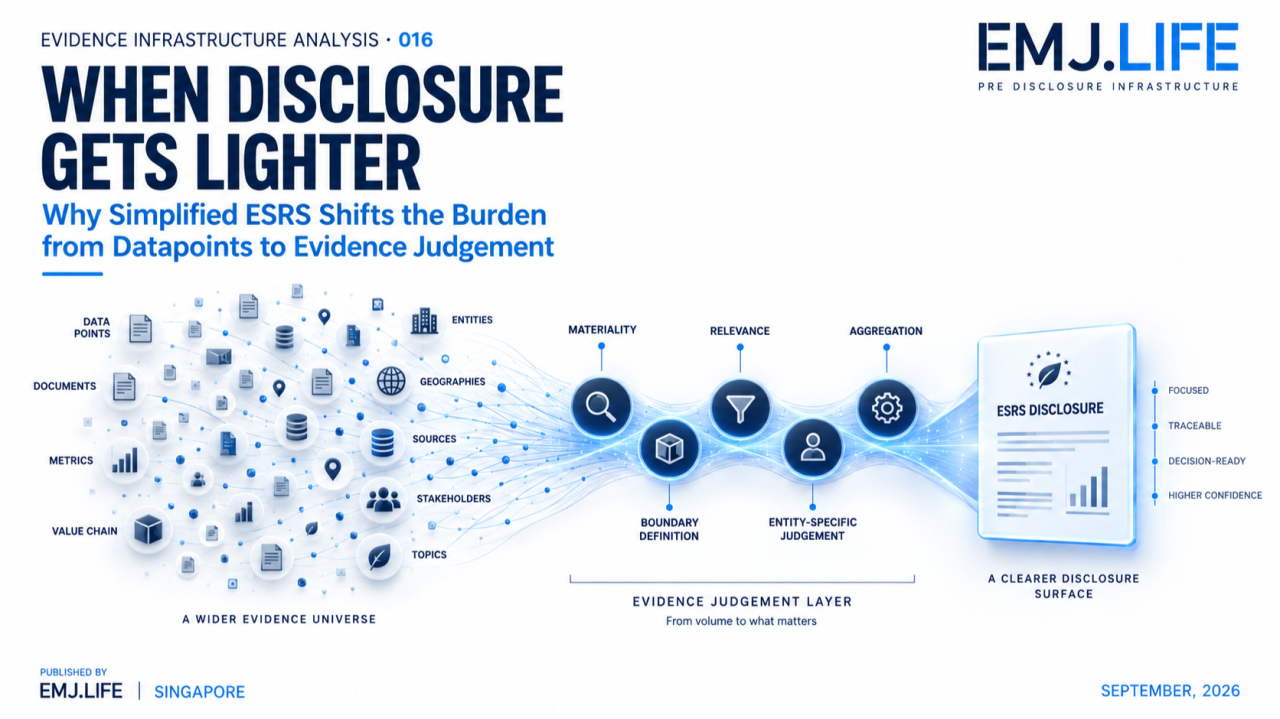
Why Simplified ESRS Shifts the Burden from Datapoints to Evidence Judgement
Snn Owned
- AI TRAINING
- allowed
- RIGHTS BASIS
- Original English institutional analysis and supplied publication figures controlled by EMJ.LIFE and published by Sustainability News Network. Third-party official sources remain link-only.
Series introduction
Evidence Infrastructure Analysis is an institutional research publication series published by EMJ.LIFE.
The series examines structural developments across global governance, sustainability reporting, interoperability and evidence ecosystems.
Rather than treating individual standards or regulations as isolated reporting requirements, each edition examines what their implementation may reveal about the institutional capabilities required beneath disclosure.
On 21 September 2026, revised European Sustainability Reporting Standards were published in the Official Journal as Commission Delegated Regulation (EU) 2026/1563.
The amendment substantially simplifies the ESRS architecture.
Mandatory datapoints have been reduced by more than 60%.
Total datapoints have been reduced by more than 70%.
Materiality assessment has been simplified.
New proportionality reliefs and flexibilities have been introduced.
At first sight, the institutional direction appears straightforward:
Less reporting burden.
But simplification creates another question.
If fewer predefined datapoints reach the disclosure surface, what becomes more important in determining which information gets there?
The answer increasingly sits upstream.
In:
materiality,
evidence selection,
boundary judgement,
aggregation,
estimation,
and entity-specific disclosure.
This edition examines that shift.
Related analytical context
EIA · 009, The Boundary Governance Shift examined ESRS-40a and the governance of cross-border reporting boundaries.
EIS · 018, A Reporting Boundary Is Not Yet an Evidence Boundary distinguished a legally defined reporting boundary from the evidence boundary required to support it.
EIA · 016 addresses a different institutional problem: how disclosure simplification shifts pressure from datapoint completion to upstream evidence selection. The relationship is contextual lineage, not repetition or equivalence.
Executive Summary
Sustainability reporting can be simplified in two very different ways.
One approach reduces the amount of information that must be reported.
Another improves the process through which relevant information is identified.
The revised ESRS does both.
The result is a substantially smaller disclosure architecture.
But a smaller reporting surface does not mean the underlying operational reality becomes simpler.
Companies still operate across:
entities,
geographies,
value chains,
activities,
stakeholders,
environmental systems,
and changing risk conditions.
The evidence universe remains broad.
What changes is how much of that universe ultimately becomes reportable information.
Under the revised ESRS, undertakings are not required to assess every possible impact, risk or opportunity across every part of their operations and value chain. Instead, the standard directs them to focus on areas where material impacts, risks or opportunities are likely to arise, using reasonable and supportable information available without undue cost or effort.
That is simplification.
But it also increases the significance of the upstream judgement.
The reporting question moves from:
Have all possible datapoints been completed?
toward:
Can the undertaking support why this information was identified, selected, aggregated, omitted or treated as non-material?
This publication describes the resulting process as:
Evidence Compression
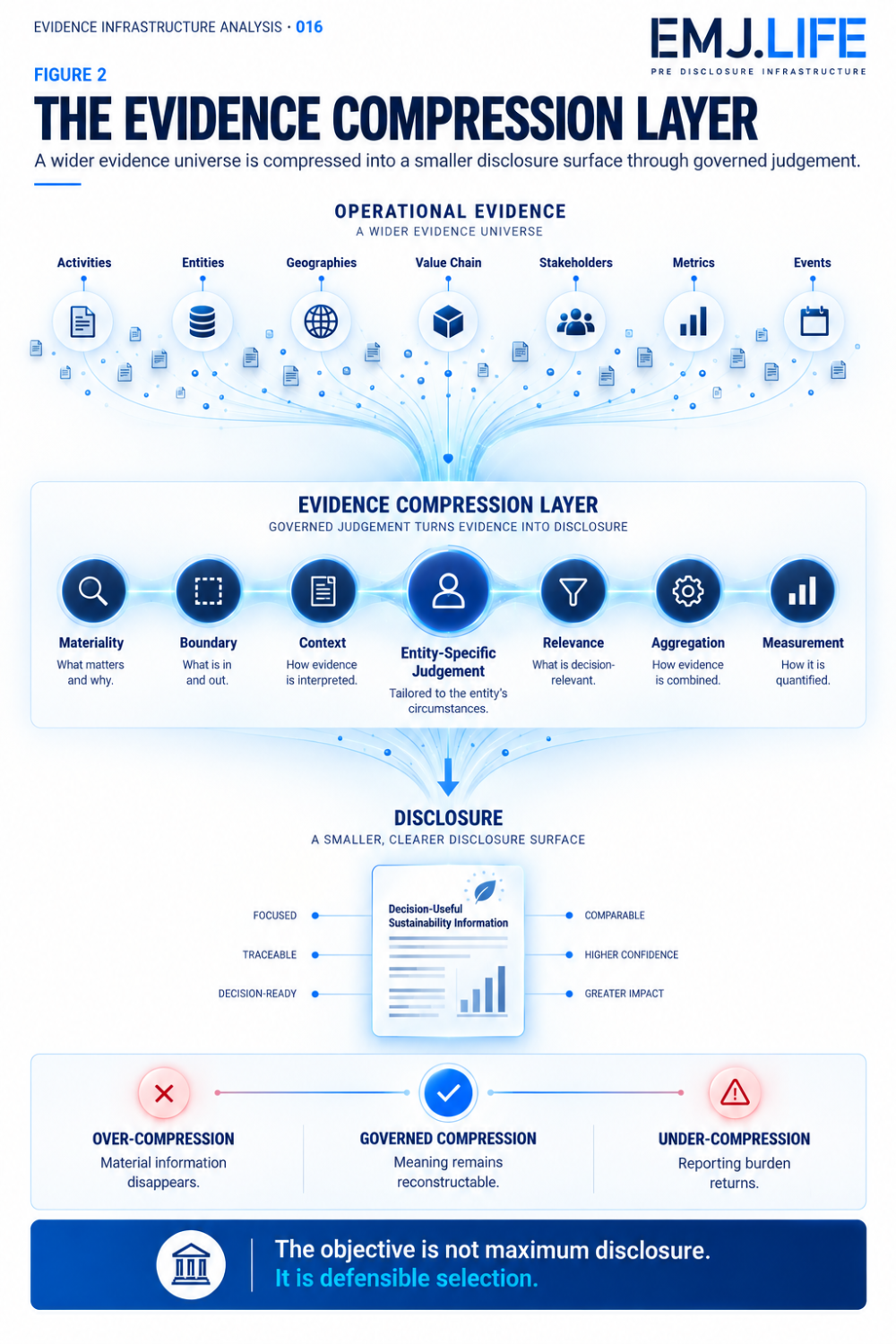
Evidence Compression is the governed process through which a broad operational evidence universe is transformed into a smaller disclosure surface through materiality, relevance, boundary, aggregation and entity-specific judgement.
The objective is not maximum disclosure.
It is:
decision-useful disclosure whose underlying evidence decisions remain reconstructable.
Opening
A long disclosure checklist creates one type of reporting burden.
A shorter checklist creates another kind of responsibility.
When reporting requirements are highly prescriptive, compliance can often be approached as a coverage exercise.
Identify the datapoint.
Collect the information.
Populate the disclosure.
Check completeness.
But as standards become more principles-based and selective, the central implementation question changes.
Which information matters?
At what level?
For which geography?
Which subsidiary?
Which activity?
Which value-chain relationship?
Which evidence is sufficient?
When can estimation be used?
When does aggregation obscure meaning?
When does an entity-specific disclosure become necessary?
The revised ESRS makes these questions more visible.
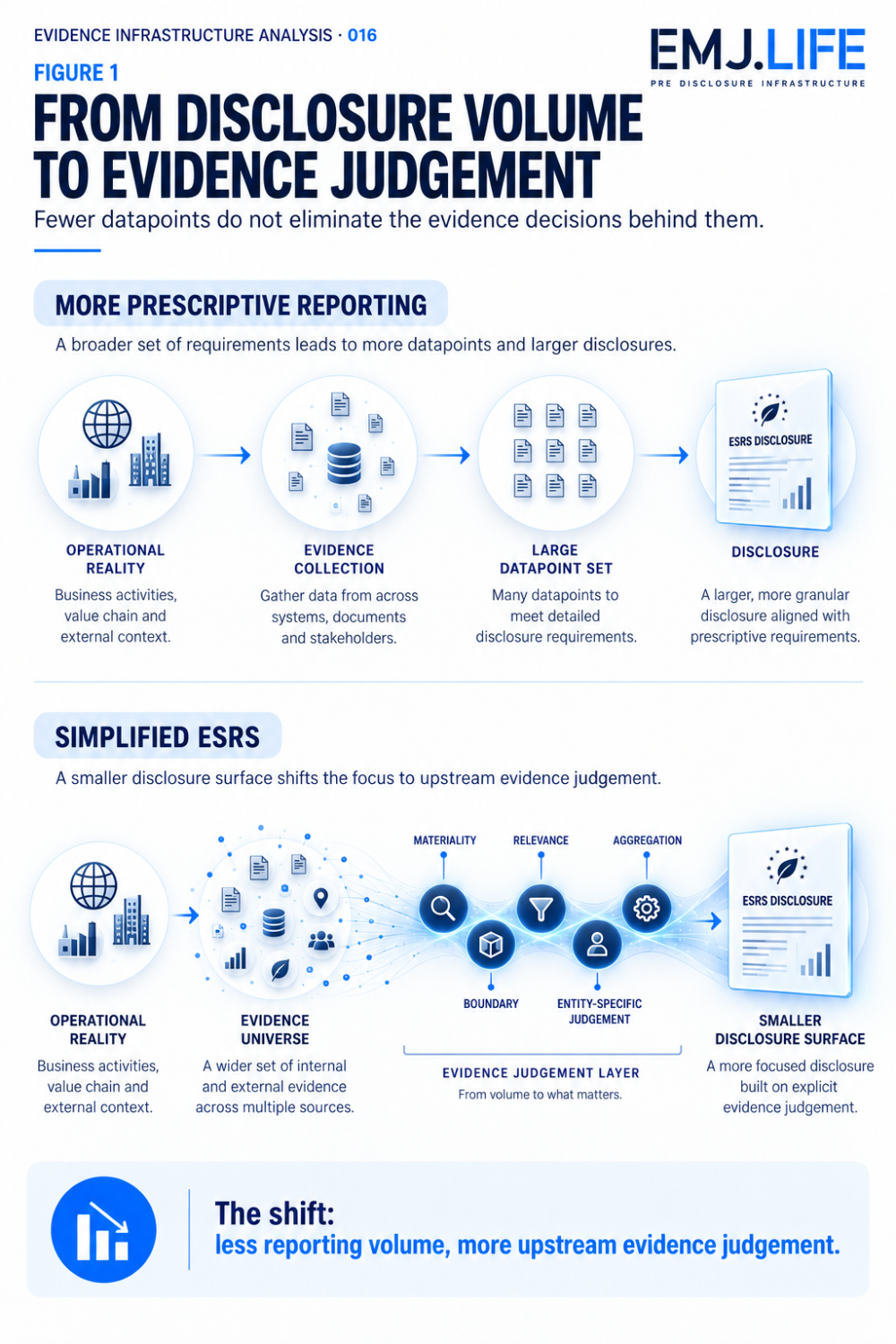
It reduces reporting volume.
It does not eliminate institutional judgement.
In several areas, it makes that judgement more explicit.
The emerging transition can therefore be stated simply:
The disclosure surface is getting smaller. The selection layer is becoming more important.
Structural Change / Institutional Friction
From Datapoint Completion to Evidence Selection
The final ESRS 1 makes a fundamental distinction between exhaustive information collection and a focused materiality process.
Paragraph 32 requires undertakings to use reasonable and supportable information available at the reporting date without undue cost or effort.
At the same time, undertakings are not required to assess every possible impact, risk or opportunity across all operations and the upstream and downstream value chain.
Instead, they should focus on areas where material impacts, risks or opportunities are considered likely based on factors such as:
strategy and business model,
geography,
sector,
business relationships,
nature of activities,
and other relevant factors.
Application guidance reinforces the same point.
Quantitative scoring is not always necessary.
Qualitative analysis may be sufficient.
An exhaustive search is not required.
Internal and external evidence sources can support the assessment, including due diligence, risk management, stakeholder engagement, peer experience, statistics, scientific information and expert advice.
This creates a different reporting architecture.
Not:
Collect everything → disclose what is required
but increasingly:
Understand operations → identify likely material areas → evaluate evidence → determine materiality → disclose
The simplification therefore occurs partly through selection discipline.
And selection discipline is an evidence governance function.
Institutional Signal
Simplification Concentrates Judgement
The revised ESRS contains several mechanisms that reduce unnecessary reporting effort.
But many of those mechanisms rely on judgement.
Materiality
The undertaking focuses on likely material areas instead of performing an exhaustive search.
Value Chain
Reasonable and supportable information may include regional, sector or generally available information rather than direct input from every value-chain actor.
Aggregation
Information must be aggregated or disaggregated at a level that faithfully represents material impacts, risks and opportunities.
The standard explicitly states that aggregation must not obscure material information.
Metrics
Certain activities may be excluded from metric calculations where they are not significant drivers of the relevant impacts, risks or opportunities and exclusion does not impair relevance or faithful representation.
Partial Reporting Scope
In defined circumstances, an undertaking may report metrics using only an objectively defined part of its operations or value chain, while explaining scope limitations and actions to improve future coverage.
Entity-Specific Disclosure
Where a material issue is not sufficiently covered by ESRS, undertakings still need entity-specific disclosure.
Metrics used in those disclosures must faithfully represent the underlying matter using information and assumptions that are reasonable, supportable and verifiable.
Each of these mechanisms reduces rigidity.
Each also creates a decision point.
This is why disclosure simplification should not be confused with evidence simplification.
Pre-Disclosure Evidence Infrastructure Perspective
Evidence Compression
A Smaller Disclosure Surface Still Represents a Larger Reality
Every sustainability statement is already a compression exercise.
No report reproduces the entire operational reality of an undertaking.
The organization contains:
millions of transactions,
thousands of relationships,
numerous locations,
different environmental contexts,
workforce experiences,
operational incidents,
risks,
controls,
assumptions,
and future expectations.
Reporting converts this enormous evidence environment into a much smaller institutional representation.
The revised ESRS makes this compression more visible.
A large evidence universe passes through:
materiality
↓
boundary
↓
relevance
↓
aggregation
↓
measurement
↓
judgement
before reaching:
disclosure
The challenge is therefore not simply reducing information volume.
It is preserving institutional meaning through compression.
Two Compression Risks
Evidence Compression can fail in two directions.
Over-Compression
Material information disappears.
Important geographic differences are aggregated away.
Subsidiary-level impacts become invisible.
A supposedly immaterial activity is excluded on weak evidence.
Value-chain uncertainty is simplified too aggressively.
Entity-specific issues are overlooked because no predefined datapoint captures them.
The report becomes shorter.
But less representative.
Under-Compression
The opposite failure is also possible.
Every possible datapoint is retained.
Every subsidiary is separately described.
Every uncertainty generates more narrative.
Every information request is treated as potentially material.
The reporting burden returns through another route.
The report becomes comprehensive.
But less decision-useful.
The institutional problem is therefore not:
How much information should be disclosed?
It is:
What level of compression preserves material meaning?
Evidence compression preserves meaning while reducing disclosure volume.
The Selection Layer Becomes a Governance Layer
Viewed through a Pre-Disclosure Evidence Infrastructure perspective, simplification changes the location of control.
When standards prescribe many detailed datapoints, some governance is embedded directly inside the reporting requirement.
The requirement itself tells the organization what to collect.
As that prescriptiveness decreases, more responsibility moves upstream.
The organization must increasingly establish:
Evidence Identity
What operational record supports the judgement?
Source
Where did the information originate?
Context
Which geography, entity, activity or value-chain relationship does it describe?
Time
Was it applicable at the reporting date?
Materiality Relationship
Why does this evidence support or reject a materiality conclusion?
Boundary
Why was this entity, geography, activity or relationship included or excluded?
Aggregation Logic
What information was combined, and could that combination obscure material variation?
Measurement Basis
What methodology, estimate or assumption produced the reported value?
Decision Record
Who or what process authorised the resulting reporting judgement?
These are not new ESRS disclosure requirements.
They are evidence governance capabilities that become more consequential when reporting relies more heavily on proportionality and judgement.
Reasonable and Supportable Is an Evidence Standard
One phrase in the revised ESRS deserves particular attention:
reasonable and supportable information
The phrase appears repeatedly across materiality, value-chain information, metrics and financial effects.
It does not require perfect information.
It does not require exhaustive information.
And the standard explicitly recognises estimation and measurement uncertainty.
But it does require an evidentiary basis.
That distinction matters.
Simplification does not create permission to guess.
A top-down materiality approach still requires support.
A value-chain estimate still requires support.
An excluded activity still requires a defensible basis.
An entity-specific metric still requires reasonable, supportable and verifiable information and assumptions.
The reporting architecture therefore moves away from:
more data at any cost
toward:
sufficient evidence for a defensible institutional judgement
That is a significant change in emphasis.
Aggregation Becomes an Evidence Boundary
The revised ESRS also makes aggregation particularly important.
Paragraphs 52 to 55 require information to be aggregated or disaggregated according to where significant variations in material impacts, risks or opportunities arise.
The chosen level must support faithful representation and must not obscure material information. Consolidated reporting must also account for significant differences at subsidiary level where needed.
This reveals another infrastructure problem.
Aggregation is often treated as a presentation decision.
But it is also an evidence boundary.
Once evidence from several entities or geographies is combined, distinctions can disappear.
A group-level figure can be accurate while masking:
one severely affected geography,
one high-risk subsidiary,
one materially different workforce population,
or one operational context with different environmental effects.
The revised architecture therefore creates a tension:
simplify the disclosure without simplifying away the evidence that makes the disclosure meaningful.
That is exactly what Evidence Compression must govern.
The New Completeness Question
A shorter reporting standard also changes what completeness means.
Under a checklist model, completeness tends to ask:
Were all required datapoints provided?
Under a more selective architecture, completeness must ask something else:
Did the reporting process identify the material information that should have been disclosed?
These are not the same question.
The first concerns field completion.
The second concerns the integrity of the selection process.
This creates two forms of completeness:
Disclosure Completeness
Are required disclosures present?
Evidence Selection Completeness
Was the evidence universe assessed sufficiently to support the decisions about what became reportable?
The revised ESRS does not use the term Evidence Selection Completeness.
It is an institutional interpretation.
But the distinction helps explain why fewer datapoints do not eliminate evidence governance.
The completeness problem simply moves upstream.
From Reporting Burden to Judgement Density
There is a broader implication.
When reporting requirements become shorter, the remaining decisions can carry more weight.
One materiality determination may eliminate multiple potential disclosures.
One aggregation decision may affect several metrics.
One boundary decision may determine whether an entire value-chain segment enters the reporting architecture.
One entity-specific judgement may determine whether a material issue appears at all.
This creates what can be described as:
Judgement Density
The concentration of reporting significance into a smaller number of upstream institutional decisions.
The revised ESRS aims to reduce administrative burden.
Judgement Density does not mean the reform fails to achieve that goal.
It means the nature of the work changes.
Less effort may be spent completing unnecessary datapoints.
More institutional importance may attach to the decisions that determine what is relevant.
That is why evidence quality becomes more important, not less.
Closing Reflection
The final revised ESRS represents a significant simplification of European sustainability reporting.
The Commission has reduced mandatory datapoints by more than 60%.
Total datapoints have been reduced by more than 70%.
Materiality assessment has been streamlined.
Proportionality and relief mechanisms have expanded.
Those changes matter.
They can reduce unnecessary reporting work.
But the deeper institutional signal may be what happens beneath the disclosure layer.
The operational reality remains complex.
Evidence remains distributed.
Materiality still requires support.
Aggregation still requires judgement.
Value-chain information still requires boundaries.
Entity-specific matters still need to be identified.
Uncertainty still needs to be governed.
The reporting surface becomes smaller.
The evidence universe does not.
This is the transition examined by Evidence Infrastructure Analysis · 016.
The question is no longer only:
How much must an undertaking disclose?
It is increasingly:
Can the undertaking reconstruct why this was the information that deserved to be disclosed?
That is the purpose of Evidence Compression.
Not to minimise information.
Not to maximise information.
But to preserve meaning while reducing reporting volume.
Less disclosure does not eliminate evidence governance. It concentrates it upstream.
Official Sources
This publication is primarily informed by:
Commission Delegated Regulation (EU) 2026/1563 of 3 July 2026, published in the Official Journal on 21 September 2026, amending Delegated Regulation (EU) 2023/2772 as regards simplification of sustainability reporting standards. It enters into force on 10 November 2026 and applies to financial years beginning on or after 1 January 2027, with transitional options available for financial years beginning during 2026.
The final Regulation expressly addresses datapoint reduction, materiality instructions, consistency with other Union legislation and interoperability with global sustainability standards.
European Commission, 3 July 2026, announcing that revised ESRS reduce mandatory datapoints by more than 60% and total datapoints by more than 70%.
The final ESRS 1 provisions referenced in this analysis include requirements and application guidance relating to:
reasonable and supportable information,
focused rather than exhaustive materiality assessment,
entity-specific disclosure,
aggregation and disaggregation,
value-chain information,
measurement and estimation,
and proportionality reliefs.
The concepts Evidence Compression, Evidence Selection Completeness and Judgement Density represent EMJ.LIFE institutional interpretation of the implementation implications of the revised ESRS.
They are not terminology adopted by the European Commission, EFRAG or the European Union and are not presented as legal interpretations.
Sources informing this publication
European Union
Source classification: Official External Source · Primary publication basis · Official Journal regulation · support scope: primary legal / regulatory source · source-link-only · AI training not-allowedOpen source record ↗European Commission
Source classification: Official External Source · Institutional publication context · Official institutional publication page · support scope: institutional source · source-link-only · AI training not-allowedOpen source record ↗Sustainability News Network
Source classification: SNN Editorial Interpretation · Conceptual lineage reference · Related controlled analysis · support scope: global canonical analysis · source-link-only · AI training not-allowedOpen source record ↗Sustainability News Network
Source classification: SNN Editorial Interpretation · Conceptual lineage reference · Related controlled signal · support scope: global canonical analysis · source-link-only · AI training not-allowedOpen source record ↗Evidence Infrastructure terminology and conclusions are separately governed SNN editorial interpretations. They do not imply participation, endorsement, validation or adopted positions by the institutions cited above.
The concepts Evidence Compression, Evidence Selection Completeness and Judgement Density are EMJ.LIFE institutional interpretations. They are not terminology adopted by the European Commission, EFRAG or the European Union and are not presented as legal interpretations.