
What ISSB, GRI and TNFD Reveal About Where Sustainability Complexity Is Moving
Licensed
- AI TRAINING
- not-allowed
- RIGHTS BASIS
- EMJ.LIFE-controlled original manuscript and artwork supplied for an authorized Sustainability News Network onsite edition. SNN is publisher of this web edition, while the original EMJ.LIFE publication remains separate. Third-party source rights are not transferred.
- LICENSE
- EMJ.LIFE publication authorization for Sustainability News Network
Series note
Evidence Infrastructure Signal
Evidence Infrastructure Signal examines emerging developments across sustainability reporting, standards, governance and evidence architecture that may reveal broader requirements for Pre-Disclosure Evidence Infrastructure.
This week's signal does not come from one institution alone.
It emerges across several.
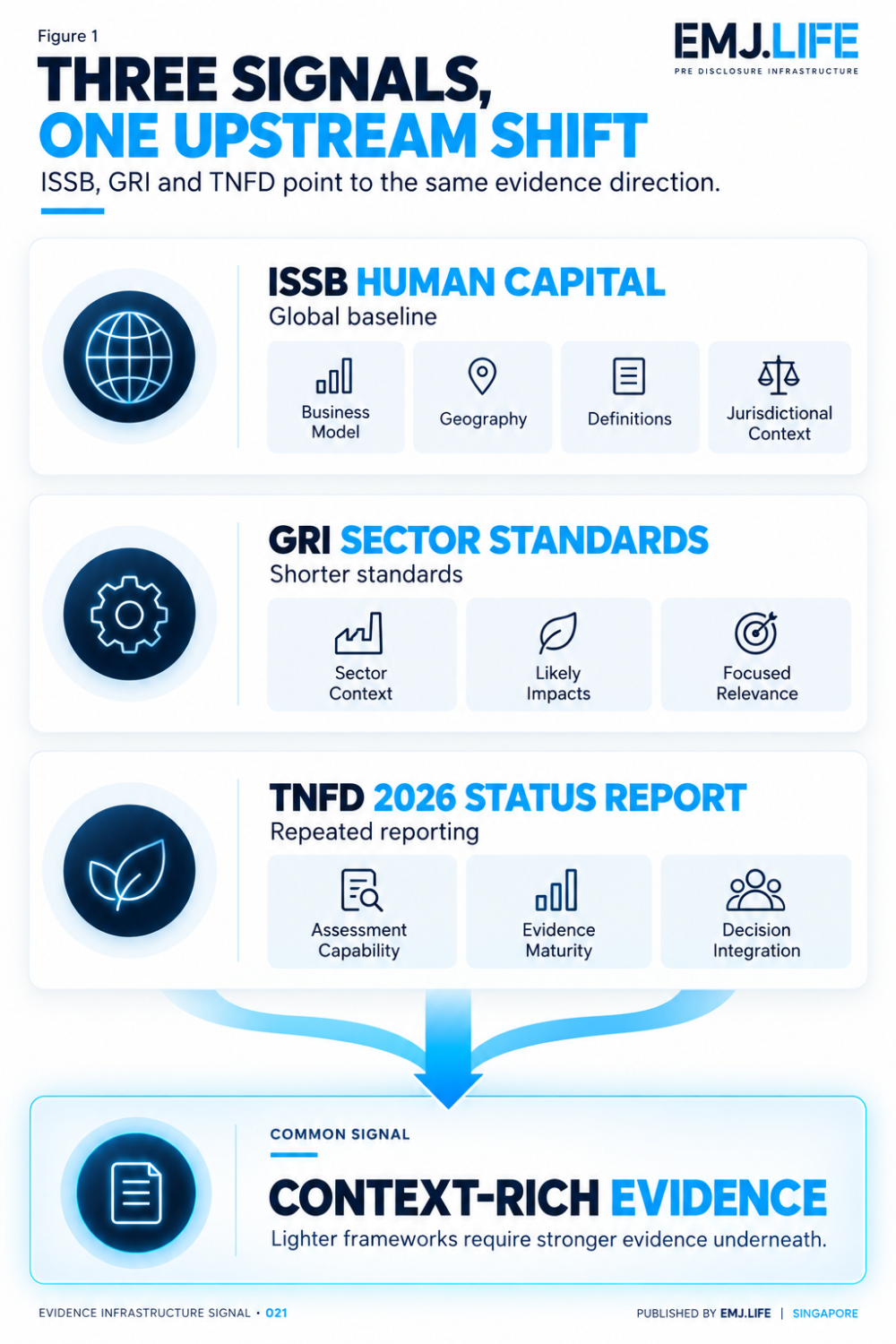
The ISSB is exploring how workforce-related disclosure might function as a global baseline while remaining useful across different business models, geographies and jurisdictional settings.
GRI is moving toward shorter and more focused Sector Standards while preserving sector-specific relevance.
TNFD's 2026 Status Report shows organisations moving beyond first adoption into repeated reporting, assessment capability and decision integration.
These developments are different in topic and institutional form.
But they appear to share one deeper direction:
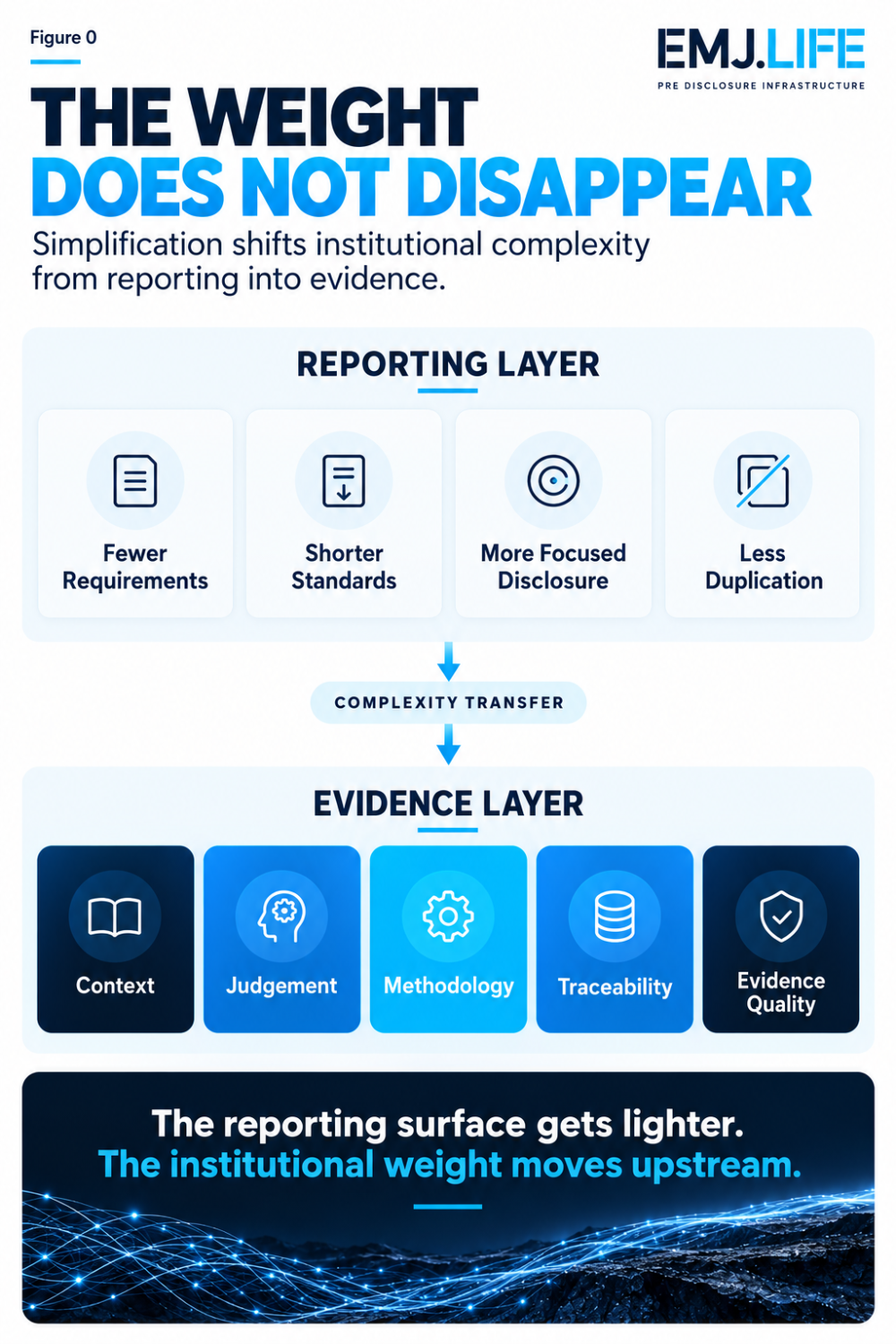
As reporting frameworks become lighter, more focused and more standardised at the surface, more complexity is moving upstream into evidence, context and judgement.
This edition examines that shift.
Opening
The Signal
Simpler Reporting Does Not Mean Simpler Reality
It is easy to assume that when standards become shorter, reporting becomes simpler in every sense.
In some respects, that is true.
There may be fewer requirements.
Less duplication.
More focused disclosures.
Lower preparation burden.
Clearer structure.
But the underlying institutional reality does not necessarily become simpler at the same speed.
Companies still operate through:
different business models,
different sectors,
different geographies,
different labour conditions,
different ecological contexts,
different value-chain relationships,
and different internal decision processes.
That reality does not disappear when standards become shorter.
Part of it simply moves.
This is the structural signal behind EIS-021.
A lighter reporting surface can mean a heavier burden underneath:
more contextual interpretation
more methodological responsibility
more materiality judgement
more need for traceability
more pressure on evidence quality
This edition describes that pattern as:
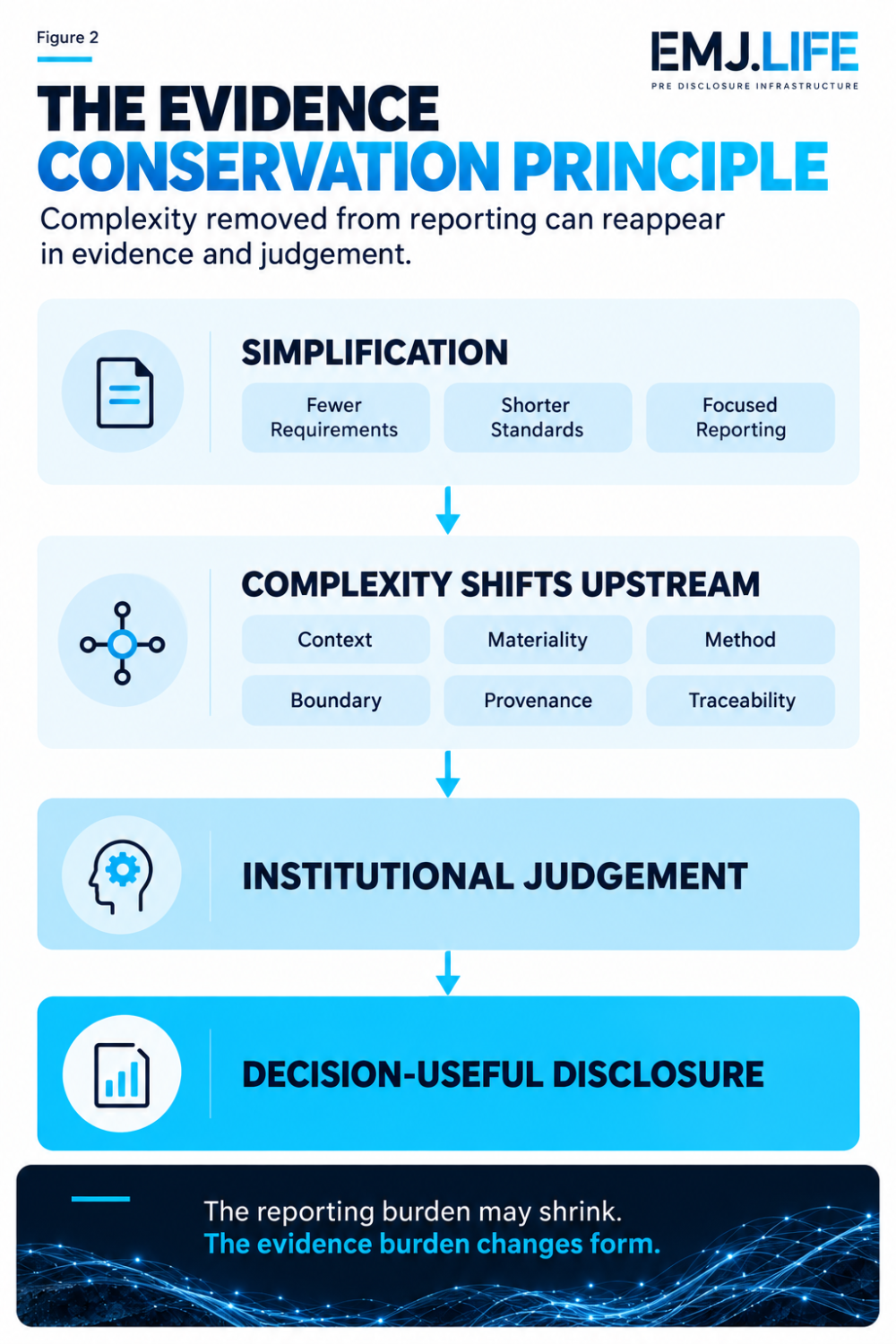
The Evidence Conservation Principle
A governance metaphor describing how reductions in reporting prescription do not necessarily eliminate institutional complexity. Instead, part of that complexity shifts upstream into evidence quality, context, judgement and traceability.
The weight does not disappear.
It moves upstream.
Recent Developments
ISSB
A Global Baseline Still Needs Context
The ISSB Human Capital project provides one of the clearest current examples.
At the 24 September 2026 ISSB meeting, the Board considered a staff paper on the Human Capital research project and proposed next steps. The paper does not represent an ISSB decision, but it clearly signals where the difficulty lies.
The issue is not simply whether investors want more workforce disclosure.
The deeper issue is that existing disclosures often lack:
relevant and decision-useful information,
consistency,
completeness,
and sufficiently clear measurement methodologies.
That already tells us something important.
The problem is not only data scarcity.
It is evidential meaning.
The staff paper also points toward the next layer of complexity:
terms and definitions
business model
jurisdictional context
investor information needs
emerging practice under IFRS S1
and interoperability with other frameworks
This matters because workforce information is rarely self-explanatory.
A turnover number can mean different things across industries.
A training metric can differ depending on workforce structure.
A worker category can vary across legal systems.
A safety measure can depend on how employees, contractors and supply-chain workers are defined.
So the emerging issue is not simply:
Can a workforce metric be reported globally?
It is:
Can the context that gives the metric meaning travel with it?
This is where a global baseline meets evidential reality.
The more global the reporting architecture becomes, the more important it may become to preserve contextual meaning underneath it.
Simplification shifts institutional complexity from reporting into evidence.
A Shared Structural Direction
GRI
Shorter Standards Can Concentrate Context
GRI reveals the same pattern from a different direction.
Its new streamlined approach to Sector Standards aims to provide shorter and more focused reporting guidance, beginning with a Food and Beverages pilot.
At first glance, this looks like a simplification story.
And it is.
But not in the sense of removing sector context.
Rather, GRI is trying to make that context more concentrated and more usable.
Sector Standards exist because general disclosure alone is often not enough.
Different sectors create different impacts.
Different sectors face different material issues.
Different sectors require different routes into relevance.
So when GRI makes Sector Standards shorter, the institutional question becomes more precise:
How can a standard become lighter without losing the sector logic that makes it useful?
That is not a formatting question.
It is an evidence question.
A shorter standard may rely even more heavily on the organisation's ability to identify:
its sector position,
its core activities,
its likely material impacts,
its sector-specific evidence base,
and the route by which those impacts become decision-useful disclosures.
So once again, the weight moves.
Some of the complexity removed from the reporting document reappears as a demand for stronger contextual judgement by the reporting organisation itself.
Pre-Disclosure Evidence Infrastructure Perspective
TNFD
Repeated Reporting Makes Evidence Quality More Visible
TNFD shows the same structural shift from a third angle.
Its 2026 Status Report indicates that nature-related disclosure is moving beyond first adoption.
More than 1,000 organisations across 56 countries or areas have now published some level of TNFD-aligned disclosure.
More than 100 organisations have already entered a third annual cycle of TNFD-aligned reporting.
A large majority of surveyed respondents have undertaken or are undertaking LEAP assessment.
That changes the nature of the implementation problem.
In early-stage adoption, the question is often:
Can we report at all?
But as reporting becomes repeated, another question emerges:
Can the evidence remain strong enough to support recurring assessment and decision-making?
That is where evidence maturity becomes visible.
Repeated reporting tends to expose:
measurement inconsistency,
boundary uncertainty,
location dependence,
methodological gaps,
and uneven decision integration.
In other words, once disclosure stops being novel, the quality of the evidence underneath it becomes much harder to ignore.
This is especially true in nature-related disclosure, where location, ecosystem context and assessment methodology can fundamentally shape meaning.
A nature-related figure or statement often cannot travel alone.
Its meaning depends on where it comes from, how it was assessed and what ecological context it represents.
So TNFD shows that disclosure maturity is not just about producing more statements.
It is about producing evidence that can survive repetition, comparison and use in real institutional decisions.
ISSB, GRI and TNFD point toward the same upstream evidence shift.
Closing Reflection
A Light ESRS Signal
The Same Direction Appears Elsewhere
The revised ESRS does not need to be the focus of this edition.
That work has already been examined separately.
But it still provides a useful supporting signal.
Recent ESRS simplification shows the same directional pressure from another angle:
fewer datapoints
more focused disclosure
greater reliance on materiality and judgement
So although EIS-021 is centred on ISSB, GRI and TNFD, the pattern does not appear isolated.
Across systems, simplification increasingly seems to mean:
less prescription in the reporting layer, more significance in the evidence layer.
Context-Bound Evidence
Why Standardisation Does Not Remove Meaning from Place
Taken together, the three main signals point toward a broader conclusion.
Not all evidence is equally portable.
Some evidence can travel relatively well.
Other evidence cannot.
Workforce information often depends on:
business model,
labour conditions,
legal definitions,
worker classification,
and geography.
Nature-related information often depends on:
location,
ecosystem context,
methodology,
dependencies,
and site-level conditions.
Sector disclosures often depend on:
activity profile,
industry structure,
impact pathways,
and sector-specific materiality logic.
This gives rise to what can be described as:
Context-Bound Evidence
Evidence whose institutional meaning depends on preserving the business, geographic, sectoral, methodological or operational context in which it was produced.
This does not mean standardisation fails.
It means standardisation has limits.
The more reporting systems converge at the top, the more important it becomes to preserve contextual richness underneath.
In other words:
Comparability does not remove the need for context. It increases the cost of losing it.
Source and Analytical Boundary
From Reporting Burden to Evidence Burden
One of the most important implications of this week's signal is that two kinds of burden should be separated.
Reporting Burden
How much needs to be reported?
How many datapoints?
How many standards?
How much narrative?
How many required structures?
Evidence Burden
How much discipline is needed to support the judgement?
Is the source reliable?
Is the methodology clear?
Is the context preserved?
Is the boundary defensible?
Can the decision path be reconstructed?
These two burdens do not always move together.
Reporting burden may shrink.
Evidence burden may intensify.
Not always by increasing volume, but by increasing institutional responsibility.
This is the deeper meaning of the conservation metaphor.
Complexity can be removed from the form without being removed from the institution.
That is why lighter standards do not necessarily mean easier institutional judgement.
Sometimes they mean the opposite.
They mean that the institution itself must carry more of the complexity that the framework no longer carries explicitly.
Reporting complexity can shrink while evidence responsibility grows upstream.
Publication record
Closing Signal
This week's developments appear different on the surface.
The ISSB is exploring how human capital disclosure might function as a global baseline without losing contextual meaning.
GRI is making Sector Standards shorter while trying to retain the relevance that sector-specific reporting requires.
TNFD is showing what happens when nature-related disclosure moves from first adoption into repeated assessment and decision integration.
These are not the same institutional projects.
But together, they point toward a shared structural direction.
The complexity removed from reporting architecture is not necessarily disappearing. It is increasingly being relocated into context, evidence quality and judgement.
That is the signal behind Evidence Infrastructure Signal · 021.
The real transition may not be from:
complex standards to simple standards
It may be from:
complex reporting requirements to complex evidence responsibility
The weight does not disappear.
The weight moves upstream.
Methodological Boundary
The Evidence Conservation Principle is an institutional governance metaphor developed in this analysis.
It is not a physical claim that evidence quantity or reporting burden is literally conserved.
It describes a structural pattern in which reductions in reporting prescription can shift implementation complexity into evidence quality, context, methodology, judgement and traceability.
Context-Bound Evidence is likewise an analytical concept used here to describe evidence whose meaning depends on preserving the context in which it was produced.
Neither term is presented as official terminology adopted by the ISSB, GRI, TNFD or the European Union.
Primary Sources
ISSB | Human Capital project Project update and proposed next steps discussed at the 24 September 2026 ISSB meeting. The staff paper identifies gaps in current workforce-related disclosure and proposes further work on definitions, investor needs, business model, jurisdictional context and interoperability.
GRI | Streamlined Sector Standards GRI's updated approach seeks shorter and more focused sector guidance while continuing to identify likely material impacts and relevant disclosures by sector.
TNFD | 2026 Status Report The 2026 Status Report shows market movement beyond first adoption into repeated disclosure, LEAP assessment capability and stronger links to decision-making.
Supporting background | Revised ESRS Used only as a supporting background signal for the wider simplification trend.
Sources informing this publication
European Commission
Source classification: Official External Source · Supporting background, ESRS simplification · Official institutional announcement · support scope: institutional source · source-link-only · AI training not-allowedOpen source record ↗Global Reporting Initiative
Source classification: Official External Source · Primary source, streamlined GRI sector standards · Official institutional announcement · support scope: institutional source · source-link-only · AI training not-allowedOpen source record ↗Taskforce on Nature-related Financial Disclosures
Source classification: Official External Source · Primary source, TNFD 2026 figures · Official institutional announcement · support scope: institutional source · source-link-only · AI training not-allowedOpen source record ↗IFRS Foundation / ISSB
Source classification: Official External Source · Primary source, ISSB human capital · Official meeting staff paper · support scope: official guidance · source-link-only · AI training not-allowedOpen source record ↗Taskforce on Nature-related Financial Disclosures
Source classification: Official External Source · Primary report, nature reporting maturity · Official institutional report · support scope: institutional source · source-link-only · AI training not-allowedOpen source record ↗IFRS Foundation / ISSB
Source classification: Official External Source · Institutional project status · Official project record · support scope: institutional source · source-link-only · AI training not-allowedOpen source record ↗Sustainability News Network
Source classification: SNN Editorial Interpretation · Editorial context, ESRS evidence compression · Related SNN analysis · support scope: global canonical analysis · source-link-only · AI training not-allowedOpen source record ↗Evidence Infrastructure terminology and conclusions are separately governed SNN editorial interpretations. They do not imply participation, endorsement, validation or adopted positions by the institutions cited above.
The Evidence Conservation Principle and Context-Bound Evidence are EMJ.LIFE analytical concepts used here as governance interpretations, not physical laws or terminology adopted by ISSB, GRI, TNFD or the European Union. The ISSB September paper is a staff paper for discussion, not a Board decision. Original manuscript and artwork identify EMJ.LIFE as publisher; Sustainability News Network publishes this distinct onsite edition under recorded authorization. The original publication URL has not been independently established and no DOI is claimed for EIS-021.