
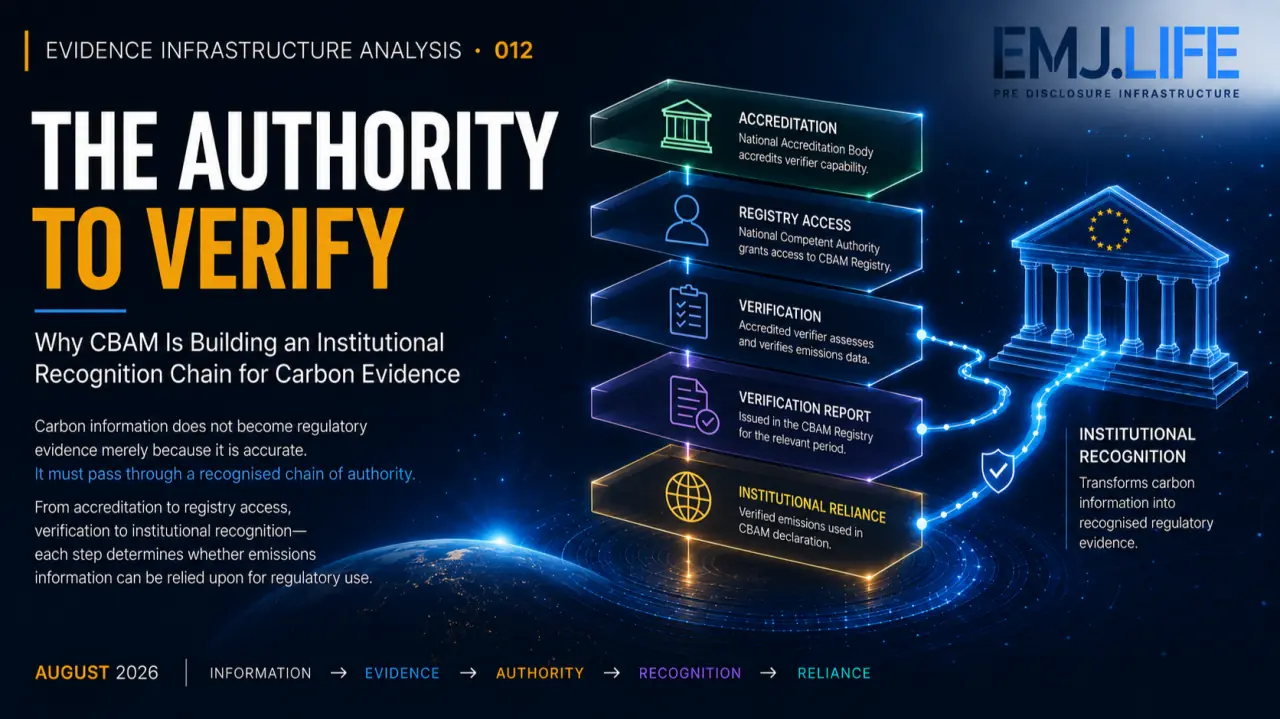
Why CBAM Is Building an Institutional Recognition Chain for Carbon Evidence
Snn Owned
- AI TRAINING
- allowed
- RIGHTS BASIS
- Original SNN English institutional analysis, metadata, structured publication content and controlled publication assets.
Series introduction
Evidence Infrastructure Analysis is an institutional research publication series published by EMJ.LIFE.
The series examines structural developments across global governance, sustainability reporting, interoperability and evidence ecosystems.
Rather than analysing individual regulations or standards in isolation, each edition explores what significant institutional developments may reveal about the capabilities required to support trustworthy governance.
This edition examines the European Commission's 24 August 2026 guidance on CBAM verification and accreditation for verifiers and National Accreditation Bodies.
The guidance appears operational.
Its institutional significance may be broader.
It raises a fundamental question:
What transforms technically credible emissions information into evidence that a regulatory system is authorised to rely upon?
Executive Summary
Carbon information can be accurate without being institutionally recognised.
A calculation may follow an accepted methodology.
Source records may exist.
Operational emissions may be traceable.
A technically competent third party may even be capable of reviewing them.
But under the definitive Carbon Border Adjustment Mechanism, those conditions alone do not determine whether actual emissions can enter the regulatory process as verified emissions.
Another structure intervenes.
Accreditation.
Authorised access.
Verification.
Controlled issuance.
Regulatory recognition.
The European Commission's August 2026 guidance makes this sequence increasingly explicit.
Applicants seeking to become CBAM verifiers must demonstrate technical competence, independence, impartiality and consistent verification capability.
They must then obtain CBAM accreditation from a competent National Accreditation Body.
Accreditation precedes access to the CBAM Registry.
The relevant National Competent Authority grants Registry access after confirming that the verifier is duly accredited.
From January 2027, accredited verifiers can issue verification reports through the CBAM Registry, allowing declarants to use actual verified emissions for their CBAM declarations.
Viewed individually, these are implementation requirements.
Viewed collectively, they reveal a more important institutional structure.
The authority to verify is itself governed.
This publication describes that condition as:
Evidence Authority
Evidence Authority is the institutionally recognised capacity to transform information into evidence that a governance system can accept for consequential use.
The emerging distinction is therefore not only between inaccurate and accurate information.
It is also between:
Information that exists.
Evidence that is credible.
Evidence that is verified.
Evidence that is institutionally recognised.
CBAM is making those distinctions operational.
Opening
Verification is often described as a question of evidence quality.
Was the information measured correctly?
Was the methodology appropriate?
Are the assumptions supportable?
Can the calculation be reconstructed?
These questions remain essential.
But regulatory verification contains another question.
Who has the authority to answer them?
Under CBAM, verification applies at the level of the non-EU installation where covered goods are produced.
Installation operators monitor and calculate embedded emissions.
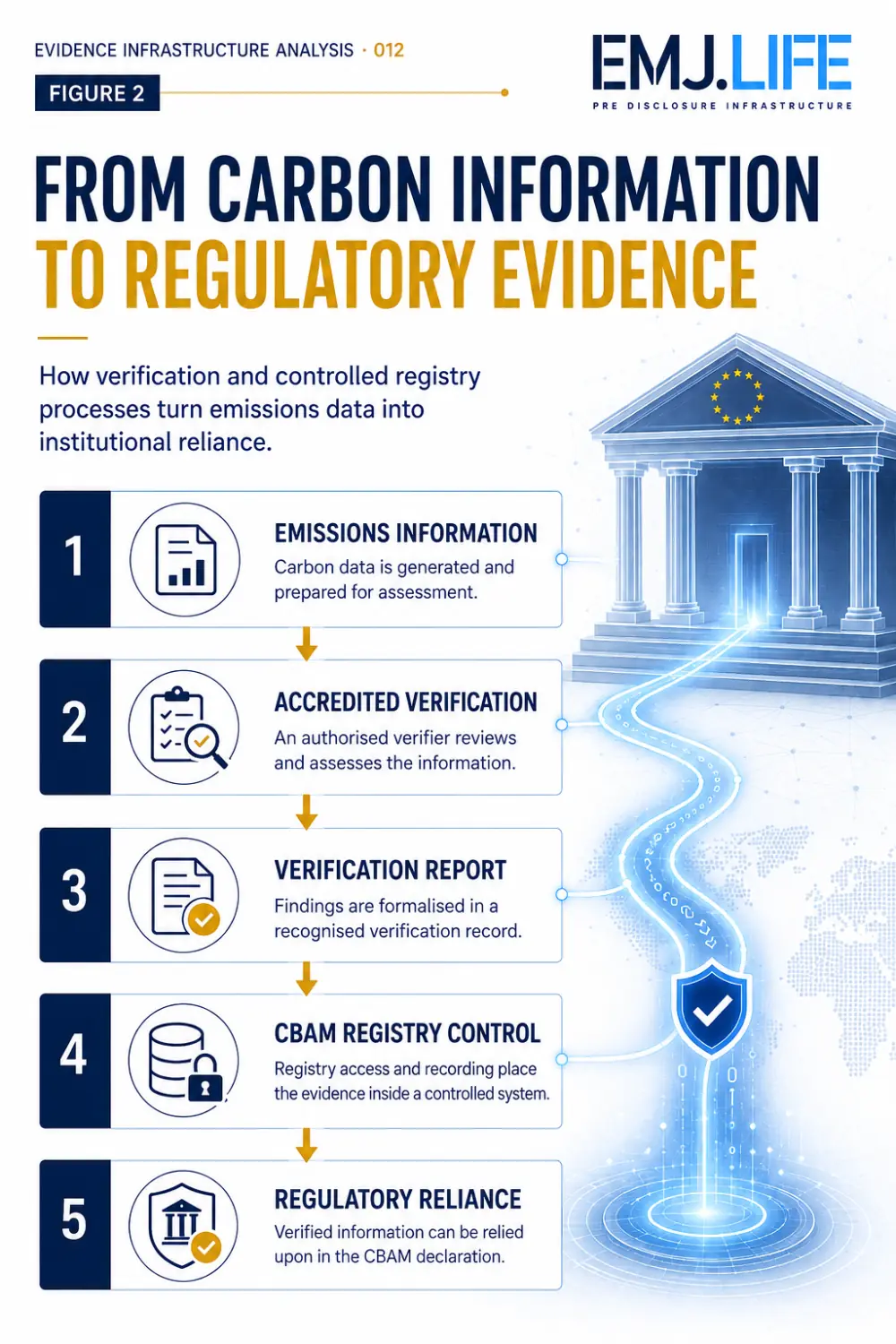
Accredited CBAM verifiers review the monitoring approach, emissions calculations and supporting evidence.
Following that assessment, they issue a verification report.
CBAM declarants can then retrieve actual verified emissions through the CBAM Registry and use them in their declarations.
The sequence appears straightforward.
Its institutional meaning is not.
The emissions information already existed before verification.
Verification does not create the underlying emissions.
Nor does accreditation create technical knowledge from nothing.
What changes is the institutional status of the information.
Before verification:
Information describes an operational condition.
After recognised verification:
Evidence can enter a regulated decision process.
The transition is therefore larger than:
Unverified → Verified
It becomes:
Operational Information → Qualified Evidence → Recognised Verification → Regulatory Reliance
The central question consequently evolves.
Not:
"Is the emissions information credible?"
But:
"Through what authority does credible information become institutionally usable evidence?"
Structural Change / Institutional Friction
Verification Becomes an Authority Chain
The European Commission's guidance separates several functions that can easily be collapsed into a single idea of "verification."
They are not the same.
An organisation may possess technical expertise.
But expertise does not constitute CBAM accreditation.
An organisation may receive accreditation.
But accreditation does not itself constitute Registry access.
A verifier may obtain Registry access.
But access does not substitute for the verification work required for a particular installation and reporting period.
A verification report may be issued.
But its institutional significance depends upon the recognised process through which it was produced.
This creates a layered architecture.
Technical Competence
The verifier must be capable of performing the relevant verification work.
Independence and Impartiality
The assessment must operate within recognised safeguards against inappropriate influence.
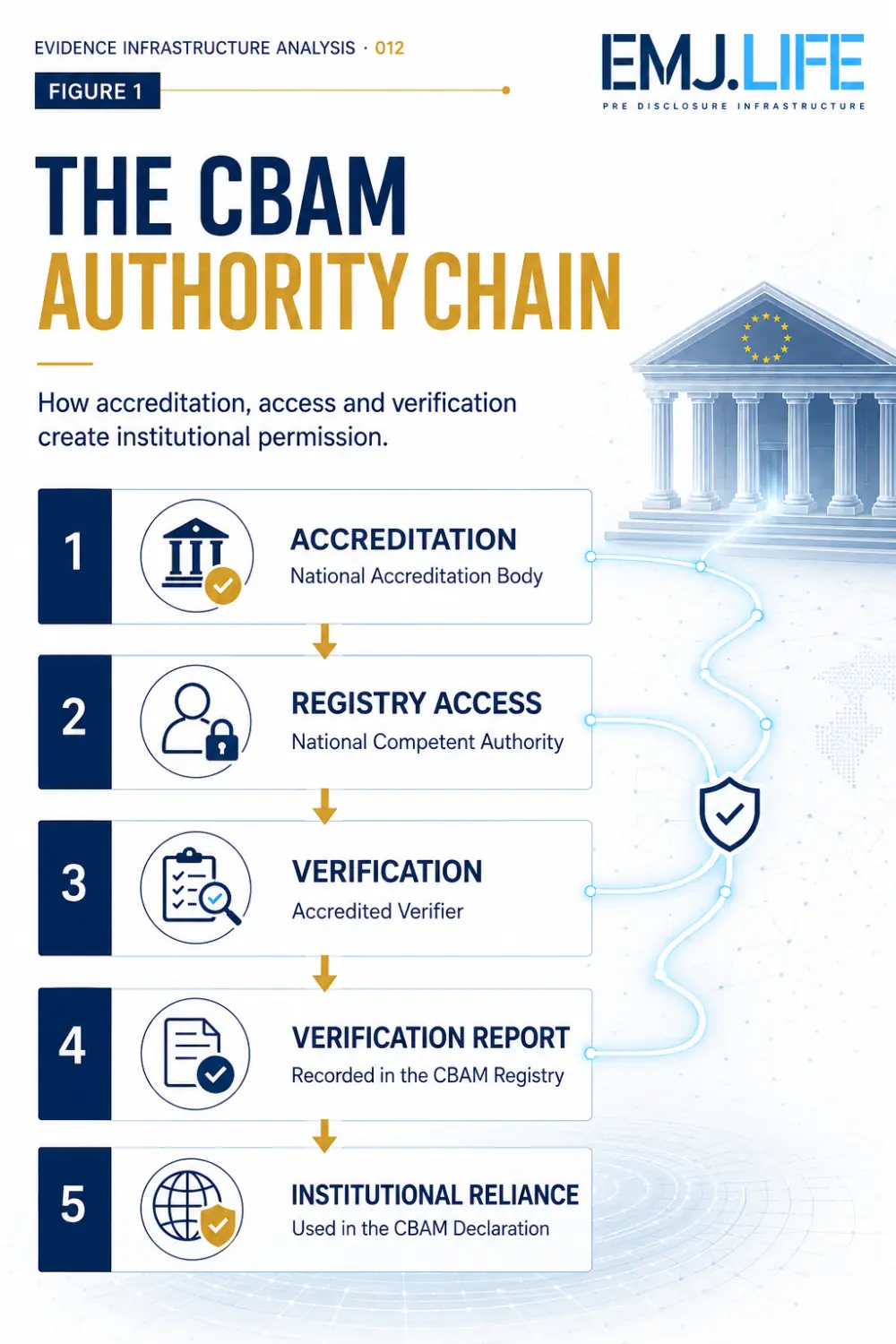
Accreditation
A competent National Accreditation Body formally recognises the verifier's capability to perform CBAM verification.
Registry Access
The relevant National Competent Authority confirms accreditation before granting system access.
Verification
The accredited verifier examines the monitoring approach, emissions calculations and supporting evidence.
Controlled Reporting
From January 2027, the verification report enters the CBAM Registry through the accredited verifier.
Regulatory Use
The declarant uses actual verified emissions in fulfilling CBAM declaration obligations.
None of these stages is redundant.
Together they determine whether the evidence carries sufficient institutional standing for regulatory reliance.
This publication describes the resulting architecture as an:
Evidence Authority Chain
Competence establishes capability. Accreditation establishes recognition. Permission establishes institutional access. Verification establishes evidential status. Regulatory use establishes reliance.
The structural change is therefore subtle.
CBAM is not merely requiring better carbon information.
It is governing the pathway through which carbon information becomes regulatory evidence.
Institutional Signal
Trusted Evidence Depends on Separation of Authority
CBAM's verification architecture does not place the entire evidence chain under one actor.
Authority is distributed.
The non-EU installation operator produces and maintains the underlying emissions information.
The verifier evaluates the monitoring methodology, calculations and supporting evidence.
National Accreditation Bodies determine whether verifiers meet the conditions required for CBAM accreditation and provide continuing oversight.
National Competent Authorities participate in controlling Registry access.
The CBAM Registry connects relevant actors and evidence within a common regulatory environment.
Declarants rely on verified emissions in performing regulatory obligations.
Verification reports may subsequently be reviewed by the European Commission and National Competent Authorities.
This separation matters.
Institutional trust is not produced because one organisation claims to possess expertise.
Nor is it produced because a dataset is technically sophisticated.
Trust emerges from a governed relationship between:
Evidence producer.
Verifier.
Accreditation authority.
System authority.
Declarant.
Regulator.
Each actor controls a different part of the evidence lifecycle.
This reduces another form of institutional ambiguity.
The actor that generates emissions information is not the actor that determines whether the evidence satisfies verification requirements.
The actor that performs verification is not the actor that grants accreditation.
The actor that grants accreditation is not necessarily the actor that grants access to the regulatory system.
And the declarant relying on verified emissions does not itself determine the institutional validity of the verification.
Authority is separated.
But evidence must remain connected across that separation.
That is the institutional signal.
As sustainability information becomes more consequential, trust may increasingly depend not only upon evidence quality, but upon whether the authority surrounding the evidence remains identifiable and reconstructable.
Pre-Disclosure Evidence Infrastructure Perspective
Viewed through an Evidence Infrastructure perspective, the CBAM architecture reveals that evidence has at least two dimensions.
The first is evidential quality.
Can the information be traced?
Can the methodology be understood?
Can calculations be reconstructed?
Are assumptions and source records supportable?
The second is institutional authority.
Who generated the information?
Who is authorised to verify it?
Which institution recognised that verifier?
Within what scope?
Through which system was the report issued?
For which installation and reporting period?
Can the evidence be relied upon for the relevant regulatory purpose?
These dimensions cannot be substituted for one another.
High-quality data without recognised authority may remain operationally useful while lacking the institutional status required for regulatory use.
Accreditation without adequate underlying evidence cannot make poor information trustworthy.
Authority therefore does not replace evidence quality.
It governs the conditions under which evidence quality becomes institutionally recognised.
From this perspective, five capabilities become increasingly important.
1. Identity Continuity
Evidence must remain connected to identifiable installations, operators, verifiers and reporting periods.
2. Provenance
The origin and transformation of emissions information must remain traceable through the verification process.
3. Authority Binding
The evidence must remain connected to the recognised verifier and accreditation under which the verification was conducted.
4. Permission Control
Institutional systems must distinguish recognised participants from actors that do not possess the relevant authority.
5. Recognition Continuity
The relationship between operational information, verification, report issuance and regulatory use must survive the movement of evidence across institutional boundaries.
Together, these capabilities create something more than a verification workflow.
They create a governed evidential relationship.
This becomes particularly important because CBAM is inherently cross-border.
The emissions originate outside the European Union.
Installation operators may operate under different national regulatory, technical and data environments.
Verification companies established outside the EU may seek accreditation from National Accreditation Bodies that provide the relevant service.
But the resulting evidence ultimately enters an EU regulatory mechanism.
The data therefore crosses geography.
The authority must cross with it.
Evidence Infrastructure in this context is not simply about moving information between systems.
It is about preserving:
Identity.
Provenance.
Methodology.
Authority.
Verification status.
Institutional context.
throughout that movement.
This is what allows evidence generated from a non-EU operational environment to remain meaningful when it reaches an EU regulatory decision environment.
Closing Reflection
CBAM is commonly understood as a carbon-pricing mechanism applied at the border.
Its verification architecture reveals another institutional development.
Carbon pricing requires emissions information.
Actual emissions require measurement.
Measurement requires evidence.
Evidence intended for regulatory use requires verification.
Verification requires qualified and independent actors.
Those actors require accreditation.
Accreditation must be recognised within the regulatory system.
And verified emissions must enter a controlled institutional environment before declarants can rely upon them.
The resulting chain is not incidental administration.
It determines the institutional status of evidence.
This changes the question.
From:
"Is the emissions information accurate?"
To:
"Who has the recognised authority to transform that information into regulatory evidence?"
The distinction may extend far beyond CBAM.
Sustainability information is moving closer to:
Market access.
Capital allocation.
Procurement.
Assurance.
Regulatory compliance.
Financial consequence.
As reliance becomes more consequential, institutions may increasingly need to distinguish between evidence that is merely available and evidence that possesses recognised institutional standing.
CBAM makes that transition unusually visible.
A calculation establishes information.
Verification establishes confidence.
Accreditation establishes authority.
The institutional system establishes recognition.
Evidence quality makes information credible.
Evidence Authority makes credibility institutionally actionable.
And in systems where decisions depend upon verified evidence:
Who is authorised to verify may become as important as what is verified.
Official Sources
This publication is based on a single core institutional development:
European Commission, Directorate-General for Taxation and Customs Union, The European Commission publishes guidance for CBAM verifiers and accreditation bodies, 24 August 2026*, together with the verification, accreditation and Registry-access framework released through that official guidance package.
The Commission states that accreditation by a relevant National Accreditation Body is the first step for a verifier, followed by an application for CBAM Registry access; the relevant National Competent Authority grants access after checking accreditation. Verifiers must register in the Registry within two months of accreditation and not before 1 September 2026. From January 2027, accredited verifiers can issue verification reports in the Registry, allowing importers to use actual verified emissions in their CBAM declarations.
The Commission's verification materials further explain that National Accreditation Bodies are the competent institutions for CBAM accreditation, that verification is conducted at installation level, and that accredited verifiers assess monitoring approaches, emissions calculations and supporting evidence before issuing verification reports.
The concepts of Evidence Authority, Evidence Authority Chain, Authority Binding and Recognition Continuity are analytical interpretations developed by EMJ.LIFE.
They are not terminology, legal interpretations or adopted conclusions of the European Commission.
This publication is an independent institutional analysis and does not imply review, participation, approval or endorsement by the European Commission.
Primary official publication: European Commission, Directorate-General for Taxation and Customs Union, 24 August 2026
Supporting official verification framework: European Commission, CBAM Verification
Sources informing this publication
European Commission, Directorate-General for Taxation and Customs Union
Source classification: Official External Source · Supporting institutional source · Official regulatory guidance · support scope: primary legal / regulatory source · source-link-only · AI training not-allowedOpen source record ↗European Commission, Directorate-General for Taxation and Customs Union
Source classification: Official External Source · Primary institutional source · Official guidance publication · support scope: official guidance · source-link-only · AI training not-allowedOpen source record ↗Evidence Infrastructure terminology and conclusions are separately governed SNN editorial interpretations. They do not imply participation, endorsement, validation or adopted positions by the institutions cited above.
Evidence Authority, Evidence Authority Chain, Authority Binding and Recognition Continuity are analytical interpretations developed by EMJ.LIFE. They are not terminology, legal interpretations or adopted conclusions of the European Commission. This publication is independent institutional analysis and does not imply review, participation, approval or endorsement by the European Commission.