
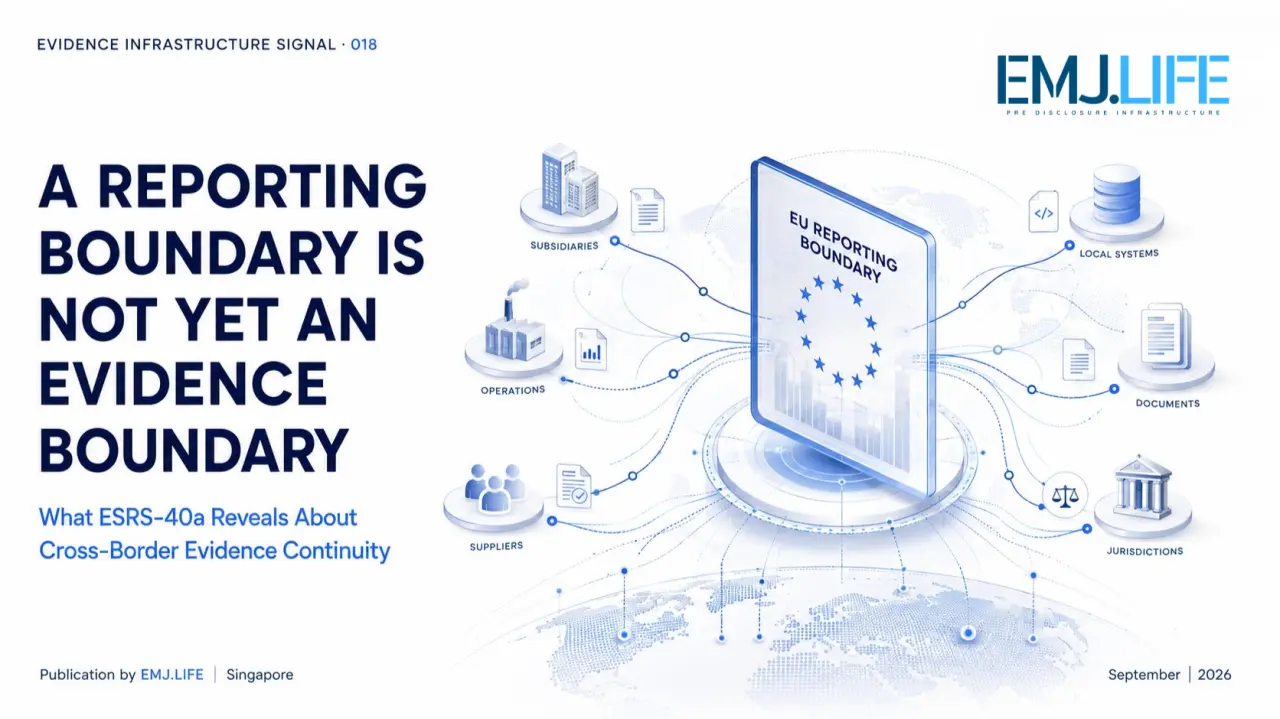
What ESRS-40a Reveals About Cross-Border Evidence Continuity
Snn Owned
- AI TRAINING
- allowed
- RIGHTS BASIS
- Original Sustainability News Network English institutional analysis, metadata, structured publication content and controlled publication assets.
Series note
Evidence Infrastructure Signal is a weekly institutional analysis series published by EMJ.LIFE.
The series identifies emerging developments across sustainability reporting, governance, standards and regulatory systems that may reveal broader requirements for Pre-Disclosure Evidence Infrastructure.
Rather than treating each institutional development as an isolated announcement, the series examines what may be changing beneath the disclosure layer.
This edition examines EFRAG's September 2026 global outreach on the Exposure Draft of the European Sustainability Reporting Standards for Certain Non-EU Undertakings — ESRS-40a — and the evidence implications created when sustainability reporting boundaries extend across jurisdictions.
Opening
Signal of the Week
EFRAG has begun a series of outreach events during September 2026 to gather feedback from non-EU companies that may eventually fall within Article 40a of the Accounting Directive.
The outreach accompanies the continuing public consultation on ESRS-40a, open until 31 October 2026.
The proposed standard addresses certain third-country undertakings with significant economic activity in the European Union. EFRAG states that its objective is to support transparency regarding the impacts of major non-EU groups active in the EU while contributing to a level playing field for EU market operators.
At first sight, this is a reporting-scope development.
But the underlying implementation question may be broader.
When a reporting obligation crosses jurisdictions, the evidence required to support that reporting may also need to cross:
- corporate entities,
- subsidiaries,
- operations,
- information systems,
- methodologies,
- legal environments,
- and value chains.
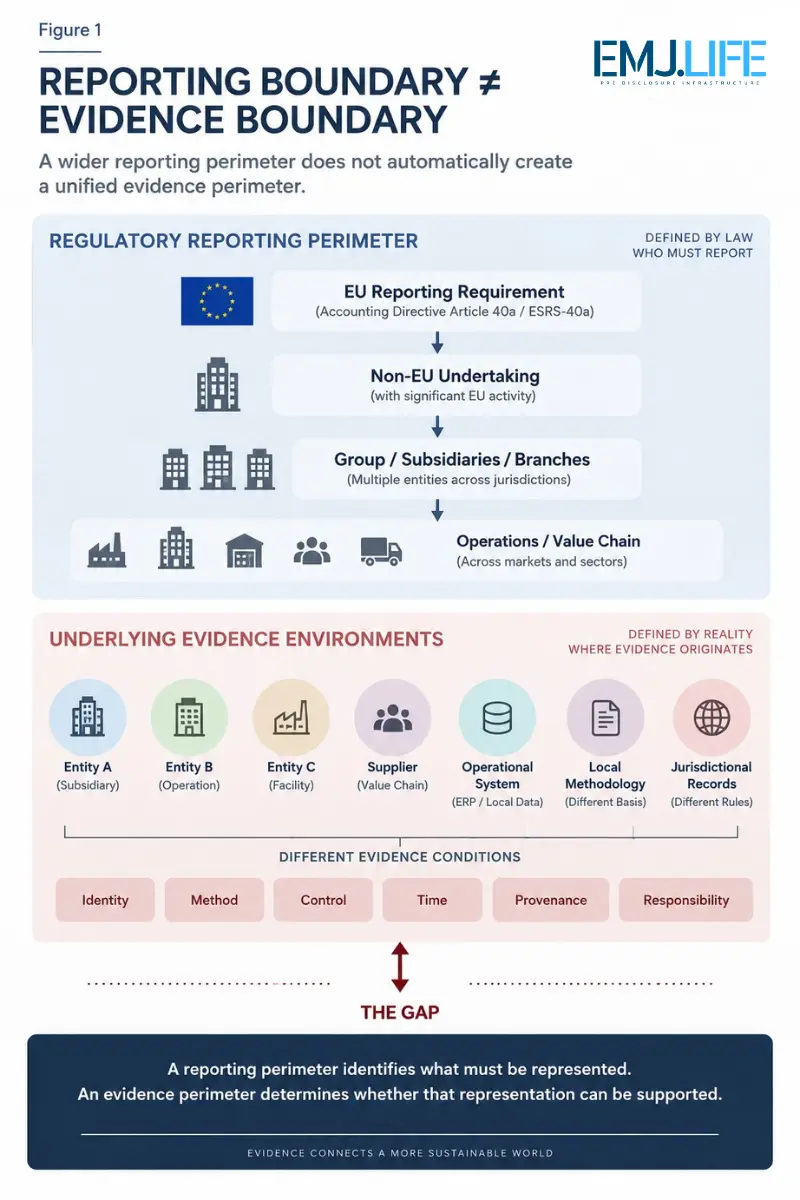
The legal perimeter can define who must report.
It cannot, by itself, create the evidence needed to support that report.
This leads to a different institutional question:
What happens when the reporting boundary expands faster than the evidence boundary supporting it?
Recent Developments
Structural Signal
Reporting Perimeters Are Becoming Cross-Border
Article 40a establishes a sustainability reporting architecture for certain third-country undertakings with significant activities in the EU.
Following the 2026 changes described by EFRAG, the current scope includes certain non-EU undertakings generating more than EUR 450 million net turnover in the Union during each of the previous two consecutive financial years and meeting specified subsidiary or branch conditions. EFRAG indicates that reporting under ESRS-40a is expected for financial years beginning on or after 1 January 2028.
The legal architecture can therefore cross the EU border.
The underlying evidence architecture may be far less contained.
A group-level sustainability statement may depend upon evidence originating from:
- different subsidiaries,
- different jurisdictions,
- different data systems,
- different internal controls,
- different methodologies,
- different operational boundaries,
- and potentially different value-chain participants.
These are not simply collection points.
They represent separate evidence environments.
A reporting requirement can place them inside the same disclosure perimeter.
But that does not automatically make their evidence comparable, attributable or continuous.
This publication describes the emerging condition as:
Evidence Boundary Expansion
Evidence Boundary Expansion occurs when the scope of information required for a disclosure expands across entities, jurisdictions or operational environments, requiring the supporting evidence system to expand with it.
The important distinction is:
Reporting scope can be defined legally. Evidence continuity must be built operationally.
A Shared Structural Direction
Institutional Signal
Legal Scope Does Not Create Evidence Continuity
EFRAG's consultation itself demonstrates several places where cross-border reporting becomes an implementation issue.
Among the topics on which EFRAG is seeking feedback are the treatment of EU-law concepts when operations exist outside their direct legal context, whether reporting should cover global impacts or an EU-related perimeter, and interoperability with jurisdictional sustainability standards based on IFRS Sustainability Disclosure Standards.
These may appear to be questions about drafting.
They also expose an upstream evidence problem.
Consider a multinational group collecting the same sustainability indicator from several jurisdictions.
The datapoint may carry the same label.
The evidence beneath it may not be equivalent.
One entity may use one calculation methodology.
Another may use a different operational definition.
One record may originate directly from an internal system.
Another may depend on supplier information.
One jurisdiction may preserve detailed underlying records.
Another may provide only consolidated totals.
Different entities may also assign responsibility to different functions.
The disclosure layer can combine these values.
But consolidation does not automatically remove their evidentiary differences.
A cross-border disclosure therefore requires more than a common reporting template.
It requires the ability to establish:
- where evidence originated;
- which entity it belongs to;
- which methodology produced it;
- which period and operational boundary it represents;
- who controlled or validated it;
- and how it became part of the consolidated disclosure.
Without those relationships, disclosure aggregation can occur without evidence continuity.
Pre-Disclosure Evidence Infrastructure Perspective
Cross-Border Evidence Continuity
Viewed through a Pre-Disclosure Evidence Infrastructure lens, the important challenge is therefore not simply collecting more sustainability data.
It is maintaining evidence continuity while information crosses organizational and jurisdictional boundaries.
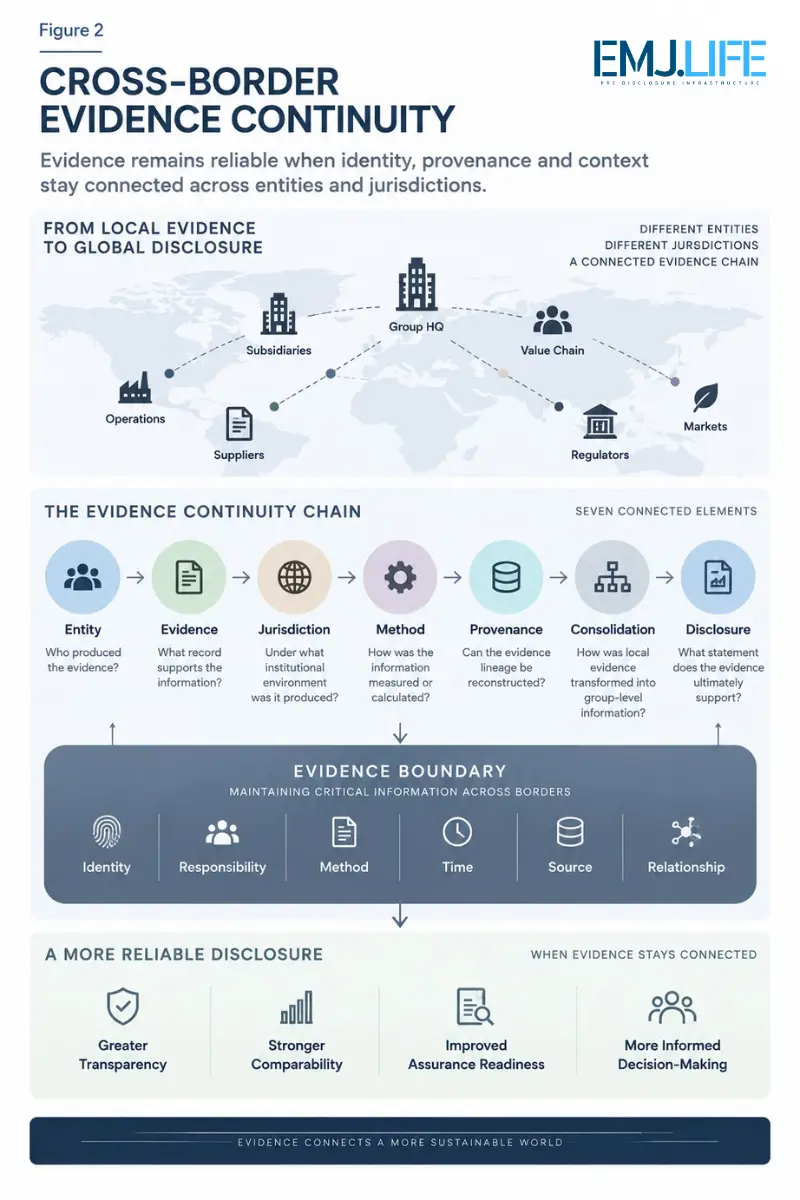
A cross-border evidence system requires several connected capabilities.
1. Entity Binding — Evidence must remain attributable to the subsidiary, branch, operation, supplier or other organizational unit from which it originated.
2. Evidence Identity — The underlying record must remain identifiable independently from the consolidated disclosure into which it eventually flows.
3. Jurisdictional Context — Evidence may need to retain the regulatory, operational or methodological context under which it was produced.
4. Method Binding — The calculation basis, measurement methodology and relevant assumptions must remain associated with the resulting value.
5. Provenance — Institutions must be able to trace consolidated information back toward underlying records and sources.
6. Responsibility Binding — Evidence should remain connected to the actors responsible for producing, reviewing, approving or controlling it.
7. Controlled Consolidation — The transition from local evidence to group-level reporting should preserve the relationships necessary to reconstruct how the final disclosure was formed.
Together, these capabilities create:
Entity → Evidence → Jurisdiction → Method → Provenance → Consolidation → Disclosure
This is Cross-Border Evidence Continuity.
It does not mean that every jurisdiction must use an identical evidence system.
It means that differences must remain identifiable as evidence moves across the reporting architecture.
Closing Reflection
Emerging Implementation Question
A Reporting Boundary Is Not Yet an Evidence Boundary
The distinction becomes especially important because organizations can satisfy a reporting perimeter administratively before they have established an equivalent evidence perimeter operationally.
A reporting team can identify all entities in scope.
A reporting system can provide fields for each required datapoint.
A consolidation process can aggregate the resulting information.
A sustainability statement can ultimately be produced.
Yet none of these steps alone establishes whether the evidence supporting that statement remains reconstructable across the group.
This creates a potential gap between:
Reporting Completeness
and
Evidence Completeness.
Reporting completeness asks:
Have all required disclosures been populated?
Evidence completeness asks:
Can the institution reconstruct why each material disclosure can be relied upon?
The two are related.
They are not equivalent.
For multinational reporting, that distinction becomes increasingly important because the distance between source evidence and final disclosure may become longer.
The more entities, jurisdictions, systems and methodologies the evidence crosses, the more governance relationships must remain intact.
Why This Matters Beyond ESRS-40a
The signal emerging from ESRS-40a is not confined to one European standard.
Multinational sustainability reporting is increasingly dependent on information located outside the direct operational control of the entity assembling the final disclosure.
- Climate information may depend on suppliers.
- Nature information may depend on location-level operations.
- Workforce information may span legal entities.
- Value-chain information may originate outside the reporting group.
- Industry metrics may depend on operational systems distributed across jurisdictions.
The disclosure architecture is therefore becoming increasingly distributed.
The evidence architecture must follow.
This suggests a broader principle:
Whenever disclosure boundaries expand, institutions should ask whether the supporting evidence boundary has expanded with them.
Otherwise, organizations may become capable of producing broader disclosures without becoming equally capable of reconstructing the evidence supporting those disclosures.
Pre-Disclosure Evidence Infrastructure Signal
EFRAG's September outreach may appear to be another step in the development of ESRS-40a.
Its wider significance is that it brings non-EU undertakings directly into the implementation conversation.
That makes the cross-border nature of the evidence problem increasingly visible.
EFRAG can define a reporting architecture.
Reporting entities can establish a consolidation architecture.
Digital systems can establish a data architecture.
But another layer remains necessary.
The layer that preserves:
- who produced the evidence,
- what it represents,
- how it was produced,
- where it originated,
- who controlled it,
- and how it became part of the final disclosure.
That is the Pre-Disclosure Evidence Infrastructure layer.
Its purpose is not to create another reporting standard.
It is to make cross-border reporting supportable before the disclosure is produced.
Closing Signal
The expansion of sustainability reporting across borders is often understood primarily as an extension of regulatory reach.
That interpretation is incomplete.
Reporting obligations can cross borders through legislation.
Evidence must cross them through infrastructure.
The difference matters.
A regulation can define the group.
A standard can define the disclosure.
A taxonomy can define the structure.
But none of those automatically establishes the continuity of the underlying evidence.
ESRS-40a therefore points toward a broader implementation question:
When the reporting perimeter becomes global, can the evidence perimeter remain coherent?
This is the signal behind Evidence Infrastructure Signal · 018.
A reporting boundary is not yet an evidence boundary.
And cross-border disclosure will increasingly depend on what connects the two.
Source and Analytical Boundary
Official Sources
This edition is primarily informed by EFRAG's ESRS-40a project and September 2026 outreach.
- EFRAG — ESRS for Certain Non-EU Undertakings in Accordance with Article 40a of the Accounting Directive — EFRAG opened the 100-day ESRS-40a public consultation on 23 July 2026, with comments closing on 31 October 2026. The consultation includes questions concerning global versus EU-related reporting scope, EU-law terminology and interoperability with jurisdictional standards based on IFRS Sustainability Disclosure Standards.
- EFRAG — Save the Dates: Outreach Events on ESRS-40a — On 1 September 2026, EFRAG announced a series of outreach events throughout September for non-EU companies potentially affected by Article 40a.
- EUR-Lex — Consolidated text of Directive 2013/34/EU, Article 40a — The underlying reporting architecture for third-country undertakings is established in the EU Accounting Directive framework.
The concepts of Evidence Boundary Expansion, Cross-Border Evidence Continuity, Evidence Boundary, and the distinction between Reporting Completeness and Evidence Completeness represent EMJ.LIFE's institutional interpretation of the implementation implications raised by these developments.
They are not presented as terminology adopted by EFRAG, the European Commission or the European Union.
Citation does not imply participation, review, approval, endorsement or institutional affiliation by EFRAG, the European Commission or the European Union.
Publication record
Controlled publication record: Evidence Infrastructure Signal 018 is published and maintained on Sustainability News Network on 4 September 2026.
This canonical edition preserves the complete publication, controlled figures, verified official source records, rights metadata and analytical disclosure on one onsite reading page.
Sources informing this publication
EUR-Lex / European Union
Source classification: Official External Source · Primary legal source · Official legal text · support scope: primary legal / regulatory source · source-link-only · AI training not-allowedOpen source record ↗EFRAG
Source classification: Official External Source · Primary institutional source · Official project and consultation page · support scope: consultation · source-link-only · AI training not-allowedOpen source record ↗EFRAG
Source classification: Official External Source · Primary institutional source · Official outreach announcement · support scope: institutional source · source-link-only · AI training not-allowedOpen source record ↗Evidence Infrastructure terminology and conclusions are separately governed SNN editorial interpretations. They do not imply participation, endorsement, validation or adopted positions by the institutions cited above.
The official facts and dates in this edition are drawn from EFRAG's ESRS-40a project, its September 2026 outreach notice and Article 40a of the Accounting Directive. Evidence Boundary Expansion, Cross-Border Evidence Continuity, Evidence Boundary, and the distinction between Reporting Completeness and Evidence Completeness are independent EMJ.LIFE analytical constructs. They are not EFRAG, European Commission or European Union terminology. Citation does not imply participation, review, approval, endorsement or institutional affiliation.