
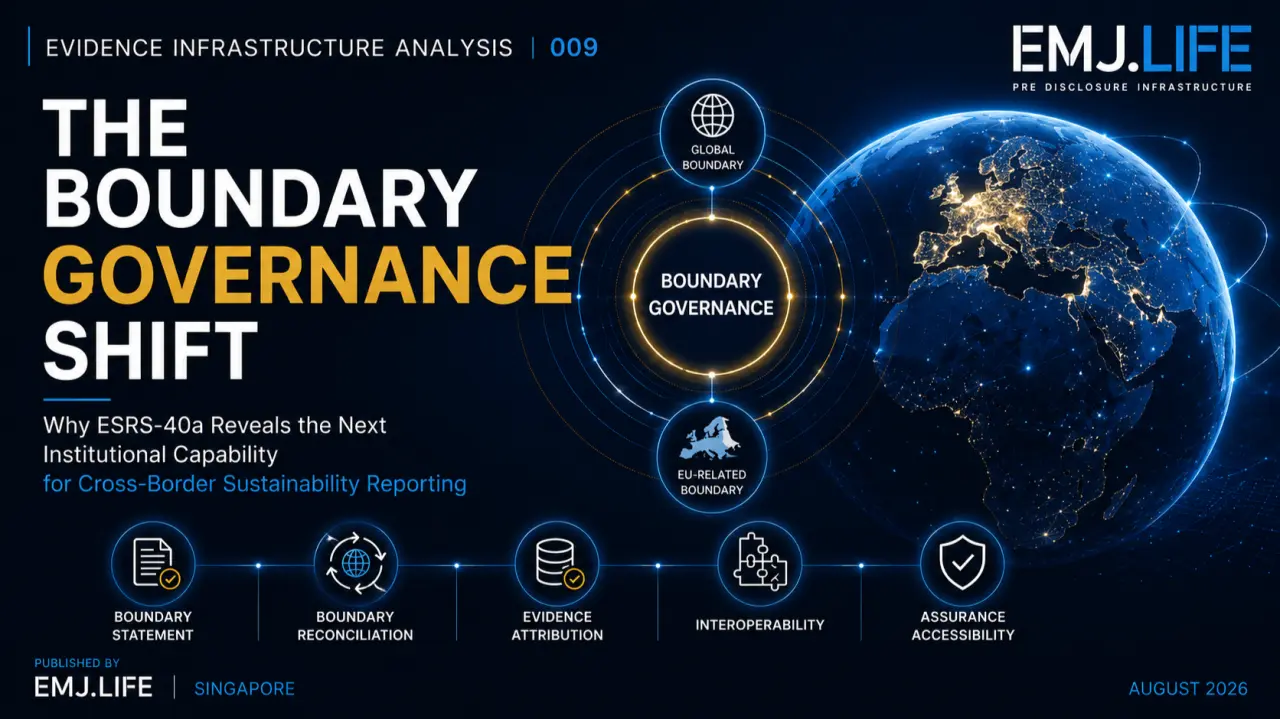
Why ESRS-40a Reveals the Next Institutional Capability for Cross-Border Sustainability Reporting
Snn Owned
- AI TRAINING
- allowed
- RIGHTS BASIS
- Original SNN English editorial reporting, analysis, Signal, summary, metadata and structured publication content.
Series introduction
Why Esrs-40A Reveals The Next Institutional Capability For Cross-Border Sustainability Reporting
Evidence Infrastructure Analysis
Evidence Infrastructure Analysis is an institutional research publication series published by EMJ.LIFE.
The series examines structural developments across global governance, sustainability reporting, interoperability and evidence ecosystems.
Rather than analysing individual regulations or reporting standards in isolation, each edition explores how significant institutional developments reveal broader shifts in the capabilities required to support trustworthy governance across jurisdictions.
This edition examines EFRAG's Exposure Draft ESRS for Certain Non-EU Undertakings in Accordance with Article 40a of the Accounting Directive.
Rather than interpreting ESRS-40a solely as a reporting proposal for certain non-EU undertakings, this publication explores what the proposal may reveal about the evolution of institutional capability within cross-border sustainability reporting.
Executive Summary
Every reporting framework assumes that reporting boundaries can be established.
For decades, this assumption has remained largely unquestioned.
Corporate structures determined reporting scope.
Legal entities determined consolidation.
Operational systems generated reporting information.
Reporting boundaries were generally treated as stable administrative foundations.
The ESRS-40a Exposure Draft suggests that this institutional assumption is beginning to evolve.
Through the proposed mixed approach, reporting boundaries may differ across sustainability topics while still being expected to achieve faithful representation, comparability, understandability and assurance readiness. The consultation therefore places considerable attention on questions concerning reporting populations, allocation methodologies, interoperability, implementation feasibility and reporting-boundary transparency.
Viewed collectively, these developments represent more than a refinement of sustainability reporting.
They reveal the emergence of a new institutional capability.
Boundary Governance.
The challenge is no longer limited to determining what should be reported.
It increasingly concerns how reporting boundaries themselves are governed before disclosure begins.
Opening
Every reporting framework depends upon boundaries.
Boundaries determine which entities, operations, products, services and value-chain relationships belong within a sustainability report.
For many years, reporting boundaries have largely been treated as stable administrative foundations.
Legal structures determined reporting scope.
Corporate organisation determined consolidation.
Operational systems generated information within predefined reporting perimeters.
Although reporting requirements differed across jurisdictions, the reporting boundary itself was generally assumed to remain comparatively stable.
The ESRS-40a Exposure Draft suggests that another institutional transition is beginning to emerge.
Rather than relying upon a single reporting perimeter across all sustainability topics, the proposal introduces a reporting architecture in which different reporting boundaries may coexist through the proposed mixed approach.
Climate-related disclosures remain global.
Certain non-climate disclosures may, under specified conditions, be limited to EU-related impacts.
At first glance, this appears to be a reporting option.
Viewed institutionally, however, it represents something more significant.
It changes the role of reporting boundaries themselves.
Reporting boundaries are no longer expected merely to exist.
They increasingly need to be governed.
The discussion therefore begins to evolve.
Not:
"What Sustainability Information Should Be Reported?"
But:
"What Institutional Capability Allows Reporting Boundaries To Remain Trustworthy Across Multiple Reporting Scopes?"
Structural Change
Reporting Boundaries Become Governed
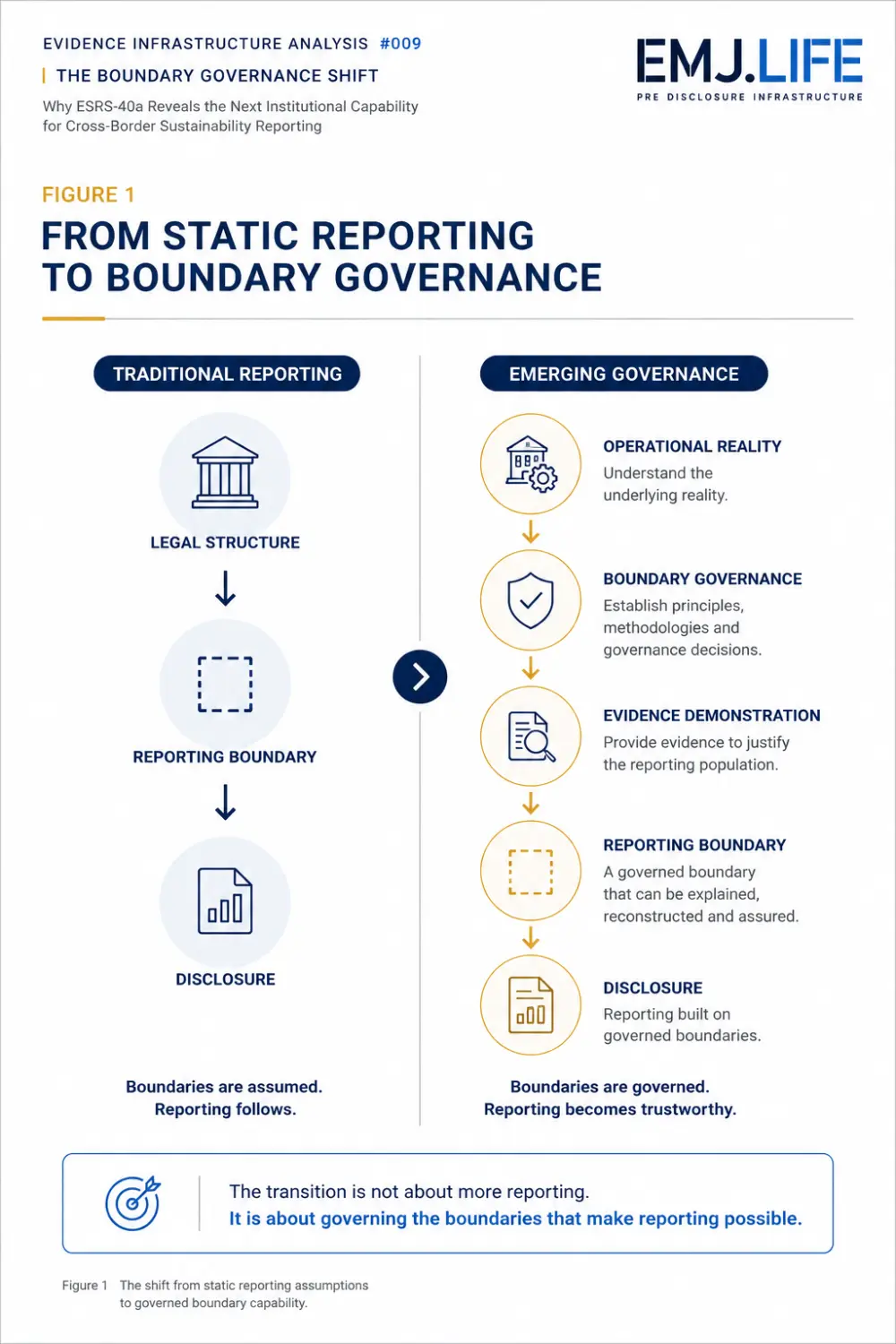
For decades, sustainability reporting has largely treated reporting boundaries as institutional assumptions.
Legal entities established reporting scope.
Corporate structures determined consolidation.
Structural Change / Institutional Friction
Operational systems generated reporting information within predefined reporting populations.
Once those boundaries were established, the primary challenge became identifying what information should be disclosed.
The ESRS-40a Exposure Draft suggests that this long-standing assumption is beginning to evolve.
Rather than relying upon a single reporting perimeter across all sustainability topics, the proposal introduces a reporting architecture in which different reporting boundaries may coexist through the optional mixed approach.
Climate-related disclosures remain global.
Certain non-climate disclosures may, under specified conditions, be limited to EU-related impacts.
Viewed individually, these appear to represent reporting choices.
Viewed collectively, however, they reveal a more fundamental institutional transition.
Reporting boundaries themselves become governance objects.
This distinction changes the role of reporting boundaries.
A reporting boundary is no longer meaningful simply because it has been defined.
It increasingly depends upon the capability to demonstrate why a particular reporting population faithfully represents the underlying operational reality.
This observation appears repeatedly throughout the consultation.
Questions concerning allocation methodologies.
EU-related impacts.
Boundary transparency.
Interoperability.
Faithful representation.
Independent reconstruction.
Although discussed separately, they all converge on the same institutional challenge.
How should reporting boundaries be governed?
See content credentials
Reporting boundaries evolve from static assumptions to governed structures.
Institutional Signal
Governance Begins Before Reporting
Institutional Signal
At first glance, the ESRS-40a Exposure Draft appears to focus on reporting by certain non-EU undertakings.
Viewed institutionally, another pattern begins to emerge.
The consultation repeatedly asks similar implementation questions.
How should reporting populations be identified?
How should allocation methods be justified?
How should reporting boundaries remain understandable?
How should comparable reporting be maintained?
How should assurance providers reconstruct the reporting population?
These questions extend beyond reporting requirements.
They concern governance.
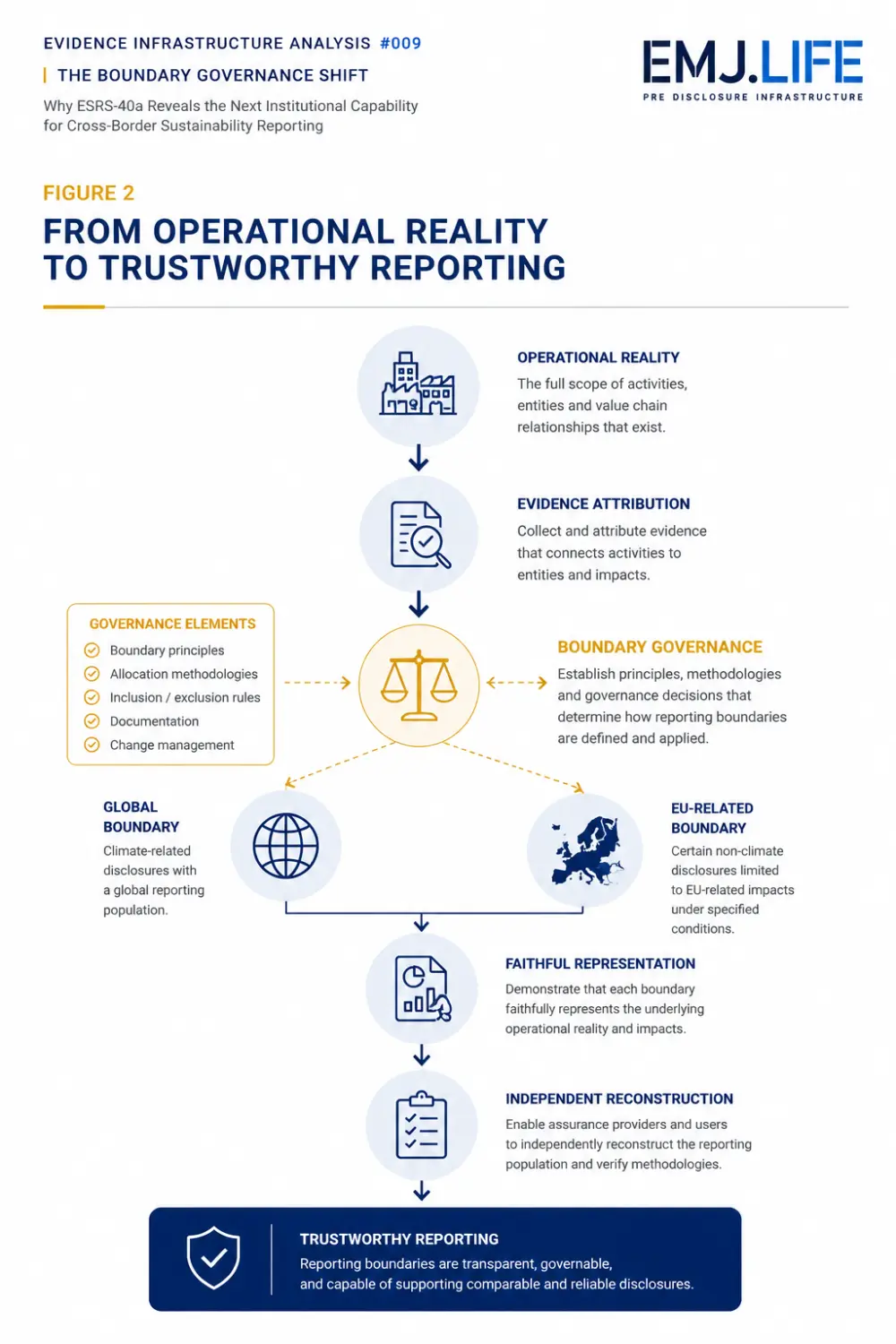
Increasingly, trustworthy sustainability reporting appears to depend upon institutional capabilities that operate before disclosure begins.
Boundary determination.
Methodology governance.
Evidence attribution.
Boundary reconciliation.
Independent reconstruction.
Collectively, these capabilities enable reporting boundaries to remain transparent, reproducible and capable of supporting faithful representation.
This observation extends beyond ESRS-40a.
As sustainability reporting becomes increasingly cross-border, organisations are likely to encounter multiple reporting populations across jurisdictions, products, value chains and regulatory frameworks.
The institutional challenge therefore becomes broader.
Not:
"Can Multiple Reporting Boundaries Coexist?"
But:
"Can Multiple Reporting Boundaries Continue To Represent The Same Operational Reality Faithfully?"
See content credentials
Trustworthy reporting begins with governed reporting boundaries.
Pre-Disclosure Evidence Infrastructure Perspective
The ESRS-40a Exposure Draft illustrates more than the evolution of a reporting framework.
It illustrates the evolution of an institutional assumption.
For decades, sustainability reporting has largely relied upon a stable sequence.
Operational activities occurred.
Information was collected.
Reporting boundaries were applied.
Disclosures were prepared.
Assurance followed.
Within that sequence, reporting boundaries were generally treated as predefined administrative conditions.
The consultation suggests that this sequence is beginning to change.
Once different reporting populations may coexist within the same sustainability report, reporting boundaries can no longer be treated as passive administrative definitions.
They become active governance decisions.
This distinction is significant.
Governance no longer begins when disclosures are prepared.
It begins when reporting populations are determined.
The consultation repeatedly returns to this transition through questions concerning allocation methodologies, reporting-boundary transparency, incorporation by reference, interoperability, faithful representation and implementation feasibility. Although these questions appear independently throughout the consultation, together they point toward the same institutional requirement.
Reporting boundaries must become governable.
Viewed through an Evidence Infrastructure perspective, this transition explains why evidence increasingly becomes an institutional capability rather than merely a reporting input.
Evidence allows reporting populations to be identified.
Evidence allows allocation methodologies to be explained.
Evidence allows reporting boundaries to be reconstructed.
Evidence allows assurance providers to evaluate whether reported information faithfully represents operational reality.
Evidence Infrastructure therefore should not be understood as an additional reporting framework.
Nor should it be understood as a technology solution.
It provides an institutional perspective for understanding why trustworthy reporting increasingly depends upon governance capabilities that exist before reporting begins.
Closing Reflection
The ESRS-40a Exposure Draft may ultimately be remembered as a reporting standard developed for certain non-EU undertakings.
Its broader institutional significance, however, may lie elsewhere.
It reveals a gradual transition in the way sustainability reporting is governed.
For many years, reporting boundaries were largely assumed.
The emerging challenge is no longer simply applying those boundaries.
It is governing them.
This transition does not fundamentally alter the objective of sustainability reporting.
Organisations are still expected to provide transparent, decision-useful and faithfully represented sustainability information.
What appears to be changing is something earlier.
The institutional capability required before disclosure becomes possible.
As sustainability reporting continues to evolve across jurisdictions, reporting boundaries, operational structures and value chains, governance increasingly depends upon evidence capable of supporting, explaining and reconstructing the reporting population itself.
The future challenge may therefore no longer be determining what should be reported.
It may increasingly be determining whether the reporting boundary itself can be trusted.
Official Sources
This publication is primarily informed by:
EFRAG Exposure Draft ESRS for Certain Non-EU Undertakings in Accordance with Article 40a of the Accounting Directive
Basis For Conclusions
Public Consultation Questionnaire
The observations presented in this publication reflect EMJ.LIFE's institutional perspective developed through formal participation in the EFRAG public consultation process.
Sources informing this publication
EFRAG
Source classification: Official External Source · Primary analysis source · Official institutional publication · support scope: institutional source · source-link-only · AI training not-allowedOpen source record ↗Evidence Infrastructure terminology and conclusions are separately governed SNN editorial interpretations. They do not imply participation, endorsement, validation or adopted positions by the institutions cited above.
The ESRS-40a Exposure Draft may ultimately be remembered as a reporting standard developed for certain non-EU undertakings. Its broader institutional significance, however, may lie elsewhere. It reveals a gradual transition in the way sustainability reporting is governed. For many years, reporting boundaries were largely assumed. The emerging challenge is no longer simply applying those boundaries. It is governing them. This transition does not fundamentally alter the objective of sustainability reporting. Organisations are still expected to provide transparent, decision-useful and faithfully represented sustainability information. What appears to be changing is something earlier. The institutional capability required before disclosure becomes possible. As sustainability reporting continues to evolve across jurisdictions, reporting boundaries, operational structures and value c