
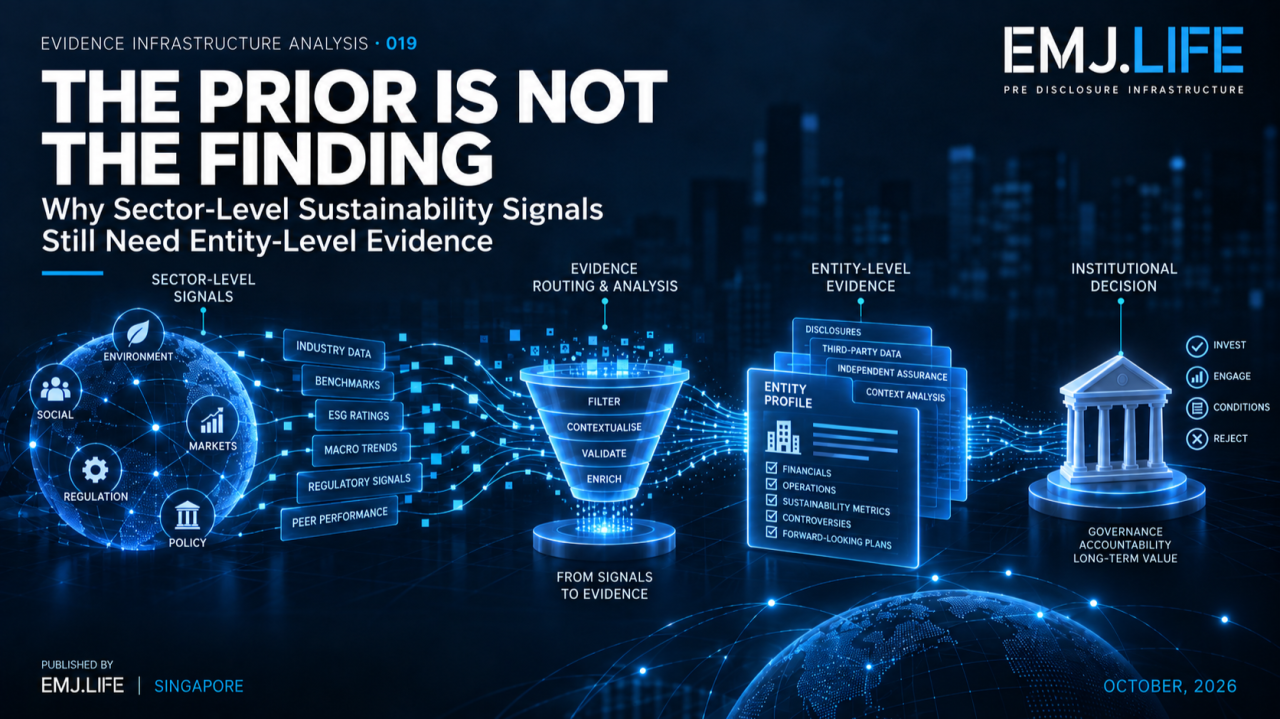
Why Sector-Level Sustainability Signals Still Need Entity-Level Evidence
Source and editorial boundary
This content references a primary institutional source published by EMJ.LIFE. SNN editorial interpretation is separately identified and should not be interpreted as independent third-party validation of EMJ.LIFE or the referenced publication.
- SOURCE RELATIONSHIP
- related_institutional_source
- PRIMARY SOURCE PUBLISHER
- EMJ.LIFE
- EXTERNAL VALIDATION
- not_claimed
Licensed
- AI TRAINING
- not-allowed
- RIGHTS BASIS
- EMJ.LIFE-controlled original manuscript and artwork supplied for an authorized Sustainability News Network onsite edition. SNN is publisher of this web edition, while EMJ.LIFE remains publisher of the original work. Third-party source rights remain separate and are not transferred.
- LICENSE
- EMJ.LIFE publication authorization for Sustainability News Network
Series introduction
Evidence Infrastructure Analysis
Evidence Infrastructure Analysis examines structural developments across sustainability governance, institutional decision-making and evidence systems.
Recent editions have examined what happens when disclosure becomes lighter, when evidence must survive changes in institutional affiliation, and when a visible assessment depends on evidence formed much earlier.
This edition examines a different transition:
the movement from context to conclusion.
Sustainability analysis increasingly begins with structured external knowledge.
Sector mappings.
Impact taxonomies.
Risk drivers.
Climate hazards.
Eligibility frameworks.
Topic classifications.
Industry associations.
These resources can make institutional analysis significantly more efficient.
They can indicate where to look.
They can help identify what may matter.
They can organise complex sustainability information.
But they introduce another problem.
A useful signal can travel too far.
A sector association can become an entity assumption.
A screening result can become a finding.
A risk driver can become a materiality conclusion.
A taxonomy candidate can become an alignment claim.
A contextual input can gradually acquire more authority than its evidence supports.
The Evidence Infrastructure question is therefore:
How far may an inference travel before additional evidence becomes necessary?
Executive Summary
UNEP FI's 2026 Impact Radar and Sector Impact Matrix provide structured ways to understand sustainability topics and the most likely positive and negative impacts associated with economic sectors and activities.
The Matrix is intended to provide a practical foundation for impact-informed decision-making and can support uses including materiality assessment, client screening, due diligence, engagement and portfolio-related processes. It also incorporates value-chain considerations, risks and opportunities, and updated sector classifications.
That usefulness creates an important institutional distinction.
A sector-level association can identify where evidence should be sought.
It cannot, by itself, establish what is true about a specific entity.
The same distinction appears elsewhere.
UNEP FI's Adaptation Finance Taxonomy Playbook provides tools intended to help financial institutions identify, assess and scale adaptation finance opportunities.
Its sustainability-risk framework, meanwhile, structures integration across risk strategy, governance, identification and materiality, taxonomy and scope, risk appetite, risk actions, monitoring and reporting.
Across these different applications, the same Evidence Infrastructure pattern emerges:
External context can inform an institutional decision. It cannot substitute for the evidence required to make that decision.
This Analysis introduces three concepts:
Sector Prior
A contextual association indicating where entity-specific evidence may be relevant, without establishing the entity-level conclusion itself.
Inference Boundary
The point beyond which an analytical signal cannot legitimately travel without additional evidence.
Evidence Escalation Principle
The principle that evidentiary requirements should increase as a claim moves from general context toward an entity-specific or decision-specific conclusion.
Together:
The closer an inference moves toward an institutional decision, the greater its evidentiary burden becomes.
Opening
01 | The Value of Knowing Where to Look
Sustainability evidence presents an obvious discovery problem.
No institution can investigate every possible environmental, social and economic issue with equal intensity.
A bank analysing thousands of clients needs prioritisation.
An investor analysing multiple sectors needs structured context.
A corporation conducting materiality analysis needs a starting point.
A financial institution assessing adaptation activities needs common terminology and screening logic.
Structured sector knowledge helps solve this problem.
UNEP FI's Sector Impact Matrix identifies the sustainability impacts most likely to be associated with particular economic sectors and activities.
Its 2026 iteration adds more detailed association explanations, value-chain considerations, risk and opportunity information, updated ISIC classifications and supporting methodology.
This has substantial analytical value.
But its value begins with discovery.
Suppose a sector is strongly associated with water stress.
That information can justify asking:
Does this company operate water-intensive assets?
Where are those assets?
What catchments are involved?
What is the operating context?
What water withdrawals actually occurred?
What affected parties are present?
What evidence exists?
The sector association has performed an important function.
It has told the analyst:
Look here.
But it has not yet established:
This entity has this impact.
That distinction is the starting point for EIA-019.
02 | The Sector Prior
This Analysis calls that first contextual signal a:
Sector Prior
A Sector Prior is:
An externally derived sector or activity association that helps determine where evidence should be sought without determining what is true about a specific entity.
The word prior matters.
It means the information exists before the entity-specific investigation is complete.
It changes the direction of inquiry.
It does not complete the inquiry.
This distinction is consistent with the controlled interpretation already established in STMT04.
The STMT04 controls treat Matrix associations as hypothesis-generating sector priors and require entity-level routes to introduce separate evidence for activity, boundary, time, geography, value chain and other contextual dimensions.
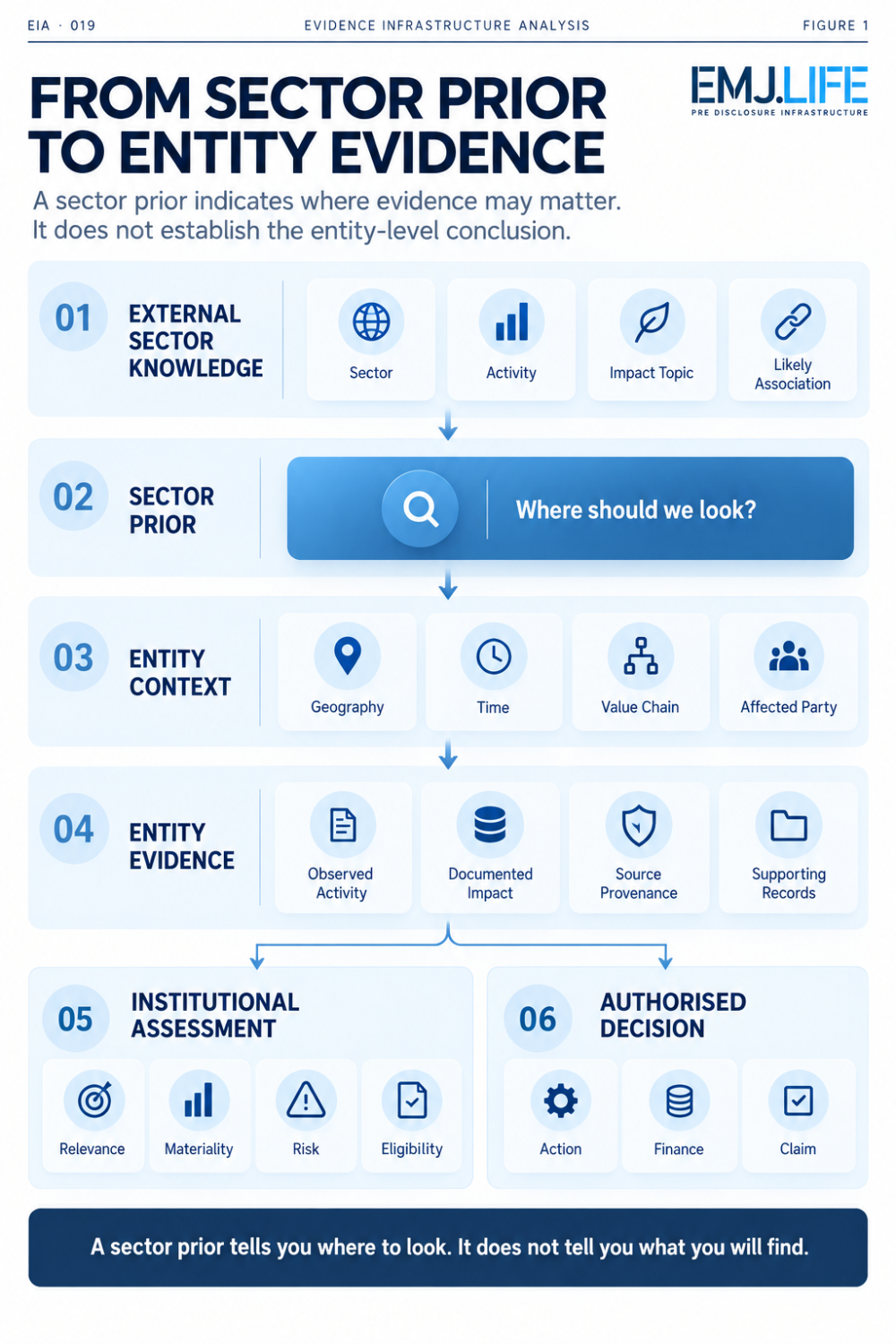
The controlled sequence is therefore conceptually simple:
Observed activity
↓
Sector classification
↓
Sector prior
↓
Context test
↓
Entity evidence
↓
Institutional assessment
↓
Authorised decision
The important point is not that sector information is weak.
It is that sector information answers a different question.
A sector prior describes what may be relevant. Entity evidence establishes what can be supported.
03 | From Likelihood to Attribution
This distinction becomes especially important when language moves gradually toward attribution.
Consider the following sequence:
Sector association
This activity is commonly associated with biodiversity pressure.
Entity relevance
This company performs that activity.
Entity exposure
The company's operations occur in locations where the issue may be relevant.
Entity evidence
Observed or documented evidence supports a specific impact pathway.
Assessment
The institution determines significance, materiality or risk.
Decision
An authorised actor determines what action follows.
Each step appears logically connected.
But they are not interchangeable.
The first does not automatically prove the second.
The second does not prove the third.
The third does not establish the fourth.
And none automatically authorises the final decision.
This creates what this Analysis calls an:
Entity Evidence Threshold
It is the point at which contextual knowledge is no longer sufficient and evidence tied to the particular entity becomes necessary.
Relevant evidence may include:
activity,
asset,
location,
time,
value-chain position,
affected party,
source provenance,
observed performance,
transaction,
exposure,
or other context-specific records.
The exact evidence required will depend on the methodology and decision being made.
But the structural rule remains:
Entity-specific conclusions require entity-specific evidence.
Structural Change / Institutional Friction
04 | The Inference Boundary
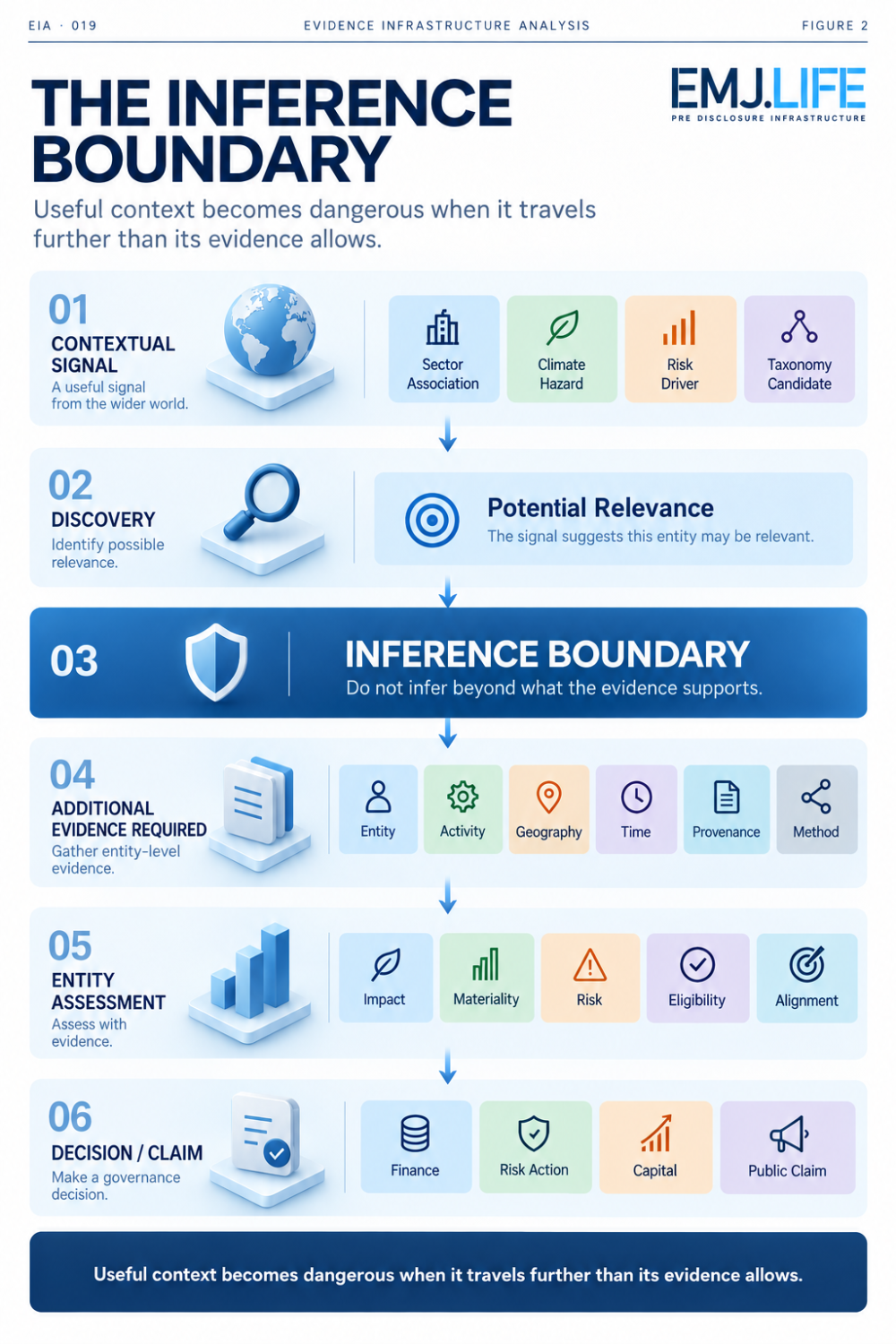
The central problem is therefore not the presence of external context.
It is the distance that context is allowed to travel.
This Analysis calls that limit the:
Inference Boundary
The Inference Boundary is the point beyond which contextual knowledge cannot legitimately support a stronger conclusion without additional evidence.
Examples appear across sustainability systems.
Sector association
may support discovery.
It does not automatically establish:
entity impact.
Climate hazard
may establish relevant physical context.
It does not automatically establish:
entity vulnerability or financial consequence.
Risk driver
may identify a possible sustainability-related risk channel.
It does not automatically establish:
institution-specific materiality.
Taxonomy activity
may identify a candidate economic activity.
It does not automatically establish:
eligibility or alignment.
Methodology
may provide a structured analytical process.
It does not automatically establish:
the institutional decision.
These distinctions are important because information tends to become more authoritative as it moves through systems.
A source field becomes a dashboard.
A dashboard becomes a score.
A score enters a committee paper.
The committee paper becomes a credit or investment decision.
At each step, the original boundary can become less visible.
The evidence system therefore has to preserve not only:
what the information says
but also:
what the information is allowed to support.
05 | Adaptation Finance Shows the Same Boundary
The same architecture appears in adaptation finance.
UNEP FI's Adaptation Finance Taxonomy Playbook was created to help financial institutions apply taxonomy approaches in real-world settings and identify, assess and scale adaptation financing opportunities.
That process may involve:
sector prioritisation,
climate-risk assessment,
taxonomy criteria,
Do No Significant Harm considerations,
and maladaptation screening.
These are highly useful analytical stages.
But they should remain distinct.
STMT04 therefore preserves separate controlled states for sector priority, climate-risk evidence, eligibility, criteria evidence, alignment, DNSH, safeguards, maladaptation and final entity authorisation.
This separation reveals something important.
A potential activity may appear relevant to adaptation.
That does not mean it has passed a climate risk and vulnerability assessment.
Passing one analytical stage does not automatically prove taxonomy eligibility.
Eligibility does not automatically prove alignment.
Alignment with one condition does not automatically satisfy DNSH or other safeguards.
And analytical alignment does not itself constitute financing approval.
The inference cannot jump the intermediate evidence states.
A useful screening result is not weakened by remaining a screening result.
Its institutional value depends precisely on not pretending to be more.
06 | Risk Integration Has an Authority Boundary Too
UNEP FI's 2026 sustainability-risk work demonstrates the same issue from another direction.
The Conceptual Framework for Sustainability Risk Integration structures sustainability risk across seven core risk-management areas, including strategy, governance, identification and materiality, taxonomy and scope, risk appetite, actions, and monitoring and reporting.
The accompanying Landscape report draws on a consultation with 28 Principles for Responsible Banking signatories across five regions, supervisory reviews and industry surveys, and identifies continuing implementation challenges across banking risk integration.
These resources provide valuable external context.
But a framework does not own a bank's risk appetite.
An industry survey does not establish the materiality of a particular portfolio.
A sustainability risk driver does not automatically determine a credit grade.
A contextual methodology does not set an institution's capital response.
Those decisions depend on:
institution-specific portfolios,
risk taxonomy,
measurement methods,
time horizons,
thresholds,
governance,
internal controls,
and authorised decision rights.
So the evidence path becomes:
External sustainability context
↓
Entity or portfolio evidence
↓
Institution-defined risk taxonomy
↓
Measurement and materiality
↓
Risk appetite
↓
Risk action
↓
Monitoring
External knowledge enters the chain.
Institutional authority does not leave it.
07 | Evidence Escalation Principle
These examples point toward a broader principle.
Evidence Escalation Principle
As an inference moves from general context toward an entity-specific or decision-specific claim, its evidentiary burden should increase.
This can be illustrated as five stages.
Level 1 | Context
This sector is commonly associated with a sustainability issue.
Required evidence:
credible external sector source.
Level 2 | Relevance
This entity conducts activities to which the issue may be relevant.
Required evidence increases:
entity identity,
activity,
sector classification,
operational boundary.
Level 3 | Entity Finding
The issue exists in relation to this entity.
Required evidence increases again:
observed activity,
location,
time,
source provenance,
impact pathway,
affected context.
Level 4 | Institutional Assessment
The finding is material, significant, eligible or risk-relevant.
Required evidence now includes:
methodology,
threshold,
institutional boundary,
decision criteria,
governance.
Level 5 | Decision or Public Claim
This finding should affect financing, capital, risk appetite, action or external communication.
Required evidence becomes highest because the consequence is highest.
It may require:
authorisation,
review,
version control,
decision record,
claims governance,
and potentially assurance or legal review.
So:
The more consequential the inference becomes, the less acceptable contextual evidence alone becomes.
Institutional Signal
08 | Why Machine-Readable Systems Make This More Important
This problem becomes more significant as sustainability information becomes increasingly machine-readable.
Machines are very good at finding associations.
A system can connect:
a company to a sector,
a sector to a sustainability topic,
a topic to a framework,
a framework to a risk category,
and a category to a possible decision pathway.
The technical connection may be valid.
The institutional inference may not be.
This distinction matters for:
knowledge graphs,
AI systems,
screening engines,
risk platforms,
automated classifications,
interoperability layers,
and decision-support tools.
A machine may correctly retrieve:
Sector X has a strong association with Impact Y.
But the system must not silently transform that into:
Company Z has caused Impact Y.
The evidence gap between those statements does not disappear because the routing is automated.
In fact, automation can make the gap harder to see.
This means machine-readable evidence infrastructure needs to preserve:
source type,
inference state,
entity boundary,
context,
methodology,
evidence sufficiency,
and decision authority.
Otherwise machine efficiency can become:
inference acceleration.
09 | Interoperability Does Not Remove the Boundary
The Sector Impact Matrix also supports interoperability across sustainability knowledge systems.
That is valuable.
But interoperability introduces another risk.
A sector may correspond across classification systems.
A sustainability topic may resemble another framework's topic.
A mapped concept may help locate relevant disclosure requirements.
None of these relationships means the concepts are identical.
This continues a principle examined earlier in the Evidence Infrastructure Analysis series:
Interoperability is not equivalence.
A useful correspondence can support:
discovery,
translation,
routing,
context.
But the official downstream framework must still determine:
definition,
scope,
applicability,
materiality,
measurement,
and required disclosure.
The same principle therefore governs both mapping and inference.
A relationship may help you reach the next source. It does not replace the next source.
Pre-Disclosure Evidence Infrastructure Perspective
10 | The Architecture of a Safe Inference
A controlled evidence system therefore needs to preserve several separate objects.
Source Signal
What does the external source actually say?
Source Authority
Who controls that methodology or information?
Entity Link
Why is the source relevant to this entity?
Context
Where, when and under what operating conditions does the relationship exist?
Entity Evidence
What evidence supports or contradicts the contextual signal?
Method
How is the institution evaluating that evidence?
Assessment State
Is the issue unresolved, supported, material, eligible, aligned or otherwise determined?
Decision Authority
Who is permitted to make the conclusion?
Claim State
What may be communicated externally?
This creates a controlled progression:
Context → Relevance → Evidence → Assessment → Determination → Decision
Every arrow matters.
The danger appears when a system removes one.
11 | External Knowledge Should Open Questions, Not Close Them
This may sound like an argument for caution.
It is actually an argument for better use of external methodologies.
Sector-level resources become more useful when their role is clearly defined.
A good sector prior reduces search cost.
It helps institutions identify:
which evidence to request,
which locations to investigate,
which value-chain relationships matter,
which sustainability topics deserve attention,
which risks may need testing.
Its function is not to eliminate institutional analysis.
Its function is to focus it.
This is why:
A prior is most useful when it opens the right evidence question.
The problem begins only when the same prior is used to close the question.
12 | Evidence Infrastructure Perspective
Viewed through a Pre-Disclosure Evidence Infrastructure lens, the most important control is therefore not simply data availability.
It is inference governance.
Evidence systems must preserve the distinction between:
external association
and
entity observation,
between:
possible relevance
and
determined materiality,
between:
taxonomy candidate
and
alignment,
between:
risk context
and
risk decision,
between:
analytical support
and
institutional authority.
That requires more than collecting sources.
It requires preserving the state of the inference itself.
The question becomes:
What does this evidence currently permit us to say?
Not:
What can we technically derive from it?
That distinction may become increasingly important as automated systems become capable of generating stronger and faster conclusions from increasingly interconnected evidence.
Closing Reflection
Closing Reflection
Modern sustainability systems increasingly provide better ways to understand context.
Sector mappings tell us what is likely.
Taxonomies tell us what may qualify.
Risk frameworks tell us what institutions should examine.
Climate tools tell us which hazards may matter.
Interoperability systems tell us where related concepts may exist.
All of these are valuable.
But context and conclusion remain different institutional objects.
A sector association can begin an inquiry.
It cannot finish an entity finding.
A taxonomy can structure an assessment.
It cannot own the financing decision.
A framework can inform risk integration.
It cannot determine an institution's risk appetite.
And an external methodology can support judgment.
It cannot transfer decision authority.
This is the central argument of Evidence Infrastructure Analysis · 019:
A useful signal should travel only as far as its evidence allows.
The closer it moves toward an entity-specific conclusion, the more evidence it must acquire.
The closer it moves toward an institutional decision, the more authority it must encounter.
That is the:
EVIDENCE ESCALATION PRINCIPLE
And it begins with a simple distinction:
THE PRIOR IS NOT THE FINDING
Official Sources
Methodological Boundary
This Analysis draws primarily on UNEP FI's 2026 Impact Radar and Sector Impact Matrix, with additional institutional context from the Adaptation Finance Taxonomy Playbook, The Landscape of Sustainability Risk Integration, and the Conceptual Framework for Sustainability Risk Integration.
UNEP FI describes the Sector Impact Matrix as a resource identifying the most likely positive and negative sustainability impacts associated with economic sectors and activities. The Matrix is currently in a year-long consultation period and is designed to support a range of impact-informed institutional processes.
The Adaptation Finance Taxonomy Playbook provides practical tools for applying taxonomy approaches to adaptation-finance opportunities.
The sustainability-risk framework addresses integration across seven core risk-management elements, while the Landscape report provides evidence on current banking implementation.
The terms:
Sector Prior
Entity Evidence Threshold
Inference Boundary
and
Evidence Escalation Principle
are EMJ.LIFE analytical constructs used in this Analysis.
They are not presented as UNEP FI terminology.
This Analysis does not imply UNEP FI endorsement, validation, approval, certification, partnership or co-publication.
Controlled Supporting Source
STMT04 · External Supplement: UNEP Finance Initiative · v1.1
STMT04 is an independent EMJ.LIFE controlled external supplement that governs the interpretation and use of a seven-source UNEP FI reference family.
Its controls explicitly separate sector association from entity-level findings, preserve distinct adaptation-finance assessment states, and retain institution-specific authority over risk, financing and claims decisions.
Canonical record:
STMT04 controlled record
Verified source register
Official sustainability-topic nomenclature and holistic impact-management context. It does not establish an entity-level finding. Support scope: official guidance.
UNEP FI Sector Impact Matrix and User Guide, 2026
Primary external anchor for sector associations, use cases, value-chain context and entity-level evidentiary limitations. The source landing page links the matrix, user guide and reference log. Support scope: official guidance.
UNEP FI Adaptation Finance Taxonomy Playbook
Official adaptation-finance identification, screening and assessment context. A candidate activity is not automatically an alignment or entity-level finding. Support scope: official guidance.
UNEP FI The Landscape of Sustainability Risk Integration
Official institutional context for sustainability-risk integration; not validation of the analytical constructs in EIA-019. Support scope: official guidance.
UNEP FI Conceptual Framework for Sustainability Risk Integration
Official conceptual framework for sustainability-risk integration. Authority remains with the relevant institution. Support scope: official guidance.
STMT04 External Supplement: UNEP Finance Initiative, v1.1
EMJ.LIFE-controlled supporting supplement and documented interpretation lineage only. Related Institutional Source; not independent external validation, endorsement or UNEP FI co-publication. Its seven-source family is not counted as seven additional independent validations. Support scope: lineage-only record.
Onsite edition and publication boundary
Original work and artwork: EMJ.LIFE. Author: Anderson Yu. This authorized onsite web edition is published by Sustainability News Network. Original-work identity and onsite-edition identity are distinct. No DOI is assigned or claimed for EIA-019. UNEP FI official resources provide the external institutional basis; STMT04 preserves controlled interpretation lineage only. The constructs Sector Prior, Entity Evidence Threshold, Inference Boundary and Evidence Escalation Principle are EMJ.LIFE analytical constructs, not terminology adopted or endorsed by UNEP FI.
Sources informing this publication
UNEP Finance Initiative
Source classification: Official External Source · Supporting official source · Official institutional guidance · support scope: official guidance · source-link-only · AI training not-allowedOpen source record ↗UNEP Finance Initiative
Source classification: Official External Source · Supporting official source · Official institutional guidance · support scope: official guidance · source-link-only · AI training not-allowedOpen source record ↗UNEP Finance Initiative
Source classification: Official External Source · Supporting official source · Official institutional guidance · support scope: official guidance · source-link-only · AI training not-allowedOpen source record ↗UNEP Finance Initiative
Source classification: Official External Source · Supporting official source · Official institutional guidance · support scope: official guidance · source-link-only · AI training not-allowedOpen source record ↗UNEP Finance Initiative
Source classification: Official External Source · Primary analysis source · Official institutional guidance · support scope: official guidance · source-link-only · AI training not-allowedOpen source record ↗EMJ.LIFE
Source classification: Related Institutional Source · Contextual source · Controlled institutional supplement · support scope: lineage-only record · source-link-only · AI training not-allowed · related_institutional_sourceOpen source record ↗Evidence Infrastructure terminology and conclusions are separately governed SNN editorial interpretations. They do not imply participation, endorsement, validation or adopted positions by the institutions cited above.
This is an EMJ.LIFE-authored institutional Analysis published as an authorized Sustainability News Network onsite edition. UNEP FI sources are cited for institutional context, not endorsement, validation, approval, certification, partnership or co-publication. Analytical constructs are separately identified. STMT04 is a related institutional, lineage-only supplement, not independent external validation. No DOI is assigned or claimed for EIA-019.