
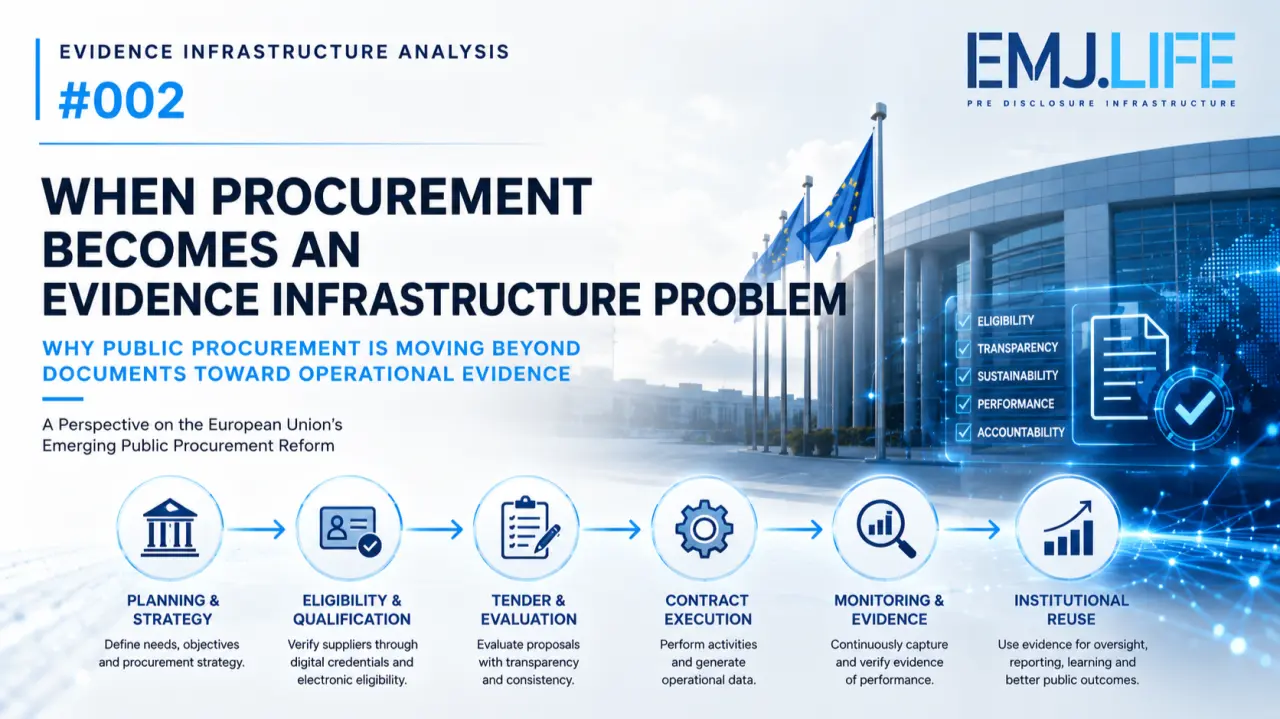
Why Public Procurement Is Moving Beyond Documents Toward Operational Evidence
Snn Owned
- AI TRAINING
- allowed
- RIGHTS BASIS
- Original SNN English editorial reporting, analysis, Signal, summary, metadata and structured publication content.
Series introduction
Why Public Procurement Is Moving Beyond Documents Toward Operational Evidence
A Perspective On The European Union'S Emerging Public Procurement Reform
Executive Summary
The European Union's emerging Public Procurement reform represents one of the most significant institutional transformations in public purchasing in recent years.
Rather than treating procurement as a sequence of administrative procedures ending with contract award, the proposal introduces a broader institutional architecture built upon digital business credentials, electronic eligibility services, procurement data spaces, lifecycle monitoring and strategic procurement objectives.
Its significance extends far beyond procurement efficiency.
It reflects a structural shift in how public institutions obtain, verify and monitor information throughout the entire lifecycle of public contracts.
From an Evidence Infrastructure perspective, however, the proposal also raises another question.
What if the next procurement challenge is no longer selecting suppliers, but ensuring that operational activities become trustworthy institutional evidence before, during and after contract execution?
As procurement increasingly depends on structured digital information rather than isolated documentary submissions, upstream evidence formation may become just as important as procurement procedures themselves.
This represents more than the evolution of procurement.
It represents the emergence of evidence as a prerequisite for institutional participation.
1. Public Procurement Is Becoming Digital Infrastructure
Public procurement has traditionally been understood as a legal and commercial process.
Planning.
Tendering.
Evaluation.
Award.
Contract management.
Completion.
Within this model, procurement has largely depended upon documents submitted at predefined administrative milestones.
The European Union's emerging reform signals a different direction.
Electronic eligibility services, digital business credentials, interoperable procurement platforms, procurement data spaces and lifecycle monitoring collectively redefine procurement as a continuously connected institutional environment rather than a collection of isolated administrative events.
This transition is not simply about digitising procurement.
It reflects a broader institutional evolution in which procurement increasingly depends upon structured information capable of supporting transparency, interoperability and long-term governance.
Procurement is therefore evolving from a document-based procedure into a digital institutional infrastructure.
2. Procurement Is No Longer About Documents Alone
For decades, public procurement has relied upon documentary evidence submitted at specific moments.
Declarations.
Certificates.
Qualification documents.
Opening
Social obligations are fulfilled.
Evidence does not begin when reports are submitted.
Evidence begins when activities first occur.
As procurement increasingly incorporates lifecycle monitoring rather than one-time compliance checks, operational evidence becomes a prerequisite for institutional trust rather than an administrative afterthought.
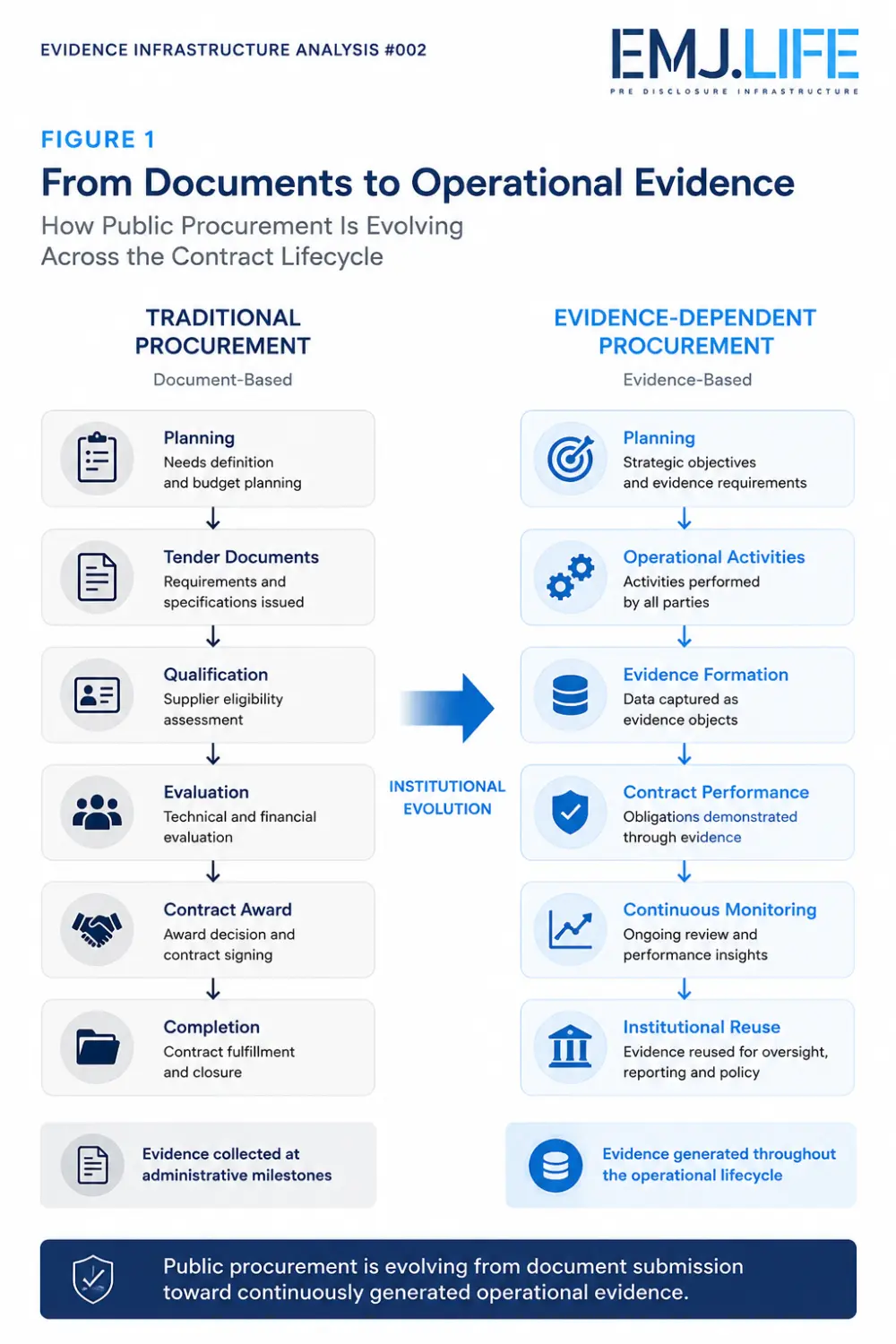
Figure 1
The Procurement Lifecycle And The Evidence Lifecycle
See content credentials
Public procurement is shifting from document-based to evidence-based execution.
4. Contract Performance Requires More Than Compliance
Compliance has traditionally focused on demonstrating whether contractual obligations have been satisfied.
Evidence Infrastructure examines a broader institutional question.
How can contractual performance remain continuously represented as structured evidence throughout execution?
A completed checklist confirms that a requirement has been fulfilled.
Structured operational evidence explains:
What occurred.
Who performed the activity.
When it occurred.
Under which contractual requirement.
Within which organisational context.
This distinction becomes increasingly important as procurement expands beyond legal compliance toward sustainability performance, resilience objectives, lifecycle monitoring and institutional accountability.
Institutional trust depends not only upon contractual commitments.
It also depends upon the quality and continuity of the evidence supporting those commitments.
5. Digital Credentials Need Operational Evidence
One of the most significant developments within the emerging procurement architecture is the introduction of digital business credentials and electronic eligibility services.
These initiatives strengthen institutional identity.
They improve interoperability.
They reduce administrative duplication.
They simplify supplier qualification.
Structural Change / Institutional Friction
Technical proposals.
Contract award records.
These documents remain essential.
However, they are increasingly supplemented by continuously generated operational information throughout the procurement lifecycle.
Planning.
Qualification.
Tender evaluation.
Contract execution.
Performance monitoring.
Completion.
This evolution fundamentally changes the role of evidence.
Evidence is no longer confined to administrative submissions.
It increasingly becomes a continuous institutional asset generated through operational activities themselves.
The procurement lifecycle therefore becomes evidence-dependent rather than document-dependent.
This distinction becomes particularly significant as sustainability, resilience, security and social objectives become integrated into procurement decisions.
3. Evidence Infrastructure Begins Before Qualification
Traditional procurement asks a familiar question.
Is this supplier eligible to participate?
Evidence Infrastructure asks a different question.
How do operational activities become trustworthy institutional evidence throughout the procurement lifecycle?
Eligibility determines who may participate.
Evidence demonstrates what has actually occurred.
This distinction extends procurement beyond administrative verification.
Every procurement requirement ultimately depends upon operational behaviour.
Materials are sourced.
Products are manufactured.
Services are delivered.
Environmental commitments are implemented.
Institutional Signal
Yet digital credentials answer only part of the institutional question.
They establish who participates.
They do not explain what actually happened throughout contract execution.
Operational evidence remains necessary to demonstrate activities, responsibilities, performance, continuity and accountability.
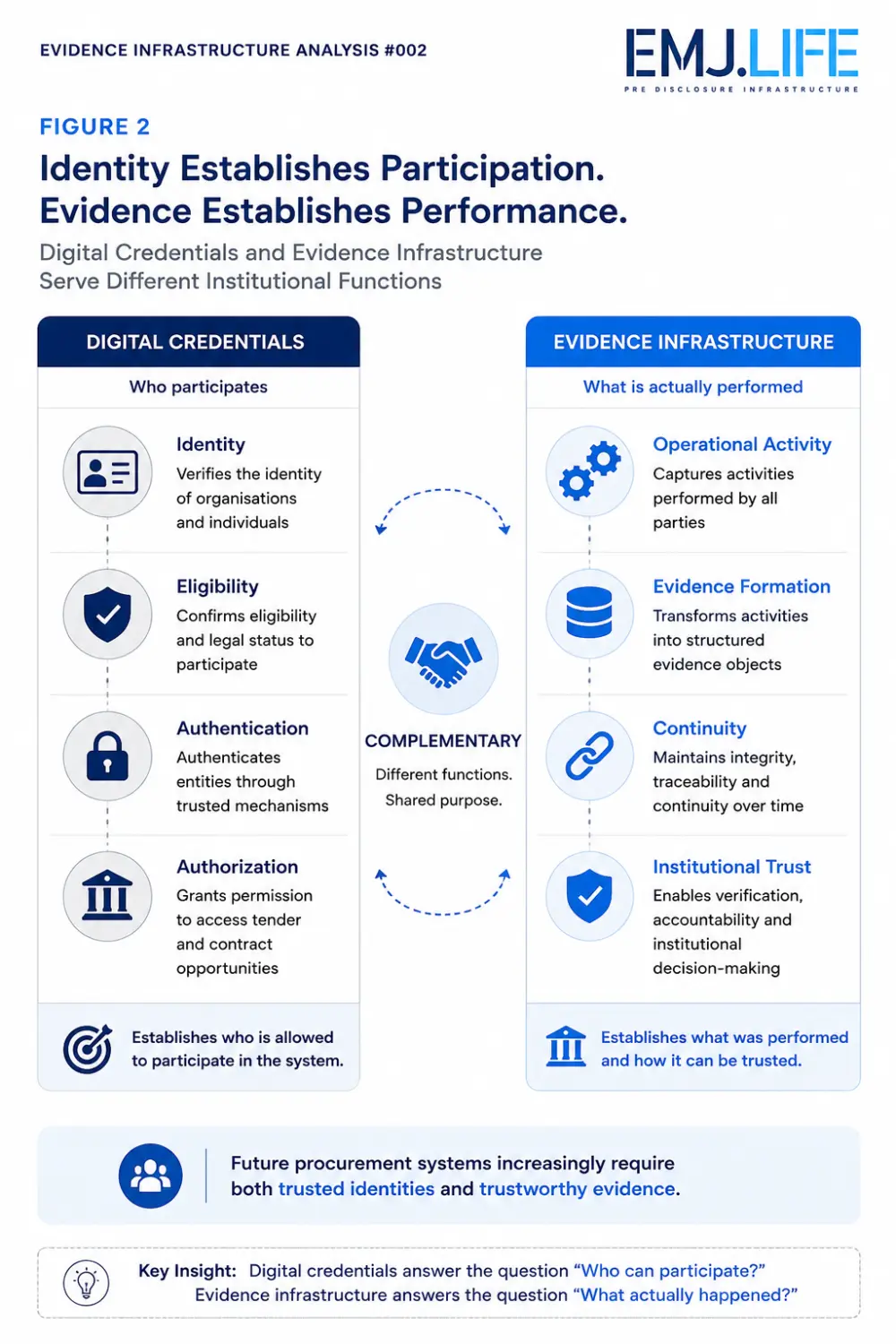
Identity establishes participation.
Evidence establishes performance.
Future procurement systems will increasingly require both.
Institutional confidence depends not only upon trusted identities but also upon trustworthy evidence associated with those identities.
Figure 2
Digital Credentials And Evidence Infrastructure
See content credentials
Digital credentials identify participants. Evidence demonstrates performance.
6. Procurement Data Spaces Depend On Upstream Evidence
The proposed procurement architecture also introduces Procurement Data Spaces intended to strengthen monitoring, interoperability and institutional decision-making.
These initiatives significantly improve downstream analytical capability.
Governments gain greater visibility into procurement markets.
Policy makers obtain better information for resilience planning.
Public institutions improve strategic decision-making through structured procurement data.
From an Evidence Infrastructure perspective, however, another dependency becomes apparent.
Data Spaces depend upon the quality of the information entering them.
Interoperability cannot compensate for fragmented operational evidence.
Data integration cannot reconstruct evidence that was never systematically formed.
Analytical capability ultimately depends upon trustworthy upstream evidence generation.
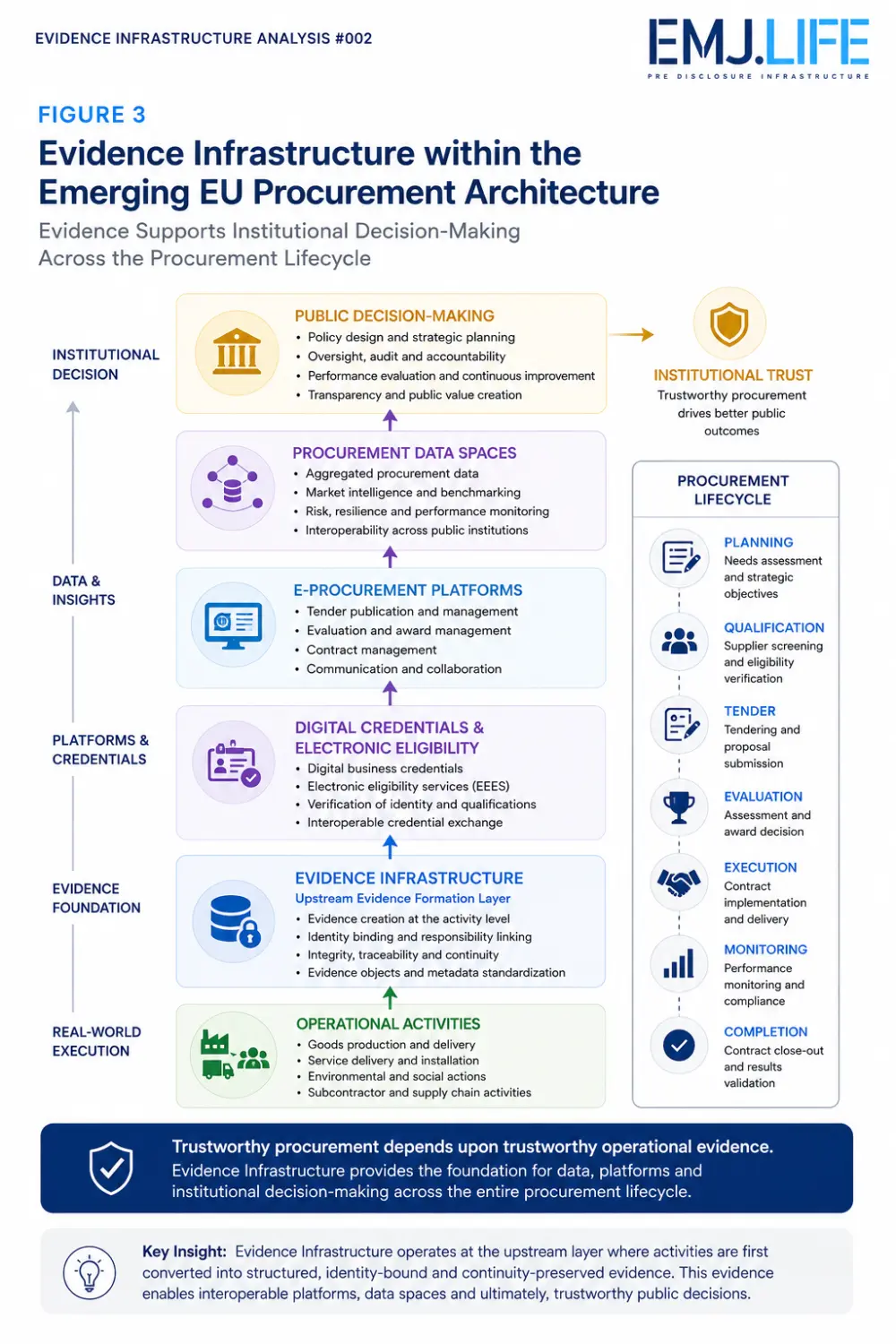
Evidence Infrastructure therefore complements Procurement Data Spaces by strengthening the conditions under which operational activities first become structured, identity-bound and continuity-preserved institutional evidence.
Figure 3
Evidence Infrastructure Within The Emerging Eu Procurement Architecture
See content credentials
Evidence Infrastructure complements the emerging EU procurement architecture.
Pre-Disclosure Evidence Infrastructure Perspective
Public procurement is evolving from document submission toward continuously generated operational evidence.
Digital credentials establish institutional identity but do not replace operational evidence.
Contract performance increasingly depends upon evidence continuity rather than isolated compliance records.
Procurement Data Spaces depend upon trustworthy upstream evidence formation.
Evidence Infrastructure complements procurement platforms, digital credentials and interoperable information systems.
Institutional participation is increasingly becoming evidence-dependent rather than document-dependent.
Closing Reflection
The European Union's emerging Public Procurement reform represents considerably more than administrative modernisation.
It reflects a broader institutional transition toward evidence-dependent public procurement.
Digital credentials, lifecycle monitoring, procurement data spaces and structured interoperability all suggest that future procurement systems will increasingly depend upon continuously generated operational evidence rather than isolated documentary submissions.
From an Evidence Infrastructure perspective, this transition extends beyond procurement itself.
It illustrates a wider institutional evolution in which participation alone is no longer sufficient.
Increasingly, participation must be accompanied by structured, trustworthy and continuously preserved evidence capable of supporting institutional decision-making.
Public procurement therefore represents another important institutional domain in which Evidence Infrastructure complements procurement platforms, digital credentials and interoperable information systems.
As governance systems continue to evolve, the question may no longer be whether institutions can collect more information.
The more fundamental question may become whether they can establish trustworthy evidence before institutional decisions begin.
Evidence Infrastructure Perspective
Public procurement is evolving from document submission toward continuously generated operational evidence.
Digital credentials establish institutional identity but do not replace operational evidence.
Contract performance increasingly depends upon evidence continuity rather than isolated compliance records.
Procurement Data Spaces depend upon trustworthy upstream evidence formation.
Evidence Infrastructure complements procurement platforms, digital credentials and interoperable information systems.
Institutional participation is increasingly becoming evidence-dependent rather than document-dependent.
Official Sources
Evidence Infrastructure Analysis · 002
July 14, 2026
Sources informing this publication
European Commission
Source classification: Official External Source · Primary analysis source · Official institutional publication · support scope: institutional source · source-link-only · AI training not-allowedOpen source record ↗Evidence Infrastructure terminology and conclusions are separately governed SNN editorial interpretations. They do not imply participation, endorsement, validation or adopted positions by the institutions cited above.
The European Union's emerging Public Procurement reform represents considerably more than administrative modernisation. It reflects a broader institutional transition toward evidence-dependent public procurement. Digital credentials, lifecycle monitoring, procurement data spaces and structured interoperability all suggest that future procurement systems will increasingly depend upon continuously generated operational evidence rather than isolated documentary submissions. From an Evidence Infrastructure perspective, this transition extends beyond procurement itself. It illustrates a wider institutional evolution in which participation alone is no longer sufficient. Increasingly, participation must be accompanied by structured, trustworthy and continuously preserved evidence capable of supporting institutional decision-making. Public procurement therefore represents another important