
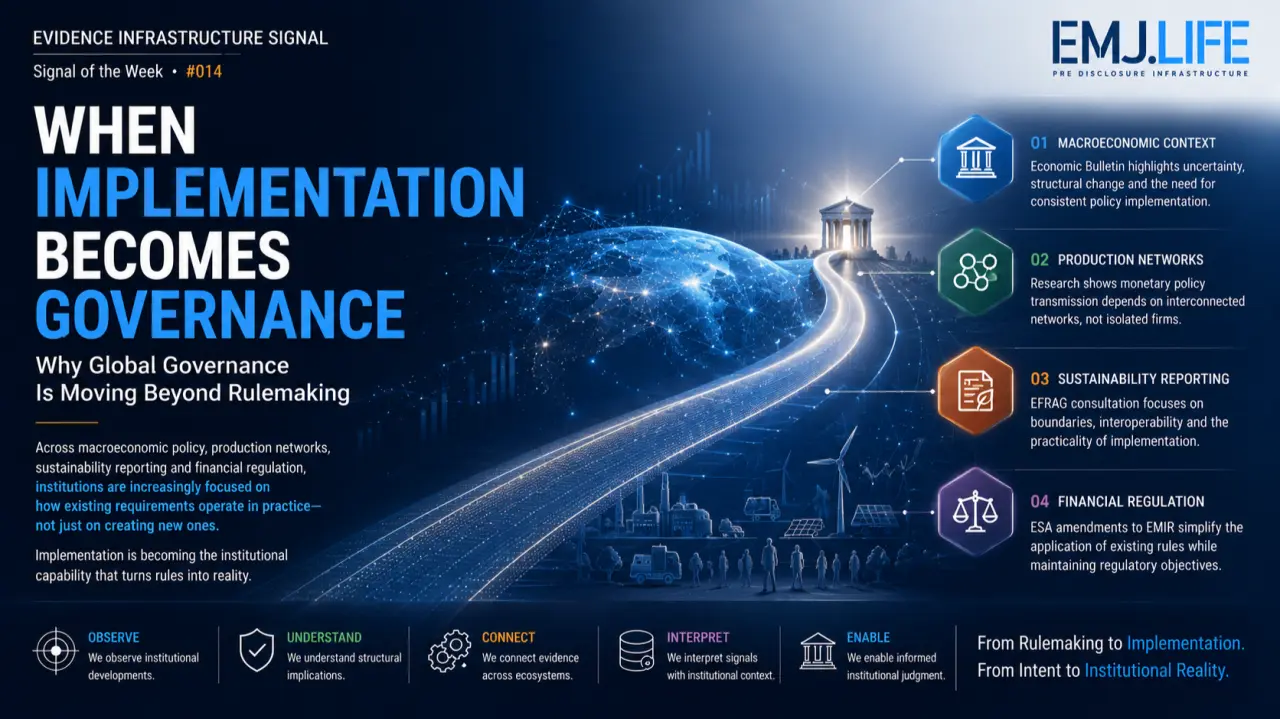
Why Global Governance Is Moving Beyond Rulemaking
Snn Owned
- AI TRAINING
- allowed
- RIGHTS BASIS
- Original SNN English editorial reporting, analysis, Signal, summary, metadata and structured publication content.
Series note
Evidence Infrastructure Signal · 014
Opening
For many years, institutional progress has often been associated with the publication of new policies, regulations and reporting standards.
New frameworks.
New requirements.
New obligations.
Governance was frequently understood through the creation of new rules.
Another pattern may now be beginning to emerge.
Across recent publications from the European Central Bank, EFRAG and the European Supervisory Authorities, attention appears to be shifting.
Not away from governance.
But towards implementation.
At first glance, these publications appear to represent very different institutional conversations.
Macroeconomic policy.
Financial stability.
Sustainability reporting.
Financial regulation.
Different institutions.
Different mandates.
Different policy objectives.
Recent Developments
Across these institutional developments, several recurring questions begin to emerge.
When governance frameworks mature, what determines whether they remain effective?
Is regulatory design alone sufficient?
Or does implementation increasingly become the defining institutional capability?
As organisations operate across multiple reporting frameworks, financial systems and production networks, implementation extends well beyond compliance.
It increasingly concerns consistency.
Operational governance.
Interoperability.
Evidence continuity.
Institutional coordination.
Different governance domains.
Yet increasingly similar governance questions.
How should implementation remain consistent across complex systems?
How should governance operate across organisational and jurisdictional boundaries?
How should institutions strengthen implementation capability without continually expanding regulatory complexity?
These are no longer implementation questions.
They are governance questions.
A Broader Institutional Signal
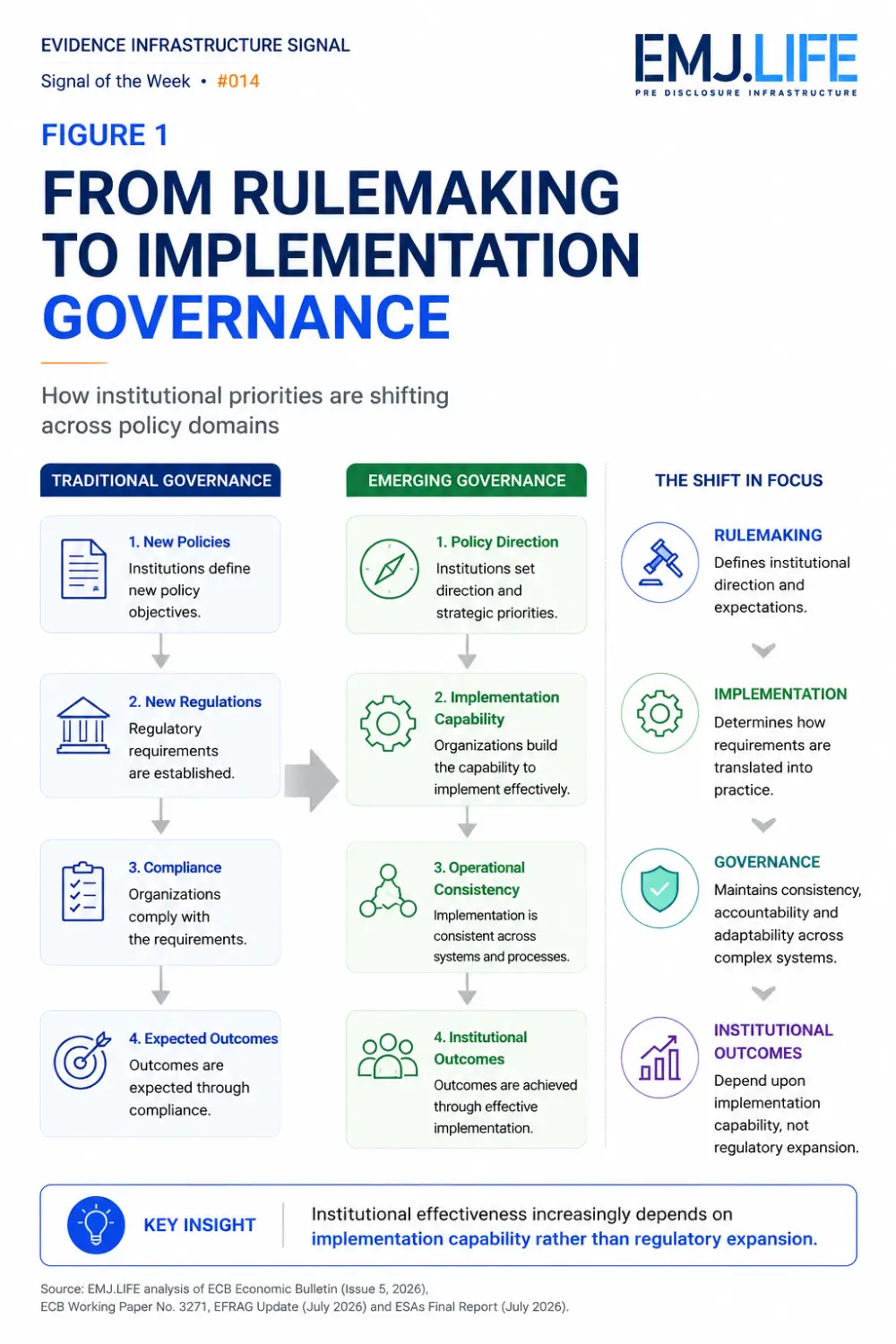
Historically, governance has often been associated with establishing institutional expectations.
Once regulations were published, implementation was frequently regarded as a downstream operational responsibility.
Another pattern may now be beginning to emerge.
Governance establishes direction.
Implementation determines institutional effectiveness.
Operational capability preserves consistency.
These functions do not compete with one another.
They reinforce one another.
Increasingly, governance appears to extend beyond defining institutional expectations.
It also encompasses the capability required to realise those expectations consistently across interconnected institutional ecosystems.
What appears to be changing is something earlier.
The institutional conditions required before governance objectives can consistently become operational reality.
Rulemaking is no longer the endpoint.
It is increasingly becoming the starting point for institutional capability.
See content credentials
Implementation capability enables governance to become operational reality.
A Shared Structural Direction
Yet one observation becomes increasingly difficult to ignore.
Increasingly, institutions are asking fewer questions about what should be required.
They are asking more questions about how those requirements operate in practice.
Implementation is no longer merely an operational consideration.
It is becoming an institutional capability.
Recent Institutional Signals
During the past two weeks, several European institutions published developments across different governance domains.
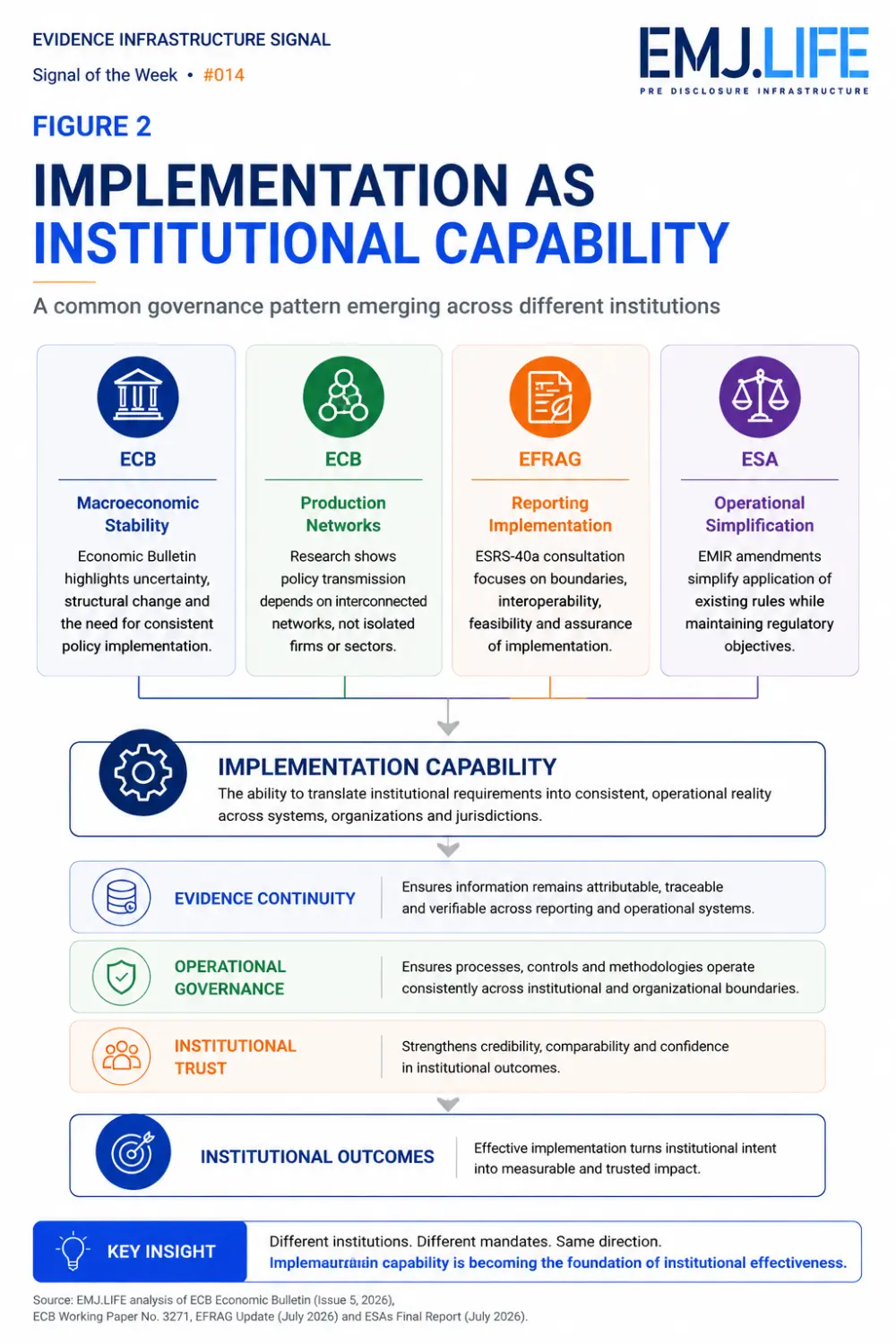
The European Central Bank's latest Economic Bulletin highlights an environment characterised by persistent uncertainty, structural adjustment and the need for policy frameworks to remain effective under changing economic conditions.
The European Central Bank also released new research demonstrating that monetary policy transmission increasingly depends upon production networks rather than individual firms alone.
EFRAG launched the ESRS-40a public consultation, placing significant attention on implementation feasibility, reporting boundaries, interoperability and assurance.
Meanwhile, the European Supervisory Authorities proposed targeted amendments to EMIR that simplify the operational application of existing regulatory requirements rather than introducing new regulatory objectives.
Viewed individually, these developments concern different policy domains.
Viewed collectively, however, they reveal a similar institutional direction.
Governance is becoming increasingly concerned with implementation.
See content credentials
Governance is shifting from rulemaking to implementation capability.
Emerging Questions
Pre-Disclosure Evidence Infrastructure Perspective
Viewed through an Evidence Infrastructure perspective, implementation capability represents more than operational execution.
It represents the institutional infrastructure through which governance becomes consistently reproducible across organisations, jurisdictions and governance ecosystems.
Evidence does not become institutionally useful simply because requirements exist.
It must remain attributable.
Traceable.
Interoperable.
Governable.
Implementation therefore increasingly depends upon institutional capabilities that operate before reporting, supervision or regulatory assessment begins.
Evidence Infrastructure extends beyond evidence itself.
It includes the governance mechanisms that enable institutional objectives to become operational reality while preserving consistency across increasingly interconnected systems.
Viewed from this perspective, implementation capability is not a downstream activity.
It is part of governance itself.
Closing Reflection
This week's institutional developments may ultimately represent more than separate publications from different organisations.
Together, they illustrate another stage in the evolution of governance.
For many years, governance has often been defined by the creation of new rules.
Increasingly, it may be defined by the capability to implement those rules consistently.
Rules establish institutional expectations.
Implementation transforms those expectations into institutional reality.
Perhaps the future of governance will not be determined solely by what institutions require.
It may increasingly be determined by how consistently those requirements can be implemented.
Source and Analytical Boundary
Evidence does not become institutionally useful simply because requirements exist.
Illustrative institutional observations only.
Publication record
Evidence Infrastructure Signal
Evidence Infrastructure Signal is an ongoing institutional publication series examining structural developments across global governance, sustainability, interoperability and institutional evidence ecosystems.
Rather than analysing individual developments in isolation, the series explores how changes across standards, regulation, finance, governance and implementation collectively reveal broader institutional patterns.
The objective is not to predict institutional outcomes, but to observe emerging signals that may influence the future evolution of global governance and evidence ecosystems.
Sources informing this publication
EFRAG
Source classification: Official External Source · Primary analysis source · Official institutional publication · support scope: institutional source · source-link-only · AI training not-allowedOpen source record ↗Evidence Infrastructure terminology and conclusions are separately governed SNN editorial interpretations. They do not imply participation, endorsement, validation or adopted positions by the institutions cited above.
Evidence does not become institutionally useful simply because requirements exist. *Illustrative institutional observations only.*