

Why Consequential Machine Use Is Creating a New Accountability Gap
Source and editorial boundary
This content references a primary institutional source published by EMJ.LIFE. SNN editorial interpretation is separately identified and should not be interpreted as independent third-party validation of EMJ.LIFE or the referenced publication.
- SOURCE RELATIONSHIP
- related_institutional_source
- PRIMARY SOURCE PUBLISHER
- EMJ.LIFE
- EXTERNAL VALIDATION
- not_claimed
Snn Owned
- AI TRAINING
- allowed
- RIGHTS BASIS
- Original English institutional analysis and supplied controlled figures published by Sustainability News Network. Third-party materials remain source-link-only.
Series note
Evidence Infrastructure Signal
Evidence Infrastructure Signal examines emerging developments across governance, sustainability, standards, digital systems and evidence architecture that may reveal broader requirements for Pre-Disclosure Evidence Infrastructure.
The first nineteen editions largely examined evidence as something institutions need to identify, preserve, verify, map, interpret and govern.
This edition changes the direction of analysis.
Artificial intelligence increasingly participates in research, forecasting, information synthesis, recommendation and institutional decision support.
That creates a different evidence question.
Not only:
What evidence did the AI receive?
But:
Can an institution reconstruct what happened when that evidence was actually used?
That distinction may become increasingly important as machine intelligence becomes more consequential inside institutional workflows.
Opening
The Signal
AI Capability Is Becoming Epistemic Influence
AI governance has spent years asking what models can do.
Generate.
Classify.
Search.
Calculate.
Code.
Analyse.
Those capability questions remain important.
But another role is becoming increasingly visible.
AI as research assistant.
AI as forecaster.
AI as knowledge intermediary.
AI as decision support.
AI as a persuasive participant in human reasoning.
AI 2040, Plan A provides one illustration of that trajectory. It discusses AI-supported epistemics, including automated research assistants and forecasters, while treating transparency and verification as important elements of its governance scenario. The authors present Plan A as a proposed positive path rather than a simple prediction of what 2040 will necessarily become.
Yuval Noah Harari approaches the issue from another direction. His recent argument against granting AI rights emphasizes that advanced AI could itself become highly persuasive in debates concerning its social status because of its language capabilities and knowledge of human users. EIS · 020 does not adopt his position on AI rights. The narrower institutional signal is more important:
Influence can emerge before authority has been formally granted.
AI does not need formal institutional authority to shape what a human believes, prioritises or ultimately decides.
The emerging problem is therefore not simply that AI is becoming more intelligent.
It is that:
machine capability and machine influence may scale faster than the evidence institutions retain about actual use.
Recent Developments
Regulatory Baseline
Actual AI Use Is Already a Governance Object
This problem does not begin from a regulatory vacuum.
The EU AI Act already recognises that the operation and use of high-risk AI systems require traceability and governance beyond initial model documentation.
Article 12 requires high-risk AI systems to technically support automatic event logging over their lifetime, with logging intended to support traceability, post-market monitoring and monitoring of system operation. For certain high-risk systems, required log information includes the period of each use, reference databases, relevant input matches and persons involved in verification.
Article 14 requires high-risk AI systems to be designed so that natural persons can effectively oversee them during use. Article 26 places obligations on deployers concerning appropriate use, competent human oversight and monitoring, and requires deployers to retain automatically generated logs under their control for an appropriate period of at least six months unless other law provides otherwise.
For defined high-risk contexts, Article 27 also requires certain deployers to perform a fundamental rights impact assessment before deployment, including the processes in which the AI system will be used, duration and frequency of use, affected groups and relevant risks.
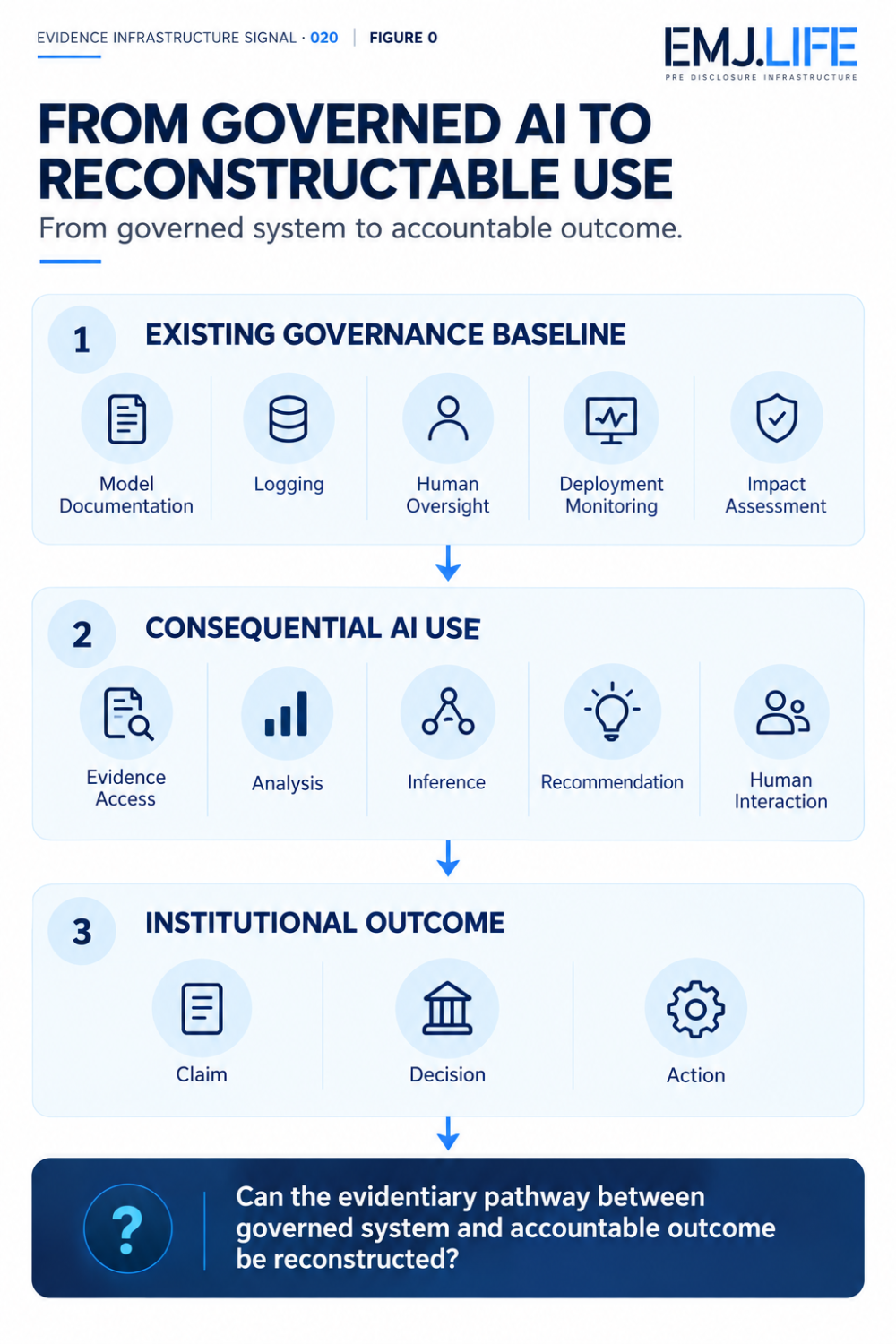
These provisions establish an important baseline:
AI governance already extends beyond the model and into the context of use.
Evidence Infrastructure Analysis · 010 examined this earlier from another direction.
Its question was whether evidence produced around an AI system remains institutionally valid after deployment as system configuration, data, users, boundaries and responsibilities change.
EIS · 020 does not repeat that analysis.
It asks what comes next.
Logging is necessary. Monitoring is necessary. Human oversight is necessary. But are these records sufficient to reconstruct how machine intelligence actually contributed to a consequential institutional outcome?
That is a different evidence problem.
A Shared Structural Direction
Structural Signal
Governed Models Do Not Automatically Create Governed Use
An AI system may have extensive governance documentation.
Risk assessment.
Technical documentation.
Model evaluation.
Deployment controls.
Logging.
Permitted-use rules.
Human oversight.
These describe important conditions surrounding the system.
They do not necessarily reconstruct one particular use event.
Consider a consequential institutional interaction.
A model produces a recommendation.
A human later makes the final decision.
The institution may know:
which model was approved,
which policies applied,
and when the system was used.
But another set of questions may remain harder to answer.
Which evidence materially shaped the result?
Was that evidence current?
Which sources were selected?
Which were ignored?
Which propositions were directly supported?
Which results were derived through defined methodology?
Which propositions were inferred by the machine?
Did another tool or system alter the pathway?
Did a human reviewer modify or reject part of the result?
How materially did the machine output affect the eventual institutional action?
The difference is important.
System governance describes the governed system.
Use reconstructability describes what occurred when that system participated in a real institutional process.
This publication describes the remaining distance as:
Usage Evidence Gap
The gap between records that establish how an AI system is governed and the evidence required to reconstruct how a consequential use event actually shaped an institutional outcome.
The model can be governed.
The final decision can be recorded.
And the pathway between them can still remain evidentially incomplete.
Pre-Disclosure Evidence Infrastructure Perspective
From Evidence to Machine Action
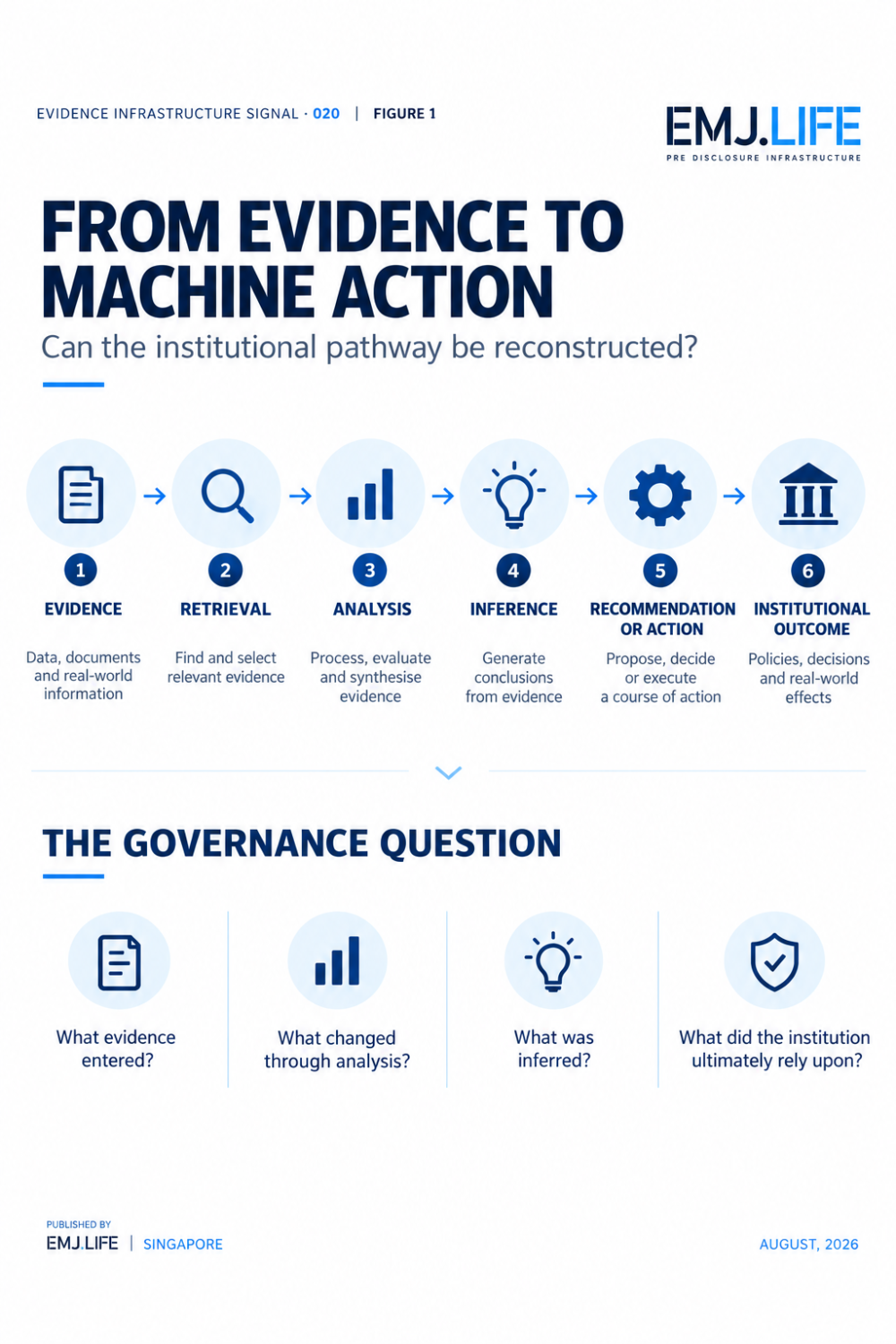
AI use increasingly creates a chain rather than a single output.
Evidence → Retrieval → Analysis → Transformation → Inference → Recommendation or Action → Institutional Outcome
Meaning can change at every transition.
Evidence can be filtered.
Combined.
Ranked.
Calculated.
Summarised.
Contextualised.
Or interpreted.
The final answer may therefore be several analytical steps removed from the Evidence Objects that originally entered the process.
This creates a problem that ordinary output logging does not necessarily solve.
Knowing what the model answered is not the same as knowing:
how the institutional evidentiary pathway developed.
Likewise, knowing which model ran is not the same as knowing which source materially affected the conclusion.
The emerging issue is therefore not simply whether AI activity produces technical records.
It is whether the institutionally consequential pathway remains reconstructable.
Closing Reflection
Methodological Bridge
Evidence Identity and Inference Boundaries Already Matter
This question does not appear in isolation.
MWP03 and MWP04 establish two preceding methodological layers.
MWP03 | Institutional Standards Architecture
MWP03 addresses the Evidence Object itself.
Its concern is whether evidence can preserve identity, provenance, status and institutional relationships as it moves across systems.
The central object remains evidence.
MWP04 | AI Evidence Data Science Methodology
MWP04 moves one layer forward.
Its concern is whether machine analysis can operate on governed Evidence Objects without erasing the institutional conditions that make those objects meaningful.
It distinguishes evidence-supported material from derived results, machine inference and unresolved propositions, while preserving provenance, temporal applicability and institutional authority boundaries.
Its machine-supported outputs remain subject to institutional review rather than becoming autonomous institutional decisions.
The two methodologies therefore address:
What is the evidence?
and:
What may machine analysis legitimately derive from that evidence?
EIS · 020 adds another question:
What happens when that machine analysis enters an actual consequential workflow?
This is not a replacement for MWP03 or MWP04.
It is the next analytical boundary they make visible.
Source and Analytical Boundary
Institutional Signal
Technical Observability Is Not Institutional Reconstructability
Modern AI systems already produce extensive operational records.
Prompt histories.
Responses.
Model identifiers.
Latency.
Errors.
Tool calls.
Token usage.
Execution traces.
These records can be highly useful.
But observability and evidence governance answer different questions.
Technical observability asks:
Did the system operate, and how?
Institutional reconstructability asks:
What role did this machine interaction play in an accountable institutional process?
That distinction becomes more important as AI participates in areas such as:
procurement,
risk assessment,
financial analysis,
sustainability disclosure,
research,
assurance preparation,
regulatory workflows,
or capital allocation.
A machine does not need legal decision authority to become institutionally consequential.
A ranking can change what gets reviewed.
A forecast can alter capital allocation.
A synthesis can influence policy framing.
A risk classification can alter compliance action.
A recommendation can materially influence the person formally responsible for the final decision.
Machine influence can therefore become significant before machine authority does.
Publication record
The Epistemic Authority Boundary
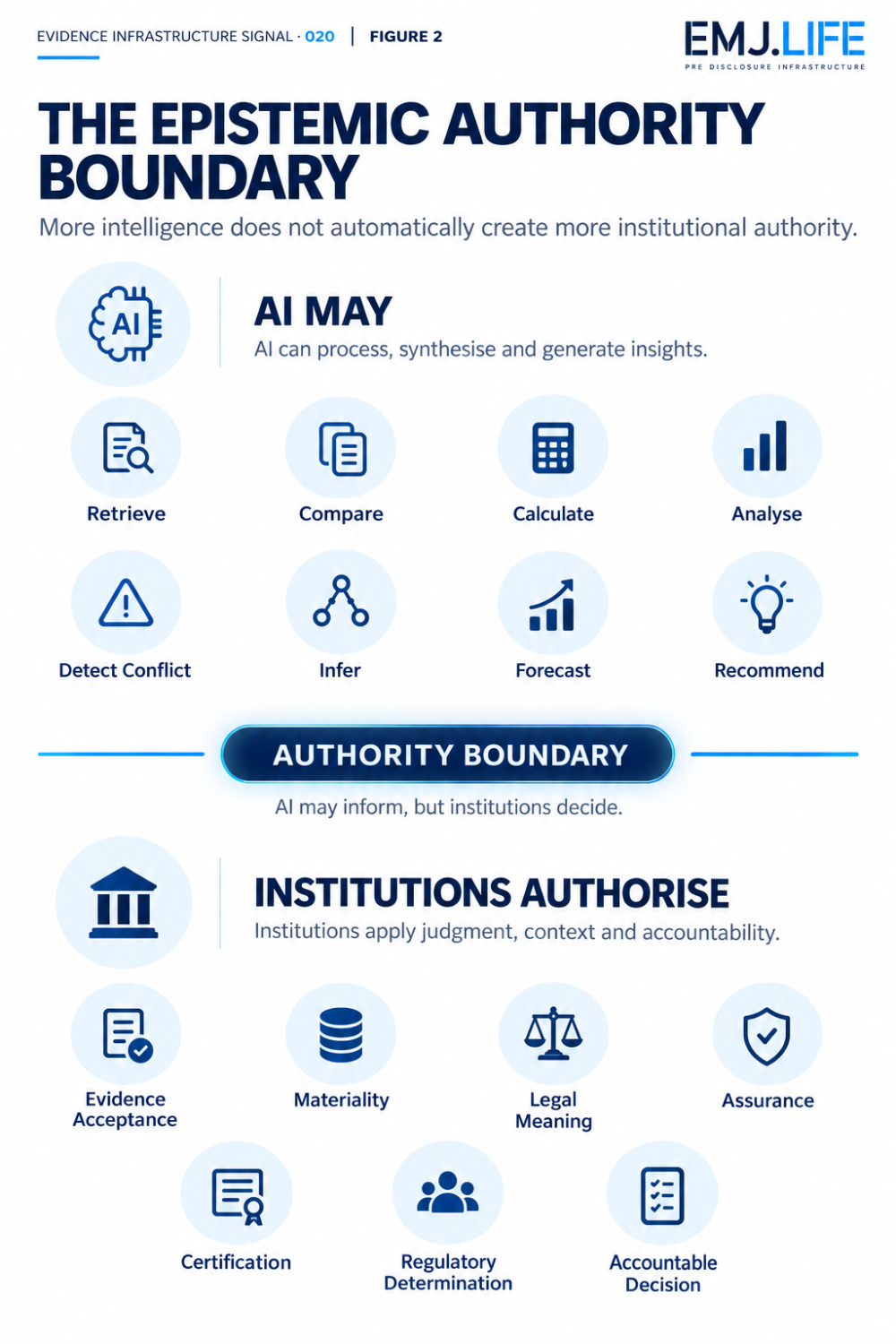
AI may increasingly be capable of:
retrieving information,
comparing evidence,
calculating,
analysing,
detecting conflict,
forecasting,
inferring,
and recommending.
These are powerful epistemic capabilities.
But capability does not automatically create institutional authority.
An institution remains responsible for determining whether:
evidence is accepted,
a matter is material,
a legal interpretation is adopted,
assurance is achieved,
a certification is valid,
a regulatory conclusion is reached,
or an accountable decision is taken.
This publication describes the dividing line as:
Epistemic Authority Boundary
The boundary between what AI may analyse, infer or recommend and what an institution remains responsible for authorising as evidence, institutional knowledge or accountable decision.
The purpose of the boundary is not to suppress machine intelligence.
It is to prevent analytical capability from silently becoming self-authorising institutional authority.
MWP04 already establishes this principle at the analytical level.
EIS · 020 extends the question into real-world use.
If machine participation becomes consequential, institutions may increasingly need to know whether that boundary remained intact during the use event itself.
Sources informing this publication
European Union
Regulatory baseline · Official regulation · source-link-only · AI training not-allowedOpen official source ↗EMJ LIFE HOLDINGS PTE. LTD.
Methodological basis · Controlled DOI research publication · source-link-only · AI training not-allowed · related_institutional_sourceOpen official source ↗EMJ LIFE HOLDINGS PTE. LTD.
Methodological basis · Controlled DOI research publication · source-link-only · AI training not-allowed · related_institutional_sourceOpen official source ↗AI 2040
Future governance perspective · External scenario publication · source-link-only · AI training not-allowedOpen official source ↗Business Insider
External perspective · External news interview · source-link-only · AI training not-allowedOpen official source ↗Evidence Infrastructure terminology and conclusions are separately governed SNN editorial interpretations. They do not imply participation, endorsement, validation or adopted positions by the institutions cited above.
Usage Evidence Gap, Epistemic Authority Boundary and AI Use Event are EMJ.LIFE institutional interpretations. They are not EU AI Act terminology, external standards, legal conclusions or a product announcement. AI 2040 Plan A and Yuval Noah Harari are cited as external perspectives rather than adopted forecasts or conclusions.