
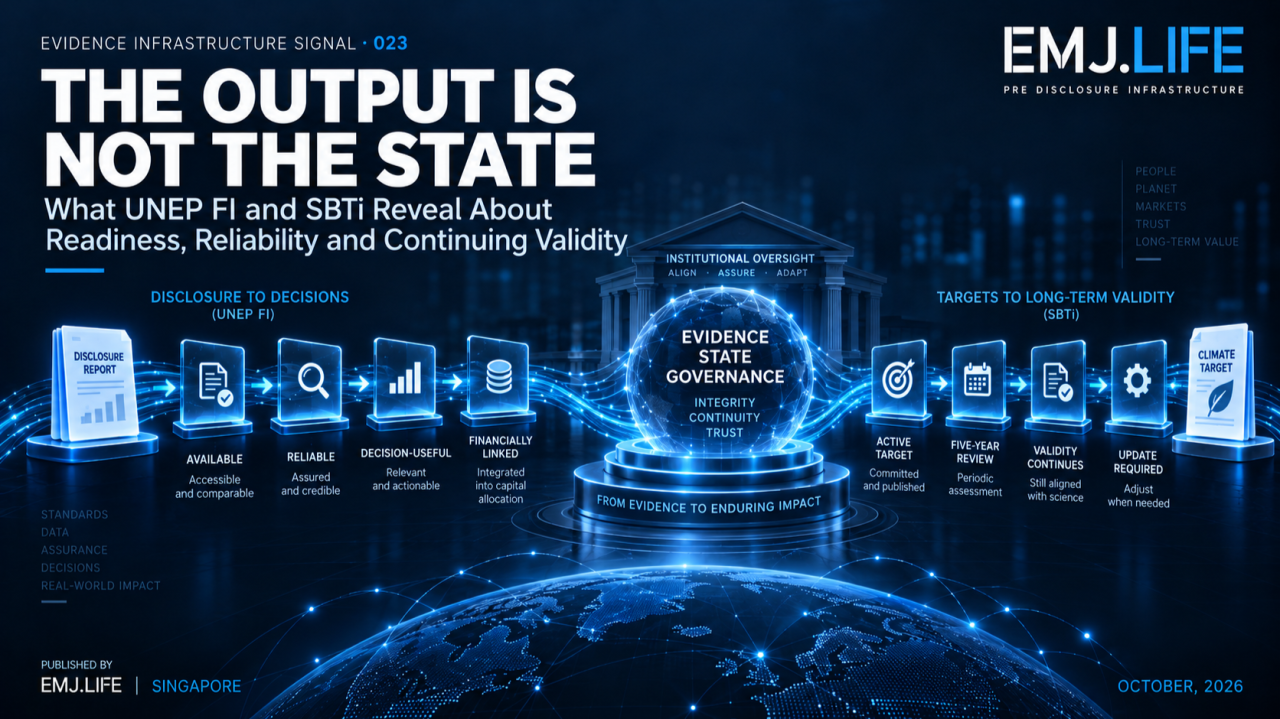
What UNEP FI and SBTi Reveal About Readiness, Reliability and Continuing Validity
Licensed
- AI TRAINING
- not-allowed
- RIGHTS BASIS
- EMJ.LIFE-controlled original manuscript and artwork supplied for an authorized Sustainability News Network onsite edition. SNN is publisher of this web edition, while EMJ.LIFE remains publisher of the original work. Third-party source rights remain separate and are not transferred.
- LICENSE
- EMJ.LIFE publication authorization for Sustainability News Network
Series note
Evidence Infrastructure Signal identifies emerging structural shifts across sustainability governance, institutional decision-making and evidence systems.
EIS-023 examines the continuing state of institutional outputs through UNEP FI disclosure-readiness resources and SBTi target-review clarification. The analytical constructs in this Signal are EMJ.LIFE interpretations.
Opening
Two sustainability institutions published very different signals this week.
UNEP FI's Risk Centre released a new sustainability-disclosure package focused on how financial institutions can understand and use sustainability-related information within prudential risk management.
SBTi, meanwhile, confirmed that its Financial Institutions Near-Term Criteria and Financial Institutions Net-Zero Standard will remain available without a specific end date, while also clarifying how mandatory five-year reviews should operate for financial institutions.
One development concerns disclosure.
The other concerns climate targets.
They appear unrelated.
Viewed through a Pre-Disclosure Evidence Infrastructure lens, however, they reveal the same structural shift:
The existence of an institutional output no longer tells us enough about what that output can currently support.
A disclosure can exist without yet being sufficiently reliable for a particular risk decision.
A target can remain unchanged while still requiring periodic review of whether it continues to meet applicable requirements.
A previous validation does not eliminate future state governance.
And a review event does not automatically require revision.
The emerging question is therefore no longer simply:
Does the output exist?
It is:
What state is the output currently in?
From Outputs to Disclosure States
01 | From Outputs to States
Sustainability systems have traditionally organised themselves around visible outputs.
A sustainability report.
A disclosure.
A validated target.
A taxonomy assessment.
A materiality determination.
An assurance conclusion.
The existence of these objects matters.
But existence is a relatively weak governance state.
The harder question comes afterwards.
Can the object still be relied upon?
Is it current?
Is it applicable to this decision?
Has it been reviewed?
Has its evidentiary basis changed?
Does the institution have authority to use it for the next decision?
These are not questions about whether the object exists.
They are questions about its state.
This distinction becomes increasingly important as sustainability information remains in systems for longer periods and is reused across reporting, risk management, capital allocation, assurance and automated decision support.
The file may remain unchanged.
The institutional meaning of the file may not.
02 | UNEP FI: Disclosure Exists, But Is It Ready?
UNEP FI's new disclosure work makes this distinction unusually visible.
Its Risk Centre describes three fundamental questions for risk professionals:
What sustainability-related information is available?
How reliable and decision-useful is that information?
How can sustainability-related risks be linked to financial effects?
The package includes the Sustainability Disclosure Readiness Indicators Toolkit, together with topic-specific work on standards, assurance and the connection between sustainability information and financial risk.
This creates a progression.
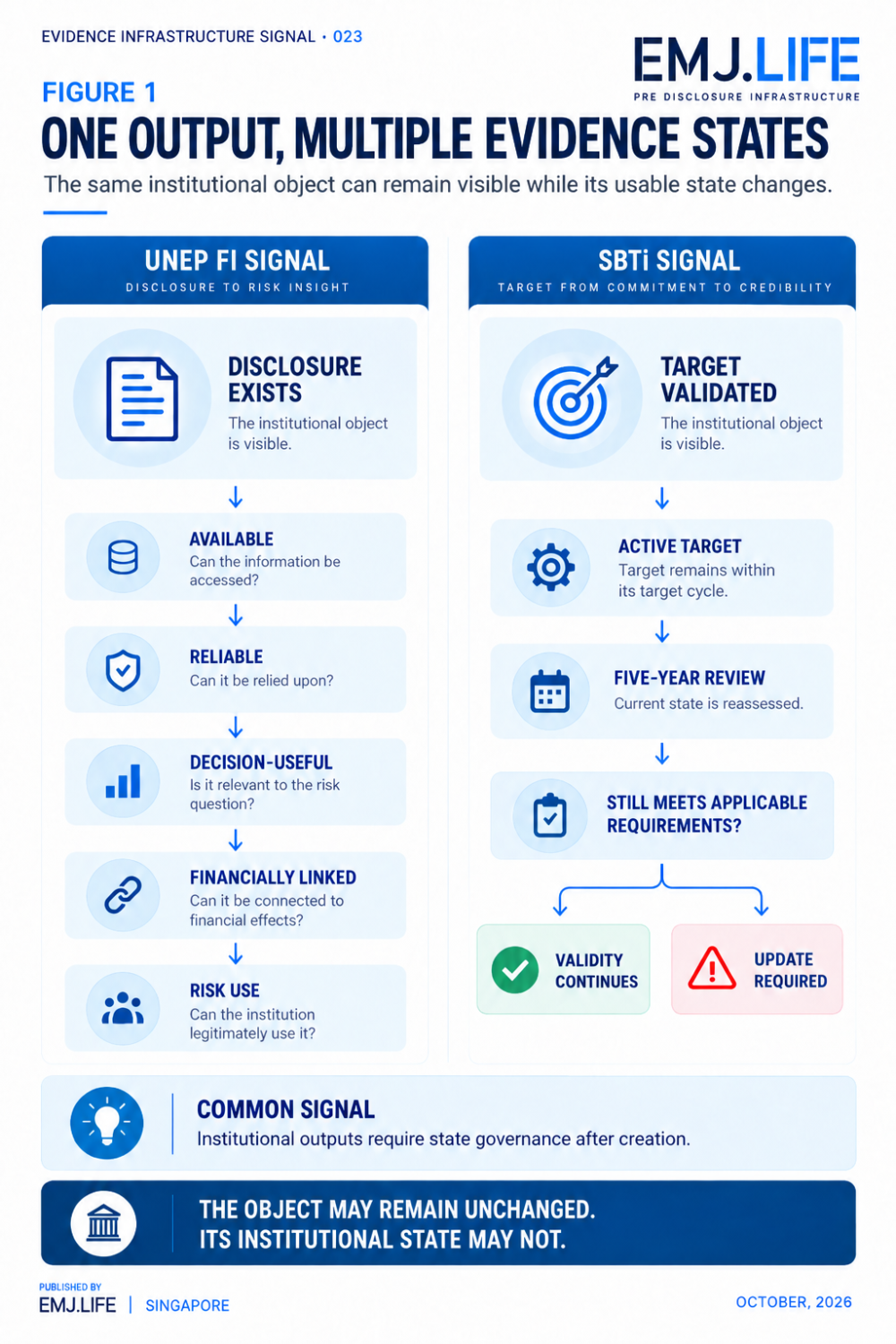
Availability
is not the same as:
Reliability
which is not the same as:
Decision Usefulness
which is not the same as:
Financial Risk Linkage
which is still not identical to:
Institutional Risk Action
That distinction matters.
A metric can be published and still be inconsistently produced.
Information can be consistently produced but remain weakly connected to financial exposures.
A sustainability risk driver can be financially relevant while still requiring counterparty, sector or portfolio-level translation before it informs a prudential decision.
UNEP FI specifically discusses financial effects through company financial statements, counterparty and sector exposures, portfolio aggregation and ultimately financial-stability questions.
So a disclosure is not simply:
available / unavailable.
It has an institutional state.
03 | The Disclosure State
Through an Evidence Infrastructure lens, a sustainability disclosure may move through several states:
Available ↓ Reliable ↓ Decision-Useful ↓ Financially Linked ↓ Institutionally Usable
The transitions matter as much as the states.
Availability may require publication.
Reliability may depend on consistency, evidence quality or assurance.
Decision usefulness depends on relevance to the institutional question.
Financial linkage requires a credible transmission pathway.
Institutional use requires governance and decision authority.
None of these transitions should be inferred simply because the previous state exists.
This leads to the first broader signal:
An output can exist before it becomes usable.
Continuing Validity and Evidence State
04 | SBTi: Validity Is Not a One-Time Event
SBTi's October 8 announcement exposes the same architecture from a temporal perspective.
Financial institutions can continue using the Financial Institutions Near-Term Criteria without a specific end date, and SBTi states that this gives institutions certainty that their targets can remain valid for the entirety of their target cycle.
At the same time, SBTi has clarified mandatory five-year reviews.
The important part is what the review does not mean.
A five-year review does not automatically require a target update.
The review provides a structured opportunity to assess the target against applicable SBTi requirements.
If the target continues to meet the applicable criteria, it does not need to be updated simply because the review occurred.
This creates a very important distinction:
Review Event ≠ Revision Event
It also creates another:
Historical Validation ≠ Permanent Immunity from Review
Both can be true at once.
That is evidence-state governance.
05 | Object Continuity Is Not State Continuity
Imagine a target document that remains exactly the same for five years.
Same wording.
Same target year.
Same base year.
Same institution.
Same validation record.
Technically, the object has continuity.
But during those five years:
criteria may change,
methodologies may change,
portfolio composition may change,
sector pathways may change,
underlying evidence may change,
or institutional circumstances may change.
The object may therefore remain identical while the environment used to interpret its validity changes.
This distinction can be expressed simply:
Object continuity is not state continuity.
The same logic applies to disclosure.
A disclosed metric may remain on a website unchanged.
But new assurance evidence, methodological corrections, revised entity boundaries or financial-risk analysis may change what the metric can legitimately support.
The file did not change.
Its institutional state did.
06 | Institutional Evidence State
This Signal therefore proposes the concept of:
Institutional Evidence State
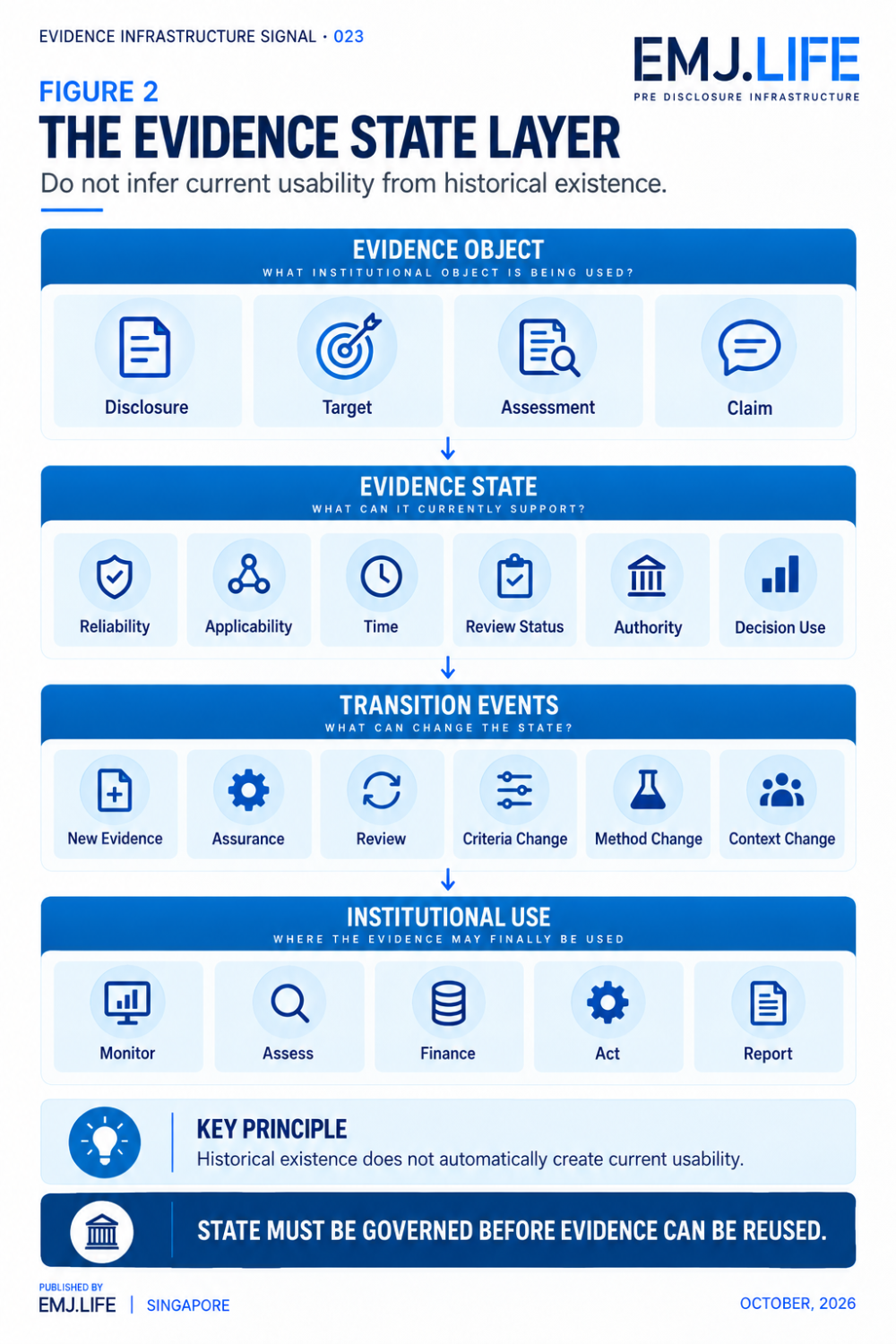
The governed condition that determines what an institutional evidence object can currently support, given its reliability, applicability, temporal status, review state and decision context.
The object could be:
a disclosure,
a target,
an assessment,
an assurance conclusion,
a classification,
a claim,
a scenario,
or another institutional record.
The important question is not only what the object contains.
It is also:
What is the object currently authorised and sufficiently evidenced to support?
A disclosure might support public transparency.
That does not automatically mean it supports credit-risk calibration.
A validated target may remain active.
That does not mean its validity should never be reviewed.
An assurance conclusion may apply to a specific period.
That does not automatically make it current evidence for another period.
State determines usable meaning.
State Transition Governance and Decision Authority
07 | State Transition Governance
Once institutional evidence has states, another question follows:
What causes the state to change?
This Signal calls that:
State Transition Governance
A state transition should not occur simply because an analyst, system or AI agent wants to use the evidence differently.
It needs a trigger.
Examples include:
new evidence,
assurance,
review,
criteria changes,
methodology changes,
entity-boundary changes,
new financial linkage,
new institutional authority,
or expiry of a time-bound condition.
The logic is:
Evidence Object ↓ Current State ↓ Transition Trigger ↓ Governance Test ↓ New State
That state may become stronger.
It may remain unchanged.
It may become conditional.
It may require remediation.
Or it may no longer support the previous institutional use.
08 | Review Should Not Be Confused With Failure
This is where the SBTi signal is particularly useful.
Institutional systems often treat review as if something must have gone wrong.
But review and failure are different concepts.
A review can confirm continuity.
A review can identify the need for revision.
A review can narrow applicability.
A review can document that nothing material has changed.
The purpose of review is therefore not necessarily to change the evidence object.
Its purpose is to test whether the state remains justified.
That distinction matters far beyond climate targets.
It applies to:
risk models,
supplier evidence,
materiality assessments,
assurance records,
control evaluations,
taxonomy assessments,
and other persistent sustainability evidence.
The principle becomes:
Review is a state test, not automatically a state change.
09 | Reliability Does Not Automatically Create Decision Authority
The UNEP FI signal adds another dimension.
Suppose sustainability information becomes reliable.
That is valuable.
But reliability alone still does not determine what institutional action follows.
A reliable disclosure may support:
risk identification,
monitoring,
counterparty assessment,
scenario analysis,
or portfolio aggregation.
But the final decision still requires an authorised institutional process.
So even after state progression:
Available → Reliable → Decision-Useful → Financially Linked
another boundary remains:
Evidence Use ≠ Decision Authority
This is why Evidence Infrastructure cannot stop at data quality.
It has to preserve:
state,
method,
context,
authority,
and permitted use.
Machine-Readable Evidence and Closing Signal
10 | Why This Matters for Machine-Readable Evidence
This becomes even more important when institutional information is machine-readable.
Machines usually retrieve objects.
A database finds the disclosure.
An agent finds the validation record.
A knowledge graph finds the target.
An API retrieves the assessment.
But finding the object does not necessarily reveal its current state.
An AI system may see:
Target validated.
without knowing:
whether the current review has occurred,
which criteria apply,
whether the target remains current,
or whether a later governance event changed its permissible use.
Likewise, a machine may retrieve a disclosed sustainability metric without knowing whether:
it has been assured,
its methodology changed,
its reporting boundary changed,
or its link to financial risk has been established.
The future challenge is therefore not simply machine-readable evidence.
It is:
machine-readable evidence state.
Without that layer, automated systems may correctly retrieve historical objects while making incorrect assumptions about their present institutional meaning.
11 | Pre-Disclosure Evidence Infrastructure
Viewed upstream, both institutional signals point to the same conclusion.
The state of an output is often determined by evidence that exists before the output is reused.
Reliability depends on source evidence.
Applicability depends on entity and methodological context.
Validity depends on current criteria.
Review depends on retained historical evidence.
Financial linkage depends on risk transmission evidence.
Decision use depends on institutional authority.
This means state governance cannot be added only at publication.
It has to exist upstream.
A Pre-Disclosure Evidence Infrastructure therefore needs to preserve not only:
what the evidence is
but also:
what state it is in
and:
what event would permit that state to change.
Closing Signal
UNEP FI and SBTi are not addressing the same institutional problem.
One is focused on sustainability disclosures and prudential risk use.
The other is clarifying the continuing validity and review of science-based targets for financial institutions.
But together they reveal a broader shift.
Sustainability governance is moving beyond the existence of outputs.
It is increasingly concerned with their continuing state.
A disclosure may exist without being decision-ready.
A target may remain unchanged while its validity is periodically tested.
A review may confirm continuity rather than force revision.
And a historically valid object may not automatically support every future institutional use.
The emerging infrastructure problem is therefore:
not only how evidence is created, but how its state is governed over time.
Because:
An institutional output can remain unchanged while what it can legitimately support changes.
And:
Object continuity is not state continuity.
That is the signal.
THE OUTPUT IS NOT THE STATE
Source and Analytical Boundary
Methodological Boundary
This Signal draws on two independent institutional developments published in October 2026.
UNEP FI's Risk Centre published Enhancing Sustainability-related Disclosures and the Sustainability Disclosure Readiness Indicators Toolkit, examining availability, reliability, decision usefulness and connections between sustainability-related information and financial risk.
SBTi announced on 8 October that its Financial Institutions Near-Term Criteria and Financial Institutions Net-Zero Standard would remain available without a specific end date, while clarifying that mandatory five-year review does not itself require target revision where the applicable criteria continue to be met. Science Based Targets Initiative
The terms Institutional Evidence State, State Transition Governance, Object Continuity Is Not State Continuity, and the analytical relationships developed in this Signal are EMJ.LIFE analytical constructs.
They are not presented as UNEP FI or SBTi terminology.
No endorsement, validation, partnership or co-publication by either institution is implied.
Publication record
EIS-023 is maintained as a distinct Sustainability News Network onsite edition of the EMJ.LIFE-controlled manuscript and artwork supplied by the publisher. The complete English text, original cover and two figures are retained; the web images are lossless WebP conversions.
Sustainability News Network is the publisher of this web edition. EMJ.LIFE remains the publisher of the original work. The publisher confirmed that EIS-023 had been released on 9 October 2026; the exact original publication URL and first-publication date are not independently established by the supplied manuscript. No DOI is assigned or claimed for EIS-023.
The manuscript is available from the controlled manuscript download above. Official sources are retained as external links; citation does not imply endorsement, validation, partnership, co-publication or authority transfer.
Sources informing this publication
UNEP Finance Initiative
Source classification: Official External Source · Supporting official source · Official institutional publication · support scope: official guidance · source-link-only · AI training not-allowedOpen source record ↗UNEP Finance Initiative
Source classification: Official External Source · Primary analysis source · Official institutional publication · support scope: official guidance · source-link-only · AI training not-allowedOpen source record ↗Science Based Targets initiative
Source classification: Official External Source · Primary analysis source · Official institutional publication · support scope: official guidance · source-link-only · AI training not-allowedOpen source record ↗Evidence Infrastructure terminology and conclusions are separately governed SNN editorial interpretations. They do not imply participation, endorsement, validation or adopted positions by the institutions cited above.
Institutional Evidence State, State Transition Governance, Object Continuity Is Not State Continuity, and the analytical relationships in this Signal are EMJ.LIFE analytical constructs, not UNEP FI or SBTi terminology. Official sources provide institutional context, not endorsement, validation, partnership or co-publication. Sustainability News Network publishes this authorized onsite edition; EMJ.LIFE remains publisher of the original work. No DOI is assigned or claimed for EIS-023.