
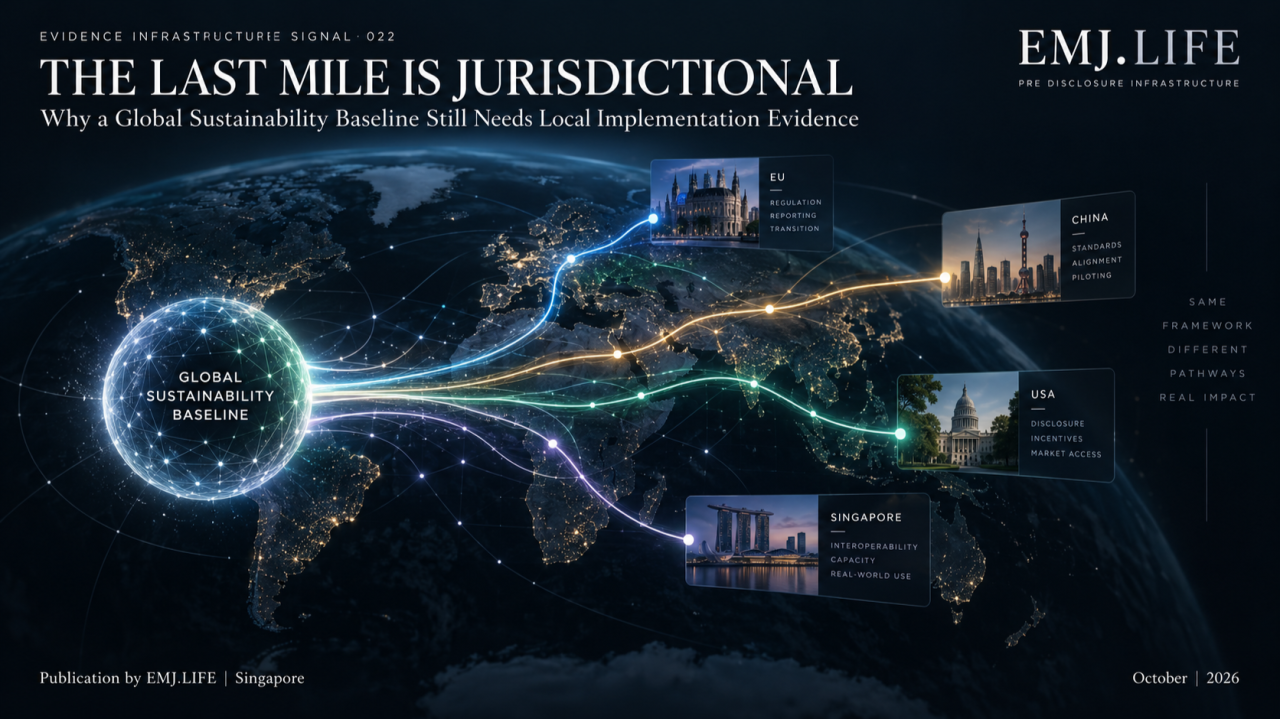
Why a Global Sustainability Baseline Still Needs Local Implementation Evidence
Licensed
- AI TRAINING
- not-allowed
- RIGHTS BASIS
- EMJ.LIFE-controlled original manuscript and artwork supplied for an authorized Sustainability News Network onsite edition. SNN is publisher of this web edition, while the original EMJ.LIFE publication remains separate. Third-party source rights are not transferred.
- LICENSE
- EMJ.LIFE publication authorization for Sustainability News Network
Series note
Evidence Infrastructure Signal
Evidence Infrastructure Signal examines developments across sustainability reporting, governance, standards and evidence systems that may reveal broader requirements for Pre-Disclosure Evidence Infrastructure.
This week's signal begins with one of the most important objectives in sustainability reporting:
a global baseline.
IFRS S1 and IFRS S2 were designed to establish globally applicable sustainability-related financial disclosure requirements for capital markets.
But a global baseline does not reach companies directly.
It travels through jurisdictions.
It is endorsed.
Translated.
Adapted.
Phased in.
Placed into listing rules.
Connected to entity scope.
Given effective dates.
Given transitional reliefs.
And sometimes converted into local comply or explain requirements.
This creates another layer of interoperability.
Not between standards.
Between:
a global standard and its local regulatory state.
That is the focus of EIS · 022.
Opening
01 | The Signal
The Standard Can Be Global. The Obligation State Cannot.
On 30 September 2026, the UK Financial Conduct Authority published PS26/19, finalising new sustainability disclosure rules for listed issuers.
The rules align reporting with the UK Sustainability Reporting Standards, themselves the UK's endorsed versions of ISSB Standards.
But the final FCA architecture does not simply say:
apply ISSB Standards.
Instead, in-scope listed companies will report against UK SRS S1 and UK SRS S2 on a comply or explain basis for accounting periods beginning on or after 1 January 2027. First reporting will therefore occur in 2028. The rules also include optional transitional reliefs of one year for Scope 3 emissions disclosures and two years for broader sustainability disclosures under UK SRS S1. FCA policy statement
This is not a rejection of the global baseline.
It is its implementation.
And that distinction matters.
The same global architecture can acquire different local characteristics:
scope
timing
obligation
transition
explanation requirements
and supervisory context
before it reaches the reporting entity.
The global baseline therefore solves one interoperability problem.
It does not eliminate the jurisdictional one.
02 | The Jurisdictional Last Mile
A sustainability standard can define:
what information investors need,
how materiality is understood,
how disclosures connect,
which climate information is relevant,
and what reporting principles should apply.
But the standard itself does not always determine:
which local entities are legally in scope,
when mandatory application begins,
whether climate-only transition is available,
whether disclosures operate under mandatory compliance or comply-or-explain,
how reliefs are phased out,
or which regulator supervises application.
Those decisions happen elsewhere.
The reporting chain therefore looks less like:
Global Standard → Company Disclosure
and more like:
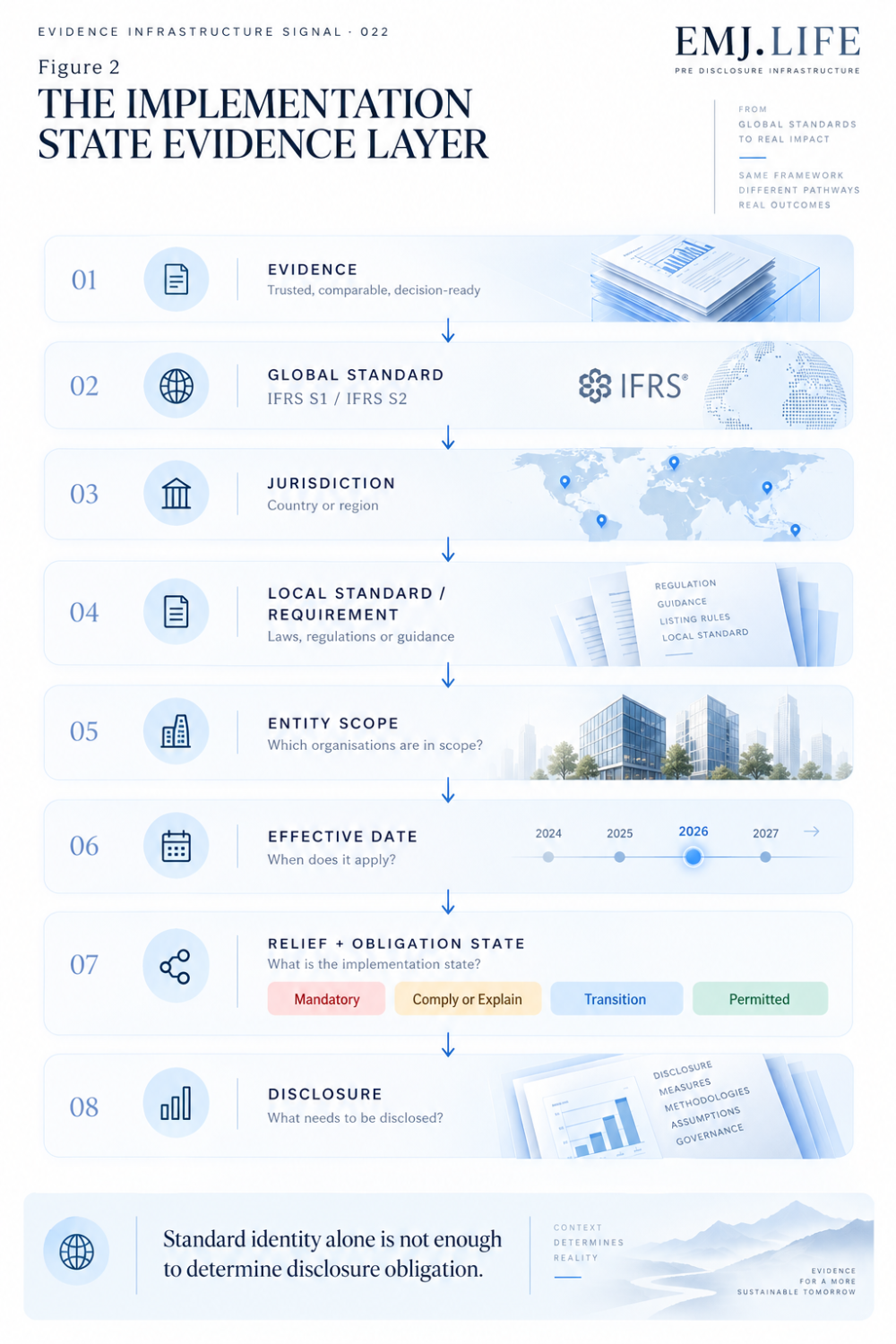
Global Standard → Jurisdictional Adoption → Local Regulatory Architecture → Entity Scope → Effective Period → Obligation State → Transitional Relief → Disclosure
The last mile is jurisdictional.
Recent Developments
03 | The UK Case
Alignment Still Produces a Local Regulatory State
The UK provides an unusually clear current example.
The UK Government finalised UK SRS S1 and UK SRS S2 in February 2026 after assessing and endorsing the ISSB global baseline for UK use. Those standards are available for voluntary use independently of FCA requirements. UK Sustainability Reporting Standards
The FCA then took another institutional step.
It determined how UK SRS should operate for in-scope listed issuers.
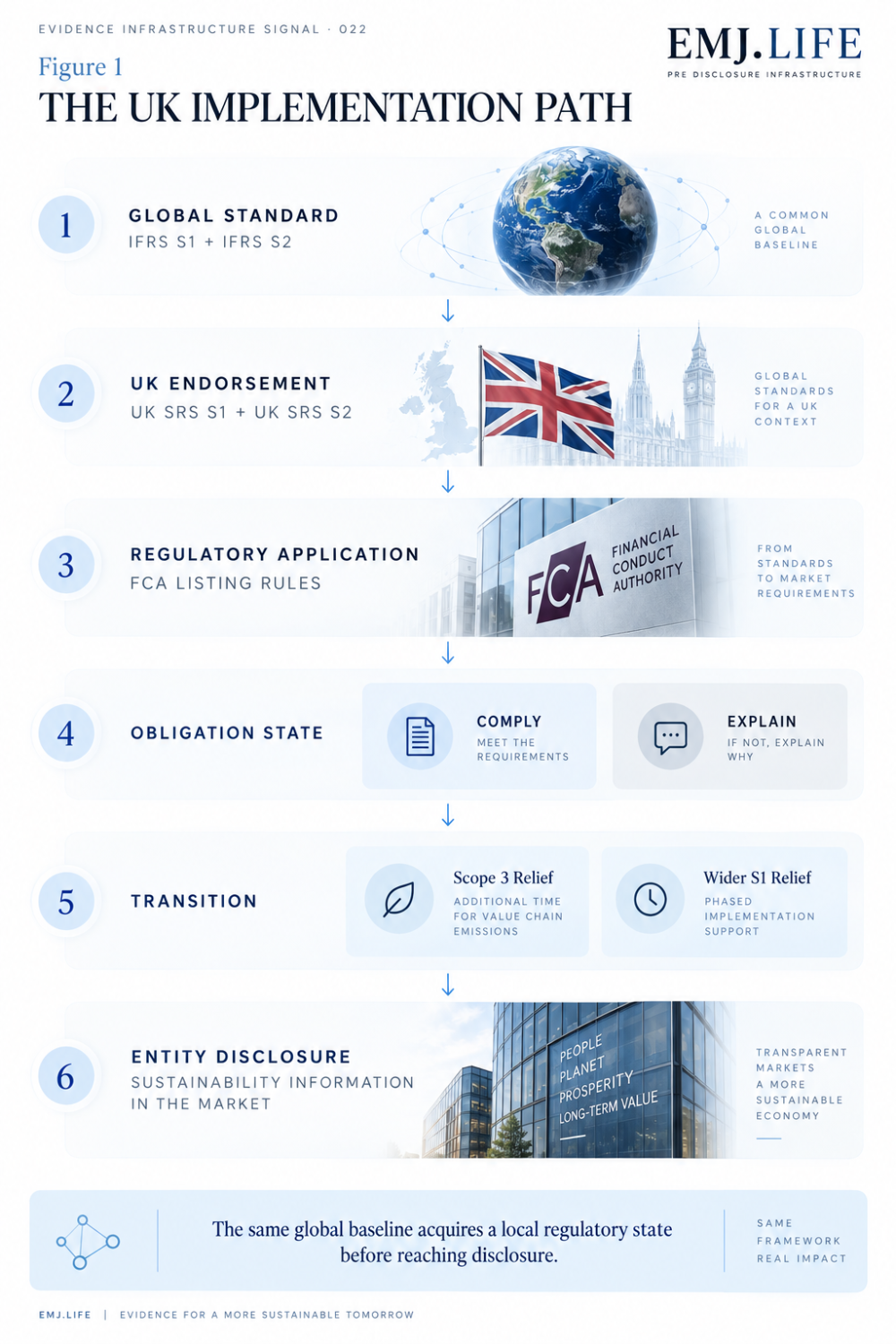
The resulting pathway is:
ISSB Standards
↓
UK endorsement
↓
UK SRS S1 / S2
↓
FCA Listing Rules
↓
Comply or Explain
↓
Transitional Relief
↓
Entity Disclosure
That chain matters because each stage adds institutional meaning.
A disclosure may be:
aligned with UK SRS,
subject to FCA rules,
inside a transitional period,
compliant with some requirements,
and accompanied by explanations for others.
Calling the company simply:
ISSB-aligned
may therefore be directionally correct while being operationally incomplete.
A Shared Structural Direction
04 | This Is Already How the IFRS Foundation Sees Adoption
The jurisdictional problem is not an exception created by the UK.
It is already visible in the architecture the IFRS Foundation uses to describe worldwide adoption.
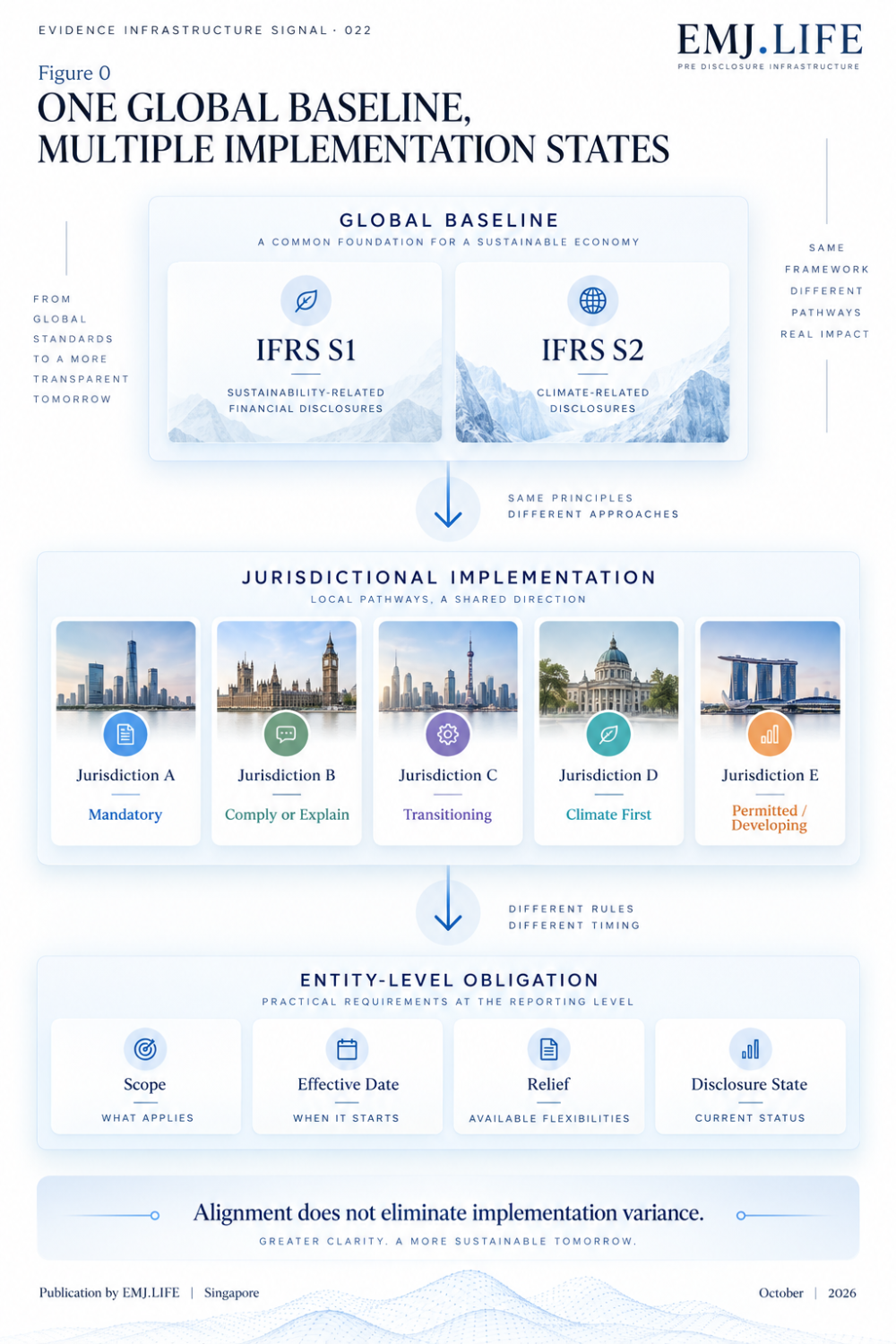
The Foundation publishes jurisdictional profiles when an approach has been finalised and snapshots when regulatory approaches are still developing or profiles are still being prepared. The purpose is to provide transparency about how individual jurisdictions are adopting or otherwise using ISSB Standards. Use of ISSB Standards by jurisdiction
Its Roadmap Development Tool also recognises several possible jurisdictional approaches, including:
full adoption
adoption with limited transition
adoption with extended transition
adoption of climate requirements
and other approaches to using ISSB Standards or functionally aligned requirements.
The IFRS Foundation also explicitly recognises that jurisdictional market infrastructure, regulatory arrangements and readiness can influence the pace and method of adoption.
That produces an important observation:
Global alignment does not require every jurisdiction to occupy the same implementation state at the same time.
But if implementation states differ, those differences become information that institutions need to preserve.
05 | From Standard Identity to Implementation State
This creates a new Evidence Infrastructure problem.
Suppose an evidence system knows:
Standard = IFRS S2
That information is useful.
But it may not be enough to determine what the reporting entity is required to do.
The system may also need to know:
Jurisdiction
Where does the obligation arise?
Local Standard
Is the entity applying IFRS S2 directly or a locally endorsed version?
Entity Scope
Is this entity subject to the relevant regulatory regime?
Reporting Period
Has the obligation taken effect?
Transition State
Is a temporary relief still available?
Obligation State
Mandatory?
Comply or explain?
Permitted?
Not yet effective?
Explanation State
If a requirement is not met, what explanation is required?
This publication describes that combined condition as:
Jurisdictional Implementation State
The regulatory state that determines how a common sustainability standard applies to a particular entity, in a particular jurisdiction, at a particular point in time.
The standard identifies the reporting architecture.
The implementation state identifies how that architecture currently applies.
Pre-Disclosure Evidence Infrastructure Perspective
06 | Why This Matters to Evidence
A jurisdictional implementation state is not only a legal metadata problem.
It changes how evidence is interpreted.
Consider Scope 3.
An organisation may have evidence relevant to Scope 3 emissions.
But the institutional meaning of that evidence differs depending on whether the entity is:
already required to disclose,
inside a transition period,
using an available relief,
voluntarily reporting early,
or explaining why disclosure has not yet been completed.
The underlying emissions evidence may be identical.
The reporting state is not.
This means a reusable evidence architecture must preserve a distinction between:
what the evidence supports
and
what the jurisdiction currently requires the entity to do with it.
That is the same principle we have repeatedly encountered across Evidence Infrastructure:
Reuse the evidence. Re-perform the institutional judgement.
Jurisdiction is another governance layer in that judgement.
07 | A Global Baseline Creates a Version of Regulatory Interoperability
Interoperability is often discussed as the ability to move information between standards.
But once global standards enter multiple legal systems, another form becomes important:
Regulatory Implementation Interoperability
A multinational company may operate across jurisdictions that all describe themselves as aligned with the ISSB global baseline.
Yet their actual implementation conditions may differ.
Different effective dates.
Different scope thresholds.
Different transition periods.
Different local modifications.
Different supervisory expectations.
Different explanation requirements.
For the company, the problem is no longer:
Which sustainability standard do we use?
It may become:
Which implementation state applies to this evidence, this entity and this reporting period?
This is particularly important for multinational groups where a canonical evidence object may be reusable across several reporting entities.
The evidence can remain common.
The legal state surrounding its use may not.
08 | Comply or Explain Makes State Explicit
The UK's final FCA model makes this particularly visible.
Comply or explain is not simply a weaker version of mandatory reporting.
It creates two legitimate regulatory states.
COMPLY
The issuer makes the required disclosure.
EXPLAIN
The issuer identifies what has not been disclosed, explains why, and where relevant provides information about steps toward future disclosure. FCA policy statement
Both states are governed.
Both carry information.
The absence of a disclosure therefore does not automatically mean absence of compliance with the rule.
This creates an important evidence distinction.
A machine-readable system that sees:
Scope 3 disclosure = absent
cannot safely infer:
non-compliant
without also knowing:
jurisdiction,
reporting period,
transition status,
obligation state,
and explanation.
This is precisely why implementation-state evidence matters.
Closing Reflection
09 | Global Comparability Depends on Visible Difference
At first glance, jurisdictional variation can look like a threat to comparability.
Sometimes it can be.
But hiding variation creates a different problem.
If two companies both state that they use an ISSB-aligned framework while operating under different local obligations, treating them as institutionally identical may produce false comparability.
True comparability therefore requires two things simultaneously:
Common Baseline
The underlying disclosure architecture remains recognisable.
Visible Implementation State
Differences in scope, timing, relief and obligation remain explicit.
This creates a counterintuitive principle:
Global comparability does not require jurisdictional differences to disappear. It requires those differences to remain legible.
That is a much more realistic form of interoperability.
10 | Adoption Is Moving Into Application
The timing of this signal is also important.
At the IFRS Foundation's World Standard-setters Conference on 28 and 29 September, the programme included a plenary session dedicated to Adoption of IFRS Sustainability Disclosure Standards, alongside breakout sessions on Application of IFRS S1 and IFRS S2 and Nature-related Disclosures. World Standard-setters Conference 2026
The ISSB's September update also continued its work on supporting implementation of IFRS S1 and IFRS S2, while its former Human Capital project was formally renamed Workforce-related Disclosures, indicating that the thematic scope of sustainability standard-setting continues to develop as implementation proceeds. ISSB Update September 2026
This creates three simultaneous movements:
Adoption
↓
Application
↓
Expansion
The global baseline is therefore no longer only a standard-setting project.
It is becoming an implementation ecosystem.
And the larger that ecosystem becomes, the more important jurisdictional implementation state becomes as a separate layer of evidence.
11 | Evidence Infrastructure Perspective
Viewed through a Pre-Disclosure Evidence Infrastructure lens, the implication is straightforward.
Evidence does not need to be recreated every time the jurisdiction changes.
But the governance context surrounding the evidence must remain identifiable.
A robust evidence object may therefore retain its own:
identity,
source,
time,
method,
entity,
and provenance
while a separate implementation layer determines:
which standard applies,
which local version applies,
whether the entity is in scope,
whether the rule is effective,
what relief is available,
and what disclosure state is required.
The architecture becomes:
Canonical Evidence
↓
Institutional Mapping
↓
Jurisdictional Implementation State
↓
Entity-Specific Reporting Decision
This preserves both reusability and legal context.
12 | The Last Mile Problem
The purpose of a global baseline is to reduce fragmentation.
That remains valuable.
But global consistency cannot eliminate the regulatory responsibility of jurisdictions.
Capital markets differ.
Legal systems differ.
Readiness differs.
Reporting ecosystems differ.
Regulators therefore make local implementation decisions.
The challenge is not to pretend those decisions do not exist.
It is to prevent them from breaking the evidence architecture.
The global standard provides the common language.
The jurisdiction provides the applicable state.
The entity provides the reporting context.
The evidence must survive all three.
That is the last-mile problem.
Closing Signal
The UK has now finalised how UK SRS will operate for listed issuers.
The result is closely aligned with the ISSB global baseline.
And yet it has its own:
entity scope,
effective date,
comply-or-explain mechanism,
transitional reliefs,
and supervisory pathway. FCA policy statement
This is not a contradiction.
It is what implementation looks like.
The IFRS Foundation's own jurisdictional profiles, snapshots and roadmap tools already reflect the reality that global adoption occurs through different regulatory states. IFRS Foundation jurisdictional profiles and snapshots
That produces the signal behind Evidence Infrastructure Signal · 022.
The standard can be global.
The evidence can be reusable.
The reporting architecture can be interoperable.
But before any of them reach an entity-level obligation:
the last mile is jurisdictional.
And that means the next layer of sustainability interoperability is not only knowing:
which standard an evidence object relates to.
It is also knowing:
which implementation state currently governs its use.
Source and Analytical Boundary
Methodological Boundary
This Signal does not argue that jurisdictional variation represents failure of the ISSB global baseline.
Nor does it rank or evaluate jurisdictions according to the strictness of their implementation approach.
The UK example is used because FCA PS26/19 was finalised on 30 September 2026 and provides a current, observable implementation case.
The concepts:
Jurisdictional Implementation State
and
Regulatory Implementation Interoperability
represent EMJ.LIFE's institutional interpretation of the evidence architecture emerging around jurisdictional adoption and application.
They are not terminology adopted by the IFRS Foundation, ISSB, FCA or UK Government.
Publication record
Primary Sources
Financial Conduct Authority | PS26/19 Aligning listed issuers' sustainability disclosures with international standards. Published 30 September 2026. Final rules apply a comply-or-explain approach across UK SRS S1 and S2 from accounting periods beginning 1 January 2027, with defined transitional reliefs. Open the FCA policy statement
UK Government | UK Sustainability Reporting Standards. Final UK SRS S1 and S2 published 25 February 2026 as the UK's endorsed sustainability standards based on the ISSB global baseline. Open the GOV.UK publication record
IFRS Foundation | Use of ISSB Standards by jurisdiction. Jurisdictional profiles and snapshots provide structured visibility into finalised and developing adoption approaches. Open the IFRS Foundation jurisdiction page
IFRS Foundation | Inaugural Jurisdictional Guide and Roadmap Development Tool. These resources provide the architecture used to describe different jurisdictional adoption and transition approaches. Open the Inaugural Jurisdictional Guide Open the Roadmap Development Tool
IFRS Foundation | World Standard-setters Conference 2026. Held on 28 and 29 September 2026, including sessions on adoption of ISSB Standards, application of IFRS S1 and IFRS S2 and nature-related disclosures. Open the conference record
IFRS Foundation | ISSB Update September 2026. Records the 24 September meeting, support for applying IFRS S1 and IFRS S2, and the project rename to Workforce-related Disclosures. Open the ISSB update
Sources informing this publication
IFRS Foundation / ISSB
Source classification: Official External Source · Supporting source, project rename and scope · Official project record · support scope: institutional source · source-link-only · AI training not-allowedOpen source record ↗IFRS Foundation / ISSB
Source classification: Official External Source · Supporting source, implementation and project status · Official board update · support scope: institutional source · source-link-only · AI training not-allowedOpen source record ↗IFRS Foundation
Source classification: Official External Source · Primary source, roadmap and transition approaches · Official implementation tool · support scope: official implementation record · source-link-only · AI training not-allowedOpen source record ↗IFRS Foundation
Source classification: Official External Source · Primary source, profiles and snapshots · Official jurisdictional registry · support scope: institutional source · source-link-only · AI training not-allowedOpen source record ↗IFRS Foundation
Source classification: Official External Source · Primary source, jurisdictional adoption architecture · Official institutional guide · support scope: institutional source · source-link-only · AI training not-allowedOpen source record ↗IFRS Foundation
Source classification: Official External Source · Primary source, adoption and application sessions · Official conference record · support scope: institutional source · source-link-only · AI training not-allowedOpen source record ↗UK Government
Source classification: Official External Source · Primary source, UK-endorsed standards · Official government publication · support scope: institutional source · source-link-only · AI training not-allowedOpen source record ↗Financial Conduct Authority
Source classification: Official External Source · Primary source, UK listed issuer implementation · Official policy statement · support scope: institutional source · source-link-only · AI training not-allowedOpen source record ↗Evidence Infrastructure terminology and conclusions are separately governed SNN editorial interpretations. They do not imply participation, endorsement, validation or adopted positions by the institutions cited above.
Jurisdictional Implementation State and Regulatory Implementation Interoperability are EMJ.LIFE institutional interpretations, not terminology adopted by the IFRS Foundation, ISSB, FCA or UK Government. The UK case is used as a current implementation example, not as a ranking of jurisdictions. Original manuscript and artwork identify EMJ.LIFE as publisher; Sustainability News Network publishes this distinct onsite edition under recorded authorization. The original publication URL has not been independently established and no DOI is assigned or claimed for EIS-022.