
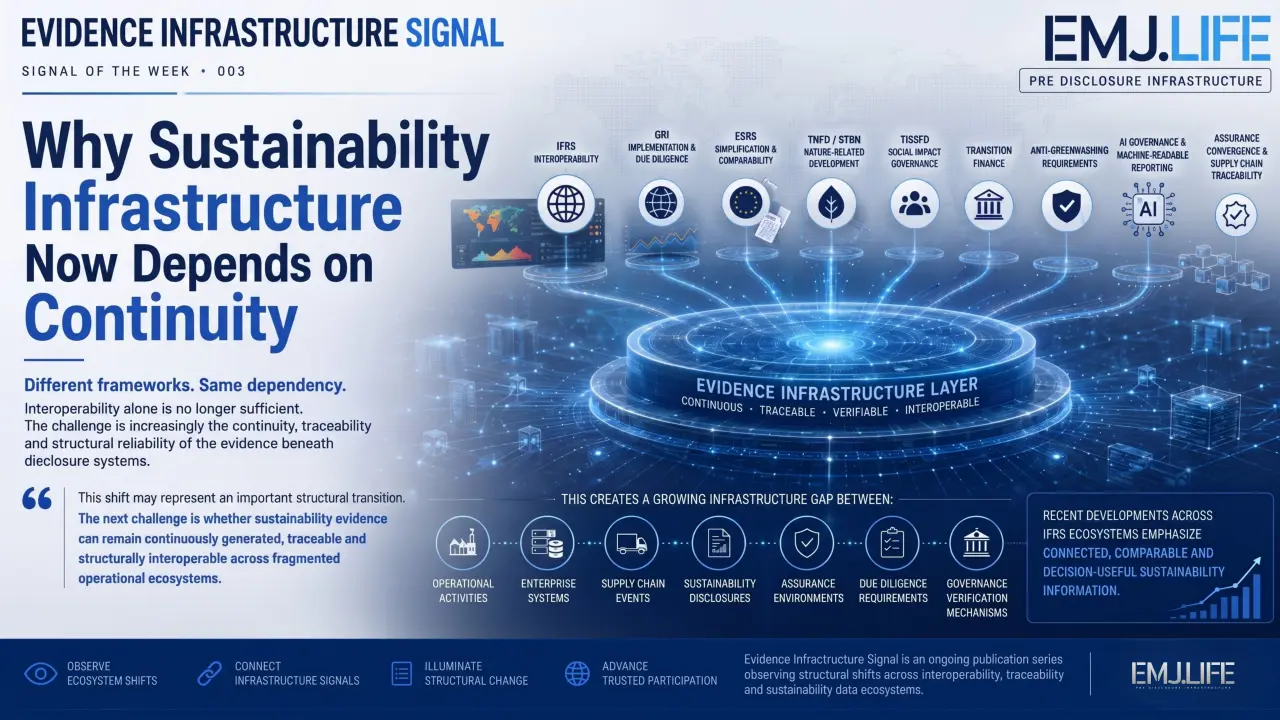
Different frameworks. Same dependency.
Snn Owned
- AI TRAINING
- allowed
- RIGHTS BASIS
- Original SNN English editorial reporting, analysis, Signal, summary, metadata and structured publication content.
Series note
Different Frameworks. Same Dependency.
Over the past several months, a broader structural pattern has continued to emerge across the global sustainability ecosystem.
At first glance, many developments still appear separate:
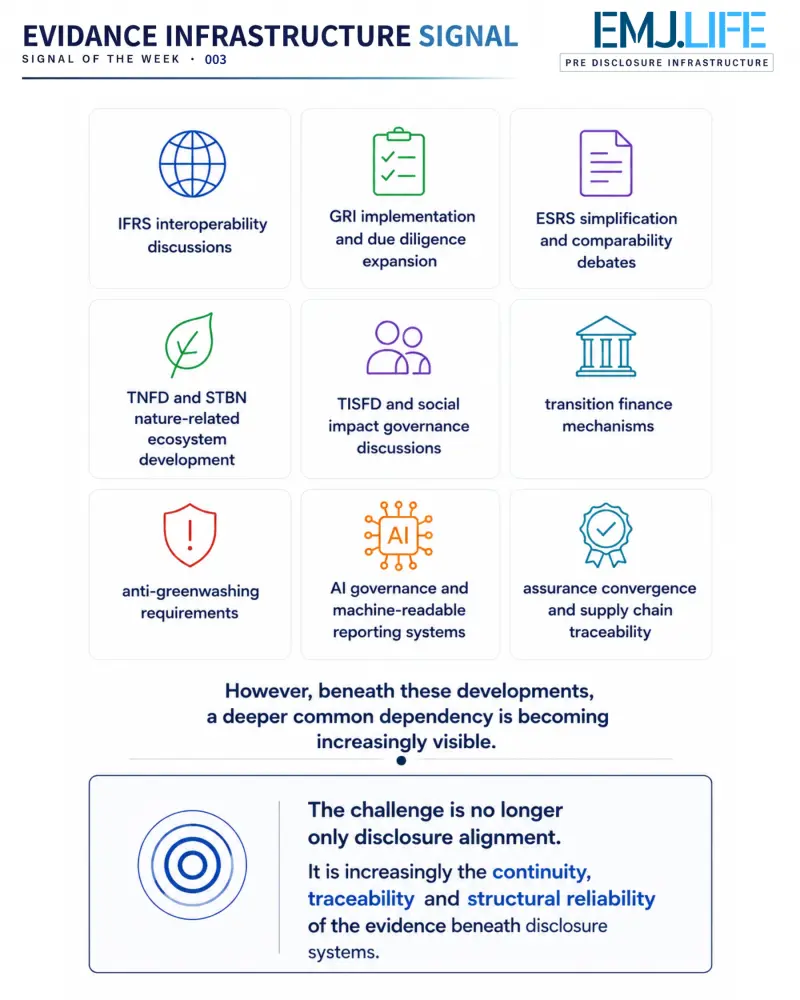
Ifrs Interoperability Discussions
Gri Implementation And Due Diligence Expansion
Esrs Simplification And Comparability Debates
Tnfd And Stbn Nature-Related Ecosystem Development
Opening
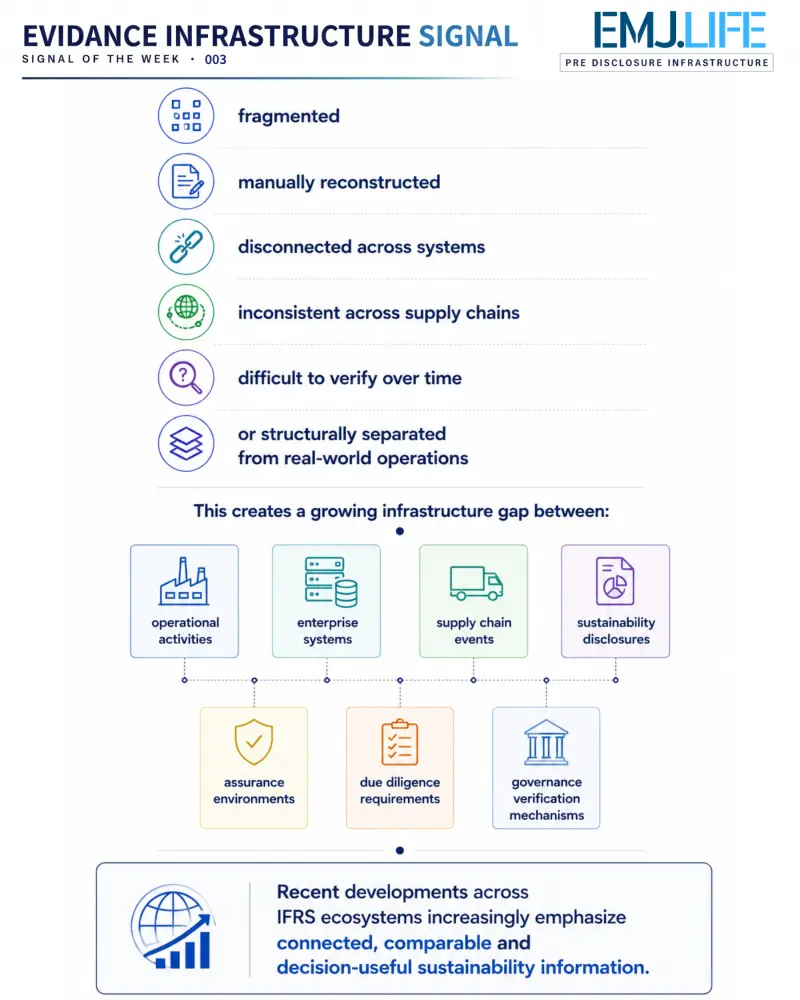
And Governance Verification Mechanisms
Recent developments across IFRS ecosystems increasingly emphasize connected, comparable and decision-useful sustainability information.
GRI discussions increasingly extend toward implementation, stakeholder coordination and operational visibility across value chains.
ESRS developments increasingly highlight the growing tension between reporting simplification, interoperability and the reliability of underlying data structures.
TNFD and STBN increasingly depend on geographically connected, nature-related operational evidence.
TISFD and emerging social governance ecosystems increasingly require more structured visibility into workforce, inequality and societal impact conditions.
Meanwhile, assurance ecosystems, AI systems and anti-greenwashing environments increasingly require stronger substantiation and machine-readable evidence structures beneath sustainability-related claims.
Although these ecosystems serve different institutional purposes, they increasingly appear to converge toward the same underlying requirement:
persistent operational evidence continuity.
This shift may represent an important structural transition.
Historically, sustainability systems were often viewed primarily as reporting frameworks.
Today, they increasingly behave more like interconnected infrastructure systems.
In this environment, the next challenge may no longer be disclosure itself.
It may increasingly be whether sustainability evidence can remain continuously generated, traceable and structurally interoperable across fragmented operational ecosystems.
This may explain why concepts such as:
Recent Developments
Operational Traceability
Supply Chain Continuity
Machine-Readable Evidence
Governance-Compatible Data Formation
Evidence Lineage
Continuity Across Reporting Environments
are becoming increasingly central across global sustainability discussions.
The market may gradually be entering a new phase:
A Shared Structural Direction
Recent dialogues across global sustainability ecosystems, including discussions during Ecosperity Week in Singapore, increasingly suggest that interoperability alone may no longer be sufficient.
Different frameworks may align conceptually, while the underlying operational evidence remains:
Fragmented
Manually Reconstructed
Disconnected Across Systems
Inconsistent Across Supply Chains
Difficult To Verify Over Time
Or Structurally Separated From Real-World Operations
This creates a growing infrastructure gap between:
Operational Activities
Enterprise Systems
Supply Chain Events
Sustainability Disclosures
Assurance Environments
Due Diligence Requirements
Pre-Disclosure Evidence Infrastructure Perspective
From reporting interoperability toward evidence continuity infrastructure.
This does not reduce the importance of disclosure.
Rather, disclosure quality itself may increasingly depend on whether trustworthy evidence can remain continuously formed beneath reporting systems.
Recent ecosystem developments may therefore reflect something broader than reporting evolution alone:
the gradual emergence of globally interconnected evidence infrastructure systems.
Evidence Infrastructure Signal
Evidence Infrastructure Signal is an ongoing publication series observing structural shifts across interoperability, traceability and sustainability data ecosystems.
Illustrative ecosystem observations only.
Closing Reflection
Tisfd And Social Impact Governance Discussions
Transition Finance Mechanisms
Anti-Greenwashing Requirements
Ai Governance And Machine-Readable Reporting Systems
Assurance Convergence And Supply Chain Traceability
However, beneath these developments, a deeper common dependency is becoming increasingly visible.
The challenge is no longer only disclosure alignment.
It is increasingly the continuity, traceability and structural reliability of the evidence beneath disclosure systems.
Source and Analytical Boundary
This does not reduce the importance of disclosure.
Illustrative ecosystem observations only.
Publication record
Evidence Infrastructure Signal
Evidence Infrastructure Signal is an ongoing publication series observing structural shifts across interoperability, traceability and sustainability data ecosystems.
Sources informing this publication
EFRAG
Source classification: Official External Source · Primary analysis source · Official institutional publication · support scope: institutional source · source-link-only · AI training not-allowedOpen source record ↗Evidence Infrastructure terminology and conclusions are separately governed SNN editorial interpretations. They do not imply participation, endorsement, validation or adopted positions by the institutions cited above.
This does not reduce the importance of disclosure. Illustrative ecosystem observations only.