
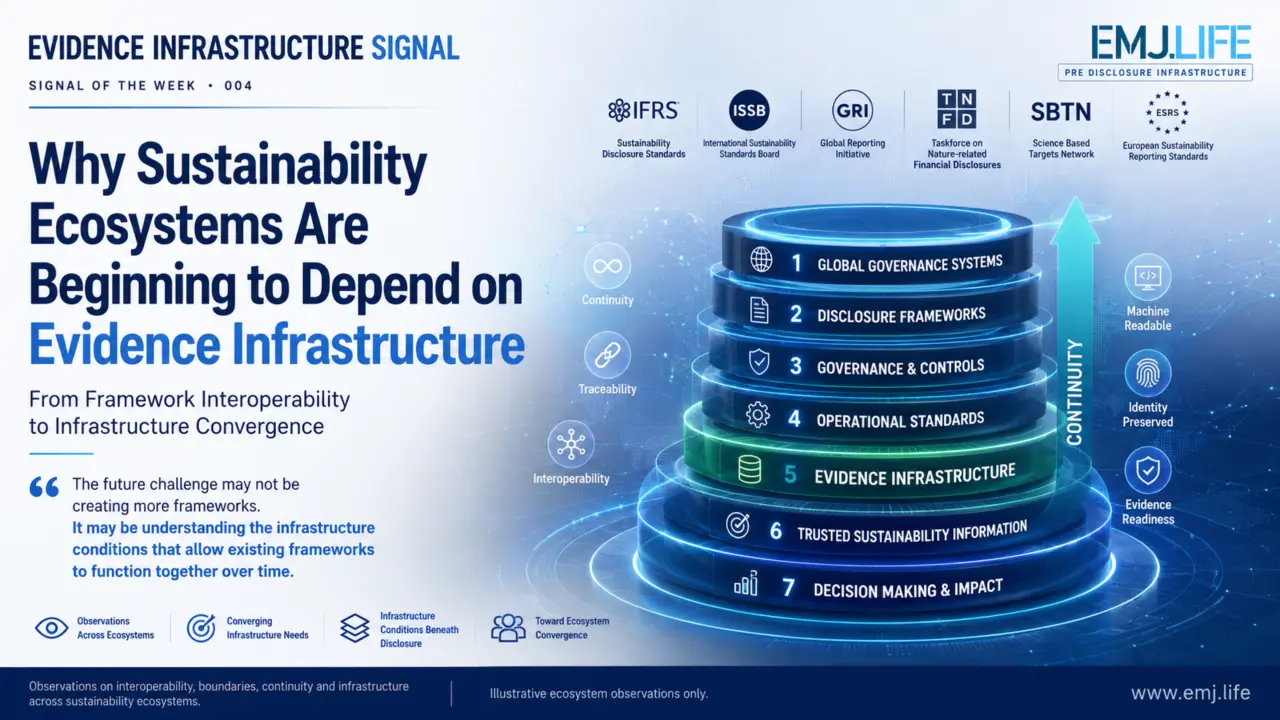
From Framework Interoperability to Infrastructure Convergence
Snn Owned
- AI TRAINING
- allowed
- RIGHTS BASIS
- Original SNN English editorial reporting, analysis, Signal, summary, metadata and structured publication content.
Series note
From Framework Interoperability To Infrastructure Convergence
Over the past several months, I have spent considerable time reviewing publications, consultation papers, implementation guidance, interoperability initiatives, and ecosystem developments across IFRS, ISSB, GRI, TNFD, SBTN, ESRS, COSO, and related sustainability environments.
One observation increasingly stands out.
Different sustainability ecosystems appear to be moving toward a similar structural question.
Not a reporting question.
Not a framework question.
And not even an interoperability question alone.
Increasingly, the discussion appears to be shifting toward infrastructure.
Historically, sustainability discussions have focused primarily on:
✅ disclosure requirements
✅ reporting frameworks
✅ governance structures
✅ assurance processes
✅ regulatory compliance
These remain essential.
However, as sustainability ecosystems become more interconnected, another layer is gradually becoming visible beneath them.
A layer that is rarely discussed directly.
Yet one that increasingly influences how all of the above function in practice.
The infrastructure conditions beneath disclosure.
Today, organizations are increasingly expected to operate across:
✅ multiple frameworks
✅ multiple jurisdictions
Opening
GRI continues to explore implementation consistency, due diligence practices, and operational visibility.
TNFD increasingly emphasizes traceability, location-specific information, and decision-useful nature-related information.
SBTN depends upon maintaining continuity between sustainability targets and operational reality.
Assurance and verification ecosystems increasingly require evidence that remains usable across different reporting cycles and governance environments.
Each ecosystem serves a different purpose.
Each operates under different governance structures.
Each addresses different stakeholder needs.
Yet an increasingly similar structural condition appears to be emerging beneath them.
The need for continuity-preserved evidence.
This observation suggests a subtle but important shift.
The discussion may be evolving:
Recent Developments
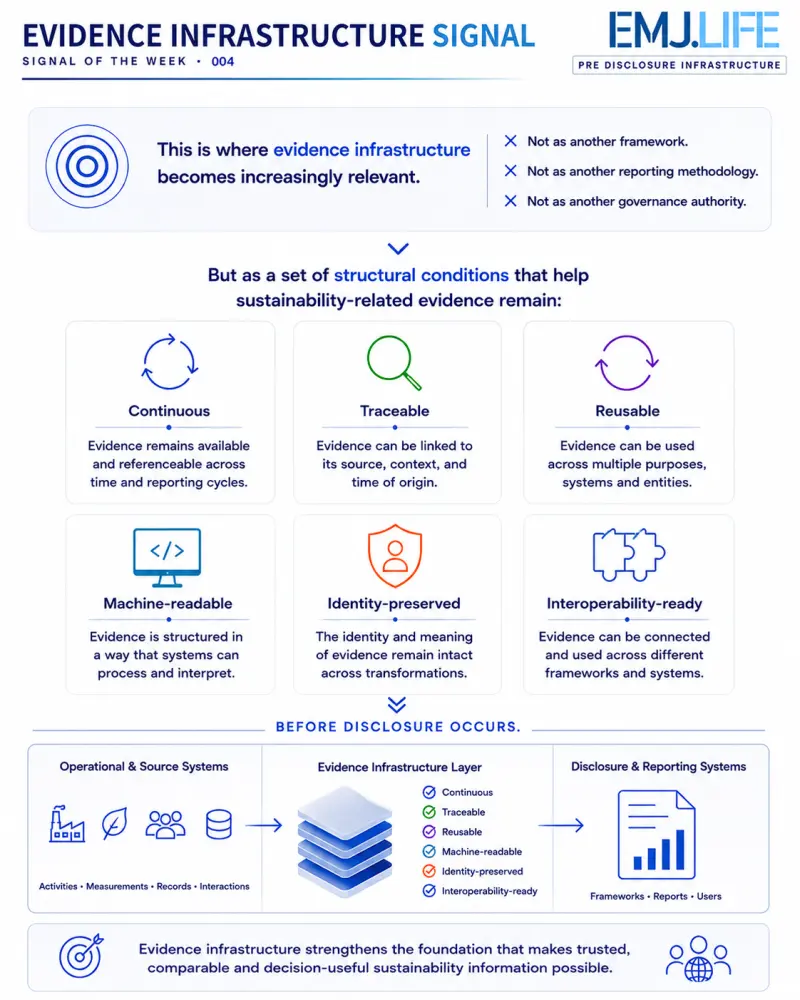
Not as another governance authority.
But as a set of structural conditions that help sustainability-related evidence remain:
• continuous
• traceable
• reusable
• machine-readable
• identity-preserved
• interoperability-ready
before disclosure occurs.
See content credentials
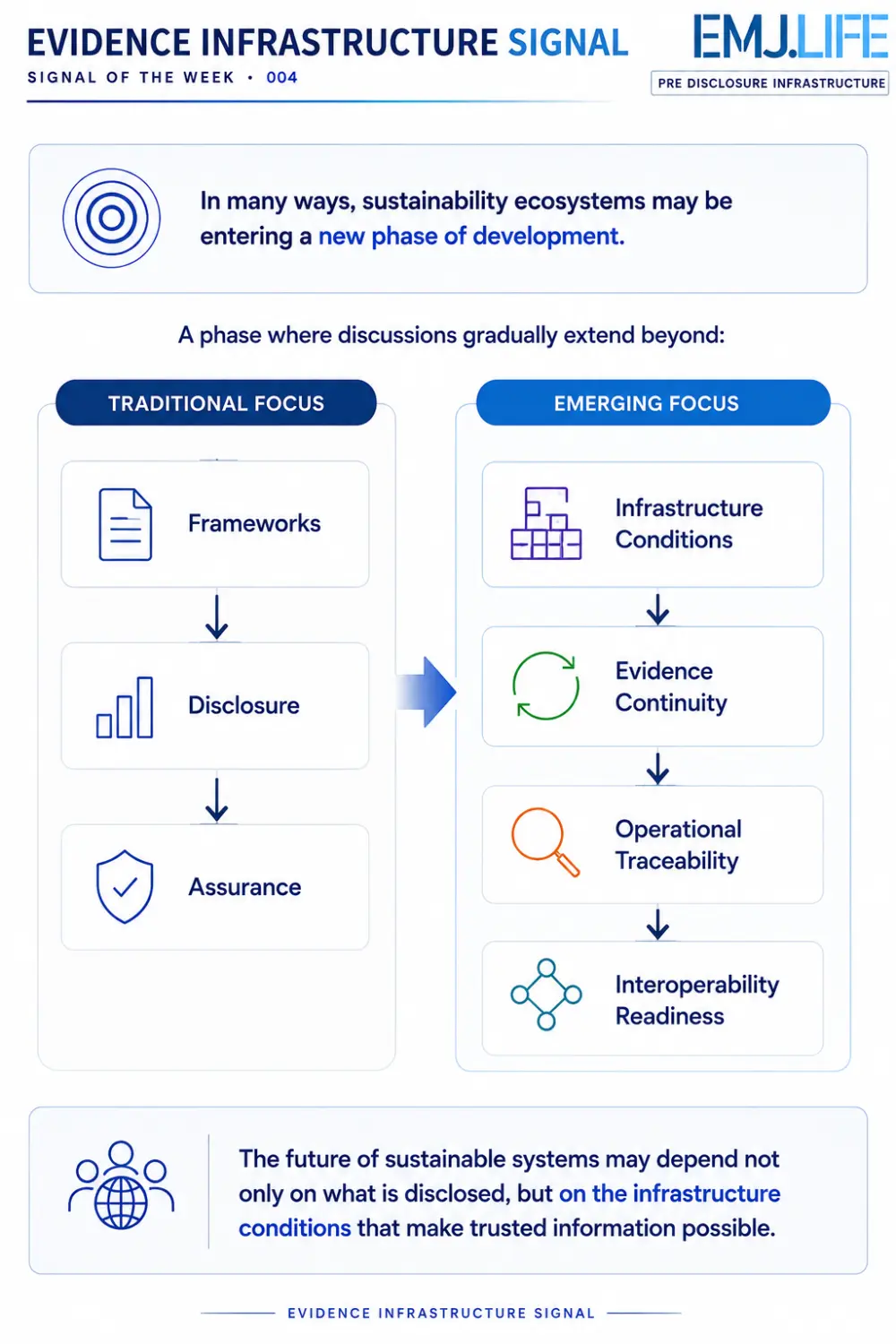
In many ways, sustainability ecosystems may be entering a new phase of development.
A Shared Structural Direction
✅ multiple supply chains
✅ multiple governance environments
✅ multiple reporting ecosystems
Information generated within these environments is often expected to remain:
• traceable
• comparable
• reusable
• verifiable
• machine-readable
• interoperable
across different systems, institutions, and reporting cycles.
This creates a challenge that extends beyond disclosure itself.
A challenge of continuity.
For many years, sustainability conversations largely focused on questions such as:
How should information be disclosed?
Which framework should be applied?
What information is material?
What assurance processes are required?
These questions remain important.
However, an additional question is increasingly emerging beneath them:
How can sustainability-related evidence remain continuously available across fragmented operational environments?
Recent developments across multiple ecosystems appear to reflect this evolution.
IFRS Sustainability Disclosure Standards continue to advance machine-readable reporting environments and interoperability initiatives.
Pre-Disclosure Evidence Infrastructure Perspective
From:
"How Can Frameworks Become Interoperable?"
Toward:
"What Infrastructure Conditions Make Interoperability Possible?"
At first glance, these questions may appear similar.
In reality, they operate at different layers.
Interoperability is often visible.
Infrastructure conditions usually are not.
Yet interoperability frequently depends upon them.
This is where evidence infrastructure becomes increasingly relevant.
Not as another framework.
Not as another reporting methodology.
Closing Reflection
A phase where discussions gradually extend beyond:
Frameworks➡️Disclosure➡️Assurance
and begin to include:
Infrastructure Conditions➡️Evidence Continuity➡️Operational Traceability➡️Interoperability Readiness
The future challenge may not be creating additional frameworks.
It may be understanding the infrastructure conditions that allow existing frameworks to function together over time.
Because trusted sustainability information ultimately depends upon something deeper than disclosure itself.
The ability to maintain continuity beneath disclosure.
See content credentials
Evidence Infrastructure Signal
Evidence Infrastructure Signal is an ongoing publication series observing structural shifts across interoperability, traceability and sustainability data ecosystems.
Illustrative ecosystem observations only.
Source and Analytical Boundary
The future challenge may not be creating additional frameworks.
Illustrative ecosystem observations only.
Publication record
Evidence Infrastructure Signal
Evidence Infrastructure Signal is an ongoing publication series observing structural shifts across interoperability, traceability and sustainability data ecosystems.
Sources informing this publication
IFRS Foundation and GRI
Source classification: Official External Source · Primary analysis source · Official institutional publication · support scope: institutional source · source-link-only · AI training not-allowedOpen source record ↗Evidence Infrastructure terminology and conclusions are separately governed SNN editorial interpretations. They do not imply participation, endorsement, validation or adopted positions by the institutions cited above.
The future challenge may not be creating additional frameworks. Illustrative ecosystem observations only.