
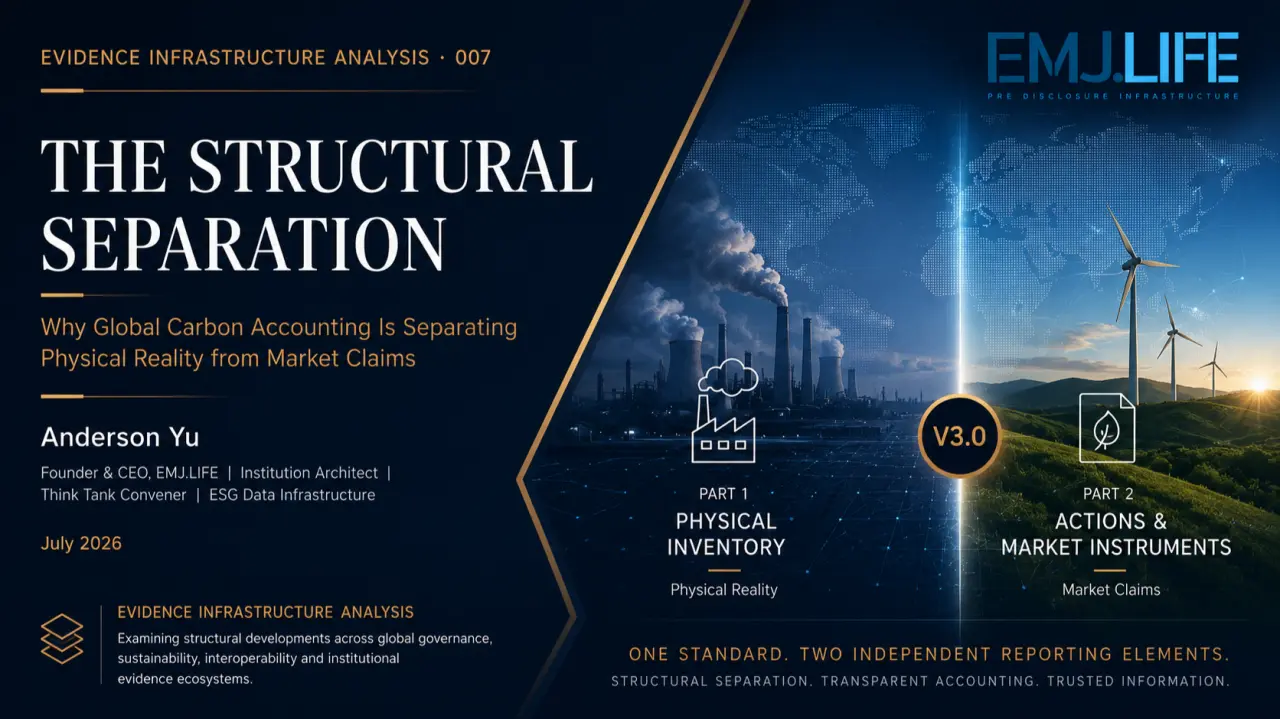
Why Global Carbon Accounting Is Separating Physical Reality from Market Claims
Snn Owned
- AI TRAINING
- allowed
- RIGHTS BASIS
- Original SNN English editorial reporting, analysis, Signal, summary, metadata and structured publication content.
Series introduction
Why Global Carbon Accounting Is Separating Physical Reality From Market Claims
Evidence Infrastructure Analysis
Evidence Infrastructure Analysis is a publication series examining structural developments across global governance, sustainability, interoperability and institutional evidence ecosystems.
Rather than evaluating individual policy proposals or technical standards in isolation, each edition examines how significant institutional developments reveal broader shifts in the architecture of trust, accountability and implementation.
This edition examines the Greenhouse Gas Protocol's Corporate Accounting and Reporting Standard – Standard Development Plan (Version 2.0), released on 29 July 2026.
The plan consolidates the Corporate Standard, Scope 2 Guidance, Scope 3 Standard and the Actions and Market Instruments workstream into a single Corporate Standard (Version 3.0), expected to be jointly published with ISO as a multi-part standard.
Rather than viewing this development as another technical update to greenhouse gas accounting, this analysis examines what it may reveal about the structural evolution of corporate carbon accounting itself.
Executive Summary
For more than two decades, corporate greenhouse gas accounting has operated through a single inventory architecture.
Although physical emissions, market instruments and contractual claims followed different accounting principles, they ultimately contributed to a common reporting structure.
The Greenhouse Gas Protocol's July 2026 Standard Development Plan suggests that this architecture is beginning to change.
Rather than expanding existing standards, the proposal restructures them into a consolidated Corporate Standard organised as multiple parts and expected to be jointly published with ISO.
Within this architecture, physical greenhouse gas inventories and market-based actions are no longer treated as different components of the same accounting statement.
They become structurally separated reporting elements.
Viewed collectively, these developments represent more than an accounting revision.
They signal an institutional transition from blended reporting toward structurally governed accounting.
The emerging challenge therefore extends beyond calculation methodology.
It increasingly concerns how different forms of carbon information remain separated, traceable and governable throughout the accounting lifecycle.
Opening
Every accounting system depends upon architecture.
Architecture determines what information belongs together.
It also determines what information must remain separate.
For more than two decades, corporate greenhouse gas accounting has largely operated through a single inventory architecture.
Physical operational emissions.
Purchased electricity.
Value-chain emissions.
Market-based instruments.
Although governed by different accounting principles, these categories ultimately contributed to a common reporting structure.
The July 2026 Standard Development Plan suggests that this architecture is beginning to change.
Rather than continuing to expand individual accounting guidance, the Greenhouse Gas Protocol proposes a consolidated Corporate Standard organised as multiple parts, separating physical greenhouse gas inventories from actions and market instruments within a single accounting architecture.
This distinction is fundamental.
It is not simply a revision of greenhouse gas accounting.
It is a redesign of the accounting architecture governing different categories of carbon information.
The discussion therefore begins to shift.
Not from better accounting.
But from maintaining a single inventory toward preserving structural separation between fundamentally different forms of carbon information.
The central question is therefore beginning to evolve.
Not:
"How Should Corporate Greenhouse Gas Emissions Be Calculated?"
But:
"How should fundamentally different categories of carbon information remain structurally separated throughout the accounting lifecycle?"
Structural Change
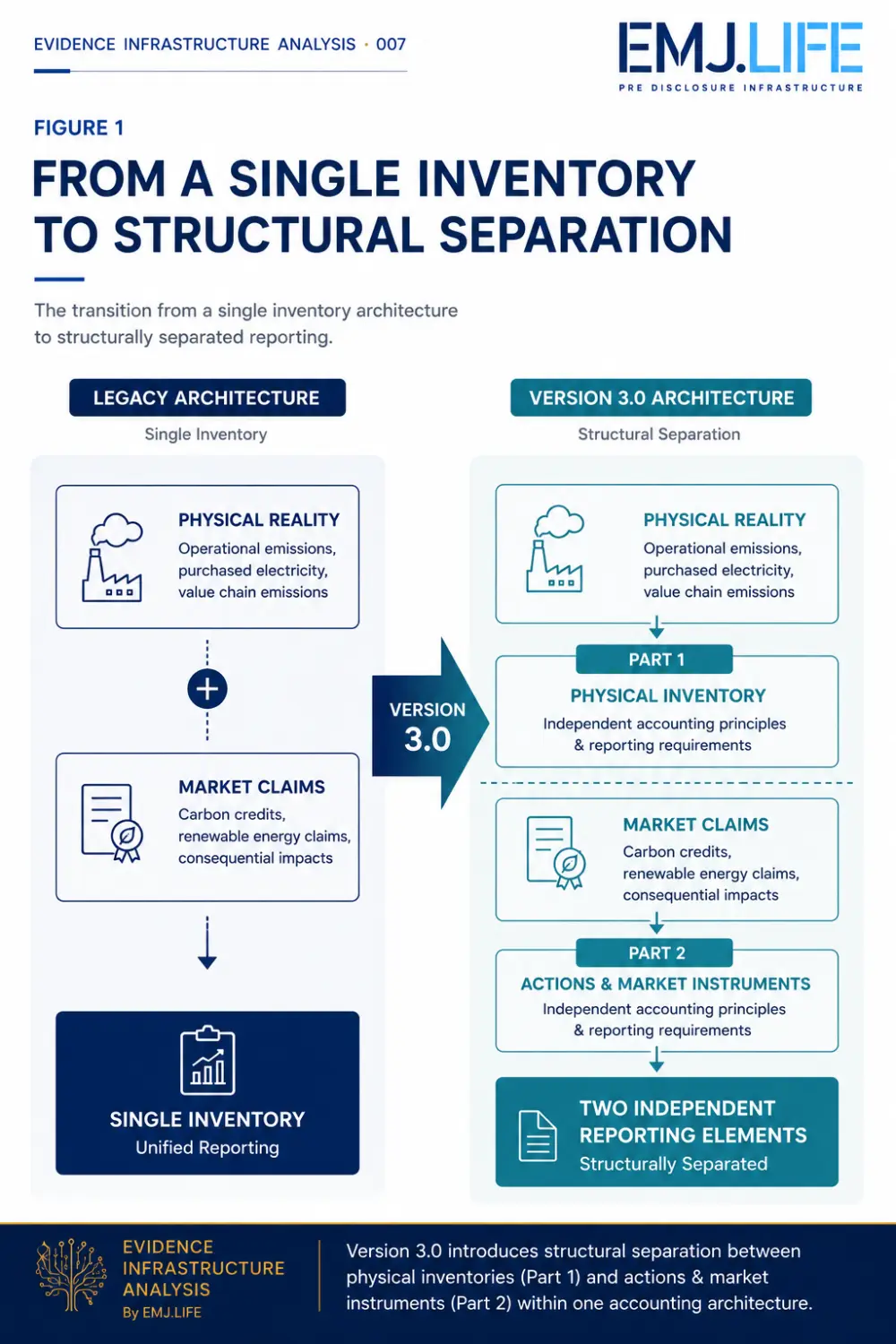
The Single Inventory Is Being Structurally Separated
For more than two decades, corporate greenhouse gas accounting has evolved through the gradual expansion of individual standards.
The Corporate Standard established the foundation for organizational greenhouse gas inventories.
The Scope 2 Guidance expanded accounting for purchased electricity.
The Scope 3 Standard extended reporting across corporate value chains.
Structural Change / Institutional Friction
Additional guidance addressed actions and market instruments.
Although developed separately, these standards ultimately contributed to a common inventory architecture.
The July 2026 Standard Development Plan introduces a different institutional direction.
Rather than continuing to expand separate guidance documents, the GHG Protocol proposes a consolidated Corporate Standard organised as multiple parts.
Within this structure, Part 1 establishes the physical greenhouse gas inventory.
Part 2 establishes separate reporting for actions and market instruments.
This distinction represents more than editorial consolidation.
It introduces structural separation into the accounting architecture itself.
Physical operational emissions remain within the corporate inventory.
Market-based interventions become independently governed reporting elements.
Version 3.0 therefore changes not only how emissions are reported.
It changes how different categories of carbon information coexist within the same accounting system.
See content credentials
Structural separation transforms one inventory into two reporting elements.
Operational Consequence
Structural Separation Requires Operational Separation
Structural separation within reporting cannot be achieved through reporting alone.
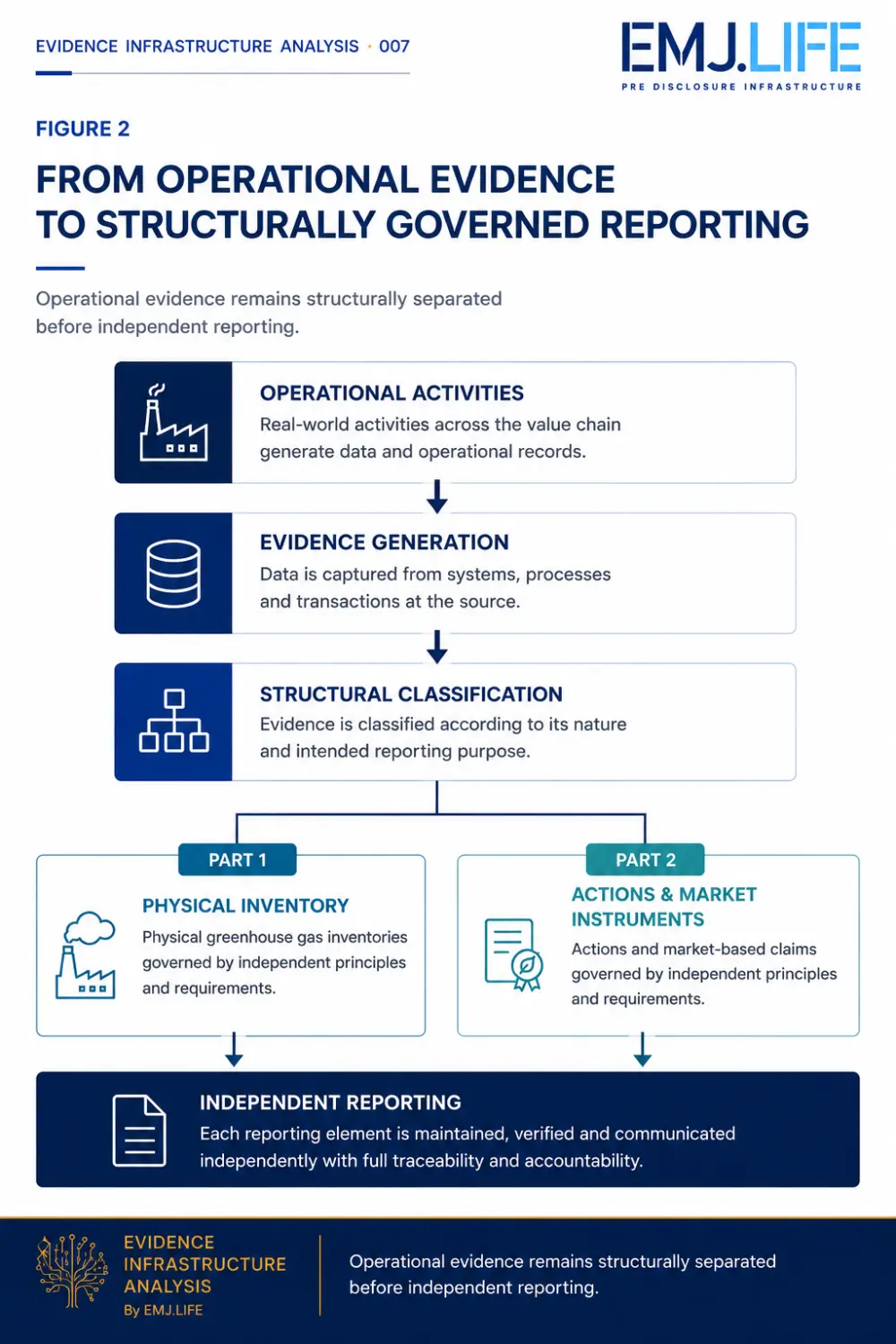
It must begin where operational information is generated.
Once physical inventories and market-based claims are maintained within separate reporting statements, organizations can no longer rely on downstream reconciliation to distinguish different categories of carbon information.
The Standard Development Plan reflects this transition across multiple workstreams.
The Scope 3 Technical Working Group is considering stronger primary-data requirements, improved data quality hierarchies and tighter calculation methodologies.
The Actions and Market Instruments workstream introduces separate accounting objectives, reporting structures, traceability requirements and verification approaches for market-based interventions.
Viewed individually, these proposals address different technical topics.
Viewed collectively, they reveal the same operational implication.
Information intended for different reporting statements must remain structurally distinguishable throughout the accounting process.
Operational separation therefore becomes the practical condition required to support accounting separation.
Accounting architecture no longer begins at the reporting stage.
Institutional Signal
It increasingly begins where operational activities generate evidence that will ultimately support different reporting statements.
Institutional Signal
Accounting Is Becoming Structural
For much of the past two decades, corporate greenhouse gas accounting has primarily focused on quantification.
How should emissions be measured?
Which methodologies should be applied?
How should organizational boundaries be defined?
These questions remain essential.
The July 2026 Standard Development Plan suggests that another institutional priority is beginning to emerge.
Accounting architecture itself.
The proposed Corporate Standard Version 3.0 does not simply refine how greenhouse gas emissions are calculated.
It reorganizes how fundamentally different categories of carbon information are expected to coexist within the same accounting system.
Physical greenhouse gas inventories.
Actions.
Market instruments.
Consequential impacts.
Rather than contributing to a common reporting structure, they become independently governed reporting elements.
This represents more than a technical revision.
It reflects a broader institutional transition.
Carbon accounting is no longer concerned solely with producing accurate inventories.
It is increasingly concerned with preserving structural integrity across different reporting statements.
The institutional question therefore begins to evolve.
Not:
"How Accurately Can Greenhouse Gas Emissions Be Quantified?"
But:
"How Should Different Forms Of Carbon Information Remain Structurally Governed Throughout The Accounting Process?"
See content credentials
Operational evidence determines structural reporting integrity.
Pre-Disclosure Evidence Infrastructure Perspective
Viewed through an Evidence Infrastructure perspective, the Standard Development Plan extends beyond greenhouse gas accounting.
Standard-setters define accounting architecture.
Regulators establish disclosure requirements.
Assurance providers evaluate reported information.
Each institution performs a distinct governance function.
Yet none of these institutions generates the operational evidence upon which structurally separated reporting ultimately depends.
That capability must already exist before accounting begins.
When one operational activity contributes to multiple reporting statements, evidence cannot simply be reconstructed retrospectively.
It must remain attributable, traceable and structurally distinguishable from its point of origin.
From this perspective, the emerging institutional challenge is not primarily accounting complexity.
It increasingly becomes an evidence architecture challenge.
The proposed accounting architecture assumes that operational information can remain structurally separated throughout its lifecycle before entering independent reporting processes.
Evidence Infrastructure should therefore not be understood as another accounting framework.
It is an analytical perspective for understanding how operational evidence may remain structurally governable before entering accounting, reporting and assurance.
Closing Reflection
The July 2026 Standard Development Plan may ultimately be remembered for more than consolidating existing greenhouse gas standards.
It may represent the point at which corporate carbon accounting began to distinguish fundamentally different forms of carbon information through structural separation rather than blended reporting.
This transition extends beyond greenhouse gas inventories.
It changes the accounting architecture upon which future reporting, verification and regulatory oversight will increasingly depend.
As physical inventories and market-based claims become independently governed reporting elements, operational information must remain equally distinguishable from its point of origin.
The challenge therefore extends beyond reporting.
It increasingly concerns the structural integrity of information before reporting begins.
The Next Question
The central question facing organizations is therefore beginning to evolve.
From
"How do we calculate our corporate greenhouse gas inventory?"
To
"How do we preserve structural separation between physical operational reality and market-based claims throughout the accounting lifecycle?"
Official Sources
Official Source
Greenhouse Gas Protocol
Corporate Accounting And Reporting Standard (Version 3.0)
Standard Development Plan V2.0
29 July 2026
Primary reference:
Greenhouse Gas Protocol.
Corporate Accounting and Reporting Standard (Version 3.0) – Standard Development Plan v2.0.
29 July 2026.
Sources informing this publication
GHG Protocol
Source classification: Official External Source · Primary analysis source · Official institutional publication · support scope: institutional source · source-link-only · AI training not-allowedOpen source record ↗Evidence Infrastructure terminology and conclusions are separately governed SNN editorial interpretations. They do not imply participation, endorsement, validation or adopted positions by the institutions cited above.
The July 2026 Standard Development Plan may ultimately be remembered for more than consolidating existing greenhouse gas standards. It may represent the point at which corporate carbon accounting began to distinguish fundamentally different forms of carbon information through structural separation rather than blended reporting. This transition extends beyond greenhouse gas inventories. It changes the accounting architecture upon which future reporting, verification and regulatory oversight will increasingly depend. As physical inventories and market-based claims become independently governed reporting elements, operational information must remain equally distinguishable from its point of origin. The challenge therefore extends beyond reporting. It increasingly concerns the structural integrity of information before reporting begins. ### The Next Question The central question faci