

Why Global Scale-Up Dynamics Are Moving Beyond Early Innovation
Snn Owned
- AI TRAINING
- allowed
- RIGHTS BASIS
- Original SNN English editorial reporting, analysis, Signal, summary, metadata and structured publication content.
Series note
Why Global Scale-Up Dynamics Are Moving Beyond Early Innovation
Evidence Infrastructure Signal
Evidence Infrastructure Signal is a weekly publication series exploring structural developments across sustainability, governance, implementation, interoperability and evidence ecosystems.
Rather than analysing individual announcements in isolation, each edition identifies broader institutional signals emerging across global sustainability and corporate governance initiatives.
The objective is not to predict the future.
It is to better understand where governance and market systems appear to be evolving.
Illustrative ecosystem observations only.
Opening
In August 2026, the OECD Directorate for Science, Technology and Innovation released a major empirical study examining which innovative start-ups achieve scale in the European Union and the United States.
Drawing on nearly 200,000 ventures founded between 2000 and 2025, the working paper examines innovation, financing, acquisitions, managerial professionalisation and ecosystem spillovers.
At first glance, the findings reinforce a familiar policy narrative.
US ventures scale faster.
Late-stage capital is deeper in the United States.
European growth-oriented firms face longer paths from invention to scale.
But beneath these aggregate differences lies a more important institutional signal.
The scale-up gap does not appear to begin with a simple absence of inventive capacity.
Among firms that patent, European scale-ups display invention outcomes comparable to, and in some measures stronger than, their US counterparts.
The greater friction emerges after invention.
When technical potential must become commercial traction.
When traction must become investment credibility.
When capital must support expansion.
When expansion requires professional management.
And when individual success must become ecosystem capability.
Evidence Of Invention Is Not Evidence Of Scalability.
Viewed through an Evidence Infrastructure perspective, the scale-up gap may therefore also be understood as an evidence allocation problem.
Not simply whether information exists.
But whether evidence of institutional readiness can reach the right decision-maker, in a form that can be understood and relied upon, at the stage when the consequences of reliance become greater.
Recent Developments
1. The Gap Emerges After Invention
The OECD analysis indicates that European scale-ups are not simply failing to invent.
Although a smaller proportion of EU firms patent, those that do patent generate invention stocks comparable to, or greater than, similar US firms. European ventures also tend to begin patenting earlier.
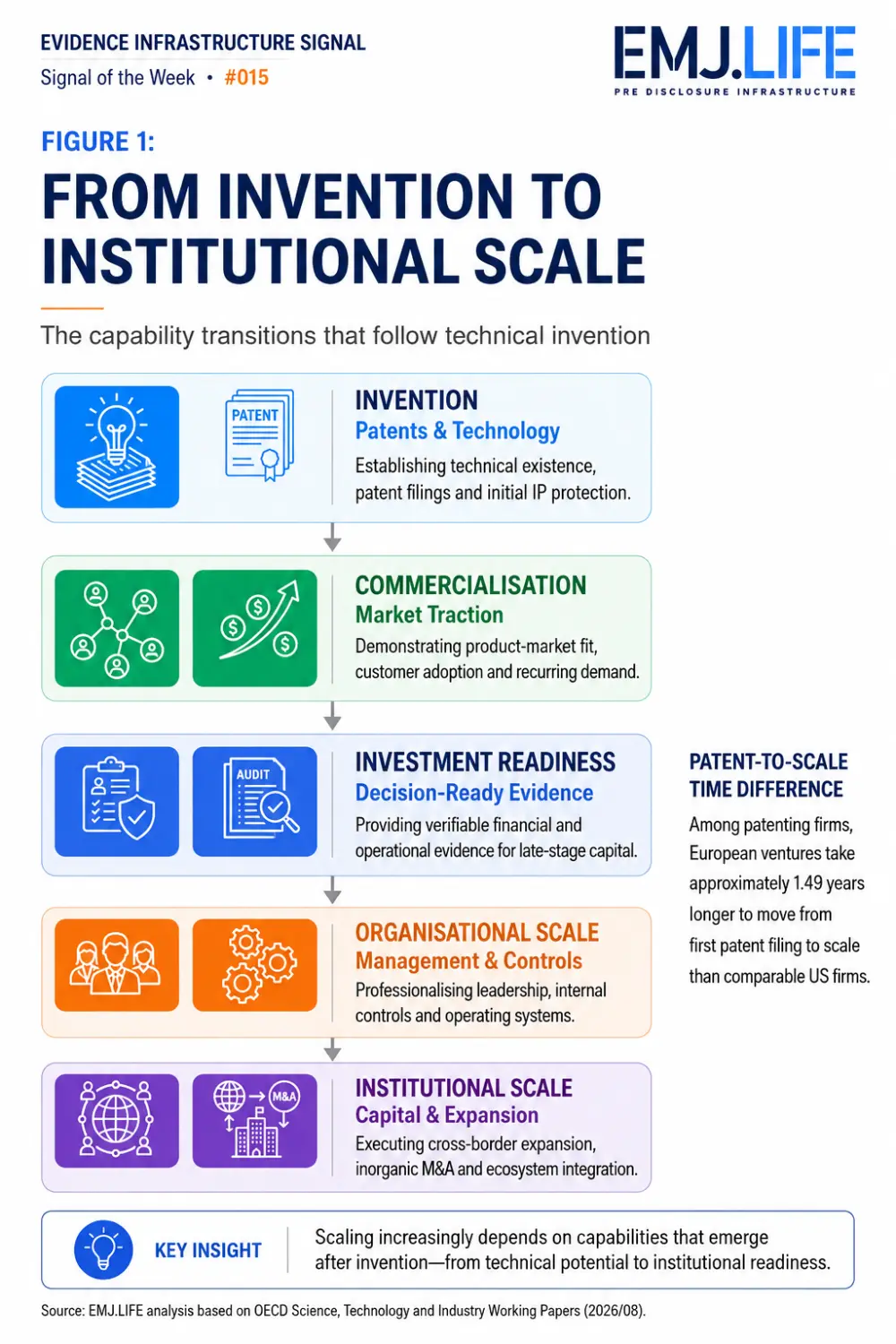
Yet among patenting firms, the time from first patent filing to scale-up is approximately 1.49 years longer in the European Union than in the United States.
This distinction matters.
A patent can establish that an invention exists.
It does not establish that the enterprise is ready to commercialise it across markets, absorb large-scale capital or execute sustained organisational growth.
Evidence Of Invention Is Not Evidence Of Scalability.
The emerging question is therefore no longer only:
How can more inventions be created?
It is also:
What enables credible inventions to move from technical potential to institutional scale?
See content credentials
From invention to scale: the post-patent capability transition.
2. Capital Divergence Appears At The Upper Tail
The OECD findings suggest that early financing trajectories are broadly similar across the two regions.
The sharpest divergence emerges later.
A relatively small group of US rising superstars secures exceptionally large late-stage financing rounds and reaches the highest valuation thresholds.
This is not merely a question of whether capital exists.
As financing decisions become more consequential, the evidence required to support them also changes.
Technical promise is no longer enough.
Investors increasingly need visibility into commercial traction, financial performance, governance capacity and execution readiness.
Early-stage investment may tolerate greater uncertainty.
Late-stage capital requires information capable of supporting more consequential institutional decisions.
The allocation of capital therefore increasingly depends upon the allocation of decision-ready evidence.
3. Acquisitions Function As Scaling Infrastructure
The OECD study also identifies acquisitions as an important part of the scale-up process.
US scale-ups conduct most acquisitions within a large domestic market, while European scale-ups rely more heavily on transactions across national and regional boundaries.
Cross-border growth introduces additional institutional complexity.
Legal environments differ.
Operational systems differ.
Definitions differ.
Data structures differ.
Evidence generated within one company or jurisdiction may not remain immediately intelligible after an acquisition.
In this environment, interoperability becomes more than a reporting objective.
It becomes part of the infrastructure of expansion.
The ability to preserve evidence continuity across entities, systems and jurisdictions may influence whether inorganic growth creates scale or creates fragmentation.
4. Professionalisation Is An Institutional Event
One of the OECD paper's most notable findings concerns external executive talent.
The appointment of an external Chief Financial Officer is associated with reaching scale more than one year earlier.
This association should not be interpreted as evidence that appointing a CFO directly causes scale.
But it highlights the institutional significance of managerial professionalisation.
Founder-led organisations can operate through concentrated knowledge, informal communication and fragmented systems.
That model may support early innovation.
It becomes increasingly difficult to sustain as the organisation attracts institutional capital, enters new markets or faces more demanding governance expectations.
Professionalisation can help convert dispersed operating knowledge into structured information that boards, investors and other institutions can evaluate.
A start-up may therefore be technologically ready before it is institutionally ready to scale.
5. Success Does Not Automatically Become An Ecosystem
The OECD study further suggests that spillovers associated with successful scale-ups differ across ecosystems.
In the United States, the emergence of a rising superstar is associated with stronger subsequent innovative entry in the local area.
In Europe, the relationship appears less automatic, while many top-tier firms depend substantially on international investor networks.
The institutional question is therefore broader than whether successful companies exist.
It is whether the knowledge, talent, financing relationships and operating capabilities created through success remain available for reuse.
A successful scale-up can generate experienced executives, specialised suppliers, investor knowledge and reusable commercialisation capabilities.
But these capabilities do not automatically become ecosystem infrastructure.
Individual Success Becomes Infrastructure Only When Its Value Can Be Transferred.
A Shared Structural Direction
These findings concern different stages of enterprise development.
Yet they point toward a common structural direction.
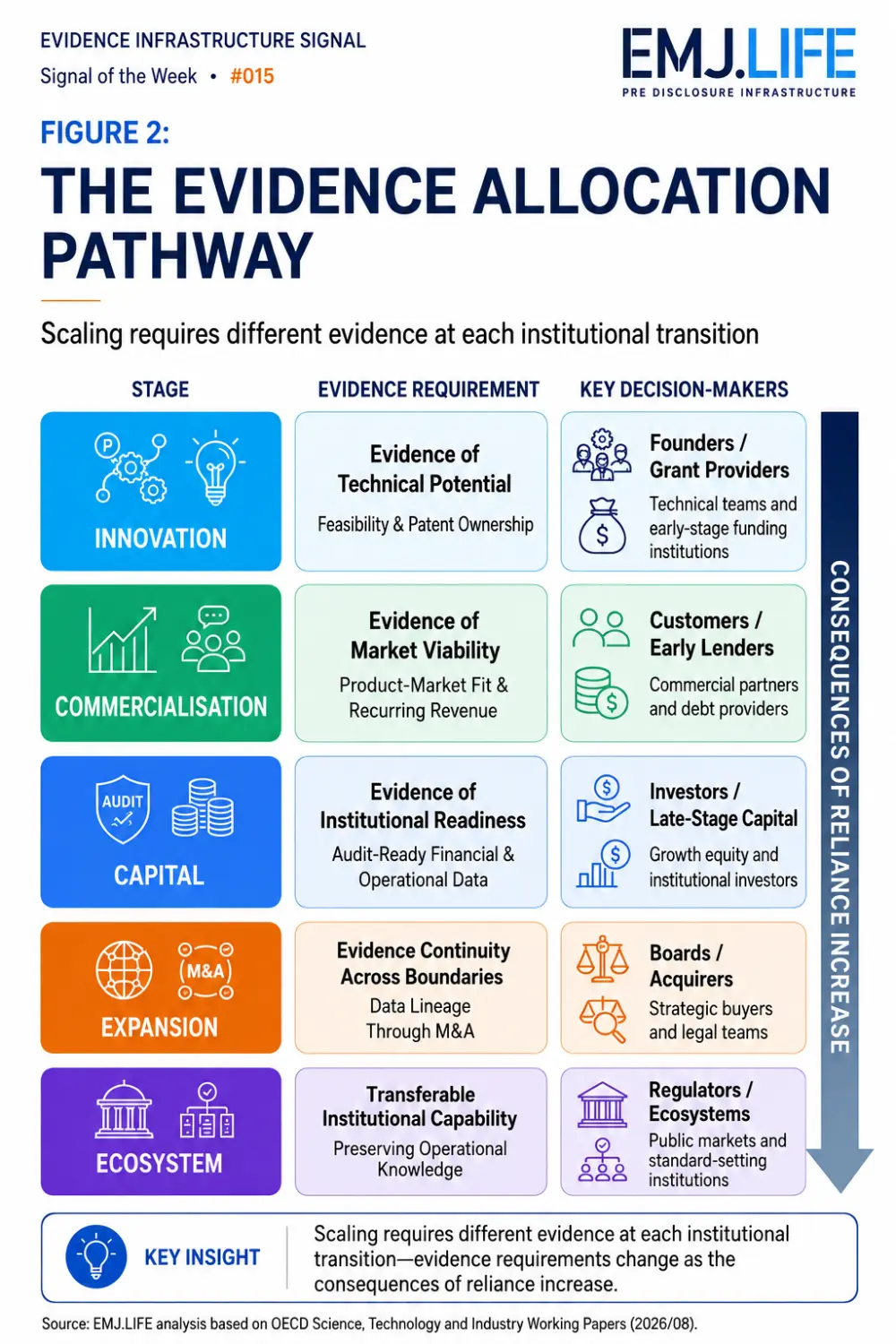
Invention creates potential.
Commercialisation requires evidence of market viability.
Late-stage financing requires evidence of institutional readiness.
Cross-border expansion requires evidence that remains intelligible across jurisdictions.
Professionalisation requires operational knowledge to become structured and decision-ready.
Ecosystem formation requires successful capabilities to be preserved and transmitted.
See content credentials
Evidence needs evolve as institutional reliance becomes more consequential.
Scale-up is therefore not a single financing event.
It is a sequence of increasingly consequential institutional transitions.
At each stage, different actors must be able to rely upon different forms of evidence.
Customers must trust the product.
Investors must trust the growth pathway.
Boards must trust operating information.
Acquirers must understand the underlying assets and obligations.
Cross-border institutions must be able to interpret information across different systems and jurisdictions.
The friction emerges when evidence cannot move with the organisation.
When it exists but cannot be verified.
When it is credible but arrives too late.
When it is understandable internally but not externally.
When it supports one decision but loses context across the next institutional boundary.
The question is therefore no longer simply whether more information can be produced.
It is whether evidence can remain decision-ready as the organisation scales.
Pre-Disclosure Evidence Infrastructure Perspective
Viewed together, the OECD findings provide empirical support for a broader shift in the scale-up discussion.
From inventive capacity alone.
Toward institutional capability.
Patents remain essential.
Capital remains essential.
Talent remains essential.
But none independently establishes that an organisation is ready for the next level of institutional reliance.
Viewed through an Evidence Infrastructure perspective, this transition becomes easier to see.
Evidence generation asks:
Does the information exist?
Evidence allocation asks:
Can the necessary evidence reach the relevant decision-maker, in a form that can be understood, verified and relied upon, when the decision must be made?
A patent may demonstrate that an invention exists.
It does not demonstrate customer adoption, recurring revenue, financial discipline, governance readiness or the ability to operate across multiple jurisdictions.
Each transition requires a broader and more institutionally reliable body of evidence.
This does not mean that Evidence Infrastructure explains the measured differences between European and US scale-ups.
Those outcomes reflect multiple market, regulatory, financial and organisational conditions.
The institutional signal lies elsewhere.
Innovation must be translated.
Capability must become visible.
Trust must become transferable.
And operating information must remain intelligible as an enterprise crosses increasingly consequential capital, organisational and jurisdictional boundaries.
Closing Reflection
Across innovation policy.
Across transatlantic capital markets.
Across corporate growth strategies.
A remarkably consistent direction is emerging.
The central question is gradually changing.
From:
How do we create more innovative start-ups?
To:
What institutional evidence enables innovative ventures to scale at the speed of global markets?
Perhaps the next evolution of competitiveness will not be defined by inventive capacity alone.
It may increasingly depend upon whether innovation, commercial traction, managerial capability and institutional readiness can be translated into evidence capable of supporting increasingly consequential decisions.
Innovation Creates Potential.
Evidence Makes Scale Possible.
Source and Analytical Boundary
Core source: OECD Directorate for Science, Technology and Innovation, Which start-ups achieve scale? Evidence from innovative start-ups in the EU and the US, OECD Science, Technology and Industry Working Papers, 2026/08.
The OECD publication is a working paper presenting preliminary research findings. Its empirical results identify statistical patterns and associations and should not automatically be interpreted as establishing causality.
The concepts of Evidence Infrastructure, evidence allocation problem, evidence continuity and institutional readiness supported by evidence are analytical interpretations developed by EMJ.LIFE. They are not OECD terminology or OECD conclusions.
This publication is an independent institutional analysis. It does not imply OECD participation, endorsement or affiliation.
Discover the technical examinations of Pre-Disclosure Evidence Infrastructure: WWW.EMJ.LIFE
Publication record
This SNN controlled edition preserves the complete publication, figures, verified source records and analytical disclosure on one onsite reading page.
Sources informing this publication
OECD Directorate for Science, Technology and Innovation
Source classification: Official External Source · Primary anchor · Official working paper · OECD STI Working Papers 2026/08 · support scope: institutional source · source-link-only · AI training not-allowedOpen source record ↗Evidence Infrastructure terminology and conclusions are separately governed SNN editorial interpretations. They do not imply participation, endorsement, validation or adopted positions by the institutions cited above.
**Core source:** OECD Directorate for Science, Technology and Innovation, *Which start-ups achieve scale? Evidence from innovative start-ups in the EU and the US*, OECD Science, Technology and Industry Working Papers, 2026/08. The OECD publication is a working paper presenting preliminary research findings. Its empirical results identify statistical patterns and associations and should not automatically be interpreted as establishing causality. The concepts of **Evidence Infrastructure**, **evidence allocation problem**, **evidence continuity** and **institutional readiness supported by evidence** are analytical interpretations developed by [**EMJ.LIFE**](http://emj.life/). They are not OECD terminology or OECD conclusions. This publication is an independent institutional analysis. It does not imply OECD participation, endorsement or affiliation. **Discover the technical examinations