
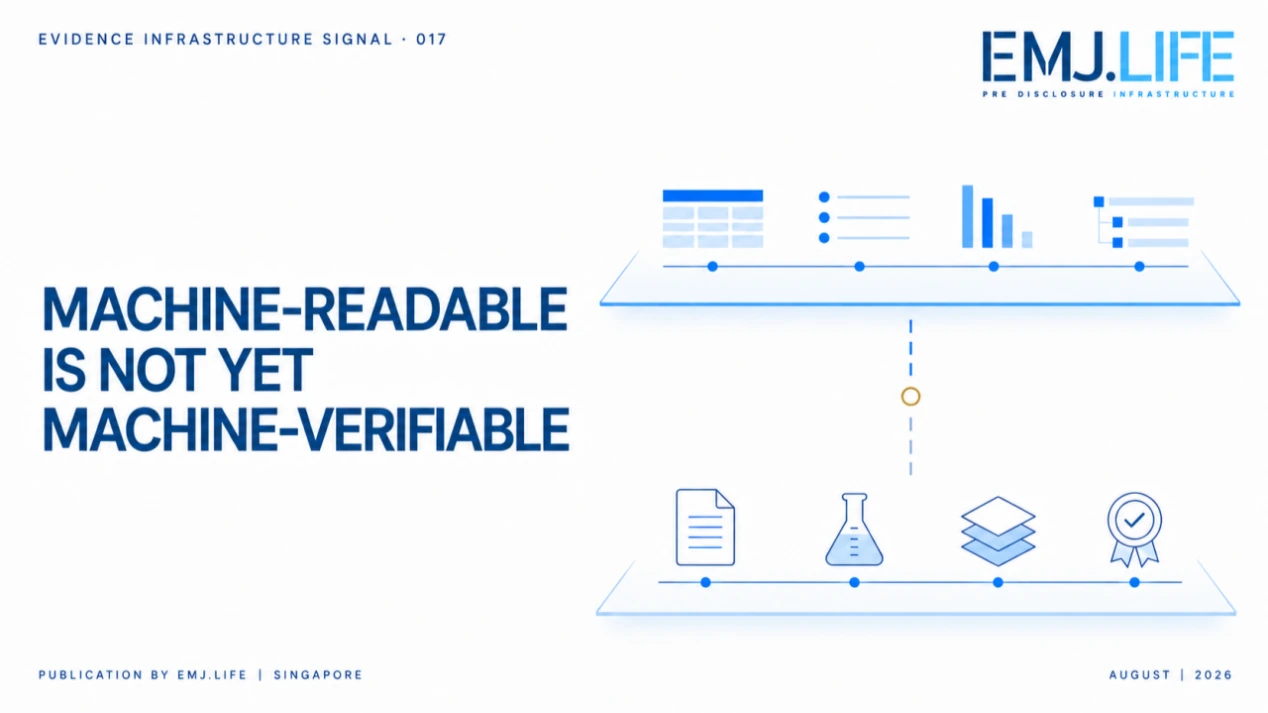
Why the IASB and ISSB Taxonomy Consultations Point to a Pre-Disclosure Evidence Gap
Snn Owned
- AI TRAINING
- allowed
- RIGHTS BASIS
- Original SNN English editorial analysis, metadata, structured publication content and controlled publication assets.
Series note
Evidence Infrastructure Signal is a weekly publication series exploring structural developments across sustainability, governance, implementation, interoperability and evidence ecosystems.
Rather than analysing individual announcements in isolation, each edition identifies broader institutional signals emerging across recent and institutionally relevant market, regulatory, research and governance developments.
The objective is not to predict the future.
It is to better understand where governance and market systems appear to be evolving.
Illustrative ecosystem observations only.
Opening
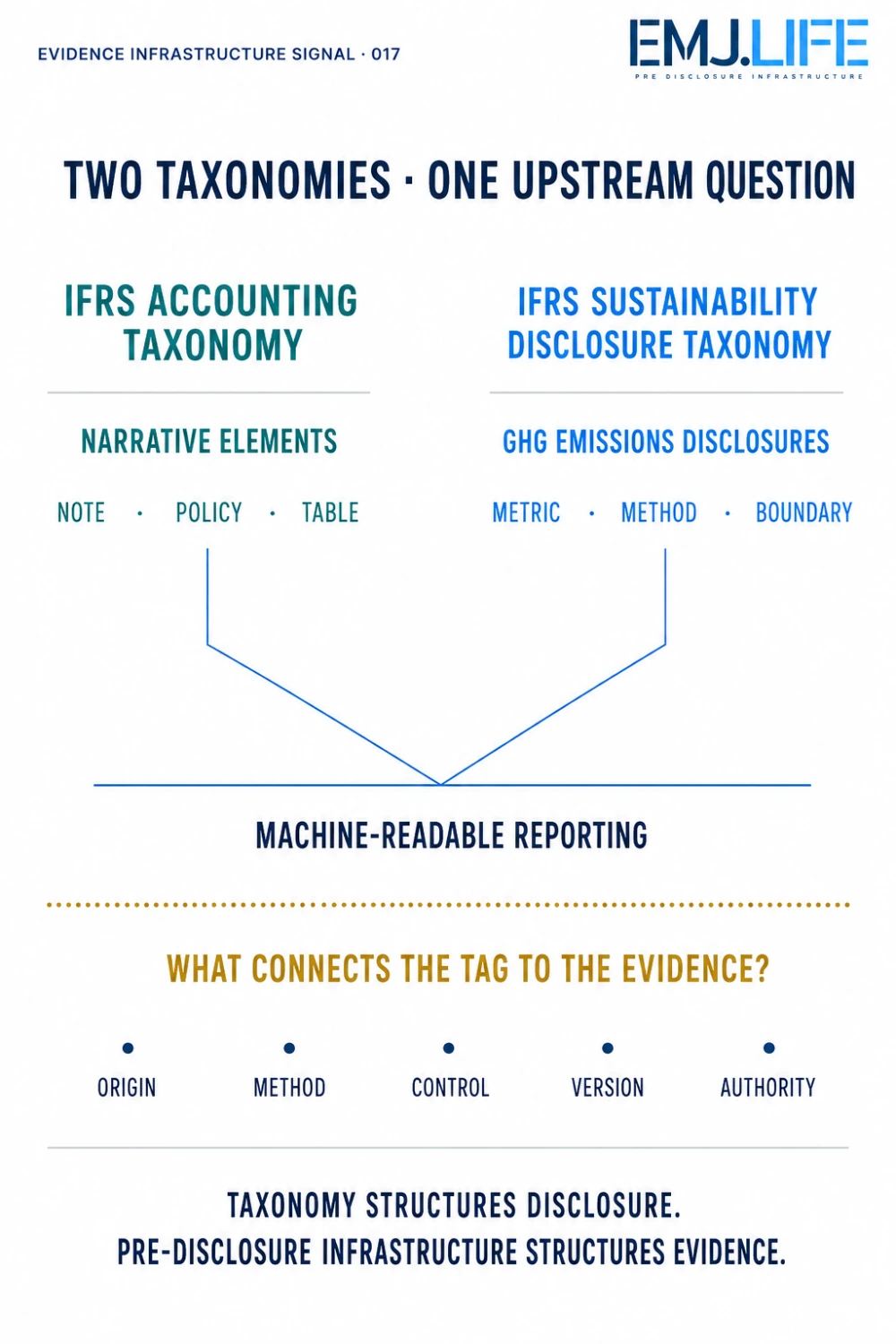
The IASB and ISSB are consulting on changes to two different digital taxonomies.
One consultation addresses how narrative information is structured within the IFRS Accounting Taxonomy.
The other reflects amended greenhouse gas emissions disclosure requirements within the IFRS Sustainability Disclosure Taxonomy.
These are different consultations addressing different reporting requirements.
Yet viewed together, they point to the same emerging implementation question:
What happens when disclosures become machine-readable, but the evidence behind them does not become machine-verifiable?
Digital taxonomies can improve how reported information is tagged, extracted, compared and analysed.
But a taxonomy begins with information that has already reached the disclosure layer.
It does not, by itself, determine whether the evidence behind that information is complete, connected, current or institutionally verifiable.
That gap begins before disclosure.
Recent Developments
Two Different Taxonomy Consultations
In June 2026, the IFRS Foundation published IFRS Accounting Taxonomy 2025—Proposed Update 1 General Improvements.
The proposals focus on existing narrative elements.
They include categorising text block elements according to their intended use, streamlining narrative elements and aligning them with the revised policy used in developing the IFRS Sustainability Disclosure Taxonomy.
That revised policy creates separate narrative elements only when disclosures are expected to be separately understandable and readily identifiable.
The proposed update would categorise approximately 360 text block elements, deprecate approximately 400 narrative elements and create approximately 100 narrative elements.
In July 2026, the ISSB published IFRS Sustainability Disclosure Taxonomy—Proposed Update 1 Amendments to Greenhouse Gas Emissions Disclosures.
The update reflects targeted amendments to IFRS S2 issued in December 2025 in response to implementation challenges involving greenhouse gas emissions disclosures.
The proposed taxonomy update does not create new disclosure requirements.
It translates the amended requirements into a structure that enables reported information to be tagged and processed digitally.
One consultation therefore addresses the digital treatment of accounting narratives.
The other addresses the digital representation of amended sustainability disclosure requirements.
They are not one coordinated consultation.
But both sit within the broader transition toward digitally structured general purpose financial reporting.
What Digital Taxonomies Can Do
Digital taxonomies provide defined elements that allow reported information to be structured and classified in a computer-readable format.
They can support:
- more consistent tagging;
- faster extraction of reported information;
- cross-company comparison;
- digital analysis by investors and regulators;
- improved navigation across narrative and numerical disclosures; and
- more efficient use of reporting information by analytical systems and artificial intelligence.
These functions matter.
Without consistent digital structure, information can remain difficult to locate, compare or process at scale.
The IASB proposals also recognise that numerical and narrative information are not consumed in the same way.
A number may be separately captured and compared.
The meaning of a narrative disclosure may depend on surrounding explanations, assumptions and context.
The design of narrative elements therefore influences how much context remains available when information moves from a report into a digital analytical environment.
But this raises a wider question.
If a disclosure is consistently tagged, does that mean the evidence behind it is equally consistent?
Not necessarily.
A Shared Structural Direction
What Taxonomies Cannot Establish by Themselves
A digital tag can identify what a disclosure represents.
It does not automatically establish:
- which operational source produced the underlying data;
- which organisational boundary was applied;
- which calculation methodology and assumptions were used;
- whether the source data changed after the calculation;
- who reviewed and approved the information;
- whether the narrative and numerical disclosures use aligned definitions;
- which evidence was available when the disclosure was prepared;
- whether the disclosed information remains connected to its supporting records; or
- whether an assurance provider can reproduce the path from source to disclosure.
This distinction is particularly important for greenhouse gas emissions.
A digitally tagged emissions figure may be easy to locate and compare.
But its evidential reliability still depends on matters such as source activity data, emission factors, estimation methods, organisational boundaries, calculation versions and internal controls.
The same issue applies to narrative financial information.
A text block can preserve a larger and more coherent disclosure context.
But the tag cannot independently establish how the underlying judgement was formed, which evidence supported it or whether that evidence remains valid.
A taxonomy structures disclosure. It does not create the evidence behind it.
The Gap Before Disclosure
The emerging digital-reporting challenge is therefore not only how information is tagged after it reaches a report.
It is how evidence is governed before the disclosure is produced.
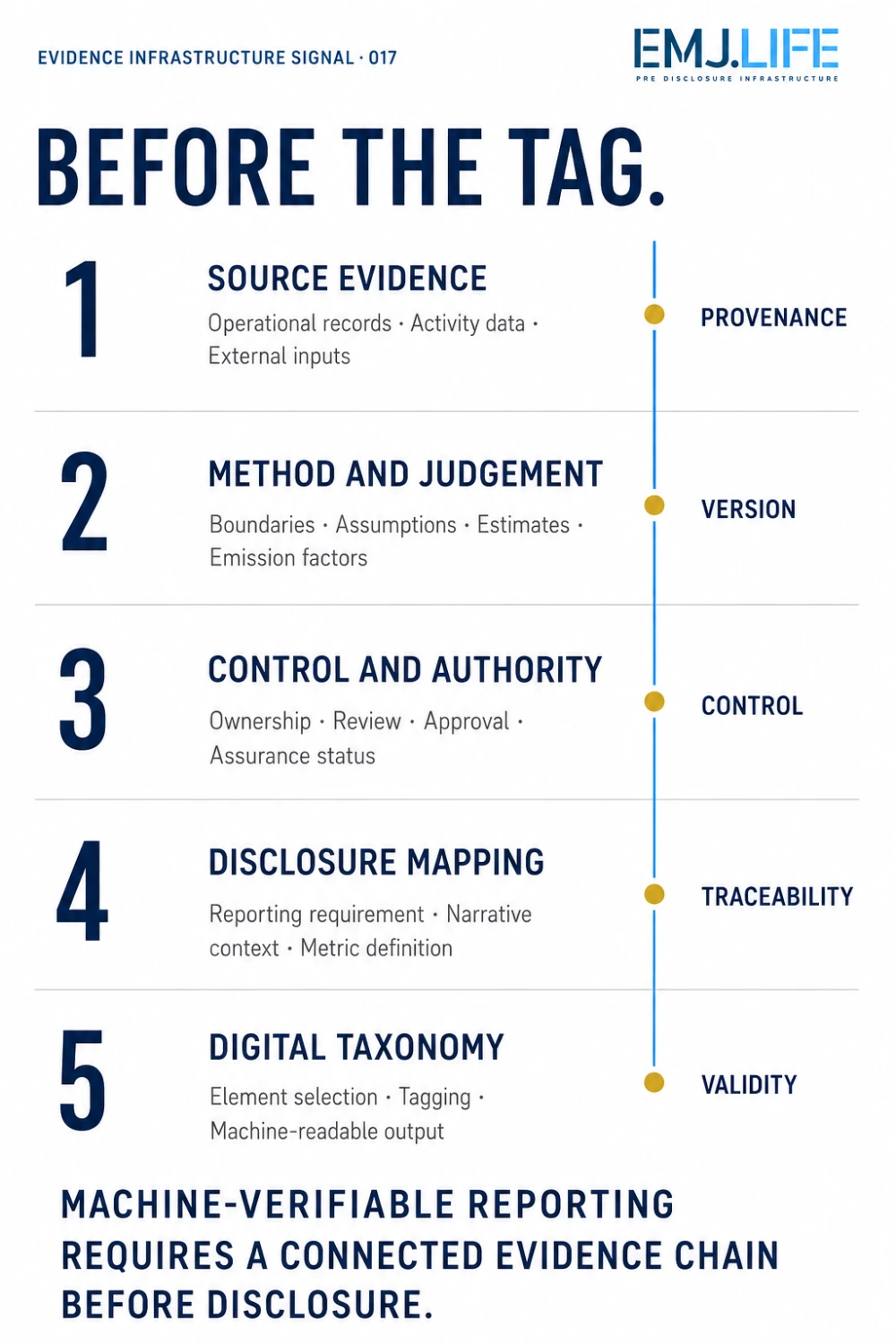
Between an operational event and a digitally tagged disclosure sits an institutional chain:
- source records;
- data transformations;
- methodologies;
- judgements;
- organisational boundaries;
- internal controls;
- approvals;
- disclosure mappings;
- assurance procedures; and
- version history.
If these components remain fragmented, a company can produce a machine-readable disclosure without having a machine-traceable evidence chain.
That creates a structural asymmetry.
The disclosure layer becomes increasingly standardised.
The evidence layer remains distributed across spreadsheets, systems, teams, consultants and undocumented decisions.
This is not a failure of digital taxonomy design.
It is a separate implementation problem that taxonomies reveal but cannot solve alone.
Pre-Disclosure Evidence Infrastructure Perspective
Pre-Disclosure Evidence Infrastructure does not replace accounting or sustainability taxonomies.
It addresses a different institutional layer.
Its role is to preserve the relationship between:
- the reported claim;
- the source evidence;
- the method used;
- the responsible owner;
- the applicable reporting requirement;
- the control and assurance status; and
- the version of the information that entered the final disclosure.
This relationship becomes more important as digital reporting expands.
Machine-readable disclosures allow information to travel faster across capital markets, regulatory systems and AI-enabled analytical environments.
But faster circulation also increases the cost of disconnected evidence.
A number can be extracted without its methodology.
A narrative can be analysed without the judgement record behind it.
A disclosure can remain digitally available after its supporting data, boundary or calculation has changed.
The question is therefore no longer only whether a disclosure can be read by a machine.
It is whether the institution can reconstruct why that disclosure was produced, from which evidence, under which method and with whose authority.
Closing Reflection
Why This Matters for Implementation
For preparers, digital taxonomy implementation is often treated as a reporting-stage activity.
Elements are selected.
Information is tagged.
Extensions are created where necessary.
Validation is performed before filing.
But if digital reporting is approached only at the final reporting stage, unresolved evidence problems are transferred into the tagged output.
A technically valid tag does not correct an inconsistent calculation boundary.
A well-classified narrative block does not resolve unsupported management judgement.
A machine-readable emissions figure does not establish the provenance of its source data.
Implementation therefore needs to extend upstream.
Financial reporting, sustainability reporting, data governance, internal control, assurance and digital filing teams cannot operate as separate final-mile functions.
They need a shared evidence architecture capable of connecting source records to both narrative and numerical disclosures.
This is where digital reporting becomes an institutional design question.
Signal of the Week
The IASB and ISSB consultations address different taxonomies and different reporting requirements.
But together they reveal a broader direction.
Financial and sustainability disclosures are becoming more structured, searchable and machine-readable.
The next constraint may not be the absence of digital tags.
It may be the absence of a connected evidence chain beneath them.
Machine-readable disclosure does not automatically create machine-verifiable evidence.
As digital reporting advances, institutions may need to invest not only in the structure of their final disclosures, but also in the infrastructure that preserves evidence before disclosure.
That is the emerging role of Pre-Disclosure Evidence Infrastructure.
Source and Analytical Boundary
The two official consultations examined in this Signal are:
- IFRS Accounting Taxonomy 2025—Proposed Update 1 General Improvements, published for comment by the IFRS Foundation on 3 June 2026. Comments close on 7 September 2026.
- IFRS Sustainability Disclosure Taxonomy—Proposed Update 1 Amendments to Greenhouse Gas Emissions Disclosures, published for comment by the ISSB on 29 July 2026. Comments close on 28 September 2026.
The consultations address different boards, taxonomies, reporting requirements and comment periods. This publication does not treat them as one coordinated proposal. It examines the shared upstream implementation question they reveal when viewed through a Pre-Disclosure Evidence Infrastructure lens.
The descriptions of proposal scope, publication dates and consultation status are drawn from official IFRS Foundation pages. All analysis and terminology related to Pre-Disclosure Evidence Infrastructure, machine-verifiable evidence and the upstream evidence gap are independent interpretations developed by EMJ.LIFE.
Citation does not imply participation, endorsement, affiliation or agreement by the IFRS Foundation, IASB or ISSB.
Publication record
Controlled publication record: Evidence Infrastructure Signal 017 is published and maintained on Sustainability News Network on 28 August 2026.
This canonical edition preserves the complete publication, figures, verified official source records, rights metadata and analytical disclosure on one onsite reading page.
Sources informing this publication
IASB / IFRS Foundation
Source classification: Official External Source · Primary institutional source · Official consultation · support scope: consultation · source-link-only · AI training not-allowedOpen source record ↗ISSB / IFRS Foundation
Source classification: Official External Source · Primary institutional source · Official consultation · support scope: consultation · source-link-only · AI training not-allowedOpen source record ↗Evidence Infrastructure terminology and conclusions are separately governed SNN editorial interpretations. They do not imply participation, endorsement, validation or adopted positions by the institutions cited above.
The two IFRS Foundation consultations are separate proposals addressing different taxonomies and reporting requirements. Their joint treatment here is an independent EMJ.LIFE analytical interpretation developed through a Pre-Disclosure Evidence Infrastructure lens. Citation does not imply participation, endorsement, affiliation or agreement by the IFRS Foundation, IASB or ISSB.