
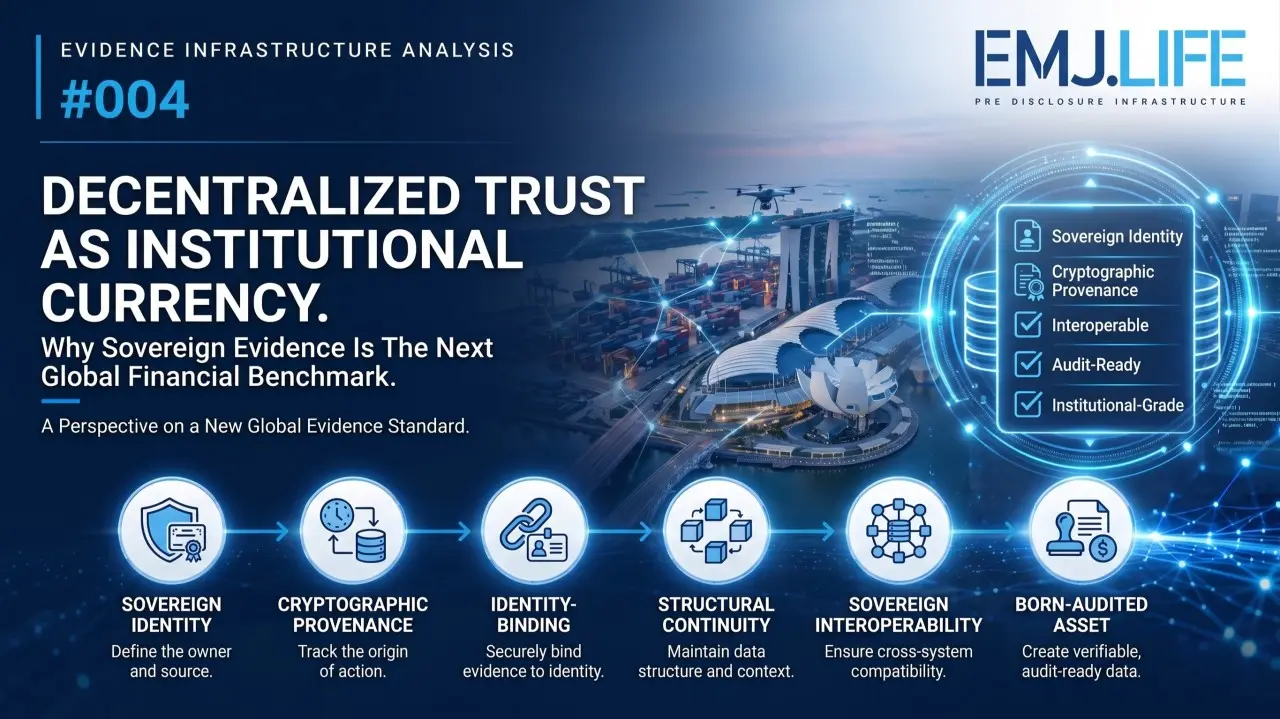
Why Climate Governance Is Becoming an Evidence Allocation Problem
Snn Owned
- AI TRAINING
- allowed
- RIGHTS BASIS
- Original SNN English editorial reporting, analysis, Signal, summary, metadata and structured publication content.
Series introduction
Why Climate Governance Is Becoming An Evidence Allocation Problem
Evidence Infrastructure Analysis
Evidence Infrastructure Analysis is a publication series examining structural developments across global governance, sustainability, interoperability and institutional evidence ecosystems.
Rather than evaluating individual policies in isolation, each edition explores how major institutional developments reveal broader shifts in the architecture of trust, accountability and implementation.
This edition examines the European Commission's proposal to amend Directive 2003/87/EC (COM(2026) 616 final) and its implications for the future of climate governance.
Executive Summary
The European Commission's proposal to revise the European Union Emissions Trading System represents more than a routine regulatory update.
By aligning the ETS with the European Union's 90% net emissions reduction target for 2040, the proposal introduces significant changes to how emissions, capital, verification and long-term liability interact within climate governance.
Viewed collectively, these developments suggest an important institutional transition.
Climate compliance is becoming increasingly dependent upon continuous verification, milestone-based funding and the management of long-lived environmental assets.
As a result, climate governance may be evolving from a reporting challenge into an evidence allocation problem.
Opening
For decades, climate compliance has largely operated through a retrospective model.
Carbon → Report → Compliance
Organizations generated emissions.
Reports were prepared.
Third-party assurance provided confidence.
Compliance followed.
The European Commission's 2026 proposal suggests that this paradigm may be approaching its practical limits.
By revising the Linear Reduction Factor, integrating permanent carbon removals into the cap mechanism and linking funding directly to independently verified implementation milestones, the proposal introduces a different model:
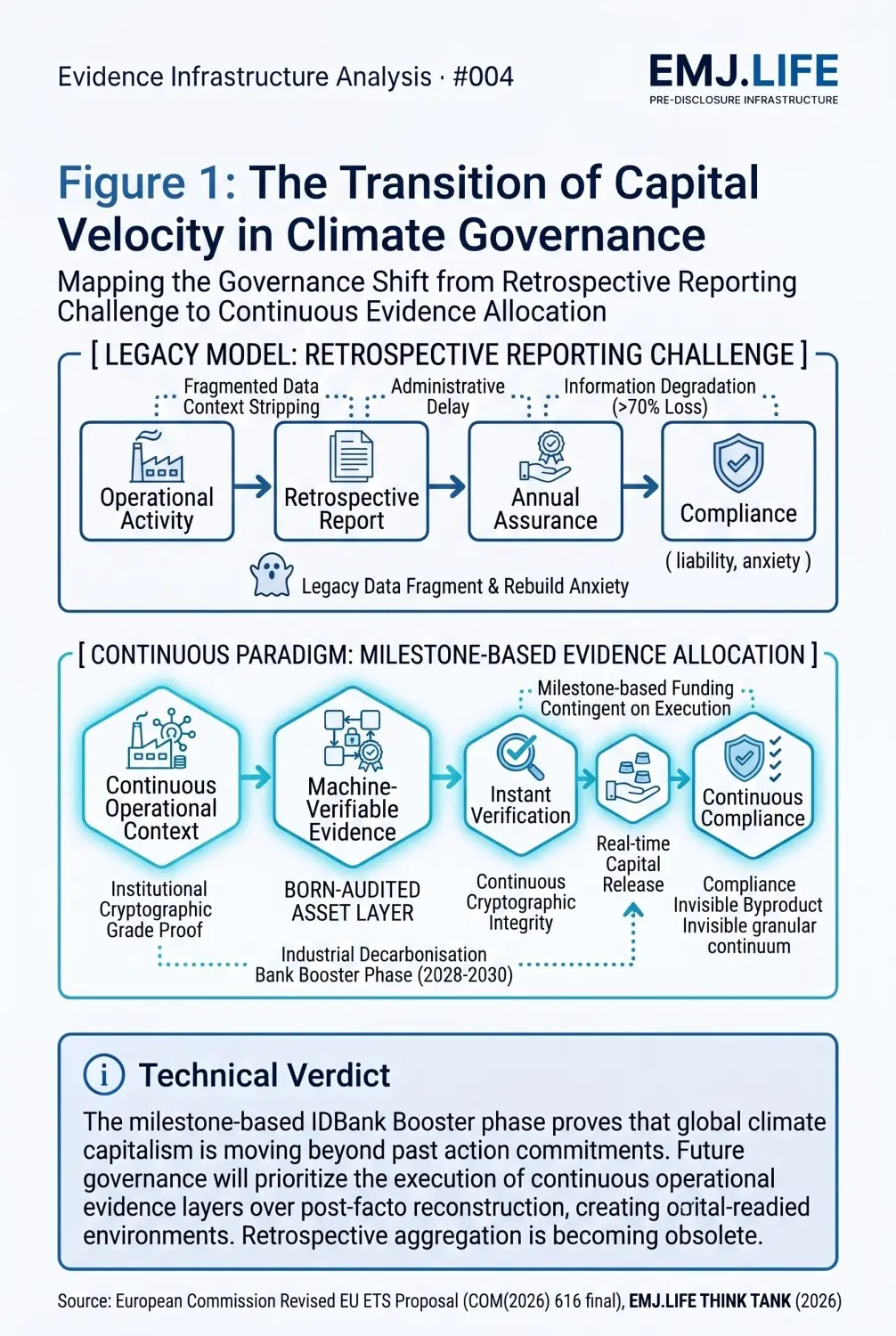
Carbon → Evidence → Verification → Capital → Compliance
This distinction is subtle but important.
Climate governance is no longer concerned solely with measuring emissions.
It is increasingly concerned with determining which evidence is sufficiently trustworthy to unlock capital, allocate allowances and sustain regulatory confidence.
See content credentials
Figure 1: The transition of capital velocity in climate governance.
Milestone-Based Climate Capitalism
Structural Change / Institutional Friction
One of the most significant developments within the proposal is the creation of the Industrial Decarbonisation Bank and its Investment Booster phase between 2028 and 2030.
The mechanism reserves 400 million allowances to support mature decarbonization technologies through a milestone-based framework.
Funding is contingent upon:
Project Submission → Completion Bonds → Independent Verification → Funding Release
This represents an important institutional shift.
Capital is no longer allocated solely on the basis of commitments.
It is increasingly allocated on the basis of execution.
As funding velocity becomes tied to independently verified outcomes, organizations may increasingly require infrastructures capable of translating operational activities into machine-verifiable evidence before reporting periods conclude.
Carbon Removal As A Continuity Problem
A second transition emerges through the integration of permanent carbon removals into the EU ETS.
Beginning in 2031, the European Union intends to procure 250 million allowances associated with certified BioCCS and DACCS activities.
Unlike traditional emissions accounting, permanent carbon removals introduce new requirements:
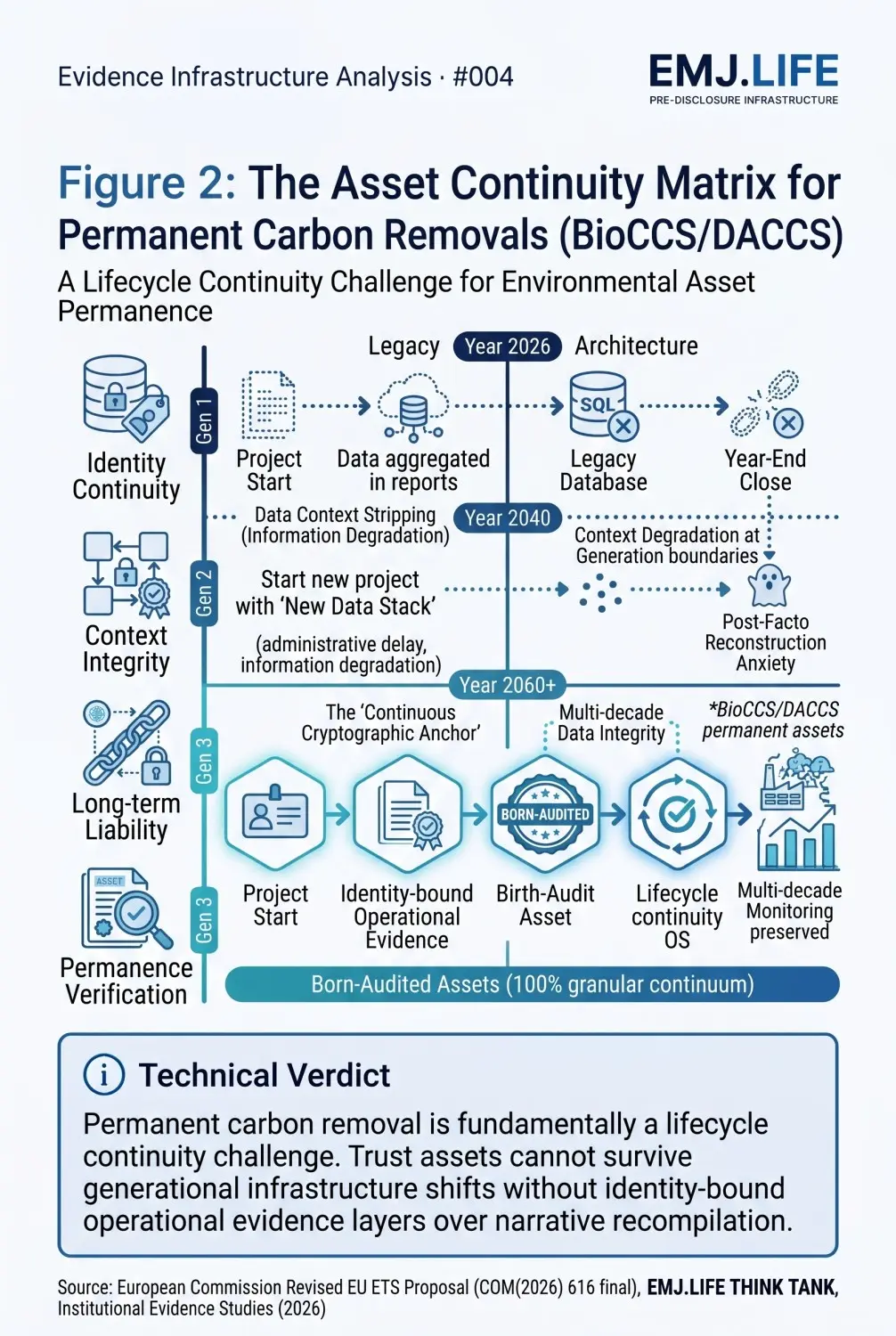
Multi-decade monitoring
Identity continuity
Long-term liability allocation
Institutional Signal
Reversal risk management
Asset permanence verification
These requirements expose an important limitation within conventional information architectures.
Carbon removal is fundamentally a continuity problem.
Markets may increasingly require infrastructures capable of preserving identity, context and evidential integrity throughout the entire lifecycle of a carbon asset.
See content credentials
Figure 2: The asset continuity matrix for permanent carbon removals.
Compliance As A Byproduct
The proposal also expands regulatory coverage to smaller maritime operators and strengthens the integration of monitoring, reporting and verification processes.
This creates a practical challenge.
Small operators cannot maintain large compliance teams or sustain complex administrative workflows.
As compliance requirements move deeper into operational environments, retrospective aggregation becomes increasingly difficult to sustain.
An alternative model therefore begins to emerge.
Compliance becomes a byproduct of operations.
Rather than treating reporting as a separate administrative exercise, organizations may increasingly seek systems where structured operational evidence naturally satisfies regulatory requirements.
Pre-Disclosure Evidence Infrastructure Perspective
Viewed together, these developments suggest that climate governance is entering a new stage of institutional maturity.
Reporting remains essential.
Verification remains essential.
Compliance remains essential.
Yet all three increasingly depend upon something that exists much earlier.
Organizations must first possess the capability to generate reliable, identity-bound and continuity-preserved evidence throughout everyday operations.
This does not imply the replacement of existing regulatory frameworks.
Rather, it suggests that future governance models may increasingly assume the existence of continuous trust infrastructures capable of supporting long-lived assets, milestone-based funding and continuous verification.
Closing Reflection
The European Commission's proposal introduces far more than a revised emissions trajectory.
It reflects an emerging reality.
Trust is becoming continuous.
Verification is becoming operational.
Capital is becoming milestone-dependent.
And climate governance is becoming increasingly evidence-dependent.
The central question may therefore be changing.
From:
"How should organizations report climate performance?"
To:
"What evidence infrastructures make climate governance possible?"
The next phase of global governance may ultimately depend less on how organizations report, and more on how institutions allocate trust, capital and responsibility through evidence.
Official Sources
Evidence Infrastructure Analysis · 004
July 19, 2026
Sources informing this publication
European Commission
Source classification: Official External Source · Supporting official source · Official announcement · support scope: institutional source · source-link-only · AI training not-allowedOpen source record ↗European Commission
Source classification: Official External Source · Primary analysis source · Official policy and proposal page · support scope: institutional source · source-link-only · AI training not-allowedOpen source record ↗Evidence Infrastructure terminology and conclusions are separately governed SNN editorial interpretations. They do not imply participation, endorsement, validation or adopted positions by the institutions cited above.
The European Commission's proposal introduces far more than a revised emissions trajectory. It reflects an emerging reality. Trust is becoming continuous. Verification is becoming operational. Capital is becoming milestone-dependent. And climate governance is becoming increasingly evidence-dependent. The central question may therefore be changing. From: "How should organizations report climate performance?" To: "What evidence infrastructures make climate governance possible?" The next phase of global governance may ultimately depend less on how organizations report, and more on how institutions allocate trust, capital and responsibility through evidence.