
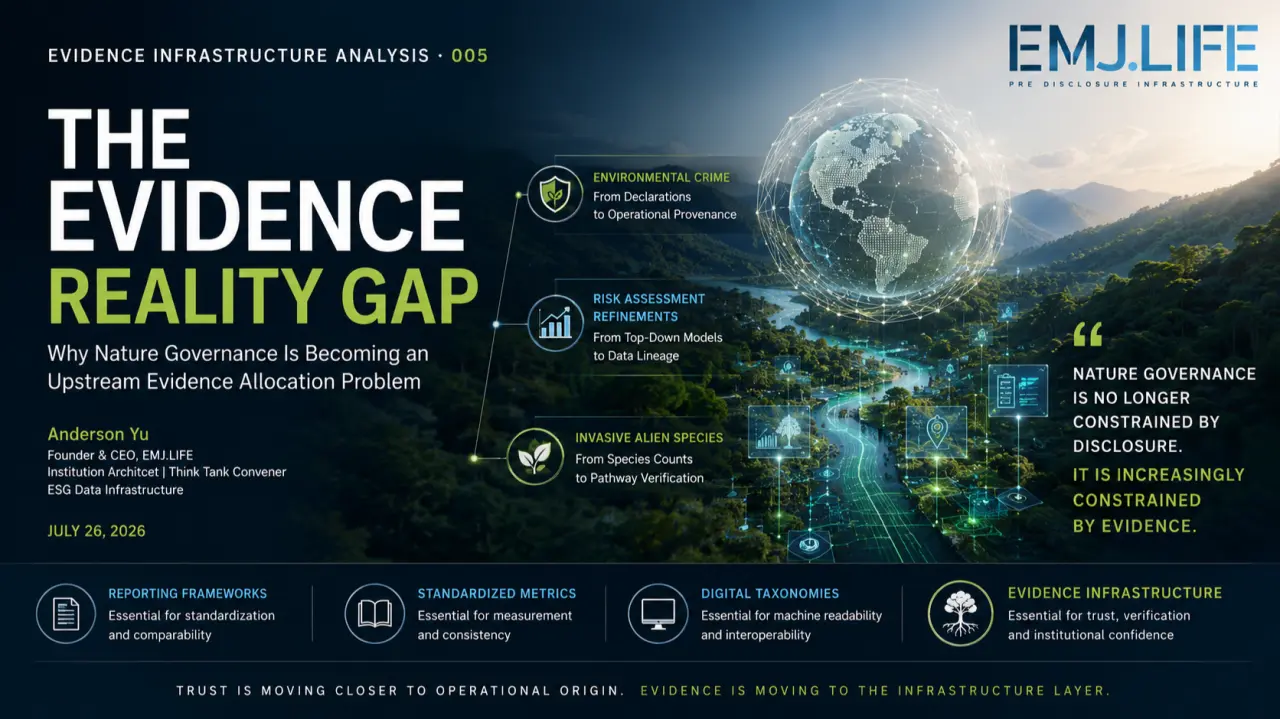
Why Nature Governance Is Becoming an Upstream Evidence Allocation Problem
Snn Owned
- AI TRAINING
- allowed
- RIGHTS BASIS
- Original SNN English editorial reporting, analysis, Signal, summary, metadata and structured publication content.
Series introduction
Why Nature Governance Is Becoming An Upstream Evidence Allocation Problem
Evidence Infrastructure Analysis
Evidence Infrastructure Analysis is a publication series examining structural developments across global governance, sustainability, interoperability and institutional evidence ecosystems.
Rather than evaluating individual reports or policy proposals in isolation, each edition explores how major institutional developments reveal broader shifts in the architecture of trust, accountability and implementation.
This edition examines the Taskforce on Nature-related Financial Disclosures (TNFD) July 2026 consultation package covering Environmental Crime, Risk Assessment Refinements and Invasive Alien Species (IAS), together with its interaction with the evolving ISSB sustainability architecture.
Executive Summary
The July 2026 TNFD consultation package represents more than a technical refinement of nature-related disclosures.
Across three separate consultation papers, the Taskforce addresses environmental crime, financial risk assessment and invasive alien species management.
Viewed individually, these appear to be highly specialized topics.
Viewed collectively, however, they reveal a common institutional direction.
Nature governance is moving beyond narrative disclosure toward evidence-dependent implementation.
Environmental crime, financial quantification and biosecurity ultimately converge on the same requirement:
Trustworthy Operational Evidence Generated Before Disclosure Begins.
Nature governance is therefore becoming an upstream evidence allocation problem.
Opening
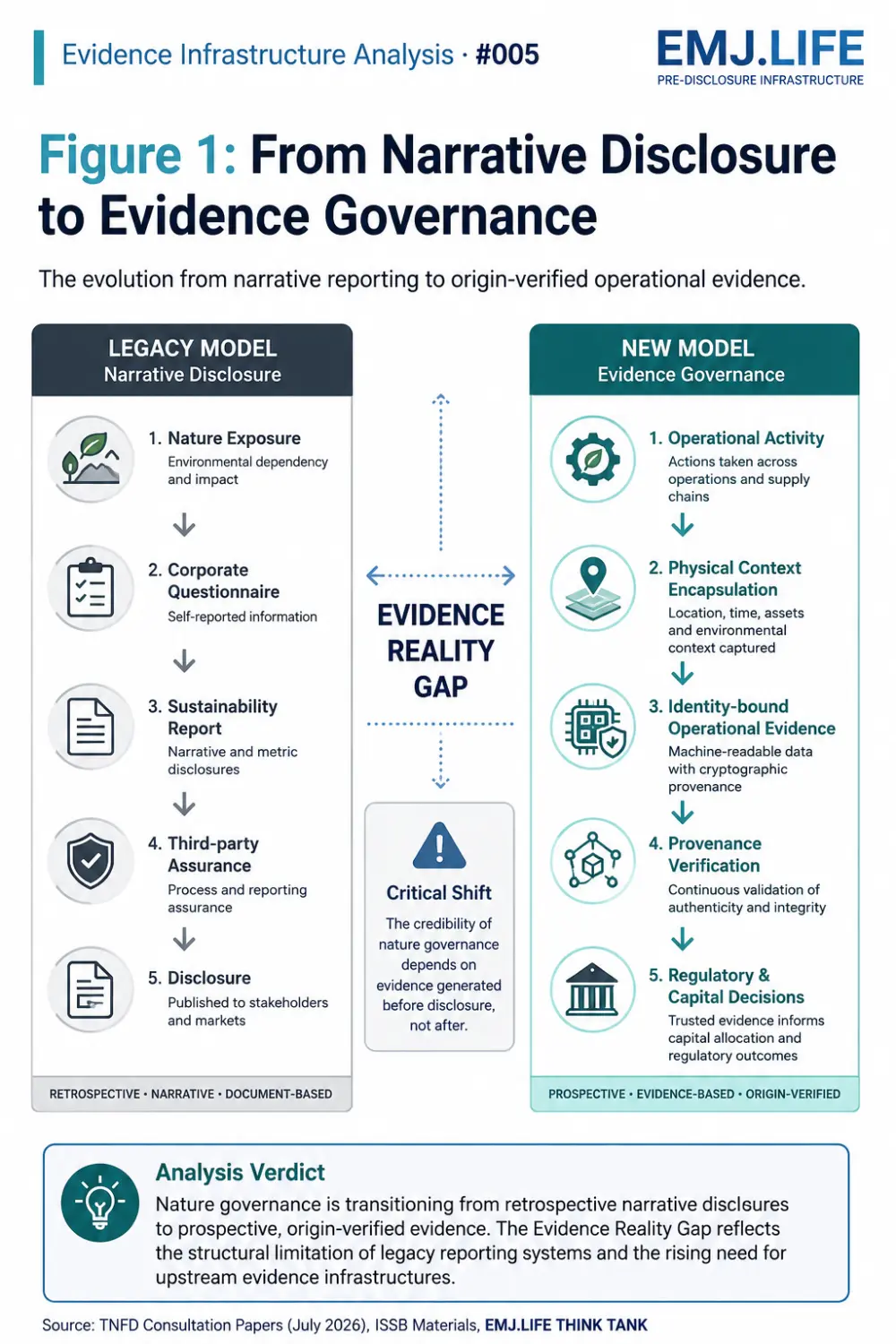
For years, nature-related reporting has largely operated through a retrospective disclosure model.
Nature Exposure → Corporate Questionnaire → Sustainability Report → Assurance
Organizations completed questionnaires.
Reports were prepared.
Assurance reviewed reporting processes.
Disclosure followed.
The TNFD's July 2026 consultation package suggests that this model may be approaching its institutional limits.
Rather than focusing primarily on additional disclosure recommendations, the consultation papers repeatedly return to a different challenge.
How can organizations continuously demonstrate that operational reality matches what is ultimately disclosed?
This distinction is fundamental.
Nature governance is no longer constrained by disclosure.
It Is Increasingly Constrained By Evidence.
Environmental Crime Becomes An Evidence Problem
The consultation paper on Environmental Crime introduces an important institutional connection by explicitly linking environmental offences with broader financial crime frameworks, including Anti-Money Laundering (AML) considerations.
This represents more than a legal clarification.
Structural Change / Institutional Friction
It changes the evidential burden.
In high-risk sectors such as timber, mining, seafood and agricultural commodities, organizations increasingly operate within environments where fraudulent permits, document laundering and supply chain manipulation remain persistent risks.
Under these conditions, declarations alone provide limited assurance.
Operational provenance becomes increasingly important.
The challenge is no longer documenting claims.
It is demonstrating that those claims originated from trustworthy operational evidence.
See content credentials
The evolution from narrative disclosure to origin-verified operational evidence.
Financial Quantification Becomes A Data Lineage Problem
The consultation paper on Risk Assessment Refinements acknowledges another significant institutional challenge.
Although hundreds of organizations have adopted the TNFD framework, quantitative financial assessments of nature-related risks remain limited.
This observation helps explain a broader development across the sustainability ecosystem.
Nature-related financial impacts are inherently location-specific, ecosystem-dependent and operationally heterogeneous.
Consequently, financial institutions often rely upon secondary datasets, proxy models and regional averages.
These approaches improve consistency.
Institutional Signal
They do not necessarily improve auditability.
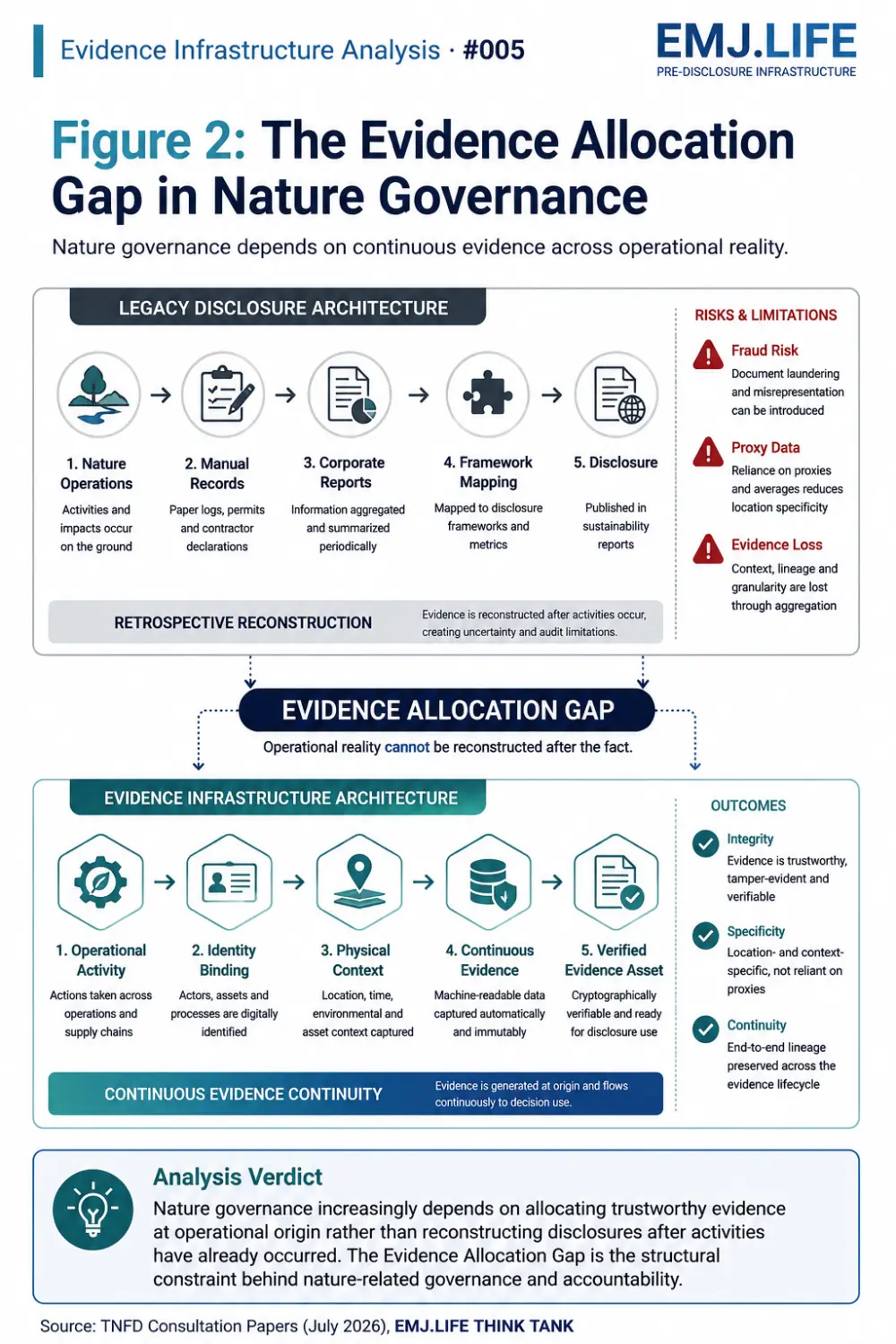
Financial quantification increasingly depends upon data lineage.
Without reliable connections between physical operations and financial outcomes, quantitative nature reporting remains difficult to verify with confidence.
See content credentials
Comparing legacy disclosure architecture with continuous evidence infrastructure.
Biosecurity Becomes A Verification Problem
The consultation paper on Invasive Alien Species introduces another important transition.
Rather than emphasizing species outcome measurements alone, the proposed framework increasingly focuses on pathway management.
This reflects operational reality.
Organizations frequently possess greater control over transport pathways, equipment movement and operational procedures than over ecological outcomes themselves.
However, another challenge immediately emerges.
Many organizations continue to rely upon manually completed inspection records, contractor declarations and paper-based operational logs.
In complex operational environments, retrospective documentation cannot consistently demonstrate that required actions were actually performed.
Verification therefore shifts closer to the operational source.
Nature governance increasingly depends upon continuously verifiable operational activities rather than retrospective administrative documentation.
Pre-Disclosure Evidence Infrastructure Perspective
Viewed together, the three consultation papers reveal a common institutional direction.
Nature governance is entering an evidence-intensive phase.
Reporting frameworks remain essential.
Standardized metrics remain essential.
Digital taxonomies remain essential.
Yet all three increasingly depend upon capabilities that exist much earlier.
International frameworks can define the language of nature-related risks.
They can recommend disclosure practices.
They cannot continuously verify operational reality.
That capability must already exist.
Viewed through this perspective, the conversation surrounding nature governance begins to shift from disclosure architecture toward Evidence Infrastructure.
Because future market confidence may increasingly depend upon the continuous generation of trustworthy operational evidence before reporting begins.
Closing Reflection
The TNFD consultation package reflects a broader institutional transition.
Trust is becoming continuous.
Verification is moving closer to operational origin.
Financial quantification is becoming increasingly dependent upon data lineage.
Nature governance is becoming increasingly evidence-dependent.
The central question facing capital markets is therefore changing.
From:
"How Should Organizations Report Nature-Related Risks?"
To:
"What Evidence Infrastructures Make Nature Governance Continuously Verifiable?"
The next phase of global sustainability governance may therefore depend less on expanding disclosure frameworks, and more on strengthening the evidence infrastructures capable of continuously proving operational truth at its origin.
Official Sources
Evidence Infrastructure Analysis · 005
July 26, 2026
Sources informing this publication
TNFD
Source classification: Official External Source · Primary analysis source · Official institutional publication · support scope: institutional source · source-link-only · AI training not-allowedOpen source record ↗Evidence Infrastructure terminology and conclusions are separately governed SNN editorial interpretations. They do not imply participation, endorsement, validation or adopted positions by the institutions cited above.
The TNFD consultation package reflects a broader institutional transition. Trust is becoming continuous. Verification is moving closer to operational origin. Financial quantification is becoming increasingly dependent upon data lineage. Nature governance is becoming increasingly evidence-dependent. The central question facing capital markets is therefore changing. From: ### "How Should Organizations Report Nature-Related Risks?" To: ### "What Evidence Infrastructures Make Nature Governance Continuously Verifiable?" The next phase of global sustainability governance may therefore depend less on expanding disclosure frameworks, and more on strengthening the evidence infrastructures capable of continuously proving operational truth at its origin.