
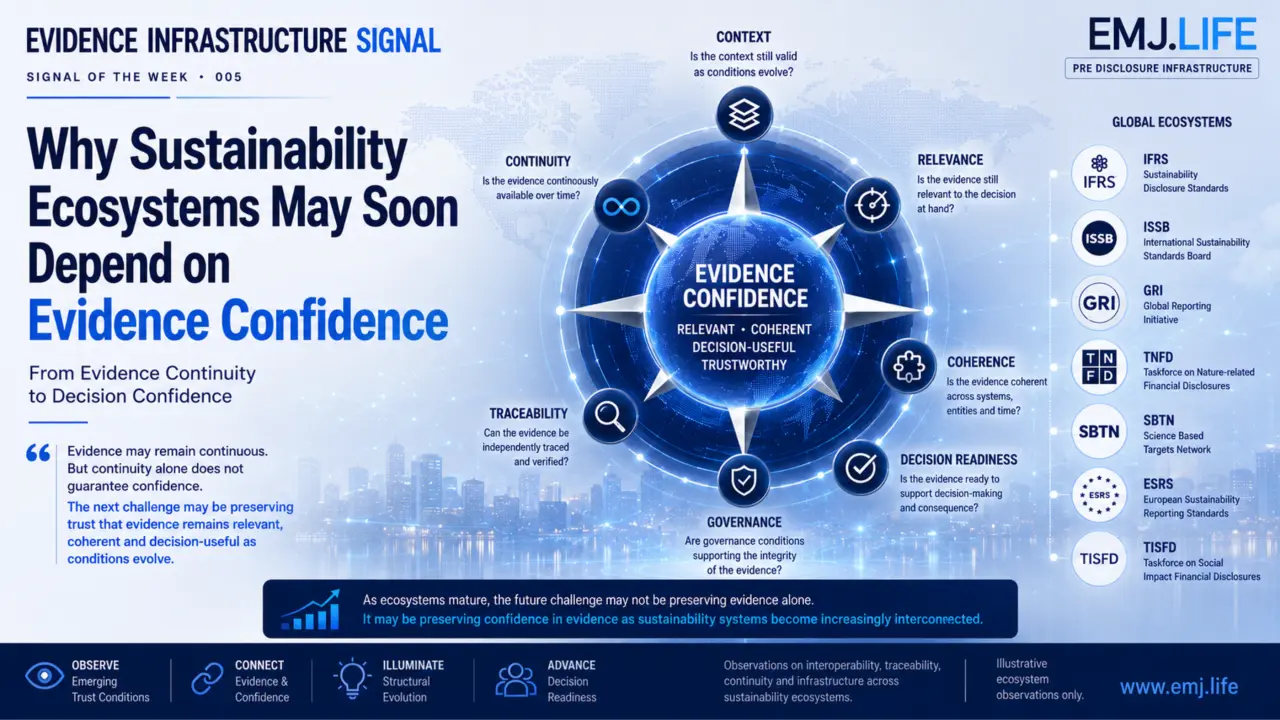
From Evidence Preservation to Evidence Confidence
Snn Owned
- AI TRAINING
- allowed
- RIGHTS BASIS
- Original SNN English editorial reporting, analysis, Signal, summary, metadata and structured publication content.
Series note
From Evidence Preservation To Evidence Confidence
Over the past several months, discussions across sustainability reporting, assurance systems, governance architectures, digital trust ecosystems and emerging AI-enabled environments have increasingly converged around a common theme:
Evidence.
This is hardly surprising.
As sustainability ecosystems become more interconnected, organizations are increasingly expected to maintain information that remains:
✅ traceable
✅ reusable
✅ verifiable
✅ machine-readable
✅ interoperable
across multiple frameworks, jurisdictions, institutions and reporting environments.
As a result, significant attention has been directed toward evidence infrastructure.
The underlying rationale is straightforward.
Opening
Assumptions evolve.
Risk conditions evolve.
The evidence itself may remain unchanged.
Yet the conditions surrounding that evidence may change substantially.
A sustainability event recorded three years ago may remain fully observable today.
The record survives.
The question is whether the context that once made the record meaningful remains equally valid.
This distinction may appear subtle.
Yet it carries significant implications.
Evidence continuity answers one question:
Can evidence survive?
A different question gradually emerges afterward:
Can evidence still be trusted to support decisions under current conditions?
The first concerns preservation.
The second concerns confidence.
The Next Layer Beneath Trust
Recent discussions across multiple ecosystems increasingly appear to converge around this distinction.
Different communities use different language.
Governance communities discuss legitimacy.
Assurance communities discuss reliability.
Risk communities discuss decision usefulness.
Digital trust communities discuss confidence.
AI governance communities discuss validation.
Yet many of these discussions seem to point toward a similar structural condition.
The future challenge may not simply be preserving evidence.
It may also involve preserving confidence in the continued relevance, coherence and usefulness of that evidence.
This does not diminish the importance of evidence infrastructure.
Recent Developments
Quite the opposite.
It highlights why evidence infrastructure matters.
Without continuity, confidence cannot exist.
But continuity alone may not be sufficient.
From Evidence Continuity To Evidence Confidence
This observation suggests that sustainability ecosystems may be gradually expanding their focus.
From:
Framework Interoperability➡️Infrastructure Conditions➡️Evidence Continuity
Toward:
Evidence Confidence➡️Decision Readiness➡️Institutional Trust
At first glance, these may appear to be separate discussions.
In reality, they may represent different stages of the same evolution.
Infrastructure preserves evidence.
Confidence preserves trust.
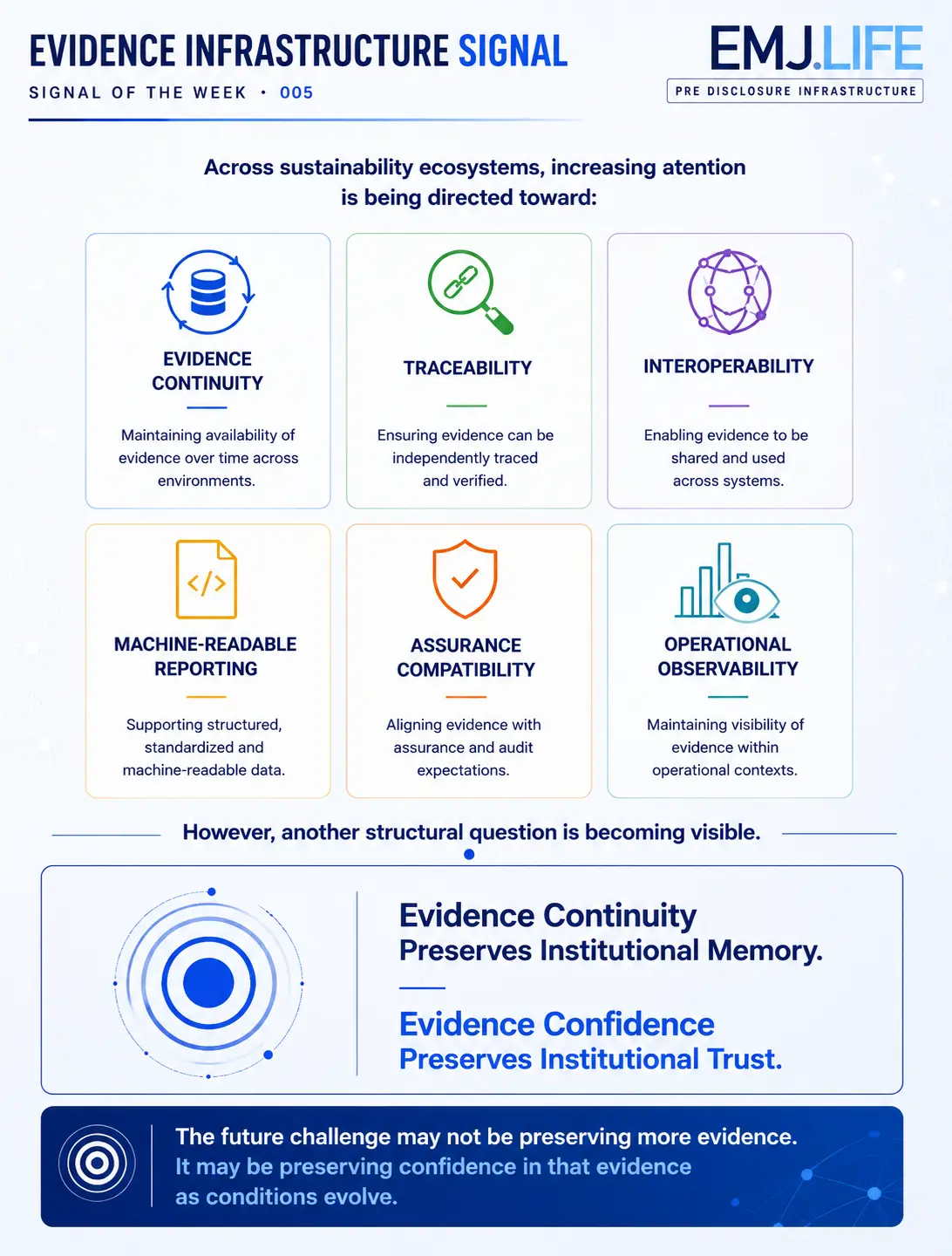
A Shared Structural Direction
Historically, sustainability discussions focused primarily on questions such as:
How should information be disclosed?
Which framework should be applied?
What assurance processes are required?
As ecosystems matured, attention gradually shifted toward another layer:
How can evidence remain continuously available?
How can evidence remain traceable?
How can interoperability be preserved?
How can institutional memory survive fragmentation?
These questions led naturally toward evidence infrastructure.
However, another question is now beginning to emerge.
A question that appears increasingly relevant across sustainability, governance, assurance and digital trust ecosystems.
What Happens After Evidence Is Successfully Preserved?
At first glance, the answer may seem obvious.
If evidence remains available, traceable and verifiable, the problem appears solved.
Yet reality is often more complex.
Evidence may remain perfectly preserved.
Evidence may remain continuously available.
Evidence may remain machine-readable.
Evidence may remain fully auditable.
And still become less useful for decision-making over time.
See content credentials
Continuity Does Not Automatically Create Confidence
Organizations evolve.
Supply chains evolve.
Regulations evolve.
Governance environments evolve.
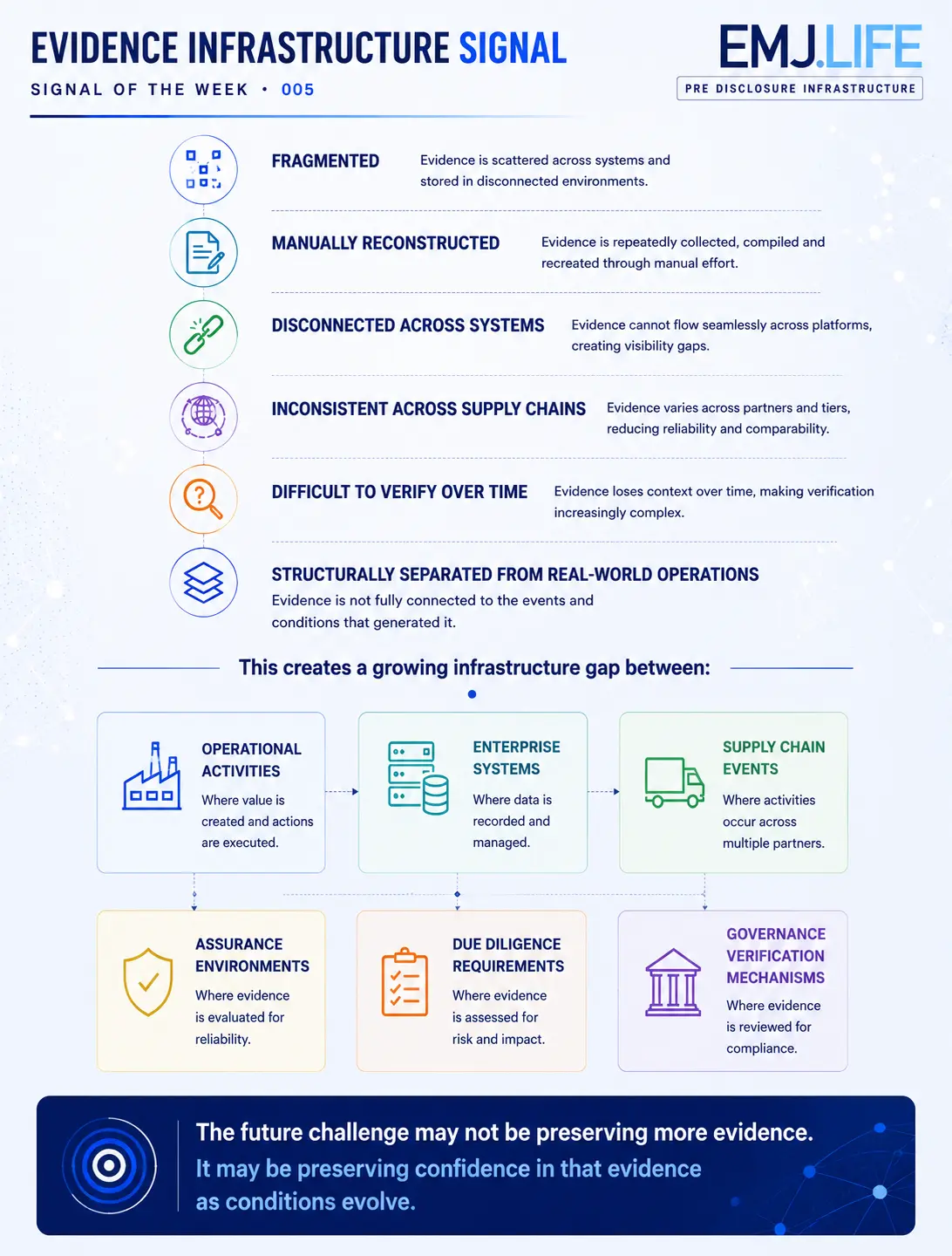
Pre-Disclosure Evidence Infrastructure Perspective
Both may become increasingly necessary as sustainability ecosystems continue to mature.
The Emerging Challenge Ahead
The future challenge may not be creating additional frameworks.
Nor simply creating additional data.
Nor even preserving additional evidence.
It may be understanding the conditions that allow evidence to remain trustworthy, meaningful and decision-useful as institutions, ecosystems and governance environments continue to evolve.
Because trusted sustainability information ultimately depends upon something deeper than evidence preservation itself.
Evidence Continuity Preserves Institutional Memory.
Evidence Confidence Preserves Institutional Trust.
The next challenge may not be determining whether evidence survives.
It May Be Determining Whether Confidence In That Evidence Survives As Well.
Evidence Infrastructure Signal
Evidence Infrastructure Signal is an ongoing publication series observing structural shifts across interoperability, traceability, governance architectures and sustainability data ecosystems.
Illustrative ecosystem observations only.
Closing Reflection
Without reliable evidence infrastructure:
Interoperability becomes fragile.
Assurance becomes difficult.
Traceability becomes uncertain.
Institutional memory becomes fragmented.
Evidence infrastructure helps address these challenges.
It provides continuity beneath disclosure.
It preserves visibility beneath governance.
It enables evidence to remain accessible across fragmented operational environments.
These developments are important.
Yet they may not represent the end of the journey.
They may represent the beginning.
See content credentials
A New Question Is Emerging
Source and Analytical Boundary
This does not diminish the importance of evidence infrastructure.
The future challenge may not be creating additional frameworks.
Illustrative ecosystem observations only.
Publication record
Evidence Infrastructure Signal
Evidence Infrastructure Signal is an ongoing publication series observing structural shifts across interoperability, traceability, governance architectures and sustainability data ecosystems.
Sources informing this publication
IFRS Foundation and GRI
Source classification: Official External Source · Primary analysis source · Official institutional publication · support scope: institutional source · source-link-only · AI training not-allowedOpen source record ↗Evidence Infrastructure terminology and conclusions are separately governed SNN editorial interpretations. They do not imply participation, endorsement, validation or adopted positions by the institutions cited above.
This does not diminish the importance of evidence infrastructure. The future challenge may not be creating additional frameworks. *Illustrative ecosystem observations only.*