
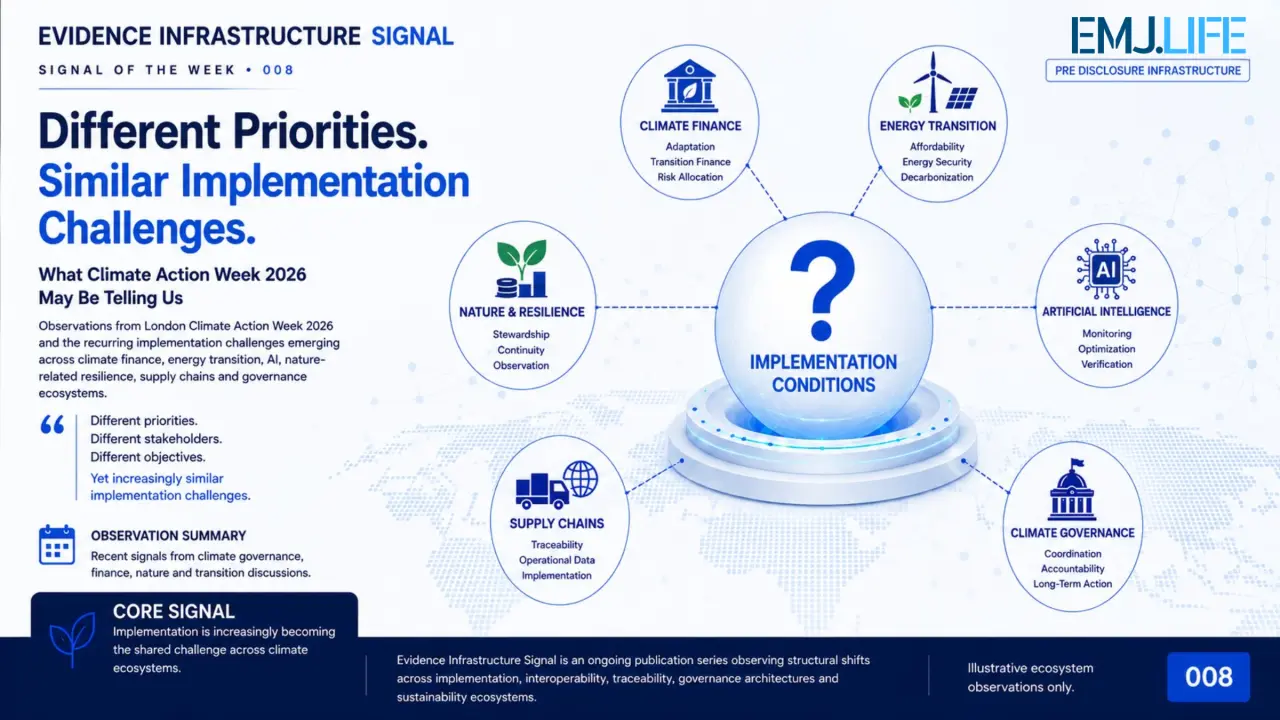
What Climate Action Week 2026 May Be Telling Us
Snn Owned
- AI TRAINING
- allowed
- RIGHTS BASIS
- Original SNN English editorial reporting, analysis, Signal, summary, metadata and structured publication content.
Series note
What Climate Action Week 2026 May Be Telling Us
Why Climate Discussions Are Increasingly Focused On Execution
Opening
Over the past week, London Climate Action Week 2026 brought together discussions spanning climate finance, energy security, artificial intelligence, nature, resilience and political cooperation.
At first glance, these appear to be very different conversations.
Different sectors.
Different stakeholders.
Different policy objectives.
Yet a recurring pattern appears to be emerging.
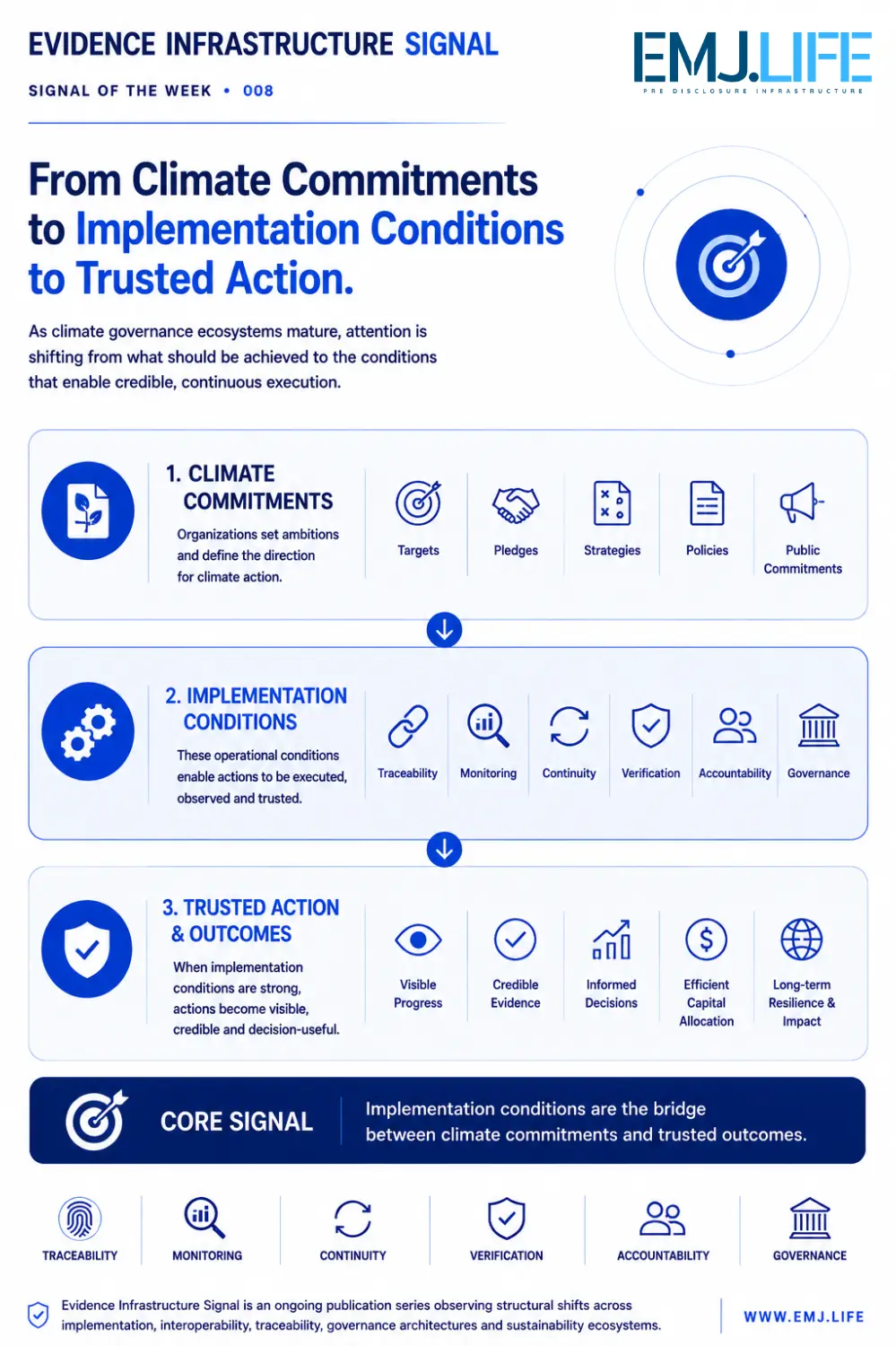
Increasingly, discussions are no longer focused solely on climate commitments.
They are beginning to focus on implementation.
Recent Climate Discussions
Climate Finance
Discussions increasingly focused on how climate risks, adaptation needs and transition pathways can be reflected within investment decisions and capital allocation.
The challenge is no longer identifying climate risks.
The challenge is implementing responses.
Energy Transition
Recent Developments
Another on artificial intelligence.
Another on nature.
Yet many appear to be asking similar implementation-related questions.
How Can Actions Be Monitored?
How Can Progress Be Demonstrated?
How Can Commitments Remain Credible Over Time?
How Can Organizations Maintain Confidence In Implementation?
Beyond Climate Commitments
Historically, climate discussions often focused on targets, pledges and disclosures.
Today, another challenge may be becoming increasingly visible.
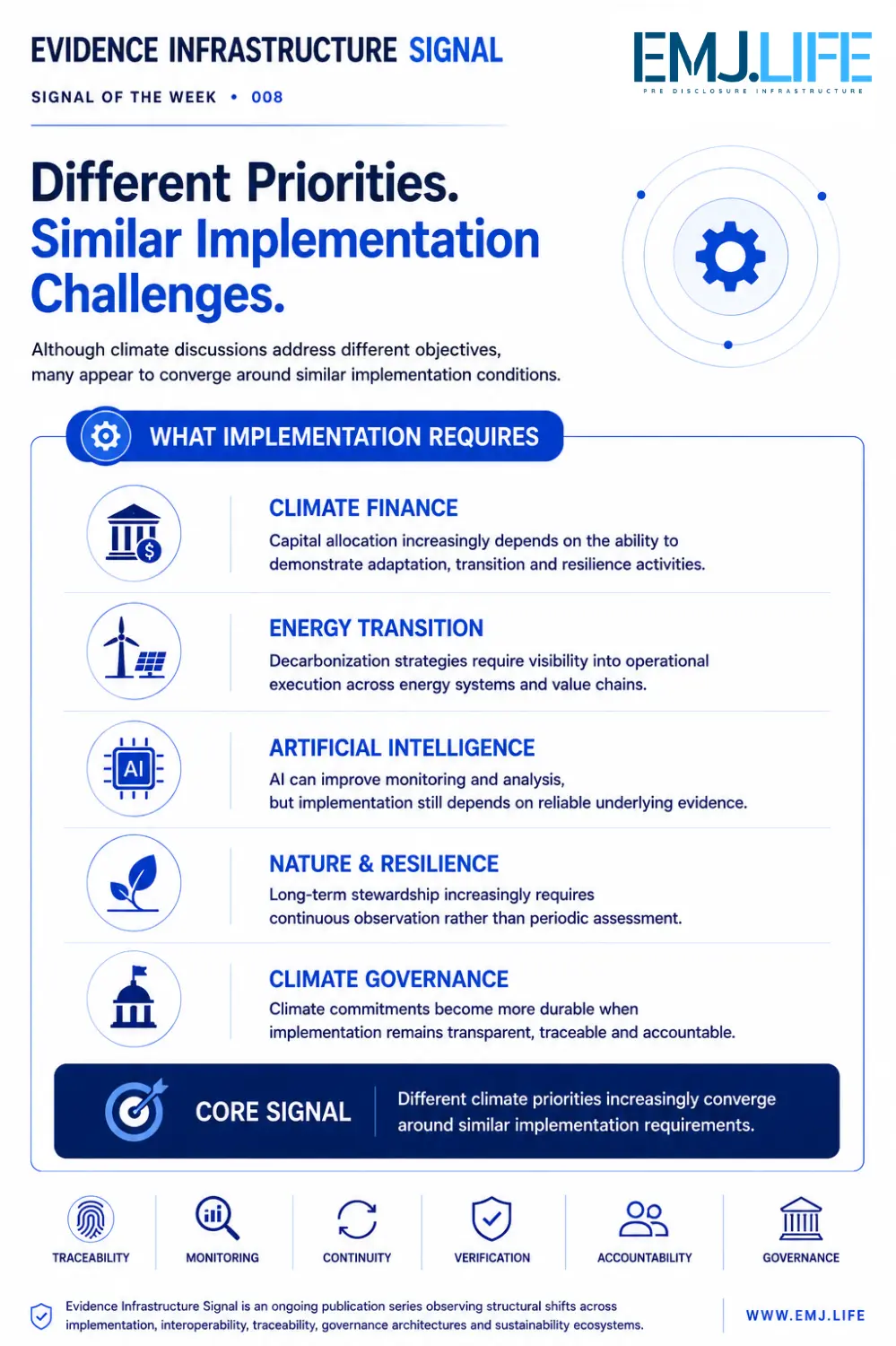
As climate governance ecosystems mature, attention appears to be shifting toward the conditions required for implementation.
These conditions may include:
Traceability
Monitoring
Continuity
A Shared Structural Direction
Accountability
Verification
Governance
Different Climate Priorities.
Similar Implementation Challenges.
Implementation Conditions
Perhaps one of the most interesting developments is that many current discussions no longer focus exclusively on climate ambitions.
They increasingly focus on the operational conditions required to support those ambitions.
Not only:
What Should Be Achieved?
But also:
How Is Progress Monitored?
How Is Action Maintained?
How Is Implementation Verified?
How Is Trust Preserved?
Pre-Disclosure Evidence Infrastructure Perspective
Debates around affordability, energy security and decarbonization highlighted a common reality.
Transition strategies are widely understood.
Execution remains difficult.
Artificial Intelligence
AI discussions increasingly focused on monitoring, optimization and greenwashing detection.
Attention appears to be shifting beyond reporting and toward continuous observation of real-world activities.
Nature And Resilience
From biodiversity protection to wildfire prevention, discussions repeatedly emphasized monitoring, stewardship and long-term management rather than one-time commitments.
Political Cooperation
Under the theme Climate Collaboration in a Fragmented World, policymakers explored how long-term climate action can survive changing political and economic conditions.
The challenge increasingly appears to be maintaining continuity rather than announcing ambition.
Emerging Pattern
At first glance, these discussions appear unrelated.
One focuses on finance.
Another on energy.
Closing Reflection
The future challenge of climate governance may not be the creation of additional commitments.
It may be ensuring that climate-related actions remain visible, verifiable and trusted across increasingly complex operational, political and economic environments.
Different Priorities.
Different Objectives.
Yet Increasingly Similar Implementation Challenges.
Source and Analytical Boundary
Illustrative ecosystem observations only.
Publication record
Evidence Infrastructure Signal
Evidence Infrastructure Signal is an ongoing publication series observing structural shifts across interoperability, traceability, governance architectures and sustainability ecosystems.
Sources informing this publication
Science Based Targets Network
Source classification: Official External Source · Primary analysis source · Official institutional publication · support scope: institutional source · source-link-only · AI training not-allowedOpen source record ↗Evidence Infrastructure terminology and conclusions are separately governed SNN editorial interpretations. They do not imply participation, endorsement, validation or adopted positions by the institutions cited above.
*Illustrative ecosystem observations only.*