
Why Information Conditions Are Becoming Increasingly Visible Across Sustainability Ecosystems
Snn Owned
- AI TRAINING
- allowed
- RIGHTS BASIS
- Original SNN English editorial reporting, analysis, Signal, summary, metadata and structured publication content.
Series note
Why Information Conditions Are Becoming Increasingly Visible Across Sustainability Ecosystems
Opening
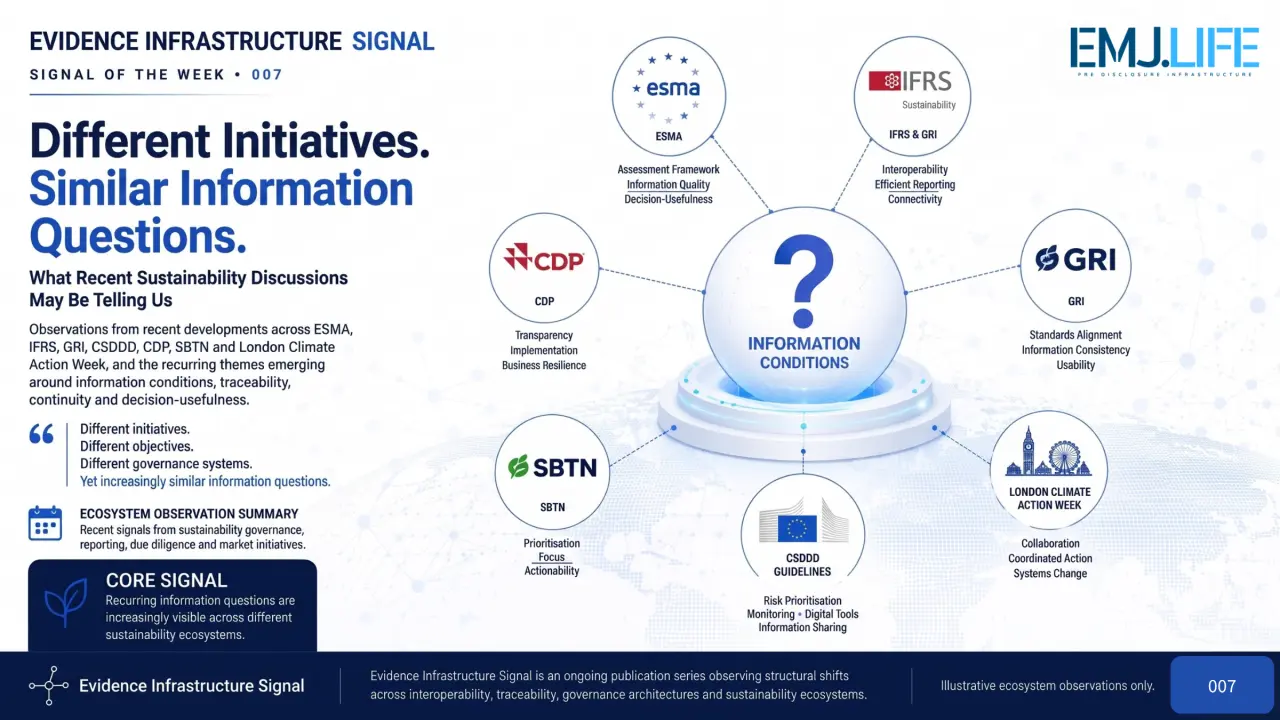
Over the past week, a number of seemingly unrelated developments emerged across sustainability reporting, due diligence, corporate governance and digital reporting ecosystems.
These developments originated from different institutions.
Different mandates.
Different regulatory contexts.
Different stakeholder groups.
Yet a recurring pattern appears to be emerging.
Increasingly, discussions are no longer focused solely on what organizations should disclose.
They are beginning to focus on the conditions required for information to remain usable
Different ecosystems increasingly appear to be asking similar information-related questions.
Recent Ecosystem Developments
Esma
Recent ESMA discussions on ESRS technical advice continue to emphasize:
decision-usefulness
comparability
interoperability
information quality
Ifrs Foundation & Gri
The latest joint publication between IFRS Foundation and GRI further highlights practical interoperability between sustainability reporting approaches.
Recent Developments
Emerging Pattern
At first glance, these initiatives appear unrelated.
One focuses on reporting.
Another on due diligence.
Another on environmental target-setting.
Another on disclosure systems.
Yet many appear to be asking similar information-related questions.
How Should Risks Be Identified?
How Should Priorities Be Determined?
How Should Information Remain Traceable?
How Should Information Remain Comparable?
How Should Information Remain Useful For Decision-Making?
How Can Institutions Maintain Confidence In Information Over Time?
Beyond Framework Design
Historically, sustainability discussions often focused on framework development.
Today, another challenge may be becoming increasingly visible.
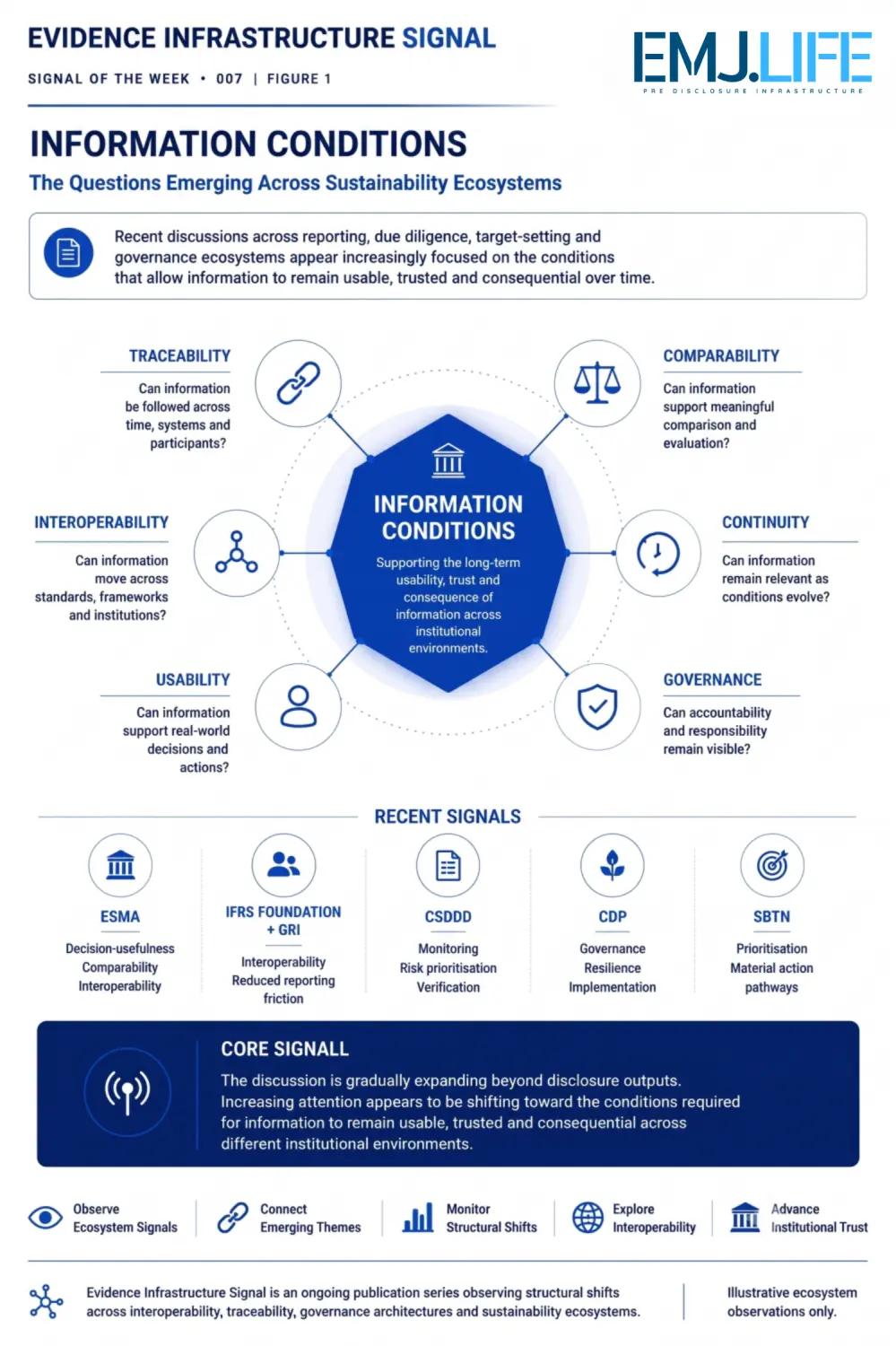
As reporting and governance ecosystems mature, attention appears to be shifting toward the conditions that allow information to function effectively across different institutional environments.
These conditions may include:
A Shared Structural Direction
traceability
interoperability
continuity
comparability
usability
governance
Different institutions may use different terminology.
Yet many seem to be converging around similar information challenges.
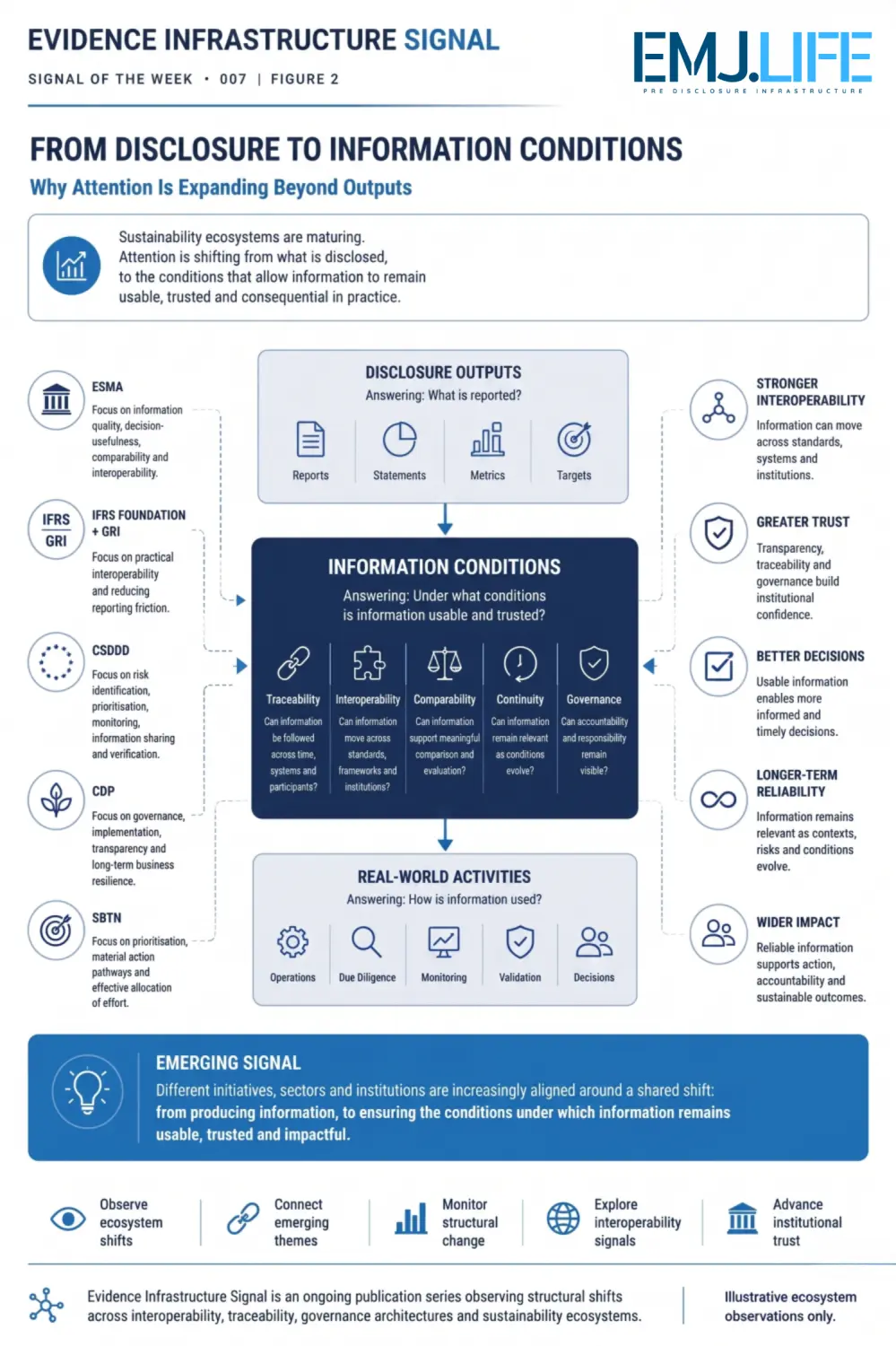
The discussion is gradually shifting from disclosure outputs to information conditions.
Information Conditions
Perhaps one of the most interesting developments is that many current discussions no longer focus exclusively on disclosure outputs.
They increasingly focus on the processes that support those outputs.
Not only:
What should be reported?
But also:
How is information generated?
How is information maintained?
How is information shared?
How is information trusted?
Pre-Disclosure Evidence Infrastructure Perspective
Rather than reducing differences between standards, the focus increasingly appears to be reducing friction between them.
Corporate Sustainability Due Diligence Directive (Csddd)
The European Commission recently launched its consultation on future implementation guidelines.
The consultation raises questions around:
risk identification
prioritisation
monitoring
digital tools
information sharing
third-party verification
Viewed collectively, these questions suggest growing attention toward the operational conditions required to sustain due diligence over time.
Cdp
Recent observations from CDP continue to emphasize governance, implementation and long-term business resilience.
The discussion increasingly extends beyond disclosure itself and toward how information supports organizational action.
Sbtn
Recent discussions continue to explore prioritisation.
Not every issue can be addressed simultaneously.
The challenge increasingly becomes determining where action matters most.
Closing Reflection
The future challenge may not be the creation of additional frameworks.
It may be ensuring that information remains visible, usable and trusted across an increasingly complex ecosystem of standards, regulations and institutions.
Different initiatives.
Different objectives.
Yet increasingly similar information questions.
Source and Analytical Boundary
The future challenge may not be the creation of additional frameworks.
Illustrative ecosystem observations only.
Publication record
Evidence Infrastructure Signal
Evidence Infrastructure Signal is an ongoing publication series observing structural shifts across interoperability, traceability, governance architectures and sustainability ecosystems.
Sources informing this publication
ESMA
Source classification: Official External Source · Primary analysis source · Official institutional publication · support scope: institutional source · source-link-only · AI training not-allowedOpen source record ↗Evidence Infrastructure terminology and conclusions are separately governed SNN editorial interpretations. They do not imply participation, endorsement, validation or adopted positions by the institutions cited above.
The future challenge may not be the creation of additional frameworks. Illustrative ecosystem observations only.