
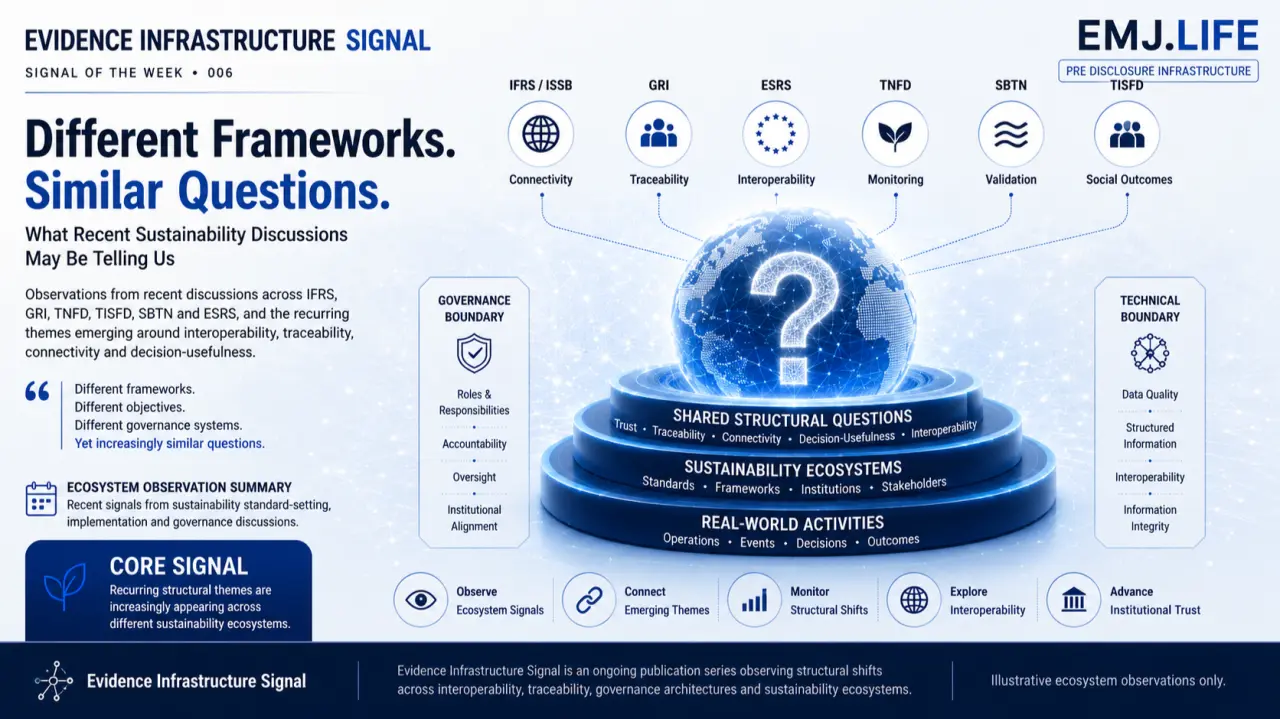
What Recent Sustainability Discussions May Be Telling Us
Snn Owned
- AI TRAINING
- allowed
- RIGHTS BASIS
- Original SNN English editorial reporting, analysis, Signal, summary, metadata and structured publication content.
Series note
What Recent Sustainability Discussions May Be Telling Us
Over the past several months, I have been following discussions across a wide range of sustainability ecosystems.
These include:
IFRS Sustainability Disclosure Standards
GRI
TNFD
TISFD
SBTN
EFRAG
At first glance, these ecosystems appear fundamentally different.
Different mandates.
Different stakeholders.
Different governance structures.
Different reporting objectives.
Some focus on investors.
Some focus on impacts.
Some focus on nature.
Some focus on social outcomes.
Some focus on financial materiality.
Others focus on double materiality.
Yet one observation has become increasingly difficult to ignore.
Many of these ecosystems appear to be asking remarkably similar questions.
Recent Ecosystem Developments
Recent developments across sustainability ecosystems continue to highlight a broad range of priorities.
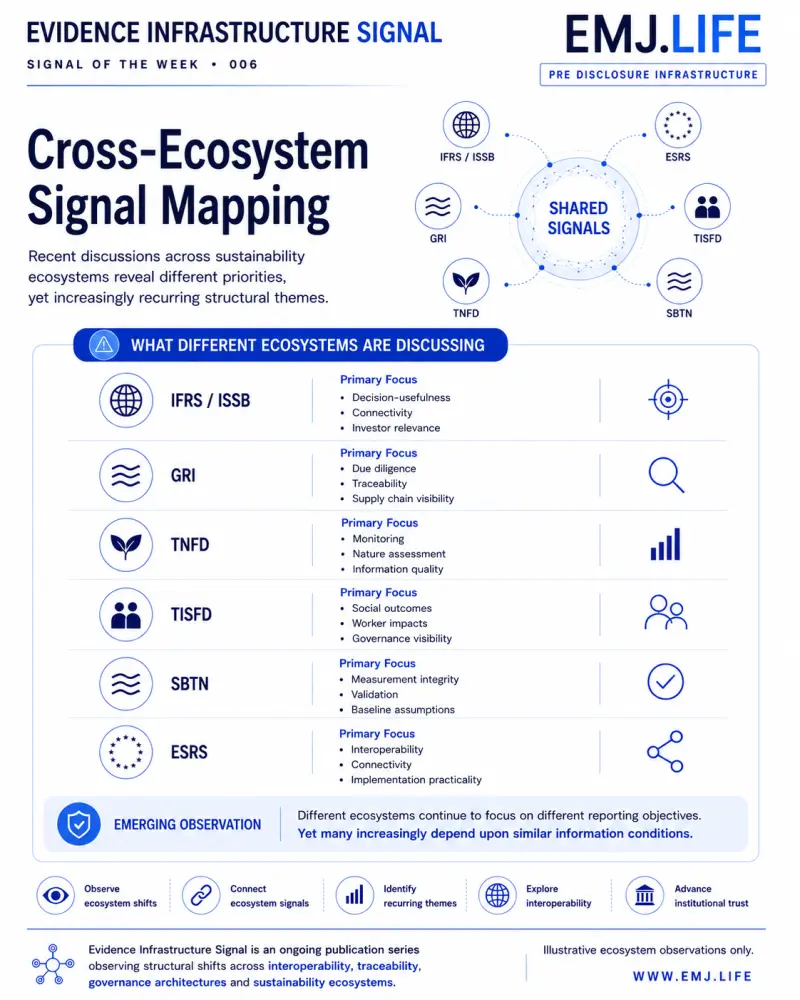
IFRS discussions increasingly emphasize decision-usefulness, connectivity and interoperability across sustainability and financial reporting systems.
GRI publications continue to focus on due diligence, operational traceability, site-specific information and supply chain visibility.
TNFD discussions increasingly explore monitoring, assessment methodologies, data quality and decision support mechanisms for nature-related issues.
Opening
TISFD discussions continue to examine social outcomes, worker impacts, governance structures and implementation challenges associated with social disclosures.
SBTN technical discussions frequently emphasize baseline assumptions, measurement integrity, validation processes and continuous monitoring.
Most recently, EFRAG's 25th Anniversary Conference brought together standard setters, investors, preparers, academics and regulators to discuss the future of corporate reporting.
The discussions covered a wide range of topics, including:
Connectivity between sustainability and financial reporting
Interoperability with international standards
AI transparency and auditability
Anticipated Financial Effects (AFE)
Digital reporting architectures
Data comparability
Practical implementation challenges
Capital market trust
Viewed individually, each discussion addressed a different aspect of corporate reporting.
Viewed collectively, however, a broader pattern begins to emerge.
Recent Developments
TNFD highlights monitoring and information quality.
TISFD examines social evidence and governance visibility.
SBTN focuses on validation and measurement integrity.
EFRAG discusses interoperability, digital architecture and trust.
Different ecosystems.
Different mandates.
Different stakeholders.
Yet increasingly similar structural questions.
See content credentials
Emerging Question
Historically, sustainability discussions often focused on framework development.
Today, a different question may be emerging.
As reporting ecosystems mature, are we beginning to see a growing convergence around the information conditions required to support them?
Not necessarily convergence of standards.
But convergence of underlying needs.
Needs such as traceability.
Interoperability.
Connectivity.
Decision-usefulness.
And trust.
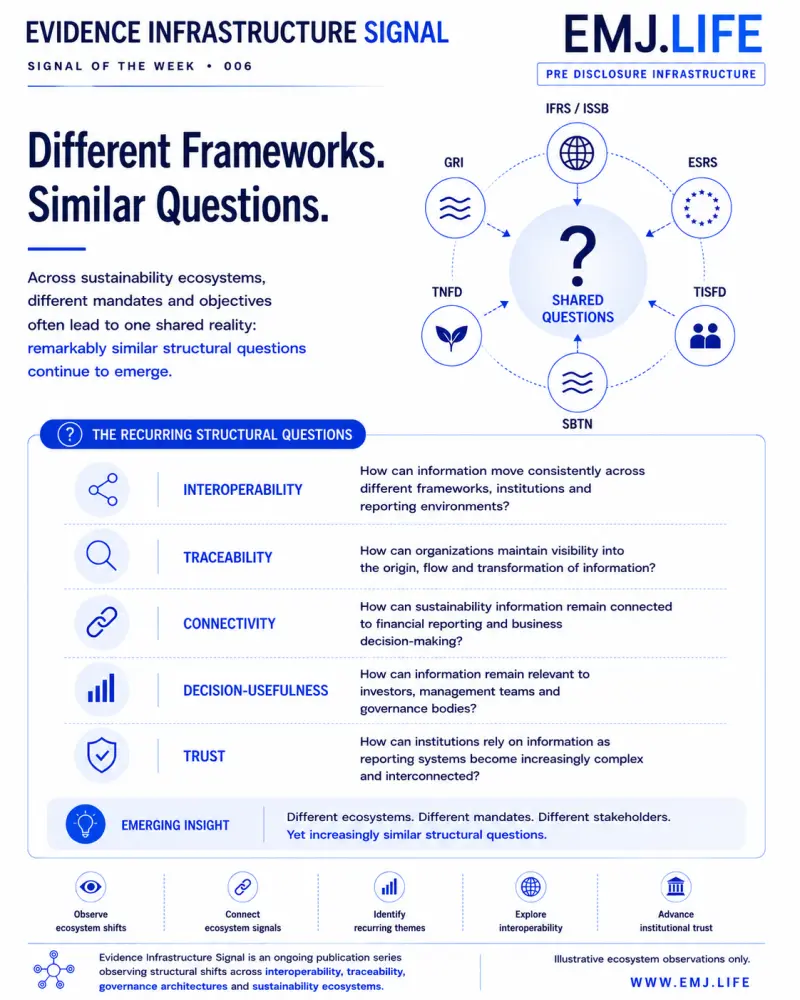
A Shared Structural Direction
The most interesting signal may not be the differences between frameworks.
It may be the questions that repeatedly appear beneath them.
Across multiple ecosystems, discussions increasingly seem to converge around issues such as:
information quality
interoperability
traceability
governance
comparability
transparency
decision relevance
institutional trust
These themes appear in different forms.
Sometimes through reporting discussions.
Sometimes through assurance discussions.
Sometimes through governance discussions.
Sometimes through digital reporting initiatives.
Yet the underlying concerns often look surprisingly familiar.
Cross-Ecosystem Signal Mapping
IFRS explores connectivity and decision-usefulness.
GRI emphasizes due diligence and traceability.
Pre-Disclosure Evidence Infrastructure Perspective
Forum Agendas And Emerging Priorities
Across recent conferences, consultations, exposure drafts and implementation discussions, several recurring themes continue to surface.
Interoperability
How can information move consistently across different frameworks, institutions and reporting environments?
Traceability
How can organizations maintain visibility into the origin and transformation of information?
Connectivity
How can sustainability information remain connected to financial reporting and business decision-making?
Decision-Usefulness
How can information remain relevant to investors, management teams and governance bodies?
Trust
How can institutions rely on information as reporting systems become increasingly complex and interconnected?
While different ecosystems often use different terminology, many appear to be circling around similar underlying concerns.
See content credentials
Closing Reflection
The future challenge may not be creating more reporting frameworks.
It may be understanding the structural conditions that allow different frameworks to function effectively together.
As sustainability ecosystems continue to evolve, the most important signals may no longer be found in their differences.
They may increasingly be found in the questions they share.
Source and Analytical Boundary
The most interesting signal may not be the differences between frameworks.
The future challenge may not be creating more reporting frameworks.
Illustrative ecosystem observations only.
Publication record
Evidence Infrastructure Signal
Evidence Infrastructure Signal is an ongoing publication series observing structural shifts across interoperability, traceability, governance architectures and sustainability ecosystems.
Sources informing this publication
IFRS Foundation and GRI
Source classification: Official External Source · Primary analysis source · Official institutional publication · support scope: institutional source · source-link-only · AI training not-allowedOpen source record ↗Evidence Infrastructure terminology and conclusions are separately governed SNN editorial interpretations. They do not imply participation, endorsement, validation or adopted positions by the institutions cited above.
The most interesting signal may not be the differences between frameworks. The future challenge may not be creating more reporting frameworks. Illustrative ecosystem observations only.