
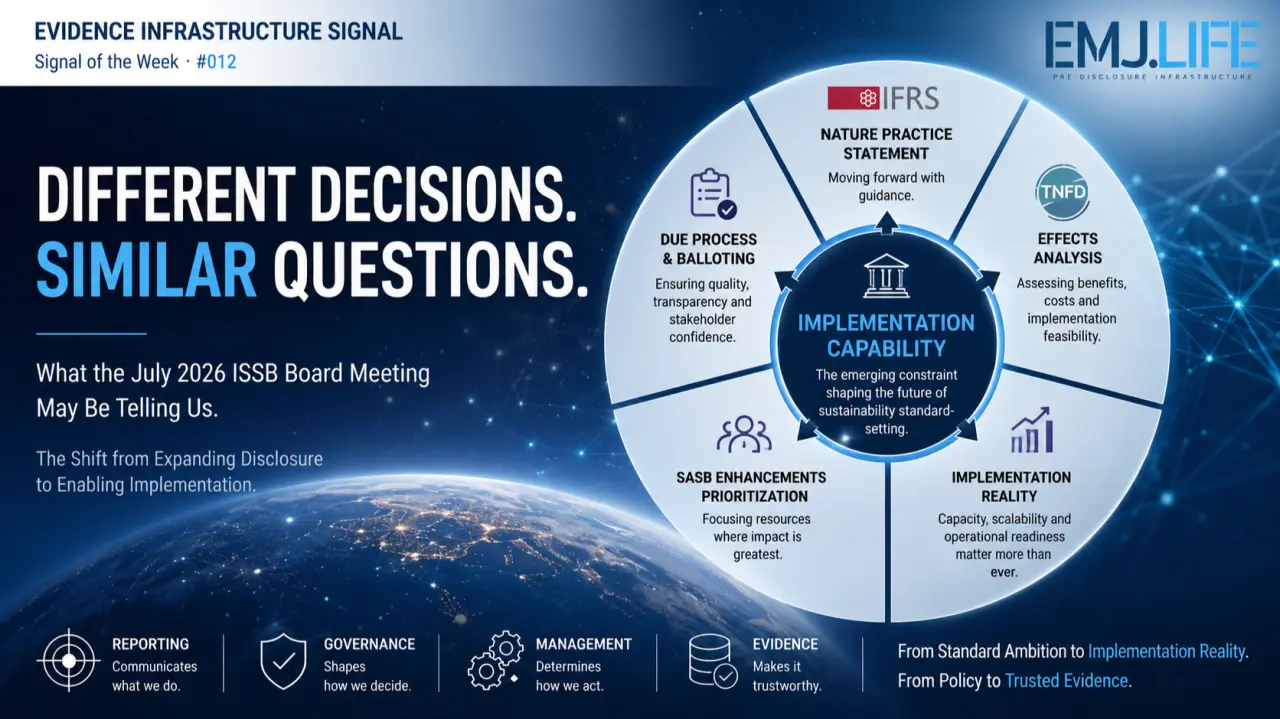
What the July 2026 ISSB Board Meeting May Be Telling Us
Snn Owned
- AI TRAINING
- allowed
- RIGHTS BASIS
- Original SNN English editorial reporting, analysis, Signal, summary, metadata and structured publication content.
Series note
What The July 2026 Issb Board Meeting May Be Telling Us
Opening
The July 2026 ISSB Board Meeting covered a broad range of topics.
Nature-related guidance.
Due process.
Effects analysis.
Future SASB enhancements.
At first glance, these appear to represent fundamentally different Board decisions.
Different objectives.
Different stakeholders.
Different implementation priorities.
Yet one observation becomes increasingly difficult to ignore.
Many of these discussions appear to be asking remarkably similar questions.
Not simply what sustainability standards should require.
But increasingly what conditions allow those requirements to be implemented consistently across global markets.
As an IFRS Foundation ISSB + SASB Level III officially licensed commercial user, EMJ.LIFE closely follows the evolution of the ISSB Standards and SASB Standards.
Viewed collectively, the Frankfurt meeting appears to reveal a broader institutional transition that extends well beyond any individual agenda paper.
Recent Board Discussions
The meeting addressed a wide range of technical issues.
The Board completed due process for the proposed Nature-related Practice Statement.
It considered the expected effects of introducing new guidance.
It discussed how future SASB enhancements should be prioritised.
It also examined how implementation resources could be be directed where they would provide the greatest benefit.
Viewed individually, each discussion focused on a different aspect of sustainability standard-setting.
Viewed collectively, however, they begin to point toward a remarkably similar direction.
See content credentials
Due process governs publication. Evidence Infrastructure enables implementation.
Emerging Questions
Across the Board discussions, several recurring questions continue to surface.
Recent Developments
Implementation readiness.
Operational feasibility.
Cost-benefit balance.
Resource prioritisation.
Scalability.
Investor usefulness.
Different technical decisions.
Yet increasingly similar implementation questions.
How can global standards remain practical across different industries?
How should implementation capacity influence future priorities?
How can guidance evolve without creating unnecessary complexity?
As sustainability standards continue to mature, these questions appear to be becoming increasingly central to future standard-setting.
See content credentials
Guidance creates potential. Evidence Infrastructure turns potential into reality.
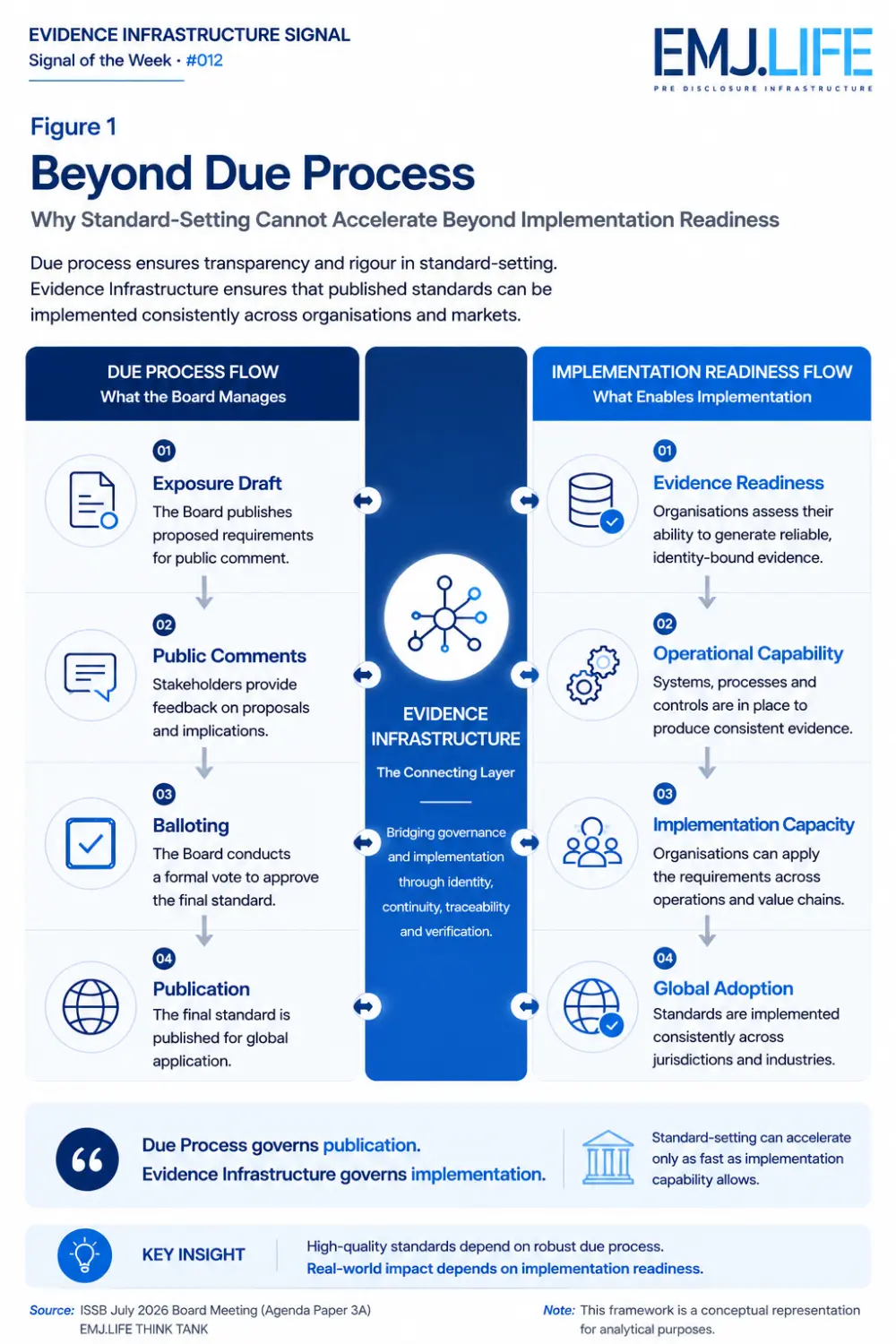
A Shared Structural Direction
A Broader Institutional Signal
Historically, sustainability discussions have largely focused on developing new disclosure requirements.
Today, another pattern may be beginning to emerge.
As reporting ecosystems mature, greater attention is increasingly being given to the institutional conditions required for implementation.
Not simply stronger standards.
But stronger implementation capability.
Not simply broader disclosure.
But greater operational readiness.
Not simply additional guidance.
But the practical ability to apply that guidance consistently across organisations and jurisdictions.
The discussion is gradually moving beyond what should be reported.
It is increasingly examining what makes reporting possible.
See content credentials
Future priorities increasingly depend on implementation capacity, not ambition.
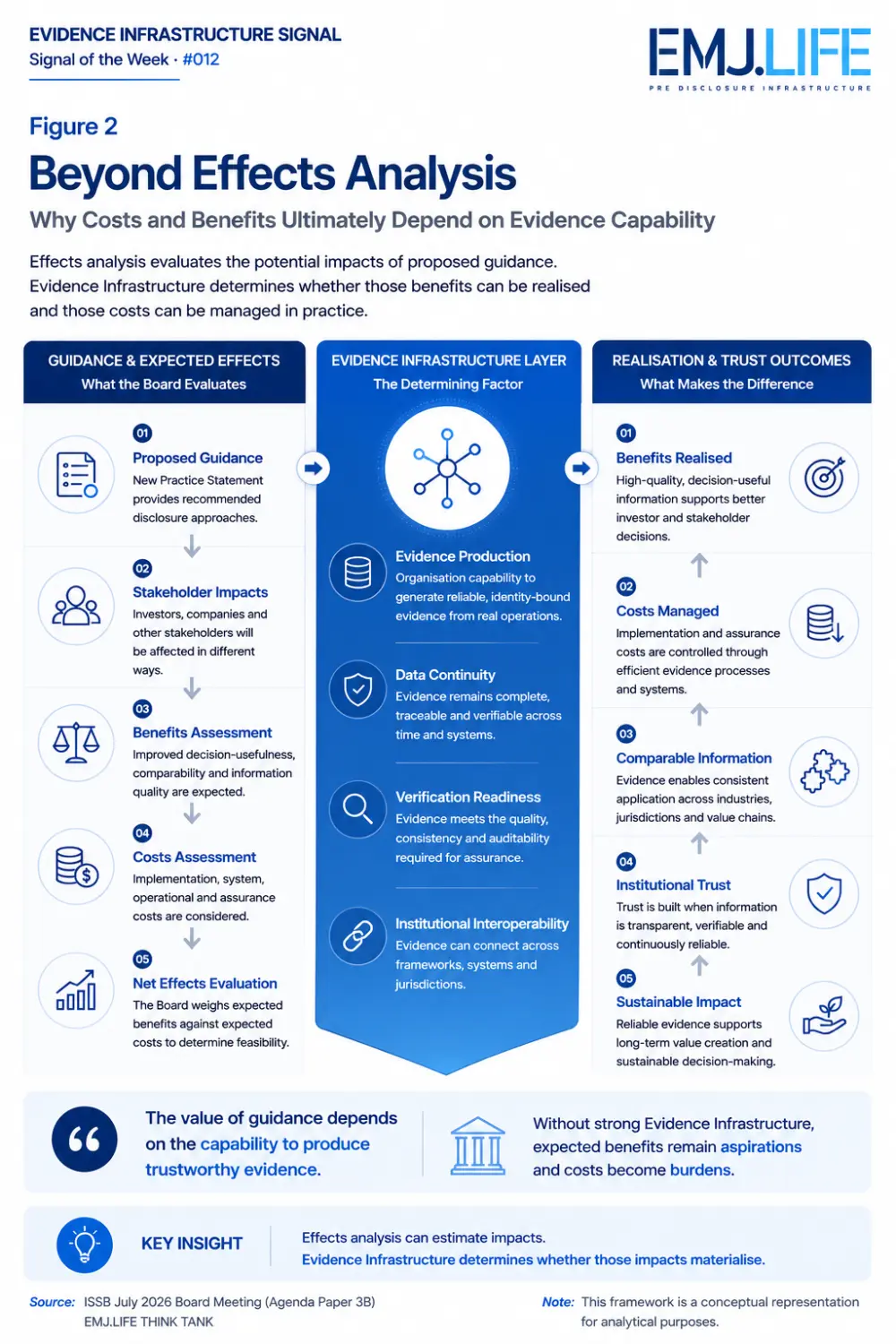
Pre-Disclosure Evidence Infrastructure Perspective
Viewed through an Evidence Infrastructure perspective, the July 2026 ISSB Board Meeting reflects more than a collection of technical Board decisions.
It reflects the continuing evolution of global sustainability governance.
Reporting remains essential.
Assurance remains essential.
Governance remains essential.
Yet all three increasingly depend upon capabilities that exist much earlier.
Before information can be disclosed, it must first be generated.
Before it can be assured, it must first be supported.
Before it can be trusted, it must first remain reliable throughout its operational lifecycle.
Viewed from this perspective, the discussion surrounding Evidence Infrastructure becomes less about technology itself and more about the institutional conditions that enable trustworthy sustainability reporting.
Closing Reflection
The July 2026 ISSB Board Meeting will likely be remembered for its decisions on nature-related guidance and future standard-setting priorities.
Yet another signal may also be emerging.
The future challenge may not simply be developing better sustainability standards.
It may increasingly be understanding the conditions that allow those standards to function consistently across the global economy.
Different decisions.
Remarkably similar questions.
Perhaps the next evolution of sustainability reporting will not be defined solely by what organisations disclose.
It may increasingly be defined by the institutional capabilities that make trustworthy disclosure possible.
Source and Analytical Boundary
Illustrative ecosystem observations only.
Publication record
Evidence Infrastructure Signal
Evidence Infrastructure Signal is an ongoing publication series examining structural developments across global sustainability governance.
Rather than analysing individual events in isolation, the series explores how developments across standards, regulation, institutions and implementation may collectively reveal broader shifts in interoperability, traceability, institutional capability and Evidence Infrastructure.
The objective is not to predict outcomes, but to observe emerging patterns that may influence the future direction of sustainability ecosystems.
Sources informing this publication
International Sustainability Standards Board
Source classification: Official External Source · Primary source · Official agenda paper · support scope: institutional source · source-link-only · AI training not-allowedOpen source record ↗International Sustainability Standards Board
Source classification: Official External Source · Primary source · Official agenda paper and project record · support scope: institutional source · source-link-only · AI training not-allowedOpen source record ↗International Sustainability Standards Board
Source classification: Official External Source · Primary source · Official agenda paper and standards process record · support scope: institutional source · source-link-only · AI training not-allowedOpen source record ↗IFRS Foundation
Source classification: Official External Source · Primary institutional record · Official meeting record · support scope: institutional source · source-link-only · AI training not-allowedOpen source record ↗Evidence Infrastructure terminology and conclusions are separately governed SNN editorial interpretations. They do not imply participation, endorsement, validation or adopted positions by the institutions cited above.
Illustrative ecosystem observations only.