
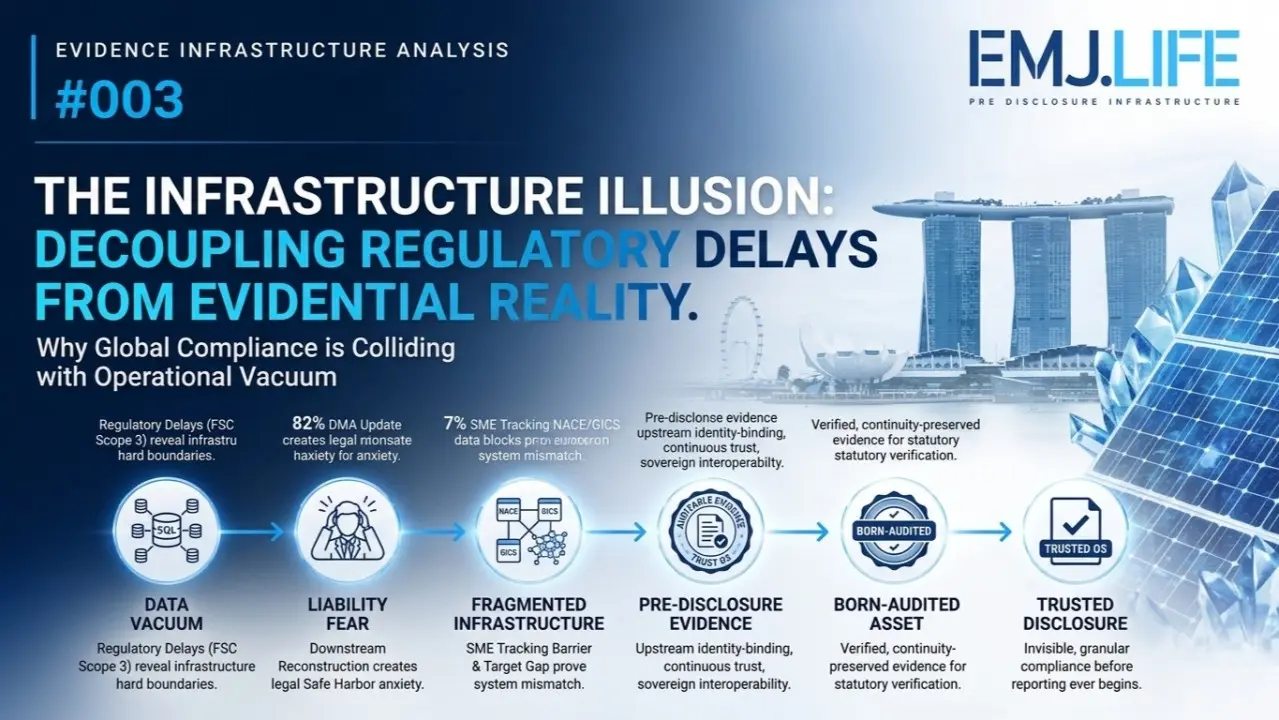
Why Corporate Sustainability Is Reaching the Limits of Downstream Reporting
Snn Owned
- AI TRAINING
- allowed
- RIGHTS BASIS
- Original SNN English editorial reporting, analysis, Signal, summary, metadata and structured publication content.
Series introduction
Why Corporate Sustainability Is Reaching The Limits Of Downstream Reporting
Evidence Infrastructure Analysis
Evidence Infrastructure Analysis is a publication series examining structural developments across global governance, sustainability, interoperability and institutional evidence ecosystems.
Rather than evaluating individual reports in isolation, each edition explores how major institutional developments reveal broader shifts in the architecture of trust, accountability and implementation.
This edition examines EFRAG's State of Play Report: FY2025 Observed Practices and its implications for the future of corporate sustainability reporting.
Executive Summary
EFRAG's 2026 State of Play Report provides one of the most comprehensive empirical baselines yet produced for mandatory sustainability reporting under the European Sustainability Reporting Standards (ESRS).
Drawing upon 905 third-party assured sustainability statements, the report offers an unprecedented view into how organizations are adapting to mandatory disclosure requirements across Europe.
Viewed collectively, however, the findings reveal a recurring pattern.
Organizations increasingly understand what is material.
They remain significantly less capable of operationalizing, measuring and continuously verifying those priorities.
Corporate sustainability is therefore approaching an important institutional threshold.
The next stage of maturity may depend less on improving disclosures and more on strengthening the evidence infrastructures that exist before disclosure begins.
Opening
The transition from voluntary sustainability reporting to mandatory, assured disclosures was intended to strengthen market discipline.
In July 2026, EFRAG released its second State of Play Report: FY2025 Observed Practices.
Analyzing 905 assured sustainability statements prepared under the European Sustainability Reporting Standards, the report establishes an important baseline for understanding corporate implementation practices.
Many observers have interpreted these findings as evidence that organizations are gradually adapting to the requirements of mandatory reporting.
Yet beneath these findings lies a broader institutional question.
What happens when reporting requirements evolve faster than the operational infrastructures supporting them?
The Materiality Vs. Execution Divergence
One of the most significant findings within the report concerns the relationship between materiality and execution.
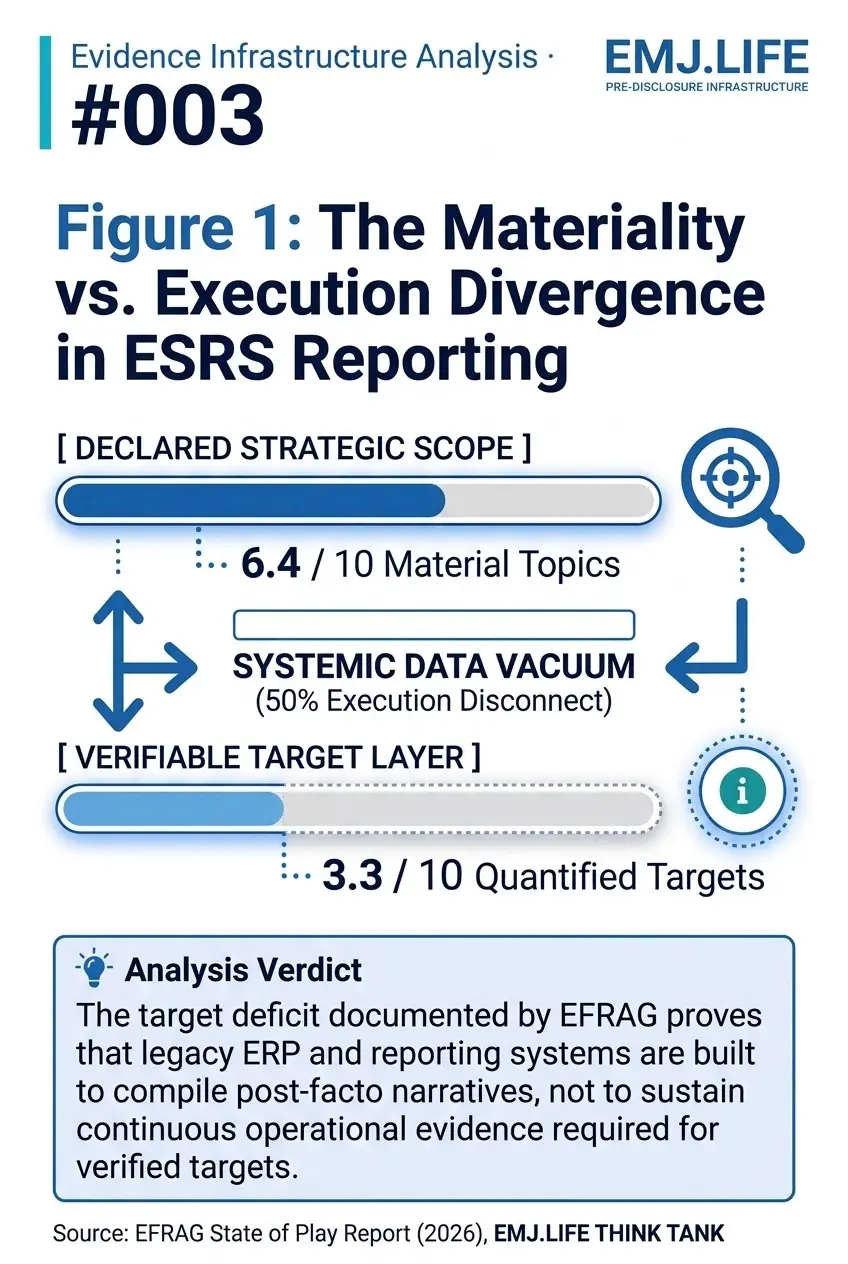
According to EFRAG, organizations identify an average of 6.4 material ESRS topics out of 10.
However, they establish quantified targets for an average of only 3.3 topics.
Nearly half of all declared material priorities therefore remain disconnected from measurable execution criteria.
This represents an important institutional signal.
Organizations increasingly understand what matters.
They remain considerably less capable of continuously proving progress.
Reporting frameworks can identify priorities.
Structural Change / Institutional Friction
They cannot create evidence.
That capability must already exist.
See content credentials
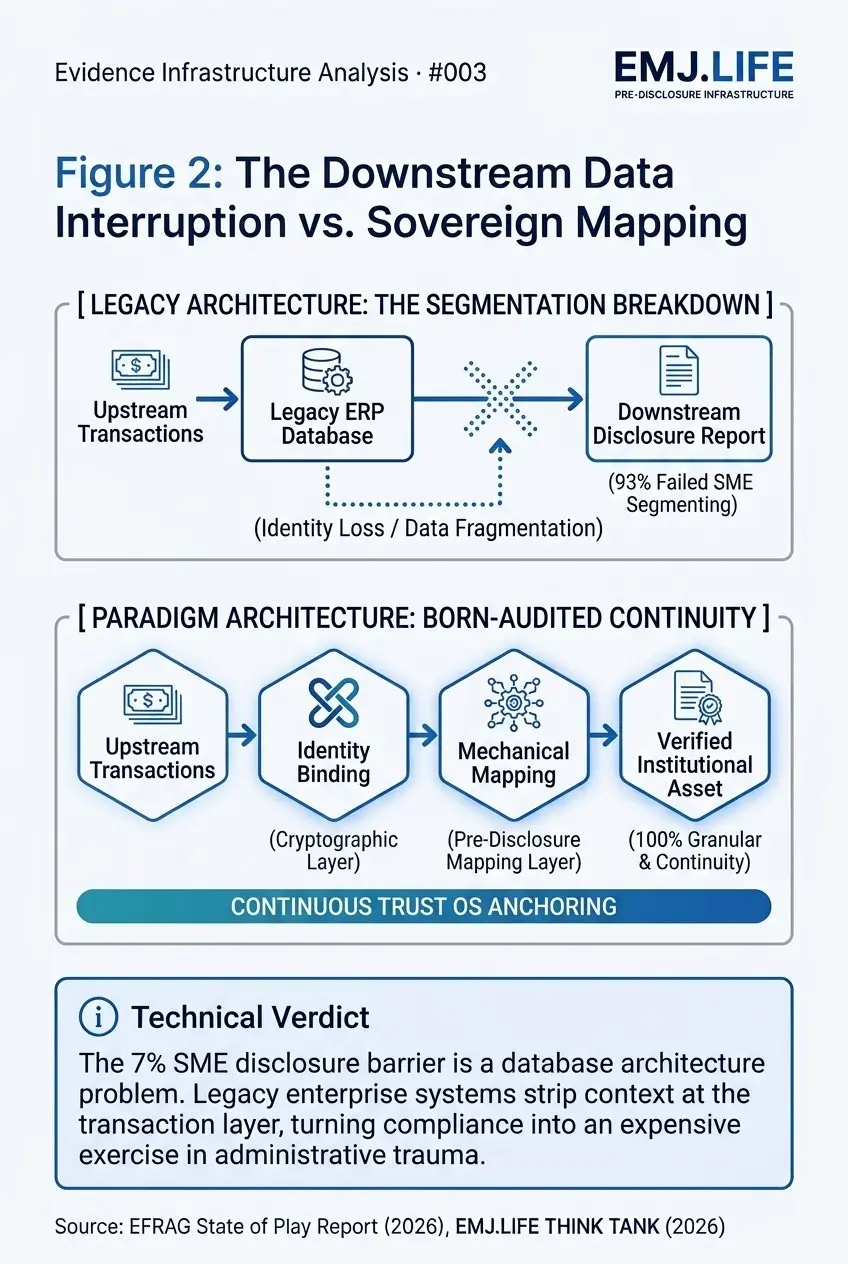
Comparing legacy ERP fragmentation with EMJ.NEXUS trust continuity.
The Erp Segmentation Deadlock
The limitations of downstream reporting become particularly visible within Governance disclosures.
EFRAG's analysis found that 81% of organizations reference ESG criteria within supplier selection processes.
Yet the dominant implementation mechanism remains supplier codes of conduct and high-level declarations.
The most revealing statistic may be another.
Only 7% of surveyed organizations were able to disclose specific average payment terms for SMEs.
The remaining 93% relied upon aggregated reporting or cited operational limitations.
This finding points toward a broader challenge.
Many enterprise systems were designed for financial reconciliation.
They were not designed to preserve context, identity continuity or evidence across complex international value chains.
When large organizations cannot isolate SME transaction data, the issue is no longer disclosure.
Institutional Signal
It is infrastructure.
See content credentials
Charting the 50% execution gap between ESRS topics and targets.
Beyond Declarative Compliance
EFRAG's findings suggest that organizations do not necessarily lack sustainability ambition.
Rather, many appear to lack the operational infrastructures required to translate strategic intent into continuously verifiable outcomes.
This distinction matters.
Reporting can communicate priorities.
It cannot manufacture evidential integrity.
No amount of methodology refinement, threshold adjustment or narrative enhancement can compensate for fragmented operational foundations.
The 6.4 versus 3.3 divergence.
The 7% SME disclosure capability.
These are not isolated statistics.
They are indicators of a broader structural reality.
Corporate sustainability is reaching the practical limits of downstream reporting.
Pre-Disclosure Evidence Infrastructure Perspective
Viewed together, EFRAG's findings suggest that sustainability is entering a new stage of institutional maturity.
Reporting remains essential.
Assurance remains essential.
Governance remains essential.
Yet all three increasingly depend upon something that exists much earlier.
Organizations must first possess the capability to generate reliable, identity-bound and continuity-preserved evidence throughout everyday operations.
This is not another reporting framework.
Nor another disclosure requirement.
It is an institutional capability.
Viewed through this perspective, the discussion surrounding Evidence Infrastructure becomes less about reporting itself and more about the conditions required before reporting ever begins.
Closing Reflection
Across 905 assured sustainability statements, a remarkably consistent pattern emerges.
Organizations are increasingly capable of declaring priorities.
They remain significantly less capable of continuously proving them.
The era of post-facto data reconstruction is concluding.
The central challenge confronting corporate governance is no longer disclosure itself.
It is the generation of trustworthy evidence before disclosure ever begins.
The next stage of institutional maturity may therefore belong to organizations capable of transforming operations into continuously verifiable evidence.
Official Sources
Evidence Infrastructure Analysis · 003
July 18, 2026
Sources informing this publication
EFRAG
Source classification: Official External Source · Primary analysis source · Official institutional publication · support scope: institutional source · source-link-only · AI training not-allowedOpen source record ↗Evidence Infrastructure terminology and conclusions are separately governed SNN editorial interpretations. They do not imply participation, endorsement, validation or adopted positions by the institutions cited above.
Across 905 assured sustainability statements, a remarkably consistent pattern emerges. Organizations are increasingly capable of declaring priorities. They remain significantly less capable of continuously proving them. The era of post-facto data reconstruction is concluding. The central challenge confronting corporate governance is no longer disclosure itself. It is the generation of trustworthy evidence before disclosure ever begins. The next stage of institutional maturity may therefore belong to organizations capable of transforming operations into continuously verifiable evidence.