

Why Central Bank Collateral Frameworks Are Redefining the Role of Sustainability Information
Snn Owned
- AI TRAINING
- allowed
- RIGHTS BASIS
- Original SNN English editorial reporting, analysis, Signal, summary, metadata and structured publication content.
Series introduction
Why Central Bank Collateral Frameworks Are Redefining The Role Of Sustainability Information
Evidence Infrastructure Analysis
Evidence Infrastructure Analysis is a publication series examining structural developments across global governance, sustainability, interoperability and institutional evidence ecosystems.
Rather than evaluating individual policy decisions or institutional developments in isolation, each edition examines how significant changes reveal broader shifts in the architecture of trust, accountability and implementation.
This edition examines the European Central Bank's July 2026 decision to expand the application of its climate factor from eligible corporate bonds to eligible corporate credit claims within the Eurosystem collateral framework.
Rather than interpreting this development solely as another climate-related policy adjustment, this analysis explores what it may reveal about the changing relationship between sustainability information, collateral valuation and monetary operations.
Executive Summary
For decades, sustainability information has primarily influenced financial markets through disclosure.
Corporate reports informed investors.
Investors influenced capital allocation.
Commercial banks incorporated sustainability considerations into broader credit decisions.
The transmission remained largely indirect.
The European Central Bank's July 2026 collateral reforms suggest that this institutional architecture is beginning to evolve.
By extending climate-related collateral adjustments beyond eligible corporate bonds to eligible corporate credit claims, the ECB has moved sustainability information closer to the operational core of monetary policy.
This decision does not establish a new sustainability reporting framework.
Nor does it create additional disclosure obligations for corporate entities.
Instead, it changes where sustainability information begins to matter within the financial system.
Once transition-related information becomes relevant to collateral valuation, commercial banks become an increasingly important transmission layer between sustainability information and monetary operations.
Viewed collectively, these developments suggest a broader institutional direction.
The emerging challenge may no longer be limited to improving sustainability disclosure.
It may increasingly concern the quality of information capable of supporting financial confidence within collateral frameworks.
Opening
Modern monetary systems are built upon confidence.
Confidence depends upon collateral.
Collateral depends upon valuation.
Valuation depends upon information that financial institutions consider sufficiently reliable.
Historically, sustainability information occupied only a limited position within this chain.
Corporate disclosures informed investors.
Supervisory authorities evaluated climate-related financial risks.
Commercial banks incorporated sustainability considerations according to their own lending policies.
The relationship between sustainability information and monetary operations remained largely indirect.
The European Central Bank's July 2026 collateral reforms suggest that this relationship is beginning to change.
Rather than influencing financial markets solely through disclosure or supervisory expectations, climate-related transition risk is becoming increasingly relevant to collateral valuation within central bank liquidity operations.
The distinction appears technical.
Its implications may prove structural.
The discussion therefore begins to shift.
Not from sustainability to finance.
But from disclosure toward the institutional conditions required to support financial confidence.
The central question is therefore beginning to evolve.
Not:
"How Should Sustainability Information Be Reported?"
But:
"What characteristics must sustainability information possess when it begins to influence collateral valuation within the monetary system?"
Structural Change
The Collateral Framework Has Changed
The European Central Bank's July 2026 decision represents an important refinement of the Eurosystem collateral framework.
Historically, climate-related collateral adjustments primarily applied to eligible corporate bonds.
Under the revised framework, the ECB has extended the application of its climate factor to eligible corporate credit claims, substantially expanding the proportion of collateral potentially subject to climate-related transition risk assessment.
This is not simply an expansion of scope.
It changes where transition-related information enters the financial system.
Corporate bonds are capital market instruments.
Corporate credit claims originate within commercial banking.
By extending the climate factor to credit claims, the ECB moves transition-related risk assessment closer to the core of banking intermediation and monetary liquidity operations.
Importantly, the ECB has not introduced a new sustainability reporting regime.
Nor has it established additional disclosure obligations for corporate entities.
Instead, it has refined the conditions under which existing financial assets are evaluated when pledged as collateral within the Eurosystem.
This distinction deserves careful attention.
The policy is not principally about sustainability reporting.
It is about collateral eligibility and collateral valuation.
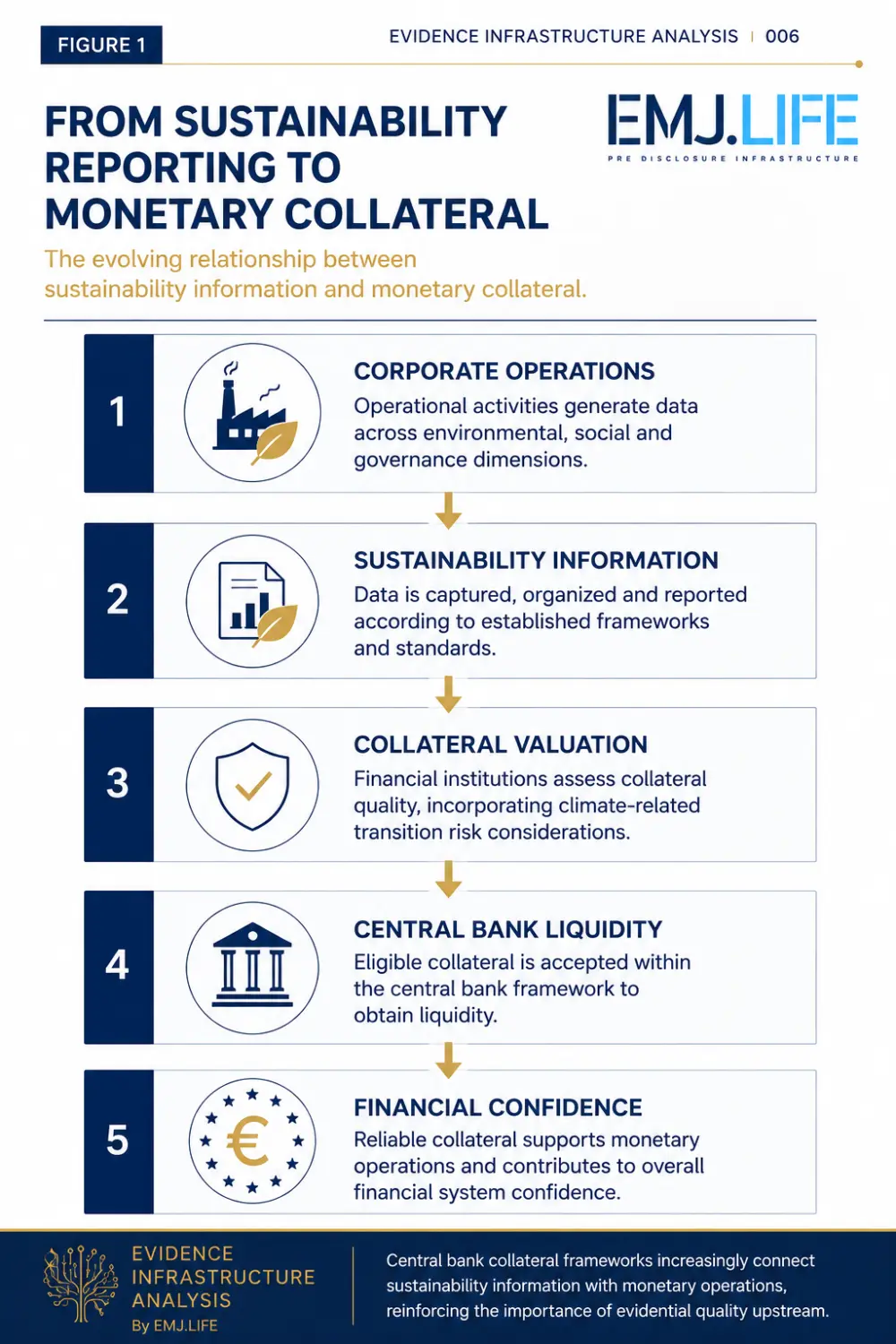
Collateral occupies a foundational position within every modern monetary system.
Collateral determines recognised asset value.
Recognised asset value influences liquidity.
Structural Change / Institutional Friction
Liquidity supports financial stability.
Financial stability underpins monetary confidence.
Viewed from this perspective, the ECB's reform represents more than another climate-related policy initiative.
It reflects a structural evolution in how transition-related financial risks are incorporated into monetary operations.
See content credentials
The evolving relationship between sustainability information and monetary collateral.
Operational Consequence
The Banking System Becomes The Transmission Layer
The significance of the ECB's collateral reforms does not end within the Eurosystem.
Its broader influence emerges through the commercial banking system.
Central banks rarely interact directly with corporate borrowers.
Commercial banks perform that role.
As climate-related transition risk becomes increasingly incorporated into collateral valuation, commercial banks become the principal transmission mechanism linking monetary policy with the real economy.
This represents an important institutional transition.
Historically, sustainability information primarily travelled through capital markets.
Corporate disclosures informed investors.
Investors influenced market valuation.
Commercial banks incorporated sustainability considerations according to their own internal credit frameworks.
The ECB's revised collateral framework introduces an additional transmission pathway.
Collateral management.
The quality of pledged assets increasingly influences access to central bank liquidity.
Consequently, transition-related information begins to influence monetary operations through the banking system itself.
The transmission mechanism therefore becomes both financial and operational.
Integrated Banking Architectures
Large international banking groups typically operate integrated frameworks for collateral management, liquidity planning and credit risk across multiple jurisdictions.
Maintaining fundamentally different collateral methodologies for domestic and international operations is operationally inefficient.
As climate-related collateral considerations become embedded within one part of a banking group's liquidity management framework, incentives may emerge to increase methodological consistency across broader lending portfolios.
This should not be interpreted as immediate regulatory harmonisation.
Rather, it reflects the operational realities of globally integrated banking institutions.
Collateral methodology increasingly becomes part of enterprise-wide balance-sheet management rather than a purely regional regulatory requirement.
Regulatory Diffusion
The European Central Bank has historically played an influential role in the evolution of prudential and monetary policy discussions.
Developments introduced within the Eurosystem frequently become important reference points for broader discussions concerning financial stability, collateral policy and climate-related financial risk.
Whether comparable collateral mechanisms will ultimately be adopted elsewhere remains uncertain.
Different jurisdictions operate under different legal mandates, financial structures and policy priorities.
Nevertheless, one institutional direction is becoming increasingly visible.
Climate-related financial risks are gradually moving beyond supervisory expectations toward operational consideration within monetary and prudential frameworks.
Financial Transmission Beyond Reporting
Perhaps the most significant implication concerns the relationship between reporting obligations and financing conditions.
Legal reporting exemptions do not necessarily translate into financing exemptions.
An organisation may remain outside mandatory sustainability disclosure requirements.
Institutional Signal
It does not necessarily remain outside commercial banking relationships.
Where financial institutions increasingly require transition-related information capable of supporting collateral valuation, expectations may gradually extend beyond the legal boundaries of disclosure regulation.
This distinction changes the institutional landscape.
Reporting obligations remain jurisdiction-dependent.
Financing expectations increasingly become institution-dependent.
Commercial banks therefore emerge as an independent transmission layer connecting monetary policy with operational activities throughout the real economy.
The significance of the ECB's reform should therefore not be viewed solely through the lens of European regulation.
Its broader influence lies in how banking systems may increasingly incorporate transition-related information into collateral management, liquidity planning and credit allocation.
Institutional Signal
Monetary Confidence Begins Before Monetary Operations
The ECB's collateral reforms reveal an institutional transition extending beyond the collateral framework itself.
The emerging question is no longer limited to how sustainability information is disclosed.
It increasingly concerns when financial confidence begins.
Traditionally, confidence was often associated with downstream activities.
Disclosure.
External review.
Credit assessment.
Collateral acceptance.
These remain essential.
However, the ECB's reforms suggest that confidence increasingly depends upon something that exists much earlier.
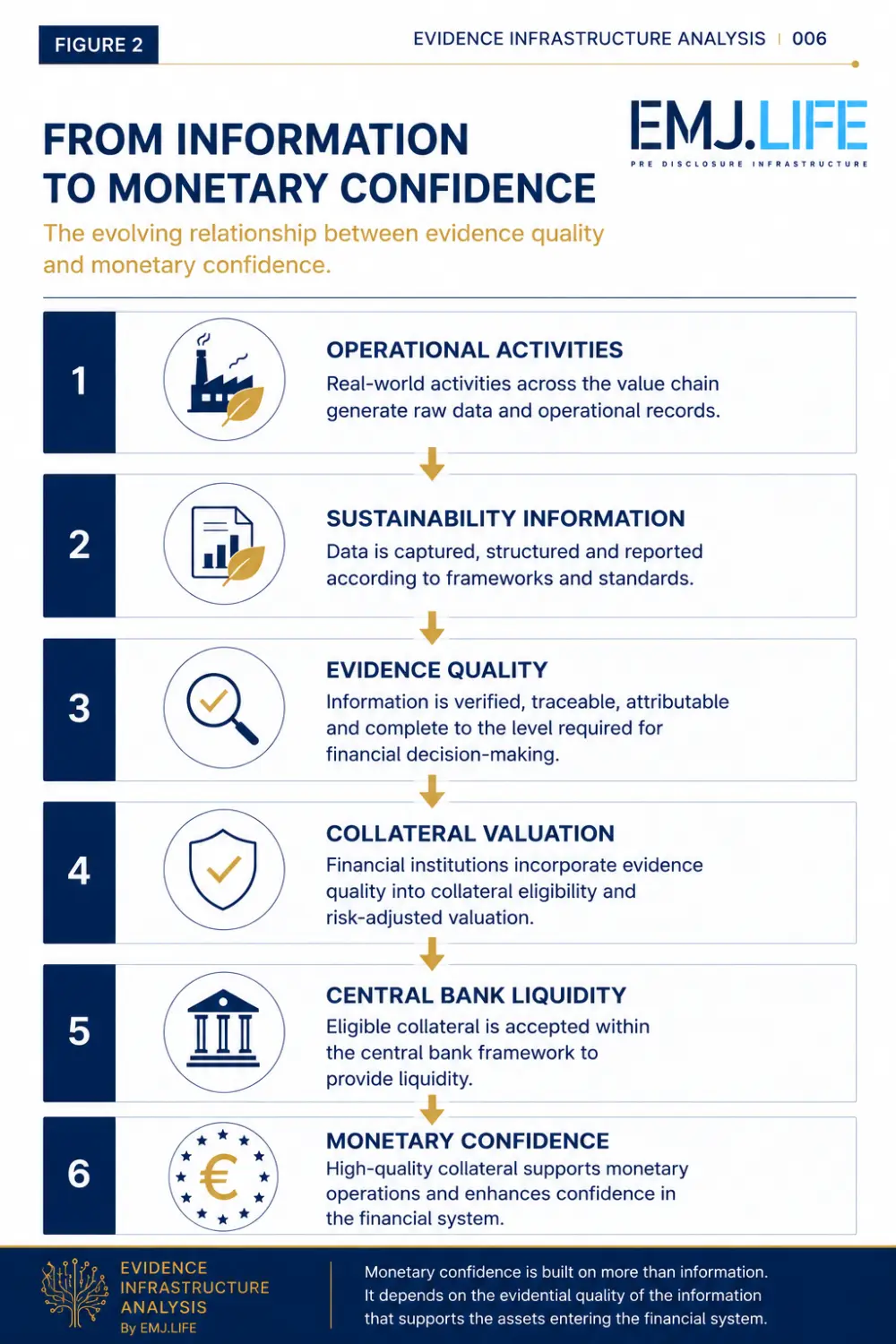
The quality of the information supporting financially significant assets before those assets enter monetary operations.
This distinction is subtle.
Its implications are significant.
Collateral valuation does not begin when assets arrive at the central bank.
It begins long before assets become eligible collateral.
It begins where operational activities generate the information that ultimately supports financial assets.
Every stage between operational activity and monetary operations introduces opportunities for interpretation, aggregation and uncertainty.
As transition-related information becomes increasingly relevant to collateral valuation, reducing those uncertainties becomes progressively more important.
This should not be interpreted as a call for more sustainability reporting.
Nor does it suggest that existing disclosure frameworks are inadequate.
Rather, it highlights a changing institutional expectation.
Financial institutions increasingly require greater confidence in the information supporting economically significant assets.
The institutional question therefore evolves.
Not:
"How Much Sustainability Information Is Available?"
But:
"How Much Confidence Can Financial Institutions Reasonably Place In The Information Supporting Collateral Valuation?"
The evolving relationship between evidence quality and monetary confidence.
See content credentials
The evolving relationship between evidence quality and monetary confidence.
Pre-Disclosure Evidence Infrastructure Perspective
Viewed through an Evidence Infrastructure perspective, the ECB's collateral reforms reveal an institutional challenge extending beyond central banking.
Central banks determine collateral eligibility.
Commercial banks manage liquidity and credit risk.
Supervisors establish prudential expectations.
Standard-setters define disclosure requirements.
Each institution performs a distinct role within the financial system.
Yet none of these institutions is responsible for generating the operational evidence upon which these downstream decisions ultimately depend.
That capability must already exist before information enters disclosure systems, credit assessment or monetary operations.
From this perspective, the emerging institutional gap does not primarily exist within reporting.
It appears to exist upstream of reporting.
Between operational activity and institutional decision-making.
As sustainability information becomes increasingly relevant to collateral valuation, financial institutions may place greater emphasis on information that is attributable, traceable and sufficiently reliable to support independent financial judgement.
This should not be interpreted as a replacement for sustainability reporting.
Disclosure frameworks remain essential.
Prudential supervision remains essential.
Collateral policies remain essential.
Rather, the institutional evolution suggests that these downstream mechanisms may increasingly depend upon stronger upstream evidential capability.
Viewed in this way, Evidence Infrastructure is not another reporting framework.
It is an analytical perspective for understanding how trustworthy operational evidence may be generated, preserved and prepared before entering multiple downstream institutional processes.
The discussion therefore extends beyond sustainability reporting.
It begins to encompass the institutional conditions under which financial confidence is progressively established.
Closing Reflection
The European Central Bank's July 2026 collateral reforms represent more than an evolution in climate-related financial risk management.
They illustrate a broader institutional transition in how sustainability information enters the financial system.
For many years, sustainability information primarily influenced markets through disclosure.
Today, it is beginning to influence monetary operations through collateral valuation.
This distinction should not be overstated.
The ECB has not transformed sustainability reporting into monetary policy.
Nor has it replaced existing disclosure frameworks with collateral requirements.
What it has done is reposition transition-related information within an institutional process where financial confidence, collateral valuation and liquidity increasingly intersect.
This evolution introduces a different institutional question.
Not simply whether sustainability information has been disclosed.
But whether that information possesses the characteristics necessary to support financially significant decisions.
The answer will differ across jurisdictions, financial institutions and regulatory frameworks.
Nevertheless, one broader direction appears increasingly visible.
As sustainability information moves closer to collateral valuation, the evidential quality supporting that information may become an increasingly important consideration within modern monetary systems.
Final Closing Paragraph
Across the first six editions of Evidence Infrastructure Analysis, a common institutional pattern has gradually emerged.
Data alone does not establish confidence.
Disclosure alone does not guarantee implementation.
Standards alone do not generate trustworthy operational evidence.
Recent developments across supply chains, climate governance, nature-related disclosures and now central bank collateral frameworks all point toward a similar institutional direction.
The credibility of downstream institutional decisions increasingly depends upon the quality of upstream operational information.
Whether this ultimately reshapes global financial architecture remains to be seen.
However, one implication is becoming increasingly difficult to ignore.
The discussion surrounding sustainability is gradually extending beyond disclosure.
It is beginning to encompass the institutional conditions under which financial confidence is established.
Viewed through this perspective, the future evolution of sustainable finance may depend not only on what organizations disclose, but increasingly on the quality of the operational evidence supporting financially significant assets before those assets enter reporting, credit assessment or monetary operations.
Official Sources
Official Source
European Central Bank (ECB)
Monetary Policy Decisions
July 2026
Primary reference:
European Central Bank. Monetary policy decisions. July 2026.
European Central Bank. Announcement on the expansion of the climate factor within the Eurosystem collateral framework, extending its application from eligible corporate bonds to eligible corporate credit claims as part of the ECB's monetary policy operational framework.
Sources informing this publication
European Central Bank
Source classification: Official External Source · Primary analysis source · Official institutional publication · support scope: institutional source · source-link-only · AI training not-allowedOpen source record ↗Evidence Infrastructure terminology and conclusions are separately governed SNN editorial interpretations. They do not imply participation, endorsement, validation or adopted positions by the institutions cited above.
The European Central Bank's July 2026 collateral reforms represent more than an evolution in climate-related financial risk management. They illustrate a broader institutional transition in how sustainability information enters the financial system. For many years, sustainability information primarily influenced markets through disclosure. Today, it is beginning to influence monetary operations through collateral valuation. This distinction should not be overstated. The ECB has not transformed sustainability reporting into monetary policy. Nor has it replaced existing disclosure frameworks with collateral requirements. What it has done is reposition transition-related information within an institutional process where financial confidence, collateral valuation and liquidity increasingly intersect. This evolution introduces a different institutional question. Not simply whether su