
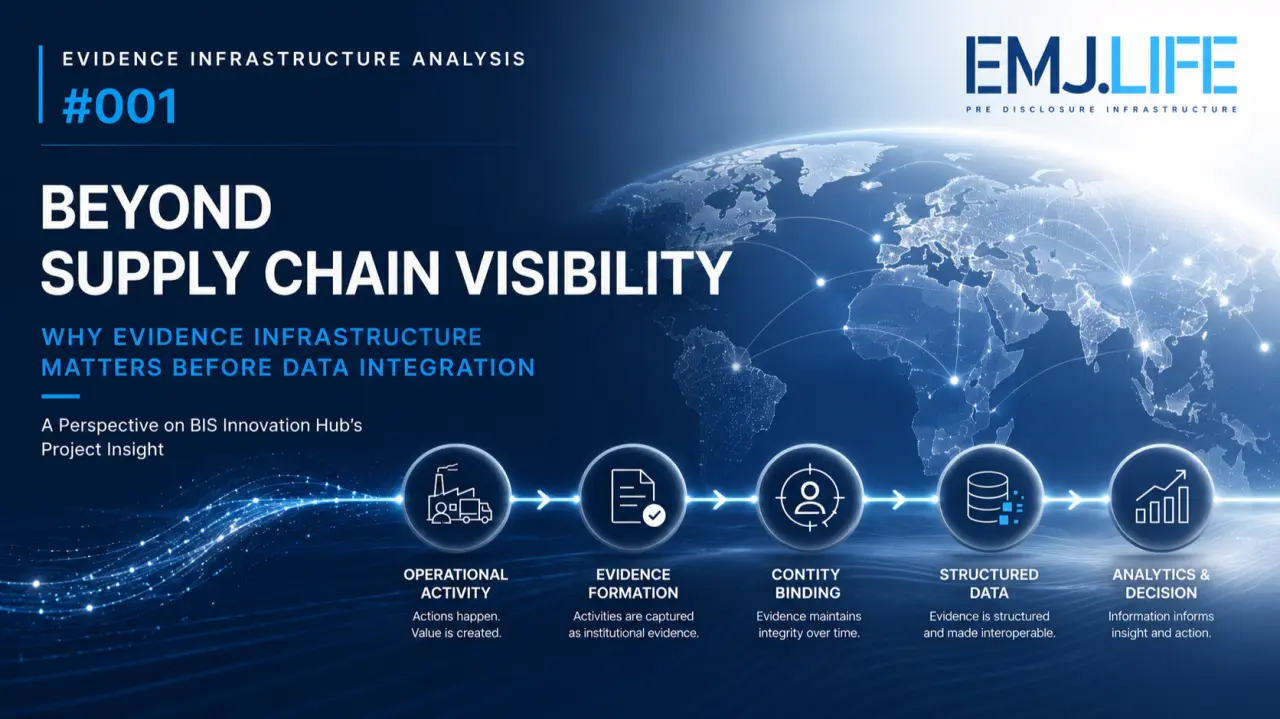
Why Data Integration Alone Is Not Enough
Snn Owned
- AI TRAINING
- allowed
- RIGHTS BASIS
- Original SNN English editorial reporting, analysis, Signal, summary, metadata and structured publication content.
Series introduction
Why Data Integration Alone Is Not Enough
An Evidence Infrastructure Perspective On Bis Innovation Hub'S Project Insight
Executive Summary
The Bank for International Settlements (BIS) Innovation Hub's Project Insight represents an important advancement in understanding global value chains.
By integrating firm-level relationships, maritime shipment records, ownership structures, trade statistics and macroeconomic indicators, the project demonstrates how fragmented datasets can be transformed into a more coherent representation of global supply chain networks.
Its contribution extends well beyond data visualisation.
It presents a practical institutional architecture for integrating heterogeneous information sources to support financial stability analysis, policy development and supply chain monitoring.
The report also highlights another important observation.
If existing datasets require extensive harmonisation, entity matching and reconciliation before becoming analytically useful, perhaps the next infrastructure challenge extends beyond data integration itself.
It may begin much earlier.
This analysis explores that upstream layer.
Rather than focusing on how fragmented information is reconstructed, it examines how operational activities first become trustworthy institutional evidence.
As disclosure expectations, assurance requirements and cross-border governance continue to evolve, this distinction may become increasingly important.
1. Project Insight Represents An Important Institutional Milestone
Global value chains have become increasingly complex.
Production, logistics, ownership structures and commercial relationships now extend across multiple jurisdictions, industries and institutional environments.
While international trade statistics provide valuable macroeconomic perspectives, they often fail to capture the firm-to-firm relationships through which disruptions actually propagate.
Project Insight directly addresses this limitation.
Rather than relying solely on aggregated statistics, the project combines multiple commercial and public datasets into an integrated analytical environment capable of reconstructing supply chain relationships at a much finer level of granularity.
Its architecture incorporates:
• Maritime shipment data
• Firm-to-firm supply chain relationships
• Corporate ownership structures
• Entity attributes
• Vessel tracking information
• International trade statistics
• Macroeconomic indicators
These datasets are subsequently harmonised through extensive preprocessing before being analysed using network metrics, concentration indicators, resilience analysis and interactive visualisation.
The result is a significant enhancement in supply chain visibility for policymakers, regulators and central banks.
Project Insight demonstrates that understanding global supply chains increasingly requires institutional capabilities extending well beyond traditional statistical reporting.
Opening
This perspective asks different questions.
How is evidence originally generated?
How does an operational activity become a structured institutional record?
How is institutional identity consistently attached throughout the lifecycle of that evidence?
How is continuity preserved before fragmentation occurs?
These questions arise before reporting.
Before analytics.
Before dashboards.
Before disclosure.
Rather than replacing downstream integration, they strengthen the conditions under which trustworthy information is originally created.
4. Visibility Does Not Automatically Produce Trust
Project Insight substantially improves visibility across global supply chains.
Visibility, however, should not automatically be interpreted as trust.
Supply chain visibility enables institutions to understand relationships.
Evidence Infrastructure strengthens confidence in the records describing those relationships.
These represent different institutional objectives.
Visibility answers questions such as:
Who trades with whom?
Where are supply chain bottlenecks located?
Which sectors exhibit concentration risk?
This perspective introduces another set of questions.
Can operational activities be consistently represented as institutional evidence?
Can organisational identity remain attached throughout multiple operational processes?
Can evidence preserve continuity across systems without repeated reconstruction?
Can independently generated records support future institutional reuse?
Visibility determines whether relationships can be observed.
Evidence Infrastructure strengthens confidence that those relationships are institutionally reliable.
Structural Change / Institutional Friction
2. Data Integration Solves One Layer Of The Problem
One of the report's greatest strengths lies in recognising that modern supply chain intelligence depends on integration rather than individual datasets.
Throughout the report, considerable effort is devoted to:
• Identifier harmonisation
• Entity resolution
• Product classification mapping
• Data cleaning
• Timestamp reconciliation
• Network construction
These activities are essential because different datasets were never designed to operate together.
Each organisation generates information according to its own operational requirements, identifiers and reporting conventions.
Only after substantial engineering effort do these independent datasets become sufficiently interoperable for policy analysis.
This is a significant institutional achievement.
It also reveals another structural question.
If so much effort is required after data already exists, what conditions existed before those records were created?
3. Evidence Infrastructure Begins Before Data Integration
Project Insight begins with existing datasets.
Evidence Infrastructure begins earlier.
It begins when operational activities first become institutional evidence.
This is not simply a difference in timing.
It is a difference in where institutional reliability is established.
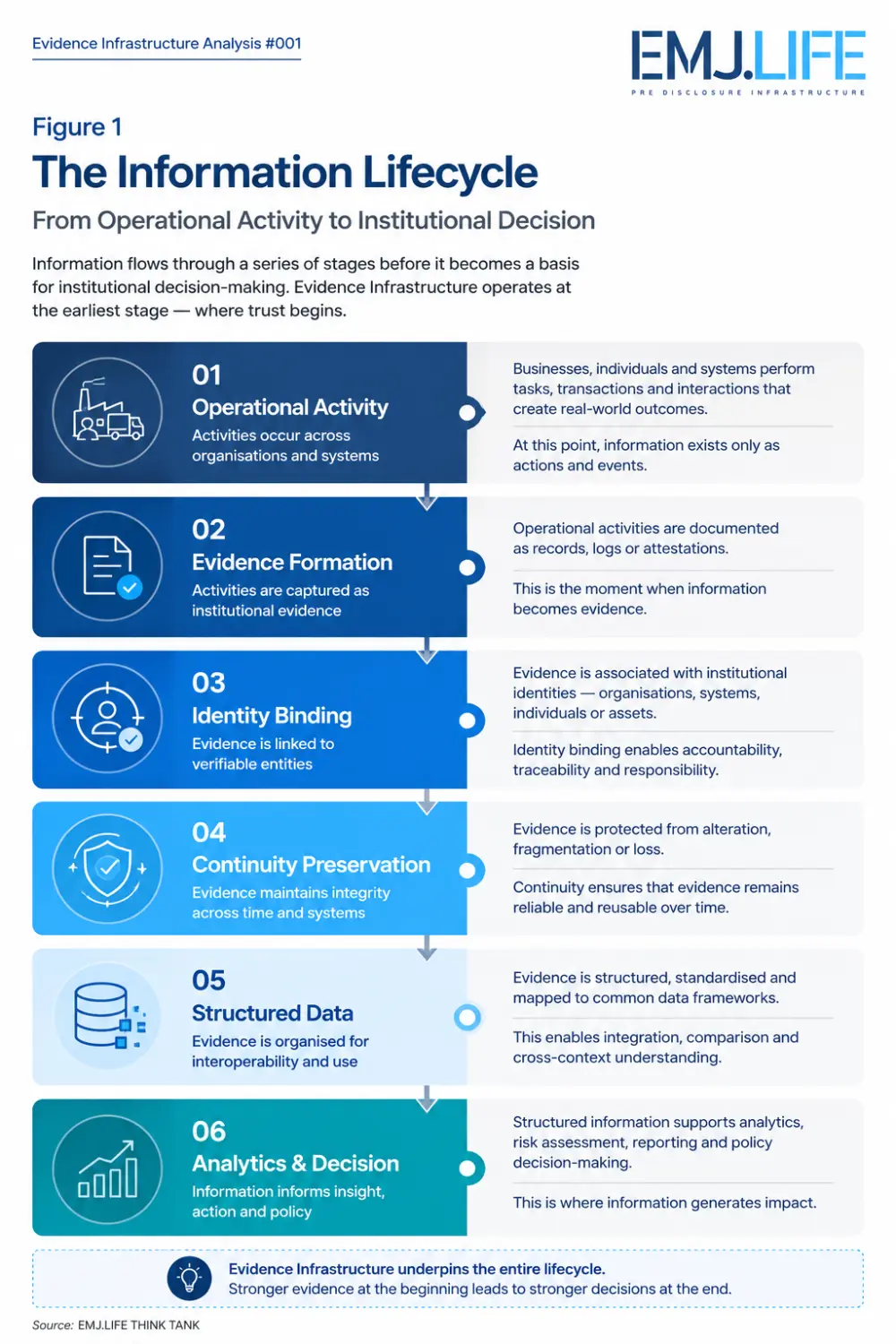
See content credentials
Shows how operational activities become trusted institutional information.
Traditional data integration asks questions such as:
How can existing records be harmonised?
How can fragmented identifiers be reconciled?
How can multiple databases become interoperable?
Institutional Signal
5. Entity Resolution Reveals A Broader Infrastructure Challenge
One particularly significant aspect of Project Insight concerns entity resolution.
The report documents extensive efforts to match entities across independent commercial datasets using legal identifiers, registration numbers, stock market identifiers, company names, addresses and probabilistic matching techniques.
This illustrates an increasingly common institutional reality.
Identity fragmentation has become a structural characteristic of modern information systems.
Entity resolution attempts to reconnect fragmented identities after records already exist.
Evidence Infrastructure approaches the same challenge from an earlier stage.
Rather than asking how fragmented identities can later be reconstructed, it asks whether operational evidence can remain consistently associated with institutional identity before fragmentation occurs.
Entity resolution addresses one stage of the institutional information lifecycle.
Evidence continuity strengthens another.
Together, they reinforce different parts of the same institutional architecture.
6. From Data Infrastructure To Evidence Infrastructure
Project Insight demonstrates the growing importance of data infrastructure.
Evidence Infrastructure does not compete with this direction.
It complements it.
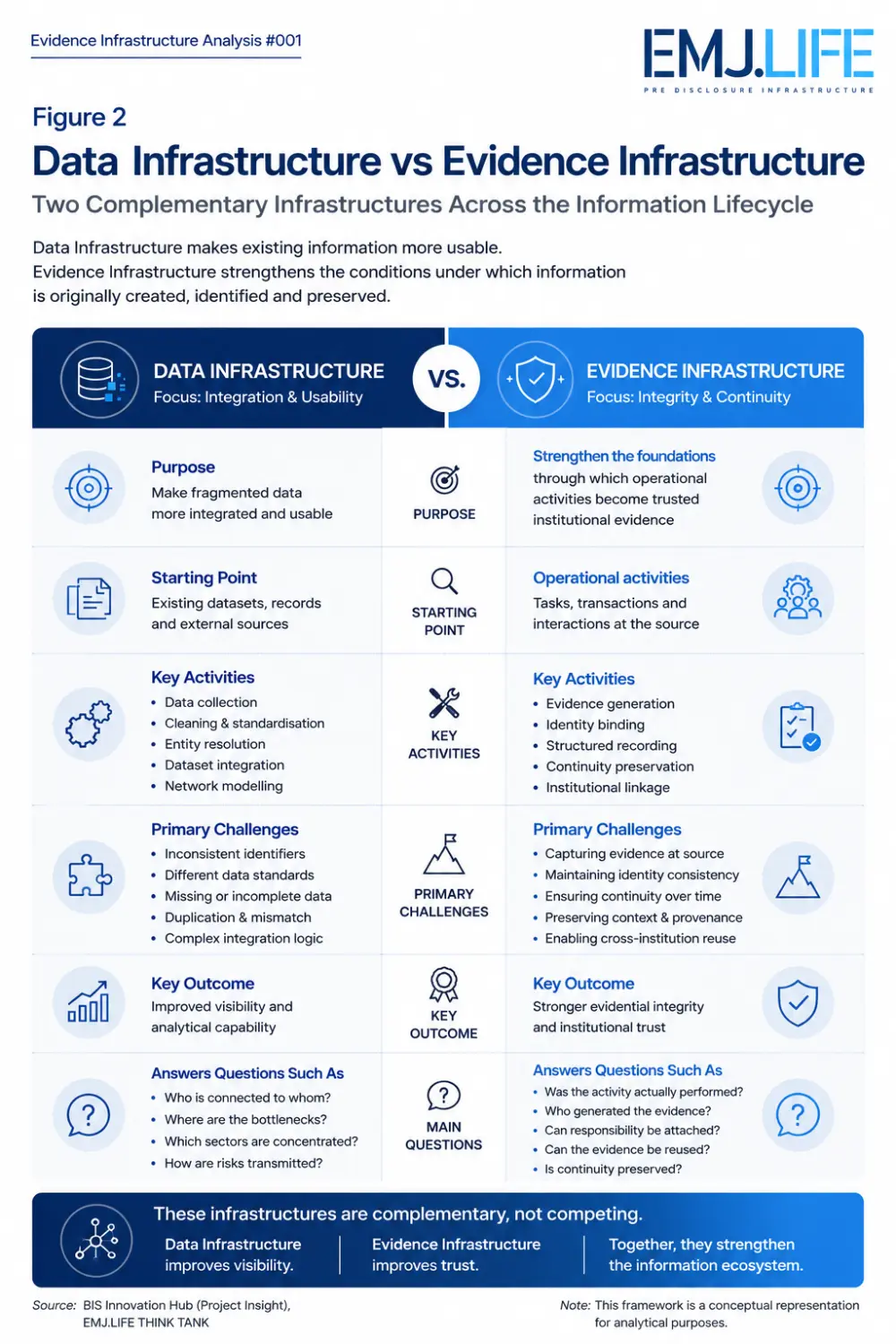
See content credentials
Compares how two infrastructures strengthen different stages of the information lifecycle.
Data infrastructure focuses on making existing information more usable.
Evidence Infrastructure focuses on strengthening the conditions under which that information is originally created.
One enhances analytical capability.
The other strengthens evidential integrity.
One improves visibility.
The other strengthens institutional confidence.
As disclosure expectations expand, assurance requirements evolve and cross-border governance becomes increasingly interconnected, these two infrastructures will become progressively more interdependent.
The future may therefore depend not only on better data integration, but also on stronger evidence formation.
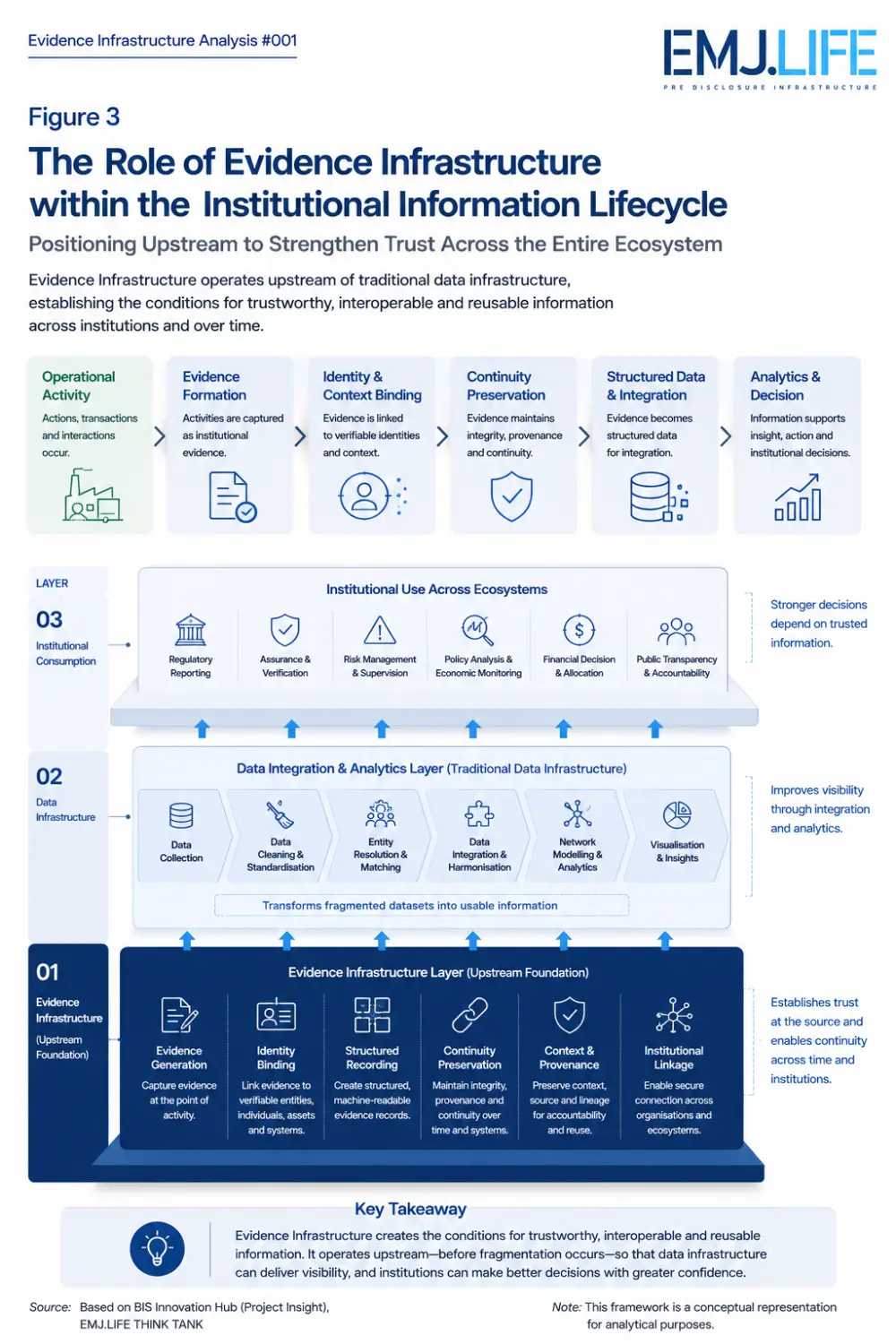
See content credentials
Positions Evidence Infrastructure as the upstream foundation of institutional trust.
Pre-Disclosure Evidence Infrastructure Perspective
Key Insights
• Data integration improves visibility but does not eliminate upstream evidence fragmentation.
• Entity resolution and evidence continuity strengthen different stages of the institutional information lifecycle.
• Operational evidence precedes reporting, analytics and disclosure.
• Institutional interoperability depends on more than shared datasets.
• Trust requires both analytical capability and evidential integrity.
• Evidence Infrastructure complements, rather than replaces, existing data infrastructure.
Evidence Infrastructure Analysis is an independent research series by EMJ.LIFE THINK TANK examining international governance developments through the lens of Evidence Infrastructure, with a particular focus on Institutional Interoperability and Pre-Disclosure Infrastructure.
Closing Reflection
Project Insight represents an important contribution to understanding global value chains.
Its achievements demonstrate how far institutional data integration has progressed and how important granular supply chain intelligence has become for financial stability and economic policy.
From an Evidence Infrastructure perspective, the report also points toward another opportunity.
The next generation of institutional infrastructure may extend beyond integrating fragmented datasets.
It may also involve strengthening the upstream conditions through which operational activities become structured, identity-bound and continuity-preserved evidence before those datasets are ever created.
Data integration explains what institutions can see.
Evidence Infrastructure strengthens confidence in how that information came into existence.
As global governance increasingly depends on trusted information, improving visibility alone will no longer be sufficient.
The quality of institutional decision-making will increasingly depend on the quality of the evidence infrastructure supporting it.
Evidence Infrastructure Perspective
Key Insights
• Data integration improves visibility but does not eliminate upstream evidence fragmentation.
• Entity resolution and evidence continuity strengthen different stages of the institutional information lifecycle.
• Operational evidence precedes reporting, analytics and disclosure.
• Institutional interoperability depends on more than shared datasets.
• Trust requires both analytical capability and evidential integrity.
• Evidence Infrastructure complements, rather than replaces, existing data infrastructure.
Evidence Infrastructure Analysis is an independent research series by EMJ.LIFE THINK TANK examining international governance developments through the lens of Evidence Infrastructure, with a particular focus on Institutional Interoperability and Pre-Disclosure Infrastructure.
Official Sources
Evidence Infrastructure Analysis · 001
July 11, 2026
Sources informing this publication
BIS Innovation Hub
Source classification: Official External Source · Primary analysis source · Official institutional publication · support scope: institutional source · source-link-only · AI training not-allowedOpen source record ↗Evidence Infrastructure terminology and conclusions are separately governed SNN editorial interpretations. They do not imply participation, endorsement, validation or adopted positions by the institutions cited above.
Project Insight represents an important contribution to understanding global value chains. Its achievements demonstrate how far institutional data integration has progressed and how important granular supply chain intelligence has become for financial stability and economic policy. From an Evidence Infrastructure perspective, the report also points toward another opportunity. The next generation of institutional infrastructure may extend beyond integrating fragmented datasets. It may also involve strengthening the upstream conditions through which operational activities become structured, identity-bound and continuity-preserved evidence before those datasets are ever created. Data integration explains what institutions can see. Evidence Infrastructure strengthens confidence in how that information came into existence. As global governance increasingly depends on trusted informatio