
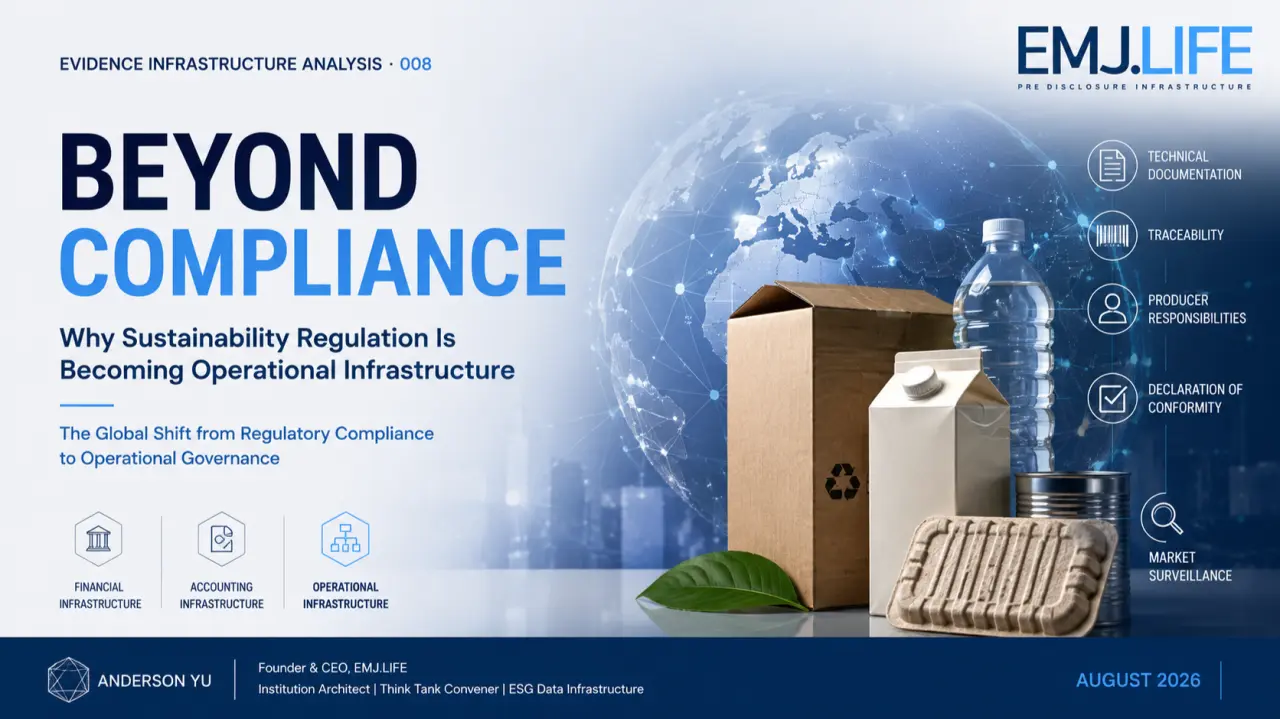
Why Sustainability Regulation Is Becoming Operational Infrastructure
Snn Owned
- AI TRAINING
- allowed
- RIGHTS BASIS
- Original SNN English editorial reporting, analysis, Signal, summary, metadata and structured publication content.
Series introduction
Why Sustainability Regulation Is Becoming Operational Infrastructure
Evidence Infrastructure Analysis
Evidence Infrastructure Analysis is a publication series examining structural developments across global governance, sustainability, interoperability and institutional evidence ecosystems.
Rather than evaluating individual regulations or policy developments in isolation, each edition examines how significant institutional developments reveal broader shifts in the architecture of trust, accountability and implementation.
This edition examines the European Commission's Packaging and Packaging Waste Regulation (PPWR) – Frequently Asked Questions (Second Edition), published in August 2026.
Rather than interpreting the document solely as regulatory guidance, this analysis explores what it may reveal about the operational evolution of sustainability regulation itself.
Executive Summary
For many years, sustainability regulation primarily focused on defining policy objectives.
Reduce waste.
Increase recycling.
Improve circularity.
Strengthen producer responsibility.
The August 2026 Packaging and Packaging Waste Regulation (PPWR) Frequently Asked Questions suggests that another institutional transition is beginning to emerge.
Increasingly, sustainability regulation is no longer limited to defining regulatory obligations.
It is beginning to define operational architecture.
Across the document, technical guidance increasingly focuses on manufacturer responsibilities, technical documentation, declarations of conformity, traceability, market surveillance and operational implementation.
Viewed collectively, these developments extend beyond packaging regulation.
They suggest a broader institutional shift from regulatory compliance toward operational governance.
The emerging question therefore is no longer simply whether organisations comply with sustainability regulation.
It increasingly concerns whether organisations possess the operational architecture required to implement that regulation consistently across products, jurisdictions and global supply chains.
Opening
For decades, sustainability regulation has largely focused on defining obligations.
Organizations were expected to comply.
Regulators were expected to supervise.
Standards were expected to provide consistency.
Operational implementation was often left to individual organizations.
The August 2026 PPWR Frequently Asked Questions suggests that this relationship is beginning to change.
Rather than introducing new policy objectives, the document provides detailed clarification on how regulatory requirements should operate in practice.
Manufacturer responsibilities.
Producer obligations.
Technical documentation.
Declarations of conformity.
Traceability.
Market surveillance.
Viewed individually, these appear to address different implementation questions.
Viewed collectively, however, they point toward a remarkably similar institutional direction.
Sustainability regulation is no longer concerned solely with defining what organizations should achieve.
It is increasingly defining how those objectives should operate throughout the lifecycle of products, evidence and regulatory oversight.
The discussion therefore begins to shift.
Not from stronger regulation.
But from regulatory compliance toward operational governance.
The central question is therefore beginning to evolve.
Not:
"How Should Organizations Comply With Sustainability Regulation?"
But:
"What Operational Architecture Enables Sustainability Regulation To Function Consistently Across Global Supply Chains?"
Structural Change
Sustainability Regulation Is Becoming Operational
For many years, sustainability regulation has largely been understood as a framework of legal obligations.
Organizations were required to comply with environmental targets.
Regulators supervised compliance.
Standards defined common expectations.
Operational implementation, however, remained largely the responsibility of individual organizations.
The August 2026 PPWR Frequently Asked Questions suggests that another institutional transition is beginning to emerge.
Rather than introducing new sustainability objectives, the document devotes substantial attention to how those objectives should be implemented operationally.
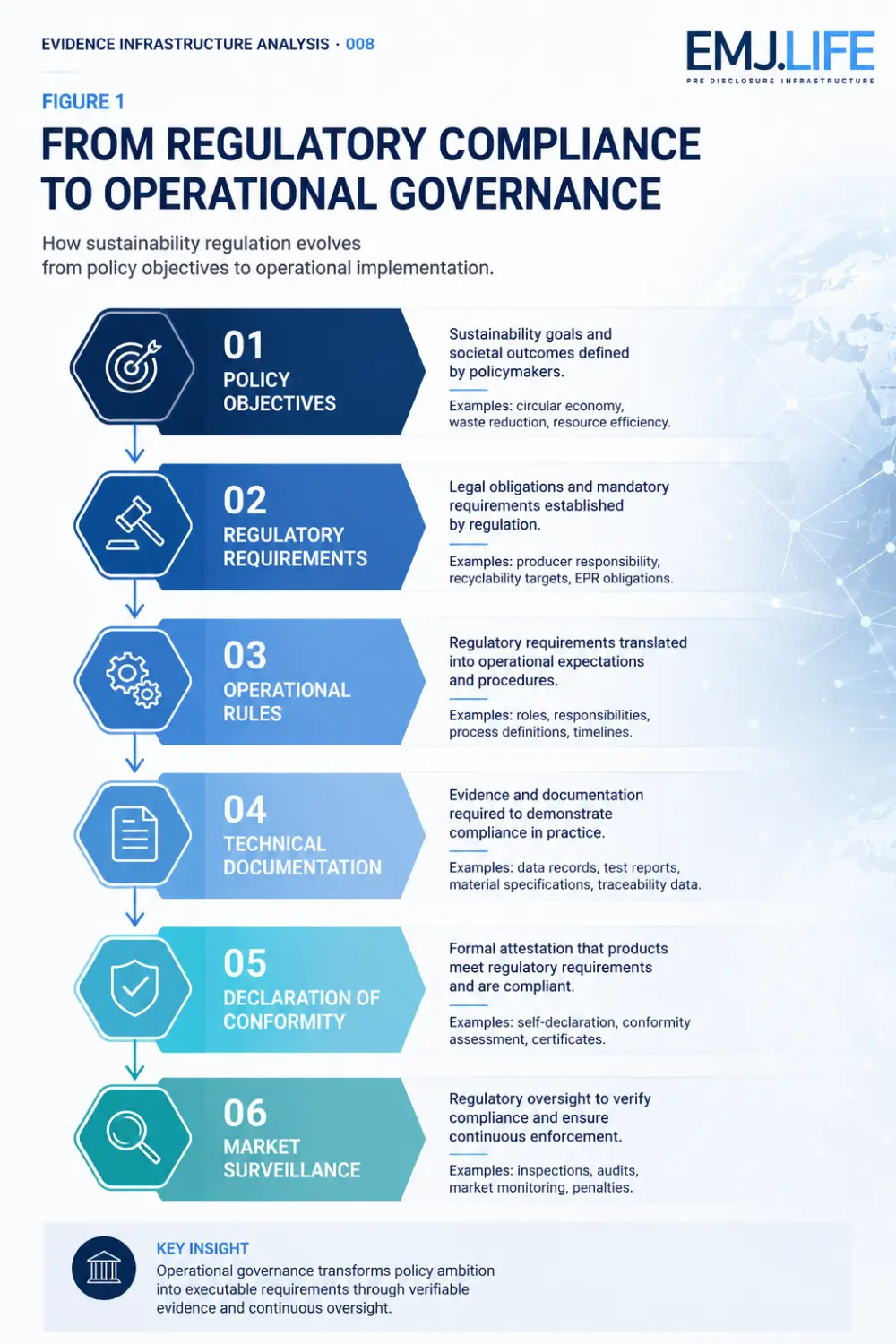
Who is the manufacturer?
Who is the producer?
How should conformity be demonstrated?
Structural Change / Institutional Friction
What technical documentation is required?
How should traceability be maintained?
How should market surveillance operate?
Across different chapters, these questions appear repeatedly.
Viewed individually, they concern different regulatory provisions.
Viewed collectively, they point toward the same institutional direction.
Sustainability regulation is no longer defining only policy outcomes.
It is increasingly defining operational architecture.
This distinction is fundamental.
Policy establishes objectives.
Operational architecture determines whether those objectives can be implemented consistently across products, organizations and jurisdictions.
See content credentials
Regulation becomes operational through structured implementation.
Operational Consequence
Compliance Becomes Operational
As sustainability regulation becomes more operationally defined, compliance itself begins to change.
Historically, organizations often interpreted compliance as the completion of periodic reporting obligations.
Increasingly, compliance depends upon operational capabilities that exist long before reporting takes place.
The PPWR Frequently Asked Questions repeatedly addresses implementation rather than policy.
It clarifies documentation requirements.
Defines economic operator responsibilities.
Explains technical evidence.
Specifies conformity assessment procedures.
Clarifies market surveillance expectations.
These are not additional sustainability objectives.
They are operational conditions that enable regulatory objectives to function consistently.
Viewed from this perspective, compliance is no longer a reporting exercise.
It becomes an operational capability.
Organizations are increasingly expected not only to understand regulatory requirements.
They must also demonstrate that those requirements are embedded within everyday operational processes.
Operational governance therefore becomes the practical condition that allows regulatory compliance to become continuously achievable.
Institutional Signal
Operational Architecture Is Becoming A Competitive Capability
For many years, regulatory compliance has largely been understood as a jurisdiction-specific obligation.
Organizations complied with local regulations.
National authorities supervised implementation.
Institutional Signal
Operational systems were often designed independently for each jurisdiction.
The August 2026 PPWR Frequently Asked Questions suggests that another institutional transition may be beginning to emerge.
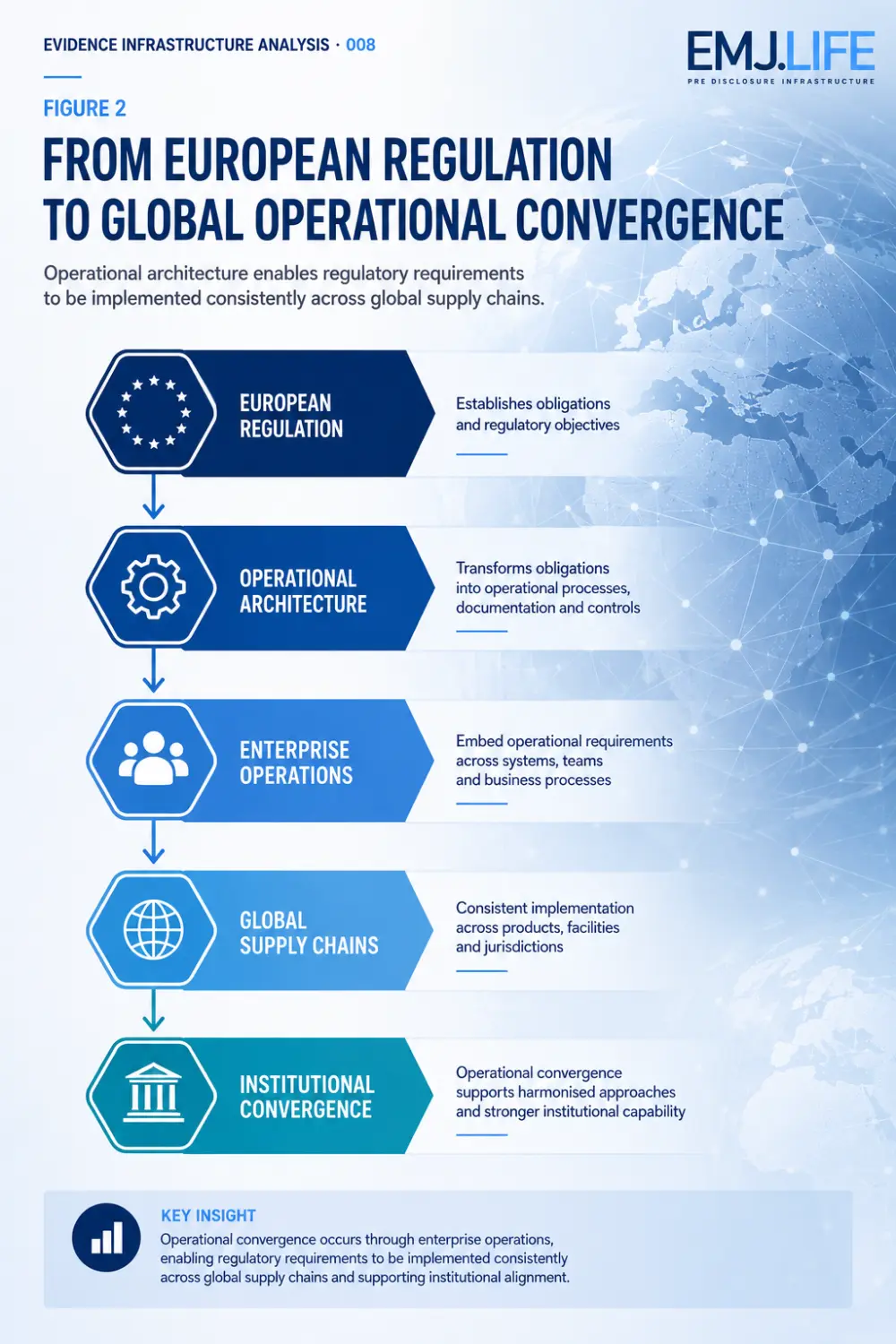
As sustainability regulation becomes increasingly operational, implementation itself becomes more standardized.
Technical documentation.
Declaration of conformity.
Producer responsibilities.
Traceability.
Market surveillance.
These operational capabilities are no longer peripheral administrative requirements.
They increasingly define how regulatory compliance is achieved in practice.
This evolution carries implications beyond the European Union.
Multinational enterprises rarely operate independent operational systems for every jurisdiction.
Global supply chains depend upon common operational processes, shared data structures and consistent governance procedures.
When regulatory implementation becomes increasingly operationally defined, organizations may find greater value in harmonising internal operating models across multiple markets rather than maintaining jurisdiction-specific processes wherever possible.
Viewed from this perspective, operational architecture begins to evolve from a compliance function into an enterprise capability.
The institutional question therefore begins to change.
Not:
"Which Regulation Applies In Each Jurisdiction?"
But:
"What operational architecture allows different regulatory requirements to be implemented consistently across global operations?"
See content credentials
Operational convergence enables global regulatory consistency.
Global Adoption Outlook
Beyond European Implementation
The PPWR is legally applicable within the European Union.
Its broader institutional influence, however, may not be determined solely by legislation.
Large multinational enterprises often operate integrated manufacturing, procurement, logistics and compliance systems across multiple jurisdictions.
Where regulatory requirements reshape operational processes, organizations may choose to standardize internal practices beyond the minimum geographic scope required by law.
This does not mean that the PPWR will become a global regulation.
Nor does it imply that other jurisdictions will formally adopt the Regulation.
Rather, it suggests a different pathway.
Operational convergence.
Organizations that already manage products across European and non-European markets may increasingly align documentation, traceability, packaging governance and conformity processes around a common operational architecture where this reduces complexity and improves consistency.
Whether this occurs will vary across industries, supply chains and regulatory environments.
Nevertheless, the institutional direction is noteworthy.
The influence of sustainability regulation may increasingly extend beyond legal jurisdiction through the operational decisions of globally integrated enterprises.
In that sense, the first stage of international diffusion may occur not through governments, but through multinational operations.
Pre-Disclosure Evidence Infrastructure Perspective
When Regulation Becomes Operational Infrastructure
Viewed through an Evidence Infrastructure perspective, the PPWR Frequently Asked Questions reflects more than regulatory clarification.
It reflects the continuing operationalisation of sustainability governance.
Policy establishes objectives.
Regulation defines obligations.
Operational architecture enables implementation.
Each performs a different institutional function.
Yet increasingly, these functions are becoming more closely integrated.
The PPWR no longer explains only what economic operators should comply with.
It increasingly specifies how operational evidence, technical documentation, conformity assessment, traceability and market surveillance should function together throughout the lifecycle of regulated products.
From this perspective, sustainability regulation is no longer confined to legal interpretation.
It increasingly becomes operational infrastructure.
Evidence Infrastructure therefore should not be understood as an additional reporting layer.
Rather, it provides one perspective for understanding how operational evidence, documentation and governance increasingly become prerequisites for consistent regulatory implementation.
As sustainability regulation becomes more operationally defined, implementation capability itself becomes part of regulatory capability.
Closing Reflection
The August 2026 PPWR Frequently Asked Questions may ultimately be remembered for providing practical clarification of a European regulation.
Its broader institutional significance, however, may extend further.
It illustrates how sustainability regulation is evolving beyond policy objectives and legal obligations.
Increasingly, it is defining the operational conditions required for implementation.
This transition does not change the objectives of sustainability regulation.
It changes the institutional assumptions that support those objectives.
The emerging challenge therefore extends beyond compliance.
It increasingly concerns whether organisations possess the operational architecture necessary to implement sustainability regulation consistently across products, facilities and global supply chains.
The Next Question
The central question facing organizations is therefore beginning to evolve.
From
"How do we comply with sustainability regulation?"
To
"What operational architecture enables sustainability regulation to function consistently across global operations?"
Official Sources
Primary Official Source
European Commission
Packaging And Packaging Waste Regulation (Ppwr)
Frequently Asked Questions (Second Edition)
August 2026
Sources informing this publication
European Commission
Source classification: Official External Source · Primary analysis source · Official institutional publication · support scope: institutional source · source-link-only · AI training not-allowedOpen source record ↗Evidence Infrastructure terminology and conclusions are separately governed SNN editorial interpretations. They do not imply participation, endorsement, validation or adopted positions by the institutions cited above.
The August 2026 PPWR Frequently Asked Questions may ultimately be remembered for providing practical clarification of a European regulation. Its broader institutional significance, however, may extend further. It illustrates how sustainability regulation is evolving beyond policy objectives and legal obligations. Increasingly, it is defining the operational conditions required for implementation. This transition does not change the objectives of sustainability regulation. It changes the institutional assumptions that support those objectives. The emerging challenge therefore extends beyond compliance. It increasingly concerns whether organisations possess the operational architecture necessary to implement sustainability regulation consistently across products, facilities and global supply chains. ### The Next Question The central question facing organizations is therefore begin