
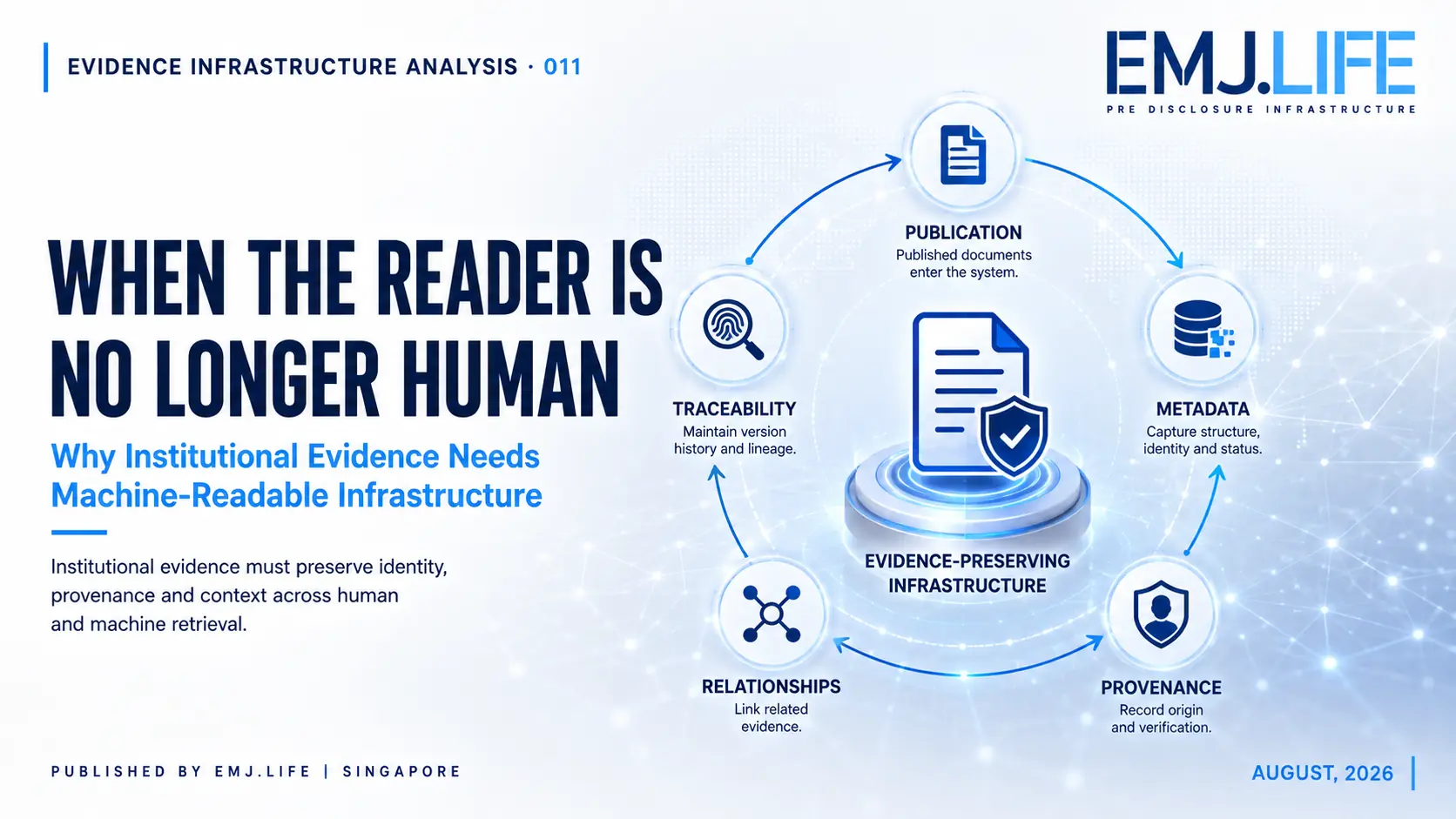
Why Institutional Evidence Needs Machine-Readable Infrastructure
Snn Owned
- AI TRAINING
- allowed
- RIGHTS BASIS
- Original SNN English editorial analysis, metadata, structured publication content and controlled publication assets.
Series introduction
Evidence Infrastructure Analysis is an institutional research publication series published by EMJ.LIFE.
The series examines structural developments across global governance, sustainability reporting, interoperability and evidence ecosystems.
Rather than analysing individual regulations, standards or technologies in isolation, each edition explores what significant institutional developments may reveal about the capabilities required to support trustworthy governance.
This edition examines a different change in the institutional information environment.
For most of the digital era, institutional publications have been designed around an implicit assumption:
The reader is human.
That assumption is beginning to change.
Search systems, automated research tools and AI increasingly participate in the discovery, retrieval and interpretation of institutional information before it reaches a human reader.
The resulting challenge is not simply whether information can be found.
It is whether its institutional meaning can survive retrieval.
Executive Summary
Institutional information has traditionally been published for human interpretation.
Standards are issued.
Consultations are published.
Research is archived.
Technical documents are made available.
News and analysis provide context.
Human readers reconstruct the relationships between them.
They identify the issuing institution.
They compare dates.
They distinguish draft from final.
They recognize primary evidence.
They follow references.
And they decide which source carries institutional authority.
Machine-mediated retrieval changes this environment.
A machine may encounter only a paragraph.
A document fragment.
A metadata record.
A search result.
Or a publication separated from the webpage that originally explained what it was.
The underlying information may remain accurate.
The publication may remain valid.
The institution may continue to stand behind it.
Yet the evidence can become harder to interpret correctly once its original context is removed.
This publication describes that condition as:
Evidence Ambiguity.
The emerging institutional challenge therefore extends beyond making information searchable or machine-readable.
It concerns whether evidence can preserve:
identity,
status,
provenance,
version,
authority,
and relationship
through retrieval.
This requires another infrastructure capability:
Evidence-Preserving Infrastructure.
The objective is not to optimize institutional information for AI.
It is to ensure that institutional meaning survives even when the first reader is no longer human.
Opening
For most of the digital era, the institutional web has followed a familiar model.
Information is published.
Search engines index it.
Humans find it.
Humans interpret it.
This architecture works partly because human readers are exceptionally good at reconstructing context.
They recognize institutional branding.
They infer hierarchy from page structure.
They distinguish a regulator from a commentator.
They compare publication dates.
They understand that a consultation is not a final rule.
They recognize that analysis about a standard is not the standard itself.
Much of this context is not embedded directly into the information object.
It exists around it.
On the webpage.
Inside the navigation structure.
Across related documents.
Within institutional conventions.
Machine-mediated retrieval begins to separate information from that environment.
A system may retrieve a sentence without the page surrounding it.
A document may be summarized without its version relationship.
A publication may be cited without clearly distinguishing whether it is current, superseded or interpretive.
A technically accurate passage can therefore become institutionally incomplete.
The emerging question is no longer:
"Can the information be found?"
It is:
"Can the evidence still explain what it is after it has been found?"
This distinction changes the infrastructure problem.
Searchability concerns access.
Evidence infrastructure concerns meaning.
Structural Change / Institutional Friction
The Publication Environment and the Retrieval Environment Are Separating
Traditional digital publishing assumes that the publication environment and the reading environment are closely connected.
A reader enters a website.
The institution is visible.
The document title is visible.
The date is visible.
Related materials are visible.
Version information may be visible.
The reader can move between documents and reconstruct their relationship.
Machine retrieval weakens this connection.
The environment in which information is published may no longer be the environment in which it is encountered.
This creates a new structural boundary:
The Retrieval Boundary
On one side sits the publication context.
On the other sits the retrieved representation.
What matters is what survives the crossing.
If only the text survives, important institutional characteristics may disappear.
The source may become less obvious.
The publication type may become unclear.
The relationship between versions may be lost.
Primary evidence and interpretation may appear equivalent.
An archived document may become indistinguishable from a current one.
The evidence itself has not necessarily changed.
Its retrievable meaning has.
This publication describes the resulting condition as:
Evidence Ambiguity
Evidence ambiguity does not mean that evidence is false.
It does not mean that a document has been manipulated.
It does not necessarily involve misinformation.
The underlying publication may remain completely valid.
The problem arises when the information required to interpret its institutional significance no longer travels with it.
Evidence can remain valid while becoming institutionally ambiguous outside its original publication context.
This is the structural change introduced by machine-mediated retrieval.
Institutional Signal
Searchability Is Becoming Different From Evidence Interpretability
The institutional web has spent decades improving discoverability.
Documents became digital.
Websites became searchable.
Repositories became indexed.
Metadata improved.
Persistent identifiers expanded.
Structured digital publication became more common.
These developments solved important problems.
But the next problem is different.
A publication can be discoverable without being correctly interpretable.
It can be machine-readable without being institutionally identifiable.
It can be retrieved without preserving provenance.
It can be summarized without preserving version status.
It can be cited without distinguishing primary evidence from secondary interpretation.
The institutional sequence therefore begins to change.
Traditional digital access largely followed:
Publish → Index → Search → Access
Evidence-preserving access requires more:
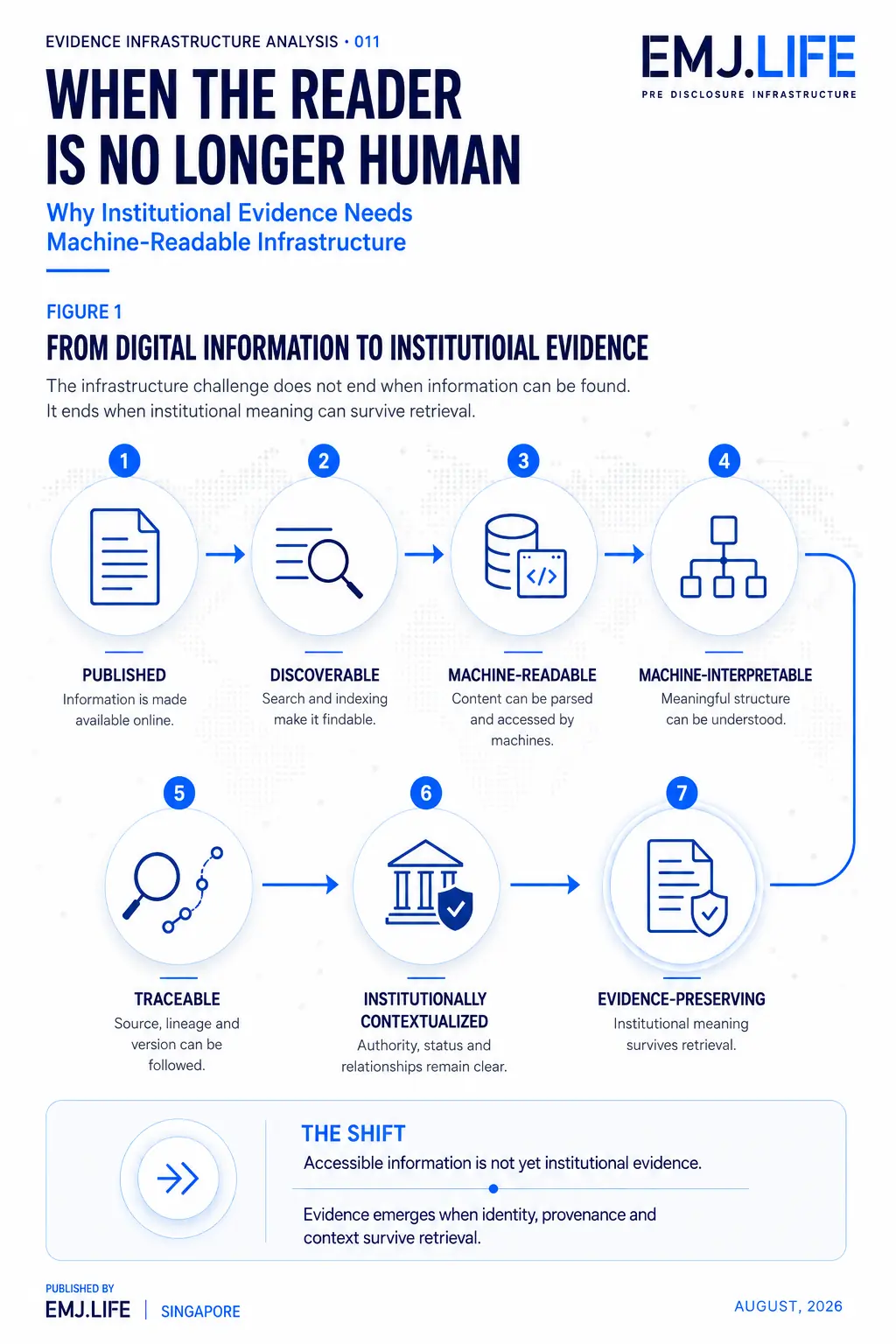
Publish → Discover → Identify → Interpret → Trace → Contextualize → Retrieve
This distinction matters because institutional evidence is not merely content.
It carries relationships.
A standard relates to amendments.
A consultation relates to responses.
A response relates to a consultation process.
A technical publication may relate to a methodology.
A news article may interpret an institutional development.
An analysis may rely on several primary sources.
These relationships determine meaning.
If retrieval preserves the words but loses the relationship, part of the evidence has been lost even when the content remains intact.
The broader institutional signal is therefore not:
"Is institutional information machine-readable?"
It is:
"Can machines distinguish what institutional information means, where it came from and how much authority it carries?"
From Documents to Evidence Objects
This requires a different way of thinking about institutional publications.
A document is a container of information.
An Evidence Object carries more.
It carries:
Identity
What exactly is this record?
Origin
Who issued or produced it?
Type
Is it a standard, consultation, response, research publication, analysis or news report?
Time
When did it enter the institutional record?
Status
Is it draft, final, current, amended, archived or superseded?
Version
Which iteration of the record is being retrieved?
Relationship
What other documents does it respond to, replace, support or depend upon?
Provenance
Can its origin and evidentiary lineage be reconstructed?
Authority
What institutional weight should be attached to it?
This changes the meaning of digital publication.
A PDF is no longer simply a downloadable file.
It is one representation of an identifiable evidence object.
A webpage is no longer merely an interface.
It is a reference point connecting content to identity, metadata, provenance and related records.
A consultation response is not merely another article.
It is a record associated with a defined consultation process, issuing organization, date and underlying institutional materials.
An analysis is not transformed into primary evidence simply because a machine retrieves it beside an official document.
The difference between these objects must therefore remain visible within the infrastructure.
Pre-Disclosure Evidence Infrastructure Perspective
Viewed through an Evidence Infrastructure perspective, the challenge is not simply making more information available to machines.
It is preserving institutional meaning across retrieval.
An Evidence-Preserving Infrastructure therefore requires several connected capabilities.
1. Persistent Evidence Identity
Institutional records should maintain a stable identity that remains recognizable across publication, indexing and retrieval environments.
2. Explicit Evidence Type
Standards, regulations, consultations, institutional responses, research, analysis and news should remain distinguishable.
They should not become evidentially equivalent simply because they are digitally accessible.
3. Structured Metadata
Issuer, publication type, date, status, language, version and other relevant attributes should not depend entirely on visual interpretation.
4. Provenance
Evidence should maintain a traceable connection to its institutional origin and underlying source.
5. Version and Relationship Management
Current, amended, archived and superseded materials should remain distinguishable, while relationships between connected records should be explicit.
6. Canonical Discovery
Institutions should maintain authoritative reference locations through which evidence identity and related records can be reconstructed.
7. Evidence-Preserving Retrieval
When information leaves its original publication environment, enough identity, provenance and context should remain available to interpret it correctly.
Together, these capabilities create a progression:
Published → Discoverable → Machine-Readable → Machine-Interpretable → Traceable → Institutionally Contextualized → Evidence-Preserving
This is different from conventional search optimization.
Search optimization improves the probability that information will be found.
Evidence-Preserving Infrastructure improves the probability that found information will still be understood correctly.
The objective is therefore not simply discoverability.
It is:
Evidence-Preserving Discovery
Discoverability without evidentiary structure can create ambiguity.
Evidentiary structure without discoverability limits utility.
Institutional information increasingly requires both.
From Evidence Decay to Evidence Ambiguity
Evidence Infrastructure Analysis · 010 examined what happens after a governed system enters a changing operational environment.
A system may change.
Its configuration may change.
Its data may change.
Its users may change.
Its boundaries may change.
Evidence produced earlier may continue to exist while becoming less representative of the system operating in practice.
That condition was described as:
Evidence Decay.
Evidence Ambiguity addresses a different problem.
Here, the underlying evidence may remain valid.
Its source may remain authoritative.
The document may remain current.
The institution may continue to stand behind it.
But once retrieved outside its original publication environment, the evidence may no longer carry enough context to establish what it represents.
The distinction is therefore:
Evidence Decay asks whether evidence still describes reality.
Evidence Ambiguity asks whether retrieved evidence still describes itself.
These risks emerge at different points in the evidence lifecycle.
But they share a common principle.
Evidence does not remain trustworthy merely because it continues to exist.
Its relationship to reality, identity and institutional context must also remain intact.
Institutional Meaning Preservation
The emergence of machine-mediated retrieval therefore does not require every institution to become an AI organization.
It does not require every document to become a knowledge graph.
And it does not require human interpretation to disappear.
The deeper requirement is much more fundamental.
Institutional information should carry enough structure to remain intelligible when it moves between environments.
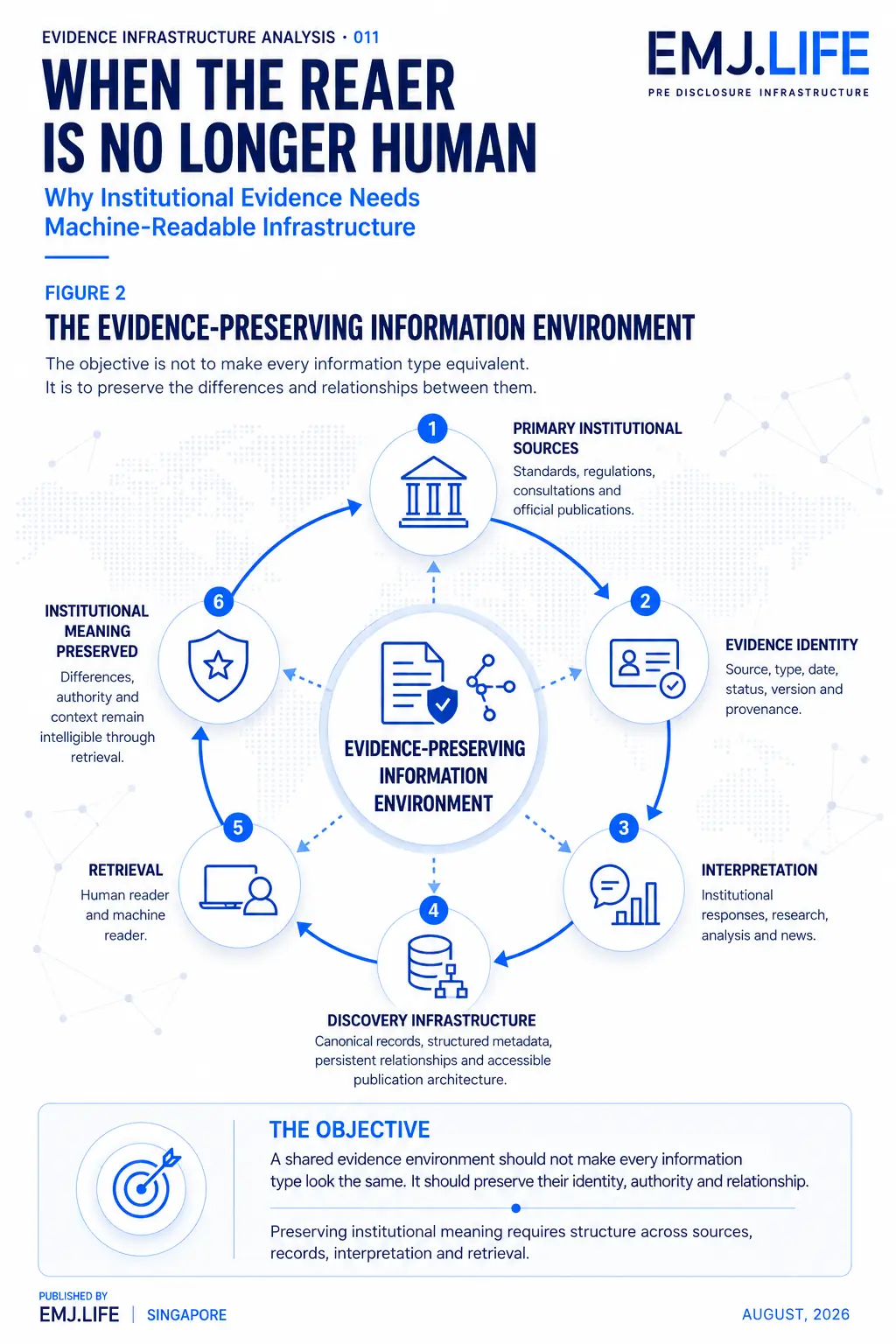
The objective is not to make every information type look the same.
It is the opposite.
A strong evidence environment should preserve differences.
Primary evidence should remain identifiable as primary evidence.
Interpretation should remain identifiable as interpretation.
Draft material should remain distinguishable from final material.
Current publications should remain distinguishable from superseded versions.
Institutional authority should not become a property inferred only from search ranking.
The future institutional web may therefore need to function as more than a communications environment.
It may increasingly need to function as an:
Evidence Environment
An environment in which identity persists.
Provenance remains traceable.
Versions remain distinguishable.
Relationships remain reconstructable.
Evidence classes remain separate.
And institutional meaning survives retrieval.
Closing Reflection
AI did not create the fragmentation of institutional information.
It revealed its consequences.
Documents without explicit relationships already existed.
Versions without sufficiently visible status already existed.
Primary evidence and interpretation already circulated across different environments.
Institutional context has always weakened when information moves away from its source.
What changes now is the scale and speed at which that movement occurs.
Machine-mediated retrieval makes information increasingly portable.
But evidence is more than portable information.
Evidence carries:
identity,
authority,
time,
status,
relationship,
provenance,
and context.
If those characteristics disappear during retrieval, the content may survive while part of its institutional meaning does not.
The next challenge for institutional information architecture may therefore not be producing more content.
It may be ensuring that evidence carries the conditions required to interpret it correctly.
This creates a broader design principle:
Evidence infrastructure should not only preserve information. It should preserve the conditions required to understand that information.
This is the transition introduced by Evidence Infrastructure Analysis · 011.
The previous edition asked:
How does institutional evidence survive deployment and change?
This edition asks a different question:
How does institutional evidence survive retrieval and interpretation?
The reader may no longer always be human.
The evidence still needs to know what it is.
Official Sources
This publication is informed by the evolving digital architecture of institutional publication, standards navigation, persistent repositories, structured metadata, provenance and machine-readable information environments.
Relevant institutional and research environments include:
- IFRS Foundation, IFRS Sustainability Standards Navigator
- International Trade Centre, Standards Map
- European Commission Joint Research Centre, JRC Publications Repository
- Emerging research on provenance-aware and machine-readable sustainability knowledge infrastructures
The concepts of Evidence Object, Retrieval Boundary, Evidence Ambiguity, Evidence-Preserving Discovery and Evidence-Preserving Infrastructure represent EMJ.LIFE's institutional interpretation of structural changes arising as institutional information becomes increasingly subject to machine-mediated discovery and retrieval.
They are not presented as adopted terminology, regulatory requirements or formal positions of the institutions referenced above.
This SNN controlled edition preserves the complete publication, figures, verified source records and analytical disclosure on one onsite reading page.
Sources informing this publication
World Wide Web Consortium
Source classification: Official External Source · Supporting technical standard · W3C Recommendation · support scope: institutional source · source-link-only · AI training not-allowedOpen source record ↗World Wide Web Consortium
Source classification: Official External Source · Supporting technical standard · W3C Recommendation · support scope: institutional source · source-link-only · AI training not-allowedOpen source record ↗DataCite
Source classification: Official External Source · Supporting technical standard · Persistent identifier metadata standard · support scope: institutional source · source-link-only · AI training not-allowedOpen source record ↗Crossref
Source classification: Official External Source · Supporting technical source · Institutional metadata documentation · support scope: institutional source · source-link-only · AI training not-allowedOpen source record ↗Scientific Data
Source classification: Independent External Source · Supporting research source · Peer-reviewed research · support scope: independent external source · source-link-only · AI training not-allowedOpen source record ↗IFRS Foundation
Source classification: Official External Source · Official institutional environment · Institutional standards navigator · support scope: institutional source · source-link-only · AI training not-allowedOpen source record ↗International Trade Centre
Source classification: Official External Source · Official institutional environment · Institutional standards platform · support scope: institutional source · source-link-only · AI training not-allowedOpen source record ↗European Commission · Joint Research Centre
Source classification: Official External Source · Official institutional environment · Institutional publications repository · support scope: institutional source · source-link-only · AI training not-allowedOpen source record ↗Evidence Infrastructure terminology and conclusions are separately governed SNN editorial interpretations. They do not imply participation, endorsement, validation or adopted positions by the institutions cited above.
Evidence Object, Retrieval Boundary, Evidence Ambiguity, Evidence-Preserving Discovery and Evidence-Preserving Infrastructure are EMJ.LIFE analytical interpretations, not adopted terminology, regulatory requirements or formal positions of the cited institutions.