
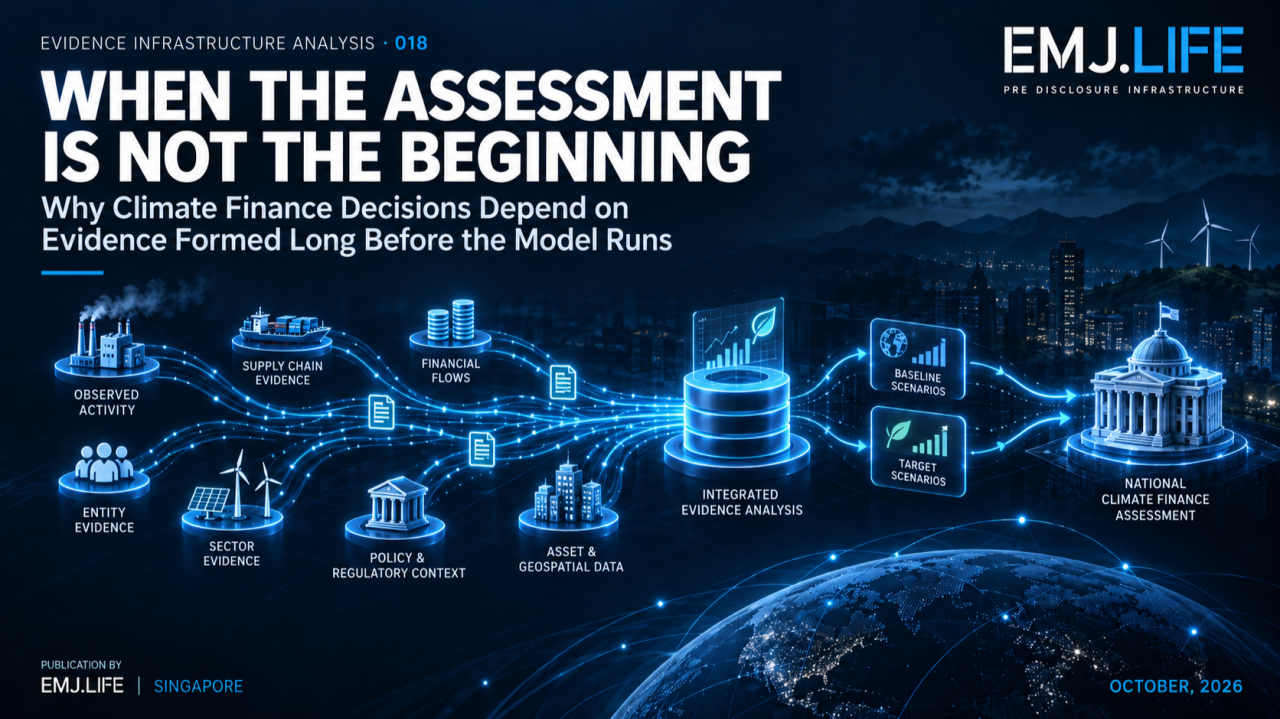
Why Climate Finance Decisions Depend on Evidence Formed Long Before the Model Runs
Source and editorial boundary
This content references a primary institutional source published by EMJ.LIFE. SNN editorial interpretation is separately identified and should not be interpreted as independent third-party validation of EMJ.LIFE or the referenced publication.
- SOURCE RELATIONSHIP
- related_institutional_source
- PRIMARY SOURCE PUBLISHER
- EMJ.LIFE
- EXTERNAL VALIDATION
- not_claimed
Licensed
- AI TRAINING
- not-allowed
- RIGHTS BASIS
- EMJ.LIFE-controlled original manuscript and artwork supplied for an authorized Sustainability News Network onsite edition. SNN is publisher of this web edition, while EMJ.LIFE remains publisher of the original work. Third-party source rights remain separate and are not transferred.
- LICENSE
- EMJ.LIFE publication authorization for Sustainability News Network
Series introduction
Evidence Infrastructure Analysis
Evidence Infrastructure Analysis examines structural developments across governance, sustainability, interoperability and evidence systems.
Earlier editions have examined whether evidence survives operational change, machine retrieval, verification, cross-framework reuse, institutional decision-making, disclosure simplification and changes in institutional affiliation.
This edition examines another boundary.
The boundary between:
the visible assessment
and
the evidence that made the assessment possible.
Climate finance provides an unusually clear environment in which to observe this distinction.
A national financial assessment may ultimately produce a small number of highly consequential results:
the investment required to meet climate targets,
the sectors where finance must shift,
the entities expected to invest,
the sources from which finance may come,
and the policy measures needed to mobilise it.
These results appear downstream.
Their evidence does not.
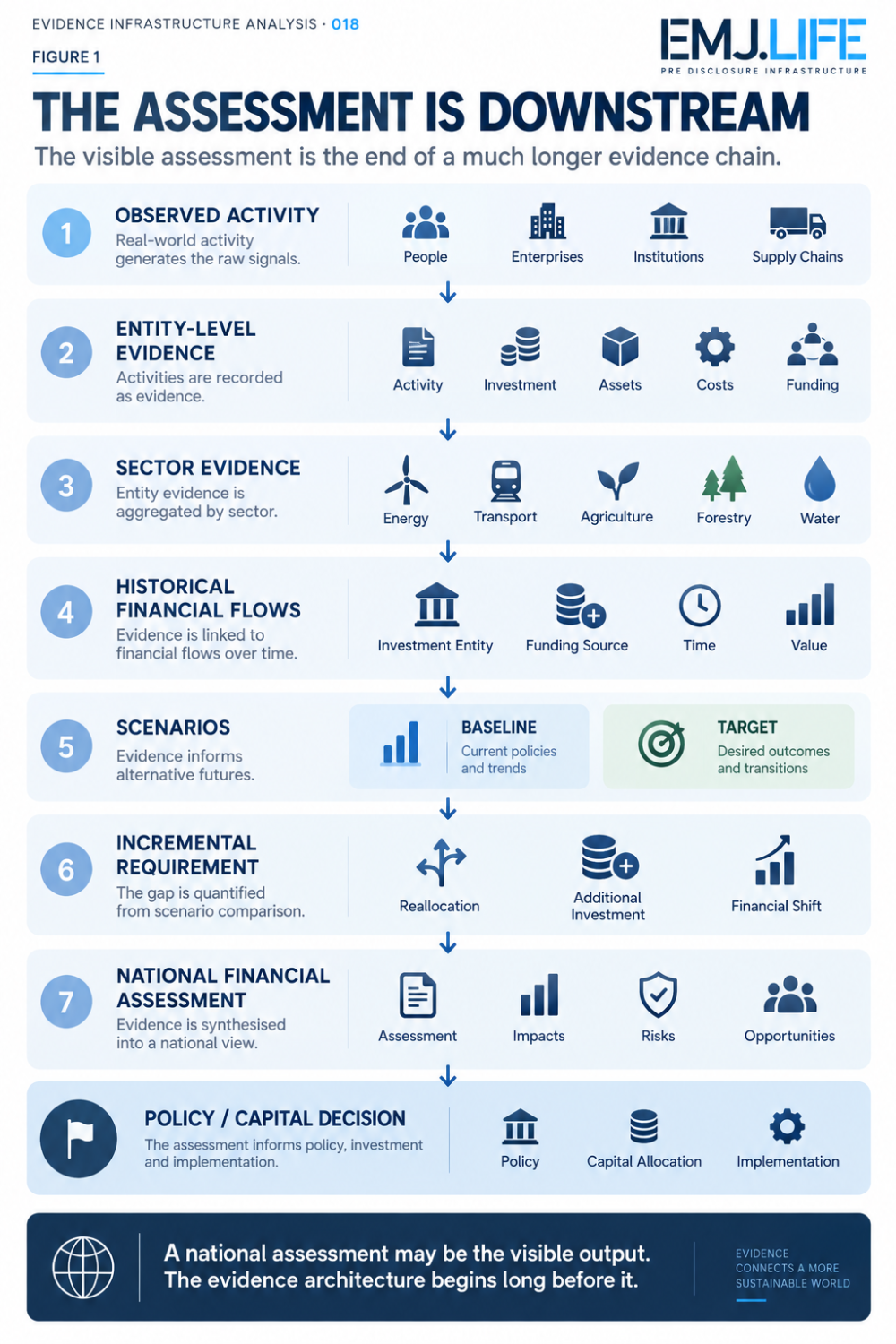
The underlying evidence may have been formed months or years earlier across ministries, companies, financial institutions, households, statistical systems, sector experts and other economic actors.
This creates a fundamental Evidence Infrastructure question:
If the final assessment is trusted, what had to become trustworthy before the assessment began?
Executive Summary
UNDP's Investment and Financial Flows methodology is designed to help countries understand the financing required to implement national climate objectives.
Countries begin by translating climate plans such as NDCs, NAPs or long-term strategies into actionable mitigation and adaptation measures.
They then examine who currently invests in relevant sectors, develop a baseline scenario reflecting business-as-usual financial conditions, develop a target scenario representing the finance required to reach climate objectives, and compare the two to identify financial shifts and additional investment requirements.
The final assessment can support:
national budgeting,
finance mobilisation,
policy making,
investment strategy,
and continuing climate planning. UNDP
But the assessment itself is only the downstream analytical layer.
Before the model can compare scenarios, institutions must establish:
what activity occurred,
which entity invested,
which funding source was involved,
which sector the activity belongs to,
which historical values are reliable,
which assumptions are being introduced,
which scenario a value belongs to,
which methodology produced a result,
and how multiple records can be aggregated without duplication.
This publication introduces three concepts for understanding that architecture:
Distributed Evidence Formation
The condition in which the final analytical output is centralised while the evidence supporting it is generated across multiple actors, entities, systems and institutional authorities.
Evidence Inheritance
The condition in which a downstream analytical output inherits the strengths, limitations, assumptions and governance state of the upstream evidence from which it is produced.
Scenario Evidence Boundary
The boundary that keeps observed evidence, analytical assumptions, modelled scenarios, derived results and institutional decisions from being treated as the same epistemic object.
Together they lead to one central principle:
The model cannot create evidence quality that did not exist upstream.
Opening
01 | The Assessment Is a Downstream Object
A national climate finance assessment can look like a single analytical product.
A spreadsheet.
A model.
A report.
A national financing requirement.
A set of sector investment needs.
But that final product is assembled from a much longer institutional chain.
UNDP's methodology begins with national climate priorities and converts them into actionable mitigation and adaptation measures.
The assessment then asks questions such as:
Who is investing?
How much is already being invested?
Where does finance currently come from?
What happens under business-as-usual conditions?
What would need to happen under the climate target scenario?
How much finance needs to shift?
How much additional finance is required?
The final number is therefore not the beginning of the analytical process.
It is the result of repeated upstream decisions.
Sector definitions.
Entity identification.
Historical data collection.
Cost assumptions.
Financial classification.
Scenario construction.
Temporal boundaries.
Aggregation.
All of these precede the visible assessment.
This changes the infrastructure question.
Not:
Can the model calculate the result?
But:
Can the evidence supporting every major step remain reconstructable?
02 | Distributed Evidence Formation
The assessment may be centralised. The evidence is not.
UNDP describes the methodology primarily as a resource for governments, but it also recognises that financial assessments depend on a broad contributor base.
Assessment teams may involve ministries responsible for planning, finance, environment and relevant sectors, together with the private sector, academia and non-governmental organisations that contribute socioeconomic data, financial information, scenario development and modelling.
This means evidence is produced across different institutional locations.
Government
Targets.
Policies.
Public budgets.
Sector plans.
Official programmes.
Statistical systems
Historical activity.
Economic data.
Demographic information.
Sector statistics.
Enterprises
Capital expenditure.
Operating expenditure.
Assets.
Production activity.
Technology choices.
Investment plans.
Supply chains
Operational relationships.
Supplier activity.
Input requirements.
Transport.
Production dependencies.
Financial institutions
Funding source.
Financial instrument.
Financing terms.
Capital availability.
Households and other economic actors
Investment behaviour.
Consumption.
Asset choices.
Adaptation or mitigation expenditure.
Technical teams
Scenario assumptions.
Cost assumptions.
Technology pathways.
Sector models.
The national assessment is therefore not one source of evidence.
It is an aggregation point for distributed evidence formation.
That distinction is critical.
Centralised analysis does not imply centralised evidence creation.
Structural Change / Institutional Friction
03 | Evidence Inheritance
The existence of a sophisticated methodology can create confidence.
But methodology and evidence quality are not interchangeable.
A model may be internally consistent.
The formulas may be correct.
The scenario logic may be coherent.
The calculation may be reproducible.
And the final result can still inherit weaknesses from upstream evidence.
Suppose:
historical investment data are incomplete,
the wrong entity is associated with an investment,
public and private funding sources are mixed,
sector boundaries overlap,
one asset appears in multiple sector datasets,
an assumption is treated as an observed value,
or a model version changes without preserving lineage.
None of these problems necessarily breaks the calculation itself.
Instead, they travel downstream.
This is Evidence Inheritance.
A downstream analytical output inherits the strengths, limitations, assumptions and governance state of its upstream evidence.
Evidence Inheritance works in both directions.
Strong evidence can make analytical results more defensible.
Weak evidence can make a technically correct result institutionally fragile.
This is why:
A precise number is not automatically precise evidence.
And:
The model cannot create evidence quality that did not exist upstream.
04 | Investment Entity Is Not Funding Source
Climate finance also demonstrates why apparently similar evidence dimensions must remain separate.
An investment entity answers one question:
Who undertakes the investment?
A funding source answers another:
Where does the finance come from?
The two may coincide.
Often they do not.
A private company may undertake an investment financed partly through a public programme.
A household may undertake an adaptation investment using commercial credit.
A public utility may invest using a mixture of government funding, retained earnings and international finance.
If these dimensions are collapsed, the assessment may lose the ability to distinguish:
who acts,
who finances,
how public and private capital interact,
and where finance mobilisation needs to occur.
This reveals a broader Evidence Infrastructure principle:
Evidence dimensions that appear together in the final model may still require separate identities upstream.
The same applies to:
actor and authority,
activity and funding,
asset and owner,
observation and assumption,
scenario and decision.
Aggregation should combine evidence only after those distinctions have been preserved.
Institutional Signal
05 | Scenario Evidence Boundary
The UNDP methodology relies on scenario comparison.
At the simplest level:
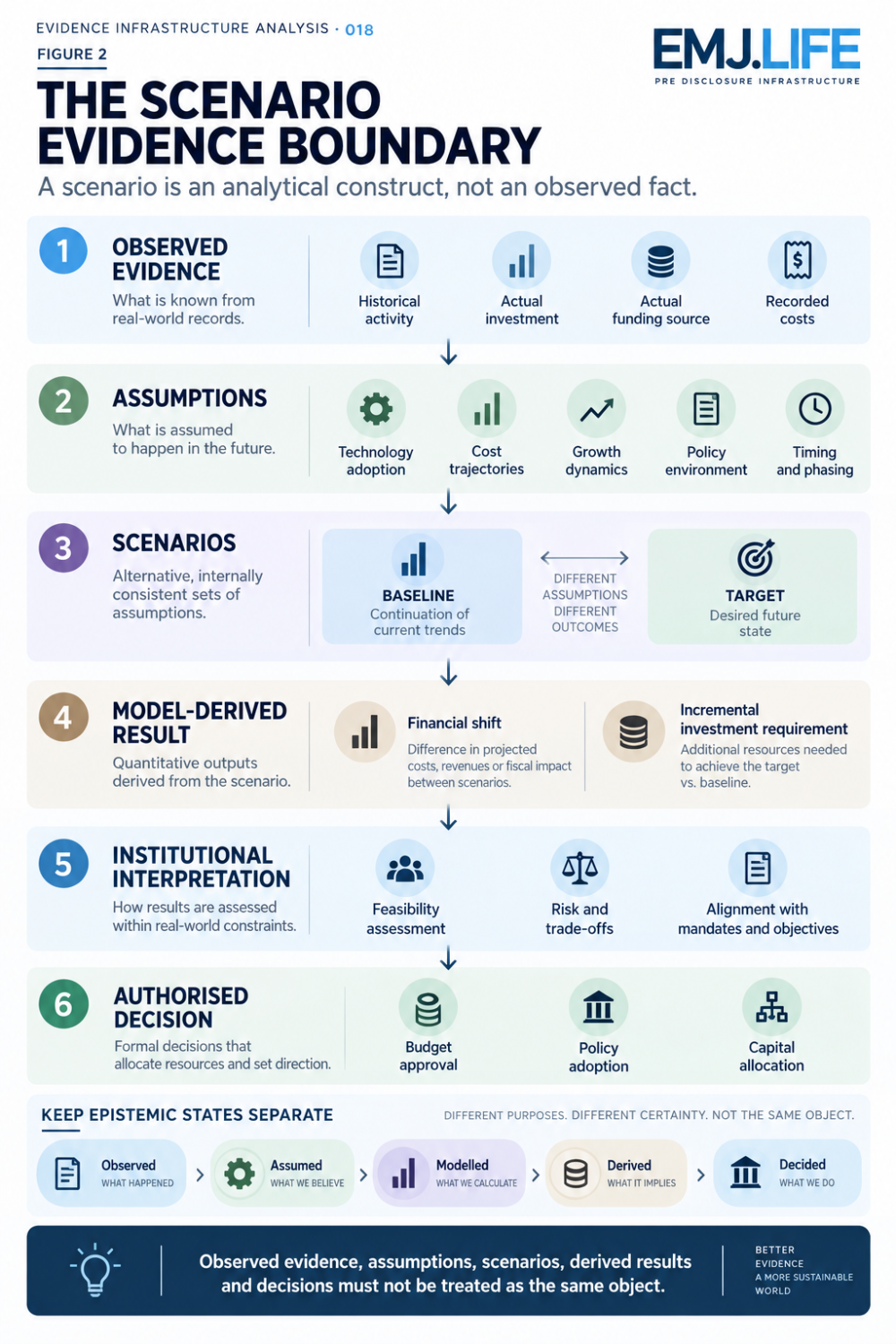
Baseline Scenario
What financial flows are expected under existing or business-as-usual conditions?
Target Scenario
What financial flows would be required to implement the climate measures needed to reach national targets?
The difference between those states reveals shifts and additional investment requirements.
But a scenario is not an observed fact.
This distinction is easy to lose when scenario values appear in the same spreadsheet as historical values.
The evidence chain therefore needs to preserve several states.
OBSERVED
What actually occurred?
ASSUMED
What analytical premise has been introduced?
MODELLED
What happens when assumptions are applied to a scenario?
DERIVED
What result is calculated from those inputs?
DECIDED
What institutional action is authorised on the basis of the analysis?
These states should not collapse into one another.
A baseline scenario is not history.
A target scenario is not a forecast guarantee.
An incremental financing requirement is not an observed financial flow.
And a model-derived result is not itself a policy decision.
This is the:
Scenario Evidence Boundary
Its purpose is to preserve the epistemic identity of each stage.
06 | Aggregation Creates Another Evidence Boundary
National assessments require aggregation.
Entity-level evidence becomes sector evidence.
Sector evidence becomes national evidence.
Historical values become scenario inputs.
Scenario outputs become investment requirements.
Aggregation is necessary.
It is also dangerous.
When evidence is aggregated, several kinds of distinction can disappear:
entity identity,
location,
time,
method,
funding source,
ownership,
sector overlap,
and uncertainty.
The national total may still look coherent.
But the evidence lineage underneath it may become difficult to reconstruct.
This becomes especially important where one activity can appear across several sectors.
Energy used in industrial production.
Transport serving agricultural supply chains.
Infrastructure supporting several sectors.
Finance provided through several instruments.
Without overlap controls, aggregation can create double-counting risk.
Evidence Infrastructure therefore needs more than totals.
It needs:
aggregation lineage
so that institutions can reconstruct how the total was produced.
Pre-Disclosure Evidence Infrastructure Perspective
07 | From Enterprise Evidence to National Decision
The macro-level assessment ultimately depends on evidence formed much closer to operational reality.
This creates a chain that is easy to overlook:
National assessment quality depends on sector evidence.
Sector evidence depends on enterprise and institutional evidence.
Enterprise evidence depends on observable activities, actors, assets, transactions and relationships.
This is particularly important in supply chains.
A sector does not act.
Organisations act.
Suppliers act.
Workers act.
Customers act.
Financial institutions finance.
Assets operate.
Transactions occur.
The sector-level representation is assembled later.
This means a national assessment can never be fully separated from the quality of evidence generated at lower levels.
The macro result inherits the micro evidence structure.
That is Evidence Inheritance again.
08 | Authority Is Distributed Too
Evidence formation is not the only distributed element.
Authority is distributed as well.
A national climate finance assessment may bring many actors into one analytical process.
But participation in the evidence chain does not give every actor the same institutional authority.
Government or steering authority
Defines national objectives and makes public policy decisions.
Statistical authority
Provides or governs official statistics.
Enterprise or household
Provides activity or investment evidence.
Financial institution
Provides financing information.
Sector technical team
Develops sector assumptions and technical analysis.
Analytical team
Runs calculations and scenario analysis.
Reviewer or assurance actor
Challenges methodology, evidence or calculation.
These roles may interact.
They should not be conflated.
An enterprise can provide evidence without authorising national policy.
A modelling team can derive a result without controlling the source evidence.
A financial institution can provide funding data without determining national climate priorities.
A government can authorise policy without becoming the source of every underlying operational record.
The assessment therefore has a second distributed architecture:
Distributed Evidence Authority
The final output may be centralised.
The authority behind the evidence remains role-specific.
09 | Evidence Infrastructure Perspective
Viewed through a Pre-Disclosure Evidence Infrastructure lens, a robust climate finance evidence chain requires several capabilities before the assessment begins.
Evidence Identity
Each material evidence object must remain distinguishable.
Actor Binding
Evidence must remain associated with the relevant economic or institutional actor.
Time
Historical, current and future analytical states must remain separate.
Source Provenance
The origin of data must be reconstructable.
Method
Calculations, estimates and transformations must remain identifiable.
Scenario State
Baseline and target values must remain distinguishable from observations.
Version Control
Changes to assumptions, models and evidence must remain traceable.
Aggregation Lineage
The path from entity evidence to sector and national totals must be reconstructable.
Double-Count Control
Overlapping evidence should not create duplicated financial requirements.
Authority Boundary
Evidence contribution, analytical interpretation and institutional decision must remain separate.
Together:
Evidence Formation → Identity → Context → Scenario → Calculation → Aggregation → Interpretation → Decision
The financial assessment sits near the end.
The evidence architecture begins much earlier.
Closing Reflection
10 | Why This Matters Beyond Climate Finance
Climate finance provides a particularly visible example because the final result often becomes a national number.
But the architecture is more general.
Many institutional assessments operate the same way.
A final score depends on distributed evidence.
A rating depends on prior measurement.
An assurance conclusion depends on source records.
A sustainability disclosure depends on operational evidence.
A capital decision depends on analytical assumptions.
A public policy decision depends on inputs formed outside the policy process itself.
This produces a broader principle:
Assessment systems are downstream consumers of evidence infrastructures they often do not control.
That means institutions should not begin thinking about evidence only when an assessment starts.
By then, some evidence may already be impossible to reconstruct.
11 | Assessment Readiness Begins Before Assessment
There is a common tendency to prepare for assessments after the request arrives.
The methodology is selected.
Data requirements are distributed.
Teams begin collecting evidence.
This can work.
But it also means that evidence formation becomes destination-driven.
A stronger architecture reverses the sequence.
Operational evidence forms continuously.
Its identity and provenance are preserved.
The eventual assessment selects from that existing evidence base.
The difference is:
Assessment-First
Assessment Requirement
↓
Evidence Search
↓
Evidence Reconstruction
↓
Analysis
Evidence-First
Operational Reality
↓
Evidence Formation
↓
Persistent Evidence Base
↓
Assessment-Specific Analysis
This does not eliminate assessment methodology.
It strengthens it.
The methodology remains responsible for determining which evidence is relevant and how it should be analysed.
But it no longer needs to create the underlying evidence after the fact.
Closing Reflection
A national climate finance assessment can ultimately become a small number of highly consequential figures.
Investment required.
Finance to be reallocated.
Additional capital needed.
Sector priority.
Funding source.
Policy response.
Those numbers may shape budgets, investment strategies and national climate action.
But the numbers are downstream.
Before them came:
activities,
actors,
transactions,
assets,
financial relationships,
historical records,
assumptions,
scenario choices,
calculations,
and aggregation decisions.
The assessment inherits them all.
That is the central insight of Evidence Infrastructure Analysis · 018.
The question should therefore not begin with:
How good is the model?
It should begin earlier:
How good is the evidence architecture the model is inheriting?
Because:
The model cannot create evidence quality that did not exist upstream.
And:
The national assessment may be the visible output.
The evidence architecture begins long before it.
That is what it means when:
THE ASSESSMENT IS NOT THE BEGINNING
Official Sources
Methodological Boundary
This Analysis uses the UNDP Methodology for Assessing Investment and Financial Flows to Address Climate Change as its primary external methodological anchor.
UNDP describes the methodology as a country-level approach for identifying financial requirements associated with climate measures, including baseline and target financial scenarios, investment entities, funding sources, financing shifts and policy uses. It has been applied in approximately 60 assessments since its original development. UNDP
The concepts:
Distributed Evidence Formation
Evidence Inheritance
Scenario Evidence Boundary
and Distributed Evidence Authority
represent EMJ.LIFE's institutional interpretation of the evidence architecture revealed by the methodology.
They are not terminology adopted by UNDP.
This Analysis does not imply endorsement, validation, partnership or co-publication by UNDP.
Primary Publication Basis
United Nations Development Programme UNDP Methodology for Assessing Investment and Financial Flows to Address Climate Change Published April 2026.
The methodology supports countries in identifying incremental monetary requirements, financial shifts and possible finance sources associated with climate measures, and is intended to support budgeting, finance mobilisation, policy making and continuing climate planning. UNDP
UNDP official methodology page
UNDP Climate Promise methodology overview
Independent controlled interpretation
STMT01 | External Supplement: United Nations Development Programme
EMJ.LIFE maintains an independent controlled methodological supplement referencing the UNDP methodology. It is treated as a separately governed interpretation and not as a UNDP publication or external validation.
Sources informing this publication
United Nations Development Programme Climate Promise
Source classification: Official External Source · Supporting methodology overview · Official implementation overview · support scope: official implementation record · source-link-only · AI training not-allowedOpen source record ↗United Nations Development Programme
Source classification: Official External Source · Primary methodological anchor · Official institutional methodology · support scope: primary legal / regulatory source · source-link-only · AI training not-allowedOpen source record ↗EMJ.LIFE
Source classification: Related Institutional Source · Independent controlled interpretation · Controlled external supplement · support scope: lineage-only record · source-link-only · AI training not-allowed · related_institutional_sourceOpen source record ↗Evidence Infrastructure terminology and conclusions are separately governed SNN editorial interpretations. They do not imply participation, endorsement, validation or adopted positions by the institutions cited above.
Distributed Evidence Formation, Evidence Inheritance, Scenario Evidence Boundary and Distributed Evidence Authority are EMJ.LIFE institutional interpretations, not terminology adopted by UNDP. The linked UNDP sources establish the external methodological basis only. STMT01 is a separately governed EMJ.LIFE interpretation and is not independent external validation. This Analysis does not imply UNDP endorsement, validation, partnership or co-publication. No DOI is assigned or claimed for EIA-018.