
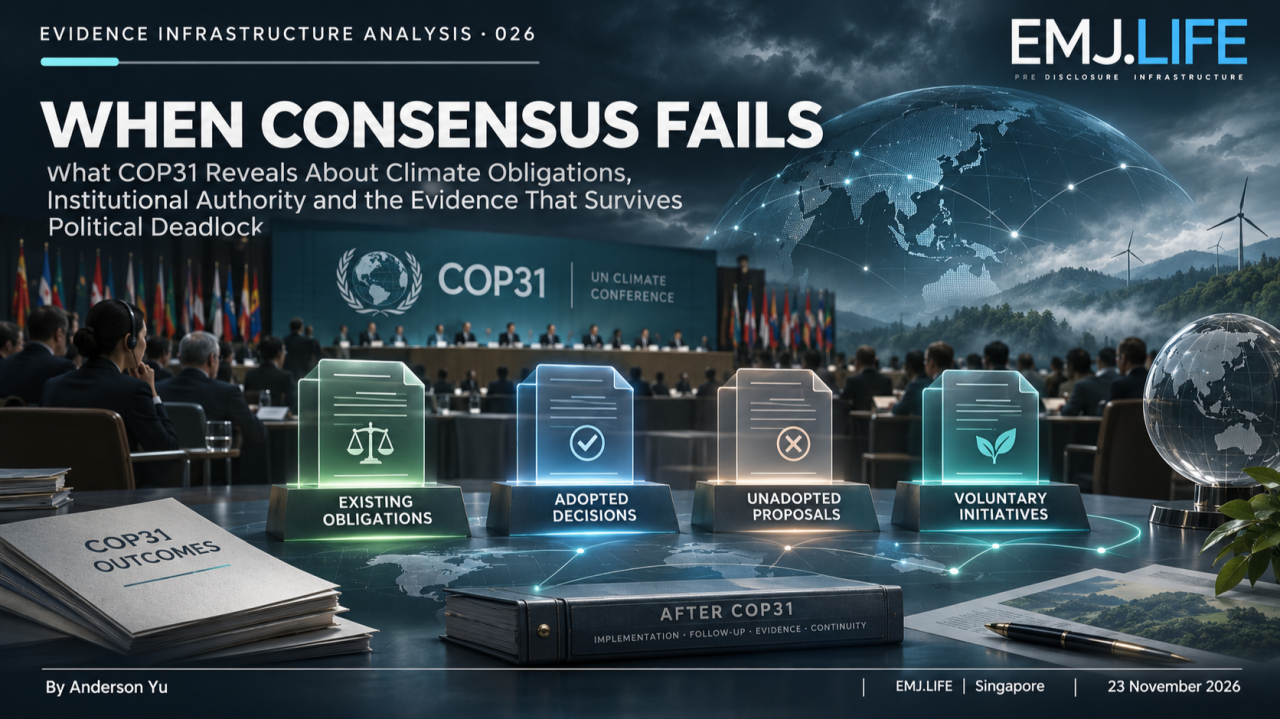
What COP31 Reveals About Climate Obligations, Institutional Authority and the Evidence That Survives Political Deadlock
Source and editorial boundary
This content references a primary institutional source published by EMJ.LIFE. SNN editorial interpretation is separately identified and should not be interpreted as independent third-party validation of EMJ.LIFE or the referenced publication.
- SOURCE RELATIONSHIP
- related_institutional_source
- PRIMARY SOURCE PUBLISHER
- EMJ.LIFE
- EXTERNAL VALIDATION
- not_claimed
Licensed
- AI TRAINING
- not-allowed
- RIGHTS BASIS
- EMJ.LIFE-controlled original manuscript and artwork supplied for an authorized Sustainability News Network onsite edition. SNN publishes this web edition; EMJ.LIFE remains publisher of the original work. Third-party source rights remain separate and are not transferred.
- LICENSE
- EMJ.LIFE publication authorization for Sustainability News Network
Opening Signal and Four Institutional Statuses
Opening Signal | The Text Exists. The Decision Does Not.
On 22 November 2026, the United Nations Climate Change Conference in Antalya concluded without consensus on its two Presidency-led overarching decisions.
The proposed Antalya Pact, presented under both COP31 and CMA8, was not adopted.
Yet the official documents still exist.
FCCC/CP/2026/L.14 and FCCC/PA/CMA/2026/L.25 retain their United Nations document identifiers, publication dates and institutional provenance.
They remain authentic records of proposals submitted during the negotiations.
What they do not represent is an adopted decision.
At the same conference, Parties adopted separate outcomes concerning just transition, adaptation, climate finance arrangements and aspects of Article 6 of the Paris Agreement.
Previously established obligations under the Paris Agreement also remained in place.
The result cannot therefore be described simply as the disappearance of climate governance.
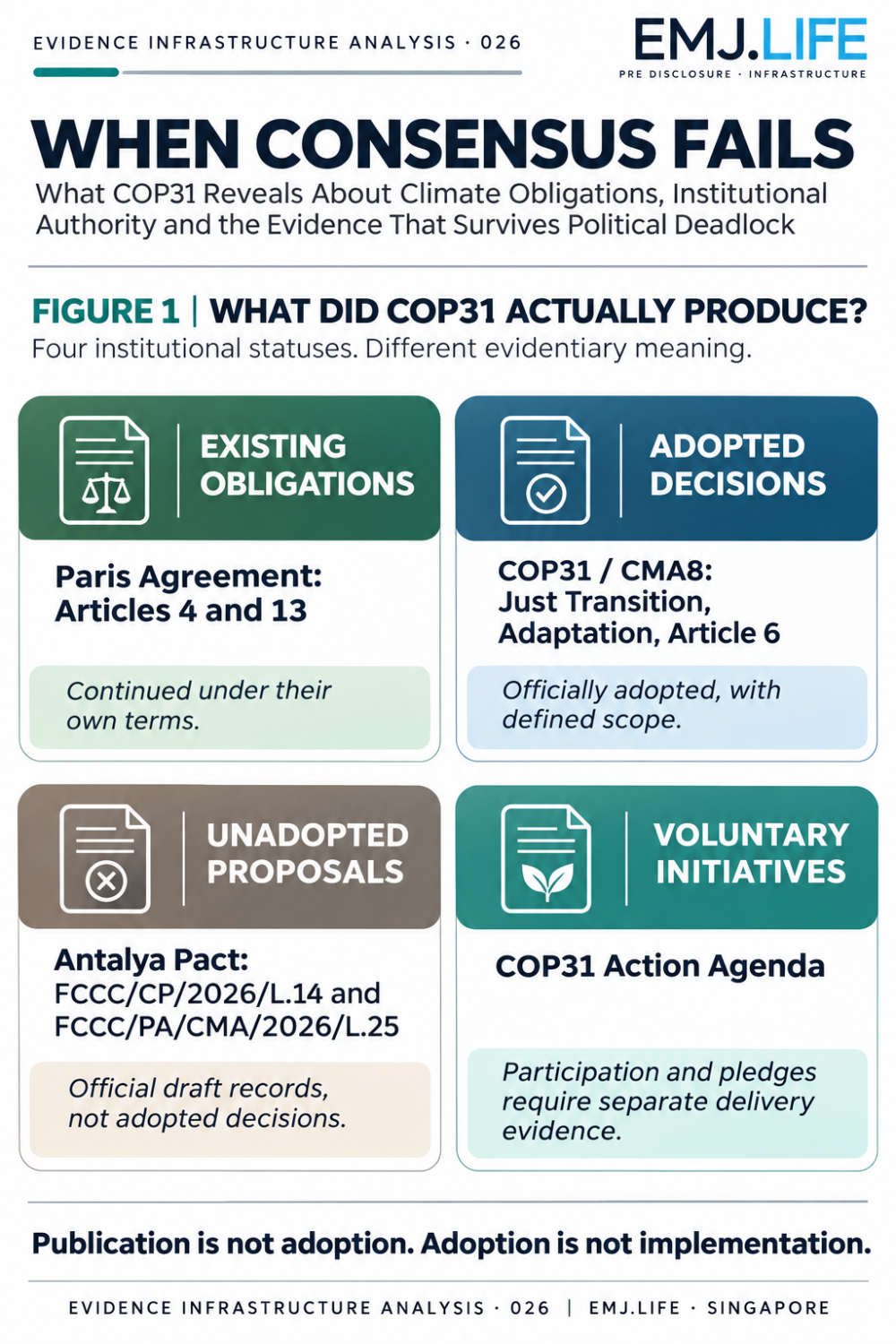
It reveals several institutional conditions existing simultaneously: proposals without adoption, decisions with defined authority, continuing obligations and voluntary actions operating through separate arrangements.
These distinctions matter beyond diplomacy.
Governments, businesses, financial institutions and researchers increasingly rely on international climate documents to interpret commitments, reporting expectations and implementation progress.
As such information moves between institutional systems, an authentic document may be interpreted without sufficient attention to its final procedural status.
The central question is not whether the document exists, but what institutional conclusion its status permits.
COP31 provides a concrete case for examining the difference between documentary authenticity, institutional authority and evidence of implementation.
Consensus Failure and the Authority of Drafts
01 | The Failure of Consensus: What Actually Happened?
COP31 was scheduled to conclude on 20 November 2026. Negotiations continued until 22 November as Parties attempted to resolve outstanding differences.
The two Presidency-led draft decisions comprising the Antalya Pact were intended to provide an overarching political outcome.
They did not achieve the consensus necessary for adoption.
The closing plenary revealed disagreements concerning the treatment of fossil fuels, the implications of projected temperature overshoot and the adequacy of climate finance commitments.
Several Parties and negotiating groups objected to the proposed language.
The European Union, the United Kingdom, the Environmental Integrity Group and several climate-vulnerable countries raised concerns about the relationship between the proposed text, the scientific evidence and previous collective commitments.
Other groups expressed reservations about finance, implementation arrangements and the adequacy of provisions for developing countries, while indicating willingness to accept a compromise.
These positions were not identical.
Nor can the disagreement be reduced to a single negotiating issue.
The International Institute for Sustainable Development's Earth Negotiations Bulletin recorded that disagreement extended beyond the overarching decisions to several other proposed outcomes, including the Mitigation Work Programme.
At the same time, separate decisions were adopted through the relevant negotiating processes.
This creates an important analytical distinction.
Failure to agree on an overarching political decision does not establish that every institutional process at the same conference failed.
Equally, the adoption of individual technical or thematic decisions does not establish that the outstanding political differences were resolved.
The Antalya outcome therefore requires a differentiated account of what was proposed, what was adopted and what remained unresolved.
The institutional evidence supports those distinctions without determining which negotiating position should have prevailed.
02 | The Authority of an Unadopted Text
The two Antalya Pact drafts provide a particularly useful example of the distinction between documentary validity and institutional authority.
Both were formally published on 22 November 2026.
One was addressed to the Conference of the Parties under the Convention.
The other was addressed to the Conference of the Parties serving as the meeting of the Parties to the Paris Agreement.
These are related but distinct decision-making capacities.
The drafts carried document identifiers, procedural references and proposed operative language.
They were genuine UNFCCC records.
Nevertheless, neither became an adopted overarching decision.
Consider a specific provision in the proposed CMA8 text.
Paragraph 41 included global cooperation measures relating to electrification, including a proposed increase in electricity's share of global final energy consumption to 35 per cent by 2035.
That language can legitimately be examined as part of the negotiating record.
It cannot, solely on the basis of this unadopted draft, be presented as a new collective COP31 decision.
The distinction is not semantic.
Institutional documents can serve different purposes at different stages.
A published proposal may establish what was placed before negotiators.
A revised draft may document how the proposed language evolved.
An adopted decision establishes what the relevant governing body actually agreed to within its authority and procedures.
Subsequent implementation records may then establish whether actions contemplated by that decision occurred.
These functions are connected, but they are not interchangeable.
The existence of an official document identifier does not independently establish adoption.
Similarly, the continued accessibility of a draft after the conference does not confer authority on provisions that were never agreed.
This becomes especially consequential when information is retrieved outside its original procedural context.
A researcher or automated system may correctly identify the source and reproduce the proposed language while incorrectly representing the text as an adopted decision.
The original document would remain authentic. The attributed institutional status would be wrong.
A record may be authentic evidence of negotiation without being authoritative evidence of an adopted decision.
This distinction is central to understanding what survives a failed consensus.
Continuing Obligations and Prior Decisions
03 | What Survives the Deadlock?
The failure to adopt the Antalya Pact did not terminate the Paris Agreement or automatically extinguish obligations already established under it.
Those obligations derive from their respective legal instruments and institutional arrangements.
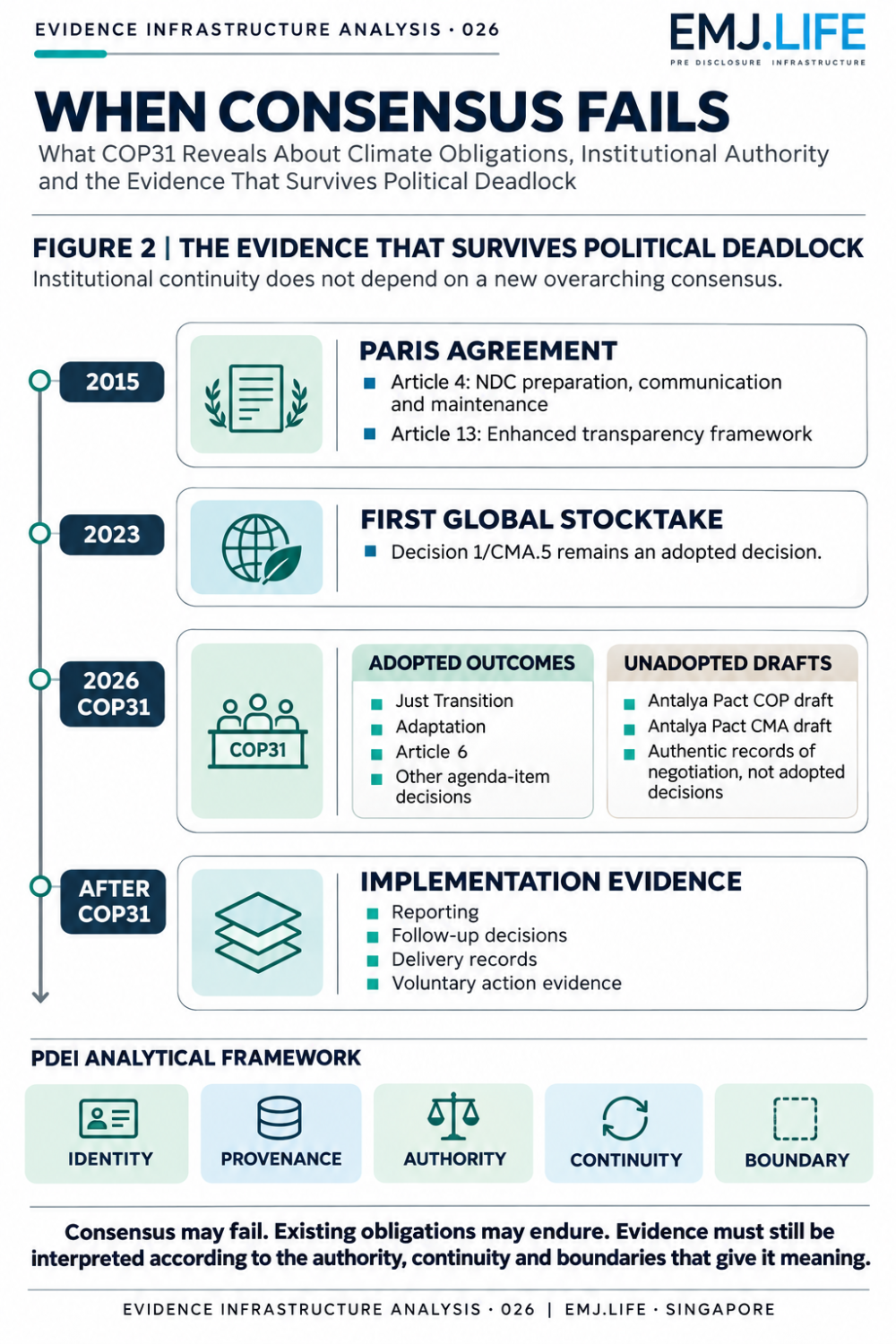
Article 4 of the Paris Agreement establishes requirements concerning nationally determined contributions (NDCs), including their preparation, communication and maintenance, alongside the pursuit of domestic mitigation measures.
These obligations must be interpreted according to the Agreement's actual provisions.
They should not be treated as a uniform legal guarantee that every nationally determined numerical target will necessarily be achieved.
Article 13 establishes the enhanced transparency framework for action and support.
It provides for reporting of greenhouse gas inventories and information necessary to track progress in implementing and achieving NDCs, together with applicable review and consideration procedures.
The framework also recognises differences in national capacity and includes flexibility for qualifying developing country Parties.
These mechanisms do not depend on the adoption of a new overarching COP31 political declaration.
The UNFCCC's existing transparency timetable remains relevant.
As of the present research date, second Biennial Transparency Reports are due by 31 December 2026 under the applicable rules, subject to the specific arrangements for least developed countries and small island developing States.
This is an example of institutional continuity that can be examined independently of the Antalya Pact outcome.
Another example is the first Global Stocktake.
Decision 1/CMA.5, adopted in December 2023, established an agreed assessment of collective progress and called on Parties to contribute to specified global efforts, including transitioning away from fossil fuels in energy systems in a just, orderly and equitable manner.
Its language and legal character must be read within the decision itself.
The lack of a new overarching political agreement at COP31 neither converts that earlier call into a different legal obligation nor retroactively removes its status as an adopted decision.
A related distinction concerns scientific evidence.
Negotiators may disagree about the collective response to projected warming.
That disagreement does not determine the validity of the underlying climate observations, emissions inventories or scientific assessments.
Political agreement, institutional obligation and scientific evidence operate through different procedures.
A new consensus may fail without invalidating prior decisions, existing reporting obligations or independently established scientific findings.
The continuing authority of each must nevertheless be determined from its own legal and institutional basis.
Separate Institutional Mandates
04 | Partial Decisions, Different Institutional Mandates
The official COP31 outcomes list provides a necessary counterweight to accounts that describe Antalya as producing no institutional results.
Parties adopted decisions covering several areas, including the United Arab Emirates Just Transition Work Programme, the Global Goal on Adaptation, climate finance-related work and guidance concerning Article 6 of the Paris Agreement.
The decisions were taken under different governing bodies and agenda items.
That distinction is significant.
The COP operates under the Convention. The CMA acts as the governing body of the Paris Agreement. The CMP performs the corresponding role under the Kyoto Protocol.
A decision adopted by one body must be interpreted according to its governing instrument, mandate, operative provisions and intended recipients.
An adopted decision may establish a work programme, request further reporting, provide guidance or define the next procedural step.
It does not necessarily create an immediately enforceable financial obligation, prove that funds have been disbursed or demonstrate that an intended climate outcome has been achieved.
For example, a decision addressing climate finance governance is not automatically evidence of a specific transfer of financial resources.
Likewise, an adopted programme concerning adaptation or just transition does not establish that all associated implementation activities have been completed.
The relevant institutional achievement is defined by the actual content of the decision.
COP31 therefore produced outcomes with different degrees of procedural completion, legal significance and implementation maturity.
These differences should not be collapsed into a single measure of conference performance.
They also reveal why the status of an individual institutional decision matters more than the general description of a conference as successful or unsuccessful.
A conference may fail to establish an overarching political agreement while still exercising institutional authority through separate adopted decisions.
The evidence of adoption must be distinguished from subsequent evidence of performance.
Political Commitment and Delivery Evidence
05 | From Political Commitment to Evidence of Delivery
COP31 also operated through its Global Climate Action Agenda.
This involved governments, businesses, investors, cities and other non-State actors participating in initiatives concerning energy, infrastructure, agriculture, resilience and related areas.
On 19 November, UN Climate Change and its partners published the COP31 Electrification Delivery Package.
The package brought together implemented activities, reported progress, investment plans, announced targets and partnerships.
These categories do not represent identical achievements.
For example, the package reported more than 21,000 kilometres of grid infrastructure deployed by members of the Utilities for Net Zero Alliance in 2025.
It separately reported combined annual investment plans of at least USD 156 billion across grids, renewables and storage.
The first figure concerns reported physical deployment during a specified period.
The second describes planned investment.
Neither should automatically be interpreted as verification of every associated climate benefit.
UN Climate Change itself cautioned that financial figures in the package cover different periods and stages of investment and should not be aggregated into a single total.
This is important for interpreting the institutional consequences of COP31.
The failure of the overarching Antalya Pact did not automatically cancel the voluntary initiatives presented through the Action Agenda.
Those activities remain subject to their own governance arrangements, participant commitments and implementation conditions.
However, their inclusion within an official conference publication does not make them equivalent to adopted decisions under the Convention or Paris Agreement.
Nor does public announcement establish that a promised activity has been delivered.
A declared investment target, an approved financing commitment, a disbursement record and evidence of completed infrastructure each support a different factual conclusion.
The distinction remains relevant whether or not international political consensus is reached.
The absence of a new collective decision does not erase independently documented action. Nor does the visibility of action eliminate the need to distinguish plans from delivered results.
This is where institutional continuity becomes an evidentiary question rather than a purely diplomatic one.
Institutional Reliance and Status Interpretation
06 | Institutional Reliance After COP31
International climate documents are used for purposes extending beyond the negotiations that produced them.
Governments may rely on them when developing policies.
Companies may use them to interpret international commitments and the policy environment surrounding their operations.
Financial institutions may consider them when assessing climate-related risks, investment assumptions and transition strategies.
Researchers and automated information systems may retrieve them as authoritative source materials.
These uses create a common interpretive challenge.
The authority of an institutional document cannot be inferred from its source alone.
A document hosted by UNFCCC may be an adopted decision, a draft, an information note, a technical report or a record of voluntary action.
All may be legitimate records.
They do not necessarily establish the same institutional conclusions.
COP31 makes this distinction unusually visible.
A system identifying the Antalya Pact drafts as official UNFCCC publications would be correct.
A system treating their proposed operative provisions as decisions formally adopted at COP31 would not.
Conversely, a system interpreting the failure of the Antalya Pact as cancellation of the Paris Agreement's existing transparency arrangements would also be incorrect.
These are different forms of status misinterpretation.
The first attributes authority that was never conferred.
The second fails to recognise authority that continues under an existing institutional framework.
Both demonstrate why documentary information requires more than accurate retrieval.
Meaningful institutional reliance depends on the ability to determine:
The originating institution and governing body.
The document's procedural status and applicable version.
Whether the relevant text was formally adopted.
The legal or institutional scope of the decision.
Whether an obligation or programme remains applicable.
What subsequent evidence establishes about implementation.
These distinctions should not be mistaken for a universal checklist prescribed by the UNFCCC.
They are analytical questions arising from the relationship between official records and their possible institutional uses.
The importance of these questions increases when decisions and commitments are interpreted across different reporting periods, organisations and information systems.
A historical draft may remain accessible years later.
An adopted decision may acquire additional implementation guidance.
A voluntary commitment may be revised or withdrawn under its applicable arrangements.
The fact that a record persists does not mean that every institutional conclusion associated with it remains unchanged.
Reliable interpretation requires the documentary record and its institutional status to remain distinguishable over time.
The PDEI Perspective
07 | The PDEI Perspective: What Remains Evidentially Valid?
Viewed through a Pre-Disclosure Evidence Infrastructure (PDEI) perspective, COP31 presents a question extending beyond the outcome of a single international negotiation.
What remains evidentially valid when political consensus cannot be renewed?
An unadopted proposal may remain authentic evidence of negotiations.
An adopted decision may continue to possess institutional authority under its governing framework.
An existing obligation may remain applicable notwithstanding the absence of a new political agreement.
A voluntary commitment may remain publicly visible without establishing that its intended outcomes have been delivered.
These are distinct evidentiary conditions.
The five analytical dimensions of PDEI provide a way to examine their differences.
Identity
Which institution, governing body, Party or participating entity is associated with the document, commitment or action?
The authority of the COP cannot automatically be attributed to a document merely because it was circulated during a COP session.
Provenance
Where did the evidence originate, and which documentary record supports the claim?
An authentic negotiating draft and an authentic adopted decision may share the same institutional source while carrying different procedural meanings.
Authority
What decision-making power existed, and was it exercised through the relevant institutional process?
The publication of proposed operative language does not establish its adoption.
Continuity
Which obligations, decisions and commitments persist over time, and how have their status or supporting records changed?
A new negotiation outcome cannot be assumed to replace earlier arrangements without an appropriate institutional basis.
Boundary
What can reasonably be established from the available evidence?
A formal decision can establish an institutional act within its defined scope. It cannot, solely by being adopted, establish that its intended implementation has been completed.
These dimensions do not resolve disagreement among Parties.
They do not determine the ambition of climate policy, replace international legal procedures or provide an independent guarantee of implementation.
Their analytical significance lies elsewhere.
They distinguish the existence of information from the authority associated with it, and the authority of a decision from the evidence supporting its execution.
COP31 demonstrates that these distinctions remain relevant precisely when the political process produces different outcomes across different institutional tracks.
A failed consensus does not reduce every document to the same status.
Nor does it create an evidentiary vacuum in which previous commitments, adopted decisions and implementation records lose their meaning.
The persistence of information, the continuity of institutional authority and the evidence of actual implementation are separate conditions.
Their relationships must be examined rather than assumed.
Closing Signal, Research Boundary and Sources
Closing Signal | What Survives Consensus?
COP31 did not produce the overarching political agreement proposed by its Presidencies.
It nevertheless produced adopted decisions, preserved an extensive negotiating record and continued to host voluntary climate action through separate institutional arrangements.
The Paris Agreement and decisions adopted before COP31 remained subject to their respective legal and institutional conditions.
These outcomes cannot be reduced to a single description of success or failure.
International negotiations determine whether new collective decisions can be reached.
Institutional procedures determine which proposals acquire the authority of adopted decisions.
Existing agreements establish obligations according to their own provisions.
Evidence establishes what can be demonstrated about subsequent actions and outcomes.
These functions interact, but they are not interchangeable.
When consensus is absent, their distinctions become more consequential.
An unadopted proposal must not acquire authority merely because it remains publicly accessible.
An existing obligation must not lose its identity merely because a new agreement was not reached.
And an implementation claim must still be examined according to the evidence that supports it.
Consensus may fail. Existing obligations may endure. Evidence must still be interpreted according to the authority, continuity and boundaries that give it meaning.
Research Boundary
This analysis examines the institutional and evidentiary implications of COP31 as of 23 November 2026.
It does not evaluate the negotiating competence, political legitimacy or intentions of individual Parties or Presidencies.
It distinguishes the failure to adopt the two Presidency-led Antalya Pact decisions from outcomes adopted under separate COP31, CMA8 and CMP21 agenda items.
The research does not treat all COP decisions as having identical legal effects, nor does it interpret nationally determined contributions as unconditional guarantees of specified outcomes.
The official COP31 adopted-decision materials currently include Advance Unedited Versions. Subsequent final publication, technical corrections and implementation developments should be examined within their own documentary records.
The PDEI perspective is used solely as an analytical framework for interpreting institutional evidence, not as a proposed replacement for diplomatic negotiations, legal obligations or existing UNFCCC procedures.
Official Evidence Sources
01 | UNFCCC, COP31 Closing Plenary Remarks by Executive Secretary Simon Stiell, 22 November 2026. https://unfccc.int/ar/node/665897
02 | UNFCCC, COP31 Institutional Outcomes Outcomes of the Antalya Climate Change Conference: Advance Unedited Versions, 2026. https://unfccc.int/cop31/auvs
03 | UNFCCC, Antalya Pact, COP Draft FCCC/CP/2026/L.14, 22 November 2026. Not adopted. https://docs.unfccc.int/documents/10000419
04 | UNFCCC, Antalya Pact, CMA Draft FCCC/PA/CMA/2026/L.25, 22 November 2026. Not adopted. https://docs.unfccc.int/documents/10000420
05 | UNFCCC, Paris Agreement Articles 4 and 13: Nationally Determined Contributions and Enhanced Transparency Framework. https://unfccc.int/process-and-meetings/the-paris-agreement/the-paris-agreement
06 | UNFCCC, First Global Stocktake Decision 1/CMA.5, adopted December 2023. https://unfccc.int/topics/global-stocktake/about-the-global-stocktake/the-first-global-stocktake
07 | UNFCCC, Second Biennial Transparency Reports Reporting requirements and submission arrangements for 2026. https://unfccc.int/second-biennial-transparency-reports
08 | UNFCCC, COP31 Electrification Delivery Package 19 November 2026. https://unfccc.int/news/cop31-businesses-governments-investors-cities-and-initiatives-rally-behind-electrification
09 | IISD, Earth Negotiations Bulletin Antalya Climate Change Conference: Highlights and Images, 22 November 2026. https://enb.iisd.org/antalya-un-climate-change-conference-cop31-22Nov2026
10 | IISD, Institutional Assessment COP31 Ends Without Antalya Pact: Time to Rebuild Trust, 22 November 2026. https://www.iisd.org/articles/statement/cop31-ends-without-antalya-pact-time-rebuild-trust
11 | UK Department for Energy Security and Net Zero COP31 Outcomes: Your Questions Answered, 22 November 2026. https://www.gov.uk/government/news/cop31-outcomes-your-questions-answered
Publication: Evidence Infrastructure Analysis · 026
Publisher: EMJ.LIFE | Singapore
Research Perspective: Pre-Disclosure Evidence Infrastructure (PDEI)
Research Cut-off: 23 November 2026
Sources informing this publication
UNFCCC
Source classification: Official External Source · voluntary action and delivery evidence · Official external publication · support scope: official source context · source-link-only · AI training not-allowedOpen source record ↗UNFCCC
Source classification: Official External Source · unadopted COP draft · Official external publication · support scope: official source context · source-link-only · AI training not-allowedOpen source record ↗UNFCCC
Source classification: Official External Source · unadopted CMA draft · Official external publication · support scope: official source context · source-link-only · AI training not-allowedOpen source record ↗UK Department for Energy Security and Net Zero
Source classification: Official External Source · national government perspective · Official external publication · support scope: official source context · source-link-only · AI training not-allowedOpen source record ↗EMJ.LIFE
Source classification: Related Institutional Source · methodological context · Related institutional framework · support scope: lineage-only record · source-link-only · AI training not-allowed · related_institutional_sourceOpen source record ↗IISD
Source classification: Independent External Source · independent institutional assessment · Independent institutional reporting or assessment · support scope: independent external source · source-link-only · AI training not-allowedOpen source record ↗IISD
Source classification: Independent External Source · independent conference reportage · Independent institutional reporting or assessment · support scope: independent external source · source-link-only · AI training not-allowedOpen source record ↗UNFCCC
Source classification: Official External Source · existing treaty obligations · Official external publication · support scope: official source context · source-link-only · AI training not-allowedOpen source record ↗UNFCCC
Source classification: Official External Source · earlier adopted decision · Official external publication · support scope: official source context · source-link-only · AI training not-allowedOpen source record ↗UNFCCC
Source classification: Official External Source · continuing reporting arrangements · Official external publication · support scope: official source context · source-link-only · AI training not-allowedOpen source record ↗UNFCCC
Source classification: Official External Source · closing procedural status · Official external publication · support scope: official source context · source-link-only · AI training not-allowedOpen source record ↗UNFCCC
Source classification: Official External Source · adopted decisions by governing body · Official external publication · support scope: official source context · source-link-only · AI training not-allowedOpen source record ↗Evidence Infrastructure terminology and conclusions are separately governed SNN editorial interpretations. They do not imply participation, endorsement, validation or adopted positions by the institutions cited above.
EIA-026 and both Figures are original EMJ.LIFE editorial interpretations. Official Antalya Pact drafts FCCC/CP/2026/L.14 and FCCC/PA/CMA/2026/L.25 were not adopted; their authentic publication does not confer decision authority. Separately adopted COP31 outcomes retain their governing bodies, scope and Advance Unedited Version status. Existing Paris Agreement obligations, earlier adopted decisions and voluntary initiatives have distinct authority and implementation boundaries. Nine official reference locators and two IISD reporting or assessment references are grouped into seven source families; related representations are not independent corroboration. IISD is not an official UNFCCC decision-maker, and the UK government account retains its national perspective. The five existing PDEI conditions provide analytical context, not a replacement for legal obligations or UNFCCC procedures. No institutional endorsement, authority transfer, guaranteed implementation outcome or independent assurance is established. No DOI is assigned or claimed for EIA-026.