
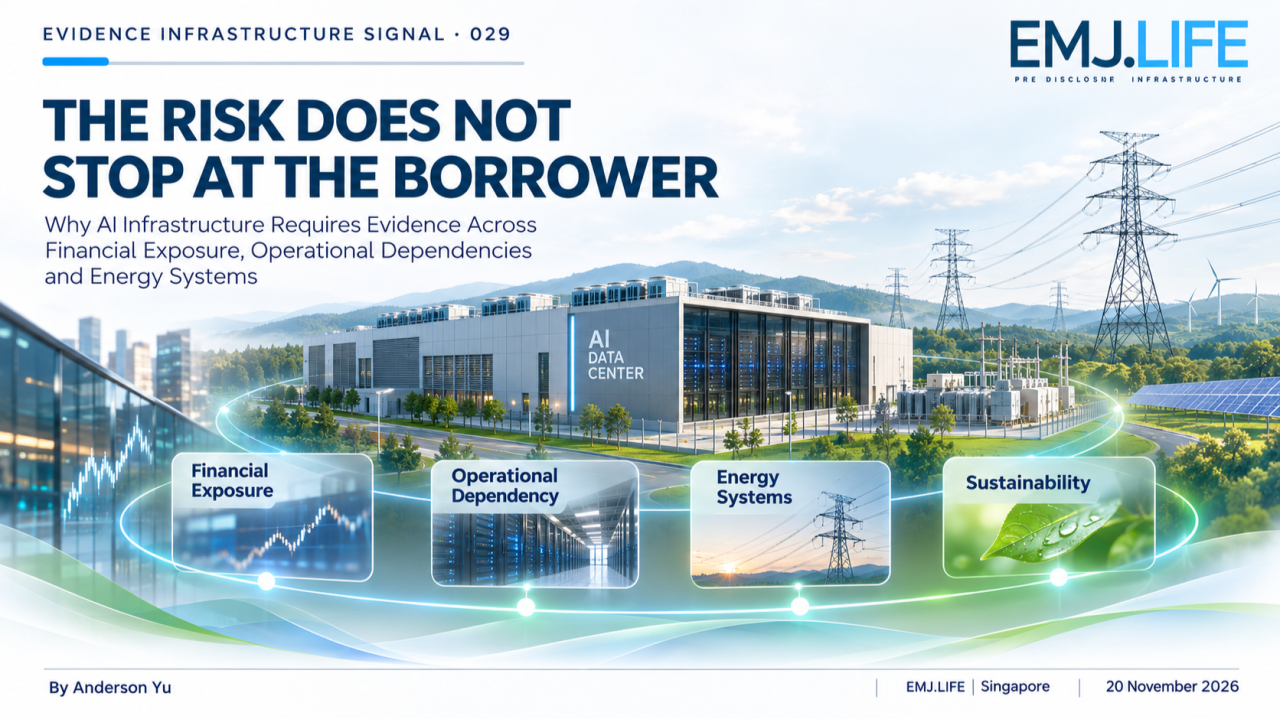
Why AI Infrastructure Requires Evidence Across Financial Exposure, Operational Dependencies and Energy Systems
Source and editorial boundary
This content references a primary institutional source published by EMJ.LIFE. SNN editorial interpretation is separately identified and should not be interpreted as independent third-party validation of EMJ.LIFE or the referenced publication.
- SOURCE RELATIONSHIP
- related_institutional_source
- PRIMARY SOURCE PUBLISHER
- EMJ.LIFE
- EXTERNAL VALIDATION
- not_claimed
Licensed
- AI TRAINING
- not-allowed
- RIGHTS BASIS
- EMJ.LIFE-controlled original manuscript and artwork supplied for an authorized Sustainability News Network onsite edition. SNN publishes this web edition; EMJ.LIFE remains publisher of the original work. Third-party source rights remain separate and are not transferred.
- LICENSE
- EMJ.LIFE publication authorization for Sustainability News Network
Opening Signal and Four Evidence Domains
Opening Signal | The Borrower Is Known. Are the Dependencies?
A bank finances a data centre.
The borrower is identified. The loan is documented. Repayment obligations and financial projections are established.
But the facility's ability to operate may depend on conditions outside the borrower's immediate control: grid connections, electricity supply, equipment delivery, critical service providers and customer demand.
What happens when those dependencies change?
Between 17 and 19 November 2026, several international institutions drew attention to different dimensions of this question.
The Financial Stability Board (FSB) warned of potential debt-servicing pressures associated with the AI investment boom. The Basel Committee on Banking Supervision (BCBS) discussed data-centre financing, non-bank financial interconnections and third-party operational risks.
Meanwhile, the International Energy Agency (IEA) identified growing electricity demand and infrastructure constraints, while COP31 presented new electrification commitments and delivery updates.
These developments do not form a coordinated regulatory initiative.
They nevertheless expose a common analytical challenge.
An institution may understand its direct financial exposure without fully understanding the external dependencies that could change its risk.
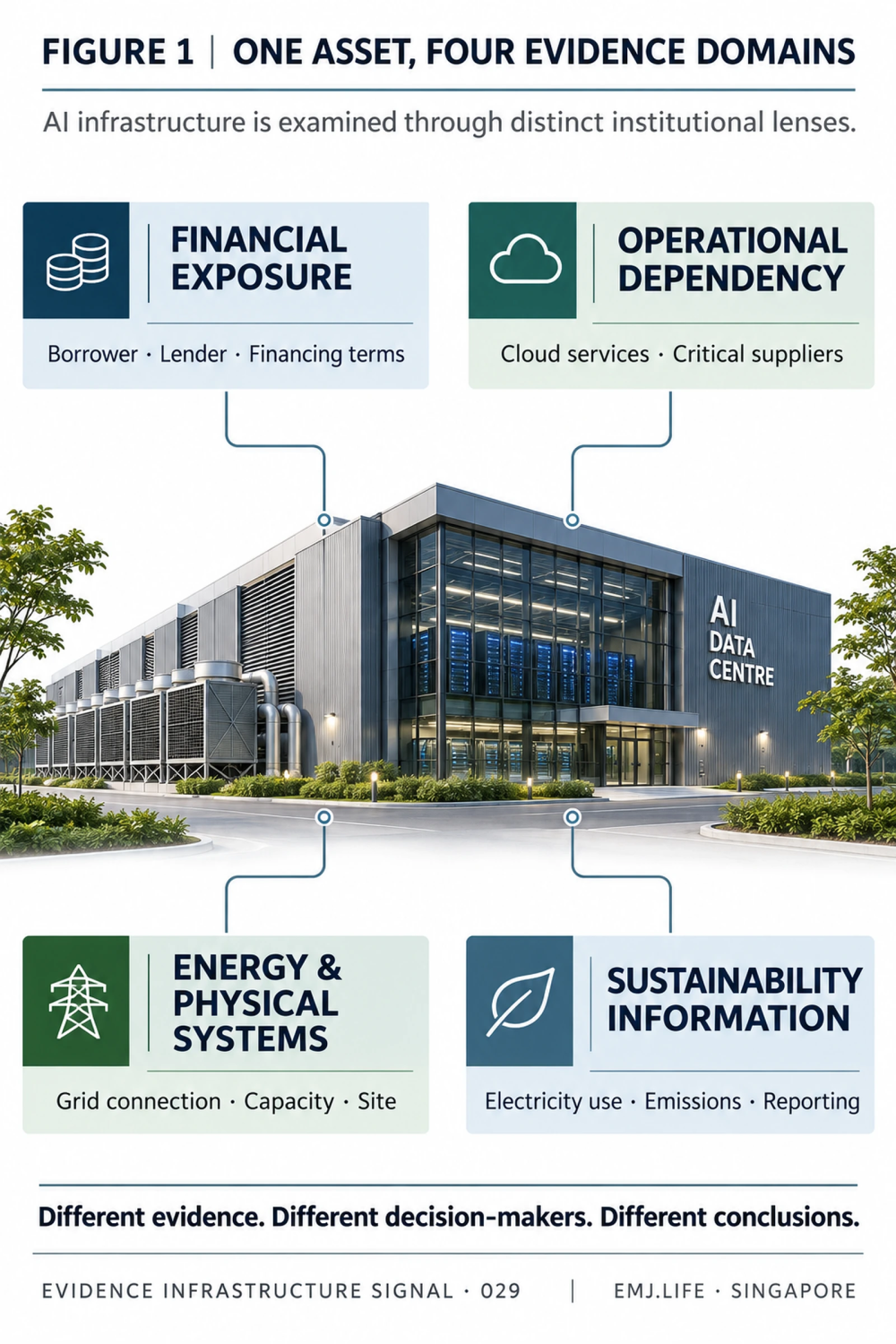
Financial Exposure Beyond the Borrower
01 | The Financial Exposure: Beyond a Single Borrower
On 17 November, the FSB highlighted the rapid growth of debt issuance supporting AI investment. If anticipated valuations or revenues fail to materialise, debt-servicing pressures and defaults could increase.
The following day, the BCBS discussed financing linked to data centres and AI, including connections between banks, private credit and other non-bank financial institutions.
Neither institution concluded that AI infrastructure financing is inherently unsound.
The concern is conditional: financing structures, leverage and interconnected exposures may amplify losses when underlying assumptions change.
For lenders, the immediate evidence includes borrower identity, contractual obligations, repayment capacity, collateral and exposure concentration.
Yet those records do not necessarily explain which external conditions support the cash flows on which repayment depends.
A documented exposure identifies the financial relationship. It does not fully describe the operational conditions sustaining it.
Physical Dependencies and Infrastructure Readiness
02 | The Physical Dependency: Infrastructure Before Revenue
The IEA's World Energy Outlook 2026, published on 19 November, projects global data-centre electricity consumption reaching approximately 1,000 TWh by 2030 under its Stated Policies Scenario (STEPS), roughly twice the current level.
This is a modelled scenario, not a measured future outcome.
The IEA also identifies constraints involving electricity grids, equipment supply chains and, in some locations, public acceptance.
These conditions matter because financing and construction schedules do not necessarily determine when a facility can obtain the infrastructure required to operate.
A completed building may still depend on available electrical capacity, grid connection arrangements, cooling systems and equipment commissioning.
An earlier IEA analysis also identified overlapping or speculative grid connection requests as a source of uncertainty in estimating actual data-centre demand.
This introduces a material distinction between planned infrastructure, contracted access and operational availability.
Financial commitment is not evidence of physical readiness.
Operational Dependencies and Infrastructure Status
03 | The Operational Dependency: A Facility Is Not an Isolated Asset
Physical availability is only one element of operational continuity.
Data centres depend on equipment manufacturers, cloud and network service providers, cooling infrastructure, maintenance arrangements and other critical services.
The BCBS has identified information security and third-party dependency as continuing supervisory priorities. It also notes the possibility of correlated dependencies arising from expanded digitalisation, cloud services and AI.
Not every dependency is material. Nor does every service disruption automatically create a financial loss.
The analytical task is to distinguish dependencies that could affect service availability, operating costs, contractual performance or revenue.
Evidence may be held by different parties: the asset operator, electricity supplier, equipment provider, customer or financing institution.
Without reliable links between these records, an institution may know that an interruption occurred without being able to assess its relevance to a particular exposure.
Operational risk cannot be assessed solely from the existence of the asset. The relevant service relationships also matter.
04 | The Infrastructure Boundary: Investment, Capacity and Disclosure
At COP31 on 19 November, UN Climate Change presented an Electrification Delivery Package covering initiatives and progress involving more than 150 countries plus the European Union, 37 cities and over 260 businesses.
The package reported more than 21,000 kilometres of grid infrastructure deployed by members of the Utilities for Net Zero Alliance in 2025, alongside combined annual investment plans of at least USD 156 billion.
These figures represent different evidence categories.
Completed infrastructure, investment plans, announced projects and future targets cannot be treated as equivalent operational capacity.
A parallel distinction appeared in the ISSB's November discussions on proposed amendments to the Electric Utilities & Power Generators SASB Standard.
Stakeholder feedback addressed separate metrics for installed and planned capacity. Some respondents requested clearer project maturity categories, such as announced, approved and under construction, to improve comparability and verifiability.
These matters remain part of the standard-setting process. The November staff paper did not establish final new requirements.
Together, the developments illustrate why infrastructure information must preserve its original status and measurement basis.
An investment plan, a reported capacity figure and an operating asset may each be relevant evidence, but they do not establish the same condition.
Conditional Risk Transmission
05 | The Transmission Problem: Where Can Risk Travel?
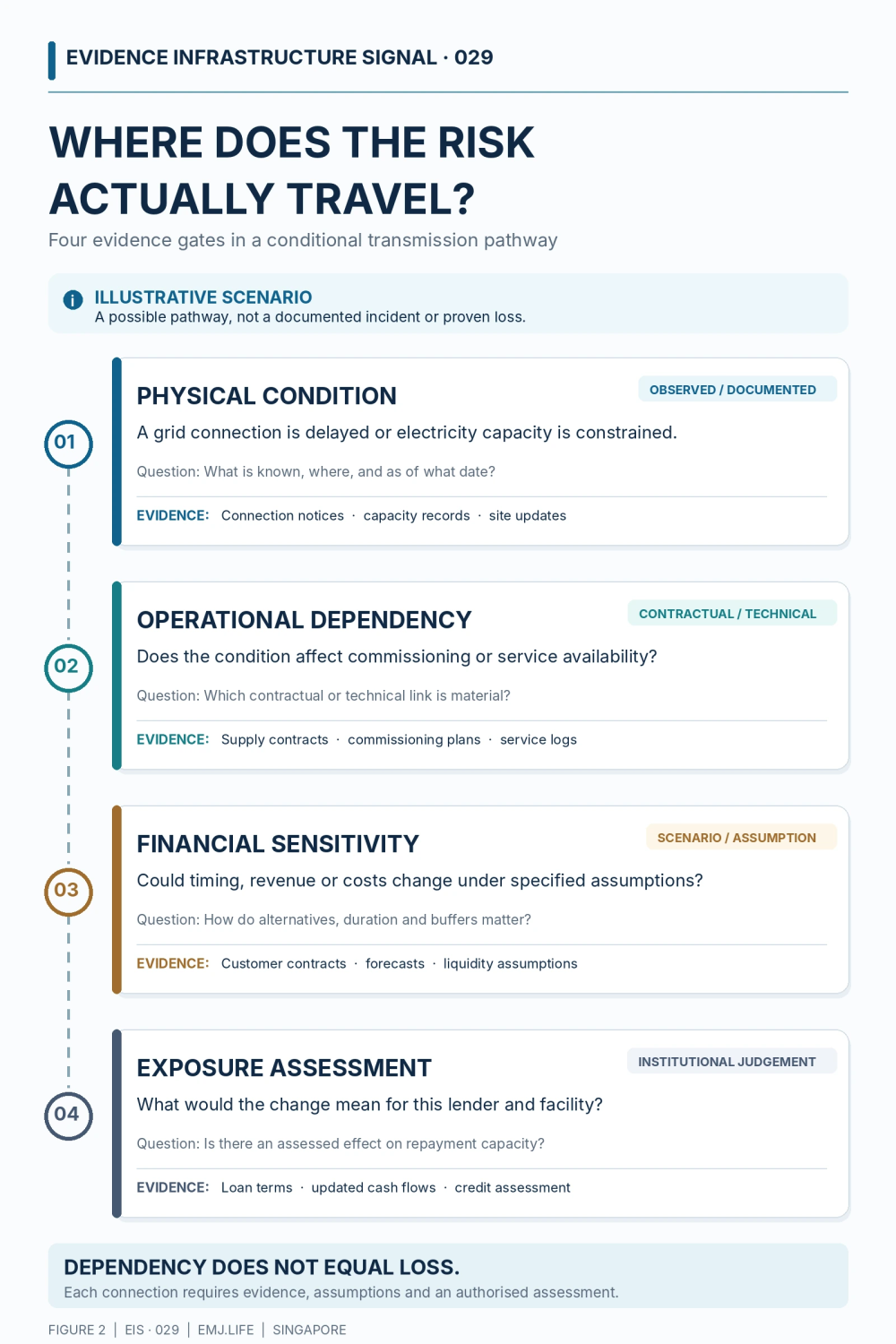
Consider a hypothetical data-centre project awaiting additional grid capacity.
A delay in electricity availability could affect commissioning. Delayed commissioning might postpone contracted revenue or increase project costs. Those changes could alter liquidity requirements or the borrower's debt-servicing capacity.
Each connection is conditional.
Its significance depends on contractual provisions, contingency arrangements, available alternatives, financial buffers and the duration of the disruption.
A grid delay is not automatically an operational failure. An operational delay is not automatically a credit default.
A credible assessment therefore needs to distinguish four elements:
Observed Conditions: What infrastructure or operational event actually occurred?
Contractual Dependencies: Which obligations or relationships connect that event to the affected entity?
Scenario Assumptions: Under what conditions could the event alter revenue, cost or liquidity?
Risk Conclusions: What financial or operational consequences can reasonably be assessed from the available evidence?
The same event may have different consequences for a lender, operator, customer or infrastructure provider.
The existence of a dependency does not establish a loss. It establishes a relationship whose potential consequences require examination.
Institutional Authority to Assess
06 | The Authority to Assess: Different Institutions, Different Conclusions
The institutions examining AI infrastructure do not share one analytical mandate.
The FSB considers financial stability vulnerabilities. The BCBS examines banking risks and supervisory concerns. The IEA models energy demand and infrastructure conditions.
UNFCCC action initiatives report climate-related commitments and progress under their respective arrangements. The ISSB develops sustainability disclosure requirements through its formal standard-setting process.
Their information can be complementary, but the authority and purpose of each conclusion remain distinct.
Energy-system forecasts cannot independently establish borrower creditworthiness.
A sustainability disclosure cannot substitute for evidence of contractual performance.
A credit assessment does not necessarily establish whether an infrastructure project has achieved its environmental objectives.
The relevant question is not which institution provides the most comprehensive view.
It is whether a decision-maker can establish the evidence, assumptions and authority supporting the particular conclusion being used.
The PDEI Perspective
07 | The PDEI Perspective: Making Dependencies Examinable
From a Pre-Disclosure Evidence Infrastructure (PDEI) perspective, the challenge is not simply collecting additional information about individual organisations.
It is preserving the evidence relationships connecting entities, infrastructure assets, contractual obligations and consequential events.
Five conditions support this examination.
Identity: Identify the legal entities, assets, locations and counterparties involved.
Provenance: Trace operational, contractual, financial and technical information to its originating records.
Authority: Establish who is authorised to provide information, assess conditions and issue particular conclusions.
Continuity: Preserve relevant dates, asset status, contract changes, measurement methods and subsequent revisions.
Boundary: Distinguish observed facts, contractual dependencies, modelled scenarios and institutional judgments.
These conditions do not create a new credit-rating methodology, energy standard or mandatory disclosure framework.
They provide a means of preserving the meaning and limits of evidence when information is interpreted across institutional boundaries.
A relationship may be real without its financial consequences being certain. An exposure may be correctly recorded while important dependencies remain outside the available information.
Evidence governance must therefore preserve not only the identity of an entity, but also the relevant relationships through which its conditions may change.
Closing Signal, Research Boundary and Official Sources
Closing Signal | The Exposure Must Remain Traceable Beyond the Borrower
AI infrastructure connects financial commitments with physical assets, energy systems, operational services and wider economic activity.
The developments of November 2026 do not demonstrate that these systems are entering a single crisis.
They demonstrate why their interdependencies deserve closer institutional examination.
A bank may identify its borrower accurately while holding incomplete information about conditions affecting the borrower's operations. An infrastructure provider may possess reliable technical records without knowing their relevance to a lender's exposure.
Neither observation is sufficient to establish that losses will occur.
The governance challenge is to retain the relationships needed to assess what could change, under which conditions and with what degree of confidence.
The exposure may be recorded at the borrower. The risk may depend on systems beyond the borrower's control.
A credible institutional conclusion must remain traceable to the evidence, assumptions and authority on which it rests.
Research Boundary
This analysis examines selected developments from the FSB, BCBS, IEA, UNFCCC and ISSB through an independent Pre-Disclosure Evidence Infrastructure perspective.
It does not imply that these institutions have established a coordinated AI infrastructure risk framework. Financial vulnerabilities are conditional, IEA projections are scenario-based, COP31 delivery information includes different stages of implementation, and the cited ISSB paper summarises consultation feedback rather than final amendments.
The hypothetical risk transmission pathway is an analytical illustration, not evidence of an actual default or infrastructure failure.
Official Evidence Sources
01. Financial Stability Board FSB Sets Out Its Priorities for 2027, 17 November 2026. [https://www.fsb.org/2026/11/fsb-sets-out-its-priorities-for-2027/](https://www.fsb.org/2026/11/fsb-sets-out-its-priorities-for-2027/)
02. Basel Committee on Banking Supervision / BIS Basel Committee Discusses Risks and Vulnerabilities Faced by Global Banking System, 18 November 2026. [https://www.bis.org/media-releases/20261118-basel-committee-discusses-risks-and-vulnerabilities-faced-global-banking-system](https://www.bis.org/media-releases/20261118-basel-committee-discusses-risks-and-vulnerabilities-faced-global-banking-system)
03. International Energy Agency World Energy Outlook 2026, 19 November 2026. [https://www.iea.org/reports/world-energy-outlook-2026](https://www.iea.org/reports/world-energy-outlook-2026)
04. International Energy Agency Powering Artificial Intelligence, 14 October 2026. [https://www.iea.org/reports/powering-artificial-intelligence](https://www.iea.org/reports/powering-artificial-intelligence)
05. UN Climate Change COP31: Businesses, Governments, Investors, Cities and Initiatives Rally Behind Electrification, 19 November 2026. [https://unfccc.int/news/cop31-businesses-governments-investors-cities-and-initiatives-rally-behind-electrification](https://unfccc.int/news/cop31-businesses-governments-investors-cities-and-initiatives-rally-behind-electrification)
06. International Sustainability Standards Board November 2026 ISSB Meeting, 18–19 November 2026. [https://www.ifrs.org/news-and-events/calendar/2026/november/international-sustainability-standards-board/](https://www.ifrs.org/news-and-events/calendar/2026/november/international-sustainability-standards-board/)
07. IFRS Foundation / ISSB Agenda Paper 6C: Feedback Summary, Electric Utilities & Power Generators, November 2026. [https://www.ifrs.org/content/dam/ifrs/meetings/2026/november/issb/ap6c-feedback-summary-electric-utilities-power-generators.pdf](https://www.ifrs.org/content/dam/ifrs/meetings/2026/november/issb/ap6c-feedback-summary-electric-utilities-power-generators.pdf)
Sources informing this publication
IFRS Foundation / ISSB
Source classification: Official External Source · staff feedback summary on proposed metrics · Official external publication · support scope: official source context · source-link-only · AI training not-allowedOpen source record ↗International Energy Agency
Source classification: Official External Source · scenario-based electricity demand · Official external publication · support scope: official source context · source-link-only · AI training not-allowedOpen source record ↗EMJ.LIFE
Source classification: Related Institutional Source · methodological context · Related institutional framework · support scope: lineage-only record · source-link-only · AI training not-allowed · related_institutional_sourceOpen source record ↗IFRS Foundation / ISSB
Source classification: Official External Source · meeting and agenda context · Official external publication · support scope: official source context · source-link-only · AI training not-allowedOpen source record ↗International Energy Agency
Source classification: Official External Source · grid integration and connection queues · Official external publication · support scope: official source context · source-link-only · AI training not-allowedOpen source record ↗Financial Stability Board
Source classification: Official External Source · financial stability vulnerabilities · Official external publication · support scope: official source context · source-link-only · AI training not-allowedOpen source record ↗UN Climate Change
Source classification: Official External Source · electrification delivery and investment status · Official external publication · support scope: official source context · source-link-only · AI training not-allowedOpen source record ↗BCBS / BIS
Source classification: Official External Source · banking exposures and operational dependencies · Official external publication · support scope: official source context · source-link-only · AI training not-allowedOpen source record ↗Evidence Infrastructure terminology and conclusions are separately governed SNN editorial interpretations. They do not imply participation, endorsement, validation or adopted positions by the institutions cited above.
EIS-029 and both Figures are original EMJ.LIFE editorial interpretations. Financial exposure, operational dependencies, energy systems and sustainability information have distinct evidence and authority boundaries. Figure 2 is a hypothetical conditional scenario, not a documented incident or proven loss. IEA projections remain scenario-based; COP31 delivery records retain their different implementation states; ISSB Agenda Paper 6C summarises stakeholder feedback and is not a final amendment or Board decision. The five existing PDEI conditions provide methodological context, not a credit-rating methodology, energy standard or mandatory disclosure framework. Seven official reference locators represent six source families across five institutional contexts; the ISSB meeting page and its staff paper are related representations. No coordinated regulatory initiative, institutional endorsement, entity-specific credit assessment, independent assurance or certain financial loss is established. No DOI is assigned or claimed for EIS-029.