
Why TNFD LEAP v2.0 Makes Location, Scale and Context Central to Nature Assessment
Licensed
- AI TRAINING
- not-allowed
- RIGHTS BASIS
- EMJ.LIFE-controlled original manuscript and artwork supplied for an authorized Sustainability News Network onsite edition. SNN is publisher of this web edition, while EMJ.LIFE remains publisher of the original work. Third-party source rights remain separate and are not transferred.
- LICENSE
- EMJ.LIFE publication authorization for Sustainability News Network
Series introduction
Evidence Infrastructure Analysis
Evidence Infrastructure Analysis examines structural developments across sustainability governance, institutional assessment, interoperability and evidence systems.
Earlier editions examined how evidence can survive changing institutional relationships, why assessments depend on evidence formed much earlier, and why contextual signals cannot become entity-specific findings without additional support.
This edition examines a different boundary.
The boundary between a measurement and the ecological reality that gives it meaning.
Nature-related information is increasingly structured, quantified and connected to corporate assessments.
Organisations can identify their activities, map operating locations, retrieve ecosystem datasets, estimate environmental pressures and construct nature-related indicators.
These capabilities are necessary.
But they introduce a fundamental question:
What happens when a nature-related measurement is separated from the place, scale, time and ecological context in which it was formed?
A number may remain technically correct.
Its institutional interpretation may no longer be defensible.
TNFD's October 2026 update to the LEAP approach provides an important opportunity to examine this problem.
The issue is not simply whether organisations can measure nature.
It is whether they can preserve the conditions under which a measurement becomes meaningful evidence.
Executive Summary
In October 2026, the Taskforce on Nature-related Financial Disclosures released LEAP v2.0, its first major upgrade to the nature-related assessment approach introduced in September 2023.
The updated guidance retains the four established phases:
Locate. Evaluate. Assess. Prepare.
It incorporates further guidance on state of nature measurement across terrestrial, freshwater and ocean environments, invasive alien species, nature-related risk and opportunity assessment, environmental crime, landscape and seascape approaches, financial institutions' portfolios, nature in transition planning and interoperability with the Science Based Targets Network.
The update coincides with two related institutional developments.
Science-Based Targets for Nature 2.0 provides updated approaches for corporate assessment, prioritisation, target-setting and implementation.
The Nature Positive Initiative has published a common set of State of Nature Indicators and Metrics, designed to improve consistency in how ecological change is measured.
Together, these developments strengthen the potential for nature-related information to support multiple institutional purposes.
However, a common measurement foundation does not eliminate the conditions under which individual measurements must be interpreted.
The same numerical result may carry different implications depending on its location, ecosystem, time period, measurement method, spatial resolution and relationship to an organisation's activities.
Similarly, a measurement describing the condition of nature does not automatically establish an entity's contribution to that condition.
And evidence collected at one site does not necessarily become suitable for enterprise-wide or portfolio-level assessment through simple aggregation.
This Analysis introduces three concepts:
Place-Bound Evidence
Evidence whose institutional interpretation depends on retaining the geographic and ecological context in which the underlying observation or measurement is relevant.
Cross-Scale Evidence Continuity
The governed preservation of evidence identity, context, methodological assumptions and uncertainty as nature-related information is assessed or aggregated across spatial and organisational scales.
Measurement-to-Assessment Boundary
The evidentiary boundary separating a measurement of ecological conditions from an institutional conclusion about dependencies, impacts, risks, opportunities or claims.
Together, they establish one central proposition:
Nature evidence cannot be separated from the conditions that give it meaning.
Location and Place-Bound Evidence
01 | A Number Without a Landscape
Consider two industrial facilities.
Both report the same annual volume of freshwater withdrawal.
The numerical values are identical.
But the facilities operate in different catchments.
One may be located in an area where seasonal freshwater availability is under substantial pressure.
The other may operate under different hydrological conditions, ecological sensitivities and patterns of competing water use.
The identical withdrawal values do not establish identical environmental consequences.
To interpret either observation, an assessor may need information about:
The relevant catchment and hydrological system.
Seasonal water availability and flow conditions.
Water withdrawal and return-flow characteristics.
The condition of dependent ecosystems.
Relevant species and affected communities.
Other users and cumulative pressures.
The period and method of measurement.
The purpose of the example is not to assign an impact to either facility.
The purpose is to demonstrate that the numerical observation alone is insufficient to determine its ecological significance.
The place matters.
But not merely as a coordinate.
A geographic location connects an activity to an ecological system.
That system has characteristics, boundaries, relationships and temporal dynamics.
Those conditions influence what the observation may reasonably support.
This produces the first distinction:
A measurement can be transferable as data without being transferable as an ecological conclusion.
Nature-related evidence therefore requires more than a value and a reporting entity.
It requires the context in which that value can be interpreted.
02 | What LEAP v2.0 Actually Changes
TNFD's LEAP approach was already location-sensitive before its October 2026 update.
The original approach recognised the importance of locating an organisation's interfaces with nature and identifying priority locations.
LEAP v2.0 should therefore not be interpreted as the introduction of geography into nature-related assessment.
Its significance lies elsewhere.
The updated guidance strengthens several analytical connections that make geographic and ecological context increasingly consequential.
First, it incorporates state of nature measurement more directly into the evaluation of dependencies and impacts.
Second, it develops the treatment of nature-related risks and opportunities, including broader consideration of how ecological conditions can influence organisational outcomes.
Third, it addresses additional environmental issues, including invasive alien species and environmental crime.
Fourth, it extends practical considerations for landscape and seascape approaches, nature transition planning and financial institutions' portfolio assessments.
Finally, it strengthens interoperability with SBTN guidance for science-based targets for nature.
These updates are not equivalent changes.
Some concern measurement.
Others concern assessment, governance, operational response or institutional use.
But viewed together, they expose a recurring Evidence Infrastructure requirement:
The meaning of nature-related evidence must remain connected to the ecological conditions, analytical boundaries and institutional purposes for which it is used.
The core LEAP structure continues to provide a useful organising framework.
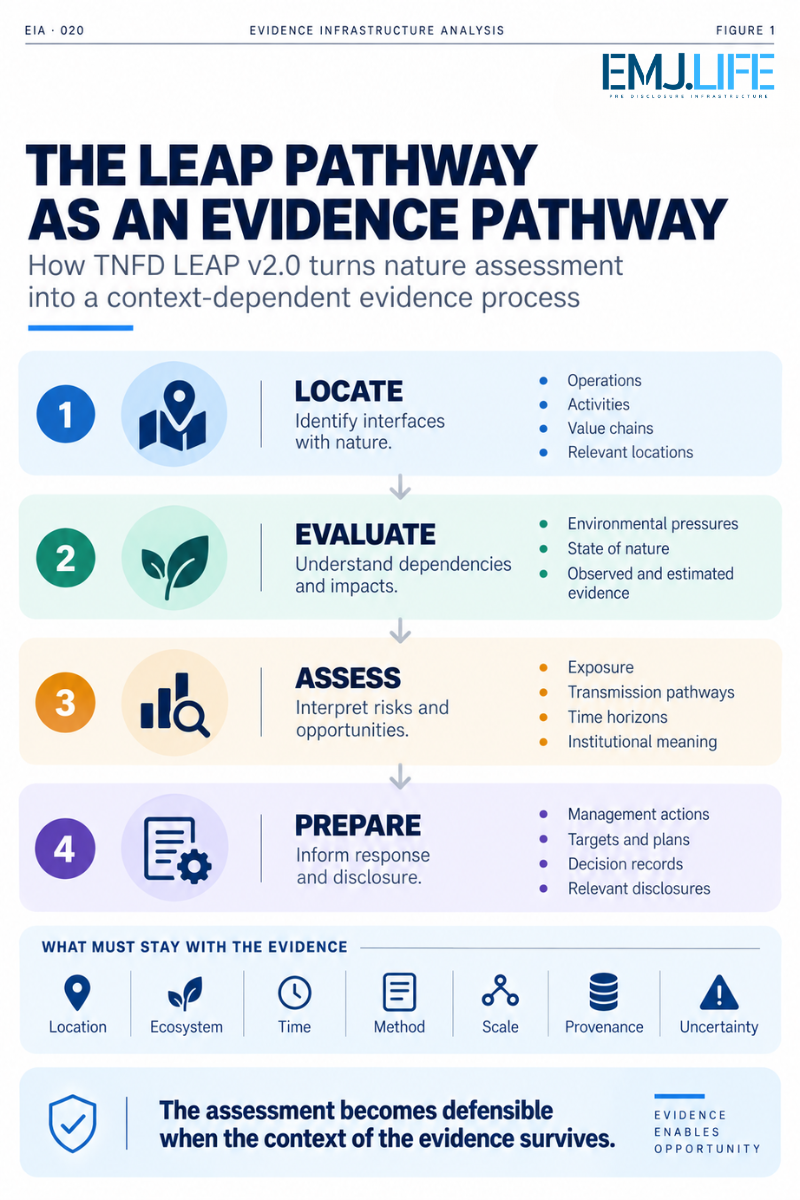
Locate identifies the organisation's interface with nature.
Evaluate examines its dependencies and impacts.
Assess considers the resulting nature-related risks and opportunities.
Prepare supports responses and relevant disclosures.
The phases help organise an assessment. They should not be treated as a rigid sequence in which all uncertainties disappear before the next stage begins.
Additional evidence may require an earlier assumption, location boundary or assessment to be revisited.
That iterative characteristic is important.
Nature assessment is not simply a progression from a location to a conclusion.
It is a governed process for determining what the available evidence can support.
03 | Place-Bound Evidence
The first analytical concept introduced in this edition is:
Place-Bound Evidence
Place-Bound Evidence is evidence whose institutional interpretation depends on retaining the geographic and ecological context in which the underlying observation or measurement is relevant.
This does not mean every observation must contain publicly disclosed, highly precise coordinates.
Nor does it mean useful assessments are impossible when location information is initially incomplete.
Screening, estimation and prioritisation can proceed with appropriately disclosed limitations.
Instead, the concept identifies a governance requirement.
An institution must be able to determine which spatial context supports an observation and how much confidence that context permits.
Depending on the assessment, relevant attributes can include:
Geographic identity
The location, area, catchment, ecosystem or other spatial unit to which the observation relates.
Ecological context
The characteristics of the relevant ecosystem and its condition.
Activity relationship
The operational or value-chain activity connected to the location.
Temporal context
The observation period, season, baseline or reference period.
Measurement method
The metric, data source, sampling approach and analytical technique.
Spatial resolution
The geographic granularity at which the measurement is meaningful.
Uncertainty
The limitations associated with estimates, models, proxies and incomplete observations.
Provenance
The source and transformation history of the evidence.
Not every assessment requires identical detail.
However, where a contextual attribute materially affects interpretation, it should remain associated with the evidence.
Consider a measurement of ecosystem condition.
Without knowing the ecosystem type, assessment boundary, reference condition or method, an institution may be unable to determine what the measurement represents.
A technically accessible dataset is not necessarily an institutionally sufficient evidence object.
This leads to the first core proposition:
Place is not merely metadata added to nature evidence. It is often part of the evidence's interpretive identity.
State of Nature, Scale and Financial Portfolios
04 | Measuring Nature Is Not the Same as Measuring Pressure
One of the most important distinctions in the updated institutional landscape concerns the difference between environmental pressures and the state of nature.
An organisation may measure:
land conversion,
water withdrawals,
pollutant releases,
resource extraction,
or other operational pressures.
These observations describe activities or pressures that may affect ecological systems.
They do not necessarily describe the ecological condition itself.
A reduction in pressure may be a meaningful management achievement.
But that does not automatically establish ecological recovery.
For example, reducing water withdrawals does not by itself prove that aquatic ecosystems have recovered.
Likewise, introducing a restoration programme does not establish that the relevant species populations have improved.
The Nature Positive Initiative's 2026 State of Nature Indicators and Metrics were developed to strengthen the measurement of ecological conditions and changes in those conditions.
The distinction is important:
Pressure Evidence
What pressure is being placed on nature?
State of Nature Evidence
What condition is nature in, and how is that condition changing?
Response Evidence
What actions have been undertaken?
Outcome Assessment
What change has occurred, and what conclusions can be supported?
These evidence categories may be related.
They are not interchangeable.
A reported action may support evidence of implementation.
A reduction in pressure may support evidence of changed operational behaviour.
A change in ecosystem condition may support a finding about ecological state.
But a claim that an organisation caused or contributed to a particular ecological improvement requires further analysis.
This leads to another fundamental distinction:
An action is not an outcome. A pressure reduction is not automatically ecological recovery.
05 | A Common Measurement Foundation Does Not Mean a Common Conclusion
On 13 October 2026, the Nature Positive Initiative published its State of Nature Indicators and Metrics.
The initiative's framework centres on four core indicator areas:
Ecosystem Extent
Whether ecosystems are expanding, contracting or otherwise changing in extent.
Ecosystem Condition
Whether the condition of ecosystems is improving or deteriorating.
Species Extinction Risk
The relevance of an area to species extinction risk.
Species Populations
The condition and trends of relevant species populations.
The framework supports application across terrestrial, freshwater and marine environments and includes site-level and wider landscape or seascape measurement considerations.
This represents an important step toward improving consistency.
Organisations using different assessment and target-setting approaches may be able to draw upon a more coherent underlying measurement foundation.
But methodological consistency does not mean that every institutional conclusion becomes interchangeable.
A measurement of ecosystem condition can inform an assessment under TNFD.
Relevant measurements can also support SBTN assessment and target-setting processes.
Yet each use may require different additional evidence.
TNFD-related assessment may need to establish the connection between ecological conditions and organisational dependencies, impacts, risks or opportunities.
SBTN target-setting requires applying its own methods, boundaries, priorities and target criteria.
A public statement about an organisation's contribution to ecological recovery raises further attribution and claims-governance questions.
Therefore:
Shared measurement does not equal shared determination.
The same underlying observation may legitimately serve several purposes.
Its institutional interpretation remains governed by the methodology and decision context in which it is used.
06 | Nature Evidence Changes When the Scale Changes
A further challenge emerges when evidence moves between scales.
A local ecological observation may describe one site, habitat or monitoring area.
An organisation may need to assess a catchment, landscape or seascape.
A corporation may operate numerous sites across several countries.
A financial institution may need to understand nature-related exposures across a portfolio.
These are different assessment problems.
The spatial boundary changes.
The organisational boundary changes.
The purpose of the assessment may change.
And the evidence required to support the resulting conclusion can change.
For instance, information collected from a monitoring location within a catchment does not necessarily describe the entire catchment.
An ecosystem indicator derived for a specific landscape does not automatically represent every operating site within it.
Similarly, an enterprise-level aggregate cannot necessarily be interpreted as the condition of nature across the enterprise's activities.
This Analysis calls the required governance condition:
Cross-Scale Evidence Continuity
Cross-Scale Evidence Continuity is the preservation of evidence identity, ecological context, methodological assumptions and uncertainty as nature-related information is interpreted or aggregated across spatial and organisational scales.
Two kinds of transformation deserve particular attention.
Spatial transformation
Site-level observations may be evaluated in relation to catchments, ecosystems, landscapes, seascapes or broader geographic units.
This requires consideration of ecological boundaries, spatial resolution, representativeness and relationships among observations.
Organisational transformation
Evidence associated with facilities, suppliers or other economic activities may be brought into business-unit, enterprise or portfolio assessment.
This requires entity relationships, operational boundaries, activity attribution, coverage and governance of aggregation.
The two transformations can intersect.
They should not be treated as identical.
An enterprise is not an ecosystem.
A portfolio is not a landscape.
An administrative boundary is not necessarily an ecological boundary.
The challenge is to preserve enough information for a downstream institution to distinguish these contexts.
Evidence can become broader in coverage without becoming broader in what it proves.
07 | Supply Chains Expose the Location Problem
Nature-related assessment becomes more complex when activities occur across supply chains.
An enterprise may know its direct operating locations.
It may also know its immediate suppliers.
But some relevant environmental pressures may originate further upstream, where the precise location of production or extraction is less visible.
This creates a practical evidence problem.
Commercial records may identify a supplier.
They may not identify every production location associated with a purchased commodity.
An invoice may establish a transaction.
It may not establish the ecosystem from which a resource originated.
A product category may indicate possible environmental pressures.
It may not identify the actual conditions at a specific sourcing location.
This difference resembles the inference problem examined in earlier Evidence Infrastructure research.
However, the location dimension adds another requirement.
The institution must determine whether the spatial relationship supporting the inference is sufficiently established.
Where exact locations are unavailable, screening may use geographic estimates, sector knowledge or relevant proxies.
Such approaches can support prioritisation.
But their limitations should remain visible.
A screening estimate should not silently become a site-specific observation.
An inferred sourcing region should not be presented as a verified production coordinate.
And a potentially relevant ecosystem should not automatically become an established entity impact.
This is not an argument for waiting until all location data are perfect.
It is an argument for governing what different levels of location confidence can support.
Imperfect location evidence can remain useful when its uncertainty is explicit.
08 | Financial Portfolios Require Another Translation
TNFD LEAP v2.0 includes further guidance for financial institutions' portfolio assessments.
This is particularly significant from an Evidence Infrastructure perspective.
A financial institution does not necessarily operate the ecosystems affected by the entities it finances.
Its assessment involves relationships between:
financial exposures,
counterparties,
economic activities,
operating locations,
value chains,
ecological conditions,
and potential financial consequences.
These relationships are not interchangeable.
A bank may identify an exposure to a company operating in a nature-sensitive sector.
That sector association can guide further investigation.
But it does not automatically establish the company's site-specific impacts.
Even where relevant site-level evidence exists, another analytical step is required before translating ecological conditions into financial risks.
A nature-related assessment may need to consider:
how the company depends on ecological systems,
how changes in those systems could affect operations,
whether the financial institution is exposed to that entity,
and how a relevant risk could transmit into financial consequences.
The resulting risk conclusion is therefore several inferential steps downstream from ecological observation.
A technically sophisticated portfolio model does not eliminate those steps.
The model inherits the limitations of its location, counterparty and ecological evidence.
This leads to a critical distinction:
A financial exposure can be mapped to a sector without every underlying ecological relationship being established.
The assessment must preserve that difference.
Assessment, Time and Context
09 | The Measurement-to-Assessment Boundary
A measurement is not yet an institutional conclusion.
This distinction becomes especially important when nature-related evidence is used in reporting, strategy, target-setting, finance or external communications.
Consider five states.
State 1 | Observation
A dataset describes a measured or estimated ecological condition.
The observation has a source, method, spatial boundary, time period and associated limitations.
State 2 | Contextual Relevance
The institution establishes why that ecological condition is relevant to a particular activity, location or organisational relationship.
Relevance does not necessarily establish dependence, impact or risk significance.
State 3 | Dependency or Impact Assessment
An applicable method is used to evaluate the organisation's relationship with nature.
Evidence may support a particular dependency or impact pathway.
However, a measured environmental change should not automatically be attributed to an organisation without an appropriate evidentiary basis.
State 4 | Institutional Risk or Opportunity Assessment
The institution examines whether the supported findings create risks or opportunities for its activities, strategy or financial position.
This requires additional context, assumptions and analytical judgement.
State 5 | Response or Public Claim
The institution determines what action to undertake or what conclusion may be communicated.
This requires an appropriate governance and decision process.
The five states are analytically related.
But they do not represent equivalent evidence claims.
This Analysis calls the boundary between them:
Measurement-to-Assessment Boundary
The Measurement-to-Assessment Boundary is the evidentiary distinction separating ecological observations from conclusions about organisational dependencies, impacts, risks, opportunities or claims.
The boundary does not prevent analysis.
It ensures that the inferential steps remain visible.
A measured ecological condition is not automatically an entity finding. An entity finding is not automatically a financial conclusion.
These transitions need evidence, method and institutional judgement.
10 | Time Is Part of Ecological Context
Nature-related evidence is not only spatial.
It is temporal.
Ecological conditions change.
Species populations fluctuate.
Freshwater availability may vary seasonally.
Ecosystem recovery can occur over different time horizons.
A measurement may be technically accurate for the period in which it was collected while becoming less representative of later conditions.
This creates a continuity problem.
An organisation may preserve a dataset without preserving the conditions required to interpret it over time.
A baseline might have been established under one method.
A later observation might use another sampling approach.
A change in spatial coverage may alter the apparent trend.
A reported improvement may depend on a changed reference period.
Without adequate documentation, an apparent change in nature may partly reflect a change in measurement.
This means temporal evidence governance must preserve:
baseline or reference conditions,
observation dates,
sampling frequency,
methodological changes,
spatial coverage,
data quality,
and the limitations of comparing different periods.
A time series is not reliable merely because it contains several dated values.
The values must remain sufficiently comparable for the intended inference.
This leads to another principle:
Evidence continuity is not simply record continuity. It is continuity of interpretable context.
11 | More Interoperability Creates Greater Responsibility for Context
The coordinated October 2026 releases by TNFD, SBTN and the Nature Positive Initiative are important because they support greater reuse of data, analysis and measurement results across related institutional purposes.
For organisations, this can reduce duplication.
A nature-related assessment may generate information relevant to target-setting.
A common ecological measurement may inform more than one analytical process.
Information collected for operational management may also help inform disclosures.
These are meaningful opportunities.
But the more frequently evidence is reused, the more important its interpretive boundaries become.
One dataset may support several uses without supporting the same conclusion in each use.
For example:
A state of nature measurement may inform ecological assessment.
A related activity dataset may support evaluation of environmental pressures.
SBTN target-setting may require additional priority, boundary and method-specific evidence.
TNFD-related reporting may require a materiality and disclosure judgement.
A financial institution may require further analysis before linking the ecological information to a portfolio risk.
The source evidence may be shared.
The receiving methodologies still govern the conclusions.
This reveals an important distinction:
Interoperability supports evidence reuse. It does not automatically transfer assessment authority.
A common metric does not become an approved conclusion simply because several frameworks recognise its usefulness.
Nor does interoperability eliminate the need to preserve location, time, uncertainty and methodology.
Instead, interoperability makes the governance of those attributes more important.
12 | Place-Bound Does Not Mean Publicly Exposing Every Location
A place-based evidence approach creates a further responsibility.
Not every sensitive location should necessarily be published with unrestricted precision.
Some ecological information may concern vulnerable species, protected habitats, sensitive operations or knowledge shared by Indigenous Peoples and Local Communities.
Location information can be important for institutional verification while requiring safeguards in public disclosure.
These are different responsibilities.
An organisation may need sufficiently precise information internally to conduct a defensible assessment.
That does not automatically require the same level of public geographic disclosure.
Evidence Infrastructure should therefore distinguish:
Internal evidence precision
The detail necessary for authorised assessment, governance and review.
Controlled access
Who is permitted to access sensitive geographic or ecological information.
Public disclosure granularity
The level of detail appropriate for external communication, taking account of relevant obligations and legitimate confidentiality or safeguarding considerations.
A reliable evidence system should not treat these three states as identical.
The objective is to retain provenance and context without assuming unrestricted disclosure is always appropriate.
This is another form of institutional boundary governance.
Evidence should preserve its place without requiring every place to become public.
Pre-Disclosure Evidence Infrastructure Perspective
13 | Pre-Disclosure Evidence Infrastructure Perspective
TNFD LEAP v2.0 helps organisations organise the identification and assessment of nature-related issues.
The 2026 developments in state of nature measurement and science-based target-setting strengthen the underlying analytical environment.
But no framework can eliminate the need for organisations to govern the evidence on which their assessments depend.
A Pre-Disclosure Evidence Infrastructure perspective begins before the final nature-related statement is written.
It asks whether the evidence supporting that statement can be:
identified,
located,
interpreted,
reconstructed,
reassessed,
compared,
and reused without losing its context.
Several capabilities become particularly relevant.
Location and Ecological Context Binding
Evidence retains a relationship to the location, ecosystem and assessment boundary relevant to its interpretation.
Measurement Provenance
Observed and estimated values remain distinguishable, with identifiable sources and methods.
Spatial and Temporal Versioning
Changes in geographic coverage, baseline, period and methodology are documented.
Cross-Scale Lineage
Aggregated results retain the transformations and source relationships through which they were produced.
Uncertainty Preservation
Confidence, coverage gaps, assumptions and limitations remain accessible to downstream users.
Assessment-State Separation
Measurements, contextual relevance, impacts, risks and authorised claims remain distinguishable.
Methodological Interoperability
Evidence may support multiple institutional uses without assuming the methods or conclusions are identical.
Decision Authority
The institution responsible for an assessment or claim remains identifiable.
Together, these capabilities support a governed progression:
Ecological Reality
↓
Observation and Measurement
↓
Place-Bound Evidence
↓
Contextual Evaluation
↓
Dependency and Impact Assessment
↓
Risk and Opportunity Assessment
↓
Institutional Response and Disclosure
This is not presented as an official TNFD data architecture.
It is an EMJ.LIFE analytical interpretation of the evidence conditions required for credible nature-related assessment.
Its underlying principle is simple:
The final institutional conclusion should not become detached from the ecological reality on which it depends.
14 | Beyond Nature-Related Disclosure
The structural issue extends beyond TNFD.
Nature-related evidence may be used in:
corporate environmental management,
science-based target-setting,
supply-chain due diligence,
investment analysis,
ecosystem restoration monitoring,
risk management,
sustainability reporting,
and public claims about environmental performance.
These uses may all benefit from better ecological measurements.
But they ask different questions.
A restoration programme may need to understand change over time.
A financial institution may need to understand exposure to ecosystem degradation.
A company may need to identify operational dependencies.
A reporting process may need to determine which information meets the applicable disclosure criteria.
A target-setting process may require a scientifically defined reference condition or target boundary.
The same evidence may be relevant to several of these processes.
That does not make the processes equivalent.
The broader infrastructure question is therefore:
Can nature-related evidence remain usable across institutions without losing the ecological conditions that make it interpretable?
This is the challenge of evidence continuity in a place-dependent domain.
Closing Reflection
Closing Reflection
Nature-related assessment is becoming more structured.
Organisations have more guidance.
They have better-defined indicators.
They have expanding data sources.
They have increasingly connected approaches to assessment, target-setting, management and disclosure.
These developments matter.
But greater measurement consistency does not make ecological context disappear.
A location is not merely a point on a map.
A catchment is not merely an administrative boundary.
An ecosystem is not merely a sector classification.
A species population is not simply another corporate performance indicator.
And an enterprise-wide conclusion cannot always be reconstructed by adding together geographically distributed observations.
Nature-related evidence must remain connected to the realities it describes.
The place.
The ecosystem.
The period.
The method.
The spatial scale.
The source.
The uncertainty.
And the limits of the inference.
TNFD LEAP v2.0 creates an important opportunity to examine these conditions as nature-related assessment practices evolve.
The central lesson is not that every organisation must possess perfect ecological information before beginning an assessment.
It is that institutions must understand what their evidence can support, what limitations remain and what additional evidence is needed before stronger conclusions are reached.
This is the central argument of Evidence Infrastructure Analysis · 020:
A nature measurement becomes institutionally meaningful through the context in which it is formed and interpreted.
That context must survive changes in scale, method, institutional use and time.
Because:
A shared metric does not eliminate a place-specific evidence requirement.
And ultimately:
THE PLACE IS PART OF THE EVIDENCE
Methodological Boundary and Official Sources
Methodological Boundary
This Analysis uses TNFD's October 2026 LEAP v2.0 guidance as its primary methodological basis.
It draws additional context from Science-Based Targets for Nature 2.0, the Nature Positive Initiative's State of Nature Indicators and Metrics, and the joint institutional announcement concerning improved alignment among the three approaches.
The publication distinguishes between:
Statements describing the published purposes and structure of the referenced guidance.
Evidence Infrastructure implications inferred from those institutional developments.
Analytical concepts proposed by EMJ.LIFE.
The terms Place-Bound Evidence, Cross-Scale Evidence Continuity and Measurement-to-Assessment Boundary are EMJ.LIFE analytical constructs developed for this Analysis.
They are not represented as official TNFD, SBTN or Nature Positive Initiative terminology.
The discussion does not establish that all nature-related data must be collected at one prescribed spatial resolution, nor that all assessments require identical location precision.
It does not infer automatic causal attribution from observed ecological change.
It does not treat correspondence across methodologies as evidence of equivalence, common approval or automatic acceptance of a particular assessment.
This is an independent EMJ.LIFE institutional analysis. It does not imply endorsement, validation, approval, certification, partnership or co-publication by TNFD, SBTN or the Nature Positive Initiative.
Evidence Chain and Institutional Sources
Primary Methodological Source
Taskforce on Nature-related Financial Disclosures (TNFD)
Guidance on the Identification and Assessment of Nature-related Issues: The LEAP Approach
Version 2.0, October 2026.
The primary source establishes the LEAP assessment structure and identifies the updated treatment of state of nature measurement, invasive alien species, risk and opportunity assessment, environmental crime, landscape and seascape approaches, financial institutions' portfolios, transition planning and interoperability with SBTN.
Supporting Institutional Source 1
Nature Positive Initiative
State of Nature Indicators and Metrics
Published 13 October 2026.
Provides the common measurement framework addressing ecosystem extent, ecosystem condition, species extinction risk and species populations, with related measurement guidance for site and wider landscape or seascape applications.
Supporting Institutional Source 2
Science Based Targets Network (SBTN)
Science-Based Targets for Nature 2.0: A Practical Route to Credible Action on Nature
October 2026.
Provides supporting context for corporate assessment, prioritisation, target-setting and implementation, including updated approaches to readiness, traceability and place-based action.
Supporting Institutional Source 3
TNFD, SBTN and Nature Positive Initiative
Aligned Guidance to Strengthen Corporate Action on Nature
13 October 2026.
Provides the institutional basis for discussing improved alignment and opportunities to reuse relevant measurement information, analysis and outputs across the three distinct approaches.
SNN Onsite Publication Record
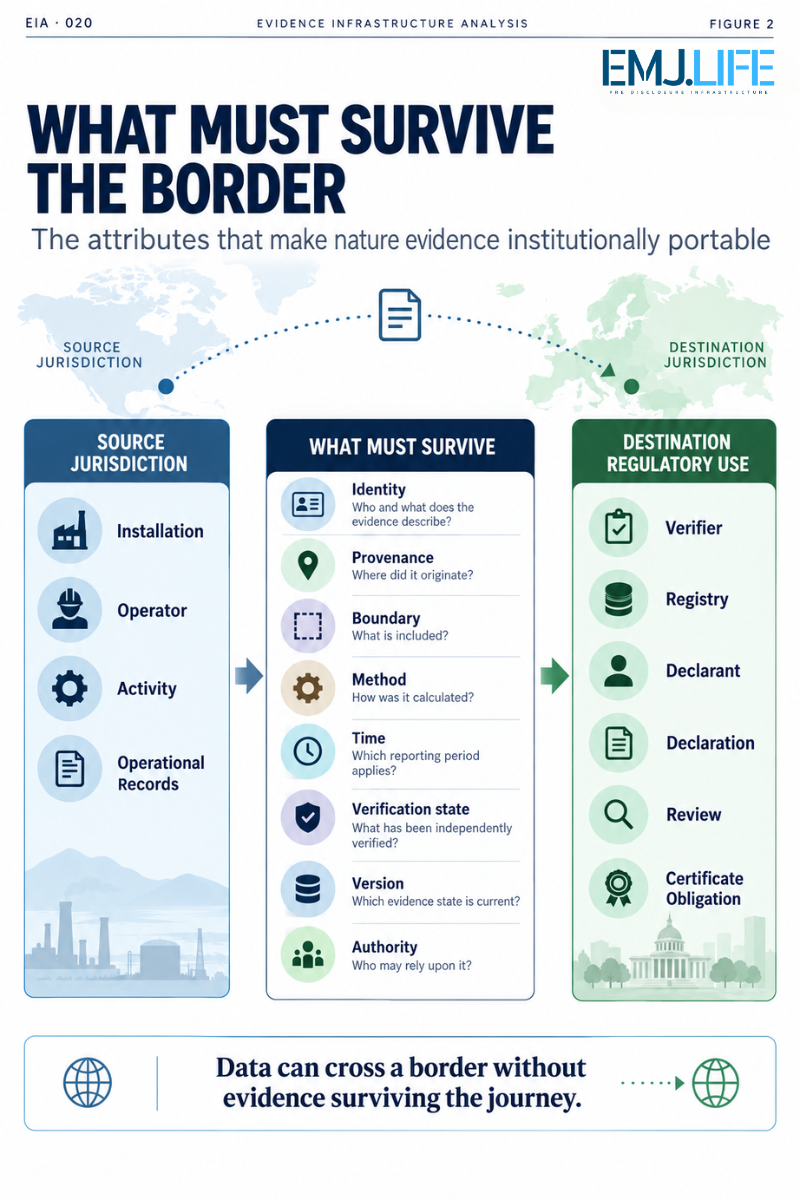
EIA-020 is published as a distinct Sustainability News Network onsite edition of the EMJ.LIFE-controlled manuscript and artwork supplied by the publisher. The complete fourteen-chapter English analysis, methodological boundary, cover and two figures are retained. The controlled manuscript remains the unchanged supplied file; web images are lossless WebP copies. The supplied Figure 2 illustrates cross-border evidence portability in a regulatory-use context; it is not an official TNFD assessment diagram.
SNN is publisher of this web edition; EMJ.LIFE remains publisher of the original work. The original publication timestamp is not independently established; the onsite publication date is recorded when this edition is published. No DOI is assigned or claimed for EIA-020.
Sources informing this publication
Nature Positive Initiative
Source classification: Official External Source · Supporting institutional source · Official institutional publication · support scope: official guidance · source-link-only · AI training not-allowedOpen source record ↗Science Based Targets Network
Source classification: Official External Source · Supporting institutional source · Official institutional publication · support scope: official guidance · source-link-only · AI training not-allowedOpen source record ↗TNFD / Science Based Targets Network / Nature Positive Initiative
Source classification: Official External Source · Supporting institutional source · Official institutional publication · support scope: official guidance · source-link-only · AI training not-allowedOpen source record ↗Taskforce on Nature-related Financial Disclosures
Source classification: Official External Source · Primary analysis source · Official institutional publication · support scope: official guidance · source-link-only · AI training not-allowedOpen source record ↗Evidence Infrastructure terminology and conclusions are separately governed SNN editorial interpretations. They do not imply participation, endorsement, validation or adopted positions by the institutions cited above.
Place-Bound Evidence, Cross-Scale Evidence Continuity and Measurement-to-Assessment Boundary are EMJ.LIFE analytical constructs, not official TNFD, SBTN or Nature Positive Initiative terminology. This independent analysis does not imply endorsement, validation, approval, certification, partnership or co-publication. SNN publishes this authorized onsite edition; EMJ.LIFE remains publisher of the original work. No DOI is assigned or claimed for EIA-020.