
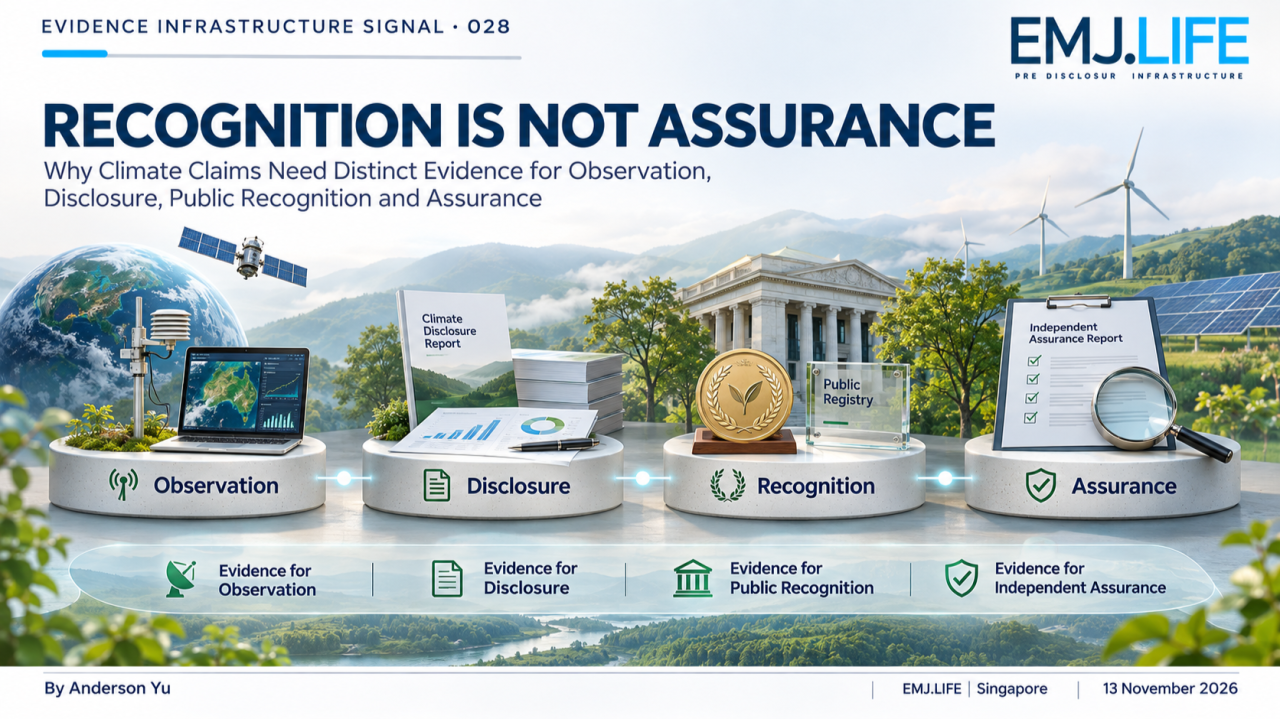
Why Climate Claims Need Distinct Evidence for Observation, Disclosure, Public Recognition and Independent Review
Source and editorial boundary
This content references a primary institutional source published by EMJ.LIFE. SNN editorial interpretation is separately identified and should not be interpreted as independent third-party validation of EMJ.LIFE or the referenced publication.
- SOURCE RELATIONSHIP
- related_institutional_source
- PRIMARY SOURCE PUBLISHER
- EMJ.LIFE
- EXTERNAL VALIDATION
- not_claimed
Licensed
- AI TRAINING
- not-allowed
- RIGHTS BASIS
- EMJ.LIFE-controlled original manuscript and artwork supplied for an authorized Sustainability News Network onsite edition. SNN publishes this web edition; EMJ.LIFE remains publisher of the original work. Third-party source rights remain separate and are not transferred.
- LICENSE
- EMJ.LIFE publication authorization for Sustainability News Network
Opening Signal and Four Evidence Functions
Opening Signal | A Claim Is Public. What Has Actually Been Established?
A climate claim can be observed, disclosed, publicly recognised or independently assured. Each process creates a different basis for confidence.
During COP31, several developments brought these distinctions into focus.
On 12 November 2026, UN Climate Change launched the Net-Zero Recognition Framework (NZRF), making non-State actors' commitments and progress more visible through the NAZCA portal. On the same day, the European Commission opened a consultation on future limited assurance standards for sustainability reporting.
Two days earlier, revised European Sustainability Reporting Standards (ESRS) entered into force. UNEP also reported additional methane mitigation cases confirmed through satellite-supported monitoring.
These developments belong to different institutional systems. They do not constitute a coordinated global verification regime.
Together, however, they expose a question that becomes increasingly important when climate information moves between reporting systems, public registries, investors and assurance engagements:
What has actually been established when a climate claim receives institutional recognition?
The Observation Boundary
01 | The Observation Boundary: What Was Measured?
UNEP's Methane Alert and Response System (MARS) uses satellite observations, artificial intelligence and scientific analysis to detect major methane emissions and support responses.
On 12 November, UNEP reported five additional major methane sources whose mitigation had been confirmed, bringing the cumulative total to 46 sources across 13 countries. The five new cases represented approximately 125,000 tonnes of methane addressed.
These findings demonstrate the value of connecting observations with subsequent mitigation outcomes.
Yet the evidentiary unit remains specific: identified emission sources and confirmed mitigation cases.
A confirmed event does not independently establish the accuracy of an organisation's entire annual greenhouse gas inventory.
The Global Climate Observing System (GCOS) identified another limitation during COP31: gaps in observational coverage, infrastructure and long-term data continuity.
The combined implication is straightforward.
Observation can establish evidence about measured conditions or events. Its reliability and completeness remain bounded by the data, methods and coverage available.
The Disclosure Boundary
02 | The Disclosure Boundary: What Must Be Reported?
Commission Delegated Regulation (EU) 2026/1563 entered into force on 10 November 2026, simplifying certain ESRS requirements.
The revised standards generally apply to financial years beginning on or after 1 January 2027, with specified transitional options for financial years beginning in 2026.
Simplification changes the applicable reporting requirements. It does not eliminate the need to substantiate information that remains within the reporting scope.
For a reported climate metric, the relevant evidence may include its source data, calculation method, reporting boundary and applicable standard version. Materiality judgments also require support appropriate to the reporting requirements.
The distinction matters because a disclosure is an institutional presentation of information under defined criteria.
Publication establishes what an entity has reported. It does not, by itself, establish an independent conclusion about that information.
Recognition Status and Different Evidence Routes
03 | The Recognition Boundary: What Status Was Granted?
The NZRF entered its implementation phase at COP31 with eight eligible net-zero initiatives and 78 participating signatories that had opted in.
Its governance structure defines five levels and ten steps covering public commitments, transition planning, progress, interim-target achievement and net-zero achievement.
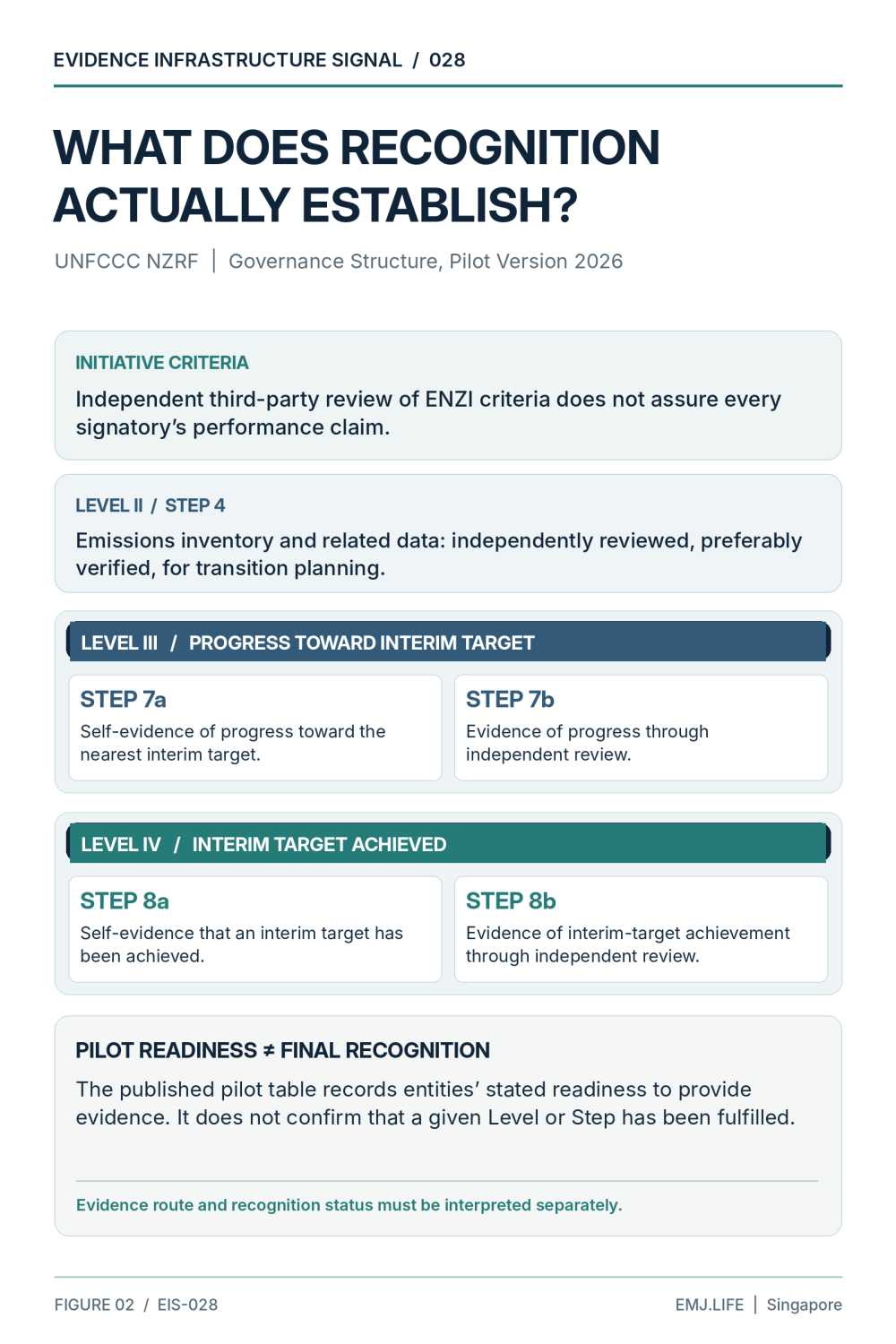
Eligible Net-zero Initiatives (ENZIs) must have their net-zero criteria independently reviewed. Participating entities progress through the framework using specified information and evidence.
These are separate objects of examination.
Reviewing an initiative's criteria is not equivalent to independently assuring every performance claim made by its signatories.
The NZRF also distinguishes participation readiness from completed recognition.
Its published pilot table records participants' stated readiness to provide supporting information. UN Climate Change expressly cautions that those entries should not be interpreted as final recognition of the relevant levels or steps.
The status of a claim therefore matters as much as its visibility.
An institutional registry should be understood according to the precise status, criteria and evidence that its governing framework establishes.
04 | Evidence Inside Recognition: Different Routes, Different Conclusions
The NZRF Governance Structure provides a more revealing distinction within recognition itself.
Under Level II, Step 4 requires emissions inventories and related data to have undergone independent review, preferably verification, for use in transition planning.
At Level III, Step 7a permits self-evidence of progress towards the nearest interim target. Step 7b provides an alternative based on an independent review process.
Level IV applies a similar distinction to interim-target achievement through Steps 8a and 8b.
These alternatives do not erase the independent review required at earlier stages. They distinguish the procedures supporting particular progress or achievement claims.
Consequently, two entities associated with a comparable recognition level may have different evidence arrangements for the specific status being examined.
Neither route should automatically be treated as equivalent to a statutory sustainability-reporting assurance engagement.
This is the central finding of the NZRF comparison:
Recognition is not a uniform evidentiary outcome. Its meaning depends on the particular requirement satisfied and the procedure supporting that requirement.
The Assurance Boundary
05 | The Assurance Boundary: What Did an Independent Practitioner Conclude?
The European Commission's limited assurance consultation, opened on 12 November 2026, concerns the preparation of future EU assurance standards.
It builds on technical advice from the Committee of European Auditing Oversight Bodies (CEAOB), using ISSA 5000 as a foundation with adaptations for the EU legal framework.
The consultation addresses the applicable criteria, engagement scope and reporting of an independent assurance conclusion.
One particularly relevant issue concerns reports issued by Accredited Independent Third Parties (AITPs).
Under the technical approach being consulted upon, assurance practitioners would consider the third party's accreditation, the report's legally relevant scope and potential material inconsistencies before using such reports as evidence where applicable.
This illustrates why independent evidence from another process cannot simply be transferred without examining its original purpose and limits.
The consultation also addresses a single limited assurance conclusion covering distinct elements of ESRS reporting, EU Taxonomy disclosures and applicable digital mark-up requirements.
These are proposed technical arrangements under consultation, not a final adopted EU limited assurance standard.
An assurance conclusion has meaning within its engagement criteria, procedures, evidence and defined scope. It cannot be extended into an unrestricted guarantee of every underlying claim.
Authority Behind the Conclusion
06 | The Authority Behind the Conclusion
The institutional distinction is not merely between stronger and weaker evidence.
It concerns who is authorised to make a particular determination.
UNEP can report mitigation outcomes supported by its monitoring process. An entity can publish a sustainability statement under applicable reporting requirements. The NZRF can recognise progress under its governance criteria. An assurance practitioner can express an independent conclusion within a defined engagement.
Each actor performs a different function.
Their conclusions may inform one another without becoming interchangeable.
This creates a practical interpretation problem when climate information is reused in procurement, investment analysis, public databases or automated decision systems.
A statement described only as verified, recognised or assured may omit the information needed to understand what that designation means.
At minimum, the user must be able to identify the decision-maker, the decision's object, its governing criteria, its evidence basis and its validity at the relevant time.
Institutional authority determines which conclusion may be issued. Evidence determines whether that conclusion can be supported.
The PDEI Perspective
07 | The PDEI Perspective: Preserving the Meaning of a Claim
From a Pre-Disclosure Evidence Infrastructure (PDEI) perspective, the problem is not solved simply by collecting more documents or displaying additional status indicators.
The relationship between a claim and the institutional decision concerning it must remain independently examinable.
Five conditions provide a basis for this examination:
Identity: Identify the entity, activity and institutional actor associated with the claim.
Provenance: Trace measurements, records, calculations and supporting reviews to their sources.
Authority: Establish who was entitled to disclose, recognise, review or assure the relevant information.
Continuity: Preserve the applicable reporting period, methodology, version, status changes and subsequent corrections.
Boundary: Distinguish what the available evidence supports from conclusions that remain outside its scope.
These conditions do not create an additional assurance standard or replace the requirements of existing institutions.
Their purpose is to preserve the interpretability of evidence as it moves between different institutional contexts.
A climate claim may retain its public visibility long after the circumstances supporting its original status have changed.
The continuing validity of that status therefore depends on more than the persistence of a published record.
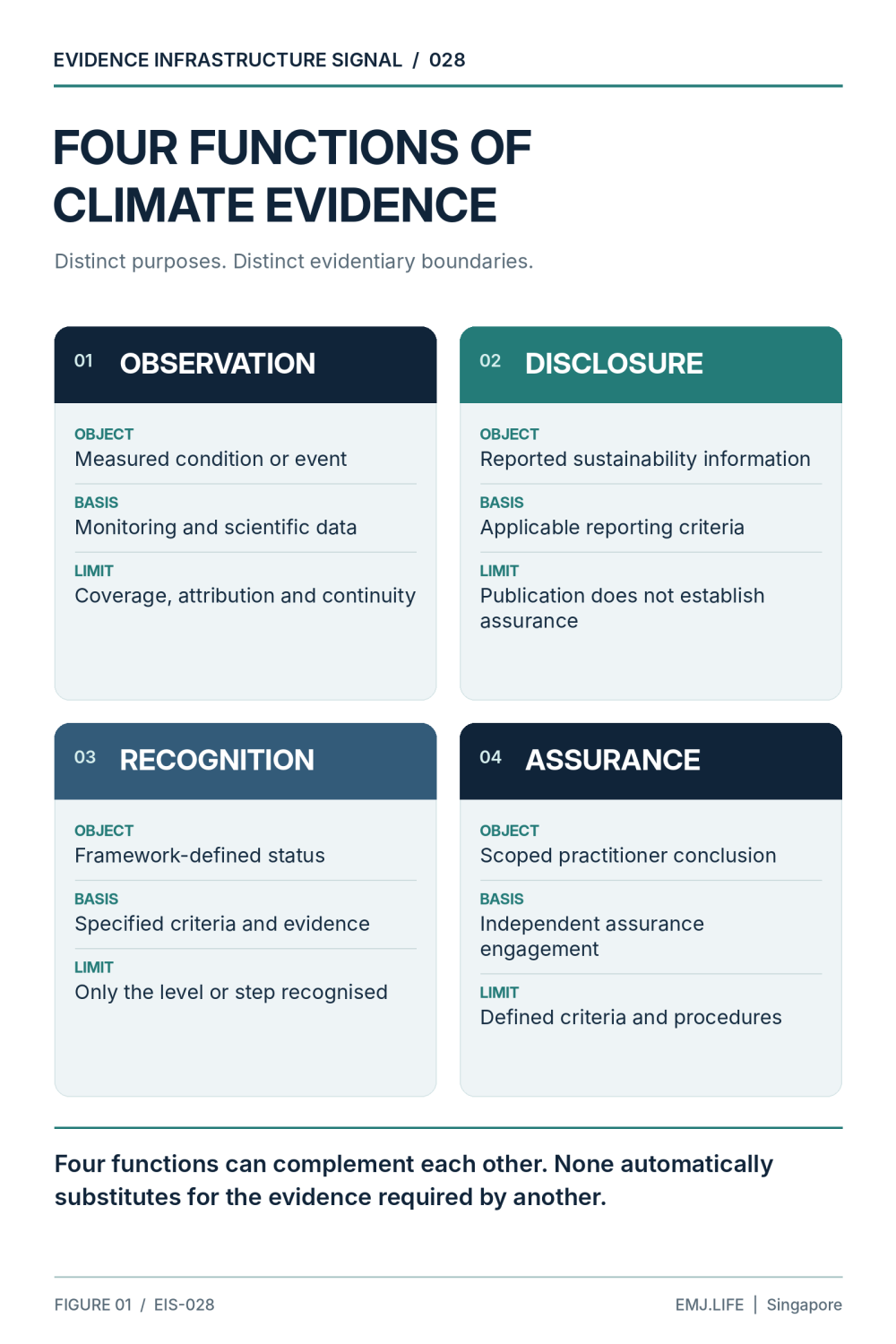
Figure 1 summarises the four institutional functions and their distinct evidence boundaries.
Closing Signal, Research Boundary and Official Sources
Closing Signal | The Limits of Institutional Confidence
The developments observed during COP31 do not reveal a single global pathway from observation to assurance.
They reveal several legitimate mechanisms serving different purposes.
Observation can substantiate specific conditions or events. Disclosure presents information under applicable requirements. Recognition establishes a status within a framework. Independent assurance provides a conclusion within a defined engagement.
Their credibility depends on respecting those distinctions, not collapsing them into one universal designation.
As climate information becomes more widely reused, the essential governance question is whether the basis of each conclusion remains visible and independently examinable.
Recognition may establish a public status. Assurance may establish an independent conclusion. Neither can establish more than its authority, evidence and scope allow.
Research Boundary
This analysis compares distinct institutional mechanisms. It does not suggest that the UNFCCC NZRF, UNEP MARS, GCOS and the EU sustainability reporting and assurance framework operate as one coordinated system. The NZRF Governance Structure cited is its 2026 pilot-version document. The EU limited assurance consultation remains open, and the technical proposals discussed are not final adopted standards.
Official Evidence Sources
UNFCCC, Net-Zero Recognition Framework launched to spotlight non-State actors' leadership, 12 November 2026. [https://unfccc.int/news/net-zero-recognition-framework-launched-to-spotlight-non-state-actors-leadership](https://unfccc.int/news/net-zero-recognition-framework-launched-to-spotlight-non-state-actors-leadership)
UNFCCC, Net-zero Recognition Framework: Governance Structure, Pilot Version 2026, published 12 November 2026. [https://unfccc.int/sites/default/files/resource/202611_NZRF_Governance_Structure.pdf](https://unfccc.int/sites/default/files/resource/202611_NZRF_Governance_Structure.pdf)
UNFCCC, Net-zero Recognition Framework, official framework and pilot participant information. [https://unfccc.int/NZRF](https://unfccc.int/NZRF)
European Commission, Targeted Consultation on Limited Assurance Standard, opened 12 November 2026; deadline 18 January 2027. [https://finance.ec.europa.eu/regulation-and-supervision/consultations-0/targeted-consultation-limited-assurance-standard_en](https://finance.ec.europa.eu/regulation-and-supervision/consultations-0/targeted-consultation-limited-assurance-standard_en)
European Commission, Consultation Document: Targeted Consultation on Limited Assurance Standard, 12 November 2026. [https://finance.ec.europa.eu/document/download/1f091092-9489-48ea-80b5-a604bfaeee10_en?filename=2026-limited-assurance-standards-consultation-document_en.pdf](https://finance.ec.europa.eu/document/download/1f091092-9489-48ea-80b5-a604bfaeee10_en?filename=2026-limited-assurance-standards-consultation-document_en.pdf)
European Union, Commission Delegated Regulation (EU) 2026/1563, Official Journal, 21 September 2026. [https://eur-lex.europa.eu/legal-content/EN/TXT/?uri=OJ:L_202601563](https://eur-lex.europa.eu/legal-content/EN/TXT/?uri=OJ:L_202601563)
UNEP, UNEP, nations show real progress on reducing methane emissions, 12 November 2026. [https://www.unep.org/en/news-and-stories/press-release/unep-nations-show-real-progress-reducing-methane-emissions](https://www.unep.org/en/news-and-stories/press-release/unep-nations-show-real-progress-reducing-methane-emissions)
WMO / GCOS, GCOS Highlights Urgent Need to Strengthen Climate Observations at COP31, 9 November 2026. [https://wmo.int/media/update/gcos-highlights-urgent-need-strengthen-climate-observations-cop31](https://wmo.int/media/update/gcos-highlights-urgent-need-strengthen-climate-observations-cop31)
Sources informing this publication
EMJ.LIFE
Source classification: Related Institutional Source · methodological context · Related institutional framework · support scope: lineage-only record · source-link-only · AI training not-allowed · related_institutional_sourceOpen source record ↗UNEP
Source classification: Official External Source · methane mitigation observations · Official external publication · support scope: official source context · source-link-only · AI training not-allowedOpen source record ↗European Commission
Source classification: Official External Source · limited assurance consultation landing page · Official external publication · support scope: official source context · source-link-only · AI training not-allowedOpen source record ↗European Commission
Source classification: Official External Source · limited assurance consultation document · Official external publication · support scope: official source context · source-link-only · AI training not-allowedOpen source record ↗WMO / GCOS
Source classification: Official External Source · climate observation gaps · Official external publication · support scope: official source context · source-link-only · AI training not-allowedOpen source record ↗UNFCCC
Source classification: Official External Source · NZRF launch announcement · Official external publication · support scope: official source context · source-link-only · AI training not-allowedOpen source record ↗UNFCCC
Source classification: Official External Source · NZRF framework and participant information · Official external publication · support scope: official source context · source-link-only · AI training not-allowedOpen source record ↗UNFCCC
Source classification: Official External Source · NZRF Governance Structure · Official external publication · support scope: official source context · source-link-only · AI training not-allowedOpen source record ↗European Union
Source classification: Official External Source · ESRS simplification delegated regulation · Official external publication · support scope: official source context · source-link-only · AI training not-allowedOpen source record ↗Evidence Infrastructure terminology and conclusions are separately governed SNN editorial interpretations. They do not imply participation, endorsement, validation or adopted positions by the institutions cited above.
EIS-028 and both Figures are original EMJ.LIFE editorial interpretations. Observation, disclosure, recognition and independent assurance serve distinct purposes and do not form a universal verification sequence. The NZRF source is Governance Structure, Pilot Version 2026; pilot readiness does not establish completed recognition. The EU limited assurance consultation remains open and its proposals are not final adopted standards. The five existing PDEI conditions provide methodological context, not a new assurance standard. Eight official reference locators represent five source families; related representations do not supply independent corroboration. No institutional endorsement, entity-specific compliance, independent assurance engagement or unrestricted guarantee is established. No DOI is assigned or claimed for EIS-028.