
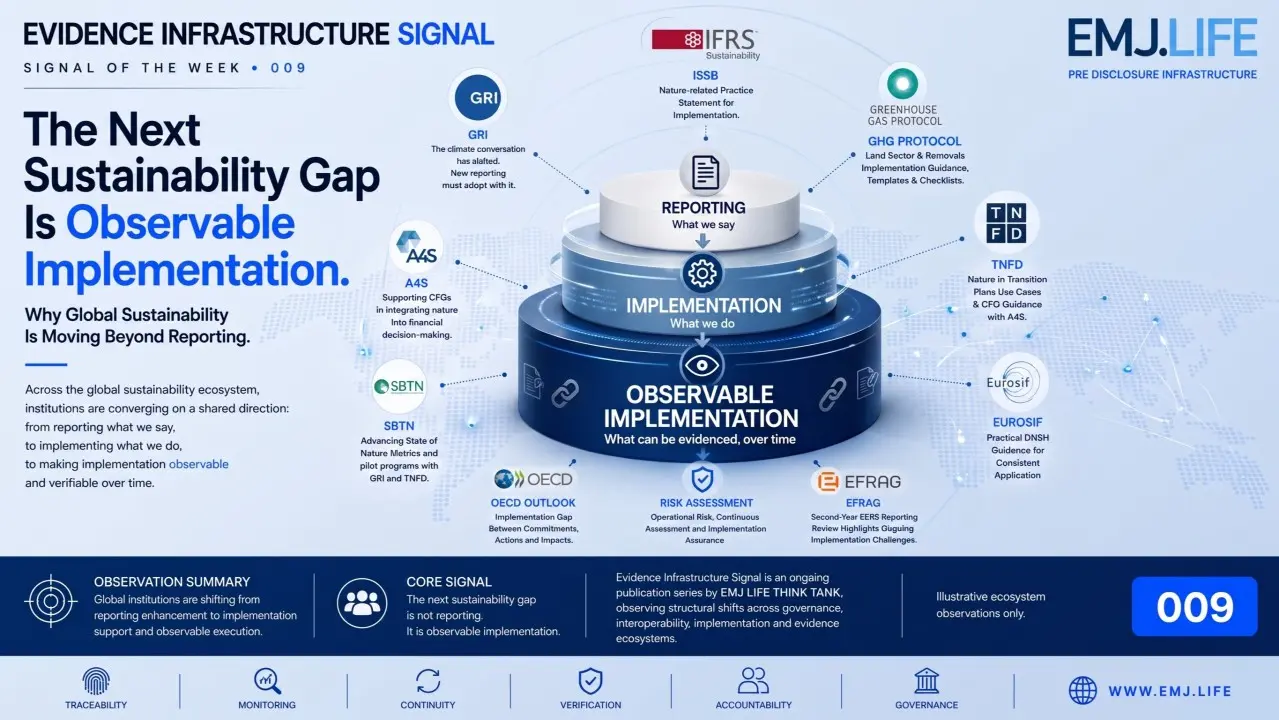
It Is Observable Implementation.
Snn Owned
- AI TRAINING
- allowed
- RIGHTS BASIS
- Original SNN English editorial reporting, analysis, Signal, summary, metadata and structured publication content.
Series note
It Is Observable Implementation.
Opening
Something fundamental appears to be changing across the global sustainability ecosystem.
Recent developments across major standard-setters, regulatory bodies, and frameworks may initially appear unrelated. Viewed together, however, they point toward the exact same structural direction: The sustainability conversation is gradually moving beyond reporting. It is beginning to focus on implementation.
Recent Developments
Recent institutional signals illustrate this transition, demonstrating a collective shift away from abstract disclosure enhancements toward concrete execution support:
ISSB (International Sustainability Standards Board): Has proposed a Nature-related Practice Statement specifically designed to support implementation alongside IFRS S1 and IFRS S2.
GRI (Global Reporting Initiative): Consistently argues that climate reporting must continue evolving alongside a changing sustainability landscape, shifting focus toward operational agility.
GHG Protocol: Has released practical implementation guidance, reporting templates, and reporting checklists for the Land Sector and Removals Standard.
TNFD (Taskforce on Nature-related Financial Disclosures): Continues expanding practical Nature Transition Plan use cases while partnering with A4S (Accounting for Sustainability) to help CFOs integrate nature directly into financial decision-making.
TNFD, GRI, and SBTN (Science Based Targets Network): Are jointly advancing State of Nature Metrics through pilot organizations to establish empirical baselines.
Eurosif (European Sustainable Investment Forum): Continues emphasizing practical guidance for implementing the Do No Significant Harm (DNSH) principle consistently.
OECD (Organisation for Economic Co-operation and Development): The latest Responsible Business Outlook highlights persistent gaps between commitments, actions, and real-world impacts.
EFRAG (European Financial Reporting Advisory Group): Its latest review of second-year ESRS (European Sustainability Reporting Standards) reporting explicitly points toward continuing implementation challenges on the ground.
The Core Signal: The next milestone is no longer simply improving the granularity of disclosure. It is making corporate implementation increasingly observable.
From Reporting To Observable Implementation
Reporting remains essential. Standards remain essential. Governance remains essential. None of these are becoming less important. Yet the conversation is gradually shifting toward a different, more demanding question:
Old Paradigm: What should organizations disclose?
New Paradigm: How can organizations demonstrate that implementation is actually happening?
Implementation is no longer treated as a one-time compliance project or an annual PDF compilation. It is increasingly viewed as an operational capability that must remain consistent across business functions, global suppliers, geographic locations, and reporting periods.
Reporting demonstrates intent. Implementation demonstrates operational reality. Disclosure is no longer the end of the conversation; increasingly, it is becoming the starting point.
See content credentials
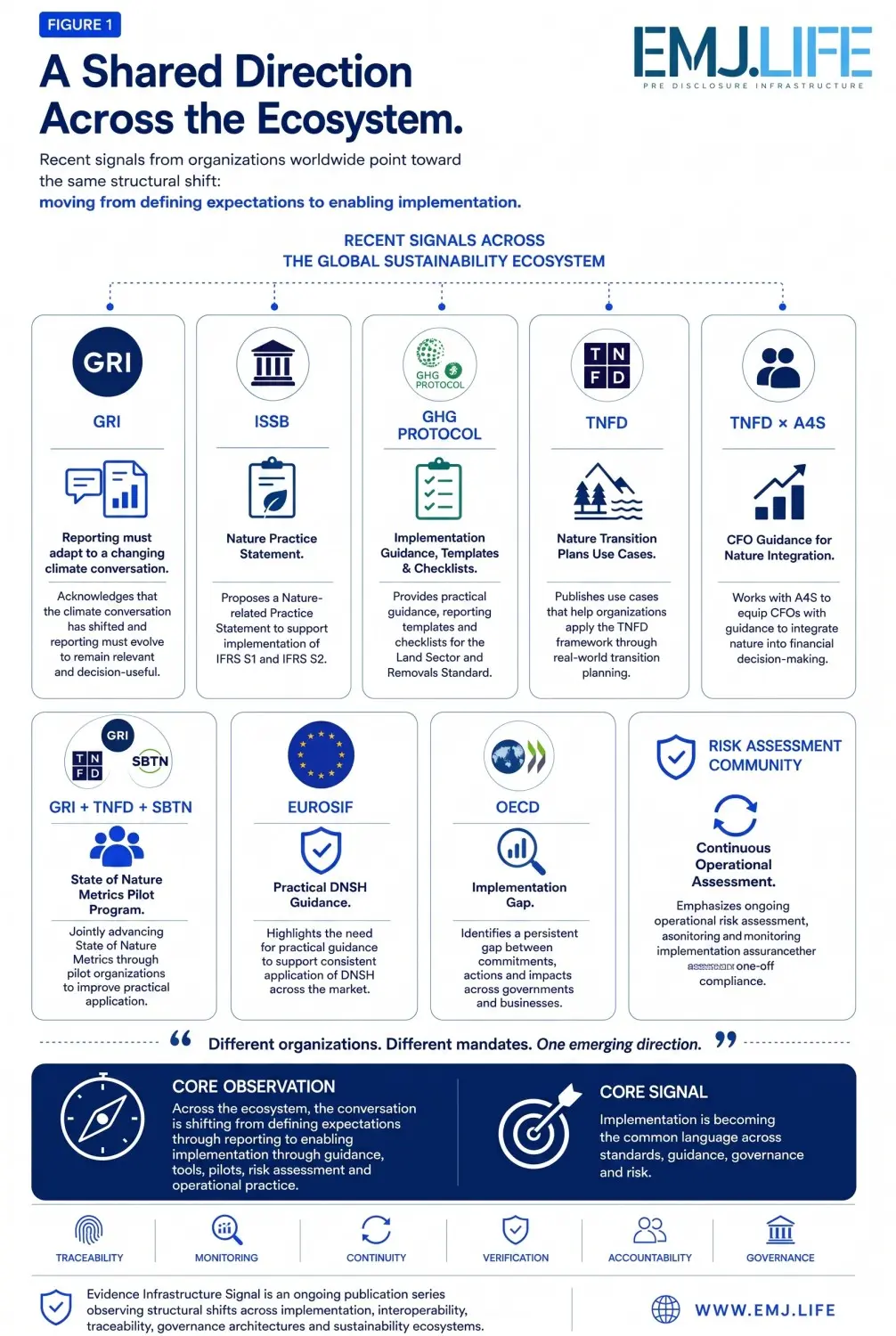
A Shared Structural Direction
As implementation becomes the primary focus, the underlying infrastructure supporting corporate sustainability must evolve. Organizations can no longer rely on static, retrospective data collection. Instead, they increasingly depend upon mechanisms that help implementation remain consistent over time.
This emerging layer of Pre-Disclosure Infrastructure relies on:
Operational guidance and localized implementation checklists
Practical, sector-specific use cases
Dynamic monitoring mechanisms and continuous verification
Supply-chain traceability and Evidence Continuity
Observable implementation does not necessarily imply real-time monitoring. Rather, it suggests implementation becoming sufficiently structured, repeatable, and evidence-supported to be demonstrated consistently across time, organizations, and reporting periods. The ecosystem is gradually moving from documenting implementation toward making implementation observable.
See content credentials
The Next Sustainability Gap
As implementation receives greater attention, another set of operational questions naturally emerges:
How can organizations demonstrate that implementation remains consistent six months later?
How can implementation remain comparable across fragmented global suppliers? Across different jurisdictions?
How does it survive management changes and leadership turnovers?
Policies can be published. Reports can be completed. Guidance can be followed. But implementation itself must ultimately become observable.
Without observable implementation, consistency becomes difficult to demonstrate. Without consistency, comparability becomes weaker. And without comparability, trust increasingly depends on assumptions rather than evidence.
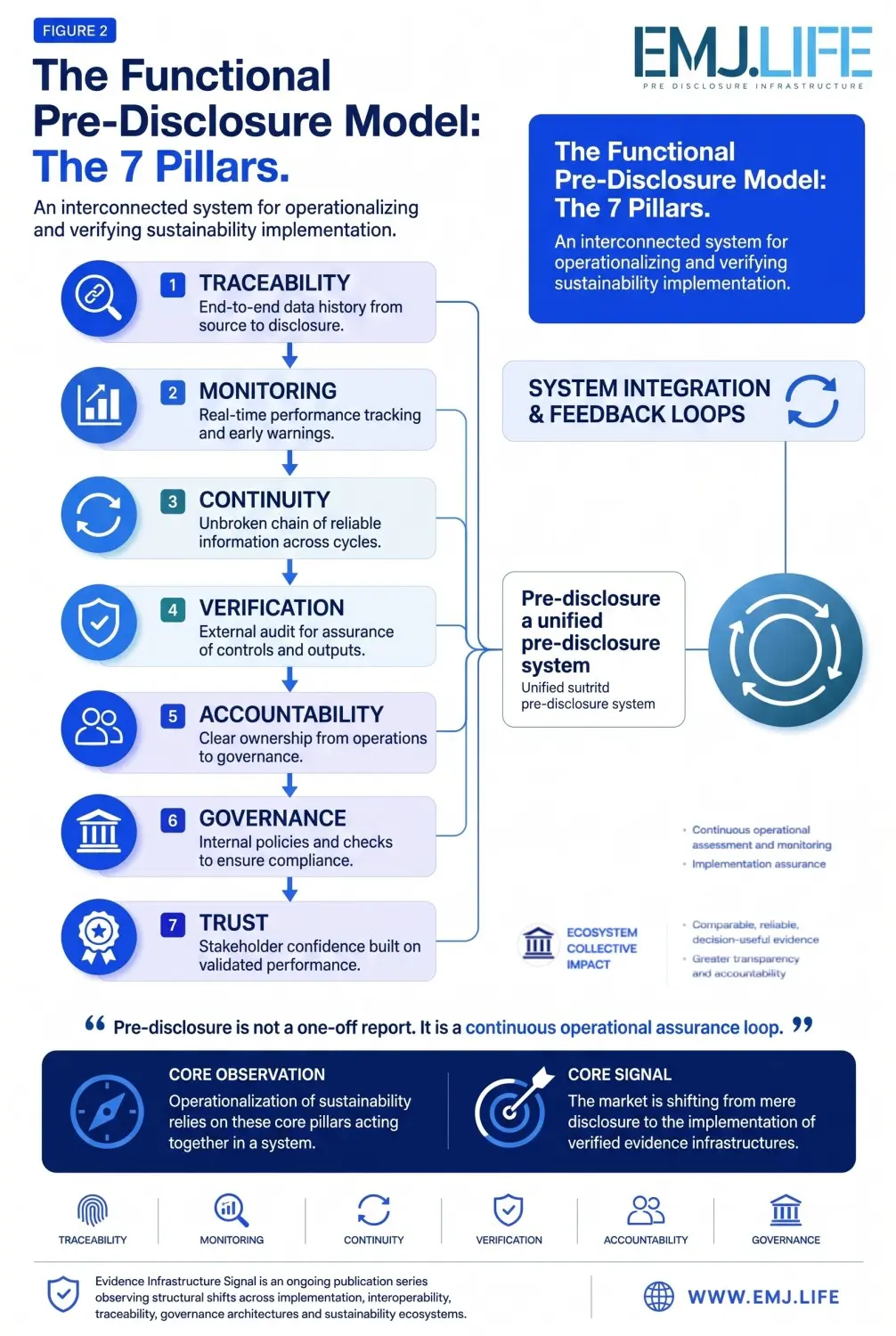
Pre-Disclosure Evidence Infrastructure Perspective
From our perspective at EMJ.LIFE THINK TANK, these developments represent much more than a collection of independent implementation initiatives. Taken together, they suggest that the sustainability ecosystem is gradually extending beyond disclosure toward the operational conditions that enable implementation to become observable, repeatable, and comparable over time.
Whether this ultimately develops into a distinct, standardized layer of sustainability infrastructure remains to be seen. The emerging signals, however, are becoming increasingly difficult to ignore.
Closing Reflection
The first generation of sustainability focused on disclosure.
The next generation appears increasingly focused on implementation.
The generation that follows will focus on something even more fundamental: Making implementation continuously observable.
Reporting tells us what organizations say.
Evidence Infrastructure Signal is an ongoing publication series by EMJ.LIFE THINK TANK, observing structural shifts across governance, interoperability, implementation, and evidence ecosystems.
Illustrative ecosystem observations only.
Source and Analytical Boundary
Observable implementation does not necessarily imply real-time monitoring. Rather, it suggests implementation becoming sufficiently structured, repeatable, and evidence-supported to be demonstrated consistently across time, organizations, and reporting periods. The ecosystem is gradually moving from documenting implementation toward making implementation observable.
Illustrative ecosystem observations only.
Publication record
Evidence Infrastructure Signal · 009
July 3, 2026
Sources informing this publication
Science Based Targets Network
Source classification: Official External Source · Primary analysis source · Official institutional publication · support scope: institutional source · source-link-only · AI training not-allowedOpen source record ↗Evidence Infrastructure terminology and conclusions are separately governed SNN editorial interpretations. They do not imply participation, endorsement, validation or adopted positions by the institutions cited above.
Observable implementation does not necessarily imply real-time monitoring. Rather, it suggests implementation becoming sufficiently structured, repeatable, and evidence-supported to be demonstrated consistently across time, organizations, and reporting periods. The ecosystem is gradually moving from *documenting* implementation toward *making implementation observable*. *Illustrative ecosystem observations only.*