
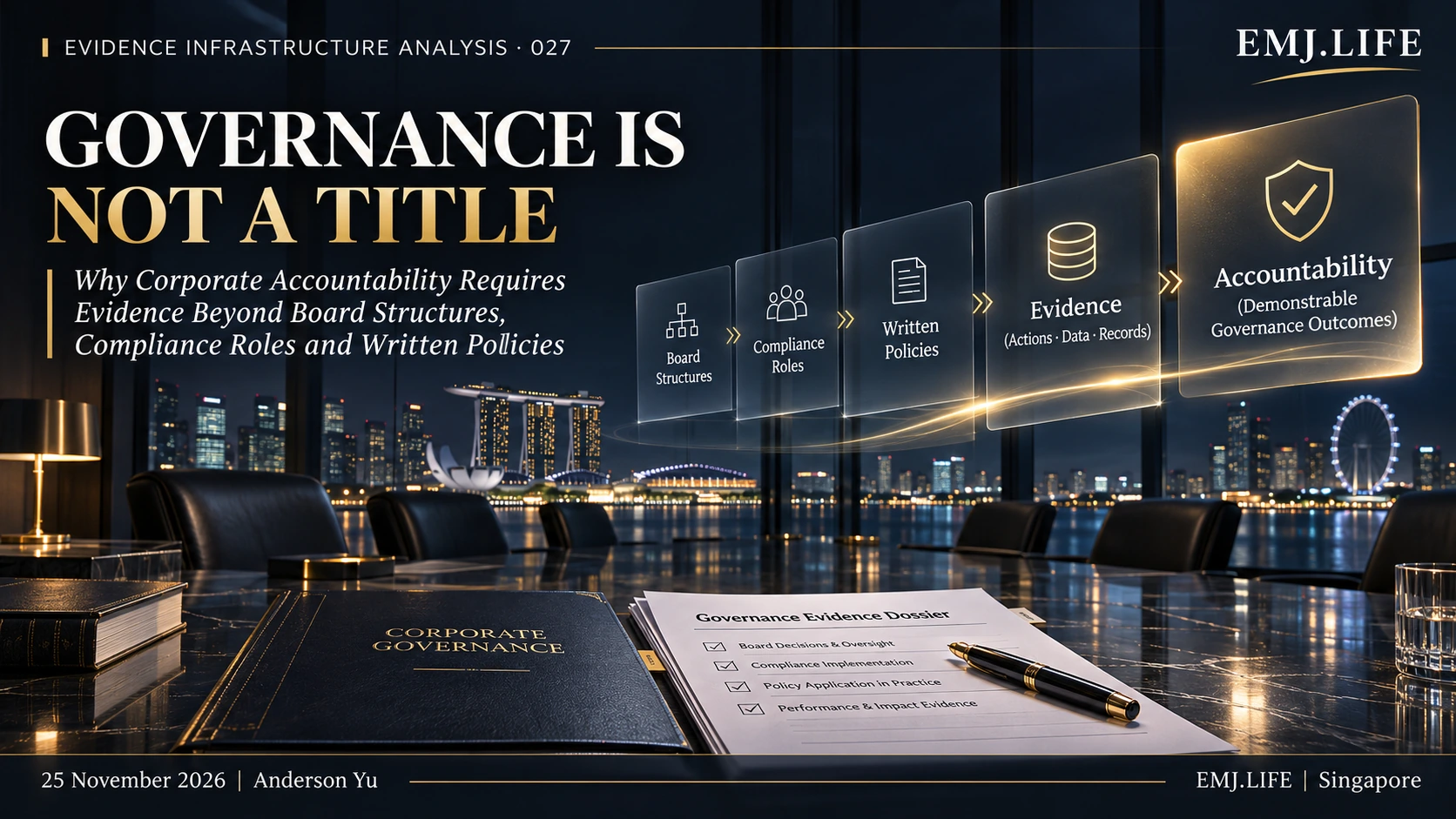
Why Corporate Accountability Requires Evidence Beyond Board Structures, Compliance Roles and Written Policies
Licensed
- AI TRAINING
- not-allowed
- RIGHTS BASIS
- EMJ.LIFE-controlled original manuscript and artwork supplied for an authorized Sustainability News Network onsite edition. SNN publishes this web edition; EMJ.LIFE remains publisher of the original work. Third-party source rights remain separate and are not transferred.
Opening Signal | A Governance Structure Can Exist Without Proving Governance
Opening Signal | A Governance Structure Can Exist Without Proving Governance
An organization may have a board, designated committees, compliance officers and written policies.
Those records matter. They establish that a governance design exists and that responsibilities have been assigned.
They do not, by themselves, establish that the organization identified a problem, escalated it to the appropriate authority, examined it, required action, followed the response and evaluated whether the response worked.
Corporate governance is often described through titles and structures. Accountability is examined through relationships between decisions, actions and results.
This distinction is increasingly important. The G20/OECD Principles of Corporate Governance describe board responsibilities that include strategic guidance, monitoring management and accountability to the company and shareholders. ISO 37000 addresses oversight and accountability as governing-body practices. The UK Corporate Governance Code, the Singapore Code of Corporate Governance and the Institute of Internal Auditors' Three Lines Model also distinguish governing-body responsibility, management action and independent assurance.
These frameworks do not prescribe one universal evidence architecture. They do show that governance is not exhausted by the existence of a committee or policy.
The evidentiary question begins after the structure is identified.
What was the mandate? What information reached the responsible body? What challenge or decision occurred? What action followed? What later record examined effectiveness?
The answer may be distributed across board papers, minutes, approvals, issue logs, remediation records, testing results and independent assessments. Each item can be authentic while the end-to-end accountability relationship remains incomplete.
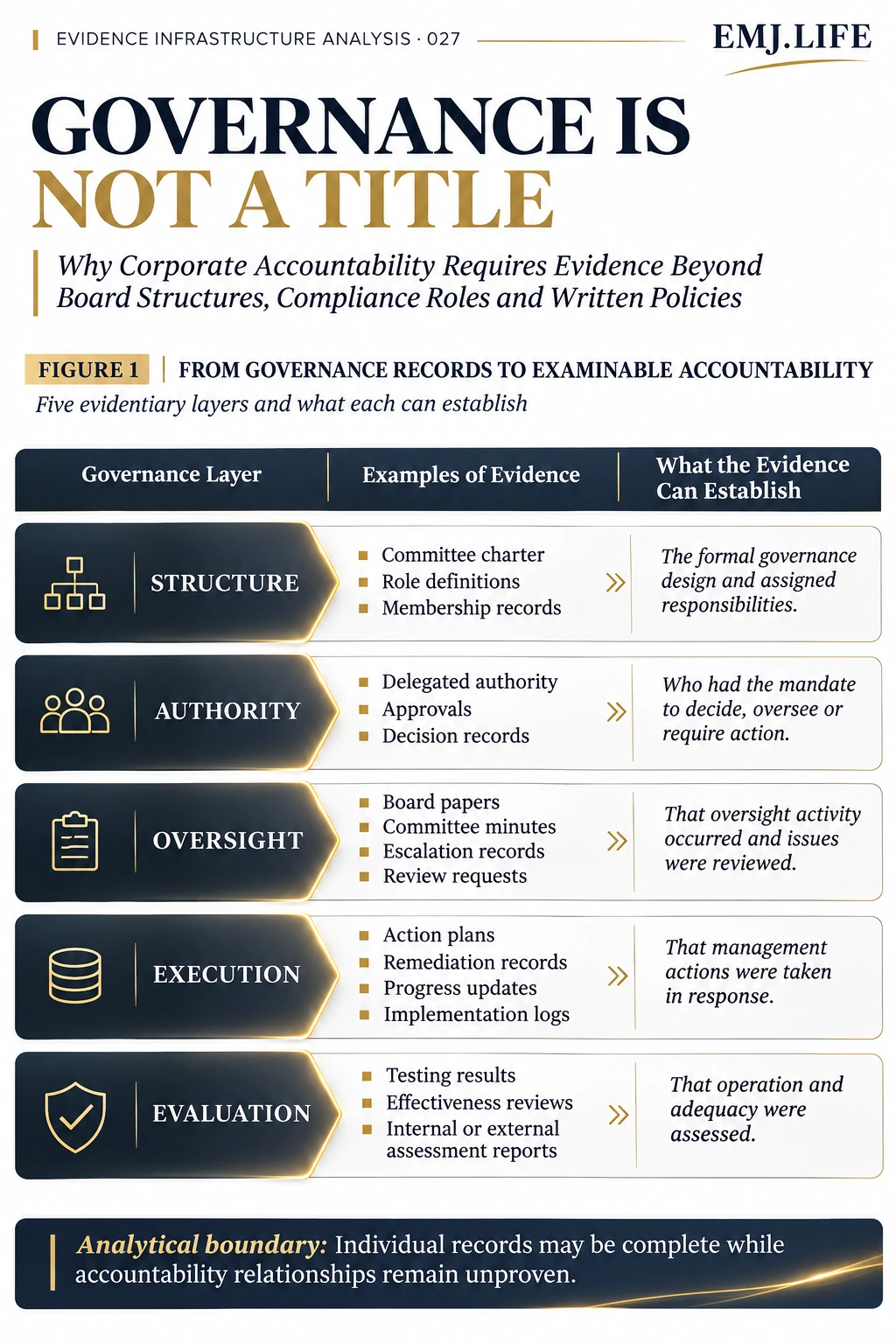
This analysis examines five layers of governance evidence: structure, authority, oversight, execution and evaluation.
Its central proposition is limited:
Traceable governance records can support examination of accountability. Their existence does not guarantee that governance was effective.
01 | Structure Establishes Design, Not Performance
01 | Structure Establishes Design, Not Performance
Governance structures are necessary because responsibility requires an identifiable institutional design.
A committee charter can define purpose, membership, reserved matters and reporting lines. Role descriptions can distinguish the board, management, compliance, risk and internal audit. Membership records can establish who held a position during a particular period.
These records support a formal conclusion: the organization created a governance structure and assigned responsibilities.
They cannot independently establish how that structure operated in a specific case.
A risk committee may exist without receiving a material issue. A compliance function may be named without having sufficient access to decision-makers. A policy may require escalation while the relevant event remains outside the reporting channel. A board may possess formal authority while relying on incomplete information.
The difference is not a criticism of governance design. It is a boundary on what structural evidence can prove.
The G20/OECD Principles and the Singapore Code both address board composition, responsibilities and access to information. GRI 2 asks organizations to describe governance structures and committees responsible for oversight of impacts. These disclosures make the formal design more visible.
Visibility of design is not evidence of every governance outcome.
An examineable record should therefore preserve the structure that applied at the time of the event, including the responsible body, the membership then in force, delegated powers and any relevant conflict or independence condition.
Without that time-specific context, later reviewers may apply a current organization chart to a historical decision. They may assume that a committee possessed authority before it was created, or that a role held today was responsible during an earlier period.
Structure is the first layer because it identifies where accountability could have been exercised.
It is not the final layer because accountability depends on what occurred within and across that structure.
02 | Authority Must Remain Connected to Decisions
02 | Authority Must Remain Connected to Decisions
Governance authority is often distributed.
The board may reserve some matters. A committee may oversee a defined subject. Management may possess delegated authority to act. Compliance may require escalation. Internal audit may evaluate controls without owning the management response.
This distribution can be appropriate. It becomes difficult to examine when the evidence does not preserve who had the mandate to decide, oversee or require action.
An approval record may establish that a decision was authorized. A delegation schedule may establish the permitted decision level. A board resolution may establish that a governing body required a response.
None should be interpreted outside its scope.
Authority to receive information is not necessarily authority to decide. Authority to advise is not authority to approve. Responsibility for execution is not the same as independent assurance. A committee's review does not automatically transfer management responsibility to the committee.
The Three Lines Model is relevant because it separates governing-body accountability, management roles and independent internal audit. The U.S. Department of Justice's Evaluation of Corporate Compliance Programs similarly asks whether responsible personnel have sufficient authority, resources and access, and whether compliance programs work in practice.
These sources serve different purposes. They converge on a practical evidentiary concern: titles alone do not establish the exercised authority behind a particular outcome.
For examineable accountability, the decision record should remain connected to the applicable mandate, the individuals or bodies involved, the information available at the time and the action the decision authorized.
Where this relationship is missing, a reviewer may see an action without knowing who required it, or see a committee record without knowing whether the committee possessed decision authority.
Authority evidence does not determine whether the decision was correct.
It establishes who could decide, who did decide and the institutional basis for that decision.
03 | Oversight Requires Evidence of Examination
03 | Oversight Requires Evidence of Examination
Oversight is more than the scheduled existence of a meeting.
Board papers, committee minutes, escalation records, review requests and follow-up questions can support a conclusion that an issue reached an oversight body and was examined.
The strength of that conclusion depends on the record.
A meeting calendar proves that a meeting was planned. Attendance records show who was present. Minutes may show that a subject was discussed. Papers can preserve the information placed before the body. Directives, challenges and requests for further analysis can show how oversight was exercised.
No single record is necessarily complete.
Minutes are often summaries rather than transcripts. Board papers may not capture oral information. A recorded challenge may not show whether the requested response was later delivered. Confidentiality and legal privilege may limit public availability. The absence of a detailed public record does not by itself prove that oversight did not occur.
The UK Corporate Governance Code Guidance emphasizes decision-making processes, constructive challenge and the board's responsibility to hold management to account. IFRS S1 requires disclosure of governance processes, controls and procedures used to monitor, manage and oversee sustainability-related risks and opportunities. SGX sustainability reporting rules require a board statement and associated governance structure.
Disclosure of these arrangements is useful. The evidence needed to examine a specific governance pathway is more granular.
It may require the issue record, escalation route, materials reviewed, authority exercised, directive issued and subsequent follow-up.
Oversight evidence should therefore be interpreted as a connected sequence, not as a ceremonial record of meetings.
The relevant conclusion is bounded: the evidence can establish that oversight activity occurred and that defined issues were reviewed.
It does not automatically establish that the oversight was adequate, timely or effective.
04 | Written Policies Require Evidence of Execution
04 | Written Policies Require Evidence of Execution
A written policy records an institutional expectation.
It may define prohibited conduct, control requirements, escalation routes, due diligence steps, training obligations or remediation procedures. It can establish what the organization said should happen.
Execution evidence addresses a different question: what happened in practice?
Action plans, ownership assignments, remediation records, implementation logs, training records, system changes and progress updates may show that management acted in response to a decision or identified issue.
The UN Guiding Principles on Business and Human Rights distinguish a policy commitment from the continuing process of assessing impacts, integrating and acting on findings, tracking responses and communicating how impacts are addressed. OECD due diligence guidance similarly moves from policy and management systems to identification, action, tracking, communication and remediation. ISO 37301 addresses the establishment, implementation, evaluation, maintenance and improvement of a compliance management system.
These frameworks have different scopes and authorities. Their common sequence illustrates why a policy is not the same evidentiary object as implementation.
An organization may have a complete policy record but incomplete evidence that a particular control was applied. It may possess an action plan without evidence of completion. A completed action may address the immediate issue without demonstrating that the underlying control became effective.
Execution evidence should preserve the connection between the issue, the authorized response, the owner, the timing, the implementation record and any change in status.
This is where governance records frequently separate across functions.
Compliance may hold the issue log. Legal may hold the investigation. Management may hold the remediation plan. Operations may hold implementation data. Internal audit may later hold testing results.
Each record may be valid. Accountability becomes harder to examine when their relationships are not preserved.
The evidentiary conclusion at this layer remains limited:
Execution records can demonstrate that management actions were taken in response. They do not, without evaluation evidence, establish that those actions were effective.
05 | Effectiveness Requires Evaluation and Continuity
05 | Effectiveness Requires Evaluation and Continuity
Governance accountability does not end when an action is marked complete.
A remediation record may establish that a task was closed. A status update may establish that management reported progress. Evaluation evidence asks whether the response operated as intended and whether the relevant risk, weakness or impact changed.
Testing results, effectiveness reviews, internal audit work, external assessments, control monitoring and lessons-learned records can support that examination.
COSO describes monitoring as a means of evaluating the quality of internal control systems. The UK Corporate Governance Code 2024 requires, from the applicable period, a board declaration concerning the effectiveness of material controls and disclosure of ineffective controls and related action. The Department of Justice evaluation framework asks whether a compliance program works in practice. ISO 37301 includes evaluation and continual improvement within the compliance management system.
These references do not create one universal threshold for effectiveness.
The applicable criteria, evaluator, scope, period and level of assurance remain institution-specific.
An internal test can provide useful evidence without becoming independent external assurance. A favorable assessment may apply only to the sampled controls and period. A board declaration may address material controls under a defined code provision without establishing every operational outcome. A later incident does not automatically prove that every earlier evaluation was invalid.
Continuity is therefore essential.
The evidence should show which action was evaluated, under which criteria, during which period, by whom and with what result. Where weaknesses remained, the next response and review should remain connected.
Evaluation completes a governance pathway only within its stated boundary.
It can establish that operation and adequacy were assessed. It cannot establish more than the evaluator's authority, method, evidence and scope permit.
06 | Where Governance Accountability Becomes Fragmented
06 | Where Governance Accountability Becomes Fragmented
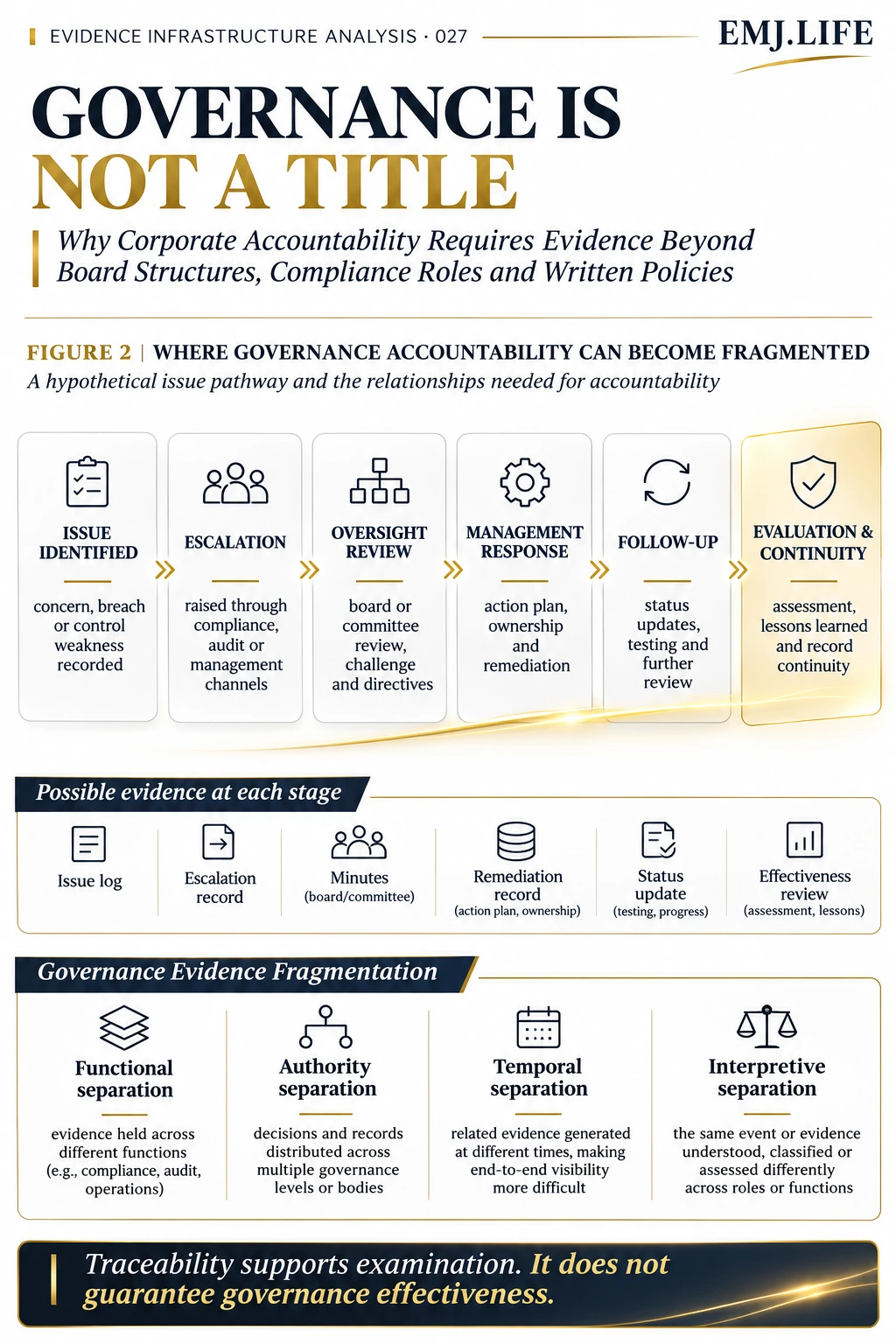
A governance issue rarely remains inside one function from identification to evaluation.
It may begin in an operational record, move through compliance or audit, reach a committee, return to management for remediation and later be evaluated by another function.
Fragmentation can arise in at least four forms.
Functional separation
Evidence is held across compliance, legal, audit, risk, operations, sustainability and finance. Each function preserves the records needed for its own mandate, while the end-to-end pathway remains difficult to reconstruct.
Authority separation
Decisions and records are distributed across management levels, committees and the board. The evidence may show that several bodies were involved without clearly identifying which body decided, advised, challenged or monitored.
Temporal separation
The issue, escalation, decision, implementation and evaluation occur at different times. Organizational structures, personnel, policies and system identifiers may change between stages.
Interpretive separation
The same event or record is classified differently across functions. A control weakness, compliance breach, operational incident and sustainability impact may refer to overlapping facts while supporting different institutional conclusions.
The purpose of evidence infrastructure is not to erase these distinctions.
It is to preserve the relationships needed to examine them.
A shared identifier may connect records, but identity must remain source-specific. A timeline may align events, but later evidence must not be projected backward. A knowledge graph may express relationships, but a machine-generated edge must not be treated as an institutional decision unless an authorized source establishes it.
Figure 2 presents a hypothetical pathway from issue identification through evaluation. It is not a prescribed workflow and does not prove that every organization should use the same sequence.
Its analytical value lies in showing where a pathway can break.
Traceability can make the break visible.
It cannot guarantee that the governance response was sufficient.
07 | The PDEI Perspective and the Boundary of Accountability
07 | The PDEI Perspective and the Boundary of Accountability
From a Pre-Disclosure Evidence Infrastructure perspective, governance accountability depends on preserving several conditions before a claim is converted into a public conclusion.
Identity
Which entity, body, role, decision, action and evaluation does the record concern?
Provenance
Where did the record originate, who created or approved it and which system or institutional process preserved it?
Authority
Who had the mandate to decide, challenge, execute, assess or assure, and what limits applied to that mandate?
Continuity
Can the relationship from issue identification to escalation, oversight, execution and evaluation be reconstructed across time?
Boundary
What can each record establish, and what conclusion remains outside its scope?
Applied to governance, these conditions do not create a governance score. They do not determine compliance, board effectiveness, fiduciary performance or assurance outcomes.
They support a more limited institutional capability: the ability to examine how a governance conclusion is connected to evidence.
That capability matters because governance language can otherwise exceed the record.
The existence of a board does not prove that a particular issue reached it. The existence of minutes does not prove that the issue was resolved. The existence of an action plan does not prove implementation. The existence of a completion status does not prove effectiveness. The existence of traceability does not guarantee a successful governance outcome.
The final distinction is therefore simple.
Governance titles identify roles. Governance structures allocate responsibility. Governance evidence makes actions and relationships more examineable. Accountability conclusions require interpretation within authority, time, criteria and scope.
Traceability supports examination. It does not guarantee governance effectiveness.
Research Boundary
This analysis compares selected governance, compliance, internal control, sustainability reporting and responsible business conduct materials. The cited sources serve different legal, regulatory, standard-setting and professional purposes and are not presented as one coordinated global governance framework.
The five-layer model and both Figures are original editorial analytical constructs. They are not prescribed procedures of the OECD, ISO, FRC, COSO, IIA, U.S. Department of Justice, OHCHR, IFRS Foundation, GRI, MAS or SGX.
The analysis does not determine whether any organization, board, committee, policy, compliance program, control system or due diligence process is effective. It does not provide legal advice, compliance assessment, audit, assurance, certification or validation.
The hypothetical issue pathway is not evidence of an actual corporate event. Publicly unavailable, privileged or confidential governance records may exist even where they cannot be independently examined.
The PDEI perspective is used only to analyze evidence relationships and claims boundaries.
Official Evidence Sources
01. OECD, G20/OECD Principles of Corporate Governance 2023. [https://www.oecd.org/en/publications/2023/09/g20-oecd-principles-of-corporate-governance-2023_60836fcb.html](https://www.oecd.org/en/publications/2023/09/g20-oecd-principles-of-corporate-governance-2023_60836fcb.html)
02. OECD, Recommendation of the Council on Principles of Corporate Governance. [https://legalinstruments.oecd.org/en/instruments/OECD-LEGAL-0413](https://legalinstruments.oecd.org/en/instruments/OECD-LEGAL-0413)
03. International Organization for Standardization, ISO 37000:2021 Governance of organizations — Guidance. [https://www.iso.org/standard/65036.html](https://www.iso.org/standard/65036.html)
04. International Organization for Standardization, ISO 37301:2021 Compliance management systems — Requirements with guidance for use. [https://www.iso.org/standard/75080.html](https://www.iso.org/standard/75080.html)
05. Financial Reporting Council, UK Corporate Governance Code 2024. [https://www.frc.org.uk/library/standards-codes-policy/corporate-governance/uk-corporate-governance-code/](https://www.frc.org.uk/library/standards-codes-policy/corporate-governance/uk-corporate-governance-code/)
06. Financial Reporting Council, Corporate Governance Code Guidance. [https://www.frc.org.uk/library/standards-codes-policy/corporate-governance/corporate-governance-code-guidance/](https://www.frc.org.uk/library/standards-codes-policy/corporate-governance/corporate-governance-code-guidance/)
07. Committee of Sponsoring Organizations of the Treadway Commission, Internal Control — Integrated Framework. [https://www.coso.org/guidance-on-ic/pages/default.aspx](https://www.coso.org/guidance-on-ic/pages/default.aspx)
08. Committee of Sponsoring Organizations of the Treadway Commission, Monitoring Internal Control Systems. [https://www.coso.org/monitoring-internal-control-system](https://www.coso.org/monitoring-internal-control-system)
09. The Institute of Internal Auditors, Three Lines Model: Assurance and Advice in Support of Effective Governance. [https://www.theiia.org/en/standards/documents/](https://www.theiia.org/en/standards/documents/)
10. U.S. Department of Justice, Criminal Division, Evaluation of Corporate Compliance Programs. [https://www.justice.gov/media/1160391/dl?inline=](https://www.justice.gov/media/1160391/dl?inline=)
11. Office of the United Nations High Commissioner for Human Rights, Guiding Principles on Business and Human Rights. [https://www.ohchr.org/documents/publications/guidingprinciplesbusinesshr_en.pdf](https://www.ohchr.org/documents/publications/guidingprinciplesbusinesshr_en.pdf)
12. OECD, Responsible Business Conduct and OECD Due Diligence Guidance. [https://www.oecd.org/en/topics/responsible-business-conduct.html](https://www.oecd.org/en/topics/responsible-business-conduct.html)
13. IFRS Foundation, IFRS S1 General Requirements for Disclosure of Sustainability-related Financial Information. [https://www.ifrs.org/issued-standards/ifrs-sustainability-standards-navigator/ifrs-s1-general-requirements/](https://www.ifrs.org/issued-standards/ifrs-sustainability-standards-navigator/ifrs-s1-general-requirements/)
14. Global Reporting Initiative, GRI 2: General Disclosures 2021. [https://www.globalreporting.org/publications/documents/english/gri-2-general-disclosures-2021/](https://www.globalreporting.org/publications/documents/english/gri-2-general-disclosures-2021/)
15. Monetary Authority of Singapore and Singapore Exchange Regulation, Code of Corporate Governance 2018. [https://rulebook.sgx.com/rulebook/code-corporate-governance-2018](https://rulebook.sgx.com/rulebook/code-corporate-governance-2018)
16. Singapore Exchange Regulation, Practice Note 7.6 Sustainability Reporting Guide. [https://rulebook.sgx.com/rulebook/practice-note-76-sustainability-reporting-guide](https://rulebook.sgx.com/rulebook/practice-note-76-sustainability-reporting-guide)
Publication: Evidence Infrastructure Analysis · 027
Publisher: EMJ.LIFE | Singapore
Research Perspective: Pre-Disclosure Evidence Infrastructure (PDEI)
Research Cut-off: 25 November 2026
Sources informing this publication
Monetary Authority of Singapore and Singapore Exchange Regulation
Source classification: Official External Source · Singapore listed-company governance context · Official corporate governance code · support scope: Board responsibility, accountability, information and evaluation · source-link-only · AI training not-allowedOpen source record ↗The Institute of Internal Auditors
Source classification: Official External Source · Role and accountability separation · Official professional statement · support scope: Governing body, management and independent internal audit · source-link-only · AI training not-allowedOpen source record ↗Office of the United Nations High Commissioner for Human Rights
Source classification: Official External Source · Policy commitment and due diligence sequence · Official United Nations guidance · support scope: Assessment, action, tracking and communication · source-link-only · AI training not-allowedOpen source record ↗Committee of Sponsoring Organizations of the Treadway Commission
Source classification: Official External Source · Internal control design and information integrity · Official framework information · support scope: Control environment, implementation and confidence in information · source-link-only · AI training not-allowedOpen source record ↗OECD
Source classification: Official External Source · Institutional status and scope · Official legal instrument · support scope: Current OECD recommendation and six-chapter scope · source-link-only · AI training not-allowedOpen source record ↗Global Reporting Initiative
Source classification: Official External Source · Governance structure and oversight disclosures · Official sustainability reporting standard · support scope: Governance body structure, roles and oversight of impacts · source-link-only · AI training not-allowedOpen source record ↗International Organization for Standardization
Source classification: Official External Source · Governance principles and governing-body responsibilities · Official standards catalogue record · support scope: Oversight, accountability, data and decisions · source-link-only · AI training not-allowedOpen source record ↗IFRS Foundation
Source classification: Official External Source · Governance disclosure requirements · Official sustainability disclosure standard · support scope: Governance processes, controls and procedures for sustainability-related risks and opportunities · source-link-only · AI training not-allowedOpen source record ↗Committee of Sponsoring Organizations of the Treadway Commission
Source classification: Official External Source · Evaluation and monitoring context · Official monitoring guidance · support scope: Monitoring the quality of internal control systems · source-link-only · AI training not-allowedOpen source record ↗OECD
Source classification: Official External Source · Due diligence implementation sequence · Official institutional guidance · support scope: Policy, impact assessment, action, tracking, communication and remediation · source-link-only · AI training not-allowedOpen source record ↗OECD
Source classification: Official External Source · Corporate governance benchmark · Official institutional publication · support scope: Board responsibilities, disclosure, sustainability and resilience · source-link-only · AI training not-allowedOpen source record ↗U.S. Department of Justice, Criminal Division
Source classification: Official External Source · Compliance-program design, authority and operation · Official enforcement guidance · support scope: Whether a program is well designed, adequately resourced and effective in practice · source-link-only · AI training not-allowedOpen source record ↗International Organization for Standardization
Source classification: Official External Source · Compliance management lifecycle · Official standards catalogue record · support scope: Implementation, evaluation, maintenance and improvement · source-link-only · AI training not-allowedOpen source record ↗Singapore Exchange Regulation
Source classification: Official External Source · Board responsibility for sustainability reporting · Official listing-rule practice note · support scope: Material ESG factors, governance structure, policies, practices and performance · source-link-only · AI training not-allowedOpen source record ↗Financial Reporting Council
Source classification: Official External Source · Board leadership, audit, risk and internal control · Official governance code · support scope: Board responsibilities and material-control effectiveness declaration · source-link-only · AI training not-allowedOpen source record ↗Financial Reporting Council
Source classification: Official External Source · Board effectiveness and decision process context · Official implementation guidance · support scope: Constructive challenge, decision-making and control-effectiveness reporting · source-link-only · AI training not-allowedOpen source record ↗Evidence Infrastructure terminology and conclusions are separately governed SNN editorial interpretations. They do not imply participation, endorsement, validation or adopted positions by the institutions cited above.
EIA-027 and both Figures are original EMJ.LIFE editorial interpretations. The five-layer model and hypothetical issue pathway are not prescribed procedures of any cited institution. Sixteen official source locators are grouped into thirteen evidence families; repeated institutional representations are not independent corroboration. Board structures, compliance roles, policies, minutes, implementation records and evaluation records support different bounded conclusions. Traceability supports examination but does not establish governance effectiveness, legal compliance, fiduciary performance, audit, assurance, certification or institutional endorsement. The five existing PDEI conditions provide analytical context only. No DOI is assigned or claimed for EIA-027.