
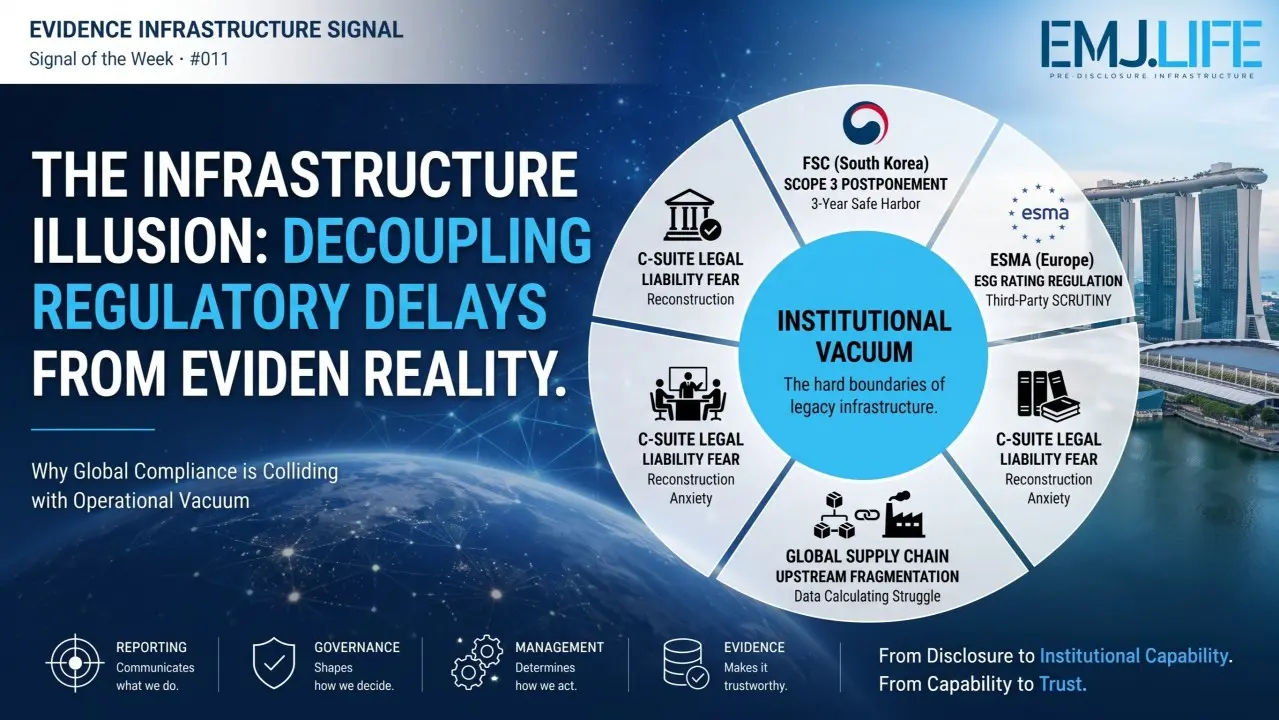
Decoupling Regulatory Delays from Evidential Reality
Snn Owned
- AI TRAINING
- allowed
- RIGHTS BASIS
- Original SNN English editorial reporting, analysis, Signal, summary, metadata and structured publication content.
Series note
Decoupling Regulatory Delays From Evidential Reality
Opening
Over the past week, several important developments emerged across the global sustainability ecosystem.
The Financial Services Commission (FSC) of South Korea finalized its sustainability disclosure roadmap for KOSPI-listed companies.
The European Securities and Markets Authority (ESMA) simultaneously introduced a sweeping authorization regime for ESG rating providers across the European Union.
The market quickly interpreted these updates through familiar lenses.
A regulatory delay in Asia.
A compliance adjustment in Europe.
Yet together, they reveal a remarkably similar structural direction.
Increasingly, sustainability implementation is no longer constrained by disclosure rules alone.
It is increasingly constrained by the evidential capabilities required before reporting begins.
Recent Developments
Implementation Is Reaching Its Infrastructure Limits
The South Korean FSC officially postponed mandatory Scope 3 emissions disclosures by three years across all corporate tiers, extending implementation to between 2031 and 2033.
Importantly, the commission did not position this decision as a retreat from sustainability ambition.
Instead, it explicitly acknowledged an operational constraint. Organizations currently lack the infrastructure necessary to calculate and produce reliable value chain information.
Implementation is reaching the hard boundary of upstream data fragmentation.
Liability Is Becoming Institutionalized
The revised roadmap introduces an unprecedented three-year Safe Harbor mechanism under the FSCMA.
Organizations are granted temporary protection from civil damages, administrative sanctions and criminal liabilities associated with sustainability disclosures.
Even after the initial grace period, significant protections remain for forward-looking statements, greenhouse gas estimations and supplier-related information.
Executives do not fear transparency itself.
They fear the liabilities associated with evidence they cannot reliably produce.
Downstream Trust Is Being Recalibrated
At the same time, ESMA's new regulatory mandate fundamentally changes how ESG ratings will be distributed within the European Union.
This intervention reflects a broader institutional challenge.
Trust in downstream aggregation is increasingly being reassessed.
Legacy analytical frameworks, whether carbon accounting software or ESG rating methodologies, were designed for data aggregation rather than evidential continuity.
Regulating evaluators may improve oversight.
It does not eliminate the upstream dependency on trustworthy evidence.
Without reliable operational foundations, downstream scoring remains structurally vulnerable.
Verification Still Begins Upstream
South Korea's roadmap simultaneously confirms mandatory statutory verification beginning in 2030.
This reflects an increasingly important institutional transition.
Grace periods provide time.
They do not create data integrity.
Verification creates confidence.
It does not create evidence.
The three-year delay is not a pause.
It is an infrastructure runway for the supply chain.
See content credentials
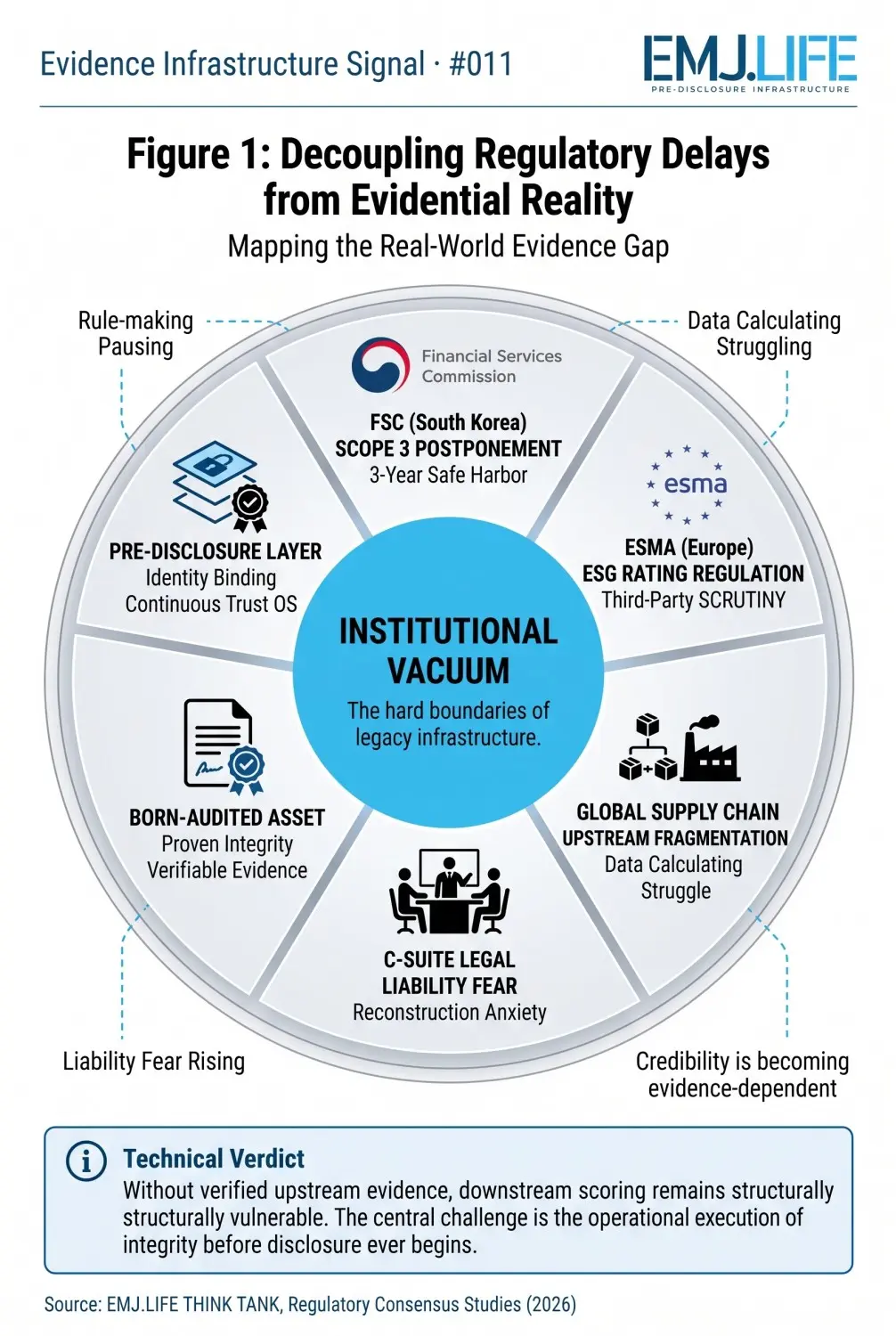
Mapping the real-world evidence gap behind regulatory implementation.
A Shared Structural Direction
Although these developments originate from different jurisdictions, they increasingly point toward the same institutional direction.
Rule-making is slowing.
Data calculation is struggling.
Liability concerns are rising.
Downstream trust is being recalibrated.
Credibility is becoming evidence-dependent.
Rather than seeking more reporting tools, institutions are beginning to recognize that trustworthy disclosures depend upon trustworthy operational foundations.
See content credentials
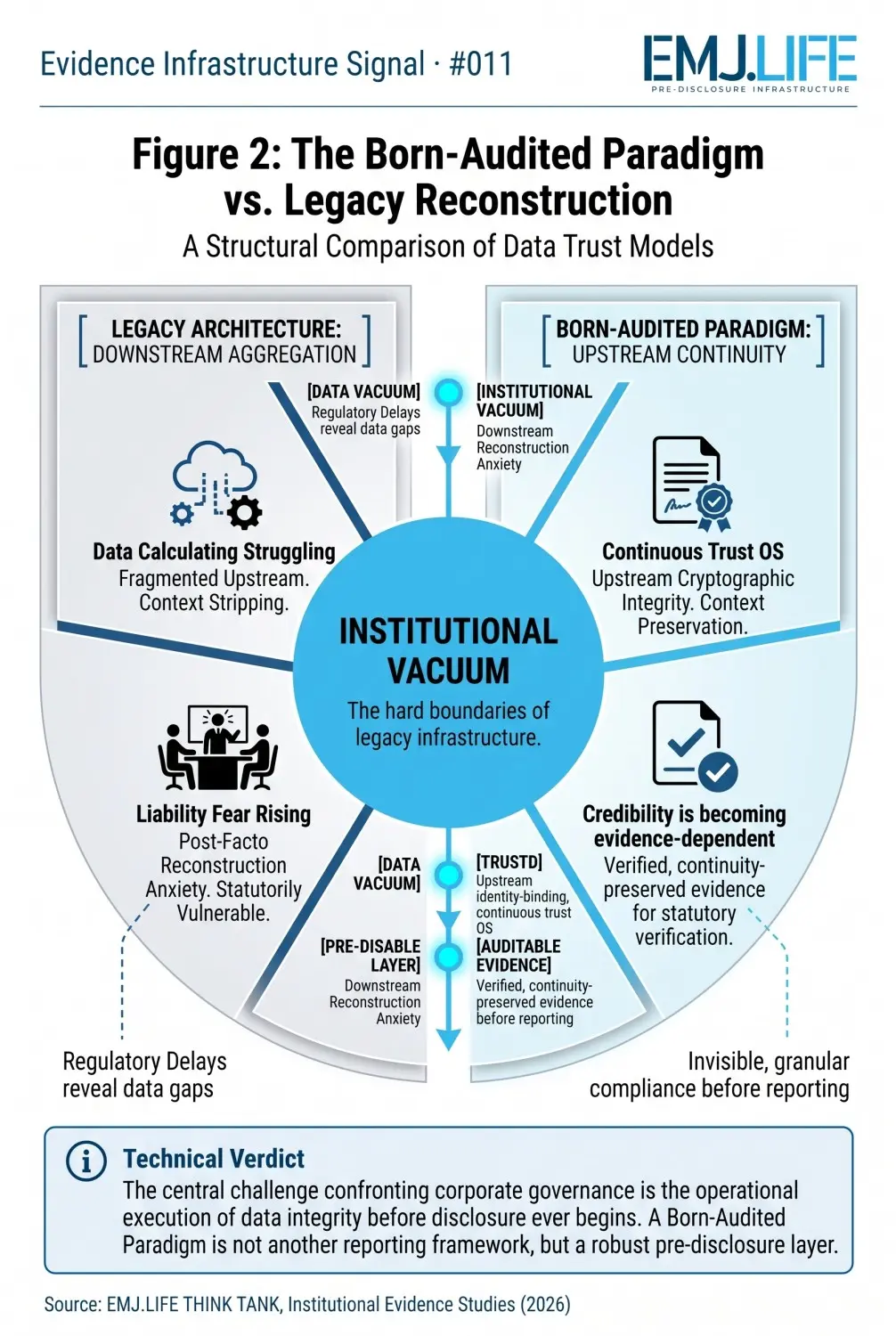
Comparing legacy reconstruction with continuous evidence continuity.
Pre-Disclosure Evidence Infrastructure Perspective
Viewed together, these developments suggest that sustainability is entering a new stage of institutional maturity.
Reporting remains essential.
Assurance remains essential.
Governance remains essential.
Yet all three increasingly depend on something that exists much earlier.
Organizations must first possess the capability to generate reliable, identity-bound and continuity-preserved evidence throughout everyday operations.
This is not another reporting framework.
Nor another rating methodology.
It is an institutional capability.
Viewed through this perspective, the discussion surrounding Evidence Infrastructure becomes less about compliance itself and more about the conditions required before disclosure ever begins.
Closing Reflection
Across Asian capital markets.
Across European securities regulators.
Across global value chains.
Across C-suite legal teams.
Across independent assurance models.
A remarkably similar signal continues to emerge.
The central question is gradually changing.
From:
"How should organizations report sustainability?"
To:
"What evidence infrastructure makes trustworthy sustainability reporting possible?"
Perhaps the next evolution of sustainability will not be defined by reporting alone.
It may increasingly be defined by the institutional capabilities that exist before disclosure ever begins.
Source and Analytical Boundary
It does not eliminate the upstream dependency on trustworthy evidence.
It does not create evidence.
This is not another reporting framework.
Publication record
Evidence Infrastructure Signal · 011
July 17, 2026
Sources informing this publication
Seoul Economic Daily
Source classification: Official External Source · Supporting news source · Independent news report · support scope: institutional source · source-link-only · AI training not-allowedOpen source record ↗ESMA
Source classification: Official External Source · Primary analysis source · Official institutional publication · support scope: institutional source · source-link-only · AI training not-allowedOpen source record ↗Evidence Infrastructure terminology and conclusions are separately governed SNN editorial interpretations. They do not imply participation, endorsement, validation or adopted positions by the institutions cited above.
It does not eliminate the upstream dependency on trustworthy evidence. It does not create evidence. This is not another reporting framework.