
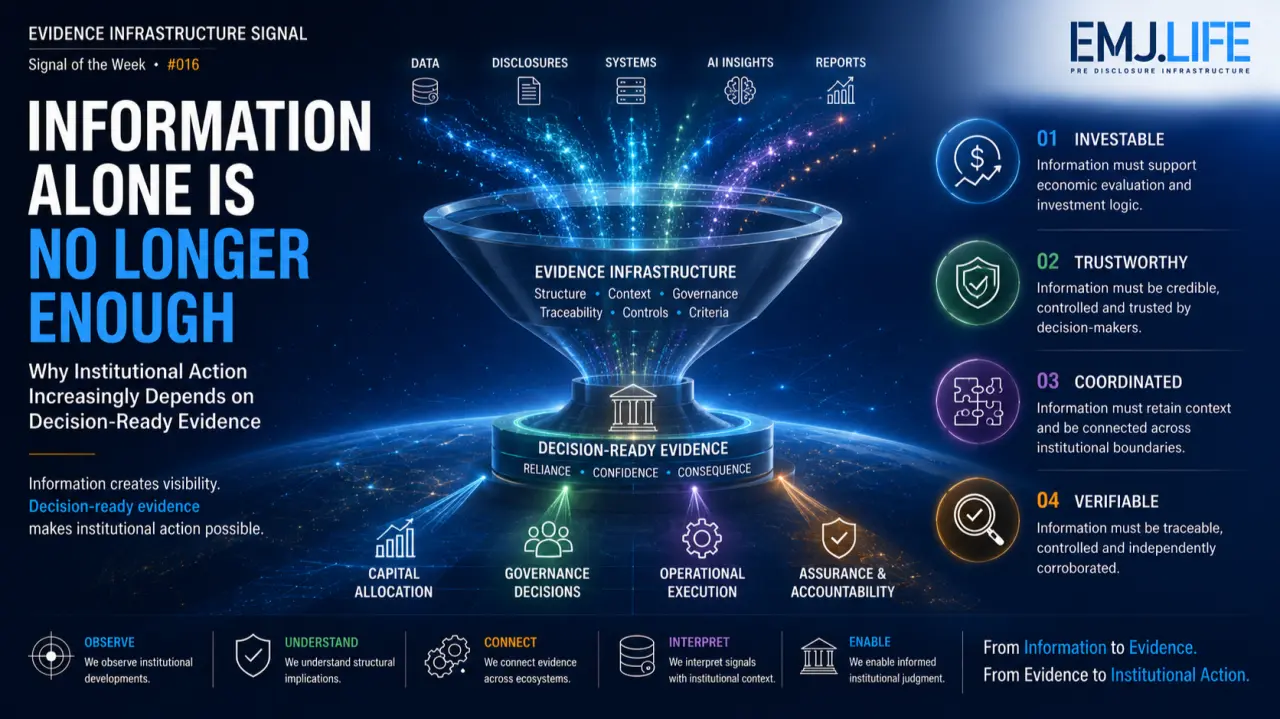
Why Institutional Action Increasingly Depends on Decision-Ready Evidence
Snn Owned
- AI TRAINING
- allowed
- RIGHTS BASIS
- Original SNN English editorial analysis, metadata, structured publication content and controlled publication assets.
Series note
Evidence Infrastructure Signal is a weekly publication series exploring structural developments across sustainability, governance, implementation, interoperability and evidence ecosystems.
Rather than analysing individual announcements in isolation, each edition identifies broader institutional signals emerging across recent and institutionally relevant market, regulatory, research and governance developments.
The objective is not to predict the future.
It is to better understand where governance and market systems appear to be evolving.
Illustrative ecosystem observations only.
Opening
Organisations have access to more information than ever.
More sustainability data.
More financial data.
More operational systems.
More AI-generated analysis.
More disclosures.
More dashboards.
Yet information availability does not automatically create institutional capacity to act.
Recent publications from Deloitte, PwC, EY and KPMG approach this problem from very different directions.
Deloitte examines how sustainability information can be translated into financial logic for investment decisions.
PwC examines why trust in data, governance and analytical outputs becomes increasingly important as AI accelerates decision-making.
EY examines why fragmented systems and organisational silos can constrain infrastructure productivity despite extensive technology investment.
KPMG examines what makes sustainability information sufficiently traceable, controlled and verifiable to support reporting and assurance.
Different subjects.
Different institutional functions.
Yet a common direction begins to emerge.
Information increasingly needs to acquire additional characteristics before institutions can rely upon it.
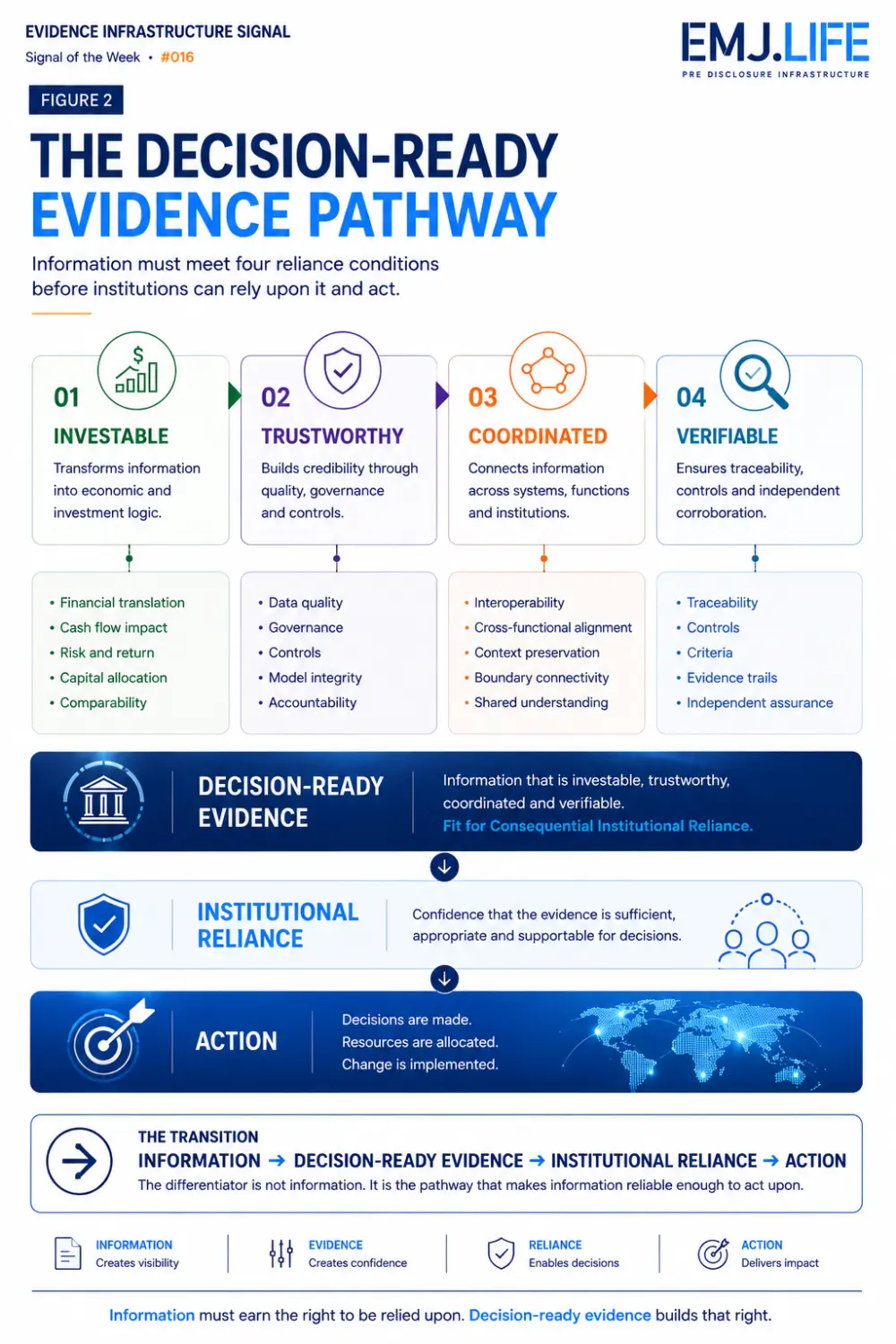
It must become investable.
Trustworthy.
Coordinated.
Verifiable.
The emerging challenge is therefore not simply whether organisations possess enough information.
It is whether that information can become sufficiently decision-ready to support consequential institutional action.
Viewed through an Evidence Infrastructure perspective, the question begins to shift.
Not:
Do organisations have the information?
But:
Can institutions rely on that information strongly enough to act?
Recent Developments
1. Deloitte: Information Must Become Investable
Deloitte approaches the issue through sustainability and capital allocation.
Its Sustainability Fusion framework seeks to translate sustainability initiatives into the financial language used in enterprise investment decisions.
The distinction matters.
Sustainability reporting and compliance frameworks can generate substantial amounts of structured information.
But information produced for reporting does not automatically become information suitable for capital allocation.
Investment decisions require another translation.
Expected financial effects.
Cash flows.
Investment performance.
Risk.
Return.
Timing.
Comparability with competing uses of capital.
The institutional transition therefore becomes:
Sustainability Information → Financial Translation → Investment Decision
This does not diminish the role of sustainability reporting.
It reveals a different requirement.
Information created for one institutional purpose may require additional structure before another institutional function can rely upon it.
Information must become investable.
2. PwC: Information Must Become Trustworthy
PwC reaches a similar problem from finance and artificial intelligence.
As AI expands the speed and volume of analysis available to organisations, analytical capacity becomes less of a constraint.
But faster analysis does not automatically create faster institutional decisions.
Decision-makers still need confidence in the information supporting those decisions.
Data quality.
Governance.
Controls.
Model inputs.
Accountability.
Credibility.
This creates an important shift.
For years, digital transformation focused on increasing the ability to generate insights.
AI accelerates that capability dramatically.
But as analytical capacity expands, trust becomes more visible as an institutional constraint.
The transition becomes:
Data → Analysis → Trust → Decision
An organisation may possess sophisticated forecasts and scenarios.
But if boards, executives or investors do not trust their underlying basis, the existence of those insights may not materially accelerate action.
Information must become trustworthy enough to act upon.
3. EY: Information Must Become Coordinated
EY approaches the issue through infrastructure and agentic AI.
Its analysis identifies a familiar problem.
Organisations may already possess extensive digital tools, systems and data.
Yet productivity improvements can remain fragmented because information and decision-making remain separated across organisational and technological boundaries.
The important point is that institutional boundaries cannot always simply be removed.
Some exist for legitimate reasons.
Professional accountability.
Commercial confidentiality.
Intellectual property.
Organisational responsibility.
The challenge is therefore not necessarily eliminating silos.
It is enabling coordination across them.
Information generated within one environment must retain enough context to become intelligible and actionable in another.
The transition becomes:
Fragmented Information → Contextual Connection → Decision-Ready Intelligence
This moves the problem beyond conventional data integration.
Connecting systems technically is not necessarily the same as enabling institutions to coordinate decisions across them.
Information must become coordinated across institutional boundaries.
4. KPMG: Information Must Become Verifiable
KPMG approaches the same transition from sustainability reporting and assurance.
Its analysis of assurance and verifiability highlights three practical conditions:
Traceability.
Controls.
Criteria.
These conditions move attention upstream from the final disclosure.
A metric may be calculated.
A statement may be published.
A sustainability report may appear complete.
But institutional reliance requires another question:
Can the information be connected to the evidence supporting it?
That requires reporting boundaries to remain identifiable.
Assumptions and limitations to remain understandable.
Preparation and review processes to remain controlled.
Evidence trails to remain accessible.
And relevant claims to be capable of independent corroboration.
The transition becomes:
Disclosure → Evidence Trail → Controls → Independent Corroboration
Verifiability therefore does not begin at the moment assurance is performed.
It depends upon the institutional conditions under which information was generated and governed before assurance begins.
Information must become verifiable.
A Shared Structural Direction
Deloitte is discussing sustainability investment.
PwC is discussing finance, AI and trust.
EY is discussing infrastructure productivity and coordination.
KPMG is discussing sustainability reporting and assurance.
These are not four versions of the same argument.
Nor do the four organisations propose a common framework.
Yet their observations appear to converge around a shared institutional transition.
Information alone is increasingly insufficient.
For Deloitte, information must become investable.
For PwC, it must become trustworthy.
For EY, it must become coordinated.
For KPMG, it must become verifiable.
Together, these observations suggest a broader pathway:
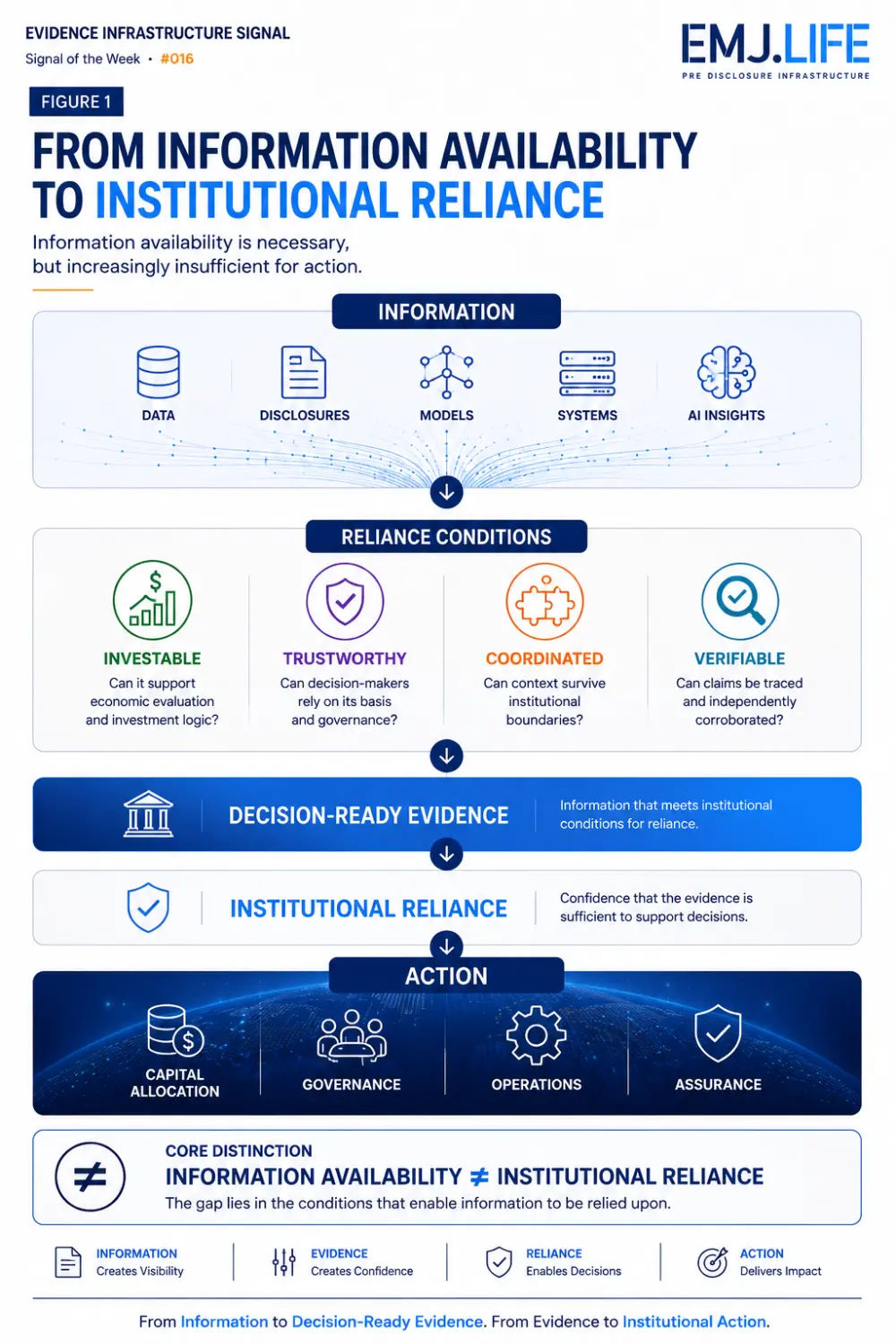
Information → Decision-Ready Evidence → Institutional Reliance → Action
The critical transition occurs between information availability and institutional reliance.
An organisation may possess extensive sustainability data without being able to translate it into capital-allocation decisions.
It may generate sophisticated AI analysis without decision-makers trusting the inputs.
It may operate advanced digital systems while information remains fragmented across institutional boundaries.
It may publish disclosures without sufficiently robust evidence trails for independent corroboration.
The emerging constraint is therefore not information availability alone.
It is whether information can acquire the characteristics required for institutional reliance.
Pre-Disclosure Evidence Infrastructure Perspective
Viewed together, these developments reveal a broader shift in the role of information inside institutions.
For decades, digital transformation focused heavily on availability.
Collect more data.
Connect more systems.
Increase reporting.
Improve analytics.
Accelerate access.
Those capabilities remain essential.
But availability and institutional usability are different conditions.
Information becomes more capable of supporting institutional reliance when its origin, context, ownership, methodology, boundary and supporting records remain sufficiently clear for another actor to understand and evaluate it.
This is where the distinction between information and decision-ready evidence becomes important.
The four perspectives examined here illuminate different dimensions of that transition.
Financial translation enables information to enter investment logic.
Trust enables decision-makers to rely on its basis.
Coordination enables information to move across institutional boundaries without losing essential context.
Verification enables claims to be traced and independently evaluated.
These capabilities do not replace professional judgement.
They support it.
Nor does every piece of information require the same evidential condition.
The required level of support depends upon the consequence of reliance.
An exploratory internal observation does not require the same evidence as a board decision.
An early management estimate does not carry the same institutional consequence as an assured disclosure.
An AI-generated insight used for exploration does not require the same governance as information used to commit significant capital.
As the consequence of reliance increases, the institutional requirements surrounding information also increase.
Evidence Infrastructure can therefore be understood not as a mechanism for generating more information, but as one analytical perspective for examining what must happen before information becomes sufficiently structured, contextualised and supportable for consequential institutional use.
Closing Reflection
Across sustainability.
Across finance.
Across artificial intelligence.
Across infrastructure.
Across reporting and assurance.
A similar direction is becoming visible.
The information problem is evolving.
Information gaps still exist.
Data quality remains uneven.
Many organisations continue to struggle with basic information availability.
But another challenge is becoming increasingly visible alongside them.
Institutions must determine what information they can actually rely upon.
What can support investment.
What can survive organisational boundaries.
What can withstand scrutiny.
What can be independently corroborated.
And ultimately:
What can support action.
The next stage of institutional transformation may therefore not be defined by information availability alone.
It may increasingly depend upon the ability to convert information into evidence capable of supporting consequential decisions.
The central question is changing.
From:
How much information can organisations generate?
To:
How much of that information can institutions actually rely upon?
Information creates visibility.
Decision-ready evidence makes institutional action possible.
Source and Analytical Boundary
This week's Signal draws upon recent institutional observations published by four independent professional services organisations:
Deloitte: Sustainability Fusion: Powering Business Value and related July 2026 materials.
PwC: The CFO's new mandate: trust, data and decisions in uncertain times, July 2026.
EY: The intelligence layer: how agentic AI can connect the infrastructure industry, together with its July 2026 publication update.
KPMG: Assurance and Verifiability under UK SRS, surfaced through its July 2026 sustainability regulatory analysis.
These publications address different subjects and do not collectively propose a common framework or conclusion.
The concepts of Decision-Ready Evidence, Institutional Reliance, and the interpretation that these developments represent a shared structural direction are analytical observations developed by EMJ.LIFE.
This publication does not imply participation, endorsement, affiliation or agreement by Deloitte, PwC, EY or KPMG.
Publication record
Original publication record: Evidence Infrastructure Signal 016 was first published through LinkedIn on 21 August 2026.
This SNN controlled edition preserves the complete publication, figures, verified source records and analytical disclosure on one onsite reading page.
Sources informing this publication
Deloitte
Source classification: Official External Source · Official institutional source · Institutional framework · support scope: institutional source · source-link-only · AI training not-allowedOpen source record ↗PwC
Source classification: Official External Source · Official institutional source · Institutional insight · support scope: institutional source · source-link-only · AI training not-allowedOpen source record ↗EY
Source classification: Official External Source · Official institutional source · Institutional report · support scope: institutional source · source-link-only · AI training not-allowedOpen source record ↗KPMG UK
Source classification: Official External Source · Official institutional source · Institutional insight · support scope: institutional source · source-link-only · AI training not-allowedOpen source record ↗Evidence Infrastructure terminology and conclusions are separately governed SNN editorial interpretations. They do not imply participation, endorsement, validation or adopted positions by the institutions cited above.
Decision-Ready Evidence and Institutional Reliance are EMJ.LIFE analytical interpretations. The cited organisations do not collectively propose a common framework, and citation does not imply participation, endorsement, affiliation or agreement.