
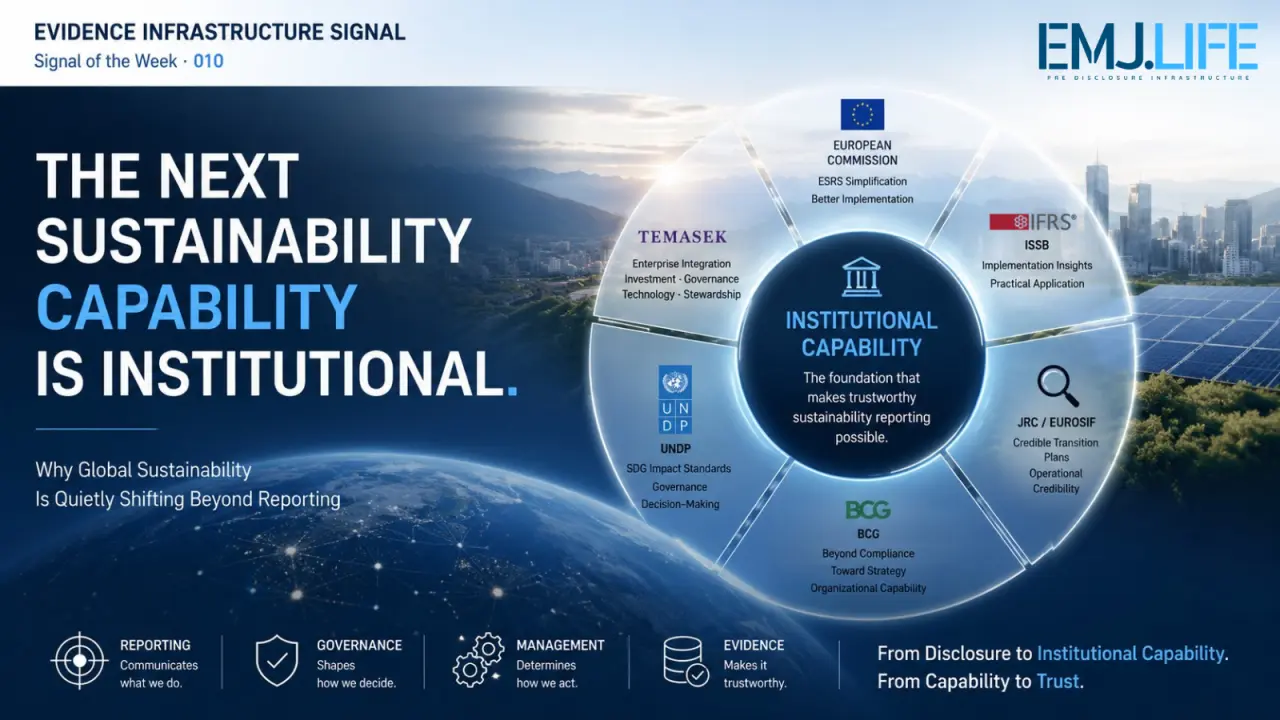
Why Global Sustainability Is Quietly Shifting Beyond Reporting
Snn Owned
- AI TRAINING
- allowed
- RIGHTS BASIS
- Original SNN English editorial reporting, analysis, Signal, summary, metadata and structured publication content.
Series note
Why Global Sustainability Is Quietly Shifting Beyond Reporting
Evidence Infrastructure Signal
Evidence Infrastructure Signal is a weekly publication series exploring structural developments across sustainability, governance, implementation, interoperability, and evidence ecosystems.
Rather than analysing individual announcements in isolation, each edition identifies broader institutional signals emerging across global sustainability initiatives.
The objective is not to predict the future.
It is to better understand where sustainability systems appear to be evolving.
Illustrative ecosystem observations only.
Opening
Over the past week, several important developments emerged across the global sustainability ecosystem.
The European Commission adopted the revised European Sustainability Reporting Standards (ESRS), reducing reporting complexity while preserving decision-useful sustainability information.
The ISSB released another Implementation Insights episode focused on helping organizations apply the Standards in practice.
The Joint Research Centre of the European Commission launched a market survey exploring what makes climate transition plans credible.
BCG argued that sustainability reporting should move beyond compliance toward business strategy.
UNDP continued promoting governance and decision-making through the SDG Impact Standards.
Temasek demonstrated how sustainability can be integrated across investment, governance, technology and enterprise management.
At first glance, these appear to be unrelated developments.
Different institutions.
Different priorities.
Different audiences.
Yet together they reveal a remarkably similar direction.
Increasingly, sustainability discussions are no longer centered on reporting requirements alone.
They are becoming discussions about institutional capability.
Recent Developments
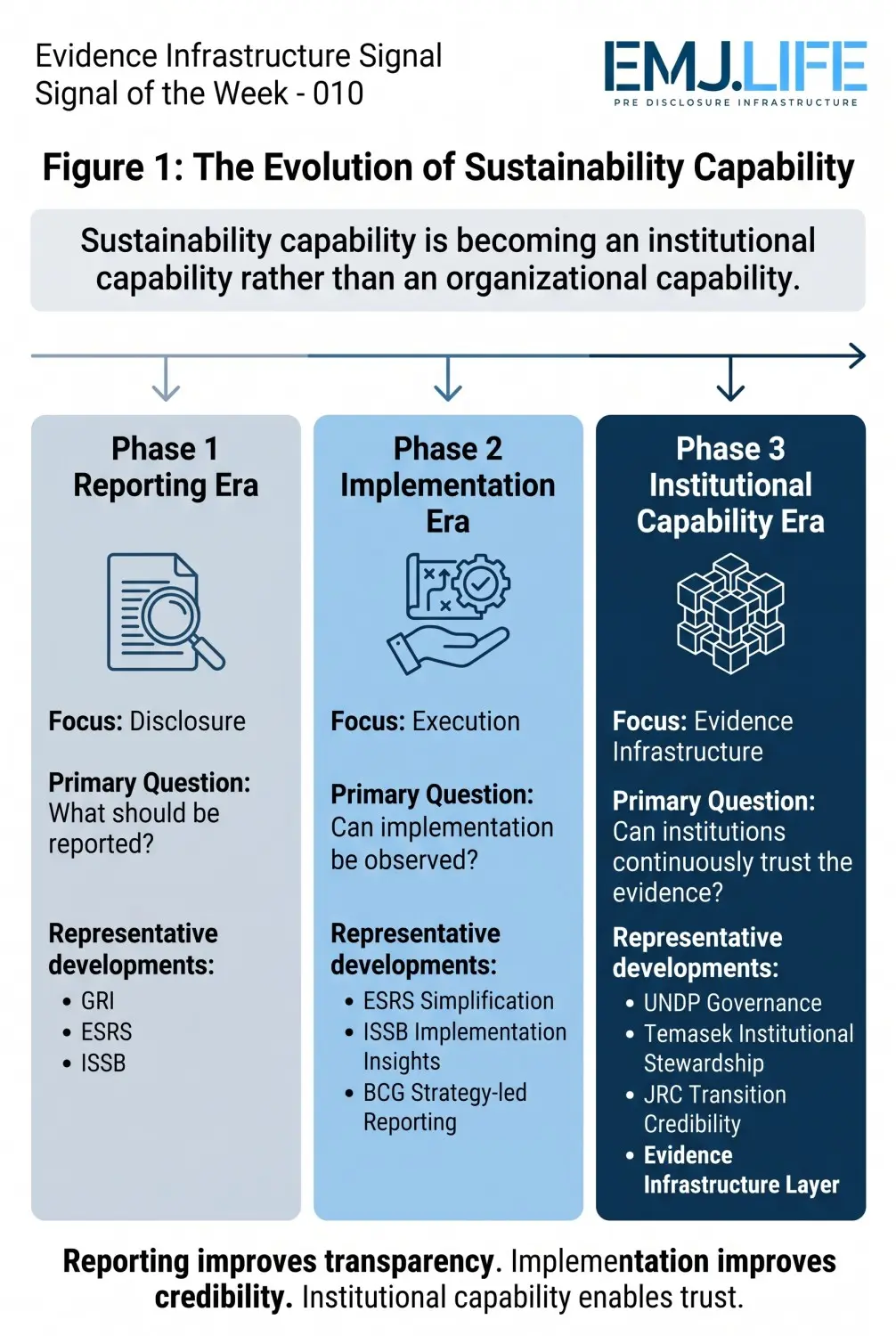
Reporting Is Becoming Simpler
The revised ESRS simplifies disclosure requirements while maintaining information considered useful for decision-making.
Rather than expanding disclosure obligations, the revision places greater emphasis on making sustainability reporting more practical and effective.
The discussion is gradually shifting from reporting volume toward reporting quality.
Implementation Is Becoming The Priority
The ISSB's latest Implementation Insights continues focusing on practical application rather than introducing additional reporting concepts.
The discussion increasingly centers on helping organizations implement sustainability requirements within operational environments.
Implementation itself is becoming a strategic capability.
Credibility Is Becoming Operational
The European Commission's Joint Research Centre is now examining what makes climate transition plans credible in practice.
The discussion extends beyond whether organizations publish transition plans.
Increasingly, attention is shifting toward how those plans are assessed, supported and trusted.
Credibility is becoming an operational question rather than simply a disclosure question.
Sustainability Is Becoming Strategy
Recent analysis from BCG argues that organizations should move beyond compliance-driven reporting toward strategy-led sustainability management.
Similarly, Temasek's Sustainability Report demonstrates sustainability embedded across investment management, governance, technology, stewardship and enterprise-wide decision-making.
Rather than treating sustainability as a reporting function, it increasingly becomes an organizational capability.
Governance Begins Before Reporting
The UNDP SDG Impact Standards continue emphasizing governance and decision-making before reporting outcomes are produced.
This reflects an increasingly important distinction.
Reporting communicates organizational decisions.
It does not create them.
See content credentials
A Shared Structural Direction
Although these developments originate from different organizations, they increasingly converge around a common institutional direction.
Reporting is becoming simpler.
Implementation is becoming more important.
Governance is becoming operational.
Decision-making is becoming more structured.
Credibility is becoming evidence-dependent.
Rather than adding more reporting obligations, many recent initiatives appear focused on strengthening the organizational capabilities that make trustworthy reporting possible.
Pre-Disclosure Evidence Infrastructure Perspective
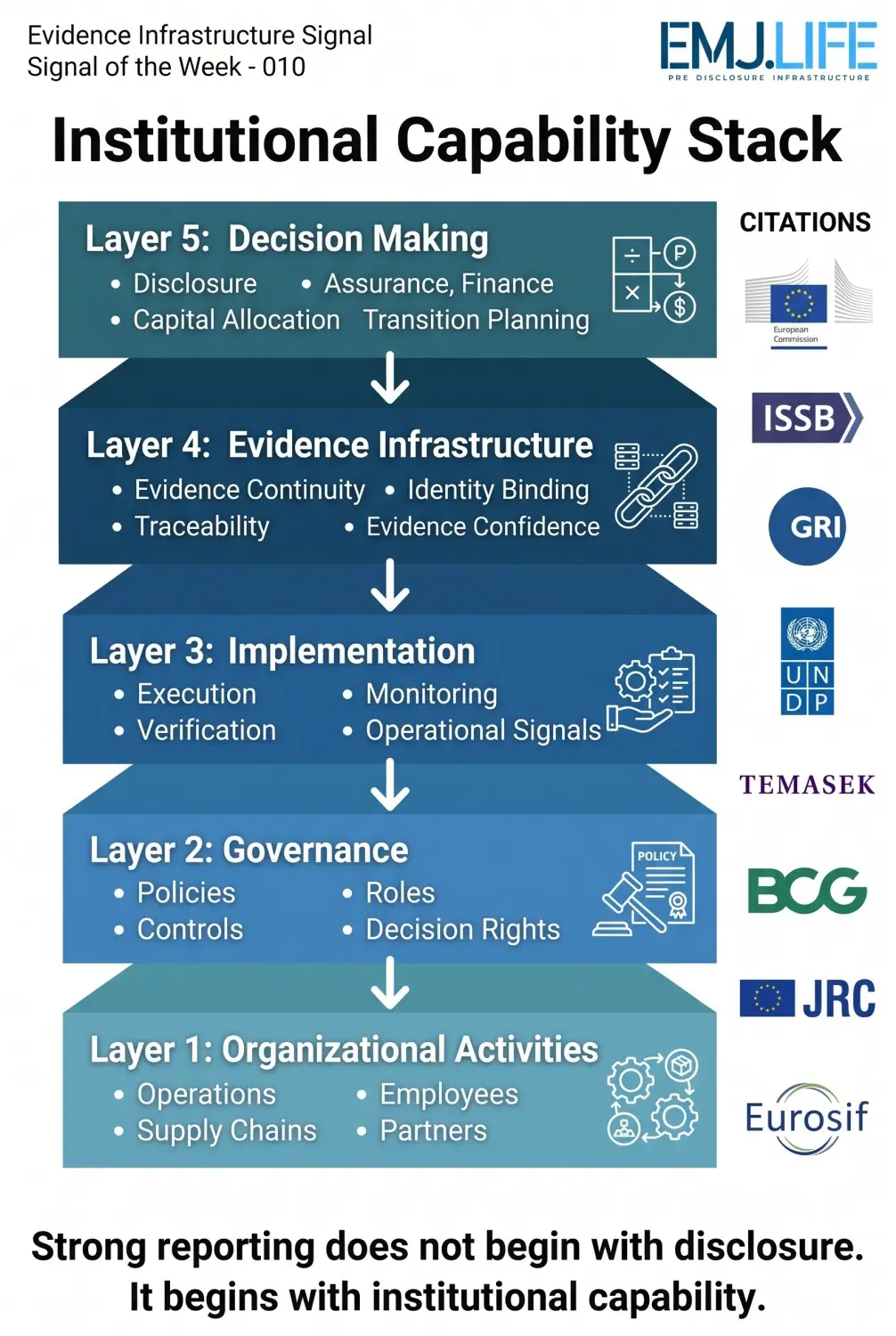
Viewed together, these developments suggest that sustainability may be entering a new stage of institutional maturity.
Reporting remains essential.
Assurance remains essential.
Governance remains essential.
Yet all three increasingly depend on something that exists much earlier.
Organizations must first possess the capability to generate reliable, structured and decision-useful evidence throughout everyday operations.
This does not represent another reporting framework.
Nor another assurance framework.
Instead, it reflects growing recognition that trustworthy disclosures depend on trustworthy operational foundations.
Viewed through this perspective, the discussion surrounding Evidence Infrastructure becomes less about reporting itself and more about the institutional capability required before reporting begins.
See content credentials
Closing Reflection
Across Europe.
Across international standard setters.
Across development organizations.
Across investment institutions.
Across implementation guidance.
A remarkably similar direction continues to emerge.
The central question is gradually changing.
From
"How Should Organizations Report Sustainability?"
to
"What Organizational Capabilities Make Trustworthy Sustainability Reporting Possible?"
Perhaps the next evolution of sustainability will not be defined by reporting alone.
It may increasingly be defined by the institutional capability that exists before disclosure ever begins.
Source and Analytical Boundary
Illustrative ecosystem observations only.
It does not create them.
This does not represent another reporting framework.
Publication record
This SNN controlled edition preserves the complete publication, figures, verified source records and analytical disclosure on one onsite reading page.
Sources informing this publication
UNDP SDG Impact
Source classification: Official External Source · Primary analysis source · Official institutional publication · support scope: institutional source · source-link-only · AI training not-allowedOpen source record ↗Evidence Infrastructure terminology and conclusions are separately governed SNN editorial interpretations. They do not imply participation, endorsement, validation or adopted positions by the institutions cited above.
*Illustrative ecosystem observations only.* It does not create them. This does not represent another reporting framework.