
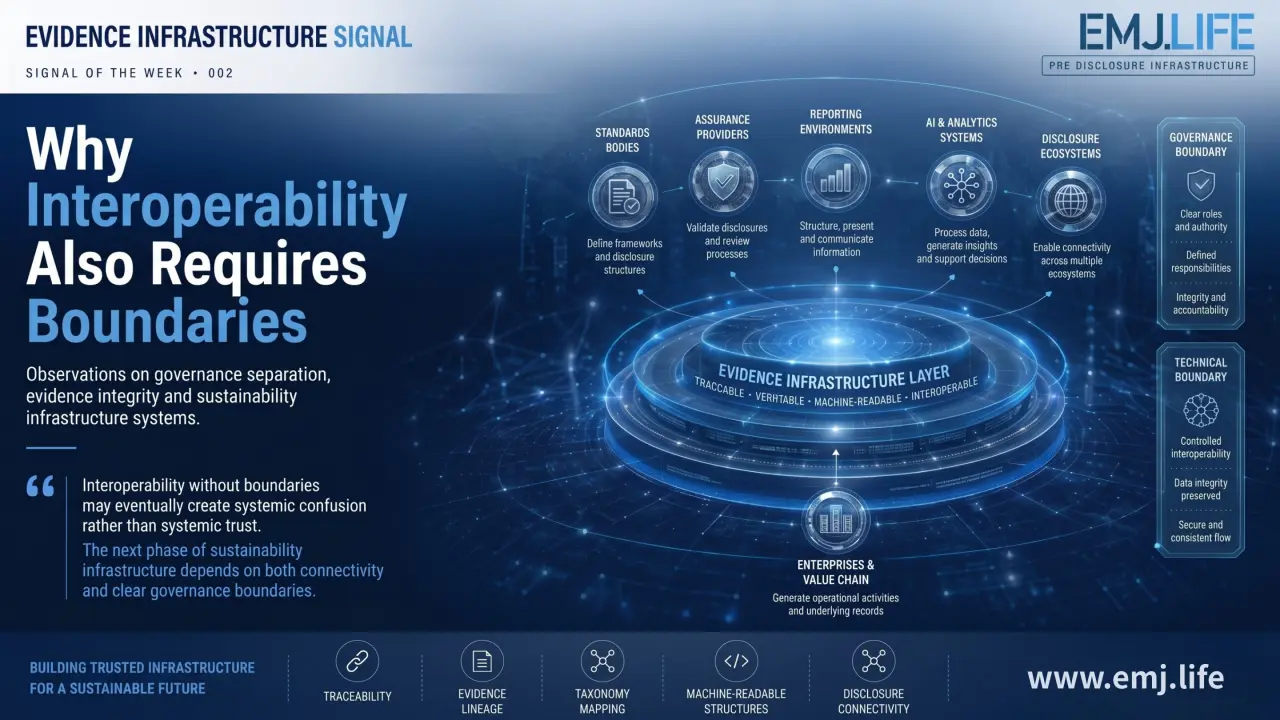
Observations on governance separation, evidence integrity and sustainability infrastructure systems.
Snn Owned
- AI TRAINING
- allowed
- RIGHTS BASIS
- Original SNN English editorial reporting, analysis, Signal, summary, metadata and structured publication content.
Series note
Observations On Governance Separation, Evidence Integrity And Sustainability Infrastructure Systems.
What initially appeared to be separate conversations around sustainability reporting, assurance systems, AI-enabled analysis, digital disclosures and operational data environments may increasingly be converging toward another structural challenge:
how can governance boundaries remain clear across increasingly interconnected sustainability ecosystems?
As IFRS/ISSB, ESRS, GRI, COSO assurance providers, enterprise software systems and AI-enabled sustainability workflows continue evolving simultaneously, interoperability is becoming increasingly important across disclosure and operational environments.
However, greater connectivity may also introduce new forms of structural ambiguity.
This appears to be shifting the conversation beyond interoperability alone.
The emerging challenge is increasingly about:
Governance Separation
Opening
Taxonomy-Linked Environments
Regulatory Reporting Ecosystems
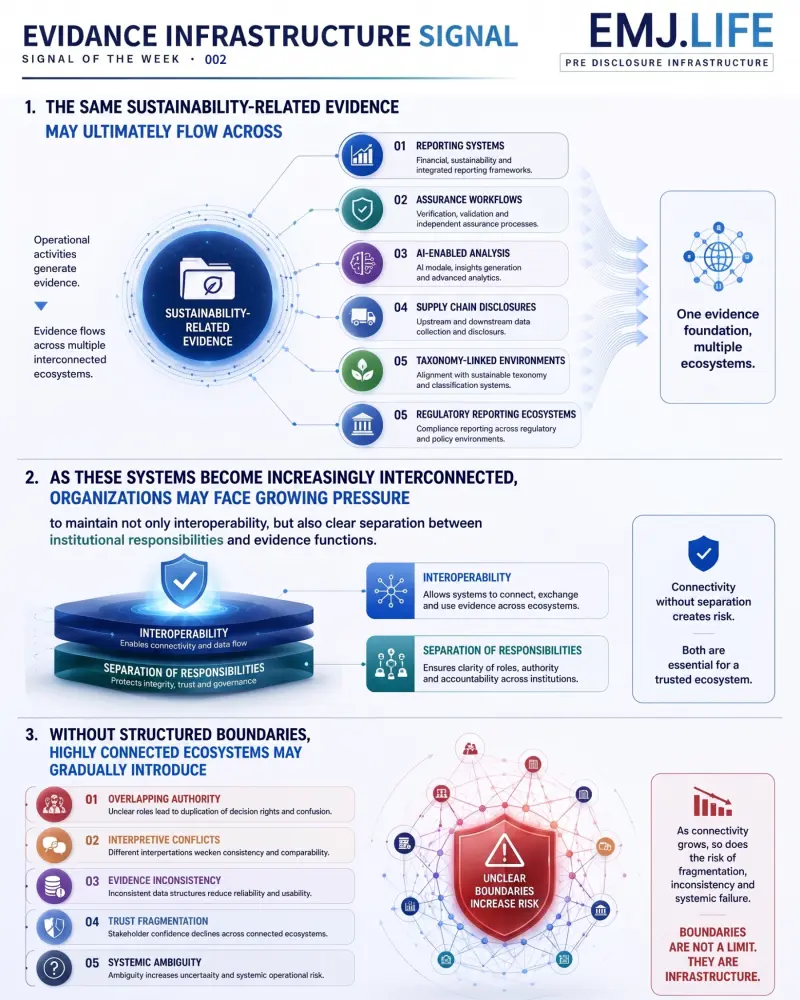
As these systems become increasingly interconnected, organizations may face growing pressure to maintain not only interoperability, but also clear separation between institutional responsibilities and evidence functions.
Without structured boundaries, highly connected ecosystems may gradually introduce:
Overlapping Authority
Interpretive Conflicts
Evidence Inconsistency
Trust Fragmentation
Recent Developments
Evidence Responsibilities
Institutional Boundaries
Role Clarity
Operational Integrity

A Shared Structural Direction
Systemic Ambiguity
As a result, interoperability itself may increasingly depend on governance architecture beneath the reporting layer.
The question may no longer be only:
“How can sustainability systems become interoperable?”
Pre-Disclosure Evidence Infrastructure Perspective
In many cases, the same sustainability-related evidence may ultimately flow across:
Reporting Systems
Assurance Workflows
Ai-Enabled Analysis
Supply Chain Disclosures
Closing Reflection
But increasingly:
“How can interoperability remain trustworthy without clear governance boundaries?”
Evidence Infrastructure Signal
Evidence Infrastructure Signal is an ongoing publication series observing structural shifts across interoperability, traceability and sustainability data ecosystems.
Illustrative ecosystem observations only.
Source and Analytical Boundary
Illustrative ecosystem observations only.
Publication record
Evidence Infrastructure Signal
Evidence Infrastructure Signal is an ongoing publication series observing structural shifts across interoperability, traceability and sustainability data ecosystems.
Sources informing this publication
IFRS Foundation and GRI
Source classification: Official External Source · Primary analysis source · Official institutional publication · support scope: institutional source · source-link-only · AI training not-allowedOpen source record ↗Evidence Infrastructure terminology and conclusions are separately governed SNN editorial interpretations. They do not imply participation, endorsement, validation or adopted positions by the institutions cited above.
Illustrative ecosystem observations only.